Freud’s Psychosexual Study of Leonardo da Vinci’s Vulture Fantasy

Excerpts from Sigmund Freud’s Leonardo da Vinci: A Psychosexual Study of an Infantile Reminiscence 

As far as I know Leonardo only once interspersed in his scientific descriptions a communication from his childhood. In a passage where he speaks about the flight of the vulture, he suddenly interrupts himself in order to follow up a memory from very early years which came to his mind. “It seems that it had been destined before that I should occupy myself so thoroughly with the vulture, for it comes to my mind as a very early memory, when I was still in the cradle, a vulture came down to me, he opened my mouth with his tail and struck me a few times with his tail against my lips.”
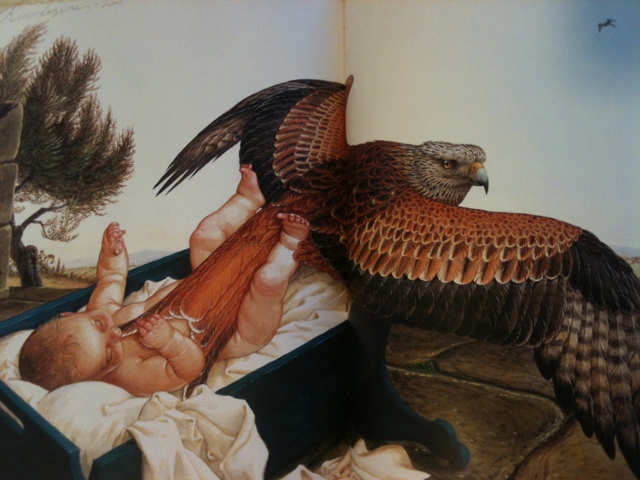
Ricordazione by Walton Ford

We have here an infantile memory and to be sure of the strangest sort. It is strange on account of its content and account of the time of life in which it was fixed. That a person could retain a memory of the nursing period is perhaps not impossible, but it can in no way be taken as certain. But what this memory of Leonardo states, namely, that a vulture opened the child’s mouth with its tail, sounds so improbable, so fabulous, that another conception which puts an end to the two difficulties with one stroke appeals much more to our judgment. The scene of the vulture is not a memory of Leonardo, but a phantasy which he formed later, and transferred into his childhood. The childhood memories of persons often have no different origin, as a matter of fact, they are not fixated from an experience like the conscious memories from the time of maturity and then repeated, but they are not produced until a later period when childhood is already past, they are then changed and disguised and put in the service of later tendencies, so that in general they cannot be strictly differentiated from phantasies.

. . .
When we examine Leonardo’s vulture-phantasy with the eyes of a psychoanalyst then it does not seem strange very long; we recall that we have often found similar structures in dreams, so that we may venture to translate this phantasy from its strange language into words that are universally understood. The translation then follows an erotic direction. Tail, “coda,” is one of the most familiar symbols, as well as a substitutive designation of the male member which is no less true in Italian than in other languages. The situation contained in the phantasy, that a vulture opened the mouth of the child and forcefully belabored it with its tail, corresponds to the idea of fellatio, a sexual act in which the member is placed into the mouth of the other person.
Strangely enough this phantasy is altogether of a passive character; it resembles certain dreams and phantasies of women and of passive homosexuals who play the feminine part in sexual relations.
. . .
The origin of Leonardo’s vulture phantasy can be conceived in the following manner: While reading in the writings of a church father or in a book on natural science that the vultures are all females and that they know to procreate without the coöperation of a male, a memory emerged in him which became transformed into that phantasy, but which meant to say that he also had been such a vulture child, which had a mother but no father. An echo of pleasure which he experienced at his mother’s breast was added to this in the manner as so old impressions alone can manifest themselves. The allusion to the idea of the holy virgin with the child, formed by the authors, which is so dear to every artist, must have contributed to it to make this phantasy seem to him valuable and important. For this helped him to identify himself with the Christ child, the comforter and savior of not alone this one woman.
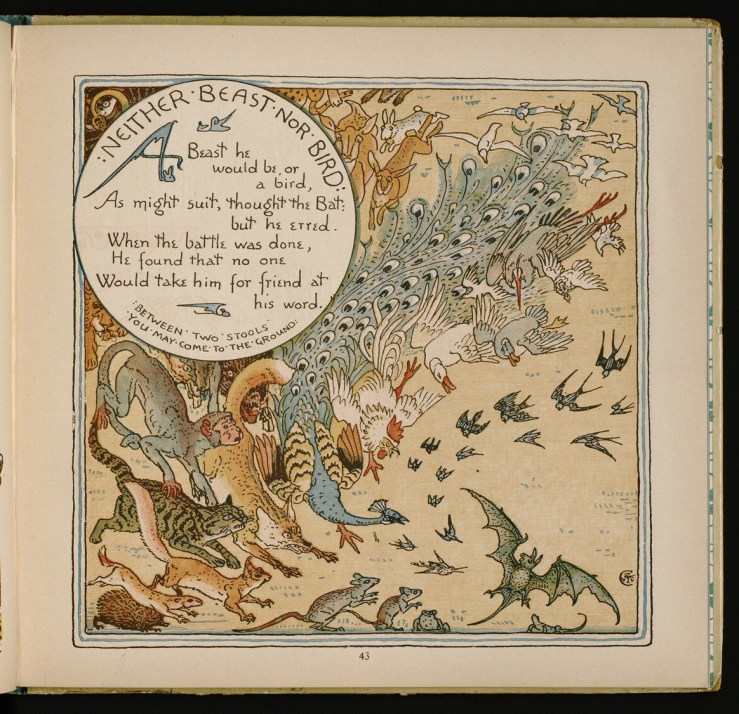
“Neither Beast Nor Bird” (Illustrated Fable, 1887)

(From The Baby’s Own Aesop: Being the Fables Condensed in Rhyme, With Portable Morals Pictorially Pointed by Walter Crane. Engraved and Printed in Colours By Edmund Evans. 1887. Via the LOC).

Slavoj Žižek: “We Are Approaching a Certain Zero Point”

“Effect of Quantity” (Nietzsche on Shakespeare)

162. Effect of Quantity. —The greatest paradox in the history of poetic art lies in this: that in all that constitutes the greatness of the old poets a man may be a barbarian, faulty and deformed from top to toe, and still remain the greatest of poets. This is the case with Shakespeare, who, as compared with Sophocles, is like a mine of immeasurable wealth in gold, lead, and rubble, whereas Sophocles is not merely gold, but gold in its noblest form, one that almost makes us forget the money-value of the metal. But quantity in its highest intensity has the same effect as quality. That is a good thing for Shakespeare.

From Human, All Too Human, Part II by Friedrich Nietzsche.

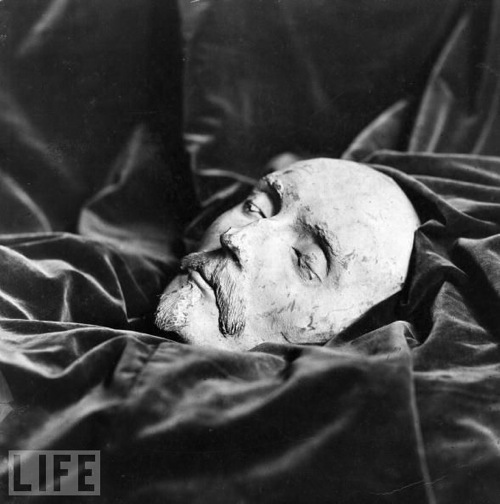
William Shakespeare’s Death Mask (Happy Birthday/Deathday!)

Wittgenstein: “This Is a Very Pleasant Pineapple”

Handwritten Draft of Auden’s “Musée des Beaux Arts”

(Via the Library of Congress).

Book Shelves #17, 4.22.2012

Book shelves series #17, seventeenth Sunday of 2012.

20120422-114730.jpg

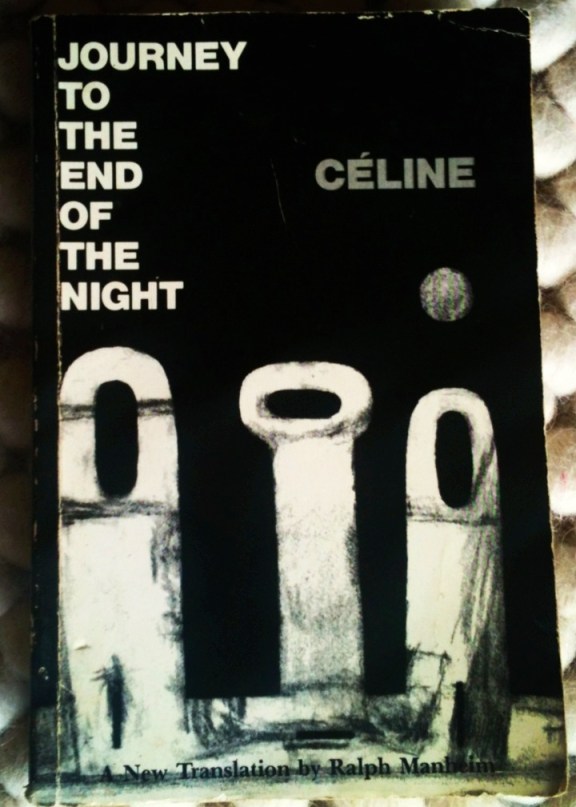
Hemingway, Fitzgerald, Steinbeck, Camus, Nabokov, Celine, Kafka.

20120422-130058.jpg

Jonathan Littell’s The Kindly Ones with Revere movie camera as bookend. Littell’s lurid, bizarre book is only shelved here temporarily (he’s in too-rarefied company, perhaps).

20120422-130453.jpg

A friend gave me this in high school.

Travel Scene, Malick’s Days of Heaven

“What David Lynch Is Really Like” — David Foster Wallace

2 what David Lynch is really like

I have absolutely no idea. I rarely got closer than five feet away from him and never talked to him. One of the minor reasons Asymmetrical Productions let me onto the set is that I don’t even pretend to be a journalist and have no idea how to interview somebody and saw no real point in trying to interview Lynch, which turned out perversely to be an advantage, because Lynch emphatically didn’t want to be interviewed while Lost Highway was in production, because when he’s shooting a movie he’s incredibly busy and preoccupied and immersed and has very little attention or brain-space available for anything other than the movie. This may sound like PR bullshit, but it turns out to be true—e.g.:

The first time I lay actual eyes on the real David Lynch on the set of his movie, he’s peeing on a tree. I am not kidding. This is on 8 January in West LA’s Griffith Park, where some of Lost Highway’s exteriors and driving scenes are being shot. Lynch is standing in the bristly underbrush off the dirt road between the Base Camp’s trailers and the set, peeing on a stunted pine. Mr. David Lynch, a prodigious coffee-drinker, apparently pees hard and often, and neither he nor the production can afford the time it’d take him to run down the Base Camp’s long line of trailers to the trailer where the bathrooms are every time he needs to pee. So my first sight of Lynch is only from the back, and (understandably) from a distance. Lost Highway’s cast and crew pretty much ignore Lynch’s urinating in public, and they ignore it in a relaxed rather than a tense or uncomfortable way, sort of the way you’d ignore a child’s alfresco peeing.

David Foster Wallace,  “David Lynch Keeps His Head”  (A Supposedly Fun Thing I’ll Never Do Again)

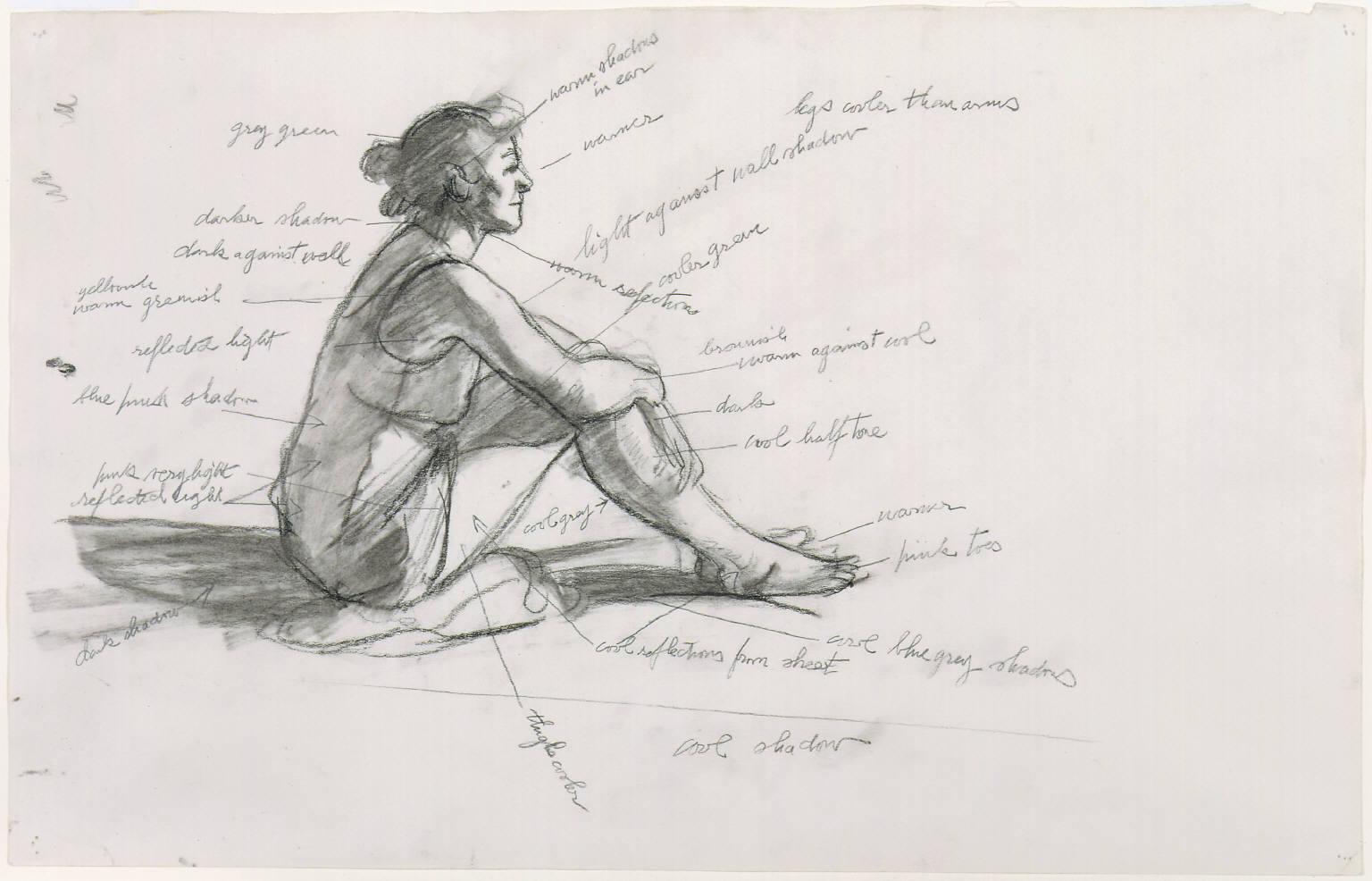
Study Sketch for Morning Sun — Edward Hopper

“The Unicorn in the Garden” — James Thurber

James Joyce’s Prescription for New Glasses

(Via Disonancia, which is very fine stuff).

“At Christmas a boy lame of a leg goes round the country summoning the devil’s followers, who are countless, to a general conclave . . . and the whole multitude become wolves.”

At Christmas a boy lame of a leg goes round the country summoning the devil’s followers, who are countless, to a general conclave. Whoever remains behind, or goes reluctantly, is scourged by another with an iron whip till the blood flows, and his traces are left in blood. The human form vanishes, and the whole multitude become wolves. Many thousands assemble. Foremost goes the leader armed with an iron whip, and the troop follow, “firmly convinced in their imaginations that they are transformed into wolves.” They fall upon herds of cattle and flocks of sheep, but they have no power to slay men. When they come to a river, the leader smites the water with his scourge, and it divides, leaving a dry path through the midst, by which the pack may go. The transformation lasts during twelve days, at the expiration of which period the wolf-skin vanishes, and the human form reappears. This superstition was expressly forbidden by the church. “Credidisti, quod quidam credere solent, ut illæ quæ a vulgo Parcæ vocantur, ipsæ, vel sint vel possint hoc facere quod creduntur, id est, dum aliquis homo nascitur, et tunc valeant illum designare ad hoc quod velint, ut quandocunque homo ille voluerit, in lupum transformari possit, quod vulgaris stultitia, werwolf vocat, aut in aliam aliquam figuram?”–Ap. Burchard. (d. 1024).

From Sabine Baring-Gould’s marvelous volume The Book of Were-Wolves (1865).

Put the book in the head not on the head

(Via Disonancia ).

Diogenes and Plato — Paul Ollswang

(Read Paul Ollswang’s fantastic comic Cynicism here)

Six (More) Stoner Novels (And a Bonus Short Story)

A few years ago, to celebrate 4/20, Sam Munson at the Daily Beast wrote an article praising “The Best Stoner Novels.” Not a bad list—Wonder Boys, sure, Invisible Man, a bit of a stretch, The Savage Detectives, a very big stretch, but sure, why not. Anyway, six more stoner novels (not that we advocate the smoking of the weed)—

Junkie, William Burroughs

Burroughs’s (surprisingly lucid) early novel Junkie may take its name from heroin, but it’s full of weed smoking. Lesson: weed smoking leads to heroin. And the inevitable search for yage.

Inherent Vice, Thomas Pynchon

Doc Sportello, the wonky PI at the off-center of Pynchon’s California noir, is always in the process of lighting another joint, if not burning his fingers on the edges of a roach. A fuzzy mystery with smoky corners.

Infinite Jest, David Foster Wallace

Hal Incandenza, protagonist of Wallace’s opus, spends much of his time hiding in the tunnels of Enfield Tennis Academy, feeding his bizarre marijuana addiction, which is, in many ways, more of an addiction to a secret ritual than to a substance. Hal’s hardly the only character in IJ who likes his Mary Jane; there’s a difficult section near the novel’s beginning that features a minor character preparing to go on a major weed binge. His pre-smoking anxiety works as a challenge to any reader seeking to enter the world of Infinite Jest.

The Lord of the Rings, J.R.R. Tolkien

I’m pretty sure “pipe-weed” isn’t tobacco.

Chronic City, Jonathan Lethem

I kind of hated Chronic City, a novel where characters seem to light up joints on every other page. It seems to have been written in an ambling, rambling fog, absent of any sense of immediacy, urgency, or, uh, plot. Bloodless stuff, but, again, very smoky.

Stoner, John Williams

Okay. Stoner has nothing to do with marijuana. But, hey, it’s called Stoner, right?

Bonus short story: Raymond Carver’s “Cathedral”

Carver’s classic story features a myopic narrator who comes up against his own shortcomings when he meets an old friend of his wife, a blind man who ironically sees deeper than he does. After drinking too much booze, they spark up, share a doob, and take in a documentary about European cathedrals. Great stuff.