Flann O’Brien, Charles Olson, Karel Capek (Books Acquired, Earlier This Week)

20120426-161730.jpg

Steinbeck on Critics: “Curious Sucker Fish Who Live with Joyous Vicariousness on Other Men’s Work”

ON CRITICS

This morning I looked at the Saturday Review, read a few notices of recent books, not mine, and came up with the usual sense of horror. One should be a reviewer or better a critic, these curious sucker fish who live with joyous vicariousness on other men’s work and discipline with dreary words the thing which feeds them. I don’t say that writers should not be disciplined, but I could wish that the people who appoint themselves to do it were not quite so much of a pattern both physically and mentally.

I’ve always tried out my material on my dogs first. You know, with Angel, he sits there and listens and I get the feeling he understands everything. But with Charley, I always felt he was just waiting to get a word in edgewise. Years ago, when my red setter chewed up the manuscript of Of Mice and Men, I said at the time that the dog must have been an excellent literary critic.

Time is the only critic without ambition.

Give a critic an inch, he’ll write a play.

From John Steinbeck’s 1969 interview in The Paris Review.

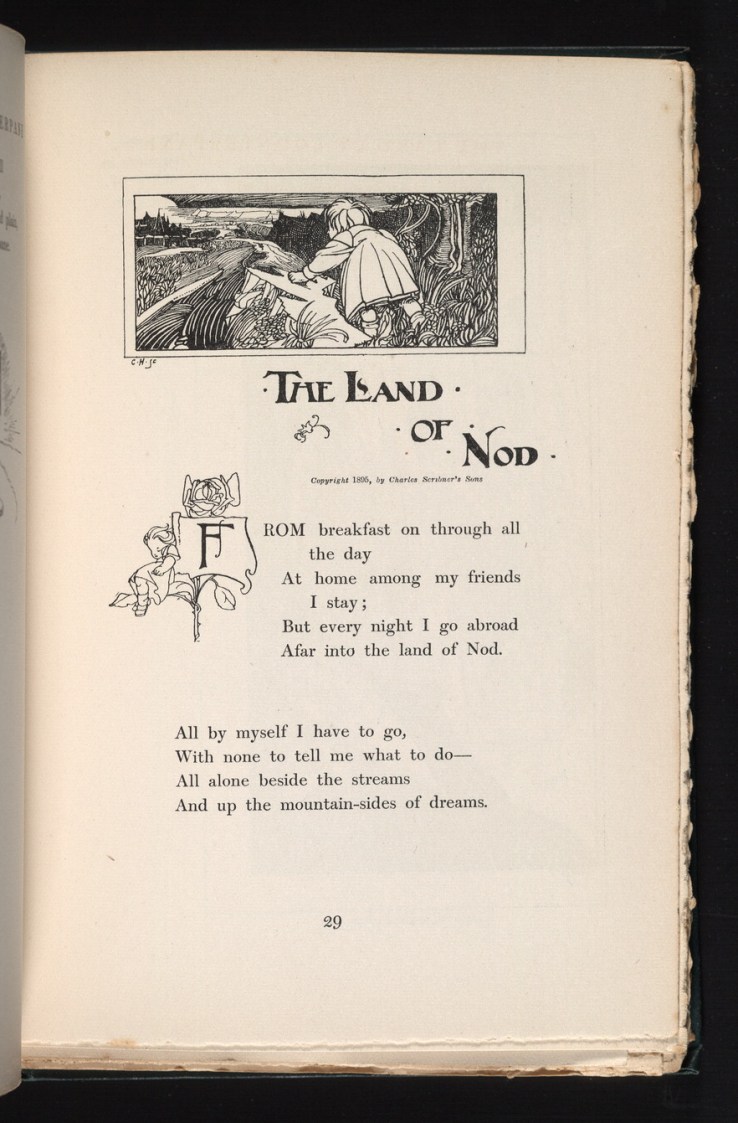
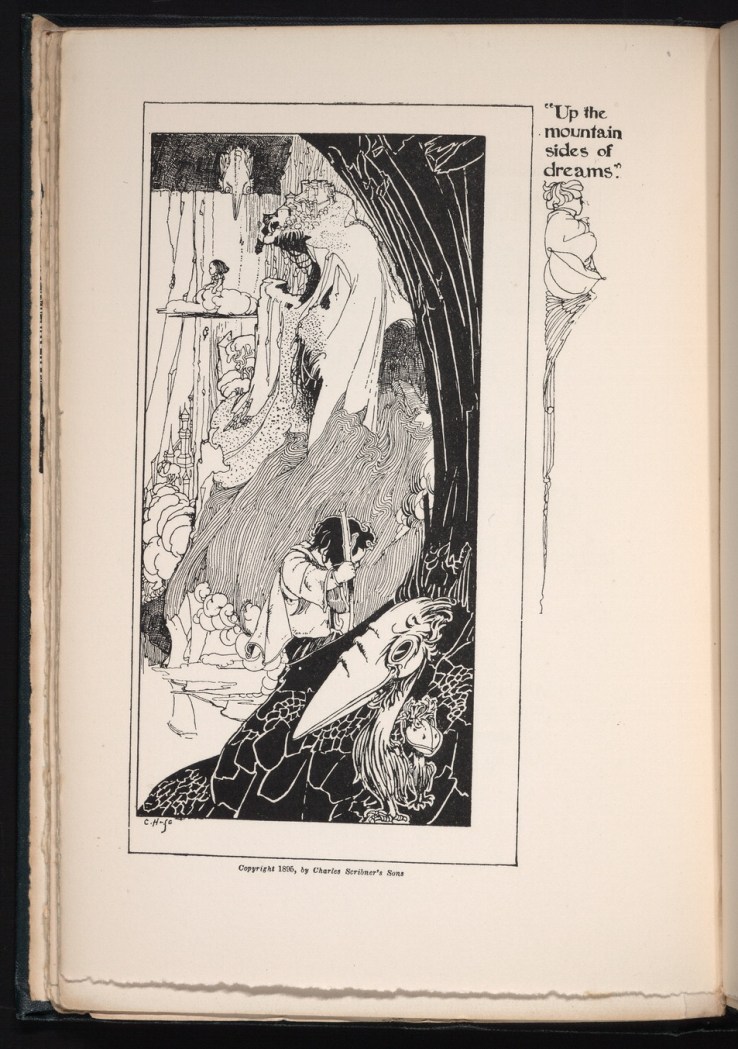
“The Land of Nod” — An Illustrated Poem by Robert Louis Stevens

(From A Child’s Garden of Verses by Robert Louis Stevenson; illustrated by Charles Robinson, 1895. Via the LOC’s rare books collection.)

Books Acquired, This Week and Last

20120426-161440.jpg

Reading for Our Time by J. Hillis Miller from Columbia University Press. Their copy:

A masterclass in attentive reading that opens up brilliant insights into two of George Eliot’s novels. J. Hillis Miller shows how reading Eliot’s great novels Adam Bede and Middlemarch can provide the pleasure and insight unique to reading fiction. The readings focus on famous passages in which the narrator reflects about the story and its characters. What do these passages really say? What role does Eliot’s figurative language play in her storytelling? These stories deal with uncovering their characters’ ideological illusions. By understanding how to expose these illusions, readers will be able to recognize how easy it is to be taken in by such mistakes, both in the personal and in the political worlds.

20120426-161452.jpg

Mary S. Lovell’s The Churchills is new in trade paperback from Norton. From the LA Times review:

Intelligent and well-written, like all of Mary S. Lovell’s biographies, “The Churchills” provides a vivid introduction to the family of English aristocrats whose nation-preserving achievements stretch from the Battle of Blenheim to the Battle of Britain and beyond. The Churchills are a much-chronicled clan, and although footnotes indicate that Lovell has read all the relevant books and delved into vast archives of personal papers, there’s nothing startlingly new here. Instead, as she did in “The Mitford Girls,” the author synthesizes a variety of familiar material to create a lively collective portrait.

20120426-161503.jpg

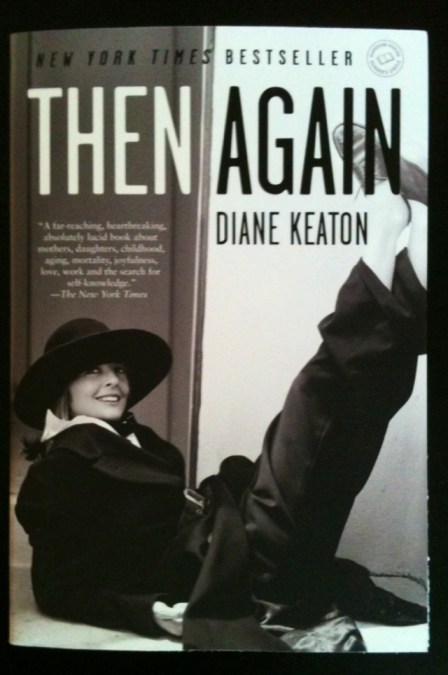
Diane Keaton’s memoir is out in trade paperback. It’s a handsome book with stylish color inserts. New from Random House.

20120426-161518.jpg

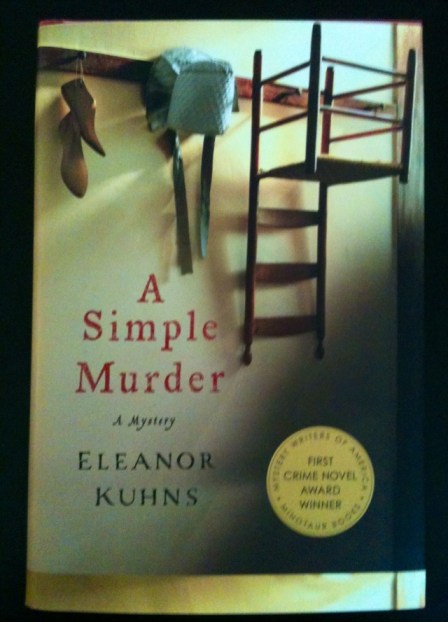
 Great cover on A Simple Murder, new from Eleanor Kuhns. Publisher Minotaur/Macmillan’s write-up:

Five years ago, while William Rees was still recovering from his stint as a Revolutionary War soldier, his beloved wife died. Devastated, Rees left his son, David, in his sister’s care, fled his Maine farm, and struck out for a tough but emotionally empty life as a traveling weaver. Now, upon returning unexpectedly to his farm, Rees discovers that David has been treated like a serf for years and finally ran away to join a secluded religious sect—the Shakers.

Overwhelmed by guilt and hoping to reconcile with his son, Rees immediately follows David to the Shaker community. But when a young Shaker woman is brutally murdered shortly after Rees’s arrival, Rees finds himself launched into a complicated investigation where the bodies keep multiplying, a tangled web of family connections casts suspicion on everyone, and the beautiful woman on the edge of the Shaker community might be hiding troubling ties to the victims. It quickly becomes clear that in solving Sister Chastity’s murder, Rees may well expose some of the Shaker community’s darkest secrets, not to mention endanger his own life.

An atmospheric portrait of a compelling time in American history, A Simple Murder is an outstanding debut from Eleanor Kuhns, Minotaur Books/Mystery Writers of America’s 2011 First Crime Novel Competition Winner.

Microreviews

Henry David Thoreau’s Walden: The Video Game

(About; via Scott Esposito).

E-Books of the Future! (Retrofuture Fun from 1959)

(Via Disonancia, which is probably my favorite thing on the internet right now).

Ezra Pound Shares Poetry Tips from Hardy, Yeats, Ford, and Bridges

Ezra Pound’s poetry tips; from The Paris Review interview:

INTERVIEWER

You once wrote that you had four useful hints from living literary predecessors, who were Thomas Hardy, William Butler Yeats, Ford Madox Ford, and Robert Bridges. What were these hints?

POUND

Bridges’s was the simplest. Bridges’s was a warning against homophones. Hardy’s was the degree to which he would concentrate on the subject matter, not on the manner. Ford’s in general was the freshness of language. And Yeats you say was the fourth? Well, Yeats by 1908 had written simple lyrics in which there were no departures from the natural order of words.

Ben Marcus Talks About His Novel The Flame Alphabet

Life: “A Queer Contraption, Very Dangerous, a Certain Death-trap” (A Passage from Flann O’Brien’s The Third Policeman)

I started Flann O’Brien’s novel The Third Policeman yesterday, on the recommendation of a few readers who commented on a post last week. Just a few chapters in, I felt the thrill of really great, strange writing, coupled with the bizarre, almost unwieldy disbelief that I hadn’t read the novel before, or more to the point, and most ashamedly, that it wasn’t even on my radar. I felt a strange antipathy to the name Flann O’Brien whenever I came across it in the past—too close to Flannery O’Connor, if I’m being honest. This is all silly and I’m embarrassed to write it now. Anyway, the novel is amazing so far. Here’s a passage that maybe stands alone. We have the (as yet?) unnamed narrator, his soul (in italics), and an old man (who may or may not be a version of the narrator?):

I smiled at him in good-humoured and said:

‘Tricky-looking man, you are hard to place and it is not easy to guess your station. You seem very contented in one way but then again you do not seem to be satisfied. What is your objection to life?’ He blew little bags of smoke at me and looked at me closely from behind the bushes of hair which were growing about his eyes.

‘Is it life?’ he answered. ‘I would rather be without it,’ he said, ‘for there is a queer small utility in it. You cannot eat it or drink it or smoke it in your pipe, it does not keep the rain out and it is a poor armful in the dark if you strip it and take it to bed with you after a night of porter when you are shivering with the red passion. It is a great mistake and a thing better done without, like bed-jars and foreign bacon.’

‘That is a nice way to be talking on this grand lively day,’ I chided, ‘when the sun is roaring in the sky and sending great tidings into our weary bones.’

‘Or like feather-beds,’ he continued, ‘or bread manufactured with powerful steam machinery. Is it life you say? Life?’

Explain the difficulty of life yet stressing its essential sweetness and desirability.

What sweetness?

Flowers in the spring, the glory and fulfilment of human life, bird-song at evening – you know very well what I mean. I am not so sure about the sweetness all the same.

‘It is hard to get the right shape of it,’ I said to the tricky man, ‘or to define life at all but if you identify life with enjoyment I am told that there is a better brand of it in the cities than in the country parts and there is said to be a very superior brand of it to be had in certain parts of France. Did you ever notice that cats have a lot of it in them when they are quite juveniles?’

He was looking in my direction crossly.

‘Is it life? Many a man has spent a hundred years trying to get the dimensions of it and when he understands it at last and entertains the certain pattern of it in his head, by the hokey he takes to his bed and dies! He dies like a poisoned sheepdog. There is nothing so dangerous, you can’t smoke it, nobody will give you tuppence-halfpenny for the half of it and it kills you in the wind-up. It is a queer contraption, very dangerous, a certain death-trap. Life?’

N + 2 — Ivan Maximov

“On Getting Started” — John Steinbeck Shares Writing Tips

From John Steinbeck’s 1969 “interview” in The Paris Review (the piece reads more like a series of short writings than a conventional interview):

ON GETTING STARTED

It is usual that the moment you write for publication—I mean one of course—one stiffens in exactly the same way one does when one is being photographed. The simplest way to overcome this is to write it to someone, like me. Write it as a letter aimed at one person. This removes the vague terror of addressing the large and faceless audience and it also, you will find, will give a sense of freedom and a lack of self-consciousness.

Now let me give you the benefit of my experience in facing 400 pages of blank stock—the appalling stuff that must be filled. I know that no one really wants the benefit of anyone’s experience which is probably why it is so freely offered. But the following are some of the things I have had to do to keep from going nuts.

1. Abandon the idea that you are ever going to finish. Lose track of the 400 pages and write just one page for each day, it helps. Then when it gets finished, you are always surprised.

2. Write freely and as rapidly as possible and throw the whole thing on paper. Never correct or rewrite until the whole thing is down. Rewrite in process is usually found to be an excuse for not going on. It also interferes with flow and rhythm which can only come from a kind of unconscious association with the material.

3. Forget your generalized audience. In the first place, the nameless, faceless audience will scare you to death and in the second place, unlike the theater, it doesn’t exist. In writing, your audience is one single reader. I have found that sometimes it helps to pick out one person—a real person you know, or an imagined person and write to that one.

4. If a scene or a section gets the better of you and you still think you want it—bypass it and go on. When you have finished the whole you can come back to it and then you may find that the reason it gave trouble is because it didn’t belong there.

5. Beware of a scene that becomes too dear to you, dearer than the rest. It will usually be found that it is out of drawing.

6. If you are using dialogue—say it aloud as you write it. Only then will it have the sound of speech.

“When Uncle Bill Quit Dope” — Johnny Cash

St. Michael Fighting the Dragon — Albrecht Dürer

“He Squatted Among the Soft Womansmelling Garments” — A Strange Sex Scene from Faulkner

A strange, gross sex scene from William Faulkner’s  novel Light in August. As a child, the book’s anti-hero,Joe Christmas, an orphan of unclear parentage, sneaks off to suck sweet toothpaste from a tube. There, he surreptitiously witnesses a clandestine meeting between the orphanage’s dietitian and another worker:

In the quiet and empty corridor, during the quiet hour of early afternoon, he was like a shadow, small even for five years, sober and quiet as a shadow. Another in the corridor could not have said just when and where he vanished, into what door, what room. But there was no one else in the corridor at this hour. He knew that. He had been doing this for almost a year, ever since the day when he discovered by accident the toothpaste which the dietitian used.

Once in the room, he went directly on his bare and silent feet to the washstand and found the tube. He was watching the pink worm coil smooth and cool and slow onto his parchmentcolored finger when he heard footsteps in the corridor and then voices just beyond the door. Perhaps he recognised the dietitian’s voice. Anyway, he did not wait to see if they were going to pass the door or not. With the tube in his hand and still silent as a shadow on his bare feet he crossed the room and slipped beneath a cloth curtain which screened off one corner of the room. Here he squatted, among delicate shoes and suspended soft womangarments. Crouching, he heard the dietitian and her companion enter the room.

The dietitian was nothing to him yet, save a mechanical adjunct to eating, food, the diningroom, the ceremony of eating at the wooden forms, coming now and then into his vision without impacting at all except as something of pleasing association and pleasing in herself to look at—young, a little fullbodied, smooth, pink-and-white, making his mind think of the diningroom, making his mouth think of something sweet and sticky to eat, and also pink-colored and surreptitious. On that first day when he discovered the toothpaste in her room he had gone directly there, who had never heard of toothpaste either; as if he already knew that she would possess something of that nature and he would find it. He knew the voice of her companion also: It was that of a young interne from the county hospital who was assistant to the parochial doctor, he too a familiar figure about the house and also not yet an enemy.

He was safe now, behind the curtain. When they went away, he would replace the toothpaste and also leave. So he squatted behind the curtain, hearing without listening to it the woman’s tense whispering voice: “No! No! Not here. Not now. They’ll catch us. Somebody will—No, Charley! Please!” The man’s words he could not understand at all. The voice was lowered too. It had a ruthless sound, as the voices of all men did to him yet, since he was too young yet to escape from the world of women for that brief respite before he escaped back into it to remain until the hour of his death. He heard other sounds which he did know: a scuffing as of feet, the turn, of the key in the door. “No, Charley! Charley, please! Please, Charley!” the woman’s whisper said. He heard other sounds, rustlings, whisperings, not voices. He was not listening; he was just waiting, thinking without particular interest or attention that it was a strange hour to be going to bed. Again the woman’s fainting whisper came through the thin curtain: “I’m scared! Hurry! Hurry!”

He squatted among the soft womansmelling garments and the shoes. He saw by feel alone now the ruined, once cylindrical tube. By taste and not seeing he contemplated the cool invisible worm as it coiled onto his finger and smeared sharp, automatonlike and sweet, into his mouth. By ordinary he would have taken a single mouthful and then replaced the tube and left the room. Even at five, he knew that he must not take more than that. Perhaps it was the animal warning him that more would make him sick; perhaps the human being warning him that if he took more than that, she would miss it. This was the first time he had taken more. By now, hiding and waiting, he had taken a good deal more. By feel he could see the diminishing tube. He began to sweat. Then he found that he had been sweating for some time, that for some time now he had been doing nothing else but sweating. He was not hearing anything at all now. Very likely he would not have heard a gunshot beyond the curtain. He seemed to be turned in upon himself, watching himself sweating, watching himself smear another worm of paste into his mouth which his stomach did not want. Sure enough, it refused to go down. Motionless now, utterly contemplative, he seemed to stoop above himself like a chemist in his laboratory, waiting. He didn’t have to wait long. At once the paste which he had already swallowed lifted inside him, trying to get back out, into the air where it was cool. It was no longer sweet. In the rife, pinkwomansmelling, obscurity behind the curtain he squatted, pinkfoamed, listening to his insides, waiting with astonished fatalism for what was about to happen to him. Then it happened. He said to himself with complete and passive surrender: ‘Well, here I am.’

When the curtain fled back he did not look up. When hands dragged him violently out of his vomit he did not resist. He hung from the hands, limp, looking with slackjawed and glassy idiocy into a face no longer smooth pink-and-white, surrounded now by wild and dishevelled hair whose smooth bands once made him think of candy. “You little rat!” the thin, furious voice hissed; “you little rat! Spying on me! You little nigger bastard!”


The Joy of Living — Max Ernst