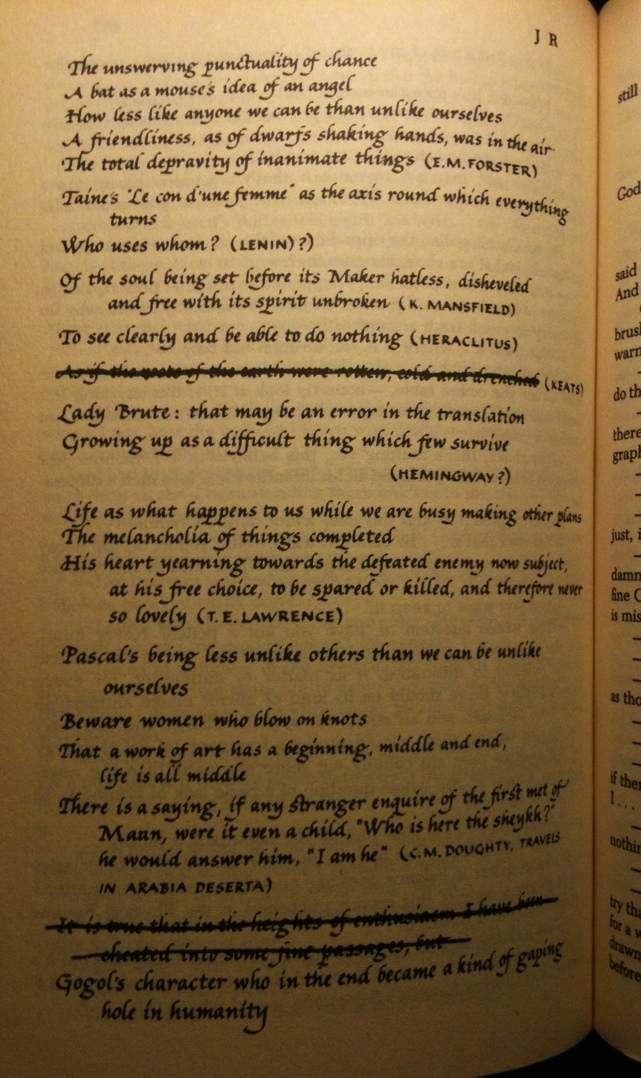
In JR, the sprawling novel of capitalism and art by William Gaddis, Jack Gibbs loads his pockets with crumpled newspaper clippings, racing forms, and citations for a book he’s working on. “More trash,” he mutters about this list (which appears on page 486 of my Penguin Twentieth Century Classics Edition).
I’m almost ashamed to admit that I hadn’t seen W.D. Richter’s slapdash madcap sci-fi send up The Adventures of Buckaroo Banzai Across the 8th Dimension until this summer. The film is so strange, so aggressively and willfully weird, that I don’t know how its cult vibes hadn’t enmeshed me earlier.
The film stars a deadpan Peter Weller as the titular Buckaroo, a neurosurgeon/rock star/superhero who, alongside his team/fellow bandmates, the Hong Kong Cavaliers, must stop the Red Lectroids from Planet 10. Or something like that.
The plot is a shambolic mess, sprawling out in bizarre directions. Buckaroo Banzai is never sure if it’s cyberpunk or Moonlighting or a winking jab at Flash Gordon or a riff on a rock movie. It’s enthralling and terrible at the same time.
But there’s no need to oversummarize here, when all one must needs do to get a feel for Buckaroo Banzai is watch its marvelous end title sequence. Go ahead, watch it:
There’s nothing I don’t love about these four minutes: The strutting! The skinny ties! Jeff Goldblum in furry chaps and a cowboy hat! Smokin’ hot Ellen Barkin! That little hop that Peter Weller does at 1:40! The promise of a sequel that never came! And that song! That jaunty joyful whistling slice of ’80s cheese! Love love love it!
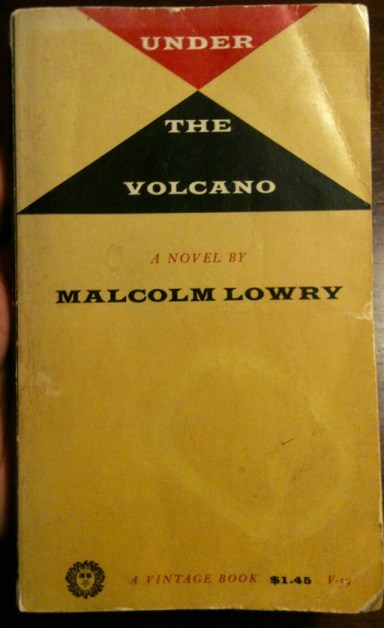
I go to the bookstore once a week, whether I need books or not, which I really don’t. This week, I picked up a book I’ve already read, Lowry’s late-modernist classic Under the Volcano, simply because I hate the cover of the version I have (a bland movie tie-in). Anyway, I’ve been prowling for a version that includes an introduction by William Vollmann, but I saw this midcentury paperback with a nice minimal vibe and had to snap it up (also, it was a dollar, and “I’d buy that for a dollar!”):
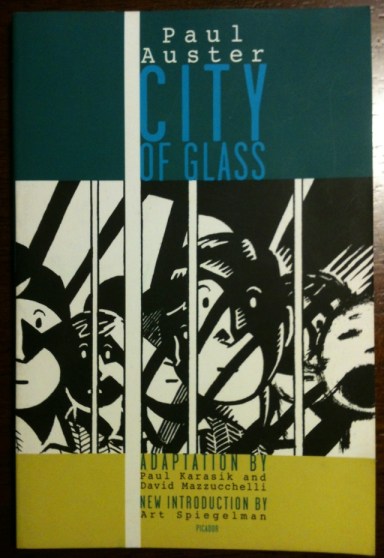
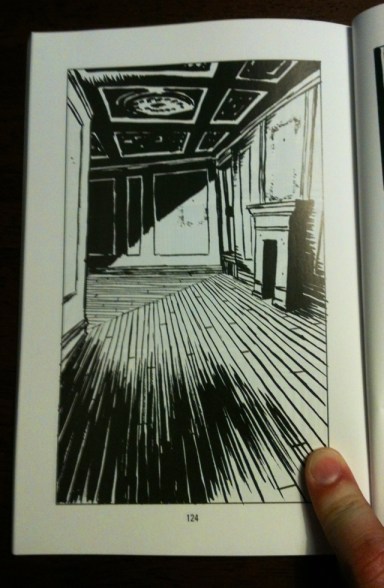
I’m not a huge Paul Auster fan, but I do like artist David Mazzucchelli’s work (especially his novel Asterios Polyp), so when I saw a crisp used copy of the graphic novelization of City of Glass(with an intro by Art Spiegelman), I had to snap it up:
A splash page of a stark empty room which I’m sure is meaningful in some way:
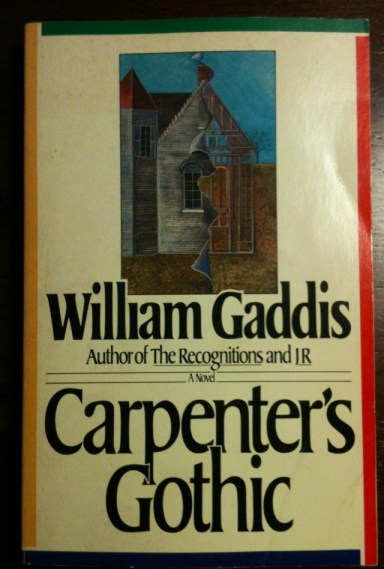
Also, couldn’t help pick up a used copy of Gaddis’s late novel Carpenter’s Gothic, even though I know there’s no way I’ll get to it anytime soon.
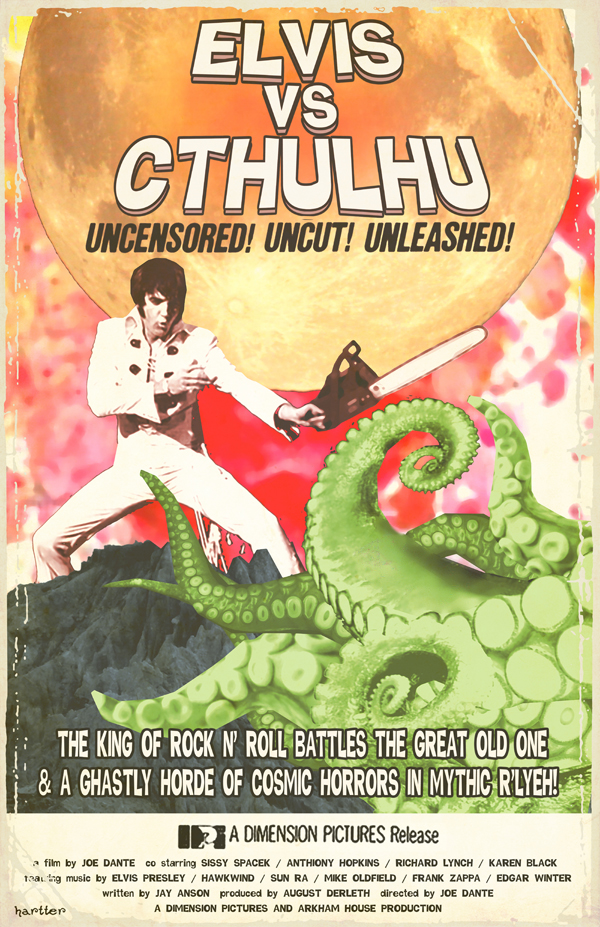
Sean Hartter’s fantabulous collection of movie poster designs from an alternate dimension relay such a precise aesthetic that they almost make me sad that these movies don’t exist. Still, I find some consolation by imagining scenes from, say, a Jodorowsky-helmed Star Wars or Vincent D’Onofrio in an x-rated version of Avatar. (Thanks to Tilford for the tip).
As studios increasingly rely on franchises—and rebooting those franchises every decade—it makes sense that franchise titles will continue to evolve like comic books have, with new artists (directors, producers, writers, etc.) doing their “take” on the property.
A few of Hartter’s images, but I suggest getting lost in his site:
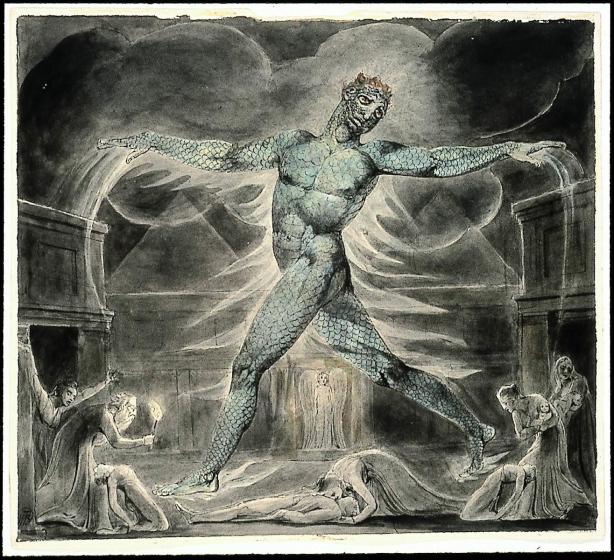
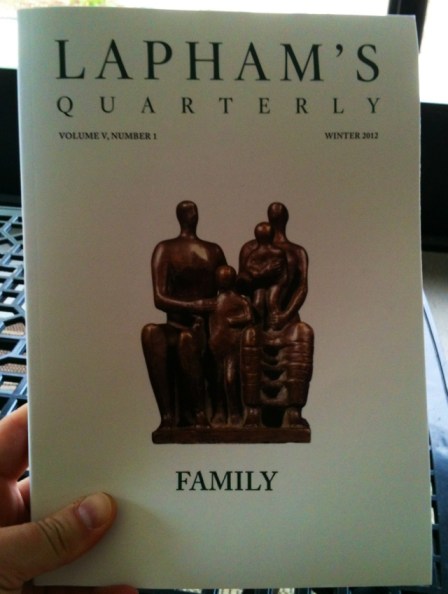
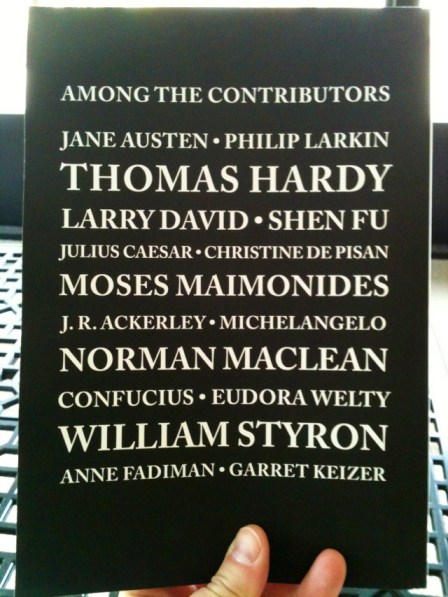
I was a relatively consistent subscriber to Harper’s magazine from 1997 to 2006, with brief flirtations after that year. Anyway, at some point my subscriptions to Harper’s, The Believer, McSweeney’s, etc. became too much. Just didn’t have time to read them all. I’m down to one subscription a year. Last year it was The Paris Review—and I very much enjoyed it. This year: Lapham’s Quarterly. The quarterly is right up my alley—short selections from (seemingly) 100s of authors. The back:
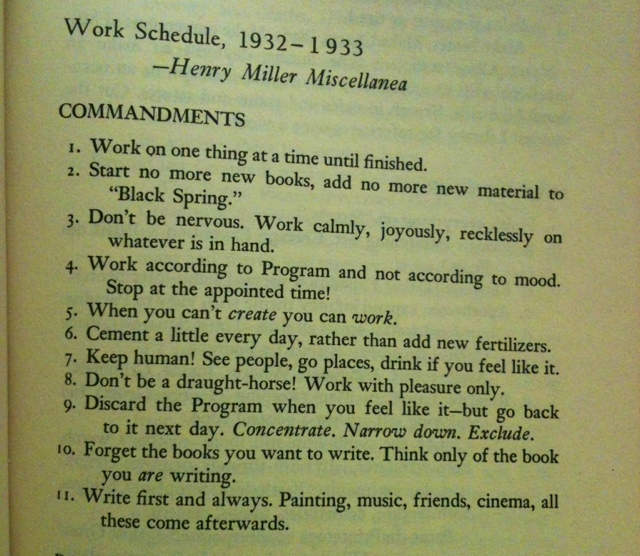
The magazine also features plenty of art selections, as well as tables, graphs, and other editorial content—but on the whole, Lapham’s Quarterly reminds me of my favorite aspect of Harper’s, the “Readings” selections.
Big thanks to Biblioklept reader (and frequent commenter) ccllyyddee, who sent me his copy of Gretel Ehrlich’s The Future of Ice. I dipped into it a bit this weekend; Ehrlich seems to be walking that strange line between the physical and metaphysical. A description from her website–
In this gripping circumnavigation of the Arctic Circle, Gretel Ehrlich paints a vivid portrait of the indigenous cultures that inhabit the starkly beautiful boreal landscape surrounding the Arctic Ocean, an ice-bound wilderness that includes northern Siberia, northwestern Greenland, Canada’s vast Nunavut, and northern Alaska. Ehrlich’s expedition, supported by the National Geographic Society, documents what remains of these cultures, specifically the similarities and differences among them, including hunting traditions, shamanic and ceremonial practices, languages and legends—the ways in which they have survived, or have been assimilated, and how they are adapting to the impact of climate change on their ice-age cultures.
Ehrlich is fascinated by what she calls the ecology of culture—the ways in which the human presence of indigenous Arctic people is intricately interwoven with land, rock, river, sea, and ice. Depicting human-caused climate change as only the latest and most destructive of the ills and abuses first peoples have been suffering for 250 years, Ehrlich’s haunting and lovely prose portrays ancient tribes and traditions on the edge of extinction and captures the austere beauty of their various lifeways in the frozen dreamscape of the world they have always known.
More from F. Scott Fitzgerald’s magical Notebooks—
143 Days of this February were white and magical, the nights were starry and crystalline. The town lay under a cold glory.
144 Dyed Siberian horse.
145 As thin as a repeated dream.
146 The sea was coming up in little intimidating rushes.
147 The island floated, a boat becalmed, upon the almost perceptible curve of the world.
148 Lost in the immensity of surfaceless blue sky like air piled on air.
151 On the great swell of the Blue Danube, the summer ball rocked into motion.
152 A circus ring for ponies in country houses.
153 The tense, sunny room seemed romantic to Becky, with its odor of esoteric gases, the faint perfumes of future knowledge, the low electric sizz in the glass cells.
154 A rambling frame structure that had been a residence in the 80’s, the country poorhouse in the 1900’s, and now was a residence again.
Even though I should have known from The Recognitions that the world was not waiting breathlessly for my message, that it already knew, and was quite happy to live with all these false values, I’d always been intrigued by the charade of the so-called free market, so-called free enterprise system, the stock market conceived of as what was called a “people’s capitalism” where you “owned a part of the company” and so forth. All of which is true; you own shares in a company, so you literally do own part of the assets. But if you own a hundred shares out of six or sixty or six hundred million, you’re not going to influence things very much. Also, the fact that people buy securities—the very word in this context is comic—not because they are excited by the product—often you don’t know what the company makes—but simply for profit: The stock looks good and you buy it. The moment it looks bad you sell it. What had actually happened in the company is not your concern. In many ways I thought . . . the childishness of all this. Because JR himself, which is why he is eleven years old, is motivated only by good-natured greed. JR was, in other words, to be a commentary on this free enterprise system running out of control. Looking around us now with a two-trillion-dollar federal deficit and billions of private debt and the banks, the farms, basic industry all in serious trouble, it seems to have been rather prophetic.




 Biblioklept