Books Acquired, 12.25.2011 (Walton Ford; Hayao Miyazaki)

20111226-144256.jpg

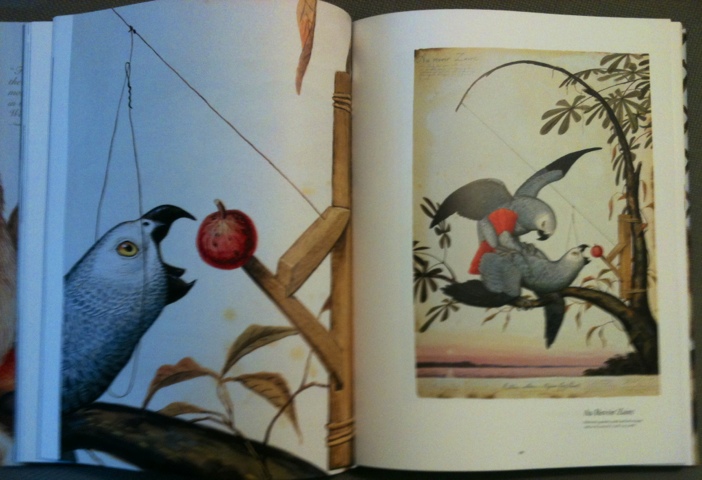
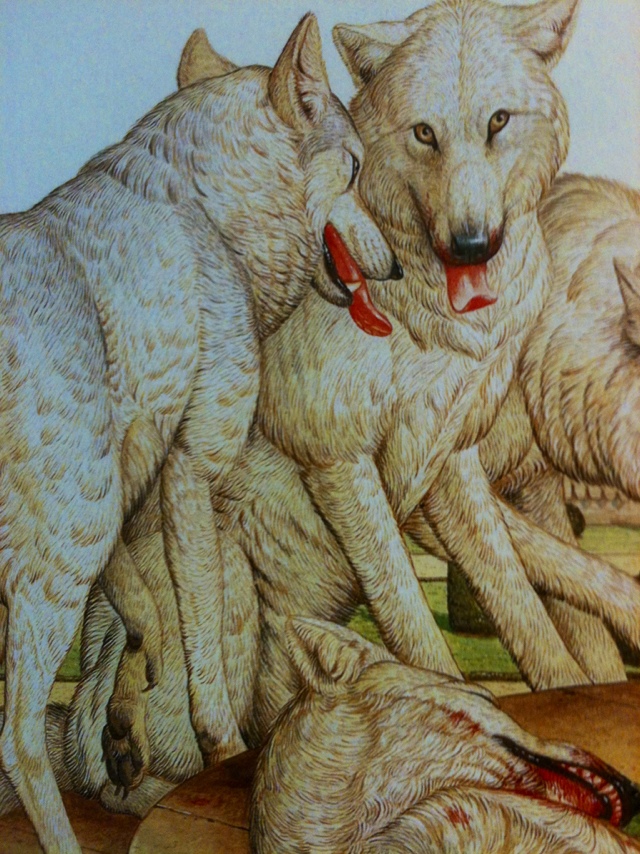
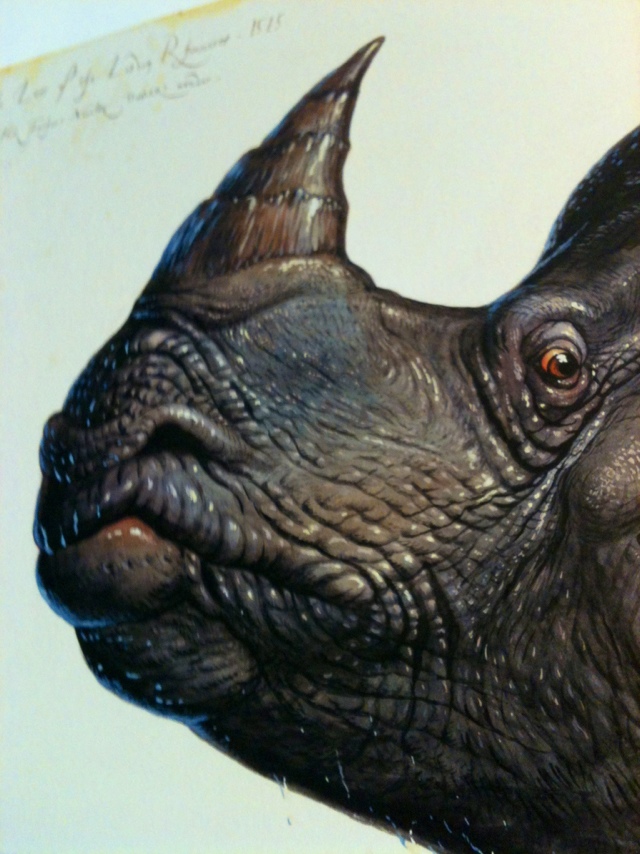
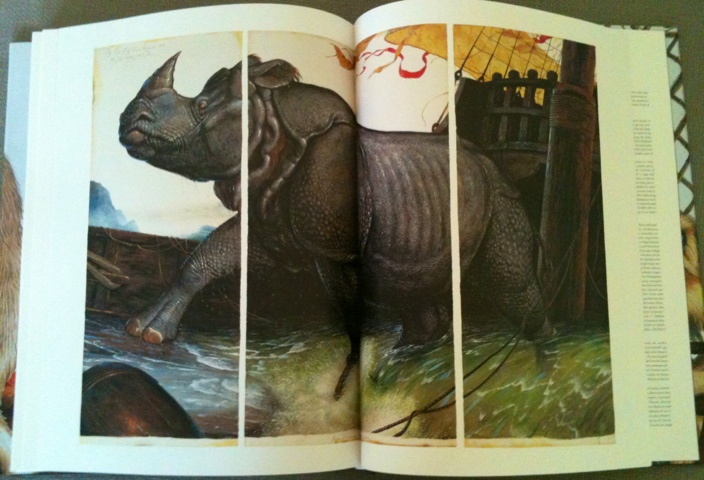
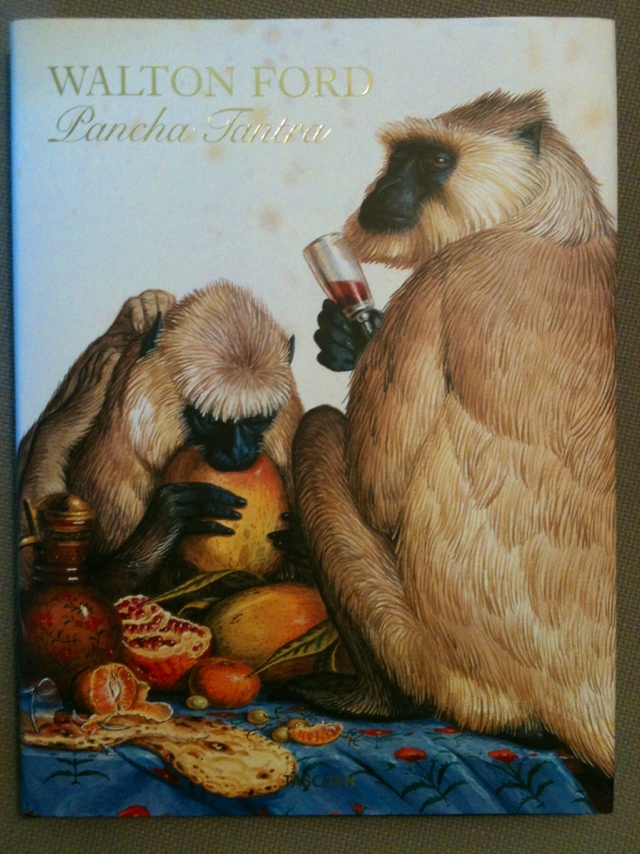
I finally got a copy of Walton Ford’s Pancha Tantra, a bestiary depicting the savage Darwinian competition between all biological species, including humans, whose encroachment upon animal habitats is examined in this book. Ford also explores themes of colonialism in his strange, naturalist paintings. My loving wife gave me this book. I took some clumsy photos with my iPhone which in no way do justice to this big, beautiful book; forgiveness please.

20111226-144302.jpg

20111226-144309.jpg

20111226-144317.jpg

20111226-144325.jpg

20111226-144333.jpg

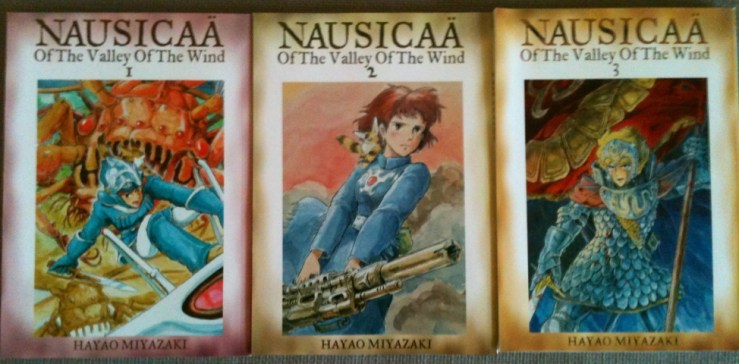
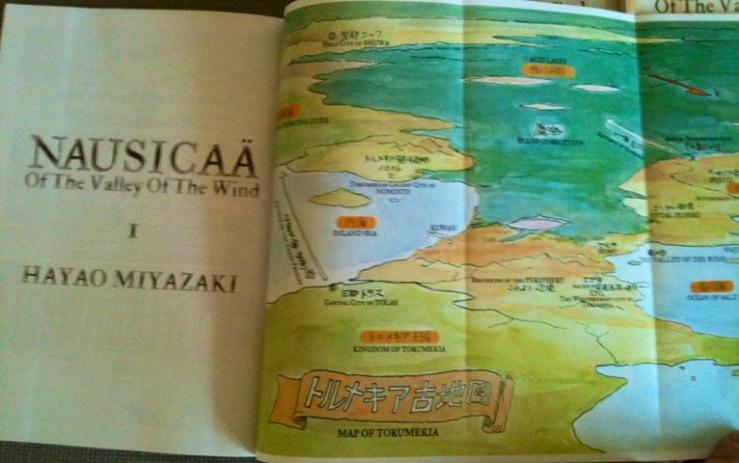
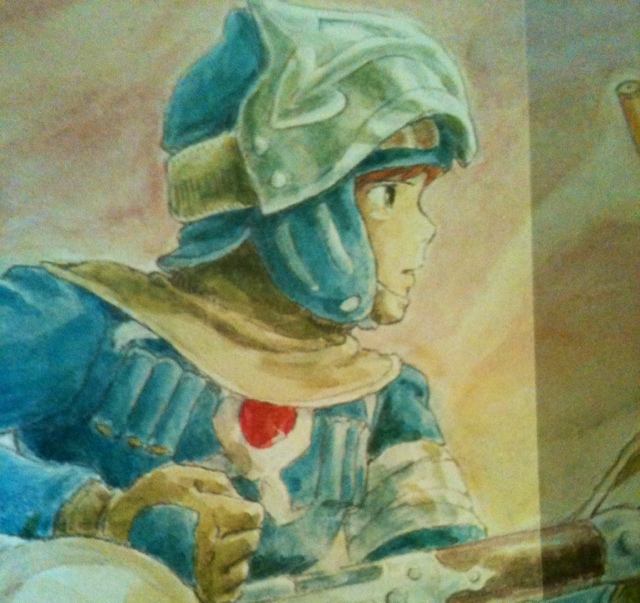
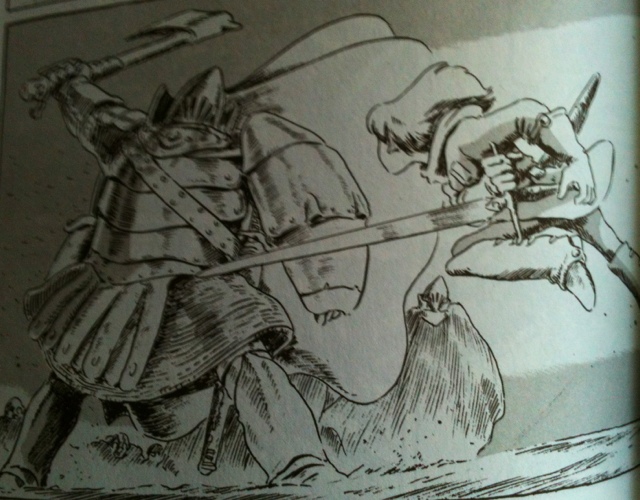
My wife also gave me Hayao Miyazaki’s graphic novel Nausicaa of The Valley of the Wind. The film based on this manga plays in our house about once a week, on heavy rotation with Miyazaki’s other films, which my four year old daughter is addicted to.

20111226-144343.jpg

20111226-144357.jpg

20111226-144406.jpg

20111226-144645.jpg

“Hold On Elmo’s Texting” Elmo — Ted McCagg

(Via The Nervous Breakdown).

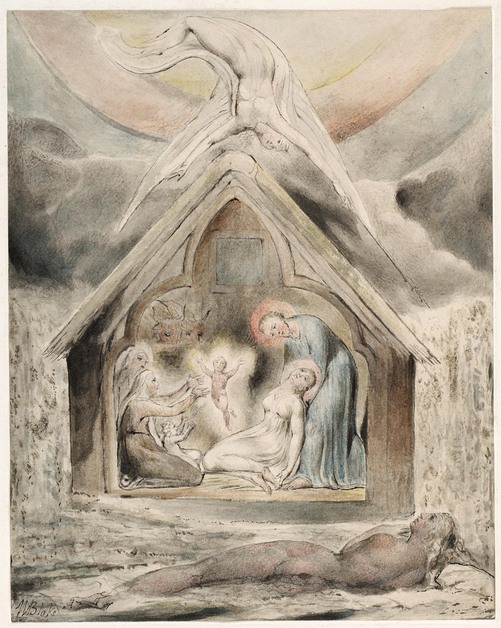
The Night of Peace — William Blake

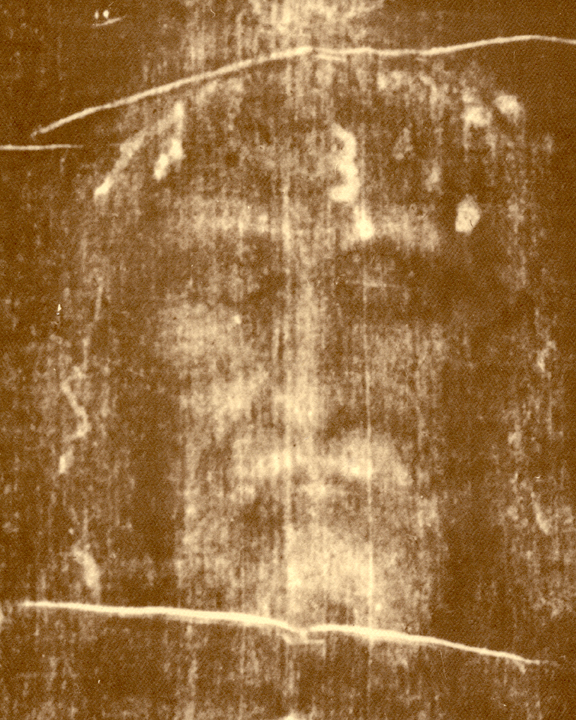
Jesus Christ’s Death Mask

Okay. Yes. Obviously this is the Shroud of Turin, which, hey, take it or leave it at your metaphysical will.

On August 29 of 2010 Biblioklept ran an image of Walt Whitman’s death mask; the day happened to be a Sunday, and we’ve run a death mask every Sunday since then, with the exception of Sunday, September 11, 2011, when to do so seemed to be in poor taste.

Over the past year and a half, folks wrote in to tell us repeatedly that the death mask was in fact a life mask, or that the death mask was perhaps of spurious origin, or even just that they liked the death mask. Thanks.

Anyway, Sunday death masks were fun for the past 17 months or so, but next Sunday marks a new year, and today’s Sunday is the last of this year, and it’s Christmas, which makes the Shroud of Turin a nice, easy way of saying: no more death masks, at least not on a regular basis. Maybe we’ll do some other regular Sunday posts (mugshots? bookshelves?) but no more regular death mask Sundays.

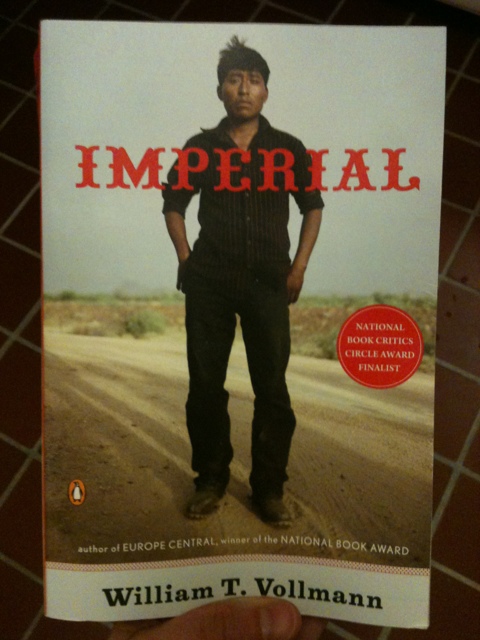
Book Acquired, 12.23.2011; Or, I Read the First 2% of William Vollmann’s Enormous Book Imperial

20111223-194549.jpg

Earlier this week, Biblioklept correspondent A King at Night suggested on this blog that William T. Vollmann, “literature’s own Batman,” may not be entirely real. While Mr. At Night’s post was perhaps a bit tongue-in-cheek, he did hip us to extremely cheap new copies of Vollmann’s 2009 California opus, Imperial. I bought one, of course, knowing that my chances of actually reading it in full were, uh, slim. It showed up today.

I read the first 25 pages, a little over 2% of the book (not counting Vollmann’s endnotes and bibliography). I read the book in the bathtub, drinking a beer (those of you who fear (or find repulsive the prospect of) visualizing my stubby little birthday-suited body besoaped and besudded, I suggest that that role may be played by Geena Davis, circa early nineties, although, obviously, you can pick whomever you like to imagine reading Imperial in a bathtub). I was cognizant of the fact that I was taking a bath—a luxury of sorts—while reading a book that deals in large part about who controls water. I also managed to get the book wet with both blood and water. I don’t know where the blood came from.

The first few pages thrust us right into typical Vollmann territory, with our protagonist paying a cokehead to guide him through the back alleys of Mexicali (Vollmann takes time to note the “street-whores,” of course). Alternately, Vollmann attends the nocturnal activities of the weary Border Patrol, who regularly catch and release Mexicans heading for the Northside (America).

There’s a great little moment, very early in this first chapter, when Vollmann ponders the Sisyphean task of the men who patrol the border:

. . . I almost pitied the futility of his occupation, as I suspect he did mine (the main purpose of my essays being to line birdcages), but then I fortunately persuaded myself that all vocations and callings are equally futile.

This seems like the prototypical Vollmann moment: earnestness bound in supple irony, self-deprecation glossing the intense pride in work that the contemporary world will be happy to (even sometimes boastfully) ignore.

I enjoyed the first pages of this massive book tremendously. Vollmann’s voluminous scope and strange background often eclipse his powers as a proseslinger, and Imperial, so far, is lucid, clean, sharp, and funny.

So I’ll go for it. I’ll read it. I’ll finish it before this time (id est, late Dec.) next year.

The Insects’ Christmas — Wladyslaw Starewicz

An Animated Christmas Card from Maurice Sendak

Maurice Sendak’s animated intro for the 1977 film Simple Gifts was based on an earlier design for a Christmas card  by the artist:

(Image and info via the very cool Michael Sporn Animation blog, with a hat tip to Jescie for sending me the link).

Happy Festivus!

Total Recall/ “In Your Eyes” Mashup

Books Acquired, 12.21.2011

20111222-130625.jpgNormally I try to comment on the review copies that come into Biblioklept World Headquarters, but sept d’un coup is too much. I promise to say something about these down the line though.

Granddad’s Eggnog

Hopefully everyone is happy and with loved ones and friends during these holidays–and what better way to show love and fellowship than sharing a draught of delicious eggnog (alternately, the sad and solitary can drown their lonely sorrows in this high-alcohol, high-calorie treat). This is an old recipe; I remember my cousin and I stealing sips of this nog during my grandparents’ Christmas parties.

You will need:

A bottle of fine bourbon

A bottle of fine rum

A liqueur of your choice (this is optional; coffee, cream, or amaretto all add a nice touch)

A gallon of vanilla ice cream (substitute frozen yoghurt if you’re concerned about calories)

A carton of store-bought eggnog (alternately, you can make your own eggnog from eggs, milk, and sugar, although it’s a genuine pain in the ass and no one will ever know the difference, unless you go around pointing it out to them, which will make you look like an asshole, and you don’t want to look like an asshole, do you?)

Nutmeg, cinnamon, mace, clove (Use whole spices! Any of your favorite holiday spices will do, but I consider these four essential)

To make a one gallon pitcher of eggnog:

Put about 6 cups of ice cream in the pitcher.

Add some cinnamon sticks and cloves; grate some nutmeg and mace into the pitcher.

Add 4 cups of the store-bought eggnog; stir mixture.

Add about 3 and 1/2 cups of bourbon, 1 1/2 cups of rum, and liqueur (about 1/2 a cup will do) to taste; add more spices.

Stir vigorously; cover and allow to set in the freezer for at least 12 hours before serving. Stir vigorously before serving.

To make your guests happy, I suggest serving the nog with both liquor and ice cream at hand; this way those inclined may add either as their taste dictates. (Note for heavy drinkers: if your intention is to get smashed, stop drinking the eggnog after two cups and begin drinking the bourbon straight! The high levels of cream and sugar in this nog will guarantee a hangover–don’t overdo it!).

Santa’s Mugshot

Image by Brad Holland

(Thanks to Bblklpt reader JESCIE for the link).

Drunk History Christmas (With Ryan Gosling, Jim Carrey, and Eva Mendes)

Books Acquired, Some Time Last Week (12.14.2011, Perhaps)

20111221-125306.jpg

Bobbi Lurie’s Grief Suite, a slim collection of poems that seem to be mostly about death and loss. Love the woodcut cover, which Ms. Lurie made herself. I read most of Grief Suite last week and found it moving if bewildering. I’m not sure how to review a book of poetry. I have no idea.

20111221-125952.jpg

The Book of Khalid by Ameen Rihani is part of Melville House’s Neversink line; it’ll get a Spring release. I read a bit the other night. Strange and romantic.

20111221-130019.jpg

Joe Dunthorne’s Wild Abandon is set on a crumbling Welsh commune. Dunthorne’s Submarine was adapted into a film last year by Richard Ayoade. I didn’t see the film. Anyway, I usually thumb through the first few pages of every review copy that shows up and try to shuffle the book into a certain stack; I wound up reading way more of Wild Abandon than I had initially expected. The first 50 pages are good—flawed but good—and it seems like a smart, funny novel that will appeal to readers who like smart, funny novels.

Sorry that my descriptions today were so lame (lamer than usual). I’m tired.

Novels Make Lousy Gifts (But We Should Give Them Anyway)

Novels make lousy gifts.

Now, if you have even a passing acquaintance with this little blog, you know that I love novels, that Biblioklept primarily focuses on novels, and that I love books in general. I am not anti-novel or anti-giving-novels-as-gifts. Send me a novel as a gift. I will appreciate it (or trade it toward another book, which is kinda sorta a form of appreciation).

I went to my favorite bookstore today, in fact, to buy some books for Christmas presents. But I restrained myself from picking up novels as gifts.

If you love books like I do, I’m sure that some of your most favorite gifts ever have been novels. Some of my most favorite gifts have been novels. The remaindered copy of The Lord of the Rings (from the South Barwon Library that some friends of the family gave me on Dec. 5th, 1990 when we visited Melbourne (the one in Australia, not Florida)) is probably one of my all-time favorite gifts. I know the exact date because the nice lady who gave it to me wrote a kind note in book and included the date in her note.

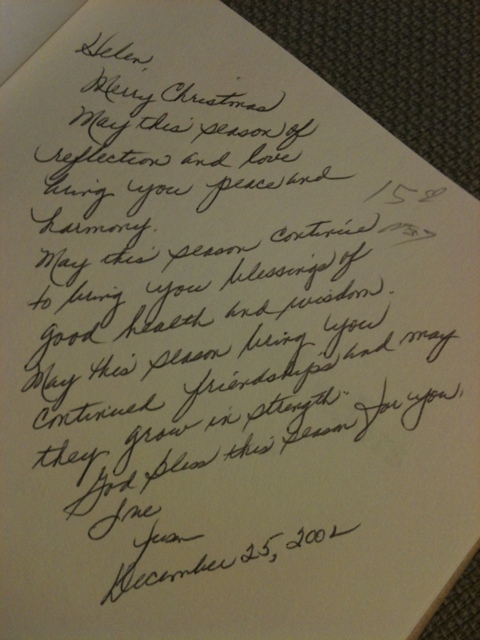
I could never bear to get rid of an inscribed book given as a gift, but lots of people do get rid of inscribed books. This is a monstrous practice, one that attests to just how easily people will discard your oh-so-earnest gifts. If you spend a lot of time in used bookstores (I do) you will come across these sad markings. Because it’s close at hand, and I’m aware of its inscription, I’ll share the note that Jean wrote to Helen (no, of course I know neither of them) in my copy of Balthus’s memoir, Vanished Splendors:
20111220-195619.jpg

I am aware that the memoir of a pervy artist is not the same as a novel, and that, as my first illustrating example, I already seem to be losing my metaphorical balance, but again, it was close at hand, right near the Tolkien in fact (by the bye, Vanished Splendors is pure gold).

In any case, I think Balthus’s memoir “reads” like a novel, which is to say that it’s mostly big chunks of text that require time and energy to decipher, set against the backdrop of TV, internet, movies, etc. It has some pictures, but not many. There’s no gimmick to it. I’m guessing that Helen just wasn’t into Balthus, or, if she had a passing interest in his art, it didn’t translate into wanting to read his memoir. She certainly didn’t read any of it (yes, I have a special sense that tells me when a book has been read. This baby was a virgin). Every time I look over the book, I feel sorta bad for Jean, whose gift seems to have gone unappreciated (by Helen; not by me. I was happy to pick it up used).

To return to an earlier point: yes, some of our favorite gifts ever might be novels. However, most of the life-changing novels I received were rarely given as birthday or Christmas gifts. They weren’t gifts of obligation, if you’ll forgive the ugliness of that term. Most of the great novels that were given to me were handed along free of occasion, given because the giver thought (knew) I should read them.

At Christmas though, we feel obliged to give. Sometimes we get some great novels as gifts. More often though, it seems like that relative who knows you “like to read” gives you a novel by, I dunno, Clive Cussler or Tom Clancy. The worst though are those tiny little hardback books that are designed specifically to be gifts, little faux-tomes of faux-philosophy usually connected to golf or angels or some other bullshit (I was horrified last year when DFW’s “This Is Water” speech got this treatment). Anyway, if you like books, you probably just go trade in this bullshit toward the books you like.

But this post isn’t really about the problem of getting airport novels or gimmick books as gifts. This post is about those of us who insist on giving novels we love to people who we know don’t really love reading novels. Especially really big, somewhat (or very) experimental novels. Important novels. Those novels that we read and decide that everyone needs to read this to become a fully realized human being [gags on that phrase].

I think sometimes we give our friends and relatives novels as gifts because we love them so much and we also love the book so much that we are maybe gunning for an intellectual three-way. We want them to read the novel so that we can share in it together, discuss it, rant about it, argue about it (remember though: that’s what the internet is for).

What often happens though is that these gifted novels (forgive the ambiguous, awkward modifier) tend to lurk about the giftee’s abode, brickishly unread, like dour unwanted houseguests. They skulk at the margins of bookshelves or migrate to the bottom of “to read” stacks; a lucky one might find occasional fingering above a commode. They are ugly reminders to the giftee, signals of how he or she has failed to meet your expectations (your expectations re: 9 or 15 or 25 or 30 hours of her time). (Young people, by which I mean college students in the liberal arts, are the exception here; they probably aren’t going to read the novel, but they are absolutely fine with putting it out for show).

People like books with pictures though, generally.

Even though I think novels tend to make lousy gifts, we should give them to our friends and loved ones anyway, even on those days of obligated giving. We should still offer novels up like they were somehow a part of our own selves in the deluded hope that the giftee will read them and discuss them with us, and that the novel will become an internal, virtual, shared experience. We should give them knowing that it’s likely they’ll go unread, that they may even be a point of shame for the giftee (especially when we ask, “Have you started . . . ?”). We should give them aware that they might point toward our own selfish desires.

Even if a novel may be a gift that implies a certain level of intellectual work, it also implies a  sense of trust and respect toward the giftee, and in this sense, giving a loved novel is a clear way to show love.
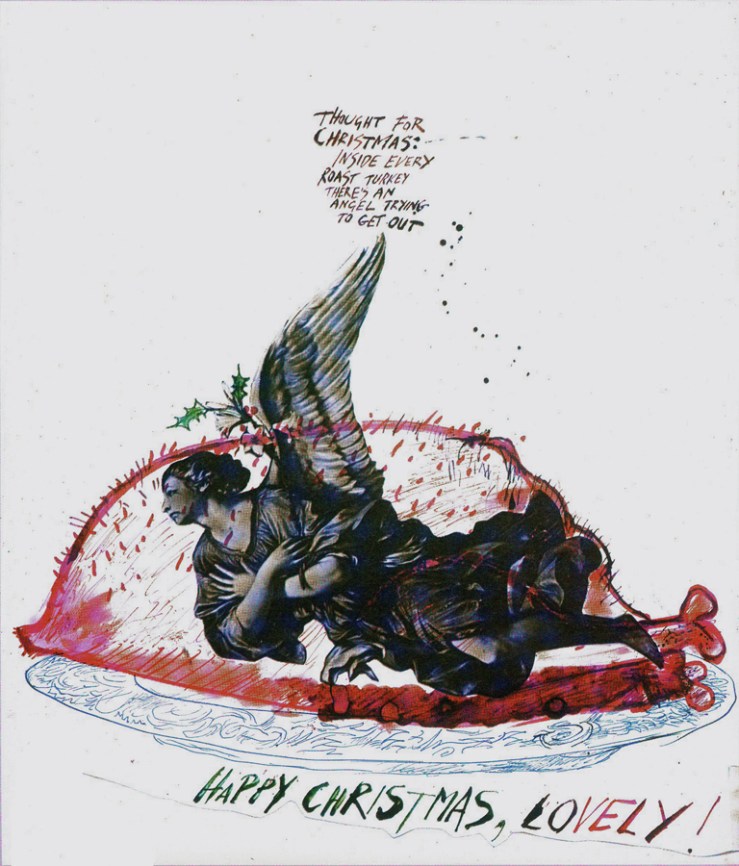
“Happy Christmas, Lovely!” — A Christmas Card from Ralph Steadman

(Thanks to Bblklpt reader JESCIE for the link).

The Hobbit Film Trailer