
Leopold Bloom, hero of James Joyce’s Ulysses likes kidneys for breakfast. In fact–
Mr Leopold Bloom ate with relish the inner organs of beasts and fowls. He liked thick giblet soup, nutty gizzards, a stuffed roast heart, liverslices fried with crustcrumbs, fried hencods’ roes. Most of all he liked grilled mutton kidneys which gave to his palate a fine tang of faintly scented urine.
Okay, so there’s not much to this recipe. First, you’ve gotta buy the kidney–
A kidney oozed bloodgouts on the willowpatterned dish: the last. He stood by the nextdoor girl at the counter. Would she buy it too, calling the items from a slip in her hand? Chapped: washingsoda. And a pound and a half of Denny’s sausages.
Then you cook it with some butter in a frying pan (don’t forget to share with the cat, and don’t forget the pepper)–
While he unwrapped the kidney the cat mewed hungrily against him. Give her too much meat she won’t mouse. Say they won’t eat pork. Kosher. Here. He let the bloodsmeared paper fall to her and dropped the kidney amid the sizzling butter sauce. Pepper. He sprinkled it through his fingers ringwise from the chipped eggcup.
Then take your lazy adulterous wife her breakfast that you’ve lovingly prepared for her (she’ll need her strength for later). Oh, and don’t forget about the kidney that’s still cooking for you (unless you’re making some kind of subconscious symbolic burnt offering or something)–
—There’s a smell of burn, she said. Did you leave anything on the fire?
—The kidney! he cried suddenly.
He fitted the book roughly into his inner pocket and, stubbing his toes against the broken commode, hurried out towards the smell, stepping hastily down the stairs with a flurried stork’s legs. Pungent smoke shot up in an angry jet from a side of the pan. By prodding a prong of the fork under the kidney he detached it and turned it turtle on its back. Only a little burnt. He tossed it off the pan on to a plate and let the scanty brown gravy trickle over it.
Enjoy with gravy, toast, and a cup of tea–
Cup of tea now. He sat down, cut and buttered a slice of the loaf. He shore away the burnt flesh and flung it to the cat. Then he put a forkful into his mouth, chewing with discernment the toothsome pliant meat. Done to a turn. A mouthful of tea. Then he cut away dies of bread, sopped one in the gravy and put it in his mouth. What was that about some young student and a picnic? He creased out the letter at his side, reading it slowly as he chewed, sopping another die of bread in the gravy and raising it to his mouth.
He sopped other dies of bread in the gravy and ate piece after piece of kidney.

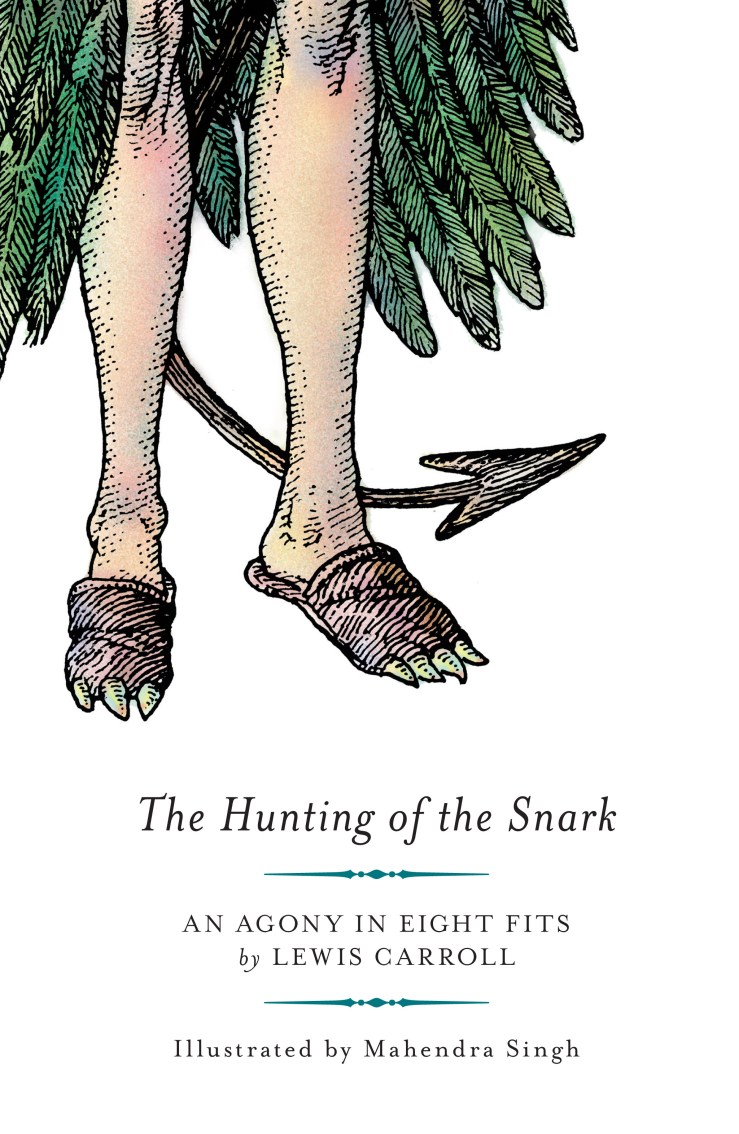 I scrapped my first two drafts for a review of Melville House’s new edition of Lewis Carroll’s The Hunting of the Snark. The problem was that I was struggling to figure out Carroll’s Nonsense poem (subtitled An Agony in Eight Fits) about a ten man crew who take to the sea, to, you know, hunt a Snark. The Bellman seems to lead them. There’s the Banker, Baker, and other guys whose names start with “b” — including enemies the Beaver and the Butcher (who wind up tight allies). The poem is both silly and dense, rippling with weird wordplay and allusions that are, for the most part, beyond me. It’s often hard to follow, and sometimes has the effect of making the reader (or at least this reader) feel like he’s skating on the surface of some deeper profundities — or, alternately, maybe it’s just Nonsense, to use Carroll’s term.


 The
The 
 Biblioklept