More from The Paris Review’s vaults. Highlights from William T. Vollmann’s 2000 interview (the entire thing is precious. Just precious) —
VOLLMANN: One of the things that I had to do occasionally while I was collecting information for that prostitute story, “Ladies and Red Lights” from The Rainbow Stories, was sit in a corner and pull down my pants and masturbate. I would pretend to do this while I was asking the prostitutes questions. Because otherwise, they were utterly afraid of me and utterly miserable, thinking I was a cop.
. . .
I kept thinking when I first began writing that my female characters were very weak and unconvincing. What is the best way to really improve that? I thought, Well, the best way is to have relationships with a lot of different women. What’s the best way to do that? It’s to pick up whores.
. . .
Also, I often feel lonely.
. . .
I almost never sleep with American prostitutes any more, unless they really want me to—if they are going to get hurt if I don’t.
. . .
Anyway, so when I was in Thailand, I went to a town in the south and bought a young girl for the night. This awful brothel—one of these places hidden behind a flowershop with all these tunnels and locked doors and stuff—was like a prison. I tried to help a couple of the girls but you just can’t get them out. I tried and I couldn’t. I made the mistake of going to the police, trying to have the police get them out—all that did was nearly get them arrested and put in jail, because the police are paid off. I managed to get the raid called off by taking all the cops out to dinner and buying them Johnnie Walker. I bought this fourteen-year-old girl and got her in a truck and drove like hell to Bangkok. I was with this other girl at the time—Yhone-Yhone, a street prostitute, a very happy one. She was my interpreter. She put the fourteen-year-old girl at ease and got her to trust me. We got her set up at a school run by a relative of the king of Thailand. I went up north, met her father, gave him some money, and got a receipt for his daughter. He didn’t know she’d been sold to a brothel. When I met him and told him he said, Oh. I didn’t know that, but, well, whatever she wants. He’s not a bad guy, just a total loser. He’s a former Chiang Kai-shek soldier. They’re all squatters there in Thailand. They can’t read or write. He lives on dried dogs and dried snakes.
INTERVIEWER: You own his daughter?
VOLLMANN: That’s right. I own her. She doesn’t particularly like me, but she was really happy to be out of that place. She loves the school. It’s sort of a vocational school. It’s called something like the Center for the Promotion of the Status of Women. Many former prostitutes are in there.
. . .
The common motif is just prostitution and love.
. . .
I want to take some responsibility and act as well as write. I don’t mean to be an actor, but rather to accomplish things . . . do things that will help people somehow . . . things like kidnapping the sex slave. It would be great if I could make my contribution to abolishing the automobile or eliminating television or something like that.










 In his
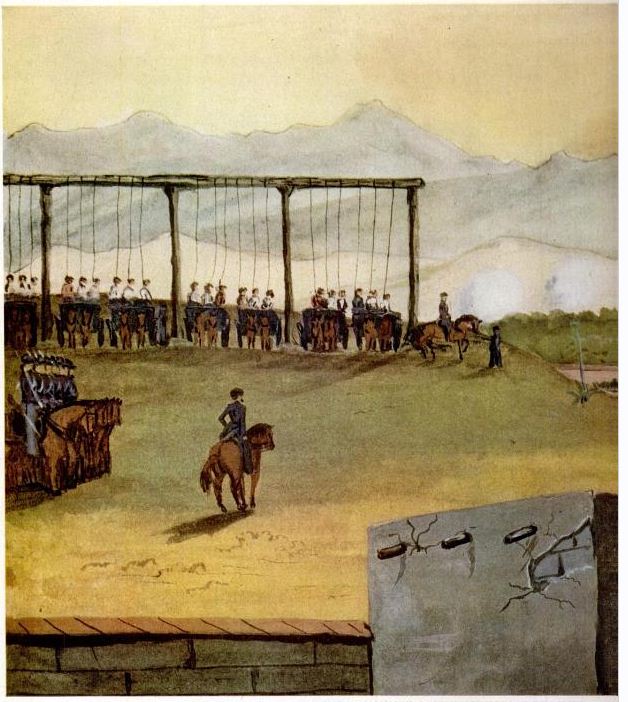
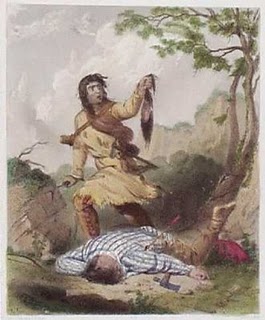
 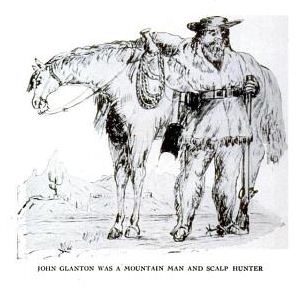 According to Chamberlain, John Glanton was born in South Carolina and migrated to Stephen Austin’s settlement in Texas. There he fell in love with an orphan girl and was prepared to marry her. One day while he was gone, Lipan warriors raided the area scalping the elderly and the children and kidnapping the women- including Glanton’s fiancee. Glanton and the other settlers pursued and slaughtered the natives, but during the battle the women were tomahawked and scalped. Legend has it, Glanton began a series of retaliatory raids which always yielded “fresh scalps.” When Texas fought for its independence from Mexico, Glanton fought with Col. Fannin, and was one of the few to escape the slaughter of that regiment at the hands of the Mexican Gen. Urrea- the man who would eventually employ Glanton as a scalp hunter. During the Range Wars, Glanton took no side but simply assassinated individuals who had crossed him. He was banished, to no avail, by Gen. Sam Houston and fought as a “free Ranger” in the war against Mexico. Following the war he took up the Urrea’s offer of $50 per Apache scalp (with a bonus of $1000 for the scalp of the Chief Santana). Local rumor had it that Glanton always “raised the hair” of the Indians he killed and that he had a “mule load of these barbarous trophies, smoke-dried” in his hut even before he turned professional.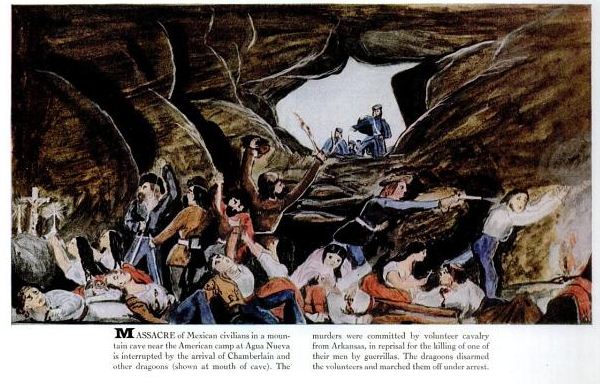
 It’s fascinating to note how much of the Judge is already there–the pedophilia, the marksmanship, the scholarship, and, most interesting of all, the lack of hair. Confession goes on to detail the killing, scalping, raping, and raiding spree that comprises the center of Blood Meridian. Chamberlain even describes the final battle with the Yumas, an event that signals the dissolution of the Glanton gang in McCarthy’s novel.
 Content aside, Chamberlain’s prose also seems to presage McCarthy’s prose. In his book
  You can view many of Chamberlain’s paintings and read an edit of his Confession in three editions of Life magazine from 1956, digitally preserved thanks to Google Books–here’s