Grand Interior, Notting Hill — Lucian Freud

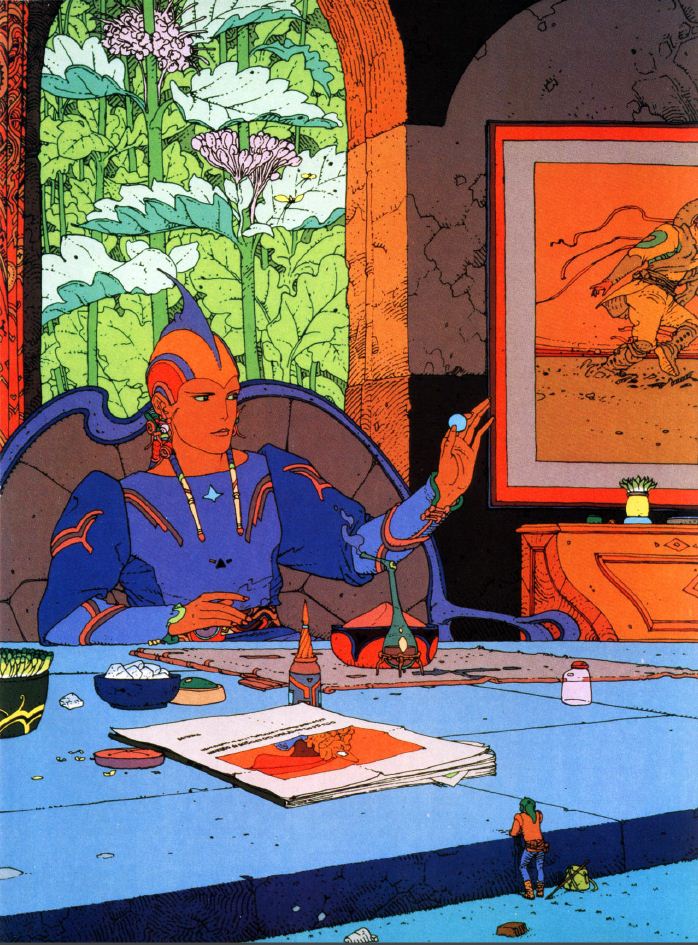
Starwatcher III — Moebius

Watch The Diary of Tortov Roddle, a Surreal Animated Dream Story

The Judgment of Paris — Charles Bell

Portrait of a Man Reading — Gerard Terborch

Native Carrying Some Guns, Bibles, Amorites on Safari — Jean-Michel Basquiat

Breaker Morant (Full Film)

Soldiers — Andrea Mantegna

Book Shelves #46, 11.11.2012

20121111-111049.jpg

Book shelves series #46, forty-sixth Sunday of 2012

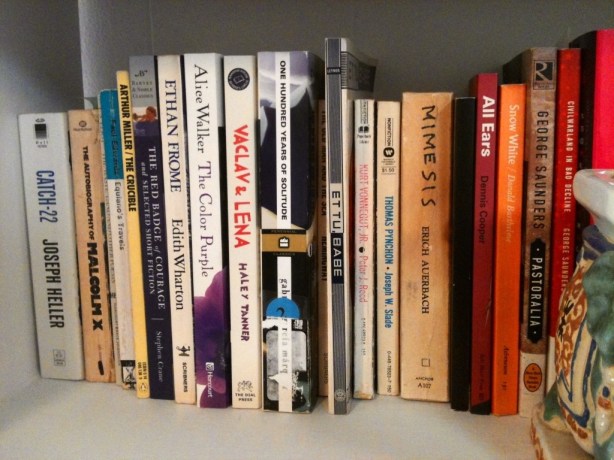
Another double-stacked shelf. This one even has a stack of drifters.

This shelf is at my eye/arm level, and looking at it this way, I see that it gets a lot of shuffling—I can see where I started certain projects for the site.

I can see books that are in line, so to speak, for either proper shelving or for reading.

The mounding stack on the shelf below is a bit out of control, although most of what sits there comes from other places (I kinda sorta wrote about those here).

Below: Unsorted stuff that I’ve been reading of an afternoon:

20121111-111057.jpg

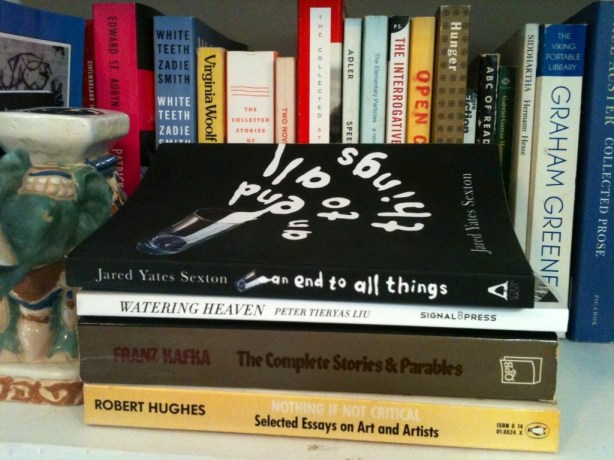
This is the front stack—books that need proper shelving elsewhere, books that I’ve read (and sometimes reviewed here) in the past few months, or meant to read, or in some other way consulted or read from:

20121111-111105.jpg

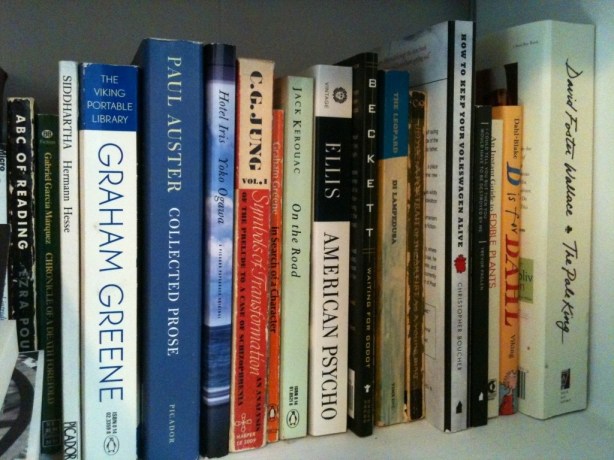
The far right side of the shelf—again, a very mixed bag. I think I originally intended to properly shelf everything here and then got sidetracked:

20121111-111113.jpg

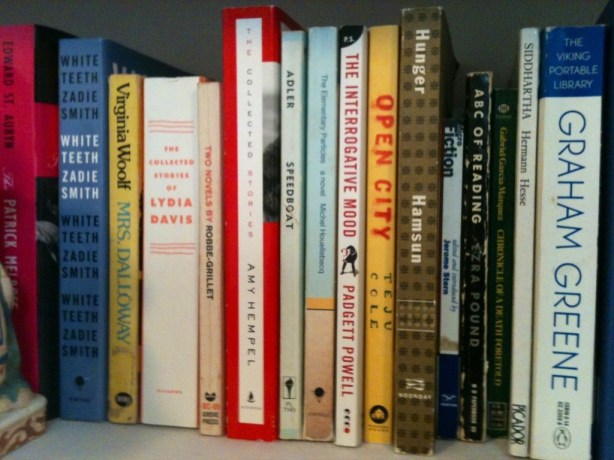
Moving left:

20121111-111124.jpg

And here’s what’s behind the front stack—okay, I can see now the edges of an idea I had for shelving; I also see where I just abandoned that idea:

20121111-111133.jpg

This whole project I blame on an essay by Georges Perec, collected in this one:

20121111-111157.jpg

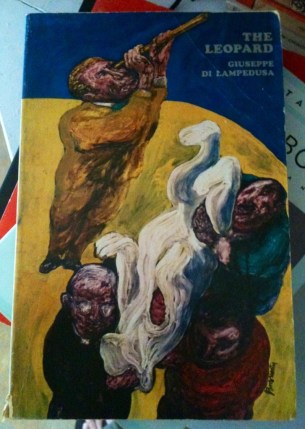
This is one of my favorite book covers:

20121111-111149.jpg

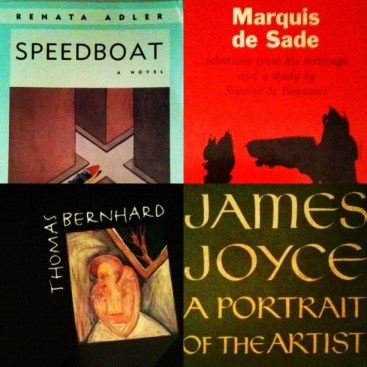
More covers I like from this shelf:

20121111-111204.jpg

Destiny — John William Waterhouse

Still Life with Fruit, Dead Game, Vegetables, a Live Monkey, Squirrel and Cat — Frans Snyders

Why I’m Not Particularly Interested in Reading a DFW Biography

(Think about it — the personal lives of most people who spend 14 hours a day sitting there alone, reading and writing, are not going to be thrill rides to hear about.)

–David Foster Wallace on literary biography in general and Edwin Williamson’s Borges: A Life in particular; from “Borges on the Couch,” a 2004 NYT piece republished this month in the David Foster Wallace collection Both Flesh and Not.

The First Lesson — Carl Larsson

Reading Chris Ware’s Building Stories / Untitled Wordless Loop

20121109-140907.jpg

Continuing this project:

I’ve thus far titled the pieces I’ve been reading of Chris Ware’s Building Stories in a rather ad hoc fashion, but this entry is a wordless affair.

It continues the story of the “lonely girl,” the “cripple” who is the primary narrator of September 23rd, 2000.

Here, we see her raising her daughter in a series of wordless, precise panels that span roughly a decade.

Building Stories’s brilliance derives in large part from its precision and economy—Ware tells a story on every page, a chapter in every small panel:

20121109-140920.jpg

I’m a parent (my daughter is five, my son is two), and so much of this untitled piece struck me as utterly real and authentic—so true in the details.

There’s a moment when our mother looks up to see her daughter reading—silently, to herself—that is bittersweet, a kind of gentle heartbreak:

20121109-140926.jpg

There’s a fine line between the precise evocation of emotion and sentimental schlock, but Ware never comes close to treading it here—he’s always firmly on the side of the real.

And yet this doesn’t come at the expense of evocations of wonder, as we can see in the panels below:

20121109-140934.jpg

As I’ve suggested a few times already, Building Stories is a sort of  Möbius strip; this particular comic nearly literalizes this metaphor.

It begins with our mother drifting from sleep to waking memory, and ends thusly, a strange loop documenting how fast and how slow life changes.

“The Great Bridge Between Modernism and Post-modernism” — David Foster Wallace on Jorge Luis Borges

. . . Borges is arguably the great bridge between modernism and post-modernism in world literature. He is modernist in that his fiction shows a first-rate human mind stripped of all foundations in religious or ideological certainty — a mind turned thus wholly in on itself. His stories are inbent and hermetic, with the oblique terror of a game whose rules are unknown and its stakes everything.

And the mind of those stories is nearly always a mind that lives in and through books. This is because Borges the writer is, fundamentally, a reader. The dense, obscure allusiveness of his fiction is not a tic, or even really a style; and it is no accident that his best stories are often fake essays, or reviews of fictitious books, or have texts at their plots’ centers, or have as protagonists Homer or Dante or Averroes. Whether for seminal artistic reasons or neurotic personal ones or both, Borges collapses reader and writer into a new kind of aesthetic agent, one who makes stories out of stories, one for whom reading is essentially — consciously — a creative act. This is not, however, because Borges is a metafictionist or a cleverly disguised critic. It is because he knows that there’s finally no difference — that murderer and victim, detective and fugitive, performer and audience are the same. Obviously, this has postmodern implications (hence the pontine claim above), but Borges’s is really a mystical insight, and a profound one. It’s also frightening, since the line between monism and solipsism is thin and porous, more to do with spirit than with mind per se. And, as an artistic program, this kind of collapse/transcendence of individual identity is also paradoxical, requiring a grotesque self-obsession combined with an almost total effacement of self and personality. Tics and obsessions aside, what makes a Borges story Borgesian is the odd, ineluctable sense you get that no one and everyone did it.

—From “Borges on the Couch,” a 2004 NYT piece republished this month in the David Foster Wallace collection Both Flesh and Not.


The Connoisseur — Norman Rockwell

“Lipostudio . . . And So On” — Matmos