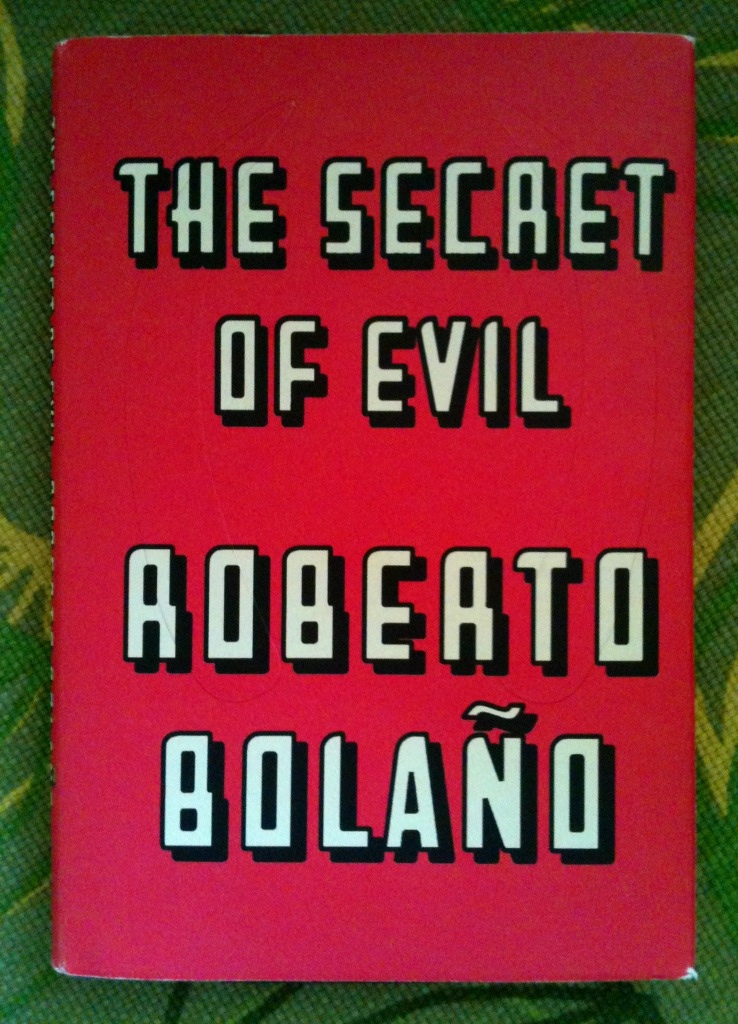
Roberto Bolaño’s The Secret of Evil (Book Acquired, 4.09.2012)

20120414-140951.jpg

How you react to a “new” book by Roberto Bolaño at this point is probably dependent on how much you love or loathe his work—although I imagine those indifferent to or unfamiliar with his writing might be unduly put off by this point at the volume of material that this writer drops posthumously [insert Tupac joke here].

I’m a fan though, so I’m excited about The Secret of Evil, even if the material collected here is in part unfinished . . . although, as Ignacio Echevarria points out in his introduction, all of Bolaño’s “narratives, not just The Secret of Evil, seem to be governed by a poetics of inconclusiveness.” A few of the pieces in Evil have already been excerpted, and I read a few this weekend (who can resist a Bolaño text called “Crimes”?), and while some pieces here are sketchier than others, there’s that preponderance of life force that we expect from late period Bolaño, from a man who seemed to pour what was left of himself into his words and sentences.

From publisher New Directions’ website:

Opening this book is like being granted access to the Chilean master’s personal files. Included in this one-of-a-kind collection is everything Roberto Bolaño was working on just before his death in 2003, and everything that he wanted to share with his readers. Fans of his writing will find familiar characters in new settings, and entirely new stories and styles, too.

A North American journalist in Paris is woken at 4 a.m. by a mysterious caller with urgent information. Daniela de Montecristo (familiar to readers of Nazi Literature in the Americas and 2666) recounts the loss of her virginity. Arturo Belano returns to Mexico City and meets the last disciples of Ulises Lima, who play in a band called The Asshole of Morelos. Belano’s son Gerónimo disappears in Berlin during the Days of Chaos in 2005. Memories of a return to the native land; Argentine writers as gangsters; zombie schlock as allegory…and much more.

Crews, Gaddis, Lish, Mutis (Books Acquired Late Last Week)

20120410-204343.jpg

I picked up Harry Crews’s novel The Knockout Artist, which I hadn’t read, after his recent death. I was not the only person to pick up Crews books: the Crews section of my favorite used bookstore, once swollen is now depleted (the omnibus and collections all snapped up).

William Gaddis’s last novel Agapē Agape was my occasion (as if I needed one) for visiting said store; I ordered it after finishing The Recognitions. I managed to bend the cover badly in the first five minutes of ownership. I started it over the weekend and then got distracted by a friend calling me to meet at a bar. I started it again last night and got about a third of the way in. Full review on the horizon.

I have no idea why I picked up Lish’s novel other than the fact that Lish is awesome; it’s a first edition paperback and the cover is awesome. Maybe that’s why. I have no idea when I’ll get around to reading it. Compulsive behaviors.

The Mutis novel, or collection of novellas, is half of the book that Dave Cianci aka Noquar reviewed on this blog  a few months ago. I wanted the full version, which collects six novellas, but I’ll settle for this (it’s used; I have store credit, etc.). Anyway, Noquar’s review made me want to read it, so I’ve slated it for summer reading (May?).

I Burn Paris (Book Acquired, Some Time Last Week, Or Maybe Late the Week Before)

20120403-153842.jpg

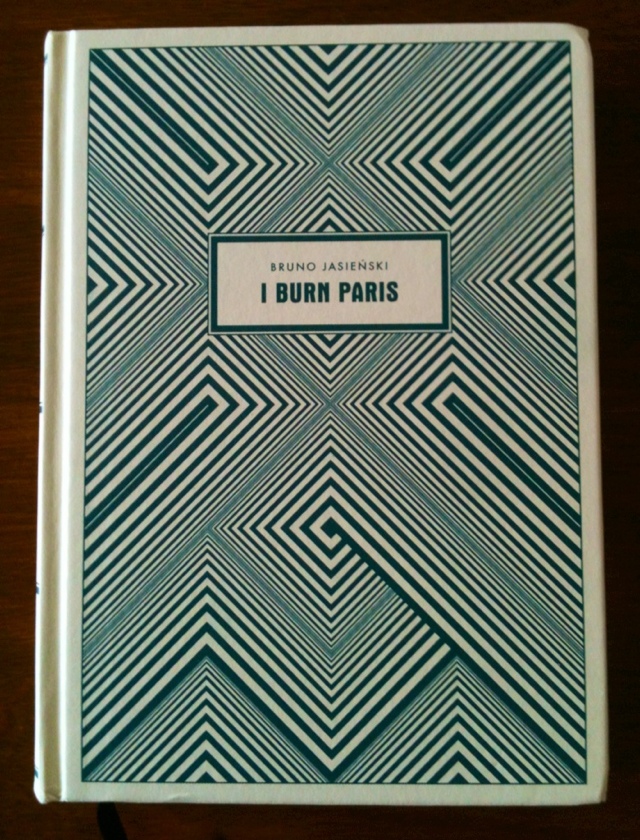
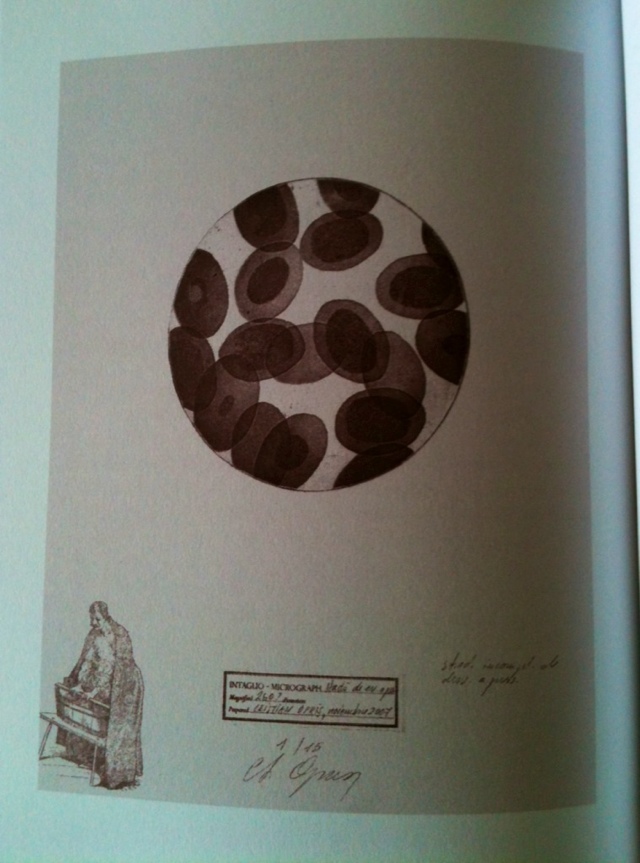
Bruno Jasieński was one of the leaders of the Polish Futurist movement, and his novel I Burn Paris looks fascinating. It’s also a beautiful looking book — publisher Twisted Spoon has done a lovely job here — an embossed hardback with no superfluous jacket, and even a nice lace bookmark (doesn’t show up in my photo). There are also illustrations by Cristian Opris.

20120403-153853.jpg

I’m hoping to get into this this weekend, but for now, here’s publisher Twisted Spoon’s description:

I Burn Paris has remained one of Poland’s most uncomfortable masterstrokes of literature since its initial and controversial serialization by Henri Barbusse in 1928 inL’Humanité (for which Jasienski was deported for disseminating subversive literature). It tells the story of a disgruntled factory worker who, finding himself on the streets, takes the opportunity to poison Paris’s water supply. With the deaths piling up, we encounter Chinese communists, rabbis, disillusioned scientists, embittered Russian émigrés, French communards and royalists, American millionaires and a host of others as the city sections off into ethnic enclaves and everyone plots their route of escape. At the heart of the cosmopolitan city is a deep-rooted xenophobia and hatred — the one thread that binds all these groups together. As Paris is brought to ruin, Jasienski issues a rallying cry to the downtrodden of the world, mixing strains of “The Internationale” with a broadcast of popular music.

With its montage strategies reminiscent of early avant-garde cinema and fist-to-the-gut metaphors, I Burn Parishas lost none of its vitality and vigor. Ruthlessly dissecting various utopian fantasies, Jasienski is out to disorient, and he has a seemingly limitless ability to transform the Parisian landscape into the product of disease-addled minds. An exquisite example of literary Futurism and Catastrophism, the novel presents a filthy, degenerated world where factories and machines have replaced the human and economic relationships have turned just about everyone into a prostitute. Yet rather than cliché and simplistic propaganda, there is an immediacy to the writing, and the modern metropolis is starkly depicted as only superficially cosmopolitan, as hostile and animalistic at its core.

This English translation of I Burn Paris fills a major gap in the availability of works from the interwar Polish avant-garde, an artistic phenomenon receiving growing attention with recent publications such as Caviar and Ashes.

Books Acquired, 3.19.2012 — Or, Here’s What’s New From Picador

20120403-153037.jpg

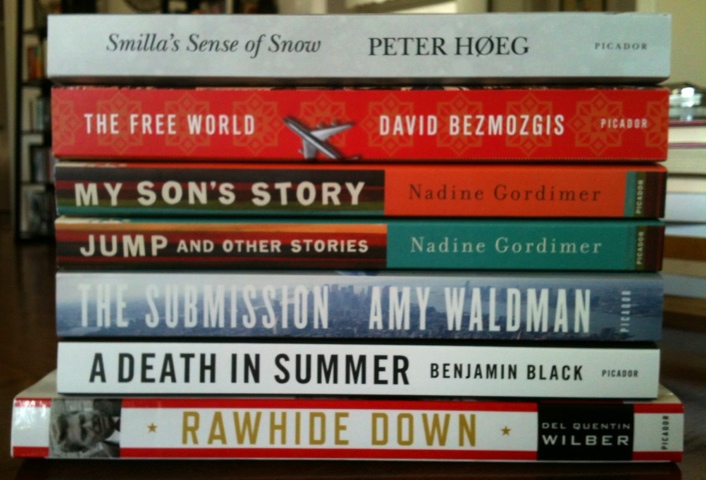
New and newish titles from the good people at Picador. A few highlights:

20120403-153044.jpg

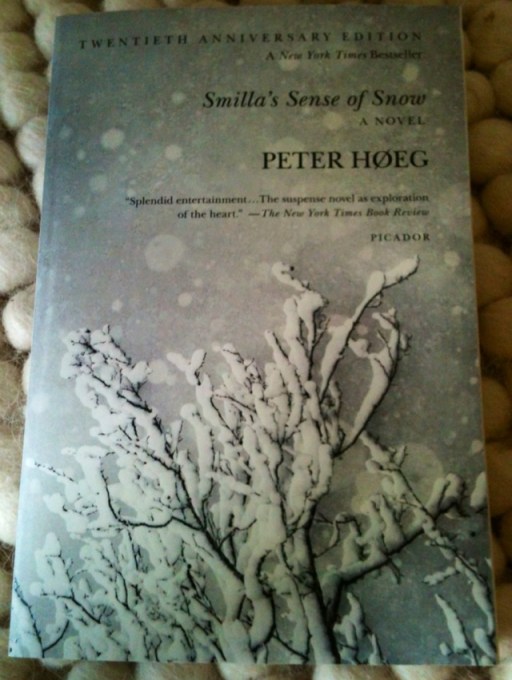
I read Peter Hoeg’s bestseller Smilla’s Sense of Snow over a decade ago; I recall reading it in a day or two, maybe as part of a long bus ride somewhere, and enjoying caustic Smilla’s murder investigation. It’s 20 years old now and getting the rerelease treatment. From Robert Nathan’s original 1993 review at The New York Times:

TRY this for an offer you could easily refuse. How would you like to be locked in a room for a couple of days with an irritable, depressed malcontent who also happens to be imperiously smart, bored and more than a little spoiled? Say no, and you will miss not only a splendid entertainment but also an odd and seductive meditation on the human condition. With “Smilla’s Sense of Snow,” his American debut following two previous books, the Danish novelist Peter Hoeg finds his own uncommon vein in narrative territory worked by writers as varied as Martin Cruz Smith and Graham Greene — the suspense novel as exploration of the heart. Mr. Hoeg’s heroine, Smilla Jaspersen, is the daughter of an Eskimo mother who was a nomadic native of Greenland and a wealthy Danish anesthesiologist father, parentage that endows her with the resilience of the frozen north and urban civilization’s existential malaise. One day just before Christmas, Smilla arrives at her Copenhagen apartment building to find a neighbor boy, 6-year-old Isaiah Christiansen, sprawled face down in the snow, dead after a fall from the roof of a nearby warehouse.

20120403-153052.jpg

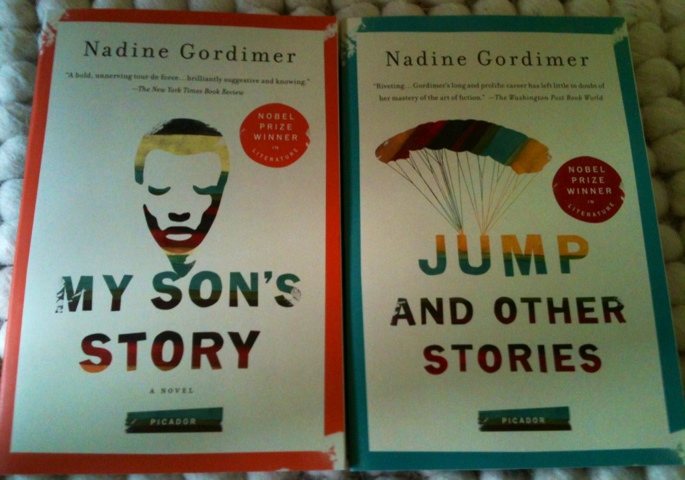
Love love love the covers for these pair by Nadine Gordimer—nice design work. I haven’t read Gordimer’s stuff — she’s a South African writer who won the Nobel in 1991 — so Jump and Other Stories seems like a good starting place. Here’s James Wood on Gordimer:

Gordimer’s talent is poetic and intellectual…Her best writing, sensuous, but aerated with deep intelligence, moving shrewdly between the serene claims of the poetic and the frantic compulsions of the political, makes her the lyrical analyst of an entire country

20120403-153103.jpg

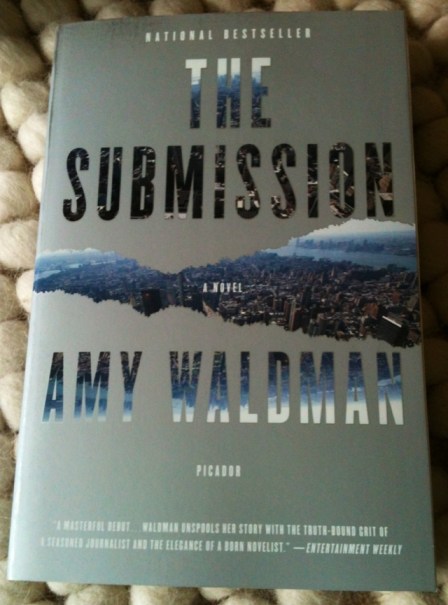
Amy Waldman’s The Submission is a 9/11 novel. Here’s Michiko Kakutani gushing in The New York Times:

A decade after 9/11, Amy Waldman’s nervy and absorbing new novel, “The Submission,” tackles the aftermath of such a terrorist attack head-on. The result reads as if the author had embraced Tom Wolfe’s famous call for a new social realism — for fiction writers to use their reporting skills to depict “this wild, bizarre, unpredictable, Hog-stomping baroque country of ours” — and in doing so, has come up with a story that has more verisimilitude, more political resonance and way more heart than Mr. Wolfe’s own 1987 best seller, “The Bonfire of the Vanities.”

20120403-153120.jpg

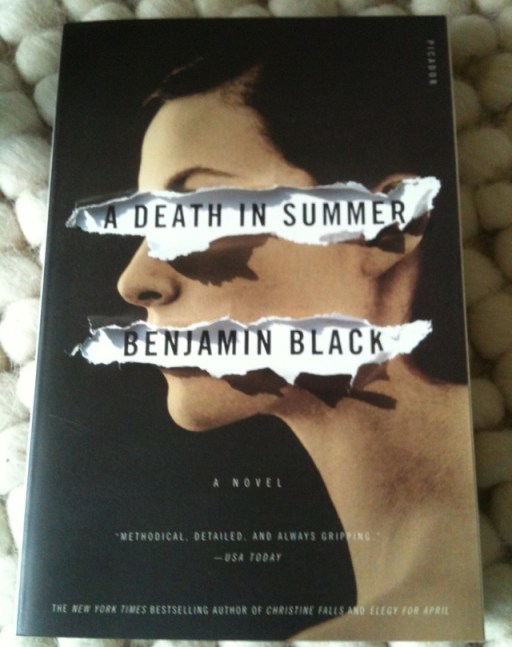
A Death in the Summer is new in trade paperback. It’s another in the Quirke crime series from Benjamin Black — pen name of writer John Banville. Jacket copy:

On a sweltering summer afternoon, newspaper tycoon Richard Jewell—known to his many enemies as Diamond Dick—is discovered with his head blown off by a shotgun blast. But is it suicide or murder? For help with the investigation, Detective Inspector Hackett calls in his old friend Quirke, who has unusual access to Dublin’s elite.

Jewell’s coolly elegant French wife, Françoise, seems less than shocked by her husband’s death. But Dannie, Jewell’s high-strung sister, is devastated, and Quirke is surprised to learn that in her grief she has turned to an unexpected friend: David Sinclair, Quirke’s ambitious assistant in the pathology lab at the Hospital of the Holy Family. Further, Sinclair has been seeing Quirke’s fractious daughter Phoebe, and an unlikely romance is blossoming between the two. As a record heat wave envelops the city and the secret deals underpinning Diamond Dick’s empire begin to be revealed, Quirke and Hackett find themselves caught up in a dark web of intrigue and violence that threatens to end in disaster.

Tightly plotted and gorgeously written, A Death in Summer proves to the brilliant but sometimes reckless Quirke that in a city where old money and the right bloodlines rule, he is by no means safe from mortal danger.

20120403-153135.jpg

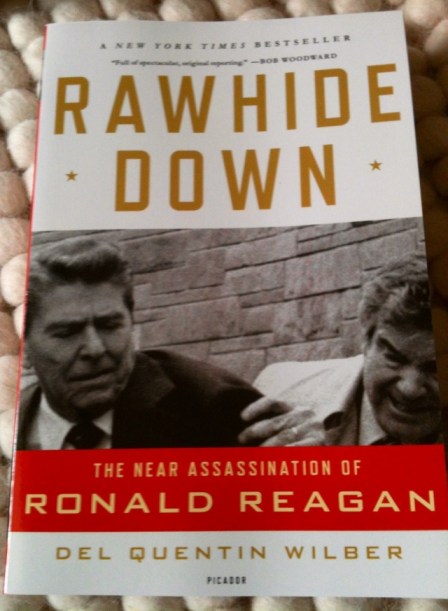
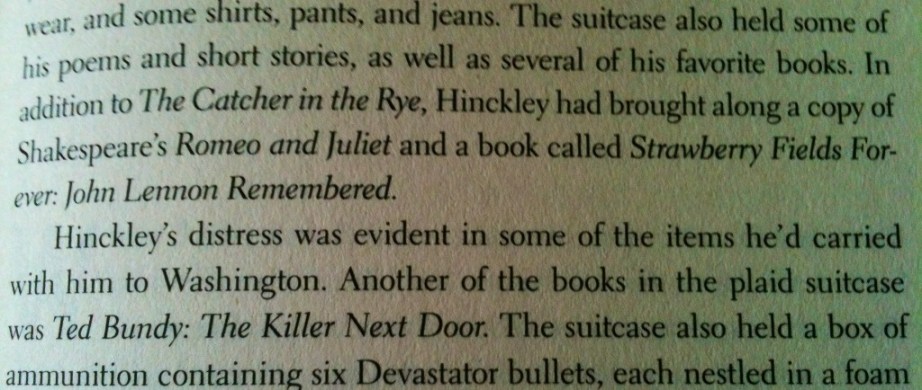
Del Quentin Wilber’s Rawhide Down: The Near Assassination of Ronald Reagan demanded more of my attention than I thought it would. It’s tightly paced book, telegraphed in sharp language—but most of all, the story of John Hinckley is just too bizarre. Here’s a sample of the would

20120403-153153.jpg

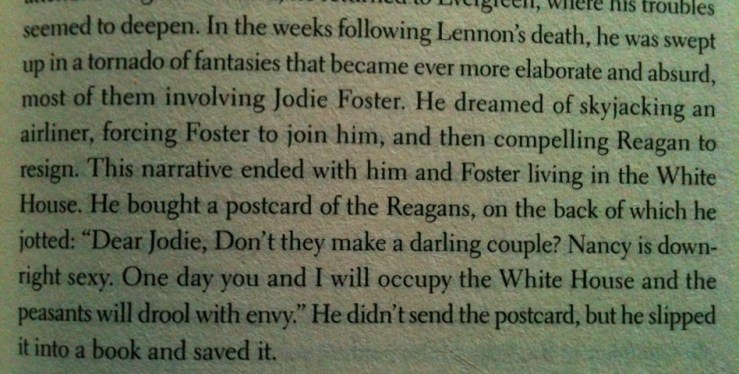
And if that’s not weird enough for you, check out Hinckley’s fantasy life:

20120403-153208.jpg

Pynchon/Vonnegut (Books Acquired, 3.28.2012)

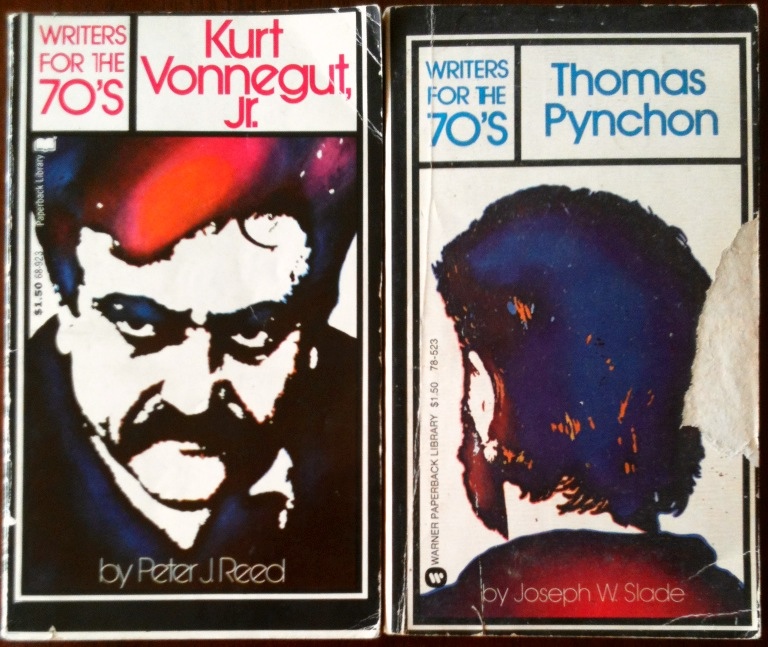
20120330-194551.jpg

Saw these in my favorite used book shop and had to have them. Shabby copies of contemporary criticisms (i.e., old criticism) of Pynchon and Vonnegut. Love the covers.


Book Acquired, 3.26.2012 (The Limpopo Academy of Private Detection)

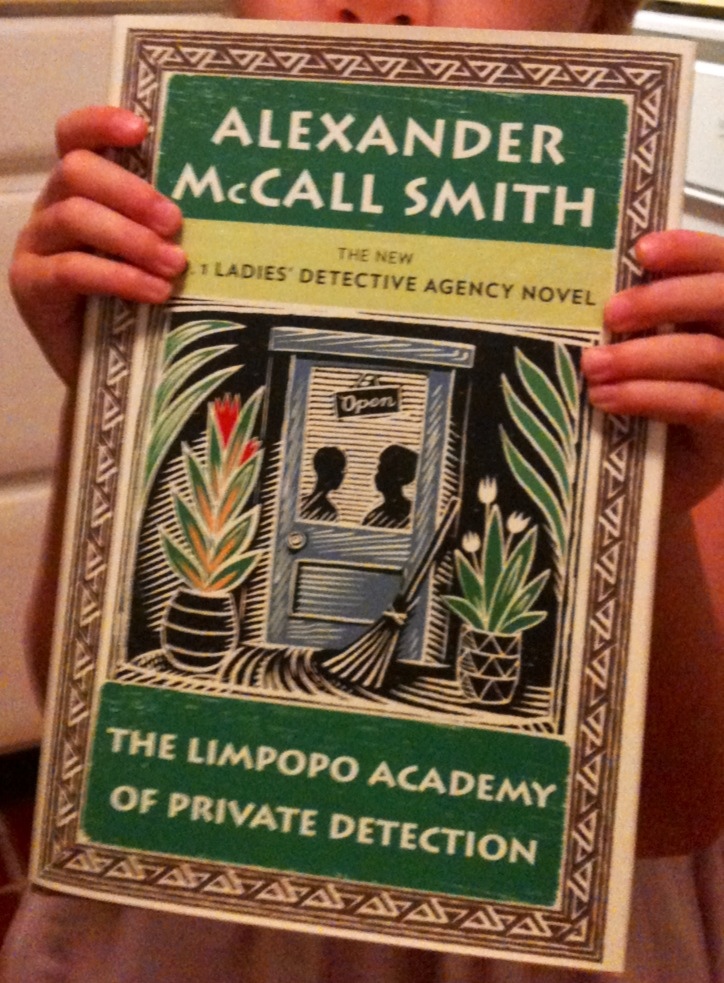
20120328-204340.jpg

I’ve never read any of Alexander McCall Smith’s No.1 Ladies’ Detective Agency books, or any of his books, but I like the cover of this new one, which is called The Limpopo Academy of Private Detection. I was photographing it clumsily with my old iPhone when my daughter decided to get in the pics and help me out. So, thanks honey.

Jacket copy from publisher Random House:

Precious Ramotswe is haunted by a repeated dream: a vision of a tall, strange man who waits for her beneath an acacia tree. Odd as this is, she’s far too busy to worry about it. The best apprentice at Tlokweng Road Speedy Motors is in trouble with the law and stuck with the worst lawyer in Gaborone. Grace Makutsi and Phuti Radiphuti are building the house of their dreams, but their builder is not completely on the up and up. And, most shockingly, Mma Potokwane, defender of Botswana’s weak and downtrodden, has been dismissed from her post as matron at the orphan farm. Can the No. 1 Ladies’ Detective Agency help restore the beloved matron to her rightful position?

As wealthy and powerful influences at the orphan farm become allied against their friend, help arrives from an unexpected visitor: the tall stranger from Mma Ramotswe’s dreams, who turns out to be none other than the estimable Clovis Andersen, author of the No. 1 Ladies’ prized manual, The Principles of Private Detection.Together, Mma Ramotswe, Mma Makutsi, and their teacher-turned-colleague help right this injustice and in the process discover something new about being a good detective.

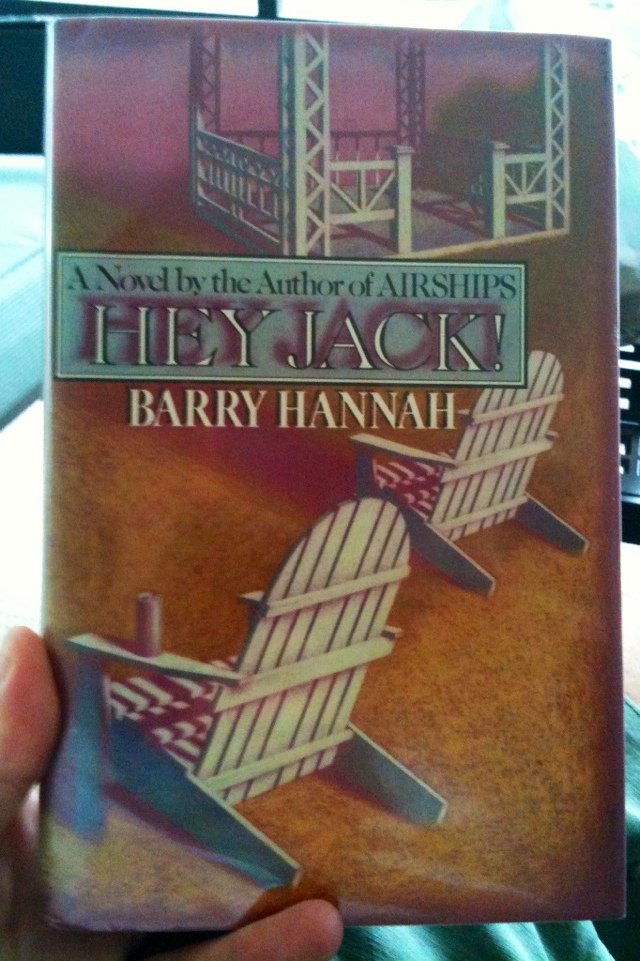
Barry Hannah’s Hey Jack! (Book Acquired, 3.23.2012; Or, Gee, Isn’t It Kinda Sad That This Ex-Library Book Was Checked Out Only Twice in 24 Years?)

20120324-143113.jpg

I bought Barry Hannah’s seventh book Hey Jack! over the internet after my favorite local bookstore told me it would be difficult or expensive for them to order. I bought a first edition hardback brokered by Amazon. It was an ex-library copy. It looks like no one ever read it, and it seems to have been checked out only twice in twenty-four years. A sad business.

I put some wear and tear on it today, reading it outside on my porch during a thunderstorm, using it as a beer coaster at one point, and then taking it into a salted bath where it got damp and curly. I read half of it. Hannah’s novel-in-vignettes is still ahead of its time. Who writes better sentences? (“Christ, the South has been pickled in the juice of its own image”).

20120324-143122.jpg

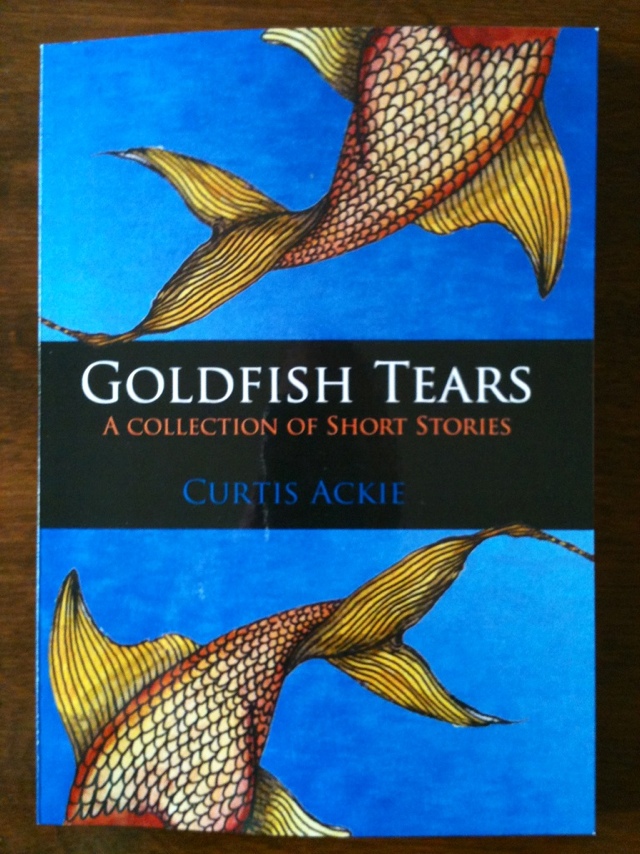
Goldfish Tears (Book Acquired, 3.16.2012)

20120317-170959.jpg

Goldfish Tears by Curtis Ackie: A good looking collection of shorts. Here’s the descriptor:

A perturbed bachelor is beleaguered by his misbehaving shadow; a reclusive alchemist builds a machine to right his wife’s disfigurement; the sun forgets to rise over a sleepy town in the middle of nowhere. Equal parts haunting and outlandish, Goldfish Tears is an enchanting collection of short stories by Curtis Ackie, a young British-born author concerned with the magic of dreams as escapism.

(More).

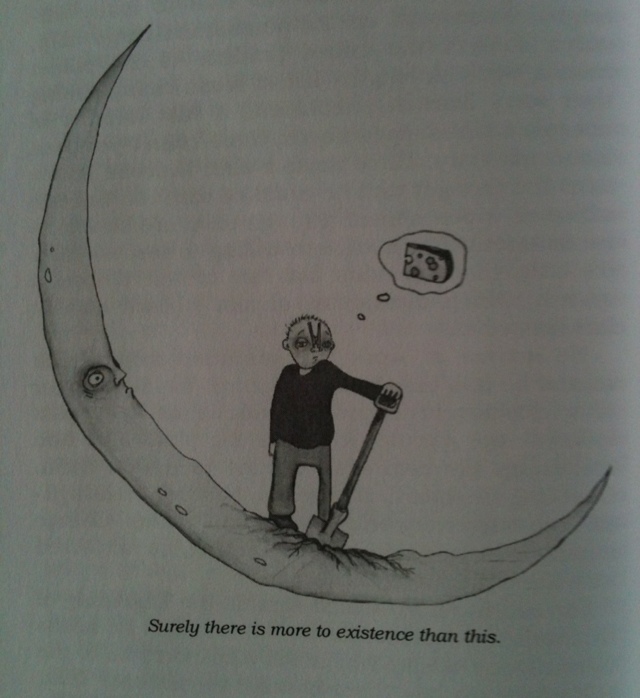
The book is full of charming illustrations that evoke whimsy and dread:

20120317-171007.jpg

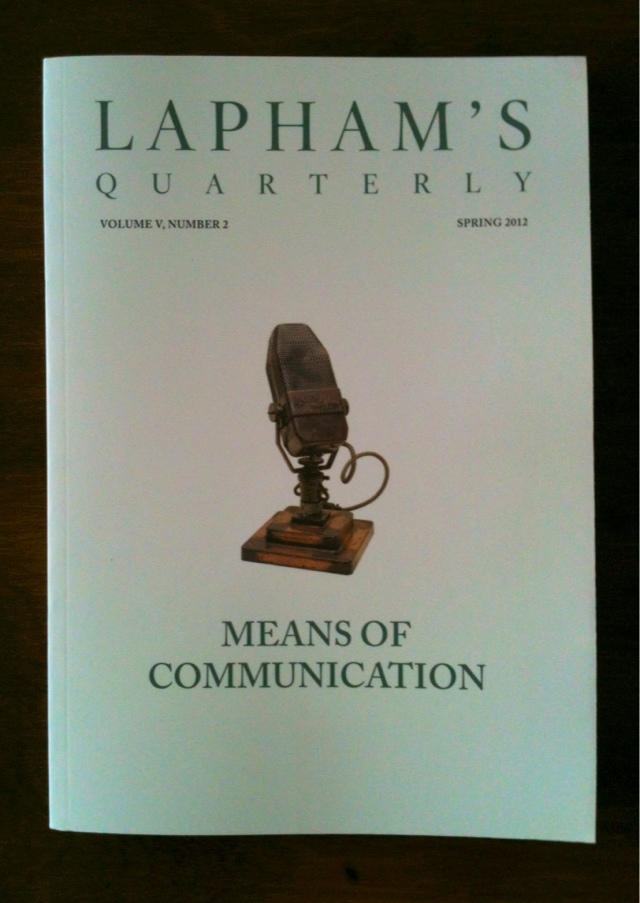
Book Acquired, 3.14.2012 (Lapham’s Quarterly, Spring 2012)

20120317-165618.jpg

20120317-165625.jpg

(Yes, I am enjoying my subscription).

A Partial History of Lost Causes (Book Acquired, 3.06.2012)

20120310-194214.jpg

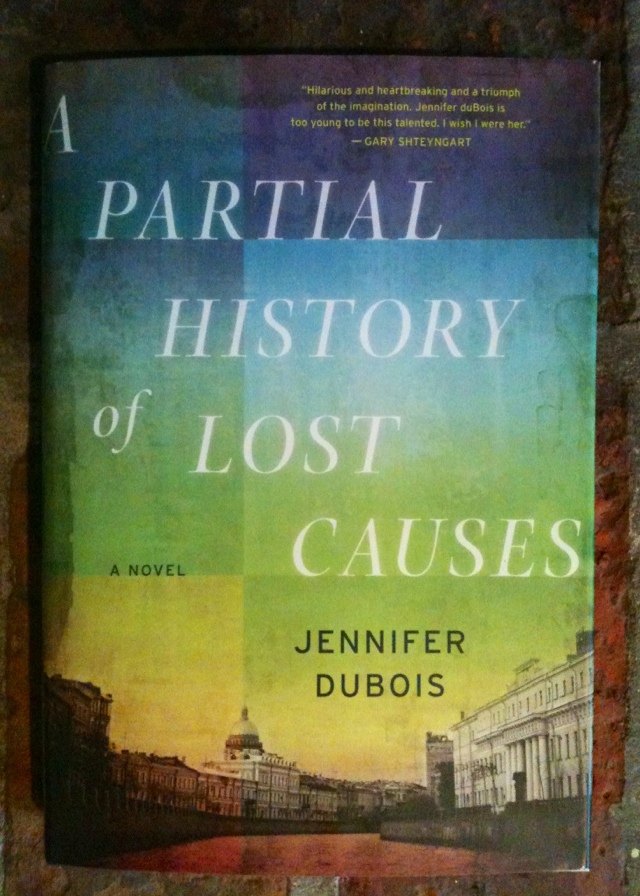
A Partial History of Lost Causes by Jennifer DuBois. Publisher Random House’s copy:

In Jennifer duBois’s mesmerizing and exquisitely rendered debut novel, a long-lost letter links two disparate characters, each searching for meaning against seemingly insurmountable odds.

In St. Petersburg, Russia, world chess champion Aleksandr Bezetov begins a quixotic quest. With his renowned Cold War–era tournaments behind him, Aleksandr has turned to politics, launching a dissident presidential campaign against Vladimir Putin. He knows he will not win—and that he is risking his life in the process—but a deeper conviction propels him forward. And in the same way that he cannot abandon his aims, he cannot erase the memory of a mysterious woman he loved in his youth.

In Cambridge, Massachusetts, thirty-year-old English lecturer Irina Ellison is on an improbable quest of her own. Certain she has inherited Huntington’s disease—the same cruel illness that ended her father’s life—she struggles with a sense of purpose. When Irina finds an old, photocopied letter her father had written to the young Aleksandr Bezetov, she makes a fateful decision. Her father had asked the Soviet chess prodigy a profound question—How does one proceed against a lost cause?—but never received an adequate reply. Leaving everything behind, Irina travels to Russia to find Bezetov and get an answer for her father, and for herself.

Spanning two continents and the dramatic sweep of history, A Partial History of Lost Causes reveals the stubbornness and splendor of the human will even in the most trying times. With uncommon perception and wit, Jennifer duBois explores the power of memory, the depths of human courage, and the endurance of love.

When General Grant Expelled the Jews (Book Acquired, 3.06.2012)

20120309-183304.jpg

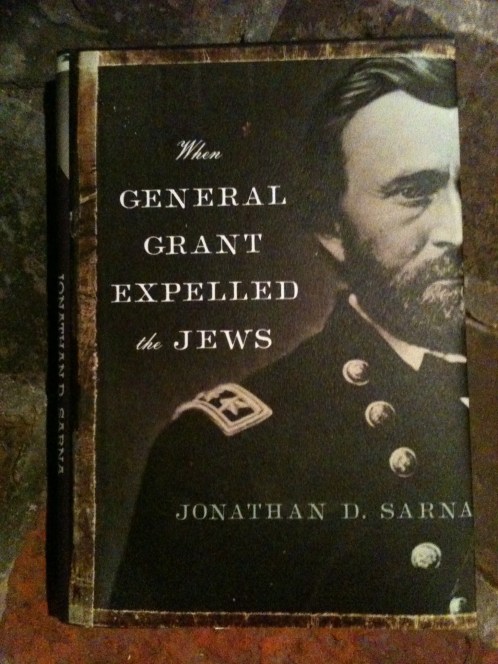
When General Grant Expelled the Jews is new from historian Jonathan D. Sarna (and Shocken books). From Harold Holzer’s review at The Washington Post:

. . . no historian has been able to fully understand — much less justify — why, on Dec. 17, 1862, Grant issued his notorious General Orders No. 11 deporting Jewish citizens. “The Jews, as a class violating every regulation of trade,” went the chilling text, “. . . are hereby expelled from [his command in the West] within twenty-four hours.” Those returning would be “held in confinement until an opportunity occurs of sending them out as prisoners.” Just two weeks before Abraham Lincoln was scheduled to extend freedom to one minority group with the Emancipation Proclamation, his most promising general thus initiated a virtual pogrom against another.

In the end, as the gifted and resourceful historian Jonathan D. Sarna points out in this compelling page-turner, General Orders No. 11 uprooted fewer than 100 Jews. But for a few weeks, he suggests, it terrorized and infuriated the Union’s entire Jewish population. It also inspired one of the community’s first effective lobbying campaigns. Jewish newspapers compared Grant to Haman, the infamous vizier of Persia in the Book of Esther. A delegation of Jewish leaders traveled to the White House to protest directly to the president, who quickly but quietly had the order revoked, eager to right a wrong but reluctant to humiliate a valuable military commander. As Lincoln carefully put it, “I do not like to hear a class or nationality condemned on account of a few sinners.” He never mentioned the episode publicly.

Books Acquired, 2.16.2012 — Or, Here’s What’s New from Picador This Month

20120228-173327.jpg

The kind folks at Picador sent a nice box of titles to Biblioklept World Headquarters a few weeks ago; I’ve had enough time to mull over them a bit and do something of a write-up. Here goes.

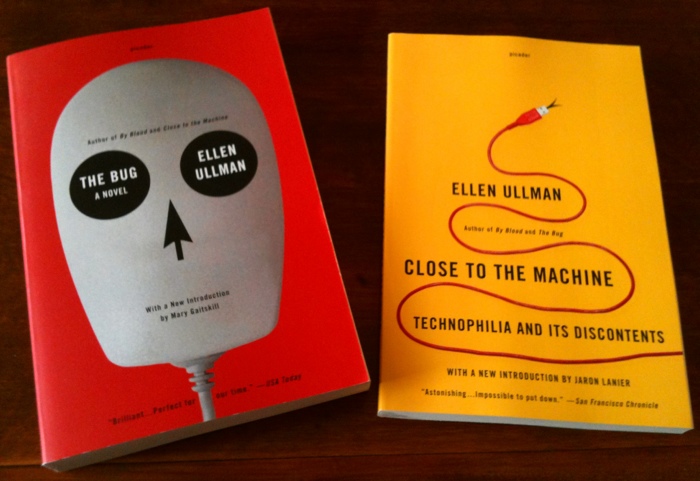
Next month, coinciding with her new novel By Blood (from FS&G), Picador re-releases (in new editions) two from Ellen Ullman:Close to the Machine and The Bug, which features a new introduction by Mary Gaitskill. Machine is a sort-of-memoir about the dawn of the tech-era; Ullman recounts her experiences as a female software engineer finding a place in the boys’ club of programming. Love these covers:
20120228-173409.jpg

The Bug, a novel is tech without the noir, cyber without the punk—something different and fresh. It reminds me of Douglas Coupland’s Microserfs only because I can’t think of what else to compare it to. Pub’s write-up:

Ellen Ullman is a “rarity, a computer programmer with a poet’s feeling for language” (Laura Miller, Salon). The Bug breaks new ground in literary fiction, offering us a deep look into the internal lives of people in the technical world. Set in a start-up company in 1984, this highly acclaimed first novel explores what happens when a baffling software flaw—a bug so teasing it is named “the Jester”—threatens the survival of the humans beings who created it.

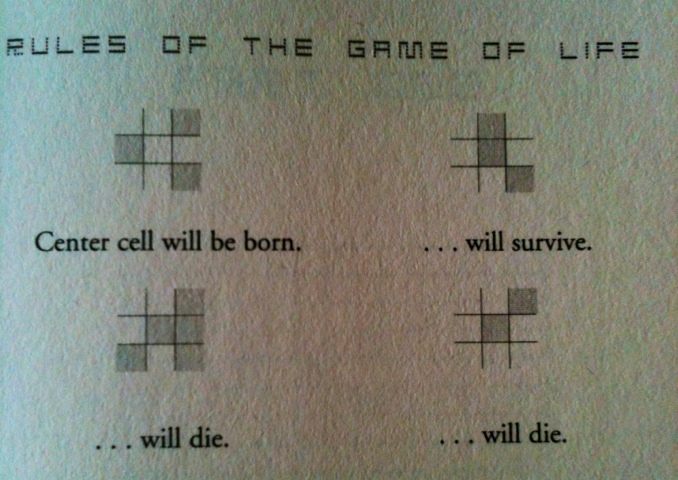
The Bug features a playfulness of the page, a willingness to examine the intersection of code and poetry. Example:
20120228-173416.jpg

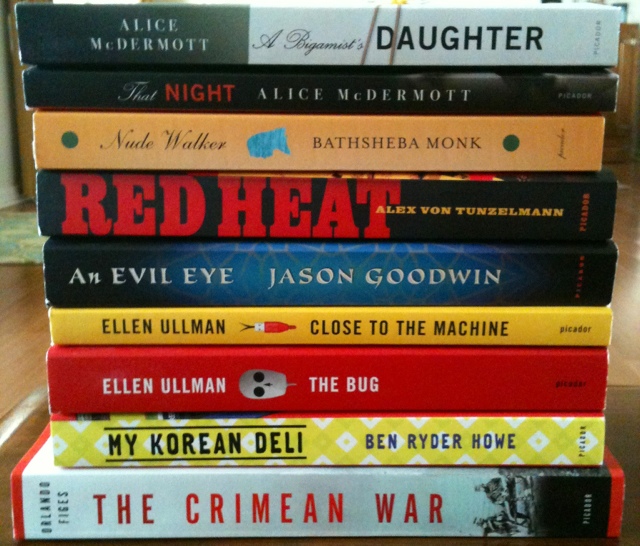
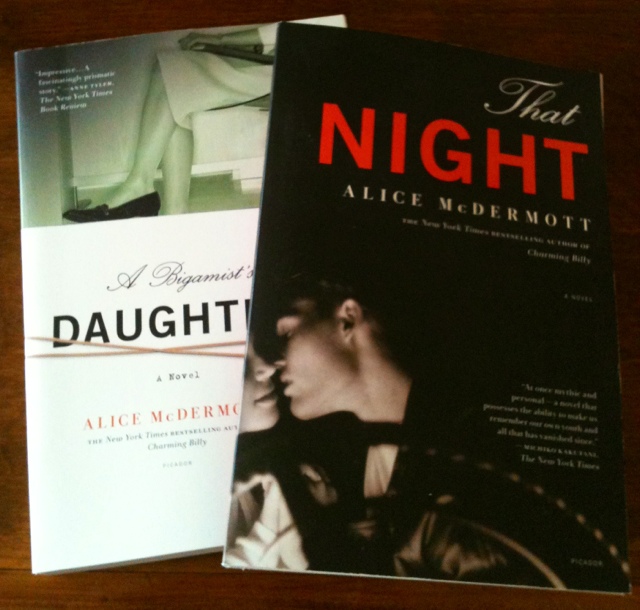
Alice McDermott also gets reissues: A Bigamist’s Daughter and That Night, which my wife picked up. That Night was a finalist for the Pulitzer and the National Book Award. It seems a little sexy and dangerous. Again, pub’s blurb:

It is high summer, the early 1960s. Sheryl and Rick, two Long Island teenagers, share an intense, all-consuming love. But Sheryl’s widowed mother steps between them, and one moonlit night Rick and a gang of hoodlums descend upon her quiet neighborhood. That night, driven by Rick’s determination to reclaim Sheryl, the young men provoke a violent confrontation, and as fathers step forward to protect their turf, notions of innocence belonging to both sides of the brawl are fractured forever. Alice McDermott’s That Night is “a moving and captivating novel, both celebration and elegy…a rare and memorable work” (The Cleveland Plain Dealer).
20120228-173424.jpg

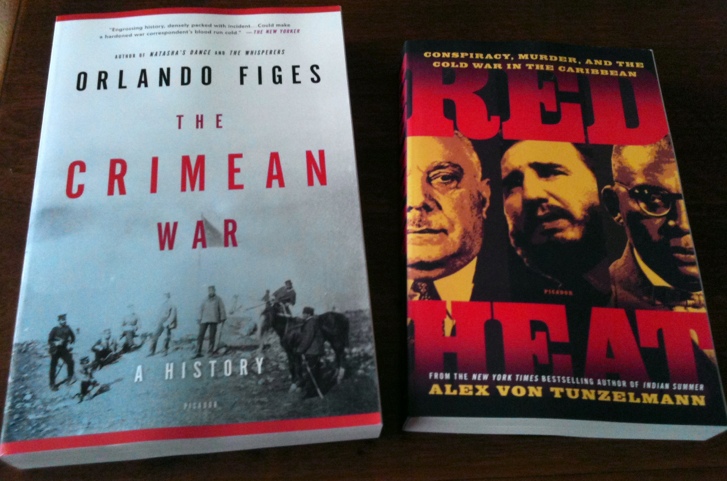
Two history books in the package: Orlando Figes’s The Crimean War and Red Heat by Alex von Tunzelmann.
20120228-173435.jpg

Here’s an excerpt from the Figes book (which is, uh, about the Crimean War):

Two world wars have obscured the huge scale and enormous human cost of the Crimean War. Today it seems to us a relatively minor war; it is almost forgotten, like the plaques and gravestones in those churchyards. Even in the countries that took part in it (Russia, Britain, France, Piedmont-Sardinia in Italy and the Ottoman Empire, including those territories that would later make up Romania and Bulgaria) there are not many people today who could say what the Crimean War was all about. But for our ancestors before the First World War the Crimea was the major conflict of the nineteenth century, the most important war of their lifetimes, just as the world wars of the twentieth century are the dominant historical landmarks of our lives.

Red Heat is not the novelization of the 1988 Schwarzenegger buddy-cop film (nor, sadly, a novelization of the 1985 Linda Blair women-in-prison film of the same name). Von Tunzelmann’s book examines the relationship between the island nations to the U.S.’s immediate south to America and Russia. Like I said, no Schwarzenegger, but plenty of strong men. From Jad Adam’s review in The Guardian:

Red Heat deftly juggles the stories of three countries – Cuba, Haiti and the Dominican Republic – and their relationship with the superpowers, where things were not as they seemed. Von Tunzelmann asserts that the political labels of the region were a sham: “democracy” was dictatorship; leaders veered to the rhetoric of the right or left according to advantage; a communist was anyone, however rightwing or nationalistic, whom the ruling regime wanted tarnished in the eyes of the US

Gaddis, Wallace, McCarthy, Cooper (Books Acquired, 3.02.3012)

20120302-173432.jpg

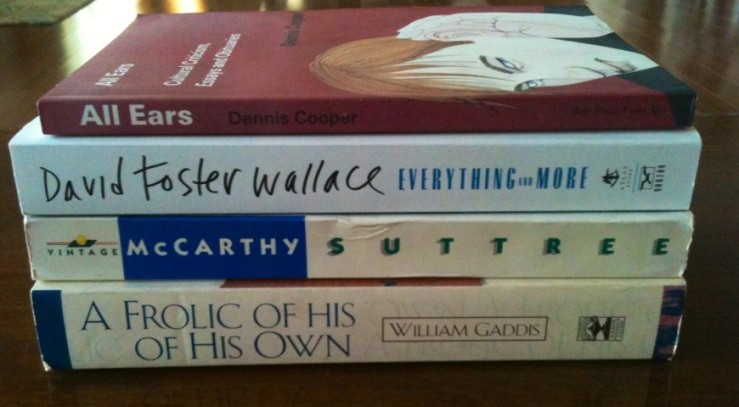
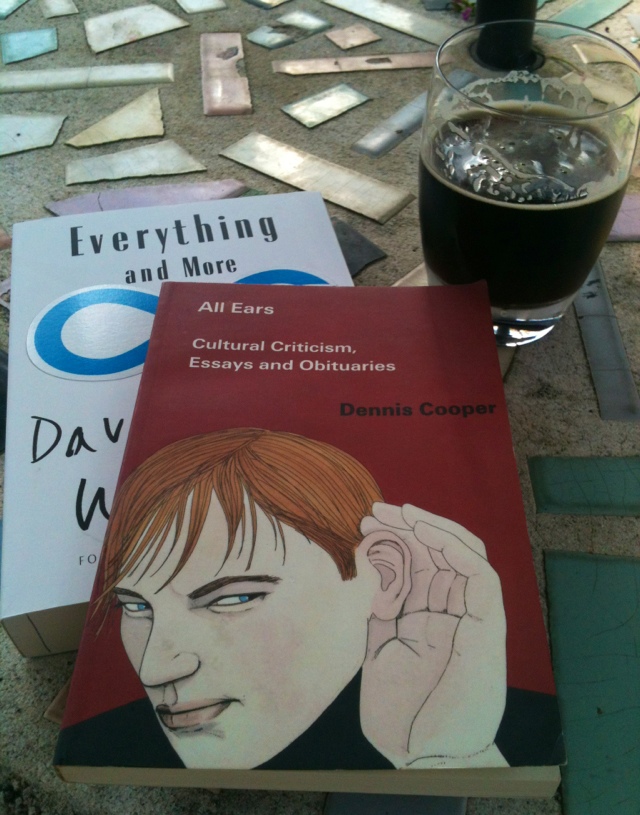
Picked up these four yesterday afternoon during my weekly visit to the bookshop (can’t help said visit; I live too close). Spent the afternoon reading Neal Stephenson’s introduction to David Foster Wallace’s Everything and More and a few of the pieces in All Ears, a collection of essays and interviews by Dennis Cooper. I read the interviews with Stephen Malkmus and Leonardo diCaprio. There’s something so nineties about the book.

20120302-173439.jpg

A nice afternoon of reading with a few homebrews.

Everything and More, DFW’s history of infinity, is one of the only books I haven’t read by him (I even got to read a big chunk of his rare early work Signifying Rappers years ago because a friend found it in a library book sale). Anyway, to the point: None of the DFW editions I owned, up to this point were posthumous (they were, uh humous (?))—so it was a little weird to see this on the back of the book:

20120302-173455.jpg

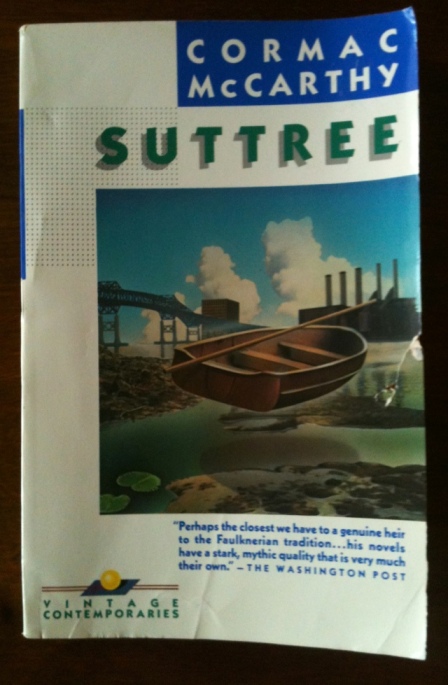
Finally: No, I didn’t need another copy of Cormac McCarthy’s Suttree (let me plug my review), but I’m a huge fan of these awful 1980s Vintage Contemporaries editions, so when I found a first ed. of Suttree, I couldn’t pass it up (I’m pretty sure this is the same edition DFW owned):

20120302-173509.jpg

Books Acquired, 2.28.2012

20120228-175055.jpg

Books acquired, 2.28.2012. All forthcoming from Pantheon, all hardback:

The Undead by Dick Teresi is a book about organ harvesting that claims to be funny. Publisher’s description:

Important and provocative, The Undead examines why even with the tools of advanced technology, what we think of as life and death, consciousness and nonconsciousness, is not exactly clear and how this problem has been further complicated by the business of organ harvesting.

Dick Teresi, a science writer with a dark sense of humor, manages to make this story entertaining, informative, and accessible as he shows how death determination has become more complicated than ever. Teresi introduces us to brain-death experts, hospice workers, undertakers, coma specialists and those who have recovered from coma, organ transplant surgeons and organ procurers, anesthesiologists who study pain in legally dead patients, doctors who have saved living patients from organ harvests, nurses who care for beating-heart cadavers, ICU doctors who feel subtly pressured to declare patients dead rather than save them, and many others. Much of what they have to say is shocking. Teresi also provides a brief history of how death has been determined from the times of the ancient Egyptians and the Incas through the twenty-first century. And he draws on the writings and theories of celebrated scientists, doctors, and researchers—Jacques-Bénigne Winslow, Sherwin Nuland, Harvey Cushing, and Lynn Margulis, among others—to reveal how theories about dying and death have changed. With The Undead, Teresi makes us think twice about how the medical community decides when someone is dead.

Jonathan Haidt’s The Righteous Mind. Publisher’s description:

Why can’t our political leaders work together as threats loom and problems mount? Why do people so readily assume the worst about the motives of their fellow citizens? In The Righteous Mind, social psychologist Jonathan Haidt explores the origins of our divisions and points the way forward to mutual understanding.

His starting point is moral intuition—the nearly instantaneous perceptions we all have about other people and the things they do. These intuitions feel like self-evident truths, making us righteously certain that those who see things differently are wrong. Haidt shows us how these intuitions differ across cultures, including the cultures of the political left and right. He blends his own research findings with those of anthropologists, historians, and other psychologists to draw a map of the moral domain, and he explains why conservatives can navigate that map more skillfully than can liberals. He then examines the origins of morality, overturning the view that evolution made us fundamentally selfish creatures. But rather than arguing that we are innately altruistic, he makes a more subtle claim—that we are fundamentally groupish. It is our groupishness, he explains, that leads to our greatest joys, our religious divisions, and our political affiliations. In a stunning final chapter on ideology and civility, Haidt shows what each side is right about, and why we need the insights of liberals, conservatives, and libertarians to flourish as a nation.

Daniel L. Everett’s Language: The Cultural Tool caught my fancy the most in this group; I spent two glasses of wine with it and may report more in the future. Publisher’s ‘script after the pic:

20120228-175104.jpg

A bold and provocative study that presents language not as an innate component of the brain—as most linguists do—but as an essential tool unique to each culture worldwide.

For years, the prevailing opinion among academics has been that language is embedded in our genes, existing as an innate and instinctual part of us. But linguist Daniel Everett argues that, like other tools, language was invented by humans and can be reinvented or lost. He shows how the evolution of different language forms—that is, different grammar—reflects how language is influenced by human societies and experiences, and how it expresses their great variety.

For example, the Amazonian Pirahã put words together in ways that violate our long-held under-standing of how language works, and Pirahã grammar expresses complex ideas very differently than English grammar does. Drawing on the Wari’ language of Brazil, Everett explains that speakers of all languages, in constructing their stories, omit things that all members of the culture understand. In addition, Everett discusses how some cultures can get by without words for numbers or counting, without verbs for “to say” or “to give,” illustrating how the very nature of what’s important in a language is culturally determined.

Combining anthropology, primatology, computer science, philosophy, linguistics, psychology, and his own pioneering—and adventurous—research with the Amazonian Pirahã, and using insights from many different languages and cultures, Everett gives us an unprecedented elucidation of this society-defined nature of language. In doing so, he also gives us a new understanding of how we think and who we are.

Turing’s Cathedral — George Dyson Explores the Origins of the Digital Universe (Book Acquired, 2.17.2012)

20120225-111107.jpg

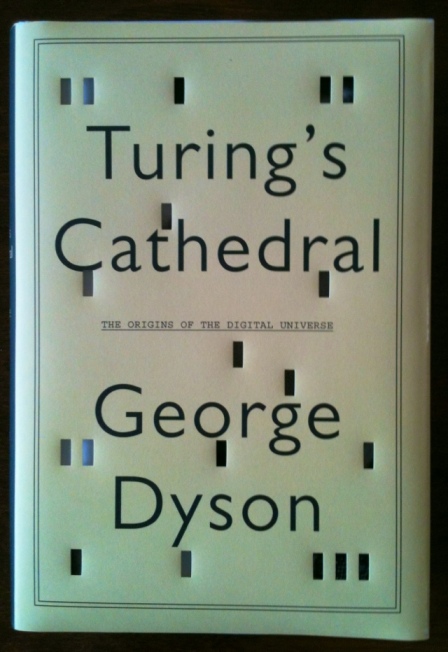
George Dyson’s Turing’s Cathedral looks pretty cool. Here’s some copy from publisher Pantheon:

“It is possible to invent a single machine which can be used to compute any computable sequence,” twenty-four-year-old Alan Turing announced in 1936. In Turing’s Cathedral, George Dyson focuses on a small group of men and women, led by John von Neumann at the Institute for Advanced Study in Princeton, New Jersey, who built one of the first computers to realize Alan Turing’s vision of a Universal Machine. Their work would break the distinction between numbers that mean things and numbers that do things—and our universe would never be the same.

Using five kilobytes of memory (the amount allocated to displaying the cursor on a computer desktop of today), they achieved unprecedented success in both weather prediction and nuclear weapons design, while tackling, in their spare time, problems ranging from the evolution of viruses to the evolution of stars.

Dyson’s account, both historic and prophetic, sheds important new light on how the digital universe exploded in the aftermath of World War II. The proliferation of both codes and machines was paralleled by two historic developments: the decoding of self-replicating sequences in biology and the invention of the hydrogen bomb. It’s no coincidence that the most destructive and the most constructive of human inventions appeared at exactly the same time.

How did code take over the world? In retracing how Alan Turing’s one-dimensional model became John von Neumann’s two-dimensional implementation, Turing’s Cathedral offers a series of provocative suggestions as to where the digital universe, now fully three-dimensional, may be heading next.

I spent an hour with the book this morning and found it engrossing. (It was also a reminder that I don’t read enough nonfiction).

Regular readers will know I despise dust jackets—I’d rather see publisher’s put their efforts into handsome but simple hardback covers. Three out of the last four hardbacks to come in have done so, including Turing’s Cathedral:

20120225-111151.jpg

Still, the design concept for these books (Alain de Botton’s Religion for Atheists and Thomas Mallon’s Watergate are the other two) still involve an integration with the dust jacket. I’d like to see the dust jacket dusted, done away with, expired.

Some cool pics from the Dyson:

20120225-111159.jpg

20120225-111207.jpg

Valentine’s Books from My Sweetie (Books Acquired 2.14.2012)

20120214-175013.jpg

Books Acquired, 2.07.2012

20120208-151957.jpg

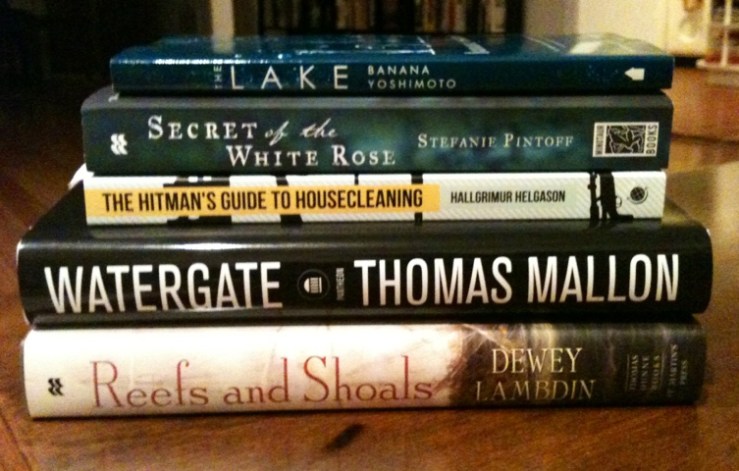
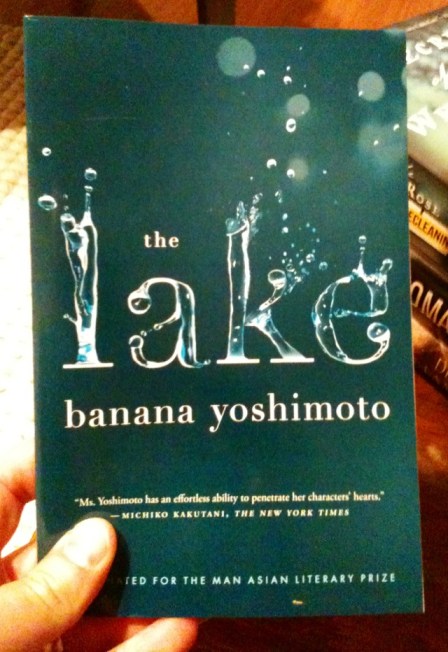
Large pile accrued yesterday although some of these were sent to the old abode. First: Lake by Banana Yoshimoto:

20120208-152021.jpg

Publisher Melville House’s description:

With its echoes of the infamous, real-life Aum Shinrikyo cult (the group that released poison gas in the Tokyo subway system), The Lake unfolds as the most powerful novel Banana Yoshimoto has written. And as the two young lovers overcome their troubled past to discover hope in the beautiful solitude of the lake in the country- side, it’s also one of her most moving.

20120208-152033.jpg

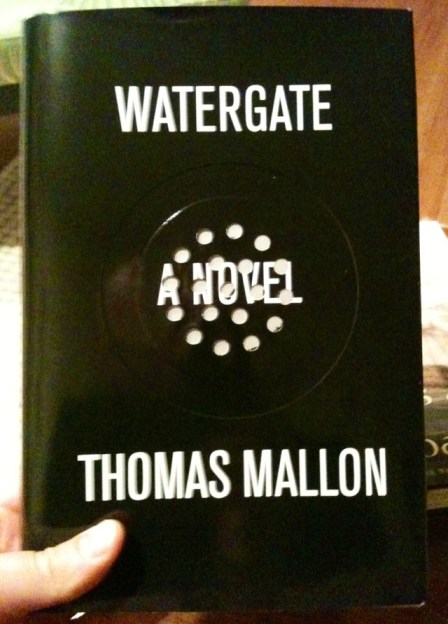
Thomas Mallon’s novelization of a scandal: Watergate. From the author’s website:

In Watergate: A Novel, Thomas Mallon conveys the drama and high comedy of the Nixon presidency through the urgent perspectives of seven characters we only thought we knew before now, moving readers from the private cabins of Camp David to the klieg lights of the Senate Caucus Room, from the District of Columbia Jail to the Dupont Circle mansion of Theodore Roosevelt’s sharp-tongued ninety-year-old daughter, and into the hive of the Watergate complex itself, home not only to the Democratic National Committee but also to the president’s attorney general, his recklessly loyal secretary, and the shadowy man from Mississippi who pays out hush money to the burglars. Mallon achieves with Watergate a scope and historical intimacy that surpasses even what he attained in his previous novels, as he turns a “third-rate burglary” into a tumultuous, first-rate entertainment.

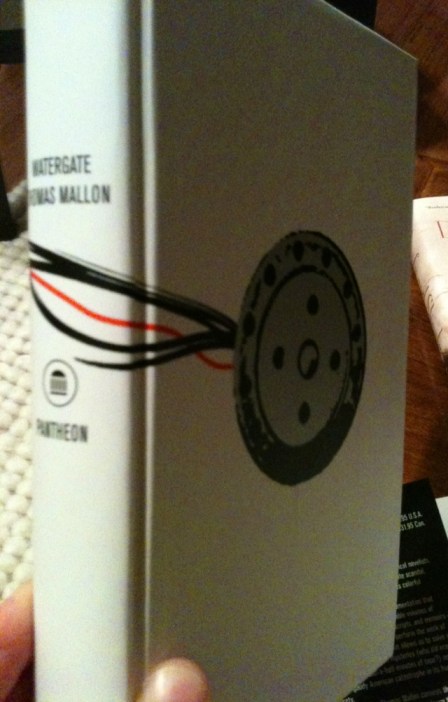
Watergate gets big points for its cover: the book jacket (oh, how I loathe them!) is punctuated with holes suggesting one of those antique things your grandfather called a telephone; strip away the jacket and there’s this (far lovelier) cover:

20120208-152041.jpg

20120208-152054.jpg

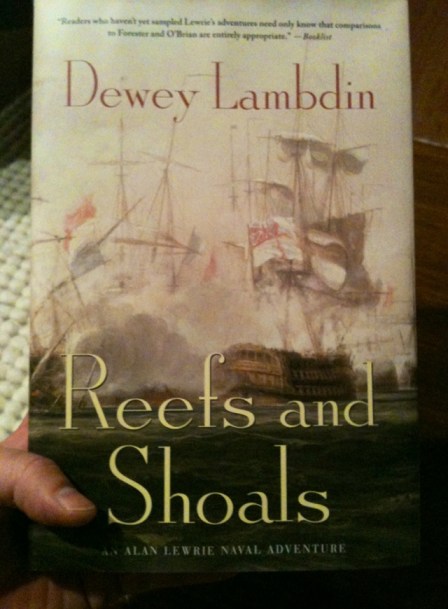
Reefs and Shoals, a naval adventure historical thing from Dewey Lambdin. From publisher Macmillan:

Pity poor Captain Alan Lewrie, Royal Navy! He’s been wind-muzzled for weeks in Portsmouth, snugly tucked into a warm shore bed with lovely, and loving, Lydia Stangbourne, a Viscount’s daughter, and beginning to enjoy indulging his idle streak, when Admiralty tears Lewrie away and order him to the Bahamas, into the teeth of ferocious winter storms. It’s enough to make a rakehell such as he weep and kick furniture!

20120208-152245.jpg

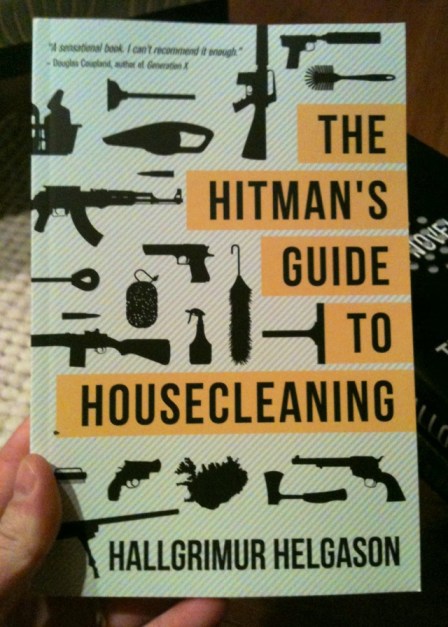
The Hitman’s Guide to Housecleaning by Hallgrimur Helagason, from, uh, Amazon’s publishing imprint:

Toxic, the hero of Hallgrimur Helgason’s The Hitman’s Guide to Housecleaning, had a record of 66 perfect kills. Then came the 67th–an undercover FBI agent–and suddenly he found himself in Iceland with a new identity. Oops. Avoid this kind of careless error by following Toxic’s handy tips.

1. Don’t miss the target. People tend to get a bit upset if they notice you’re trying to kill them.
2. Don’t waste a bullet. You have to think about the environment, too–you really shouldn’t add an unnecessary gunshot to an already noisy city.
3. Morning is for murder. Nobody expects a bullet for breakfast.
4. Don’t kill a priest. He who kills a man of the church will be killed by a church.
5. Don’t confuse killing and murder. Murder is for amateurs, killing is for the professionals.
6. If you have to take on another person’s identity, never let it be a priest. With that collar around your neck, your sex appeal is gone.
7. When you’re dating, don’t talk about your job–unless you’re overseas. Foreign girls are crazy about guys who kill Americans.
8. Embrace every new passport they give you. It’s always nice to get a new life now and then.
9. Don’t kill the wrong guy. Or you’ll end up in Iceland.
10. When in Iceland, stop the killing. There are so few of them.