Five Favorite Fictional Fathers

Literature seems to have an ambivalence toward fatherhood that’s too complex to address in a simple blog post–so I won’t even try. But before I riff on a few of my favorite fathers from a few of my favorite books, I think it’s worth pointing out how rare biological fathers of depth and complexity are in literature. That’s a huge general statement, I’m sure, and I welcome counterexamples, of course, but it seems like relationships between fathers and their children are somehow usually deferred, deflected, or represented in a shallow fashion. Perhaps it’s because we like our heroes to be orphans (whether it’s Moses or Harry Potter, Oliver Twist or Peter Parker) that literature tends to eschew biological fathers in favor of father figures (think of Leopold Bloom supplanting Stephen Dedalus in Ulysses, or Merlin taking over Uther Pendragon‘s paternal duties in the Arthur legends). At other times, the father is simply not present in the same narrative as his son or daughter (think of Telemachus and brave Odysseus, or Holden Caulfield wandering New York free from fatherly guidance). What I’ve tried to do below is provide examples of father-child relationships drawn with psychological and thematic depth; or, to put it another way, here are some fathers who actually have relationships with their kids.
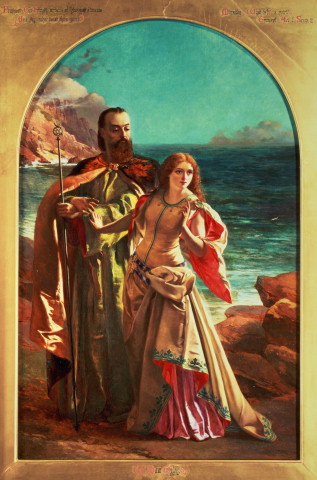
Prospero and Miranda--William Maw Egley

1. Prospero, The Tempest (William Shakespeare)

Prospero has always seemed to me the shining flipside to King Lear’s dark coin, a powerful sorcerer who reverses his exile and is gracious even in his revenge. Where Lear is destroyed by his scheming daughters (and his inability to connect to truehearted Cordelia), Prospero, a single dad, protects his Miranda and even secures her a worthy suitor. Postcolonial studies aside, The Tempest is fun stuff.

2. Abraham Ebdus, The Fortress of Solitude, (Jonathan Lethem)

Like Prospero, Abraham Ebdus is a single father raising his child (his son Dylan) in an isolated, alienating place (not a desert island, but 1970’s Brooklyn). After Dylan’s mother abandons the family, the pair’s relationship begins to strain; Lethem captures this process in all its awkward pain with a poignancy that never even verges on schlock. The novel’s redemptive arc is ultimately figured in the reconciliation between father and son in a beautiful ending that Lethem, the reader, and the characters all earn.

3. Jack Gladney, White Noise (Don DeLillo)

While Jack Gladney is an intellectual academic, an expert in the unlikely field of “Hitler studies” (and something of a fraud, to boot), he’s also a pretty normal dad. Casual reviewers of White Noise tend to overlook the sublime banality of domesticity represented in DeLillo’s signature novel: Gladney is an excellent father to his many kids and step-kids, and DeLillo draws their relationships with a realism that belies–and perhaps helps to create–the novel’s satirical bent.

4. Oscar Amalfitano, 2666 (Roberto Bolaño)

Sure, philosophy professor Amalfitano is a bit mentally unhinged (okay, more than a bit), but what sane citizen of Santa Teresa wouldn’t go crazy, what with all the horrific unsolved murders? After his wife leaves him and their young daughter, Amalfitano takes them to the strange, alienating land of Northern Mexico (shades of Prospero’s island?) Bolaño portrays Amalfitano’s descent into paranoia (and perhaps madness) from a number of angles (he and his daughter show up in three of 2666‘s three sections), and as the novel progresses, the reader slowly begins to grasp the enormity of the evil that Amalfitano is confronting (or, more realistically, is unable to confront directly), and the extreme yet vague danger his daughter is encountering. Only a writer of Bolaño’s tremendous gift could make such a chilling episode simultaneously nerve-wracking, philosophical, and strangely hilarious.

5. The father, The Road (Cormac McCarthy)

What happens when Prospero’s desert island is just one big desert? If there is a deeper expression of the empathy and bonding between a child and parent, I have not read it. In The Road, McCarthy dramatizes fatherhood in apocalyptic terms, positing the necessity of such a relationship in hard, concrete, life and death terms. When the father tells his son “You are the best guy” I pretty much break down. When I first read The Road, I had just become a father myself (my child was only a few days old when I finished it), yet I was still critical of McCarthy’s ending, which affords a second chance for the son. It seemed to me at the time–as it does now–that the logic McCarthy establishes in his novel is utterly infanticidal, that the boy must die, but I understand now why McCarthy would have him live–why McCarthy has to let him live. Someone has to carry the fire.

Harold Bloom on McCarthy’s Blood Meridian

bloom_harold

AV Club posted a great interview with master critic Harold Bloom this week. Bloom speaks at some length on one of our favorite books, Cormac McCarthy‘s violent opus Blood Meridian, which was AV Club’s “Wrapped Up In Books” book club selection for June (pretty good discussions of the book there, as well). An excerpt:

The first time I read Blood Meridian, I was so appalled that while I was held, I gave up after about 60 pages. I don’t think I was feeling very well then anyway; my health was going through a bad time, and it was more than I could take. But it intrigued me, because there was no question about the quality of the writing, which is stunning. So I went back a second time, and I got, I don’t remember… 140, 150 pages, and then, I think it was the Judge who got me. He was beginning to give me nightmares just as he gives the kid nightmares. And then the third time, it went off like a shot. I went straight through it and was exhilarated. I said, “My God! This reminds me of Thomas Pynchon at his best, or Nathanael West.” It was the greatest single book since Faulkner’s As I Lay Dying.

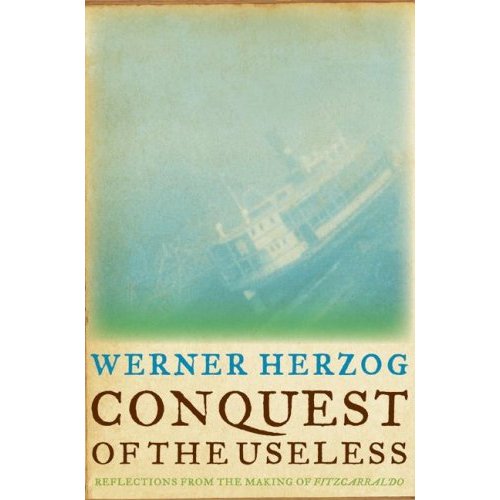
More Excerpts from Werner Herzog’s Conquest of the Useless

conquest

Last month, we were delighted to read some excerpts from Conquest of the Useless, Werner Herzog‘s forthcoming account of the making of his epic Fitzcarraldo (we wrote about it here). The paragons of moral literature at Vice Magazine have henceforth published a few more excerpts, available here. Here’s a morsel to whet the appetite:

I hurried to the first-aid station and saw a native man and a woman, both of whom had been struck with enormous arrows. They had been fishing for the camp three hours upstream by speedboat, and had spent the night on a sandbank. During the night they had been ambushed and shot at close range by Amehuacas. The woman had been hit by three arrows and almost bled to death. The wounds were close together. One arrow had gone all the way through her body just above her kidney, one had bounced off her hip bone, and the most life-threatening one was still sticking in her abdomen, broken off on the inner side of her pelvis. I spent several hours helping out while she was operated on, shining a powerful flashlight into her abdominal cavity and with the other hand spraying insect repellent to try to drive away the clouds of mosquitoes the blood had attracted. The man still had an arrow made of razor-sharp bamboo and almost thirty centimeters long sticking through his throat. He had broken off the two-meter-long shaft himself, and was gripping it in his hand. In his state of shock he refused to let go of it. The arrow’s tip, which looked more like the point of a lance, had spliced open one of his shoulders along the collarbone and was sticking crossways through his neck, with the tip lodged in his shoulder on the other side. He seemed to be in less immediate danger and was operated on only after the woman. Here is what had happened: the man, his wife, and a younger man, all three of them Machiguengas from Shivankoreni, who provide us with yucca, had gone up the Camisea to hunt. They were sleeping on a sandbank, and during the night the woman woke up because the man next to her was gasping strangely. Thinking a jaguar had got him by the throat, she grabbed a still glowing branch from the fire and jumped up. At that moment she was struck by three arrows. The younger man woke up; he had a shotgun with him, and, grasping the situation, fired two shots blindly into the night, since everything was happening in pitch darkness and complete silence. None of the three saw any trace of the attacking Amehuacas; they disappeared, leaving only a few footprints in the sand.

Lovely!

White Teeth, Perdido Street Station, and Last Evenings on Earth

white teeth

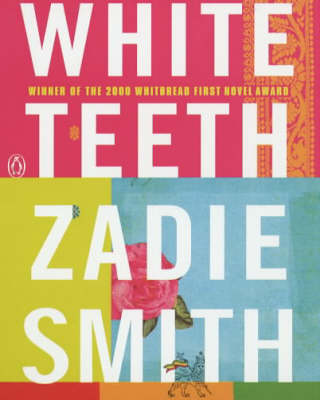
And so well with the help of Jenny Sterlin’s narration and my handy-dandy portable mp3-playing device, I finally made it through Zadie Smith‘s 2000 novel White Teeth, and, having digested all of it, am now fit to declare it hilarious in places, larded with moments of intensely brilliant prose, wildly ambitious, and ultimately hollow, overstuffed with flat characters who, despite Smith’s best efforts, do not manage to earn the Big Important Climax she shoves them toward. Smith succeeds in communicating the multicultural problematics of late-twentieth-century London, but her massive scope (the audiobook is 23 hours and my unfinished paperback runs to nearly 500 pages) is just too massive. Smith seems to think that loads of concrete detail will automatically conjure emotional force, but what we get instead verges on soap opera at times–more bathos than pathos.It doesn’t help reader expectations of course that White Teeth was wildly overpraised after its debut. While White Teeth‘s attempt to reconcile the personal traumas of a postcolonial world with the demands of family, tradition, and personal worth is admirable, its aim exceeds its grasp, and the end disappoints. Still, I enjoyed it as an audiobook–Jenny Sterlin mugs enthusiastically through the various accents and argots of a melting pot London, and Smith’s concrete emphasis on detail makes it an ideal listen for a few summer afternoons of gardening or housework. Not the Great Book we’ve been told it is, but a fine listen nonetheless.

perdido_street_station_us

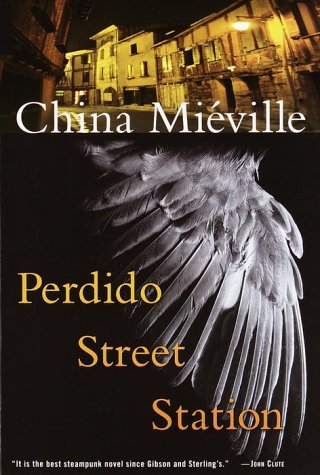
Summer is, of course, a great time for audiobooks, and I’m thrilled that China Miéville‘s breakthrough second novel Perdido Street Station is finally available on mp3. I’ve been wanting to read Miéville for quite some time now, but the length of his dystopian tomes has made it difficult until now (I am a very busy, important man, with busy, important things to do). Perdido Street Station, set in a bizarre, gross world of humans, Re-mades, and other sundry races, is weird fiction at its finest (so far)–a great hybrid of Charles Dickens and PK Dick, HP Lovecraft and JG Ballard. It trawls the line between real and surreal, art and science, grime and enlightenment, in lovely, if dense prose, that could never be mistaken as genre fiction. Great stuff, so far.

lastevenings

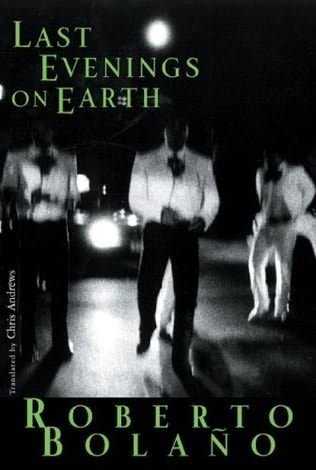
Also great stuff, so far, is Roberto Bolaño‘s collection of short stories, Last Evenings on Earth. I read the first three tales in succession last night, unable to put the book down although it was well-past my well-established “you must go to bed now or your toddler daughter will wreak havoc on you in the AM” bedtime. The first three stories are about, get this, (big surprise if you’ve read Bolaño), writers–good, bad, indifferent writers, failed, semi-failed, miserable writers. Sad writers, mad writers. The opener “Sensini” tells the story of an epistolary relationship between a young writer and an aging, uncelebrated writer. It’s sad yet measured in its pathos, and it earns its happy ending by loading that ending with the seed of potential disaster. The next story, “Henri Simon Leprince,” is the hilarious (and sad) tale of a miserable writer, a hack who teams up with the Resistance in WWII France. Despite his best intentions, he’s roundly despised by all those he helps. And he’s a terrible writer. The third story, “Enrique Martín,” literally made me laugh out loud, several times, to the point of tears. Narrated by Arturo Belano, Bolaño’s literary stand-in, it tells the desperate story of the titular failed poet, a would-be artist and sometime UFO hunter who slowly watches his dreams disintegrate.

All of Bolaño’s stories so far have extended past the mad force of his own strong voice(s) and implanted themselves into my mind, reaching into my own past; his characters, in hashing out their strange young lives (from a bit of distance, now) repeatedly evoked my own youthful memories, stuff I hadn’t thought about in years. There’s a sad brilliance under all of Bolaño’s stuff, like bright noon sun perceived through an ambiguous tear resting on your eye. Reading the beginning of Last Evenings on Earth last night, it occurred to me for the first time that Bolaño had died, and he’d died really young, and there weren’t going to be anymore books from him. But that’s a bummer note to end on. Let’s leave it at this–Last Evenings on Earth is some seriously great stuff.

Away We Go — Dave Eggers and Vendela Vida

away

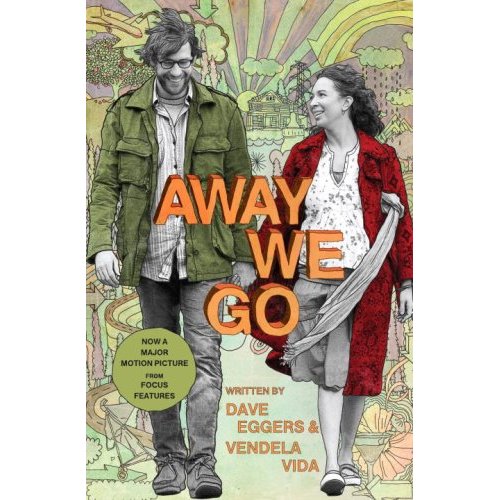
Away We Go is the story of Verona and Burt, an unmarried couple in their early thirties expecting a child. After discovering that the child’s only living grandparents will be moving to Belgium, Verona and Burt realize that there’s nothing anchoring them in Colorado. The pair set out on a cross country journey in their boxy old Volvo, meeting up with old friends and family in an attempt to find the right place to start their new family.

“We’ve attempted to make this readable to a non-screenwriting population, from whose ranks we’ve recently come,” write Dave Eggers and Vendela Vida in their introduction to their screenplay for Away We Go. Released last week in conjunction with the film, the screenplay, with its vivid cover and prestige trade format, seems to physically back up Eggers’s and Vida’s wish–they’re hoping that you’d want to, y’know, actually read it, like, a book, and not just watch Sam Mendes‘s filmed version. There’s that hopeful, informative introduction, for starters, and they really do make good on their claim of readability; stage directions and location shifts are clear but never overbearing, allowing the reader to engage the characters in his or her own imagination. The book also includes scenes (apparently) cut from the movie–should I mention now that I haven’t seen the movie?–as well as an alternate “admittedly radical Bush-era ending.” Still, it is a screenplay–not a novel, not a play, but a text intended for a movie, a movie out there getting reviewed now, a movie with physical entities playing the key roles. “Verona and Burt were written with Maya Rudolph and John Krasniski in mind,” Eggers and Vida state in their introduction, and, between this admission and press for the movie, its almost impossible to read the script without imagining these actors’ mannerisms and tics. Not that that’s a bad thing, it just limits any nuance in (and in between) the lines, and again brings up the question of why one might want to own this book.

The answer for many readers, of course, will simply be Eggers, a modern literary luminary. For the record, we’re a huge fan of Dave Eggers, even when his writing isn’t the best. Eggers is perhaps the most visible of a whole crop of post-David Foster Wallace writers (for lack of a better term), a linchpin of a (non-)movement whose literary house McSweeney’s, and its attendant magazines, Timothy McSweeney’s Quarterly Concern, The Believer, and the video journal Wholphin frequently feature some of the best writing and art out there today. His 2000 memoir A Heartbreaking Work of Staggering Genius might be a bit overrated, but it’s also one of the first post-DFW books to grapple with irony and earnestness in a moving discourse. Besides all of that, Eggers is the founder of 826 National, a nonprofit organization that tutors kids in writing and reading across the country. In short, Eggers is all about making reading and writing fun and cool and demystified for lots and lots of people, and because of that, he’s a hero of ours. Of course, he has his haters; there are many who claim that McSweeney’s is form without substance, all show, fancy design without good writing. This is a pretty silly argument, because all you have to do is sit down with an issue of McSweeney’s or The Believer and actually, y’know read it to realize that 99% of the writing is fantastic. Better yet, check out one of the books they’ve published, like Chris Adrian‘s The Children’s Hospital. Eggers’s haters generally don’t have a lucid argument because what they hate is an attitude, a vibe, a feeling. I’ll readily admit that I’m hip to what they’re describing, and something of that backlash has come out in reviews of the film–especially New York Times critic A.O. Scott’s overly-analytical takedown of Away We Go. There’s a preciousness, a smug quirkiness, an awareness that people simply do not have discussions in the manner that Verona and Burt do, and this puts people off. Of their fictional parents-to-be, Eggers and Vida–who were pregnant with their own child October when they wrote the screenplay–write: “When we conceived them, we thought of a couple who was as different from ourselves as we could muster.” People who read into things deeply might find it hard to believe that Verona and Burt are anything but stand-ins for Vida and Eggers, and that couples casual resistance to the extreme drama of having a child is, honestly, a bit offputting. (If you really want to see some visceral Eggers-hating/Eggers-defending, check out the comments on this recent A.V. Club interview with the pair).

But back to the screenplay, which I suppose was the occasion for this writing. I enjoyed it. It was funny. At times there was an irking quirk to the characters, a certain shallowness that doesn’t do justice to the intensity of pregnancy. I read it in two short sittings–less time than the film would take to watch, I suppose. It also made me want to watch the film, rather than putting me off. Eggers completists might want to add the screenplay for Away We Go to their collections; newbies interested in his work should check out his novel What Is the What, Eggers’s remarkable novelization of the life story of Valentino Achak Deng, one of the “lost boys” of Sudan.

Away We Go is now available in trade paperback from Vintage.

In the Land of Invented Languages — Arika Okrent

book-cover

Arika Okrent‘s new book In the Land of Invented Languages (released in hard back last month from Spiegel & Grau) confidently traverses the thin line between pop nonfiction and academic linguistics. Subtitled Esperanto Rock Stars, Klingon Poets, Loglan Lovers, and the Mad Dreamers Who Tried to Build a Perfect Language, Okrent’s book delves the weird world of invented languages. While many folks are familiar enough with the idealism behind Esperanto or the sadness behind, ahem, Klingon, what about Lingua Ignota, or Dritok, the chipmunk language? How much do you know about John Wilkins’s 1668 invention “Philosophical Language” (pictured below)?

wilkins1668_sampleOkrent, after explaining her fascination with invented languages, or “conlangs,” more or less uses Wilkins as a starting place, using his massive project as a measuring stick for all the invented languages that followed it. While detailing the history and implementation of Esperanto, Charles Bliss’s language of symbols, and the logical logjammin’ of Lojban, Okrent balances the erudition of complex linguistics with a humorous, human tone. In the Land of Invented Languages is filled with tree diagrams and symbol charts that will not be wholly unfamiliar to those who studied a little linguistics back in college (or even those who, like the Biblioklept, changed their major from linguistics to English when they discovered they’d have to take, gasp!, statistics). These visuals are both fun and stimulating, and help to explicate what can be pretty heady stuff at times.
At its core, Invented Languages is about dreamers and schemers, the kind of idealistic perfectionists who would go to the trouble to invent something as heavy and impossible as a language. As Okrent savvily points out in her introductory chapter, real languages–that is, the natural languages that people really speak and communicate in–are organic and don’t really require rules. They just “happen.” That’s what makes this book so much fun–all the crazy cranks that try to force their perfect philosophical systems onto the world. In the Land of Invented Languages is a rewarding exploration of meaning and language, how language means, and what happens when we try to make meaning. Recommended.

For more info, check out In the Land of Invented Language‘s fun and thorough website.

Listening Library’s Fantasy Road Trip Contest

PrintWe’re big advocates of audiobooks here at Biblioklept. A good audiobook helps the most mundane of chores zip by, making you a more educated, conscientious, and cultured person in the process (probably). Audiobooks are also essential to any road trip, and the good folks at Random House’s Listening Library labs have a new contest to help encourage parents and their kids to listen to audiobooks this summer. The contest, open to teens ages 13 to 18, is to create a video that addresses the following prompt: “If you could go on a road trip with a character from your favorite audio series, where would you go? What would you do along the way? How would you travel?” The winner will get an 8GB iPod Touch, as well as signed copies of audiobooks by the contest judges authors Libba Bray, Tamora Pierce, and Rick Riordan, all accomplished writers of young adult fantasy series. Get full details of the contest at Listening Library’s website. Seems pretty cool.
Movie Trailer for Hillcoat’s Adaptation of McCarthy’s The Road

Australian director John Hillcoat’s movie adaptation of Cormac McCarthy‘s bleak and beautiful novel The Road finally has a proper trailer as well as (another) release date, October 16th, 2009. Here’s the trailer:

I weighed in on the possible merits (and possible demerits) of a film adaptation of The Road way back in October of last year, back when the movie was planned for a Thanksgiving release (what better time than Turkey Day to watch a story with baby cannibalism?)

The trailer makes the movie look kinda “big”–explosions, way more people than I remember being in the novel, and what appears to be a heavily expanded role for the wife, played by Cherlize Theron. Still. I wanna see this. At the same time, the trailer seems to scream “Go read the book, now!” And you should. It’s great.

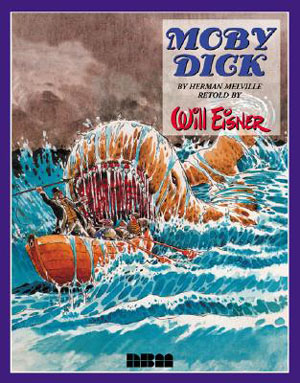
Will Eisner’s Adaptation of Herman Melville’s Moby-Dick

moby_dick_cv_300

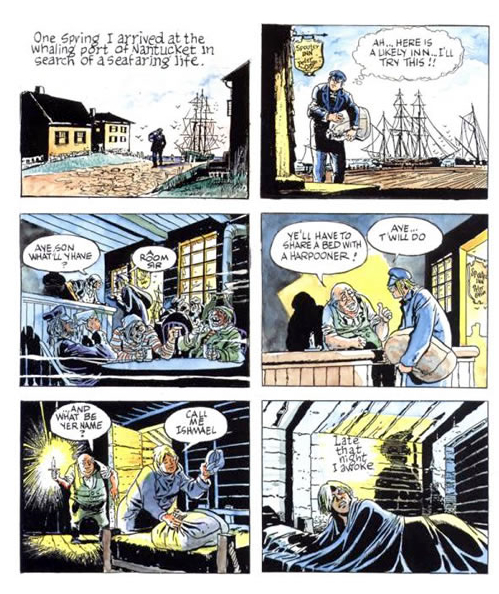
Will Eisner’s adaptation of Herman Melville’s Moby-Dick was one of his last works, completed in 2001 just four years before his death. While no comic book adaptation can match Ishmael’s expansive voice, Eisner’s work here does capture the spirit of adventure and the wish for communion that underpins Melville’s tome. We think it would make a great introduction for younger readers to Melville’s massive book, and will surely interest older readers apprehensive of Moby-Dick. Great stuff.

Eisner Moby-DickMore here.

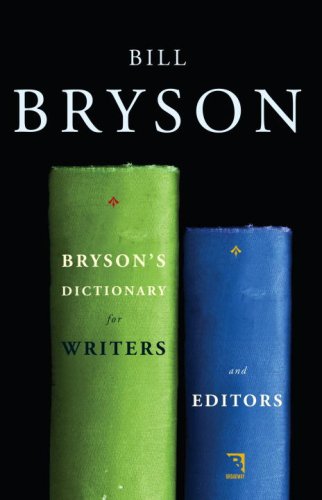
Bryson’s Dictionary for Writers and Editors — Bill Bryson

That Bill Bryson’s Bryson’s Dictionary for Writers and Editors (new this week in paperback from Anchor Books) should surpass utility and be loads of fun as well seems almost unfair. Aren’t dictionaries and style manuals meant to be dry? brysonBryson’s title here is pretty honest; he’s made a dictionary of hard-to-remember/easy-to-forget words, including plenty of commonly misspelled words. In the age of spell-check, it’s not so much Bryson’s spellings that are essential as it is the context in which he puts his words. For instance, do you know the difference between “gabardine” and “gaberdine”? (“The first is a type of worsted cloth, the second a long cloak”). Bryson goes further (not farther!) than mere distinctions between words like “creole” and “pidgin” or “bravado” and “bravery”: he actually gets into the fray of how one ought to use words. Consider the entry on “past”:
“Often a space waster, as in this example: ‘Davis said the dry conditions had been a recurrent problem for the past thirty years.’ In this sentence, and in countless others like it, ‘the past’ could be deleted without any loss of sense. Equally tautological and to be avoided are such expressions as past records, past history, past achievements, and past precedents.”

The exasperation is almost palpable! When I first picked up the dictionary, I immediately checked out what Bryson had to say on one of my own pet peeves, “couldn’t of” as the contracted form of “couldn’t have.” Here’s Bryson, in a solution that mixes humor with a bit of common sense:

“As a shortened form of ‘couldn’t have,’ couldn’t of does unquestionably avoid the clumsy double contraction couldn’t’ve, a form not often seen in print since J.D. Salinger stopped writing. However, I would submit that that does not make it satisfactory. Using the preposition of as a surrogate for ‘ve seems to me simply to be swapping an ungainly form for an illiterate one. If couldn’t’ve is too painful to use, I would suggest simply writing couldn’t have and allowing the reader’s imagination to supply the appropriate inflection.

As we see, Bryson’s interest isn’t so much on presenting himself as an absolute authority on the English language as it is in helping writers to be more lucid. We see this again–with the same wittiness–when discussing the differences between “Shakespearean” and “Shakespearian”:

“The first is the usual spelling in America and the second is the usual spelling in Britain, but, interestingly, don’t look to The Oxford English Dictionary for guidance on any spellings concerning England’s greatest poet. Perversely and charmingly, but entirely unhelpfully, the OED insists on spelling the name Shakspere, a decision it based on one of the six spellings Shakespeare himself used. It does, however, acknowledge that Shakespeare is ‘perhaps’ the commonest spelling now used.

While Bryson’s Dictionary is plenty of fun for word nerds, it’s utility and ease-of-use are really what make it a must-have for writers. Bryson devotes 11 pages of his short, useful appendix to punctuation, a section that every young (or not so young) writer should read (the three pages he devotes to comma use are particularly insightful). In sum, Bryson’s Dictionary for Writers and Editors is a witty and intuitive aid that many a writer will love having on their desk. I know I do. Highly recommended.

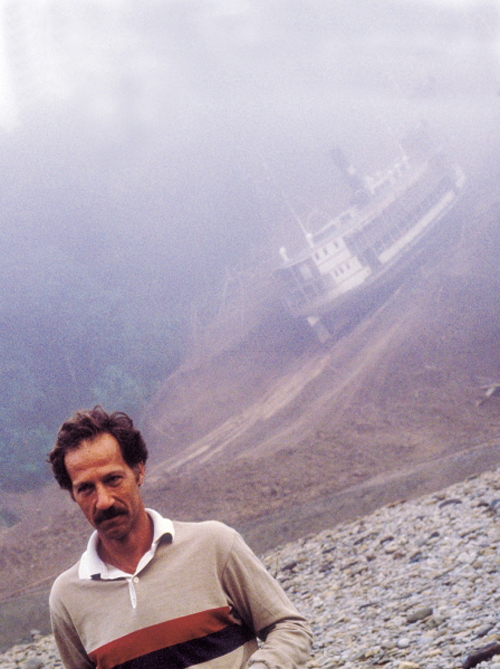
“The Jungle Is Obscene” — Werner Herzog’s Visceral Nature Writing

wernerherzogfitz

This month’s issue of Harper’s features a fantastic collection of diary entries by German film director Werner Herzog. These entries are excerpted from the forthcoming book Conquest of the Useless: Reflections from the Making of Fitzcarraldo. Released in 1982, Fitzcarraldo tells the story of a would-be rubber magnate who attempts to haul a steamship over a small mountain in Peru so that he can access an area rich in rubber trees. The infamous Klaus Kinski plays Fitzcarraldo, a European who pushes his crew to the breaking point in this mad quest; the semi-fictional plot was doubled in the real-life production disasters that plagued the movie. Fitzcarraldo dramatizes one of the oldest narrative conflicts, man vs. nature, in an earnest yet completely unromantic way. Fitzcarraldo, the opera-lover who brings ice to the natives, shatters any romantic illusions one might have about the power and majesty of nature in his mad schemes. This theme repeats throughout Herzog’s work, from the conquistador opus Aguirre, the Wrath of God to his outstanding 2005 documentary Grizzly Man. Again and again, Herzog’s films ironize, disrupt, or otherwise show the folly of romanticizing nature. His diary entries from Conquest of the Useless lay these sentiments bare in ways both bleakly poetic and terribly funny.

Take this entry from December 8, 1980: “The jungle is obscene. Everything about it is sinful, for which reason the sin does not stand out as sin.” Here, Herzog provides a succinct antithesis to Rousseau’s concept of the “noble savage.” Herzog’s view of man—de-politicized, that is—seems more Hobbesian, actually. In an entry from April 6, 1981, he writes:

“This morning I woke up to terror such as I have never experienced before: I was entirely stripped of feeling. Everything was gone; it was as if I had lost something that had been entrusted to me the previous evening, something I was supposed to take special care of overnight. I was in the position of someone who has been assigned to guard an entire sleeping army, but suddenly finds himself mysteriously blinded, deaf, and effaced. Everything was gone. I was completely empty, without pain, without longing, without love, without warmth and friendship, without anger, without hate. Nothing, nothing was there anymore, and I was left like a suit of armor with no knight inside. It took a long time before I even felt alarmed.”

Nature seems to nullify Herzog, to void any essential humanity he might have had. His repetition of “Nothing, nothing was there anymore” reminds me of King Lear’s famous lines “Never, never, never, never, never.” Although Lear is weeping over the body of his kind daughter Cordelia, the psychology of these lines surely reflect his own terrible experiences, his own nullified identity of homelessness on the wild heath.

For Herzog, nature is a war, nature will eat you. “Moss grows on lianas, and in the knobby places where the moss is thicker, a leafy plant like a slender hare’s ear grows out of the moss: a parasite on a parasite on a parasite,” he observes. If Herzog is melancholy or mordant in these grim reckonings, he’s also very, very funny. Take this hilarious June 4th entry concerning a giant albino turkey that’s been terrorizing the set:

“The camp is silent with resignation; only the turkey is making a racket. It attacked me, overestimating its own strength, and I quickly grabbed its neck, which squirmed and tried to swallow, slapped him left-right with the casual elegance of the arrogant cavaliers I had seen in French Three Musketeers films who go on to prettily cross swords, and then let the vain albino go. His feelings hurt, he trotted away, wiggling his rump but with his wings still spread in conceited display.”

And yet one senses that Herzog’s humor is a defense against the absurdity of nature, one that derives from an acute awareness that humanity is at once of and apart from nature, and at that by its own definition, its own choice. In a June 2nd entry featuring his nemesis the albino turkey, Herzog details an incident that highlights the essential ugliness of a Darwinian world:

“Our kitchen crew slaughtered our last four ducks. While they were still alive, Julian plucked their neck feathers, before chopping off their heads on the execution block. The white turkey, that vain creature, the survivor of so many roast chickens and ducks transformed into soup, came over to inspect, gobbling and displaying, and used his ugly feet to push one of the beheaded ducks, as it lay there on the ground bleeding and flapping its wings, into what he thought was a proper position and making gurgling sounds while his bluish-red wattles swelled, he mounted the dying duck and copulated with it.”

There we go. We get it all, all the order of nature. Food, sex, death, the whole deal, laid out keenly and with grim humor, neatly compacted into a single, grotesque episode. If these excerpts are any indication of the rest of the book’s trajectory, Conquest of the Useless promises to transcend standard making-of fare. Indeed, Herzog’s book seems nothing less than a profound meditation on the intersection of man, nature, terror, and mortality.

Conquest of the Useless: Reflections on the Making of Fitzcarraldo is available June 30th from HarperCollins.

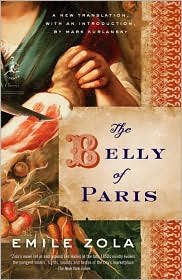
The Belly of Paris – Émile Zola

belly

It’s totally appropriate that food-writer Mark Kurlansky should helm Modern Library Classics’ new translation of Émile Zola’s The Belly of Paris. Not only does he have a keen ear for Zola’s revolutionary naturalism, he also captures the passion at the heart (or gut) of The Belly of Paris–a passion for food. To be clear, Zola’s book is not so much about gourmet preparations (although they’re there, to be sure) as it is about the production and marketing of food, and, more specifically, the ways in which food delineates class lines.

The Belly of Paris is the third of Zola’s twenty-novel naturalist cycle Les Rougon-Macquart, a series of books examining two intertwined families–one rich and respectable, the other poor and disreputable–during the rise of the Industrial Revolution in France. Belly takes Florent Quenu (one of the poor and disreputable) for its protagonist. Quenu, wrongfully accused of a crime, escapes imprisonment on Devil’s Island and attempts to start a new life in Les Halles, the great, sprawling market known as “the belly of Paris.” Readers are treated to lovingly detailed depictions of Les Halles and its produce stands, fish shops, cheese markets, butcheries, both through the eyes of Quenu and many other characters. There are those who work in the great market and their children (who also, of course, work in the market); artists and rabble rousers; the nouveau riche and the would-be revolutionaries.

Zola evokes a lust for life centered around this great belly, even as he dramatizes the sharp disparity between the rich and the poor. While Zola is hardly preachy, his sympathies are clearly with the poor and downtrodden. Like America’s great literary naturalist John Steinbeck, Zola’s major rhetorical gesture is to avoid the romanticism of metaphor in favor of a tightly-drawn Darwinian realism. Like Steinbeck, this means a strong focus not just on the symbolic registry of food–food as communion, for example–but also on the real-world consequences of not having enough food. Put another way, Zola’s not afraid to get his hands dirty, and there’s quite a bit of dirt in Belly. It’s easy even now to see why Zola’s naturalism was something of a minor scandal in its day (this translated into sales for Zola, of course).

Contemporary English-reading audiences will have no difficulties with Zola’s late nineteenth-century France. Kurlansky’s deft translation zips along with vivid intensity, and his detailed endnotes inform the text without intrusion. While Francophiles pining for romantic visions of a pristine Paris will likely be put off by Zola’s gritty visions, lovers of food writing and social fiction alike will undoubtedly enjoy The Belly of Paris. Recommended.

The Belly of Paris is available from Random House’s Modern Library Classics on May 12th, 2009.

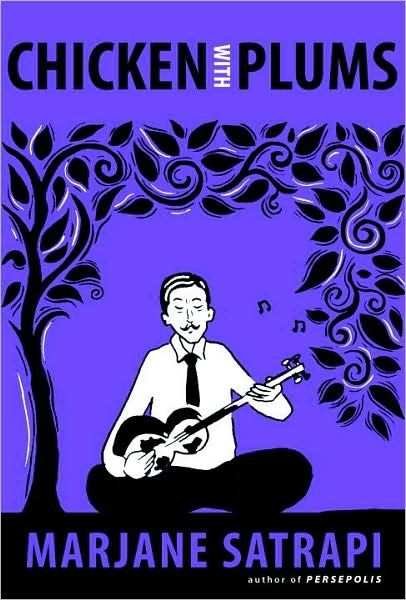
Chicken with Plums – Marjane Satrapi

chicken with plums

In Chicken with Plums, new in paperback from Pantheon, acclaimed author Marjane Satrapi tells the story of the life and death of her great uncle Nasser Ali, a renowned Iranian tar player who decides to die after his wife destroys his beloved instrument. Satrapi organizes her narrative around Ali’s last eight days alive in November, 1958–from the time he decides to quit eating and not leave his bedroom, to his eventual, somewhat unexplained death. Ali’s life story–and the reasons for his slow suicide–are revealed in a series of dreams, fantasies, flashbacks (and flashbacks within flashbacks!), and even a few flash forwards. Although the context of the recentish 1953 CIA-backed coup informs the plot, Chicken with Plums is far less concerned with Iranian politics than was the book that made her famous, her stunning debut graphic novel, Persepolis. Instead, Chicken plumbs loss and love, art and passion, family and disappointment, and the ways in which the small comforts in life–a favorite meal of say, chicken with plums, or a Sophia Loren flick, ultimately offer no protection against death.

Casual readers to comics often make the error of supposing that the medium is merely words with accompanying pictures. Satrapi’s deft work here might do wonders in correcting this ignorance. There isn’t a wasted panel in Chicken with Plums, and Satrapi commands intense emotion from her thick, black lines. There’s a seamless quality to Chicken with Plums; the text and the pictures, indivisible, add up to more than the sum of their parts. Satrapi knows when to hold back and let her simple black and white images tell the story. There is a certain economy of storytelling that great comic writers can achieve in ways entirely possible in prose, and here Satrapi has surpassed her earlier work in Persepolis, which, while great, often relied heavily on textual exposition. In Chicken with Plums, Satrapi’s evocations of troubled family life, unfulfilled love, the perils of Iranian immigration to California, and Sufi mysticism all blend into a poignant, often-funny, and occasionally devastating portrait that exemplifies the best of the comics medium.

While comparisons to her Persepolis series will undoubtedly hang over all of Satrapi’s work, Chicken with Plums is a wonderful successor, and in some senses, a more achieved work. Although it doesn’t convey the first-person immediacy of Persepolis, nor that memoir’s dramatic scope, the story of Nasser Ali is intimately detailed and achieves something rare in an age of overstuffed books: it leaves its readers hungry for more. Highly recommended.

Salon published a seven page excerpt from Chicken with Plums when the book was originally published in hardback.

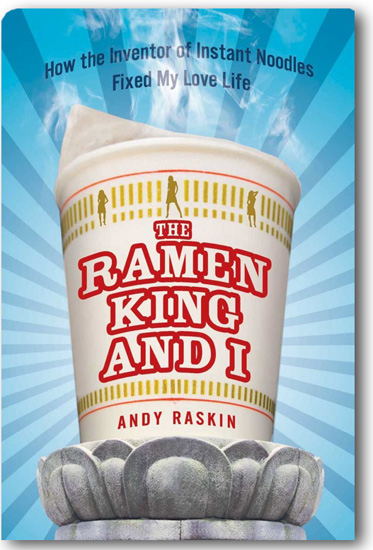
The Ramen King and I — Andy Raskin

ramenking550hshadow

In his new memoir The Ramen King and I, Andy Raskin connects sex, desire, Japanese culture, and instant noodles in an often funny, sometimes poignant, and ultimately redemptive narrative that memoir-enthusiasts (and Japanese food fans) will enjoy. Raskin’s narrative works along several tracks that eventually intertwine. The book begins with Raskin’s obsession over Momofuku Ando, inventor of instant ramen (and gifted inspirational author, to boot), backtracking in time to slowly reveal just how a kid from Long Island got to be so wound up in the writings and philosophy of an ancient Japanese businessman. Raskin balances a straightforward, chronological narrative with intensely personal letters (supposedly) written to Momofuku. These letters often read like diary entries and help to expose the core of Raskin’s dilemma: in short, he’s an emotionally detached womanizer with extreme fears of commitment (in some of the memoir’s skeevier sections, we’re treated to Raskin’s descriptions of making “dates” via Craigslist). Raskin relates his life as a tech and business writer, and his frequent trips to Japan. Eventually, after a chance encounter in a sushi bar, Raskin enters the strange world of ramen, a world that eventually leads him to Momofuku, whose zen writings in turn lead Raskin to a transcendental breakthrough.

Raskin lets his audience get to know Momofuku too, both through the narrative proper and also through short, scattered sections titled “A Very Brief History of Momofuku.” Each part delivers another pithy bit of wisdom from the ramen master (who, strangely enough, invented instant noodles in a wood shack in his back yard). It’s easy to see why Raskin admires Momofuku, especially when we’re treated to a koan like “In a line, you can see the desires of the world” (to clarify, Momofuku is referring to a queue). Raskin’s descriptions actually make readers want to pick up Mr. Ando’s books–who could resist a chapter title like “I Am a Salad Bar Man,” from Momofuku’s collection of food essays Praise the Appetite. Indeed, the best parts of The Ramen King and I center around food and Japanese culture. Raskin is particularly passionate when describing his favorite semi-secret sushi spot (in one of the book’s saddest moments, he’s banned–this only helps to facilitate that redemptive arc, though, folks); the book also shines when Raskin details the rigmarole of the ordering ritual at Ramen Jiro–a Tokyo ramen shop complete with its own shaming ceremonies. Raskin’s evocations of sushi and ramen manga also fascinates. I lived in Tokyo long enough myself to know that the Japanese have comic books about everything, but I must admit I was still surprised by the range of sushi comics Raskin describes. He also takes one of the books major thematic cues from a Japanese game show called Go Forth, where the young hosts blurt out “I wanna _____!” and fill in that blank with a random phrase; they then go attempt to fulfill their task.

On the other hand, the parts of The Ramen King and I which center on Raskin’s relationships with women often drag, or at least blur into each other. Raskin seems to understand his “ex-girl to the next-girl” mentality is detrimental to his mental health, but he’s rarely reflective about it in a meaningful way, and he certainly doesn’t attempt to plumb its roots. However, he often admits as much, pointing out that the details he remembers from relationships–even long term ones–tend to be pretty ephemeral (and, not coincidentally, attached to food). On the whole though, Raskin’s book reads at a quick, easily digestible pace without resorting to the clichés or stock phrasing that often plague memoirs. Sure, the book follows a pretty predictable pattern of fall and redemption, but it does so in a manner that enlightens without being didactic. Memoir fans, foodies, and anyone interested in contemporary Japanese culture will likely enjoy The Ramen King and I. Recommended.

The Ramen King and I is available May 7th, 2009 from Gotham/Penguin.

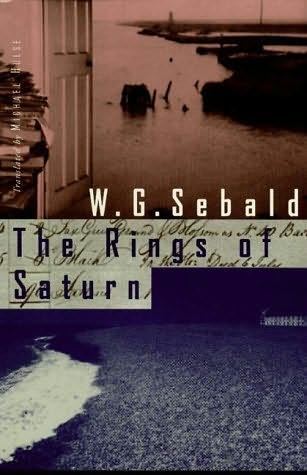
The Rings of Saturn — W.G. Sebald

rings

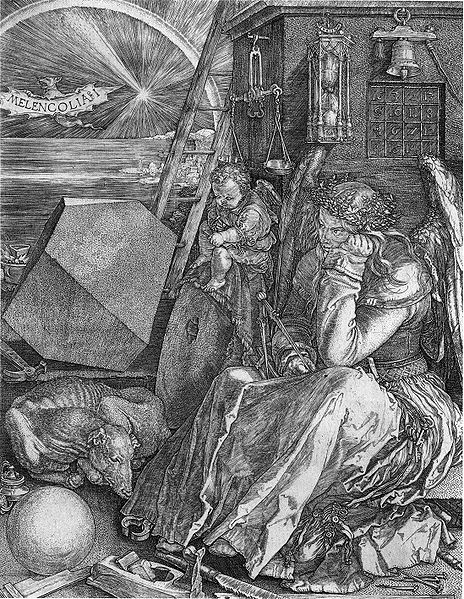
Early on in W.G. Sebald‘s strange and beautiful novel The Rings of Saturn, the erudite narrator (seemingly) offhandedly alludes to Albrecht Dürer’s 1514 engraving Melencolia I. Rings is larded with such references, stuffed to the gills with analysis of history and literature and art (and so much more), but the quick allusion to Melencolia I seems a particularly informative way of interpreting–or at least comprehending–Sebald’s grand, glorious book. Before we begin though, it will be useful to quickly summarize the plot: In 1992, a German intellectual named W.G. Sebald takes a walking tour of the east coast of England. He visits old English manors, the homes of dead writers, decaying seaside resorts, abandoned islands, and many other melancholy spots. In true King Lear style, he wanders the heath a bit. But this walking tour is not the real plot: no, instead, Sebald, in a casual, sometimes wryly humorous, and mostly melancholy tone reflects on the global and historical implications of a host of subjects far too numerous to try to list here. In other words, this is a very smart book about everything.

464px-durer_melancholia_i1

The Rings of Saturn, as its title suggests, is a book about melancholy (Renaissance medical texts identified Saturn with the bodily humor melancholy–black bile–indicated by sluggishness and moroseness, paradoxically paired with an eagerness for action (hence the modern word saturnine)). The melancholy of Rings pervades the whole text and even infiltrates each sentence. Like Dürer’s engraving, Sebald’s text is complexly and richly detailed, overflowing with allusion and symbolic registry that defies simple or easy interpretation. Just as Dürer situates the winged figure of genius at the (slightly off-) center of his image, contemplative yet dreamy, we find Sebald’s narrator to be a flighty genius made forlorn by the world he sees. And yet, just as Dürer’s figure is ultimately ambiguous (is he despondent or merely in the throes of absent fancy? Is he shirking his duty or contemplating a new grand work?) so too does Sebald’s narrator resist any simple interpretation. The narrative bulk of Rings consists of the narrator’s perspectives on history and memory, art and economics, literature and suffering. Like the myriad strange objects that surround the figure of genius in Dürer’s engraving, the connections between the subjects of the narrator’s lessons seem tenuous at first (indeed, several interpretations of Dürer’s piece have argued that it is simply a failed allegorical vision). As the text develops, we begin to see how the narrator’s obsession with, say, Thomas Browne’s skull connects to a biographical account of Joseph Conrad, or early English colonial forays into Imperial China, or reflections on the life cycle of the herring. Like the objects that litter Dürer’s engraving, the narrator’s varied lessons are detailed things, concretizations of history, or art, or literature, or science, and, at the same time–like Dürer’s objects–the narrator’s lessons are also symbols connected to grander abstractions. The work–and joy–of the reader is to link these symbols, these abstractions, into meaning. This is no simple task, but Sebald’s masterful writing ensures that it is a rewarding (and downright fun) adventure.

The flip side to melancholy is the potential energy writhing within its dramatic inertia. The very nature of the narrator’s simple quest–a walking tour–dramatizes this energy; at the same time, the decay and erosion of English coastal life threatens to overwhelm it for good. The narrator’s access to so much human knowledge, both miserable and horrible, attests to the power of history to survive through–but also to paradoxically crush–the living. This paradox of melancholy, dramatized in Dürer’s Melencolia I, is neatly summed up in a line from the first page of The Rings of Saturn (a page I immediately returned to after finishing the book, I must add):

At all events, in retrospect I became preoccupied not only with the unaccustomed sense of freedom but also with the paralysing horror that had come over me at various times when confronted with the traces of destruction, reaching far back into the past, that were evident to me even in that remote place.

In this “remote place,” this forlorn milieu, Sebald’s narrator (Sebald?) again and again uses the lens of history to–again paradoxically–attempt to come to terms with history, both collective and individual.

The result of all this is a wonderful, engaging read, on par with the greatest books I’ve read. Sebald’s command of language, his ability to dip into another’s voice recalls Roberto Bolaño’s great work 2666; Sebald’s narrator, in his will to understand and catalog recalls Ishmael in Melville’s masterpiece Moby-Dick, as does his human sympathy, humor, and sensitivity. At the same time, Sebald’s scope spills out of the conventional borders of what we’ve come to know as the novel. While hardly as dry–or neutral–as a history or science text, Sebald’s narrator’s takes on sericulture, or the life of Joseph Conrad, or the relationship between art museums and the sugar trade of the 18th century all vibrate with an intense truthfulness that informs and engages the reader without ever falling into didactic prattle.

At the end of The Rings of Saturn, Sebald’s narrator returns to Thomas Browne’s skull again–only this time resurrected, a living brain. He discusses at length Browne’s Musaem Clausum, an imaginary library that Browne invented containing texts, artifacts, and relics of every manner of wonder. Sebald’s narrator goes on for pages listing the contents of Musaem Clausum with fervor and passion–the reader realizes that the book, and the narrator, could go on and on, detailing these wonders and their connected histories under more intense scrutiny. Rings replicates both Browne’s Musaem Clausum and Dürer’s engraving, offering readers a tour through myriad marvels–and if the walk is melancholy and strange, it is also profound and beautiful, and very, very rewarding. Very highly recommended.

The 2009 PEN/O. Henry Prize Stories

penab

The short story often gets short shrift. While Hemingway’s “Hills Like White Elephants” is an astounding feat of economy, it’s rarely mentioned in the canon of Hemingway’s masterpieces like For Whom the Bell Tolls. There’s a strong case to be made that Kafka’s little fables are far more perfect than his unfinished novels, and yet The Trial, incomplete as it is, is still considered his finest work. I would take any one of Nathaniel Hawthorne’s Twice-Told Tales over the interminable stuffiness of The Scarlet Letter. There exists, perhaps, a feeling that the short story as art form is incapable of making Grand Gestures or Big Important Statements. Collections that are lauded tend to function (or at least pretend to function) as homogeneous “novels in short story” –which can be great, of course (see Denis Johnson’s inimitable volume Jesus’ Son) — but why should that be? To often, readers dismiss short stories, particularly short stories, as little more than time-fillers, neat little chunks of text to occupy specific moments in time: a subway ride, an term in a waiting room, a spare half-hour. Sometimes we set aside our real Reading Time for those oh-so important novels, so that we might Learn and Grow as a Person (or whatever). And while the tales comprising the 2009 PEN/O. Henry Prize Stories certainly won’t disappoint as time-fillers, they offer so much more than simple leisure reading.

Repeatedly, the stories in this collection explore what is at stake in the human condition, and a sense of loss underpins many (if not most) of the tales. Take the lead story, Graham Joyce’s “An Ordinary Soldier of the Queen,” for instance. This story of a British Army officer who may or may not have been exposed to toxic nerve gas during the first Gulf War unfurls in a realistic, funny, and often affecting voice. Joyce’s tale dips from a military procedural into uncanny, fantastic territory, making the reader question the perception of the narrator, who never wavers in his beliefs about the strange events (namely, meeting a djinn) that are (maybe) happening to him. I thought about “An Ordinary Soldier of the Queen” for days after I read it and I made a colleague read it so that I could force him to discuss it with me. Karen Brown’s “Isobel’s Daughter” also explores loss, communicating the profundity of those everyday tragedies we often look away from. (Brown’s evocation of Tampa, Florida is spot-on, I must add). In “Purple Bamboo Park,” E.V. Slate lets us peer into the life of an old maid in modern China. The story is heartbreaking from the get-go, and yet her protagonist is not a wholly sympathetic character; Slate’s handle on human failure and our investment in mundane adventures is crushing–who knew we could have so much in common with an aging domestic worker? Caitlin Horrocks literalizes loss in “This Is Not Your City,” thrusting her readers into the panic of Russian immigrants whose daughter goes missing. In “The Order of Things,” Judy Troy examines loss and meaning through an affair, concluding that “Feeling came first and though after; that was the order of things,” much to the surprise of her protagonist. And while Paul Theroux’s “Twenty-two Stories” is more playful in both structure and content (it is comprised of twenty-two short short short stories), again we find characters pondering loss and the circumstances of their losses. Theroux’s characters, like those in James Joyce’s Dubliners, repeatedly come to negative epiphanies, whether they lose their faith in God and religion or realize that they were unfit parents. The closing story, Junot Díaz’s “Wildwood” makes me kind of ashamed that I still haven’t read Brief Wondrous Life of Oscar Wao. I will remedy this omission forthwith.

While readers may not love every story collected in The 2009 PEN/O. Henry Prize Stories, it would take a pretty cold automaton to dismiss most of what’s presented here. The project, helmed by editor Laura Furman with jury prize selections by A.S. Byatt, Anthony Doerr, and Tim O’Brien, is really an exploration of how people handle loss and beauty and family and adventure and boredom and all those things that happen in life (and death). And isn’t that what we ask of our literature? Read this book, but give these stories their proper due. They’re more than just time-fillers; each one is a perfectly crafted little world waiting to be explored. Recommended.

The 2009 PEN/O. Henry Prize Stories is available May 5th, 2009 from Anchor Books.

“The Distance from the Moon” — Italo Calvino

We’re loving this very cool animation of Calvino’s short tale “The Distance from the Moon,” from the collection Cosmicomics. This month’s Harper’s features two funny and thoughtful little fables told by Cosmicomic‘s strange narrator Qfwfq , and if you’re too lazy to buy that, check out The New Yorker‘s recent publication of “The Daughters of the Moon.” Presumably these stories will be published in the upcoming volume Complete Cosmicomics. Stay ahead of the curve by reading them now. Special mp3 bonus: actress Maria Tucci reads from Cosmicomics.