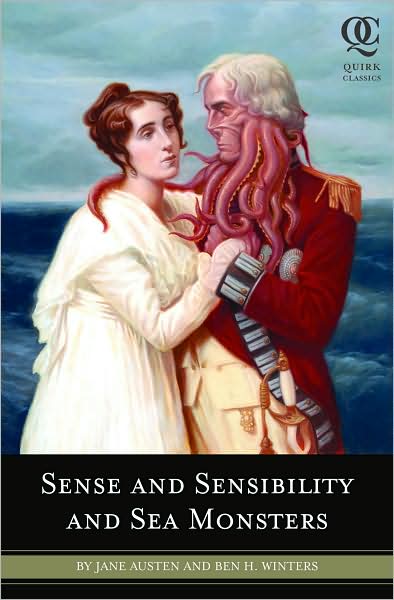
Jane Austen’s Sense and Sensibility is a mannered romance about class and love, family and duty, and the fine balance between logic and emotion. Sense and Sensibility and Sea Monsters adds giant mutant crustaceans, two-headed sea dragons, and rampaging narwhals to the mix. Don’t worry, Sea Monsters still tells the protofeminist tale of the Dashwood sisters, Elinor (sense) and Marianne (sensibility) as they try to navigate the upheaval of their changing fortunes. After their father dies, under the strict (and unfair) laws of primogeniture, the family estate must go to their half-brother and his wicked wife. Co-author Ben H. Winters moves the milieu to a bizarre aquatic world populated by pirates and monsters, full of desert islands and undersea domes. You probably know just by looking at its remarkable cover whether or not this book is for you.
Quirk Classics had a big hit earlier this year with Pride and Prejudice and Zombies, which, uh, added zombies to a Jane Austen classic. In our review of that book, we praised the concept but found the delivery flat. The zombies-and-ninjas riffing seemed a bit trite by 2009–there just wasn’t enough weirdness to make the book especially engaging. In contrast, Winters’s injections in Sea Monsters are wholly bizarre. The disaster of the patriarch’s death–and the loss of inheritance–is metaphorized in the setting, “the Alteration, when the waters of the world grew cold and hateful to the sons of man, and darkness moved on the face of the deep.” Colonel Brandon, a prospective groom with a dark past becomes a betentacled monster here. The entire oppressive system of Regency laws and social customs takes the symbol of a devouring Leviathan, eating up dreams and hopes. In short, Winters takes his conceit beyond mere ironic fancy and actually weaves it successfully into Austen’s classic. Sense and Sensibility and Sea Monsters succeeds because Winters juxtaposes his sea monster tropes so cleanly and weirdly against Austen’s mannered prose without the least bit of ironic winking at the audience. The sheer silliness of it all is beautiful fun.
Sense and Sensibility and Sea Monsters is available September 15, 2009 from Quirk Classics. You can watch the book’s trailer here.
In Pulp’s caustic 1995 anthem “Common People,” singer Jarvis Cocker delivers what has to be one of the best lines in any pop song: “Everybody hates a tourist.” Ironically, I bought the album when I was visiting London as a tourist. I’d never heard of (or heard) Pulp at that point, but our tour guide (it was a high school class trip) told me that they were the best Britpop band to date, better than my beloved Boo Radleys, he assured me. He had great taste; the album is fantastic and “Common People” became a dance party classic (this same tour guide took our entire group of high school juniors, seniors, and chaperons (teachers and parents) to a screening of Trainspotting, which had just come out in Great Britain. Many of the students and chaperons got quite upset, but for me it was kinda sorta life-changing (I was 15 or 16). Later, in Heidelburg, Germany, this same tour guide took a small group of six or seven of us out to one of the coolest bars I’ve ever been to, and laughed about the whole Trainspotting incident. He said he told our teachers that it would be an important “cultural enrichment experience” for us, but in reality it was just a great movie that he thought some of us would like to see).
I realize that this is a long, overly-personal lead-in to a book review, but Clean Breaks, from Rough Guides, embodies the spirit of the trip I discussed above. Richard Hammond and Jeremy Smith’s travel guide is not so much about how to avoid looking like a loathsome tourist, but about how to engage in the real culture of the place you are visiting while getting to know the real people who live there. In this sense, the book is not for everyone, but if you want Disney World or Las Vegas, I’m sure you won’t have any trouble figuring out what to do. However, if you’re interested in, say, hearing the desert music of Mali, or volunteering on a ranch in Brazil’s Patanal wetlands, or fishing for prawns in Kerala, then Clean Breaks is a great starting place for you. As the authors put it in their introduction, a “clean break” is essentially “about minimizing your environmental impact–on your journey and at your destination–by choosing carefully how you travel and the nature of the place you choose to stay at.” To that end, the book concentrates not just on eco-friendly hotels and restaurants that specialize in locally grown food, but also on the type of adventure trekking and activities that put you in real contact with the real people of the place you are visiting. There’s an emphasis on bicycling and walking, guest houses and natural parks, and volunteering.
Again, the adventures in Clean Breaks are certainly not going to be every tourist’s cup of tea, but they aren’t all exactly uncomfortable either. I’m lucky enough to have actually experienced a (very) small fraction of the 500 trips suggested, and can attest to their awesomeness. Taking The Ghan train from Adelaide to Alice Springs, for example, was a highlight of my young life, as was visiting a glacier in the Otago province of New Zealand. And did I mention that there are lots of pretty, pretty colorful pictures and maps accompanying the book’s 500 suggested trips (with key info like email addresses and phone numbers, of course). While Clean Breaks‘s emphasis on “ecotourism” did seem a bit suspect to me at first–just another marketing ploy, perhaps (I’ve attacked the rhetoric of “going green” in the past”)–the authors’ intentions and tone seem wholly sincere. They acknowledge, for example, that terms “such as ‘responsible,’ ‘sustainable,’ and ‘ethical’ are becoming . . . overused (and abused) by websites and tourism companies looking to ride the green wave,” and their repeated emphasis on localism and action over passive “sight-seeing” is admirable. And even though most people will never have the money and time to complete the 500 trip wish-list that Hammond and Smith present here, the book still makes for a great fantasy. Good stuff.
In his essay “In the Ruins of the Future,” published in December of 2001, Don DeLillo wrote this about the 9/11 attacks: “The writer wants to understand what this day has done to us. Is it too soon?” His question was both profound and at the same time, paradoxically utterly banal, purely rhetorical–of course it was too soon to measure the affects of the 9/11 attacks. But could the distance of time somehow sharpen or enrich perspective? DeLillo continues: “We seem pressed for time, all of us. Time is scarcer now. There is a sense of compression, plans made hurriedly, time forced and distorted.”
In retrospect–what with the Bush administration’s ludicrous invasion of Iraq and the power-grab of the Patriot Act–DeLillo’s notation of “plans made hurriedly” seems downright scary. Still, when I think back to those early days after the attacks, I remember that feeling of overwhelming shock, the paralyzing inertia that had to be overcome. DeLillo wanted–needed–to grapple with this spectacular destruction immediately. David Foster Wallace responded with similar immediacy; the caveat that prefaces his moving essay “The View from Mrs. Thompson’s“ states that the piece was “Written very fast and in what probably qualifies as shock.” The same caveat would also apply neatly to Art Spiegelman’s big, brilliant, messy attempt at cataloging his impressions immediately post-9/11,In the Shadow of No Towers.
In contrast, the trio of 9/11 stories at the heart of Chris Adrian’s short story collection, A Better Angel, all employ distance and distortion–both temporal and spatial–as a means to address the disaster (or inability to address the disaster) of the attacks on the World Trade Center. Adrian’s 9/11 tales (and his works in general, really), ask how one can grieve or attest to death on such a massive, spectacular scale. In his vision, the victims of the 9/11 attacks forever haunt his protagonists, literally possessing them, demons that can’t let go, leaving the living to grieve over and over again. In “The Changeling,” for example, the grief of the attacks is literally measured in blood, as a father repeatedly maims himself as the only means to assuage the terror and confusion of his possessed son. Adrian sets one of the collection’s most intriguing tales, “The Vision of Peter Damien,” in nineteenth-century rural Ohio. This temporal distortion veers into metaphysical territory as the titular Damien, along with other children in his village, become sick, haunted by the victims of 9/11. Adrian’s strange milieu creates a bizarre cognitive dissonance for his readers, a response that DeLillo also articulated in his 2007 novel Falling Man.
DeLillo initiates the novel as a sort of creation story: “It was not a street anymore but a world, a time and space of falling ash and near night.” The demarcation of this new world recapitulates DeLillo’s initial concern with time and space, but his novel seems ultimately to suggest an inertia, a meaninglessness, or at least the hollow ambiguity of any artistic response. This stands, of course, in sharp contrast to his sense of urgency in his earlier essay. Like the performance artist in the novel who is repeatedly sighted hanging suspended from a harness, there’s a sad anonymity in the background of Falling Man: the artist hangs as static witness to disaster, but looking for comfort, or even perhaps meaning, in the gesture is impossible.
David Foster Wallace’s short story“The Suffering Channel,” (from his 2004 collection Oblivion) is in many ways a far more satisfying jab at 9/11, although, to be fair, the majority of the story’s events take place in July of 2001. The story (or novella, really; it’s 90 pages) centers around a magazine headquartered in the World Trade Center that plans to run an article–on September 10th, 2001–about a man who literally shits out pieces of art. Wallace’s critique of American culture (shit as art, commerce as style, advertising as language) is devastating against the context of the looming disaster that his characters are so oblivious too. As the novella reaches its close (culminating in the shit artist producing an original work for a live audience), we learn more about “The Suffering Channel,” a cable channel devoted to broadcasting only images of human beings suffering intense and horrible pain. Wallace seems to suggest that The Suffering Channel’s audience watches for mere schadenfreude or morbid fascination, that modern American culture so disconnects people that genuine suffering cannot be witnessed with empathy, but only as a form of spectacular, disengaged entertainment. And yet even as Wallace critiques American culture, the specter of the 9/11 attacks ironically inform his story. With our awful knowledge of what will happen the day after the shit artist article is published, we are able to see the ridiculous and ephemeral nature of the characaters’ various concerns. At the same time, Wallace’s tale reveals that empathy for suffering is possible, but also that it comes at a tremendous price.
To contrast the journalistic immediacy of pieces like “In the Ruins of the Future” and “The View from Mrs. Thompson’s” with their respective writers attempts to measure 9/11 in literary fiction is perhaps a bit unfair. Still, Wallace’s and DeLillo’s essays–at least in my opinion–transmit something of the ineffable, visceral quality of that terrible day, as well as the strange ways we sought comfort through human connection. In contrast, the distance and distortion of their literary efforts lose something. I apologize–I don’t have a word for this “something” that the essays have that the novel and novella lack (purposely, I believe). It’s not clarity, but perhaps it’s a clarity of distortion that the essays convey, the duress, or to return to Wallace’s own notation, the pieces were of course “Written very fast and in what probably qualifies as shock.” It’s that shock, I suppose, that I’m trying to name, to say that it’s still there, accessible in those early responses (I realize now I’ve unfairly neglected Spiegelman’s book, which is a great example of immediacy). And to relive that shock is important, because, as Wallace reveals in both of his pieces, the cathartic power of shared tragedy makes us human, allows us to really live, and to be thankful that we do live.
Looking over this piece, I realize that it’s overly long and really says nothing, or at least nothing much about 9/11, or literature, or whatever. But I don’t want to be negative. I highly encourage you to read (or re-read) “The View from Mrs. Thompson’s” and “In the Ruins of the Future.” And I’ll leave it at that.
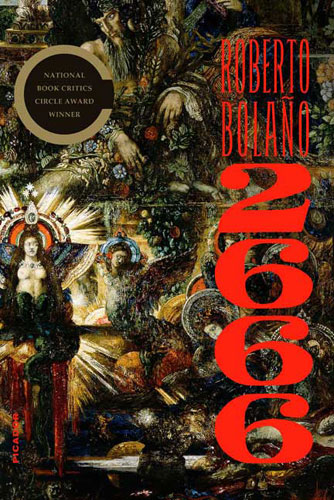
Any bibliophile can attest that one of the greatest pleasures of re-reading a favorite book is that it doesn’t change. You change, but it doesn’t, and somehow, you can measure your own change against it. So when Picador’s new single-volume trade paperback edition of Roberto Bolaño’s magnum opus 2666 (out today) showed up at my doorstep a week or two ago, I was thrilled. I already own the book, but having another copy of it, for some reason–no logical reason, of course–seemed really important. It also puts 2666 in good company: I own two (or more) copies of Moby-Dick and Ulysses, and I’ve had to buy at least three copies of David Foster Wallace’s Infinite Jest (damn biblioklepts don’t return books). I bought FS&G’s triple trade paperback edition of the book at the end of last year, and I loved it loved it loved it (review here if you don’t believe me). So how does the new single-volume edition differ, you ask? Well, first off, it’s important to note the gracious similarities–Picador’s edition retains the same pagination, a trend that I hope will always continue with this book (editions of Infinite Jest have managed to keep cohesive to date as well). The new trade paperback is surprisingly supple and portable, with wider margins than the FS&G triple-job. With more room for marginalia in the cohesive package of a single volume, Picador’s edition will likely be the go-to for scholars and book clubs (it’s also about half the retail price of the FS&G editions, but just as attractive).
So, anyway, why should you read 2666 if you haven’t already? I’m going to be lazy and refer again to my original review, but I’ll also be generous and direct you to Macmillan’s resource site for 2666. The site already has plenty of great links to full reviews and interviews with Bolaño, and Picador’s publicists have assured me that they will be updating the site frequently with additional content to aid readers, including artwork and images. Also really cool — the folks at The Morning News, who host Infinite Summer, the Infinite Jest reading project, will launch a similar site for 2666 on January 1st of next year. Even though I’m pointing out all of these resource sites, I think it’s also important to note that 2666 is an incredibly readable book. Which leads back to my current re-reading–and, hopefully, to an argument why you should re-read 2666.
So I bought my original copy in San Francisco last year, on vacation, and began digging into it on the plane ride home. I read most of Part I, “The Part about the Critics” in something of a dazed post-hangover travel stupor. I was familiar with Bolaño’s epic sentences from The Savage Detectives, but I instantly liked this book better. It also seemed to defy all of my expectations–wasn’t this supposed to be an unremitting catalog of horrific murders? Anyway, I got to that part later. Fast forward ten months or so. Again, I’m on a plane, again, coming home, returning from Las Vegas, more dazed, more hungover than before, and I pick up 2666, and again, I dig into Part I. The book is a different book. Lines that made me crack up before seem sinister. I see murder where I’d seen academic squabbling. But there’s also that hope, that possibility, that force of humanity that might be Bolaño’s signature rhetorical move, and I see it too now. Upon a first reading, 2666 might seem impossibly incomplete: a book that could never end, a book that would have to keep going. And it is. It’s a cycle; it returns to itself, a series of calls and responses far richer than can be puzzled out over one, or two, (or three, or four . . . ) readings. But best of all, it’s great, greater than before. What might have seemed a fortunate fluke of a forceful voice reveals itself to be profound and measured control–Bolaño’s themes are layered like a labyrinth, but what a joyful labyrinth to traverse! Re-reading 2666 on the plane was a strange echo, doubled in the myriad echoes that I found on my re-reading. I finished most of Part I (skipping occasionally into sections of Part V, and then Part III, and so on, liberated all of a sudden), and when I got home, despite the paramount exhaustion of a long Las Vegas weekend with a few dozen friends, I collapsed in my bed and into the book, not wanting to put it down, staying up far too late reading. Again. Great stuff. Go get it if you haven’t yet, and if you’ve got it, read it again.
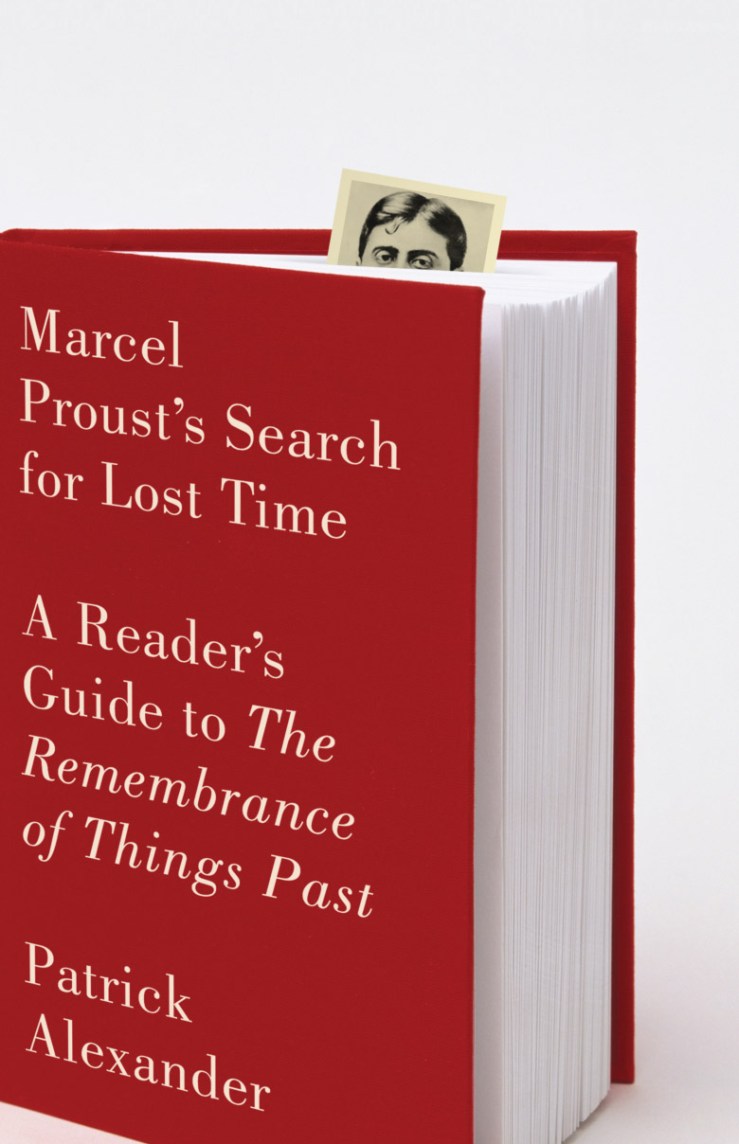
In his introduction to his reader’s guide to Proust’s In Search of Lost Time, Patrick Alexander observes that “Except for those fortunate enough to spend several years confined to a hospital bed, a federal prison, or to be stranded on a desert island with their preselected library, few modern readers have the time to tackle a novel with more than three thousand pages, a million and a half words, and more than four hundred individual characters.” Alexander goes on to point out that “Proust’s novel is increasingly read only by professional academics,” a trend he describes as a “great pity.” Alexander wants you to be able to access all the philosophical insight and rich humor of Proust, and his book Marcel Proust’s Search for Lost Time makes a great starting point for doing so.
The first of the three sections that comprise Alexander’s book, “What Happens in Proust,” summarizes the seven novels that form Proust’s great work In Search of Lost Time (sometimes translated as Remembrance of Things Past). This is easily the largest section of the book. Alexander summarizes the novels, and contextualizes their themes against their historical and social milieu. Alexander’s second section, “Who’s Who in Proust,” will likely be most useful for readers trying to keep track of the many (many, many) characters in this opus. The final section, “The World of Proust,” situates Proust’s place in Paris, French history, and modern literature. As Alexander points out himself, the book will appeal to three types of readers: those who want to read Proust but are daunted, those who are currently reading Proust and wish for a guide to keep track of all the places and names, and those who wish to return to Proust.
Alexander’s project is ambitious, and guidebooks are always an iffy business of course. I found Harry Blamires’s The New Bloomsday Book, probably the most famous guide for James Joyce’s Ulysses, to be an interminable bore, whereas Joseph Campbell’s lectures on the same subject are indispensable. There’s really a fine balance to be achieved I suppose. I’m currently making my way through another big book (okay, not as big as Proust’s), William Gaddis’s The Recognitions, and so far,Steven Moore’s A Reader’s Guide to William Gaddis’s The Recognitionshas proven to be a valuable resource when I need it. It manages to provide analytical insights and explications of all the many (many, many) allusions in Gaddis’s massive tome without ever being intrusive. Similarly, Alexander understands that a guide should never step on toes. His clean, lucid style is both humorous and realistic, and he’s never overly-reverential of Proust, but respectful at all times toward both his favorite author and his readers. Alexander’s real goal is not to paraphrase Proust, but, like all good critics, to try to get you to read the material. I never got past the first forty pages of Swann’s Way, the first book of Lost Time, but Alexander’s book makes me want to go back and give it another shot.
Marcel Proust’s Search for Lost Timeby Patrick Alexander is available from Vintage books on September 22nd, 2009.
I spent a few hours cleaning up/out the office today. Hundreds and hundreds of books. Here are a few scans of old favorites, cool covers, and some I didn’t know I even had, like this one:
No memory of acquiring this book at all. Dig the cover though. Here’s another one with a cool cover the origins of which are dim:
Probably a remainder from my high school’s library, like this book about our Fair Florida:
I’m pretty sure that the fort here is meant to be the fort in Old St. Augustine. As a Floridian, I will attest that this image captures the essence of Florida life. Lovely.
Jock of the Bushveld was one of my favorite books as a kid. I actually used to live in the part of South Africa depicted in this book. Sorta. My dad bought me this book.
Cat’s Cradle is one of my favorite books. My copy is clearly in terrible shape. The cover disappeared years ago. I think my cousin gave me this book.
I know I swiped this one from my cousin: Anthony Scaduto’s biography of Bob Dylan. I’ve read this book probably more than any other nonfiction book I own. A lot of my friends have read it too, and remarkably, it’s always made it’s way back. Not sure when the cover went MIA. Apparently, I forged Dylan’s autograph on the upper right. I’m sure there was a joke behind this at some point.
I haven’t written about an honest-to-God book theft in awhile. I stole this book from a large corporate book store when I was sixteen or seventeen. It’s pretty small. I think I just put it in my pocket. It was easy and I got a thrill from the experience. That said — kids, don’t steal stuff!
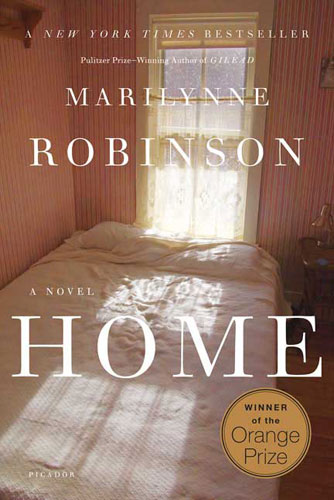
Home, Marilynne Robinson‘s follow-up to her 2004 Pulitzer Prize winning novel Gilead, tells the story of Jack Boughton, the miscreant prodigal son of Reverend Boughton (narrator of Gilead). Jack returns home after twenty years of petty theft and carousing to find his father dying and his sanctimonious sister Glory coping with a broken heart. Robinson handles the pain and secrets of the Boughton family in prose that is both spare and beautiful; there’s a simplicity here that belies the extraordinary spiritual puzzles into which Robinson’s characters delve. The result is that odd rarity: a literary novel of complexity and depth that’s also an ease and pleasure to digest, even in all its bitterness. Home is available in trade paperback from Picador September 8th, 2009.
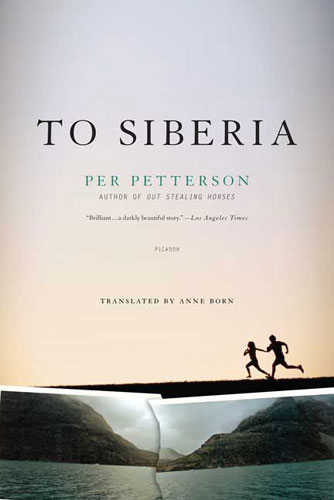
Also new in trade paperback from Picador on September 8th is Per Petterson’s novel To Siberia. Translated by Anne Born, To Siberia is the story of a Danish girl who lives in the isolated northernmost Jutland peninsula. Wishing to escape her neglectful parents and suicidal grandfather, she dreams of exotic Siberia. Set during the WWII Nazi occupation, To Siberia rhetorically mirrors the grim, cold reality of that era. Petterson delivers his tale in a crisp, almost brittle manner. There’s a translucence to the prose, a Nordic frankness that makes Petterson’s presentation of the girl’s infatuation with her older brother Jesper doubly strange. Her love and desire for him veers toward almost mythical incest, yet Petterson’s restraint reins in even the barest hints of hyperbole, leaving the reader to her own inferences. Like the grim story of Hans and Gretel, or the story of the tin soldier and his beloved ballerina, To Siberia is painful in its bleakness, but also beautiful in its imaginative underpinnings.
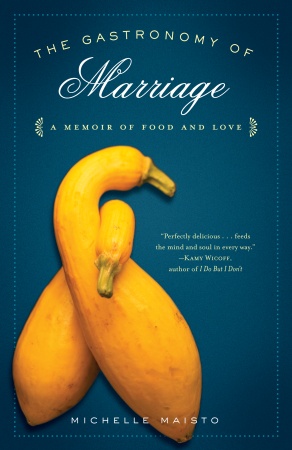
Michelle Maisto’s memoir The Gastronomy of Marriage, a Random House trade paperback original available September 8th, 2009, tells the story of Michelle’s courtship and marriage with her husband Rich, using the dining table as a lens to examine romantic relationships. Like many recent books about food, Gastronomy is interspersed with recipes, some of which sound pretty good (like the one for artichoke pie). Maisto’s is a memoir about planning for a wedding, told from a female perspective, and it might not have the widest appeal for many male readers, but it is well-written, if light, fare.
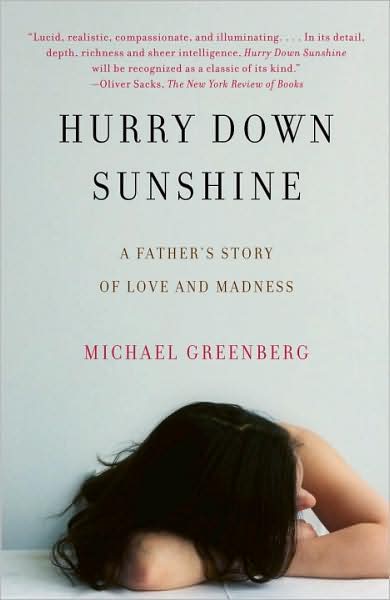
Far heavier is Michael Greenberg’s memoir Hurry Down Sunshine. Released in hardback last year to high critical acclaim, Greenberg’s memoir relates the true story of his daughter’s manic breakdown and subsequent committal to a mental hospital. Written in a spare, even terse style, with present-tense immediacy, Greenberg telegraphs his despair and frustration about his daughter’s condition with harrowing results. Greenberg even waxes a little on James Joyce’s own troubles with his daughter Lucia, as well as the poet Robert Lowell‘s bouts of manic depression.Literary angles aside, the book is not so much about his daughter’s mental condition, in the end, as it is about his own challenges as the parent of an ill child. Hurry Down Sunshine is available in trade paperback from Vintage books, September 8th, 2009.
I think I did a similar post two years ago. I teach, I gotta go back to school, the fall, the kids, blah, blah, blah. Anyway. I’ll try to get one proper book review out per week. I’ve got seven or eight really choice looking promo copies and galleys stacked up here, including new trade paperback editions of Marilynne Robinson’s Home and Per Petterson’s To Siberia. Vintage also has a really cool original by Patrick Alexander coming out in September; it’s called Marcel Proust’s Search for Lost Time and its subtitle, A Reader’s Guide to The Remembrance of Things Past pretty much sums it up. I’ve read the first 100 pages and it’s really great, and let’s face it, unless some kinda windfall happens where I can just read books all day, I’m never gonna get around to Proust, so, yeah, this’ll have to do. Proper reviews forthcoming, blah, blah, blah. (Even though William Gaddis’s The Recognitionsain’t gettin’ no shorter).
Waltz Rulz
While I’m doing lazy reviews, let me just say that Quentin Tarantino’s latest film, Inglourious Basterds is a glorious bastard of a mixed-up masterpiece. Christoph Waltz steals the show as SS Col. Hans Landa, but the real star, as usual, is Tarantino’s sense of cinema (whatever that means; c’mon, I was upfront, this is lazy reviewing). Plenty of folks have kinda sorta hated on (or outright hated on) this film, but I loved it. A revenge film about cinema posing as a Western faking as a WWII flick. Great stuff.
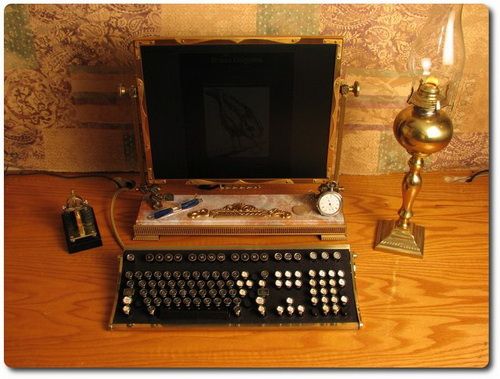
The last time I did one of these hacky “Back To School” posts, I brought up William Gibsonfor some reason–which gives me a good transition to this excellent steampunk photoset. While Gibson’s novel The Difference Engine (with co-author Bruce Sterling) is often cited as a progenitor of steampunk, many of the images in the set correspond to ideas Gibson put forth in his “Bridge Trilogy” — he envisioned a future of “organic” computers that some of these folks have gone out and made. I’d like one. Jeez, this is really bad writing, but, hey, back to school right. Like that Deftone’s song (yeah, I know the Deftones aren’t cool or hip or whatever, and I’ve never heard one of their albums, but M2 used to play that video all the time when I was in college 10 years ago and I thought it was pretty great).Cheers.
I just love this passage from William Gaddis’s The Recognitions. Mocking “hipsterism” has been around forever (or at least 50 years):
And by now they were at the door of the Viareggio, a small Italian bar of nepotistic honesty before it was discovered by exotics. Neighborhood folk still came, in small vanquished numbers and mostly in the afternoon, before the two small dining rooms and the bar were taken over by the educated classes, an ill-dressed, underfed, overdrunken group of squatters with minds so highly developed that they were excused from good manners, tastes so refined in one direction that they were excused for having none in any other, emotions so cultivated that the only aberration was normality, all afloat here on sodden pools of depravity calculated only to manifest the pricelessness of what they were throwing away, the three sexes in two colors, a group of people all mentally and physically the wrong size.
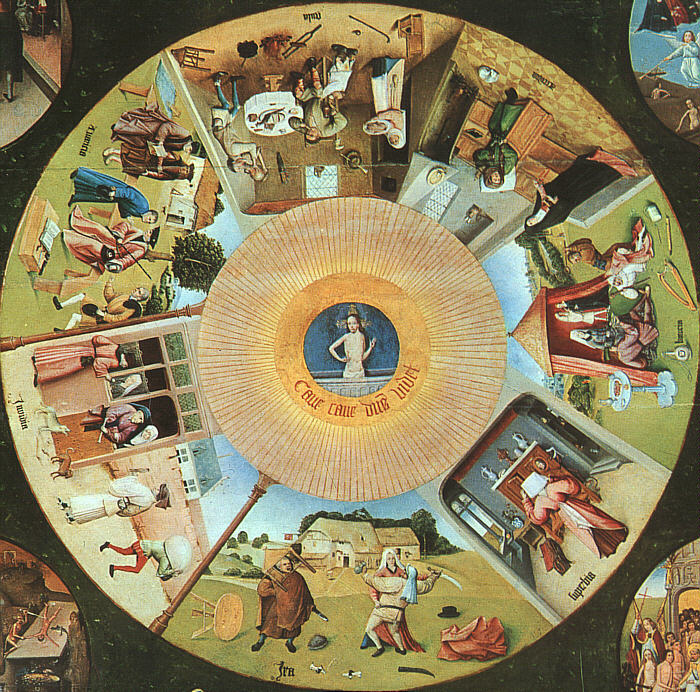
In William Gaddis‘s massive first novel, The Recognitions, Wyatt Gwyon forges paintings by master artists like Hieronymous Bosch, Hugo van der Goes, and Hans Memling. To be more accurate, Wyatt creates new paintings that perfectly replicate not just the style of the old masters, but also the spirit. After aging the pictures, he forges the artist’s signature, and at that point, the painting is no longer an original by Wyatt, but a “new” old original by a long-dead genius. The paintings of the particular artists that Wyatt counterfeits are instructive in understanding, or at least in hoping to understand how The Recognitions works. The paintings of Bosch, Memling, or Dierick Bouts function as highly-allusive tableaux, semiotic constructions that wed religion and mythology to art, genius, and a certain spectacular horror, and, as such, resist any hope of a complete and thorough analysis. Can you imagine, for example, trying to catalog and explain all of the discrete images in Bosch’s triptych, The Garden of Earthly Delights? And then, after creating such a catalog, explaining the intricate relationships between the different parts? You couldn’t, and Gaddis’s novel is the same way. I’ve finished the first of the novel’s three parts, 277 of 956 pages, and I’m going to go out on a limb and guess that the Gaddis has structured the novel as a triptych. The first part, like Bosch’s painting, The Seven Deadly Sins, is comprised of seven sections.
The Seven Deadly Sins – Hieronymous Bosch
Early in The Recognitions, teenage Wyatt copies The Seven Deadly Sins–his father owns the original, a painted table top he purchased in Europe. Wyatt replaces the original with his own and gets away with this strange crime–no small feat considering the genius of his father, the Rev. Gwyon, a New England priest who, after the death of his wife at sea, comes to reject the austere puritanism of his order and embrace (much to the consternation of his dwindling congregation) a pluralistic religious world view. In one of many stunning passages centering on Gwyon and religion, the congregation is “stirred with indignant discomfort after listening to the familiar story of virgin birth on December twenty-fifth, mutilation and resurrection, to find they had been attending, not Christ, but Bacchus, Osiris, Krishna, Buddha, Adonis, Marduk, Balder, Attis, Amphion, or Quetzalcoatl.” This series of substitutions enacts a chain of recognitions, and, in a sense, compartmentalizes much of the thematic material of the novel: What is it to be a hero, a redeemer, a savior? What is originality, and how does one recognize it? Who originates whom? What does it mean to create? How is art separate from religion? Clearly, these are not simple questions, and The Recognitions is not a simple book.
Triptych with the Martyrdom of St. Hippolytus — Dierck Bouts and Hugo van der Goes
In order to pose (and perhaps offer varying answers to) these questions, Gaddis employs daring, richly detailed prose, larded with esoteric (and not so esoteric) references to mythology, religion, art, music, and literature. Like the discrete sections of Bosch’s Sins, each of the chapters of the first section of The Recognitions has its own distinct idiom, comportment, and rhythm; yet, even as Gaddis’s approaches seem discontinuous from chapter to chapter, these coalesce to a larger picture.
The first chapter is the best first chapter of any book I can remember reading in recent years. It tells the story of Rev. Gwyon looking for solace in the Catholic monasteries of Spain after his wife’s death at sea under the clumsy hands of a fugitive counterfeiter posing as a doctor (already, the book posits the inherent dangers of forgery, even as it complicates those dangers by asking who isn’t in some sense a phony). There’s a beautiful line Gaddis treads in the first chapter between pain, despair, and melancholy and caustic humor, as Gwyon slowly realizes the false limits of his religion. The chapter continues to tell the story of young Wyatt, growing up under the stern care of his puritanical Aunt May, whose religious attitude is confounded by the increasingly erratic behavior of Wyatt’s often-absent father. While deathly ill, Wyatt teaches himself to paint by copying masterworks. He also attempts an original, a painting of his dead mother, but he cannot bear to finish it because, as he tells his father, “There’s something about . . . an unfinished piece of work . . . Where perfection is still possible. Because it’s there, it’s there all the time, all the time you work trying to uncover it.” This problem of originality, of Platonic perfection guides much of the novel’s critique on Modernism.
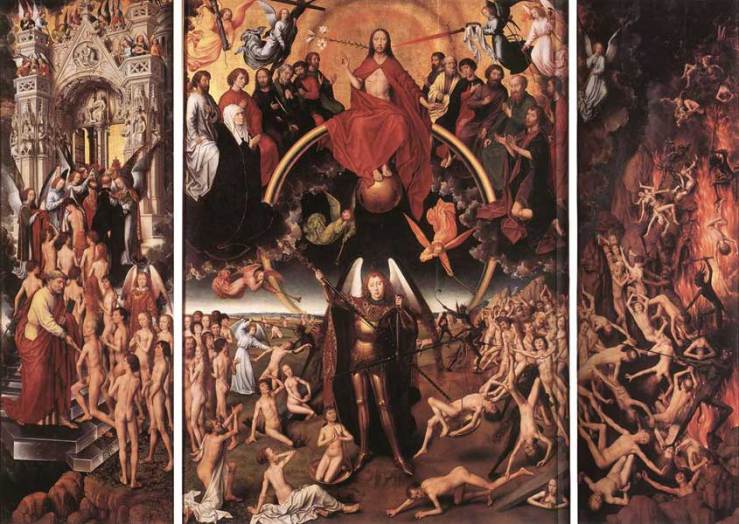
The Last Judgment – Hans Memling
Wyatt studies but ultimately rejects the ministry, opting instead to become an artist. The second chapter finds him in Paris, attempting to sell his original work. The chapter is a bravura shift into the sounds, sights, and consciousness of another world, another distinct mythology–ex-patriot Paris, Hemingway’s Paris, Woolf’s Paris. Gaddis shows a heavy debt to James Joyce‘s innovations in Ulysses here (and throughout the book, of course), although it would be a mistake to reduce the novel to a mere aping of that great work. Rather, The Recognitions seems to continue that High Modernist project, and, arguably, connect it to the (post)modern work of Pynchon, DeLillo, and David Foster Wallace. (In it’s heavy erudition, numerous allusions, and complex voices, the novel readily recalls both W.G. Sebald and Roberto Bolaño as far as I’m concerned). By the third chapter we find Wyatt married, quite unhappily, producing hack work, copies he lets his boss put his name on. The chapter is painful and often ugly, as we see his marriage disintegrate. In this chapter he meets Recktall Brown, the Mephistophelean business man who will arrange Wyatt’s future career as a counterfeiter of original paintings. As the chapter ends, Wyatt is no longer referred to by his name, a device that continues throughout the rest of part one (and perhaps the whole book). It’s as if he’s lost something intrinsic, some core originality in exchange for the ability to “become” the artist he is emulating. Wyatt now disintegrates into the background of the narrative, and is exchanged for a young Harvard grad named Otto. Otto follows Wyatt around like a puppy, writing down whatever he says, absorbing whatever he can from him, and eventually sleeping with his wife. Otto is the worst kind of poseur; he travels to Central America to finish his play only to lend the mediocre (at best) work some authenticity, or at least buzz. He fakes an injury and cultivates a wild appearance he hopes will give him artistic mystique among the Bohemian Greenwich Villagers he hopes to impress. In the fifth chapter, at an art-party, Otto, and the reader, learn quickly that no one cares about his play–everyone’s busy making their own original art. Gaddis’s evocation of a Village party in the late forties/early fifties here is wonderful, fly-on-the-wall stuff. His rhetoric captures the buzzing musicality of a raucous house party, and even if his mockery of the assembled artists, critics, and wannabes is savage, it’s also loving. Gaddis has an astute ear for the mid-twentieth century, where gossip infiltrates debate on aesthetics, and commercials punctuate classical scores on the radio.
Wyatt (unnamed) returns for the seventh (and longest) chapter of part one. He’s been very successful at his work, although he seems not to care at all for the money he’s making. Instead, he seems obsessed with channeling these ancient masters, for only in this pre-modern world is originality possible. Of course, the levels of irony are confounding here: Wyatt’s only access to originality is to pretend to be another person. The originality of the paintings he creates is subject to the condition that they be not original to him (their creator) but to another. While this attack on Modernity–namely, that originality is impossible–is severe, it’s also worth noting that Gaddis’s writing enacts originality, even as it cobbles together disparate sources. This is what makes the novel such an addictive pleasure to read. While I cannot make any final claims about a novel before finishing it, I will go out on another limb and suggest that those who already own this novel and have not yet made a crack at it for fear of its massive size and allusive structure should go ahead and take it up: it’s dark, erudite, sad, and very, very funny. It’s also not that hard to read, and if the allusions get too dense, there’s always Steven Moore‘s fantastic resource, A Reader’s Guide to William Gaddis’s The Recognitions, now available in its entirety online. Have at it. More when I finish Part II.
Thomas Pynchon‘s latest novel, Inherent Vice is loaded with musical references–the radio’s always buzzing, bands are always hammering out jams, and hero Doc Sportello is always singing a verse or two. Wouldn’t it be cool if someone would take the time to make a playlist of all the tunes in the book? Okay, that was a lame set-up. Obviously somebody did take the time, and according to the text accompanying the original list at Amazon (yeah, I’m shamelessly cutting and pasting and also saving you time), “the playlist that follows is designed exclusively for Amazon.com, courtesy of Thomas Pynchon.” Hmmmm…wonder if Pynchon made the list himself–after all, he writes his own book jacket blurbs, and he even narrated the trailer for Inherent Vice. Pretty cool. Links go to downloads (not free, sorry) or artist pages. In cases of no links, the band or artist is one of Pynchon’s original creations (although we’d really, really love to hear “Soul Gidget,” or really anything by Meatball Flag). Bonus vid after the list.
Prejudices up front: not only did I attend the University of Florida, but so did my parents, my wife, and many of my lifelong friends. I was raised on Gator football, and some of my family members, when cut, are known to bleed orange and blue. I think that Tebow is something of a national treasure (surely, had not Clinton succeeded in freeing journalists Euna Lee and Laura Ling from a North Korean labor camp, we would’ve sent Tebow), and I acted like a silly fool when I got to meet Urban Meyer last year (he was recruiting players at the high school where I teach English). Not only am I predisposed to liking a book like Historic Photos of University of Florida Football, I also happen to be a former student of the author, University of Florida professor Kevin McCarthy (I will never forget him calling me over to his desk after class one morning, poking me in the chest and commanding me, “Come to class!”).
So, yeah, it’s possible that I’m enthusiastically biased about a book combining archival photos of the Gators with insightful text and captions. Fans of the Florida State Seminoles probably know that this book isn’t for them upfront, but that’s okay. True Gator fans will not be disappointed. Historic Photos of University of Florida Football (new from Turner Publishing) is as much a history text is it is a survey of Gator football, following a team from its humble origins at the turn of last century (McCarthy informs us that “its 1904 team in Lake City was outscored 224-0,”) to its present glories as National Champions.
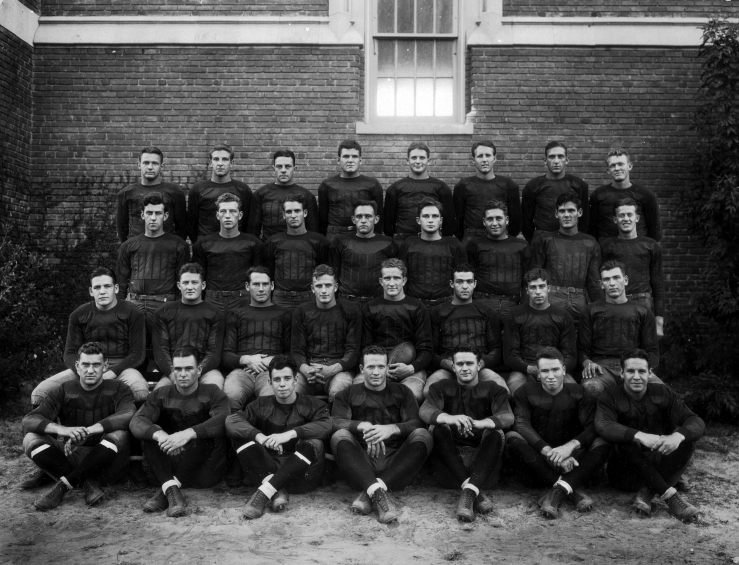
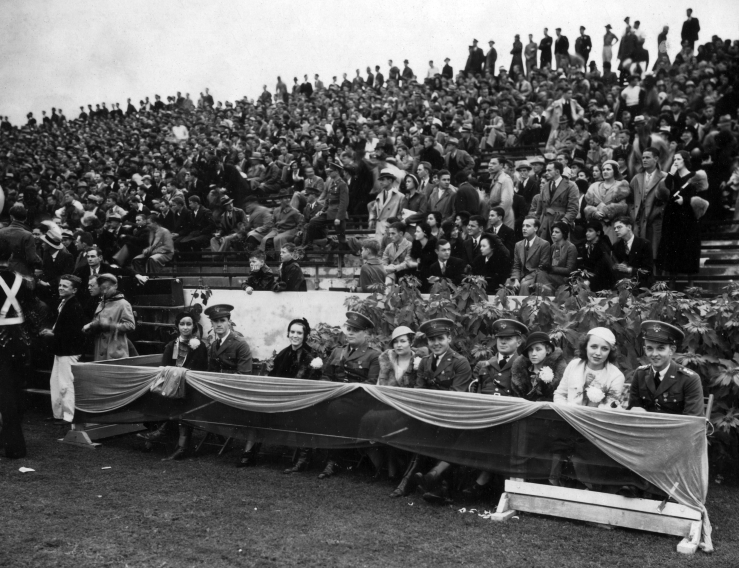
1930 UF Homecoming
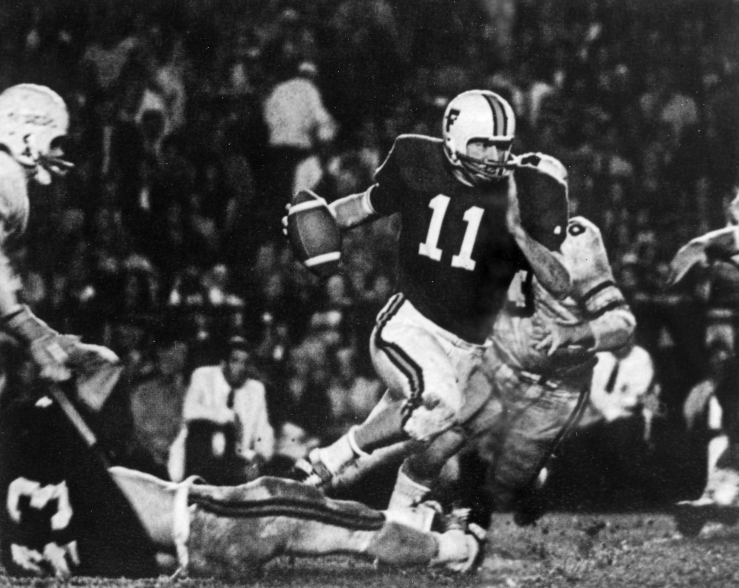
Most of the book chronicles the early days of Florida football (over half of the 200 images date from before 1960), and while some fans might be disappointed in a lack of more recent photographs, it’s worth pointing out that in our current media-saturated age it’s not so hard to come by these. Far more interesting are pics of the old days, with sweatered all-male cheerleading squads, bulky leather helmets, and folks dressed up to the nines to go to a football game (if you’ve ever lived in Gainesville you know that even in October a suit jacket, let alone a tie and pants, are pretty uncomfortable). Many of these photos capture the energy and intensity of the game, as well as a sense of nostalgia for a time when college football wasn’t so commercialized.
Steve Spurrier, 1965
The images collected here transmit a love for both the Florida Gators, as well as a sense of respect for the traditions of college football in general. As the Gators’ indomitable legacy grows, surely this book will one day be referred to as “Volume I,” as there are plenty more touchdowns to be scored, games to be won, and historical moments to be made. Recommended for Bull Gators everywhere.
About the same time I was finishing up James Wood’s How Fiction Works, I was also beginning William Gaddis‘s massive tome The Recognitions. So far the book is fantastic–I’m about 180 pages in–but it’s (very, very) long and there’s a big stack of upcoming releases here that needs to be digested for review, so who knows if I’ll finish it anytime soon. Anyway, I thought this notation from William H. Gass‘s brilliant introduction does a fantastic job of speaking to both the limits of literary criticisms (like Wood’s) as well as underscoring the value of reading–and rereading:
No great book is explicable, and I shall not attempt to explain this one. An explanation–indeed, any explanation–would defile it, for reduction is precisely what a work of art opposes. Easy answers, convenient summaries, quiz questions, annotations, arrows, highlight lines, lists of its references, the numbers of its sources, echoes, and influences, an outline of its design–useful as sometimes such helps are–nevertheless seriously mislead. Guidebooks are useful, but only to what is past. Interpretation replaces the original with the lamest sort of substitute. It tames, disarms. “Okay, I get it,” we say, dusting our hands, “and that takes care of that.” “At least I understand Kafka” is a foolish and conceited remark.
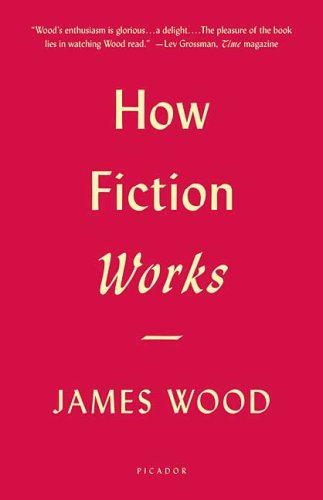
Literary critic and Harvard professor James Wood’s How Fiction Works, new in trade paperback from Picador, argues that “fiction is both artifice and verisimilitude, and that there is nothing difficult in holding together these two possibilities.” This thesis is rather broad, and really not so controversial; I’d certainly agree with it. It’s when Wood goes about showing how fiction successfully or unsuccessfully artfully represents reality that I find myself shouting at his text.
Not that I didn’t know that we were going to butt heads (to misapply a metaphor) before I began reading. After all, I was familiar enough with Wood’s aesthetic approach to literary criticism, one that eschews any notions of ideological underpinnings of a novel. In concrete terms, this means that all those discourses so (apparently) fashionable in English departments are out–you know, Marxist critiques, French deconstruction, post-colonial studies, gender readings, all that stuff. How wonderfully freeing for Wood to dispense with the baggage of history and ideology! Of course, certain novelists have felt the need to respond to these ideas, even if Wood hasn’t, leading our critic to deride a whole “genre” of “hysterical realism.” I happen to like a lot of this so-called “hysterical realism”: Pynchon, DeLillo, and David Foster Wallace spring to mind (Wood takes Wallace to task a few times in How Fiction Works, arguing that Wallace’s pseudo-business speak in “The Suffering Channel” is “fairly ugly, and a bit painful for more than a page or two”). Wood’s attack on “hysterical realism” centers on his claim that such novels privilege a (failed) attempt at a global, historical perspective at the cost of intimacy and human communication. The aesthetics here, for Wood, are precisely about how to accurately and intimately portray the world. To this end, Wood, favors writers like Henry James, Gustave Flaubert, and Chekov, and he spends much of How Fiction Works illustrating how marvelously these writers employ what he calls “free indirect style,” a type of narration where the lines between author’s and the character’s language are perfectly blended.
That Wood spends so much time on Flaubert and James (he devotes five pages to the latter’s ingenious use of the adverb “embarrassingly”) is telling when one considers the authors not represented in this book. While no literary critic should be condemned for not including every writer under the sun, it would be helpful if a book ostentatiously titled How Fiction Works took a look at something besides the work of dead white men. But there I go again, suggesting that ideology has some function in literature. Maybe I’m reaching here–to be fair, if Toni Morrison doesn’t even warrant a mention in Wood’s canon, then neither does Nathaniel Hawthorne (in fact, How Fiction Works is remarkably light on American writers in general–Melville only warrants a passing mention).
More disturbing than Wood’s limited pool of authors is his disingenuous claim that this book is for a common, everyday reader. With a hint of the anxiety of influence, he remarks that his hero Roland Barthes “does not write as if he expects to be read and comprehended by any kind of common reader,” but it must be noted that Wood will have lost anyone not fairly conversant with the history of literature by his first twenty pages.Hopefully, students new to literature will avoid Wood’s book and read something friendlier and more helpful, like Thomas C. Foster’sHow To Read Literature Like a Professor.
Did I forget to mention in all of this that I liked reading this book? Like most people who love to read, both academically and for pleasure, I like a good argument, and Wood’s aesthetic criticism is a marvelous platform for my ire, especially in a world that increasingly seems to not care about reading fiction. Wood is a gifted writer, even if his masterful skill at sublimating his personal opinion into a front of absolute authority is maddening. There’s actually probably more in his book that I agree with than not, but it’s those major sticking points on literary approaches that stick in my craw. It’s also those major sticking points that make the book an interesting read. I’d like to think that I’m not interested in merely having my opinions re-confirmed. I’d recommend How Fiction Works with the caveat that the reader not fall victim to Wood’s forceful rhetoric, to the erroneous assumption that Wood’s aesthetic values somehow trump one’s own. Read this book, but don’t mistake it for a substitute for the real education that great novels can provide. “I am really talking about the real, which is at the bottom of my inquiries,” writes Wood in his introduction, but make no mistake, Wood cannot transmit the real in his criticism. It can only be found in reading the sources yourself.
Thomas Pynchon’s latest novel, Inherent Vice is a detective-fiction genre exercise/parody set in a cartoonish, madcap circa-1970 L.A. redolent with marijuana smoke, patchouli, and paranoia. Navigating this druggy haze is private detective Doc Sportello, who, at the behest of his ex-girlfriend, searches for a missing billionaire in a plot tangled up with surfers, junkies, rock bands, New Age cults, the FBI, and a mysterious syndicate known as the Golden Fang–and that’s not even half of it. At a mere 369 pages, Inherent Vice is considerably shorter than Pynchon’s last novel Against the Day, not to mention his masterpieces Gravity’s Rainbow and Mason & Dixon, and while it might not weigh in with those novels, it does bear plenty of the same Pynchonian trademarks: a strong picaresque bent, a mix of high and low culture, plenty of pop culture references, random sex, scat jokes, characters with silly names (too many to keep track of, of course), original songs, paranoia, paranoia, paranoia, and a central irreverence that borders on disregard for the reader. And like Pynchon’s other works, Inherent Vice is a parody, a take on detective noir, but also a lovely little rip on the sort of novels that populate beaches and airport bookstores all over the world. It’s also a send-up of L.A. stories and drug novels, and really a hate/love letter to the “psychedelic 60s” (to use Sportello’s term), with much in common with Pynchon’s own Vineland (although comparisons to Elmore Leonard, Raymond Chandler, The Big Lebowski and even Chinatown wouldn’t be out of place either).
While most of Inherent Vice reverberates with zany goofiness and cheap thrills, Pynchon also uses the novel as a kind of cultural critique, proposing that modern America begins at the end of the sixties (the specter of the Manson family, the ultimate outsiders, haunts the book). The irony, of course–and undoubtedly it is purposeful irony–is that Pynchon has made similar arguments before: Gravity’s Rainbow locates the end of WWII as the beginning of modern America; the misadventures of the eponymous heroes of Mason & Dixon foreground an emerging American mythology; V. situates American place against the rise of a globally interdependent world. If Inherent Vice works in an idiom of nostalgia, it also works to undermine and puncture that nostalgia. Feeling a little melancholy, Doc remarks on the paradox underlying the sixties that “you lived in a climate of unquestioning hippie belief, pretending to trust everybody while always expecting be sold out.” In one of the novel’s most salient passages–one that has nothing to do with the plot, of course–Doc watches a music store where “in every window . . . appeared a hippie freak or a small party of hippie freaks, each listening on headphones to a different rock ‘n’ roll album and moving around at a different rhythm.” Doc’s reaction to this scene is remarkably prescient:
. . . Doc was used to outdoor concerts where thousands of people congregated to listen to music for free, and where it all got sort of blended together into a single public self, because everybody was having the same experience. But here, each person was listening in solitude, confinement and mutual silence, and some of them later at the register would actually be spending money to hear rock ‘n’ roll. It seemed to Doc like some strange kind of dues or payback. More and more lately he’d been brooding about this great collective dream that everybody was being encouraged to stay tripping around in. Only now and then would you get an unplanned glimpse at the other side.
If Doc’s tone is elegiac, the novel’s discourse works to undercut it, highlighting not so much the “great collective dream” of “a single public self,” but rather pointing out that not only was such a dream inherently false, an inherent vice, but also that this illusion came at a great price–one that people are perhaps paying even today. Doc’s take on the emerging postmodern culture is ironized elsewhere in one of the book’s more interesting subplots involving the earliest version of the internet. When Doc’s tech-savvy former mentor hips him to some info from ARPANET – “I swear it’s like acid,” he claims – Doc responds dubiously that “they outlawed acid as soon as they found out it was a channel to somethin they didn’t want us to see? Why should information be any different?” Doc’s paranoia (and if you smoked a hundred joints a day, you’d be paranoid too) might be a survival trait, but it also sometimes leads to this kind of shortsightedness.
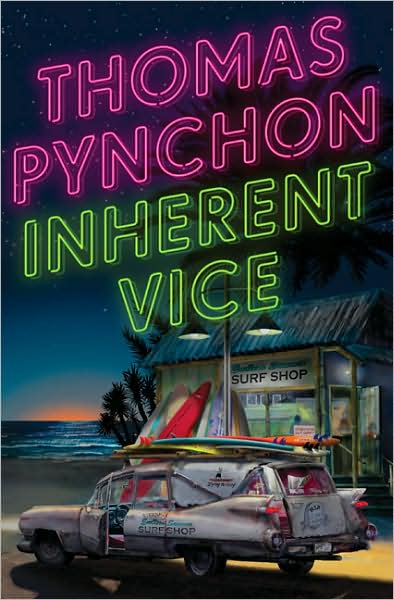
Intrinsic ironies aside, Inherent Vice can be read straightforward as a (not-so-straightforward) detective novel, living up to the promise of its cheesy cover. Honoring the genre, Pynchon writes more economically than ever, and injects plenty of action to keep up the pace in his narrative. It’s a page-turner, whatever that means, and while it’s not exactly Pynchon-lite, it’s hardly a heavy-hitter, nor does it aspire to be. At the same time, Pynchon fans are going to find plenty to dissect in this parody, and should not be disappointed with IV‘s more limited scope (don’t worry, there’s no restraint here folks–and who are we kidding, Pynchon is more or less critic-proof at this point in his career, isn’t he?). Inherent Vice is good dirty fun, a book that can be appreciated on any of several different levels, depending on “where you’re at,” as the hippies in the book like to say. Recommended.
Inherent Vice is available from Penguin August 4th, 2009.