Breakfast Nook — Charles Blackman

J.R.R. Tolkien’s manuscript map of Rohan, Gondor, and Mordor

Art of The Lord of the Rings final revised.indd

From the forthcoming The Art of the Lord of the Rings, which collects Tolkiens’s preparatory drawings for his epic. Via/more at Wired.

Sebald’s Vision (Book acquired 10.06.2015)

IMG_0023

  1. I can barely keep up with these “book acquired” posts this fall.
  2. I was actually reading Sebald last night—his essay on Rousseau in A Place in the Country. “How difficult it is in general to bring the machinery of thought to a standstill“—yes, yes, of course. Machinery! If there was just a switch…
  3. I mean that I would love to be like, transcendentalist (transcendent?  transcending? to transcend? trance? tr….) but the feeling of the feeling, the machinery of thought gets in the way. But anyway—
  4. (Sebald in this picture, and a few others, looks so much like my father that it frightens the fuck out of me. It’s horrifying).
  5. [Optometry joke]
  6. I was going somewhere with this (or not): Sebald’s Vision by Carol Jacobs. Publisher Columbia University Press’s blurb:

    W. G. Sebald’s writing has been widely recognized for its intense, nuanced engagement with the Holocaust, the Allied bombing of Germany in WWII, and other episodes of violence throughout history. Through his inventive use of narrative form and juxtaposition of image and text, Sebald’s work has offered readers new ways to think about remembering and representing trauma.

    In Sebald’s Vision, Carol Jacobs examines the author’s prose, novels, and poems, illuminating the ethical and aesthetic questions that shaped his remarkable oeuvre. Through the trope of “vision,” Jacobs explores aspects of Sebald’s writing and the way the author’s indirect depiction of events highlights the ethical imperative of representing history while at the same time calling into question the possibility of such representation.

    Jacobs’s lucid readings of Sebald’s work also consider his famous juxtaposition of images and use of citations to explain his interest in the vagaries of perception. Isolating different ideas of vision in some of his most noted works, including Rings of Saturn, Austerlitz, and After Nature, as well as in Sebald’s interviews, poetry, art criticism, and his lecture Air War and Literature, Jacobs introduces new perspectives for understanding the distinctiveness of Sebald’s work and its profound moral implications.

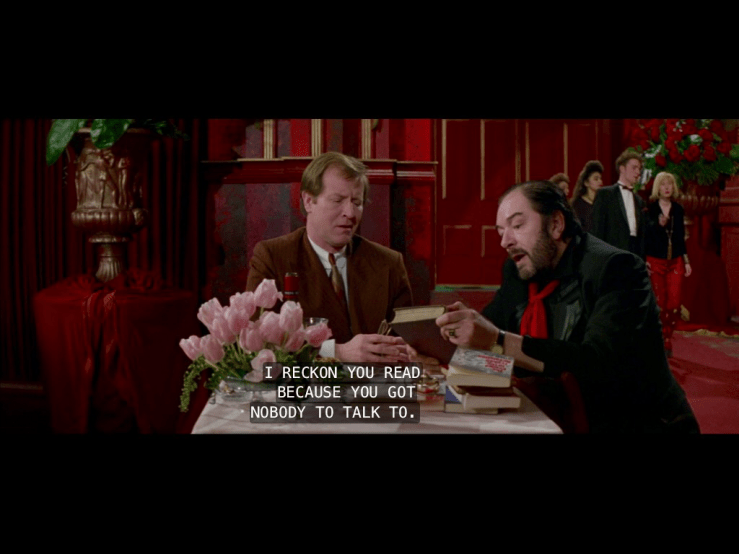
Nobody to talk to

IMG_0348

From The Cook, the Thief, His Wife & Her Lover (1989). Directed by Peter Greenaway. Cinematography by Sacha Vierny.

Three Books

IMG_0010

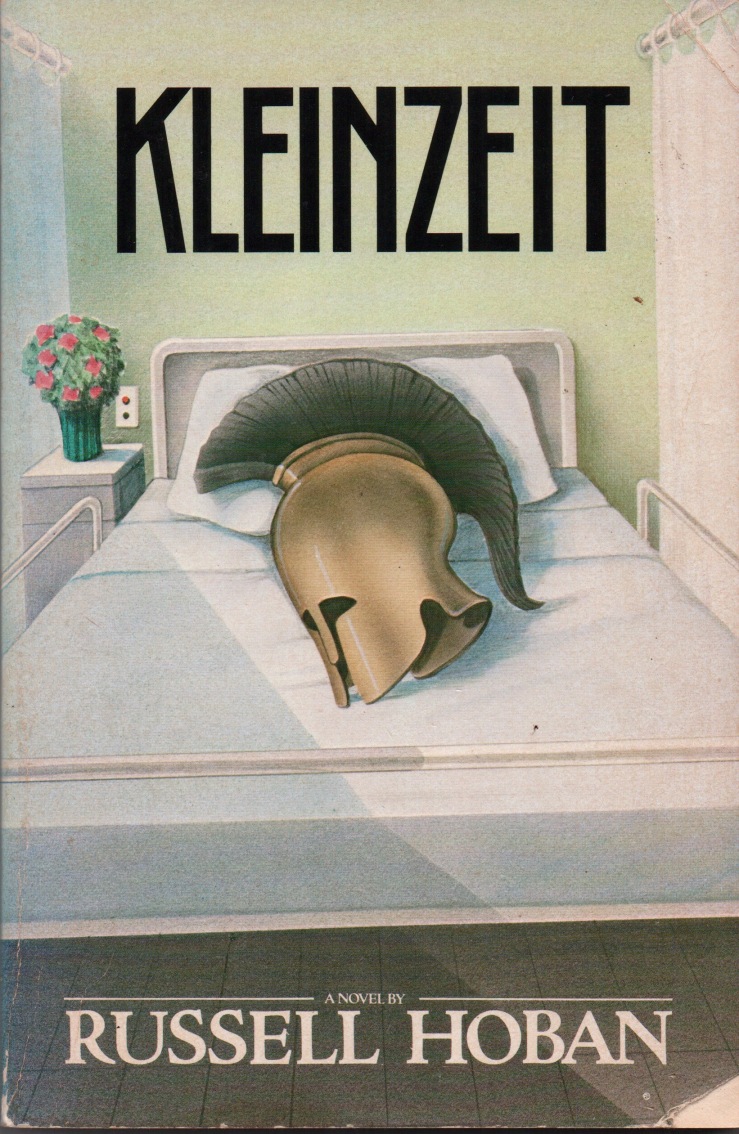
Kleinzeit by Russell Hoban. 1983 Summit Books trade paperback edition. Cover design by Fred Marcellino. A stark and funny retelling of the Orpheus myth, Hoban’s second novel obsesses over illness and art. Fans of Tom McCarthy might dig this one.

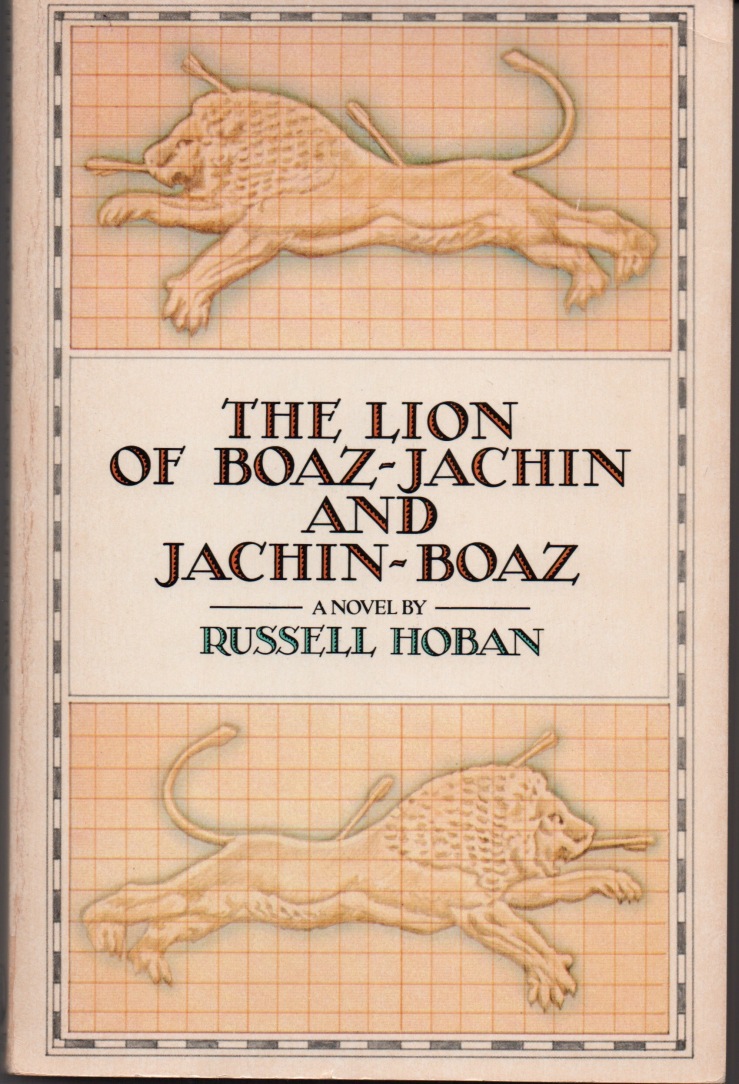
IMG_0012The Lion of Boaz-Jachin and Jachin-Boaz by Russell Hoban. 1983 Summit Books trade paperback edition. Cover design by Fred Marcellino. Hoban’s first novel. Not my favorite Hoban.IMG_0013 Pilgermann by Russell Hoban. 1984 Washington Square Press trade paperback. No designer is credited, but look closely under the horse’s fore hooves and note the signature “Rowena” — Rowena Morrill. (Note also the pig and naked lady). Pilgermann, Hoban’s follow-up (and somehow-sequel) to Riddley Walker, was the occasion for this Sunday’s Three Books post. I was reminded of this strange, wicked, dark, funny, apocalyptic book as I finished a reread of Cormac McCarthy’s Blood Meridian and began Kazuo Ishiguro’s The Buried Giant this weekend. Pilgermann is difficult but rewarding, and probably underappreciated, even as a cult novel.
The Tsar of Love and Techno (Book acquired, 9.29.2015)

IMG_8537

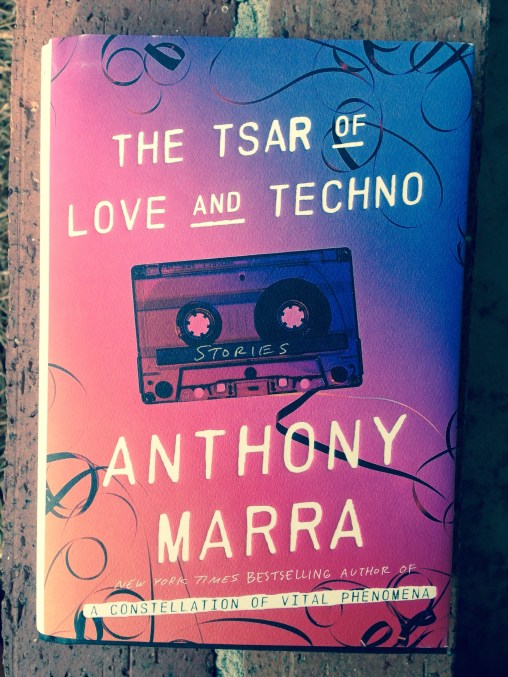
Anthony Marra’s collection The Tsar of Love and Techno is new in hardback from Hogarth next week. Here is the first part of Hogarth’s blurb (it’s the longest damn blurb I’ve ever seen I think):

Brilliantly constructed and beautifully inhabited, Anthony Marra’s new book, THE TSAR OF LOVE AND TECHNO (Hogarth; on sale October 6, 2015), is an exquisite collection of nine interconnected stories set in Russia that move across a century and introduce us to a cast of unforgettable characters whose lives intersect in ways both life-affirming and heartbreaking. Marra is a writer driven by a deep and authentic curiosity, and it was that curiosity that led him to write about Chechnya and to return there in THE TSAR OF LOVE AND TECHNO. With the recent insurgent attacks in Grozny, the Islamic State’s announcement that Chechnya will be their next zone of expansion, and 2015 marking the twentieth anniversary of the first Chechen War, Marra’s book couldn’t be timelier.

Reading — Lilla Cabot Perry

Vertigo/The Weight of Things (Books acquired, 9.28.2015)

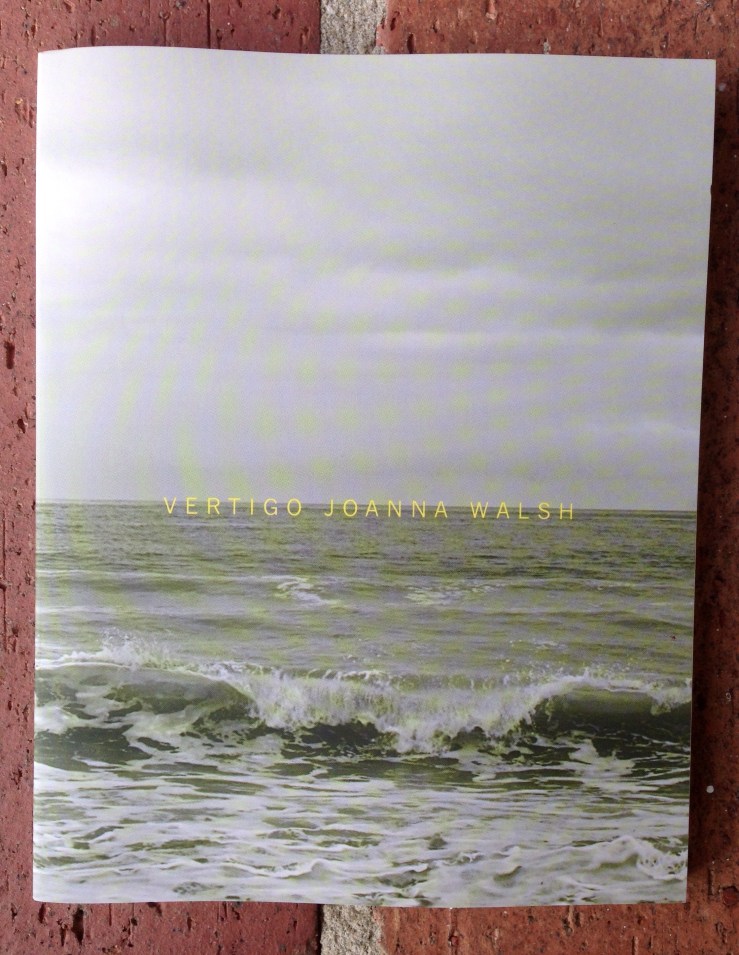
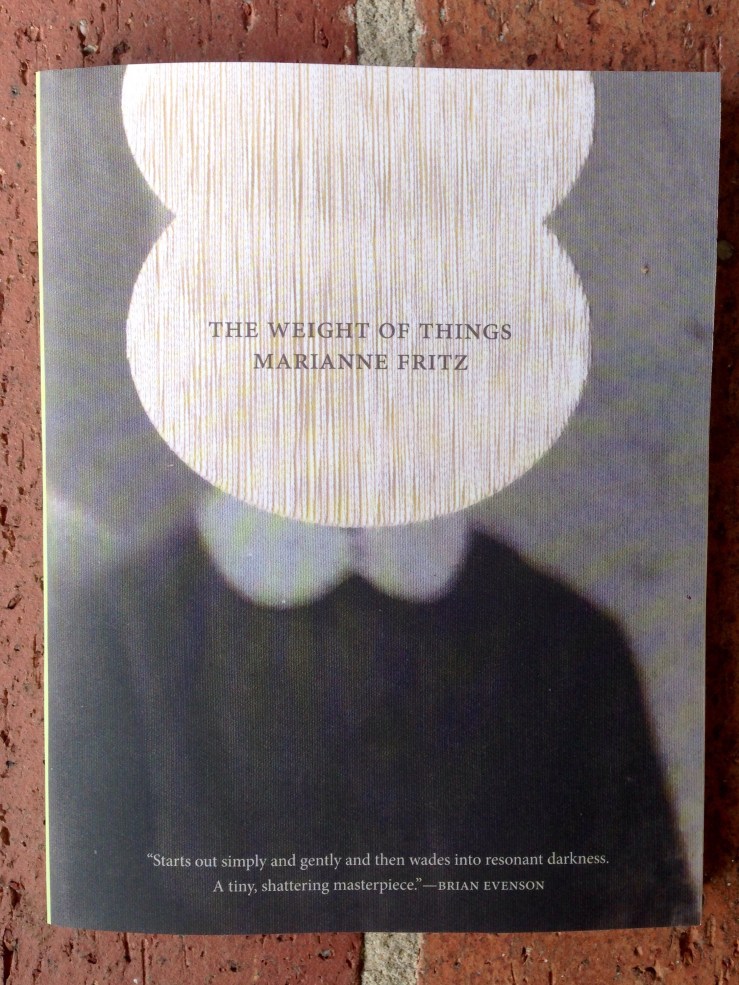
Two new books from The Dorothy Project: Joanna Walsh’s collection Vertigo and Austrian writer Marianne Fritz’s 1978 novel The Weight of Things (in English translation by Adrian Nathan West)

IMG_8532

You can read Walsh’s story “Online” online at Electric Literature.

IMG_8534

Dorothy’s blurb for Fritz’s novel:

The Weight of Things is the first book, and the first translated book, and possibly the only translatable book by Austrian writer Marianne Fritz (1948–2007). For after winning acclaim with this novel—awarded the Robert Walser Prize in 1978—she embarked on a 10,000-page literary project called “The Fortress,” creating over her lifetime elaborate colorful diagrams and typescripts so complicated that her publisher had to print them straight from her original documents. A project as brilliant as it is ambitious and as bizarre as it is brilliant, it earned her cult status, comparisons to James Joyce no less than Henry Darger, and admirers including Elfriede Jelinek and W. G. Sebald.

Yet in this, her first novel, we discover not an eccentric fluke of literary nature but rather a brilliant and masterful satirist, philosophically minded yet raging with anger and wit, who under the guise of a domestic horror story manages to expose the hypocrisy and deep abiding cruelties running parallel, over time, through the society and the individual minds of a century.

Of this is the judge judge and the night does not end (Blood Meridian)

In that sleep and in sleeps to follow the judge did visit. Who would come other? A great shambling mutant, silent and serene. Whatever his antecedents he was something wholly other than their sum, nor was there system by which to divide him back into his origins for he would not go. Whoever would seek out his history through what unraveling of loins and ledgerbooks must stand at last darkened and dumb at the shore of a void without terminus or origin and whatever science he might bring to bear upon the dusty primal matter blowing down out of the millennia will discover no trace of any ultimate atavistic egg by which to reckon his commencing. In the white and empty room he stood in his bespoken suit with his hat in his hand and he peered down with his small and lashless pig’s eyes wherein this child just sixteen years on earth could read whole bodies of decisions not accountable to the courts of men and he saw his own name which nowhere else could he have ciphered out at all logged into the records as a thing already accomplished, a traveler known in jurisdictions existing only in the claims of certain pensioners or on old dated maps.

In his delirium he ransacked the linens of his pallet for arms but there were none. The judge smiled. The fool was no longer there but another man and this other man he could never see in his entirety but he seemed an artisan and a worker in metal. The judge enshadowed him where he crouched at his trade but he was a coldforger who worked with hammer and die, perhaps under some indictment and an exile from men’s fires, hammering out like his own conjectural destiny all through the night of his becoming some coinage for a dawn that would not be. It is this false moneyer with his gravers and burins who seeks favor with the judge and he is at contriving from cold slag brute in the crucible a face that will pass, an image that will render this residual specie current in the markets where men barter. Of this is the judge judge and the night does not end.

From Cormac McCarthy’s novel Blood Meridian. 

Selections from One-Star Amazon Reviews of Cormac McCarthy’s Blood Meridian

[Editorial note: The following citations come from one-star Amazon reviews Cormac McCarthy’s novel Blood MeridianI’ve preserved the reviewers’ original punctuation and spelling. More one-star Amazon reviews.].


It may be art.

Damn McCarthy.

I find him boring.

unrelenting nihilism

The story is thin at best.

Are we supposed to enjoy it?

I felt abused by Blood Meridian

not a traditionally enjoyable book

this book is simply just not “all that”

wordy, over the top speechy dialogue

endless streams of dependent clauses

I am a devout fan of Cormac McCarthy.

The characters are not really sympathetic

He is obviously a sick man psychologically.

all about violence and no plot what so ever.

if I was a trained geologist I might like it better.

too many words that are not in standard dictionary

I guess people think he is cool because he writes so violent.

This one guy peed on some clay stuff to create a bomb like thing

murder, slaughter, killing, massacre, beating, stabbing, shooting, scalping

It consists of a series of almost unconnected scenes of unspeakable violence.

Esoteric words, eccentric expressions, pedantic philosophizing, arcane symbolism

I have to believe that he must be embarrassed to have this book back on the market.

A bunch of guys ride around Mexico killing everyone they come across for no particular reason

If you’re a fan of babies, quotation marks, and native americans, then avoid this book like the plague.

The reception he has had shows how tone deaf America has become to moral values, any moral values.

This book was written long before McCarthy had mastered the style that has brought him so much fame and credit.

the unrelenting amount of violence and cruelty in Blood Meridian strikes me as having crossed the line to pornography

It seemed like Cormac McCarthy wrote this with a dictionary in his lap trying to find words that he had never used before

Many of the words have to have been made up or are contractions of words and/or non-words, including much Spanish dialogue

Eliminate five words from the English language (“They rode on” and “He spat”)and this book would have been about 25 pages long

In this book, one sees him trying hard to hone his now-extraordinary powers of observation and description, and failing badly.

The standards for writing have clearly fallen far if all the praise heaped upon this inchoate, pompous mess of a novel is to be taken seriously.

Everything died: mules, horses, chickens, plants, rivers, snakes, babies, toddlers, boys, girls, women, men, ranchhands, bartenders, cowboys, good guys, bad guys…

I dont think the writer knows very much about AMERICAN history, the way he makes all the scalping get done by the AMERICANS and never by the indians, nor do I think he a PATRIOT

Wherein a company of men wander northern Mexico and the West killing, maiming, raping, and/or torturing everyone they meet, all described in gory, endless detail, led by the symbolic characters Glanton and his advisor, ‘the judge’, and supposedly illustrating that war and bloodletting are the only things that count, and the rest of life is just a meaningless dance.

Some kid with a few guys and a spattering of mans rambling through some part of the US or Mexico or a post-apocalyptic Australian desert seeing scores of gruesome, pointless scenes of violence, inhumanity, and death.

Holden is the sort of overt child defiling character who in real life wouldn’t last a month in a state penitentiary, because someone would rightly dispatch him as soon as possible.

Self-consciously faux-baroque linguistic stylings make this fetus-hurtin’ Treatise a feast for weakest link readers fascinated by the mark of the beast.

This book has some wonderful flowery language, and some beautiful descriptions of the southwest countryside.

They say that this book contains BIBLICAL themes, but I’ve read it and I don’t see how that could be so.

The author seems as if he is somehow trying to make some kind of “statement” about AMERICA

In a well ordered society McCarthy would be serving a life term or he would not exist at all.

there are times when it even seems as though English were not McCarthy’s first language

this book cannot be called a novel because it does not have character development

Would you let Cormac McCarthy look after your child for the night?

McCarthy is the most evil person because he is a talented writer

the author likes to use pronouns without establishing a subject

Who are the good guys and the bad guys, everyone is bad.

read Lonesome Dove instead, it’s a hundred times better

rampant nonstop mindless violence and depravity

I can’t dislike a book more than I dislike this one

This is a great writer being lazy and skating

good if you enjoy violence and nonsense

Theres lots of scalping of indians

Was there a quota on similes?

this booked scarred me

sociopath killers

It’s pure bunk.

a moral blight

utter trash

Ugh

Three Books

IMG_8503

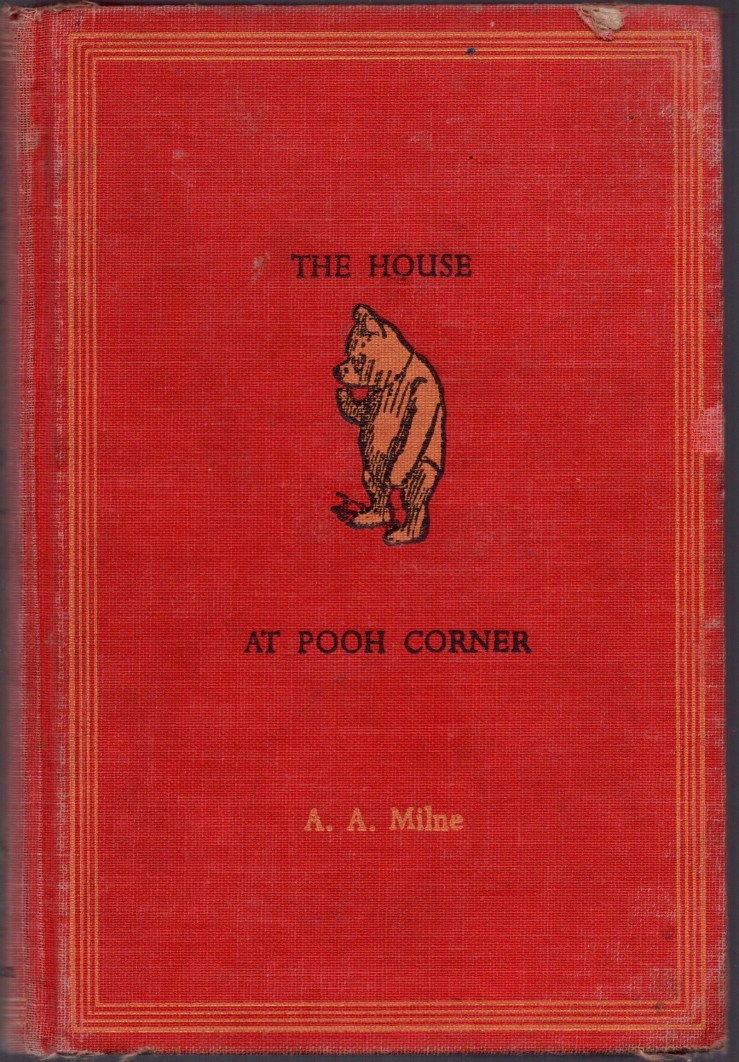
The House at Pooh Corner by A.A. Milne. A 1961 hardback by E.P. Dutton & Co. “Decorations” by Ernest H. Shepard; design credited to Warren Chappell. All three books this week come from a box my mother-in-law dropped off, containing maybe two dozen of her old books.

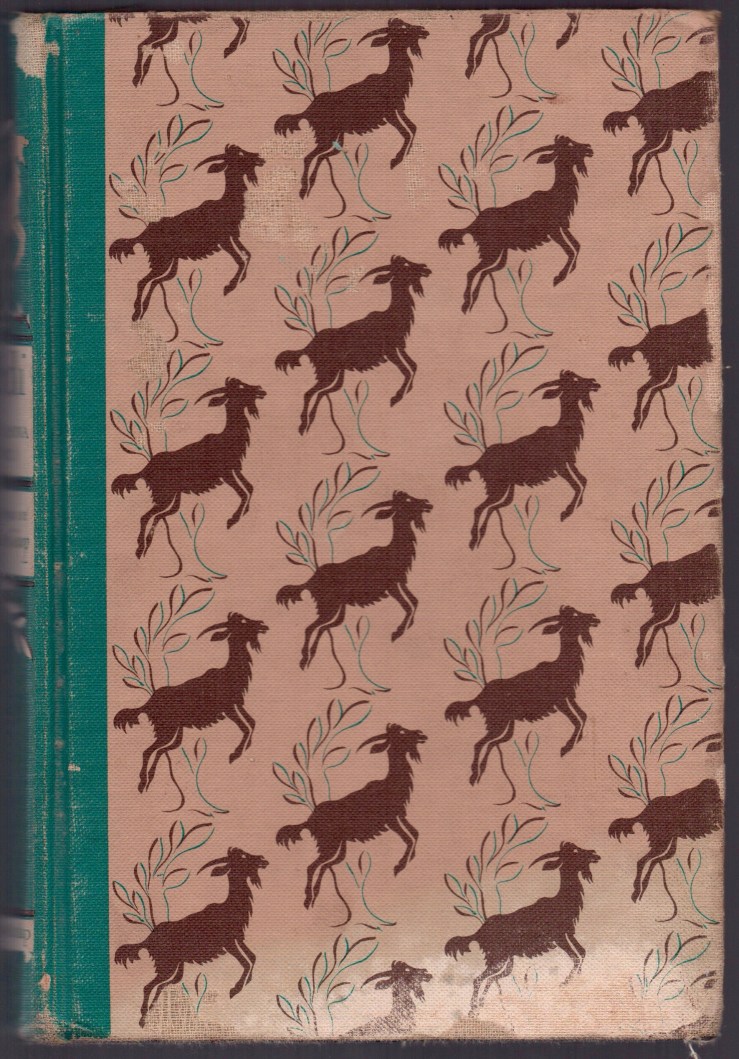
IMG_8504Heidi by Johanna Spyri. A 1945 Grosset & Dunlap Illustrated Junior Library hardback edition. Illustrations are by William Sharp, but no designer is credited for the hardback cover. My guess is that there was a dust jacket for this book at one point.
IMG_8505

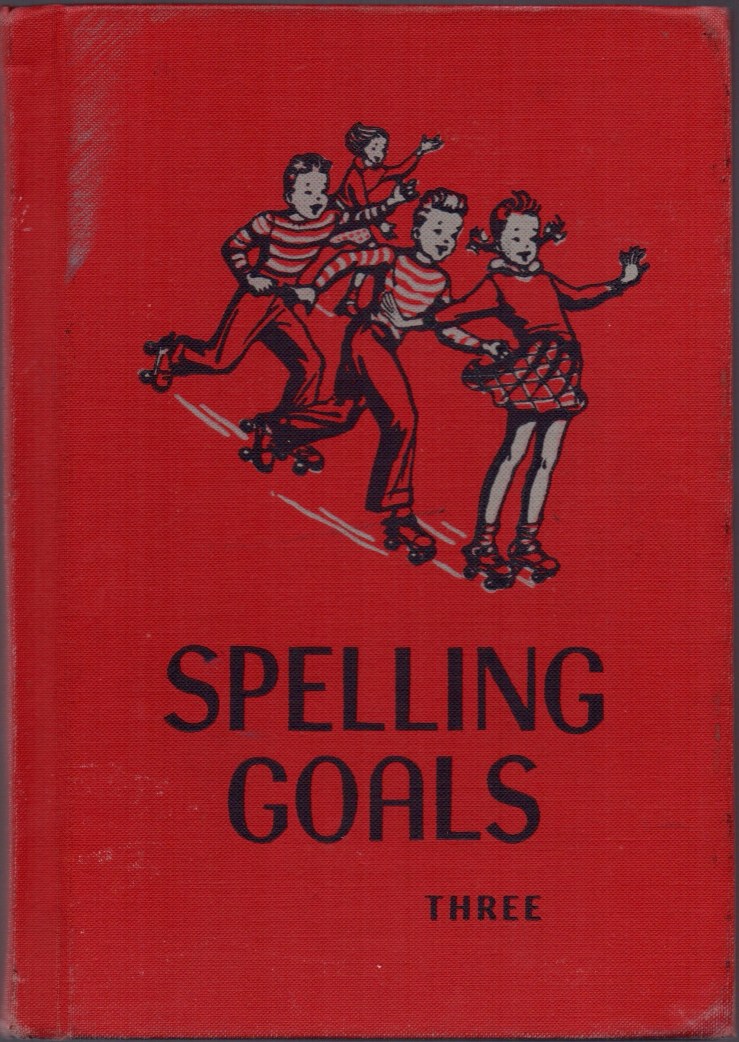
Spelling Goals (Three) by May Lambader, William Kottmeyer, and Rose Wickey. 1951, hardback, Webster. Illustrations by Edward Miller and cover by Christine Chisolm.

Portrait of a Girl Reading — Thomas Sully

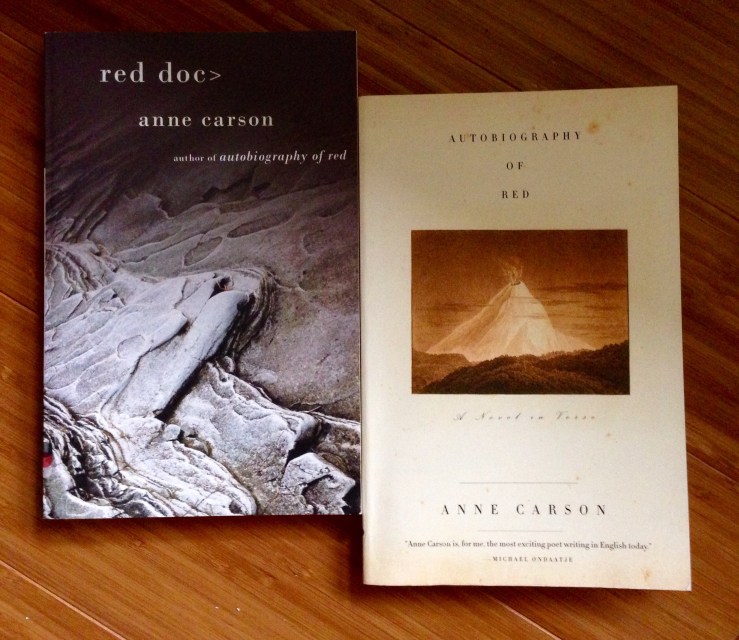
Two by Anne Carson (Books acquired, 9.14.2015)

IMG_8416

Still recovering from Anne Carson’s Autobiography of Red. Haven’t felt so zapped by a book in a long time. Amazing. Try to write something about it on here soon. Million thanks again to BLCKDGRD for sending it my way.

Three Books

IMG_8401

Victor Halfwit: A Winter’s Tale by Thomas Bernhard. English translation by Martin Chalmers. Illustration and design by Sunandini Banerjee. First edition oversized hardback from Seagull Books. On thick, heavy paper, Banerjee’s rich full-color digital collages illustrate what is essentially a microfiction by Thomas Bernhard. I bought this a few years ago at Faulkner House, a tiny bookstore in New Orleans.

IMG_8403

Go Down, Moses by William Faulkner. 1973 Vintage mass-market paperback edition. Cover photo by Robert Wenkham; no designer credited. My favorite Faulkner, although I’ve not read them all. I bought this for grad school, which explains the cheap used mass-market edition, but I love the cover. IMG_8402 Fractured Karma by Tom Clark. First edition trade paperback from Black Sparrow Press. Design by Barbara Martin. The cover painting, Waiting Room for the Beyond, is by John Register. This is the first Tom Clark book I read. Amazing.

Does Suttree die? | A riff on Cormac McCarthy’s novel Suttree

Does Suttree die?

At the end of Cormac McCarthy’s novel Suttree, I mean?

Look, before we go any farther, let’s be clear—this little riff is intended for those who’ve read the book. Anyone’s welcome to read this riff of course, but I’m not going to be, y’know, summarizing the plot or providing an argument that you should read Suttree (you should; it’s great)—and there will be what I suppose you’d call spoilers.

oarsman2
Oarsman is a sculpture by David Phelps, located at the northwest corner of Gay and Church Streets in Knoxville, TN. This photo is by Wes Morgan, part of his Searching for Suttree series.

So anyway—Does Suttree die at the end of Cormac McCarthy’s novel Suttree?

This question percolated in the background of my brain as I revisited Suttree this month via Michael Kramer’s amazing audiobook version (I also reread key sections—especially the last), in large part because of comments made on my 2010 review of the novel.

The first comment suggesting that Suttree dies at the end of the novel came in 2012 from poster “Jack foy,” who suggested that Suttree “has died in the boat and that it is his corpse cariied [sic] from there and his spirit and not his body hitching a ride at the finale.”

Earlier this year, a commenter named Julie Seeley responded to Jack foy’s idea; her response is worth posting in full:

I kind of agree that Suttree dies at the end also–or at least there are a lot of indications that the ending is meant to be ambiguous. Suttree reflects on his life, saying something to the effect of “I was not unhappy.” He visits his own houseboat and finds the door off and a corpse in his bed. A driver picks him up and says, “Come on,” even though Suttree had never even stuck out his thumb to hitch-hike It feels oddly similar to Dickinson’s “Because I could not stop for Death, He kindly stopped for me.” All of the scenery whizzing by faster and faster does feel like (sorry for the cliche) his life sort of flashing before him. This was a thought-provoking novel that I am looking forward to reading again soon.

Julie Seeley’s analysis is persuasive and her connection to Dickinson is especially convincing upon rereading the book’s final paragraphs. In my Suttree review, I argued that the book is a synthesis of American literature, tracing the overt connections to Faulkner and Frost, Poe and Cummings, Ellison and Steinbeck, before laundry listing:

…we find Mark Twain, Herman Melville, Ernest Hemingway, Walt Whitman, Emerson and Thoreau, Emily Dickinson, and William Carlos Williams, to name just a few writers whose blood courses through this novel (even elegant F. Scott Fitzgerald is here, in an unexpected Gatsbyish episode late in the novel).

Revisiting Suttree this month I found myself again impressed with McCarthy’s command of allusion and reference. Its transcendentalist streak stood out in particular. (Or perhaps more accurately, I sensed the generative material of the American Renaissance writers filtered through the writers that came before Suttree). But one American Renaissance writer I failed to name in my original review was Dickinson’s (near) contemporary Nathaniel Hawthorne, whose work of course filters through all serious American novels. There are plenty of echoes of Hawthorne in Suttree—Hawthorne’s tales in particular—but it’s the way that Hawthorne ends his tales that interests me here. Like the dashes that conclude many of Dickinson’s poems (including “Because I could not stop for Death”), Hawthorne’s conclusions are frequently ambiguous. Like the conclusion of Suttree.

So: Does Suttree die at the end of Cormac McCarthy’s novel Suttree?

Well, wait. Let’s go back to the beginning. Of the novel, I mean. Like I said, I’d had this question buzzing around in the back of my head as I revisited the book.

So, the beginning. Well, I’d forgotten that Suttree had a twin brother who had died at birth. The twin resurfaces a few times in the text, and there’s even a scene in the musseling section featuring a set of twins. Does Suttree’s twin brother’s death in infancy prefigure Suttree’s own death? How could it not? But—at the same time—hey, it’s ambiguous if Suttree dies; should I have stated my answer to my own damn question earlier?—hey, at the same time, the twin brother’s death is not Suttree’s death sentence, right? It simply introduces a motif—the dead body. Continue reading “Does Suttree die? | A riff on Cormac McCarthy’s novel Suttree”

Milton When a Boy Instructed by His Mother — Henry Fuseli

The novel is the first large-scale example of “mass art”

As practical men, the new middle classes found literature frivolous; as pious ones, they found it idolatrous; as class-conscious citizens, they felt it too committed to court and salon. Yet they could not live without it; a lust for images of their own lives, projections of their own dreams and nightmares moved them obscurely. They demanded a form that would be really their own, a mass-produced commodity to be bought or rented in the marketplace like other goods, a thick and substantial item to be placed on the table with other evidence of their wealth and taste. The novel is the first large-scale example of “mass art.” It is quite different from “folk art,” with its handmade appearance and its air of knowing its place, for folk art is rooted in the country and in agriculture; it changes slowly and almost imperceptibly, its chief appeal being its resemblance to what has come before. “Mass art,” on the other hand, is urban art, changing with the rapid changes of fashion, and seeming as much the product of new advances and technique as in any profound shift in the imagination. Like the wood-block engravings of 18th-century Japan, or the movies later on, or jazz on records, its triumphs depend chiefly on developments in manufacturing, packaging, and distribution. Like other mass-produced products, it tends to drive out of existence craft objects, which cannot survive the class structures which demand them and the class-consciousness which defines their consumers. Just as the spectacular rise of the novel is inconceivable without the perfection of printing, its final victory is inconceivable without the invention of the circulating library; mass-produced, it is also mass-circulated like any commodity in an expanding mercantile economy.

From Leslie Fiedler’s Love and Death in the American Novel (1960).