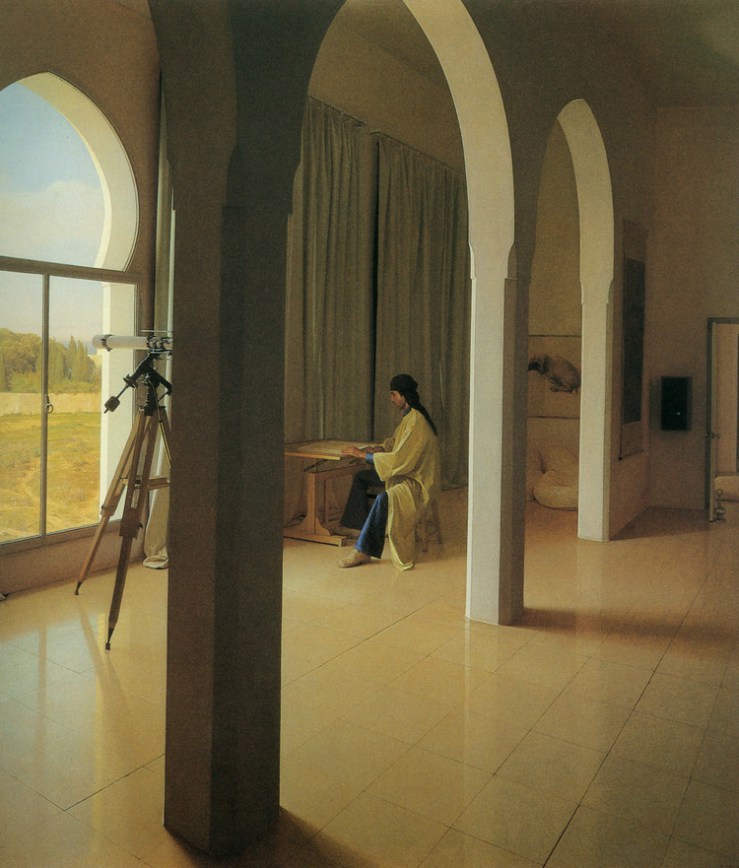
The Magician — Claudio Bravo

magician

Wouldn’t It Be Deadly? (Book Acquired, Like Last Week or the Week Before)

IMG_3228

Wouldn’t It Be Deadly by D.E. Ireland. PW’s write up:

Set in London in 1913, this tongue-in-cheek series kickoff from the pseudonymous Ireland picks up where the musical My Fair Lady left off. Eliza Doolittle has left her irascible mentor, Henry Higgins, to work for a rival elocution teacher, Emil Nepommuck. Nepommuck features her transformation from street flower-seller to someone who passed for a duchess prominently in his advertising, and manages to steal some of Higgins’s students. When someone fatally stabs Nepommuck in the back outside his apartment, Higgins, who confronted the man earlier, becomes Scotland Yard’s prime suspect. Higgins turns out to be hiding a secret, which is out of character with his stage and film personae. Some readers may find character names like Harrison and Shaw a bit heavy-handed, though others may smile when Higgins describes Eliza as a “fair lady” or wonders why anyone would care about the “rain in Spain.” A

The Reader — Wyndham Lewis

Roman Muradov’s Enigmatic Graphic Novella (In a Sense) Lost and Found Reviewed

If you regularly read The New York Times or The New Yorker, you’ve probably already seen Roman Muradov’s compelling illustrations. If you’re a fan, you also know about his strange and wonderful Yellow Zine comics (and if you don’t know them, check out his adaptation of Italo Calvino).

Muradov’s début graphic novella (In a Sense) Lost and Found was released recently by Nobrow Press, and it’s a beauty—rich, imaginative, playful, and rewarding. And it smells good.

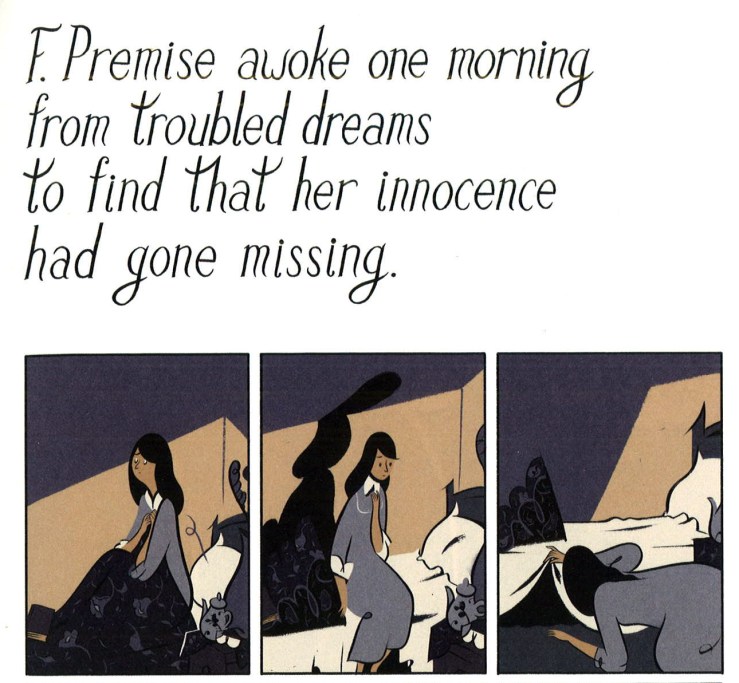
(In a Sense) Lost and Found begins with a nod to Kafka’s Metamorphosis:
8

Although we’re told by the narrative script that our heroine F. Premise (faulty premise?) “awoke,” the surreal world Muradov creates in Lost and Found suggests that those “troubled dreams” continue far into waking hours. The story runs on its own internal dream-logic, shifting into amorphous spaces without any kind of exposition to guide the reader who is, in a sense, as lost as the protagonist becomes at times on her Kafkaesque quest.

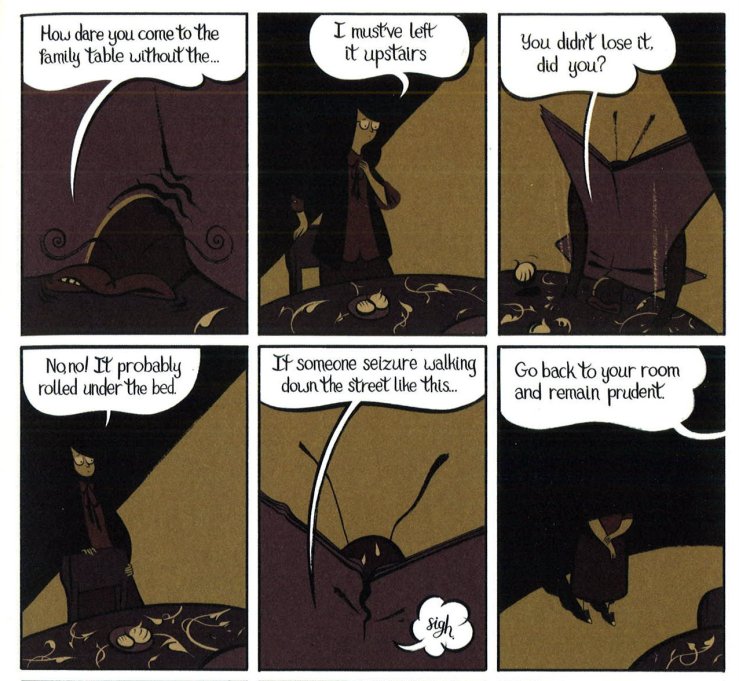
What is F. Premise’s mission? To regain her innocence, perhaps, although only the initial narrative script and the punning title allude to “innocence.” The characters seem unable or unwilling to name this object; each time they mention it, their speech trails off elliptically, as we see when Premise’s father (?) confronts her at the breakfast table:
6

Muradov’s imagery suggests Kafka’s bug again—the father’s antennae poke over the broadsheet he’s reading (the book is larded with readers), his strange mouth sagging out under it. Even more Kafkaesque though is Muradov’s refusal to reveal the father’s face, the face of authority, who sends his daughter back up to her room where she must remain locked away.

She sneaks out of course—would there be an adventure otherwise?—and it turns out that faceless father is right: F. Premise falls (literally) under the intense gaze of the community. F. Premise is startlingly present to others now by virtue of her absent virtue.
5

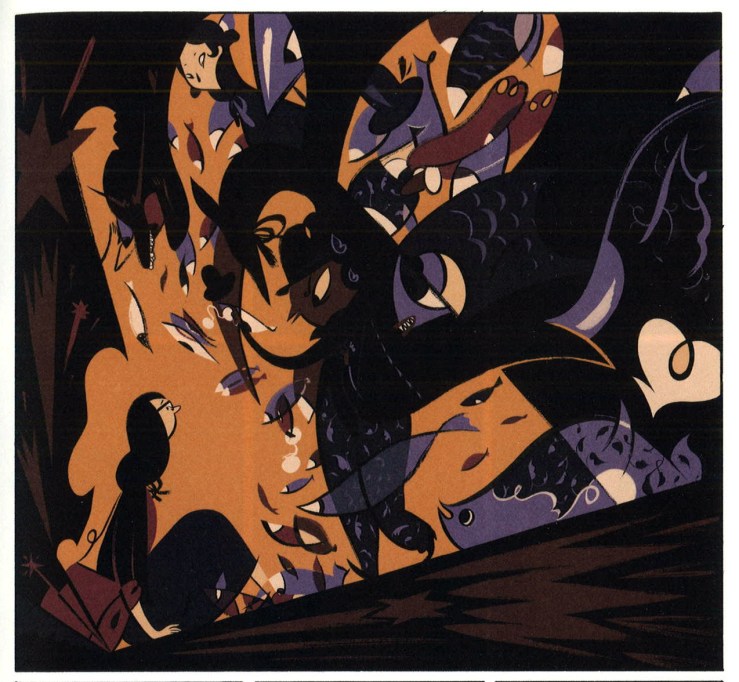
Muradov uses traditional nine-panel grids to tell his story, utilizing large splashes sparingly to convey the intensity of key moments in the narrative. The book brims with beautiful, weird energy, rendered in intense color and deep shadow. Muradov’s abstractions—pure shapes—cohere into representative objects only to fragment again into abstraction. (Perhaps I should switch “cohere” and “fragment” here—I may have the verbs backwards).

The art here seems as grounded in a kind of post-cubism as it does in the work of Muradov’s cartooning forebears. In the remarkable passage below, for example, our heroine moves from one world to another, her form nearly disappearing into complete abstraction by the fifth panel (an image that recalls Miró), before stabilizing again (if momentarily) in the sixth panel.

2

It’s in that last panel that F. Premise returns to her adopted home (of sorts)—a bookstore, of course. Earlier, the kindly owner of the bookstore loans her a pair of old plus-fours, and all of a sudden her identity shifts—or rather, the community shifts her identity, their penetrating gaze no longer trying to screw her to a particular preconception. Identity in Lost and Found is as fluid and changeable as the objects in Muradov’s haunting illustrations.

I have probably already belabored too much of the plot. Suffice to say that our heroine’s quest takes strange turns, makes radical shifts, she descends up and down and into other worlds. Embedded in the journey is a critique of nostalgia, of the commodification of memory (or, more accurately, the memory of memory). Is our innocence what we thought it was? Can we buy it back like some mass-produced object?
IMG_3292

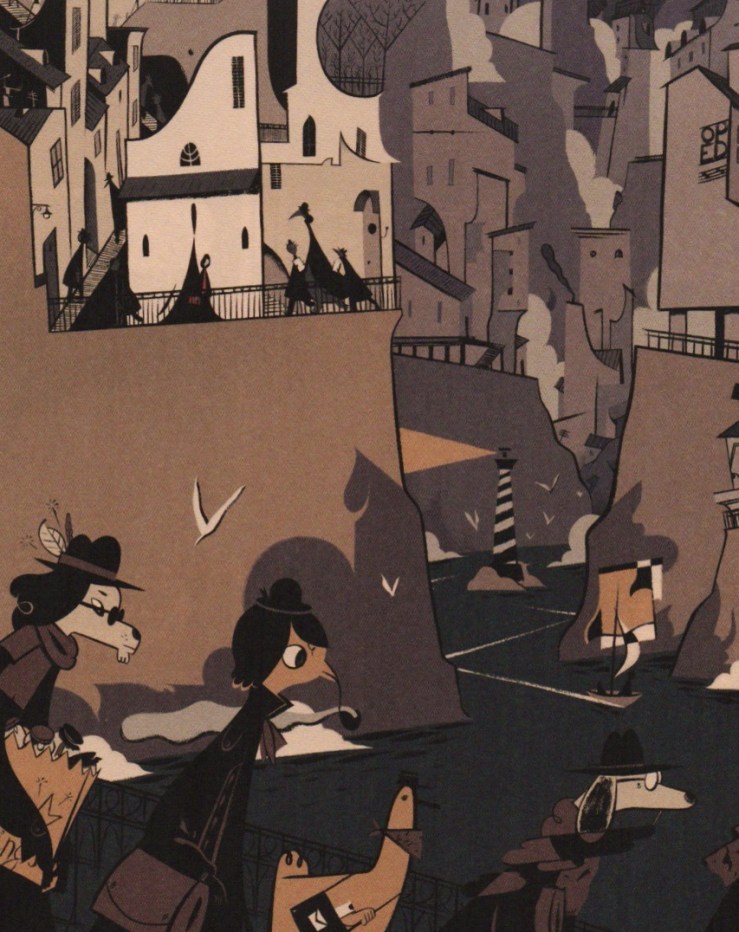
As I noted before, Lost and Found is stuffed with images of readers. There’s something almost Borgesian in the gesture, as if each background character might be on the threshold (if not right in the middle of) their own adventures.
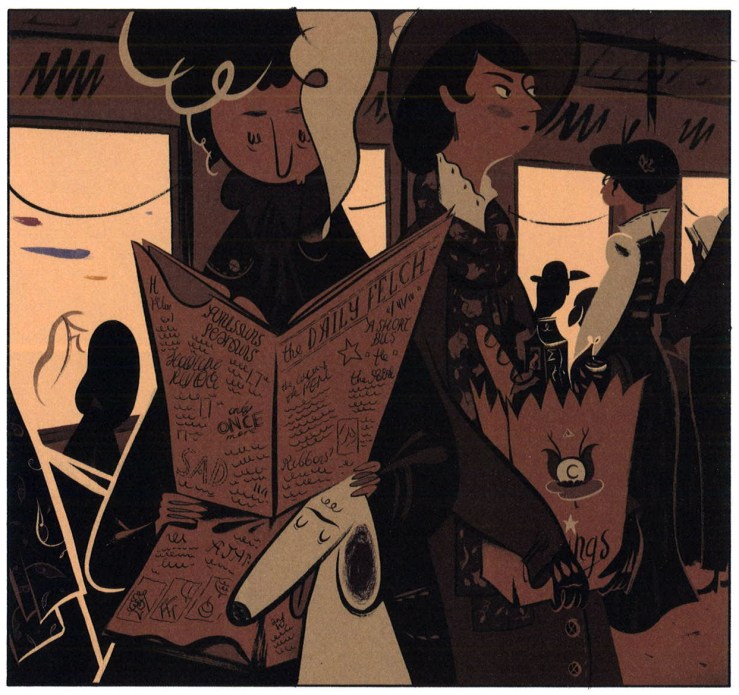
3

It’s in the book’s final moments though that we see a move from reading to writing: Our heroine F. Premise picks up the pen and claims agency, writes her own life. She is indeed the narrative voice after all, the imposing script that, like some all-knowing hand, guided us into the narrative in the first place, only to disappear until the end.
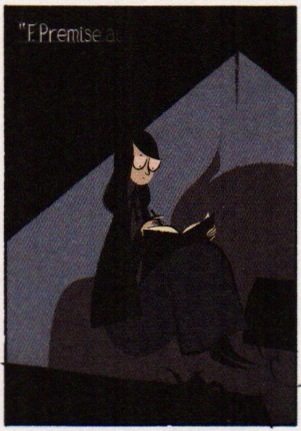
IMG_3293

I loved Lost and Found, finding more in its details, shadowy corners, and the spaces between the panels with each new reading. My only complaint is that I wish it were longer. The book is probably not for everyone—readers looking for a simple comic with an expository voice that will guide them through a traditional plot should probably look elsewhere. But readers willing to engage in Muradov’s ludic text will be rewarded—and even folks left scratching their heads will have to admit that the book is gorgeous, an aesthetic experience unto itself. And it smells good. Highly recommended.

 

Reading — Claudio Bravo

reading

Cláudio nos Rochedos — Antonio Carneiro

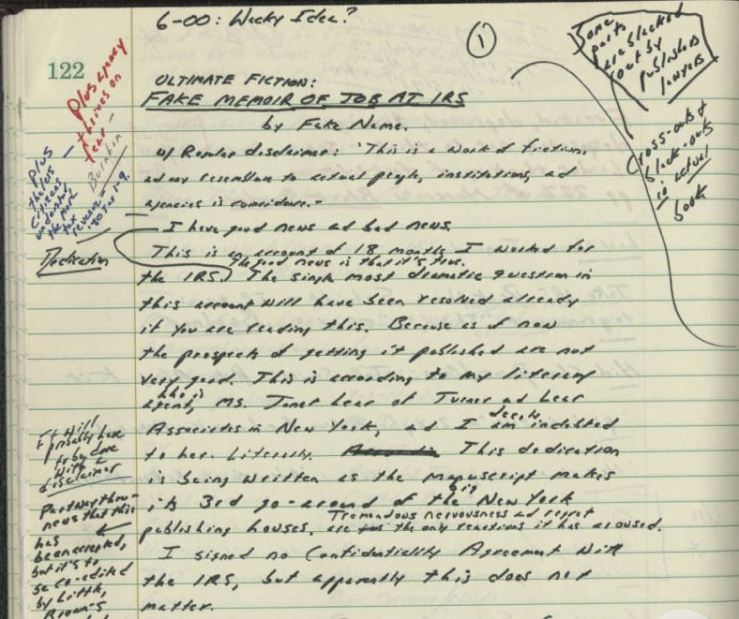
Ultimate Fiction: Fake Memoir of Job at IRS by Fake Name (David Foster Wallace Archive)

dfwThe David Foster Wallace archive at the Harry Ransom Center UT has made some documents from The Pale King accessible online, including a few pages of his workbook, handwritten drafts, and typed edits.

dfw2

(Via).


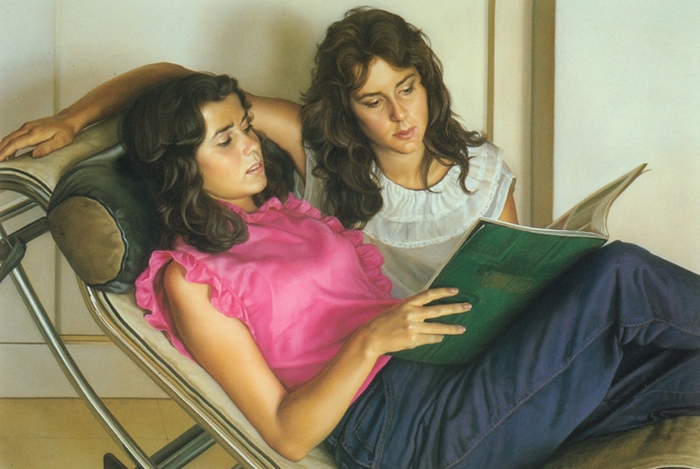
Two Friends — Claudio Bravo

Claudio Bravo - Tutt'Art@ (9)

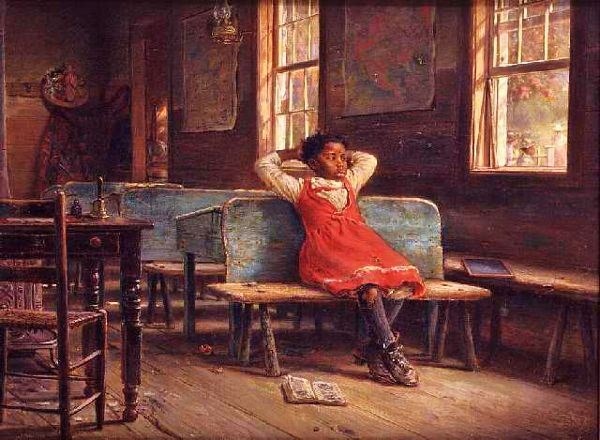
Kept In — Edward Lamson Henry

Edward Lamson Henry (American artist, 1841-1913) Kept In

My Father Fallen — Vincent Desiderio

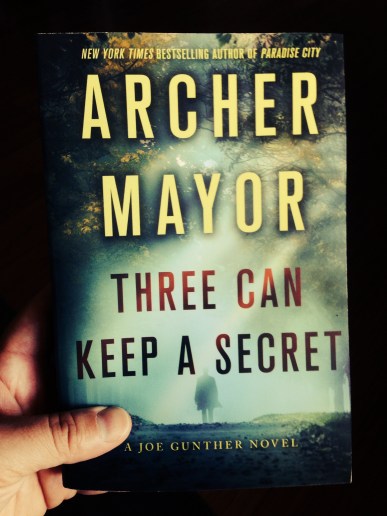
Three Can Keep a Secret (Book Acquired Some Time in August, 2014)

IMG_3119.JPG

Archer Mayor’s Three Can Keep a Secret is, the press materials assure me, the 24th in a series of Joe Gunther mysteries. Holy cow! Publisher Macmillan/Tor’s blurb:

Joe Gunther and his team—the Vermont Bureau of Investigation (VBI)—are usually called in on major cases by local Vermont enforcement whenever they need expertise and back-up.  But after the state is devastated by Hurricane Irene, the police from one end of the state are taxed to their limits, leaving Joe Gunther involved in an odd, seemingly unrelated series of cases. In the wake of the hurricane, a seventeen year old gravesite is exposed, revealing a coffin that had been filled with rocks instead of the expected remains.

At the same time, an old, retired state politician turns up dead at his high-end nursing home, in circumstances that leave investigators unsure that he wasn’t murdered.  And a patient who calls herself The Governor has walked away from a state mental facility during the post-hurricane flood. It turns out that she was indeed once “Governor for a Day,” over forty years ago, but that she might have also been falsely committed and drugged to keep her from revealing something that she saw all those years ago.  Amidst the turmoil and the disaster relief, it’s up to Joe Gunther and his team to learn what really happened with the two corpses—one missing—and what secret “The Governor” might have still locked in her brain that links them all.


Cheever holds my attention more than any other writer (Matthew Weiner)

INTERVIEWER

Who are your favorite writers?

WEINER

I don’t make lists or rank writers. I can only say which ones are relevant to me. Salinger holds my attention, Yates holds my attention. John O’Hara doesn’t, I don’t know why—it’s the same environment, but he doesn’t. Cheever holds my attention more than any other writer. He is in every aspect of Mad Men, starting with the fact that Don lives in Ossining on Bullet Park Road—the children are ignored, people have talents they can’t capitalize on, everyone is selfish to some degree or in some kind of delusion. I have to say, Cheever’s stories work like TV episodes, where you don’t get to repeat information about the characters. He grabs you from the beginning.

Poems have always held my attention, but they’re denser and smaller. It’s funny because poetry is considered harder to read. It wasn’t harder for me. Close reading, that is. Milton, Chaucer, Dante—I could handle those for some reason, but not fiction. From ninth grade on, I wrote poetry compulsively, and pushed myself to do iambic pentameter and rhymes because free verse was cheating—anybody could do that. But I was such a terrible student. I couldn’t sustain anything.

Fascinating interview with Mad Men creator Matthew Weiner in The Paris Review. I would’ve predicted the Yates and the Cheever (and Updike too, whom he doesn’t name), but not the poetry (Weiner goes on to detail his years writing poetry). My wife and I have been, uh, binge watching I think is the phrase the kids are supposed to be saying, although I don’t think the kids say it, I think culture reporters made it up—anyway, my wife and I watched the first season of Mad Men this week (hadn’t watched nary a rerun since it aired). It holds up pretty well, despite some soapy moments, cliches, and broad strokes.

The Physician — Gerrit Dou

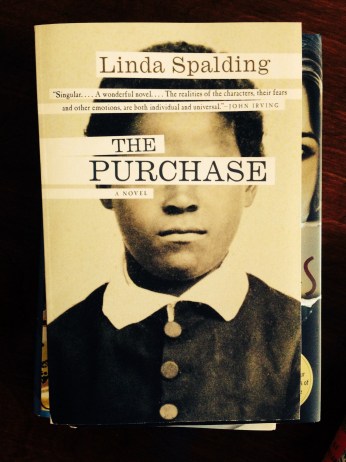
The Purchase (Book Acquired, 9.03.2014)

IMG_3226

Linda Spalding’s novel The Purchase is new in trade paperback from Random House. Their blurb:

Pennsylvania, 1798. Daniel Dickinson, a devout Quaker, has just lost his wife. When he marries a fifteen-year-old Methodist orphan to help with his five small children, his fellow Quakers disown him for his impropriety. Forced out of the only community he’s ever known, Daniel moves his family to the Virginia frontier. He has in hand a few land warrants, with which he plans to establish his new homestead.
Although determined to hold to his Quaker belief in abolitionism, Daniel is now in a slave state, and he soon finds himself the owner of a young boy named Onesimus. This fatal purchase sets in motion a twisted chain of events that will forever change his children’s lives—and his own. An unforgettable story of sacrifice and redemption, The Purchase powerfully explores questions of fate, faith, loyalty, and conscience.

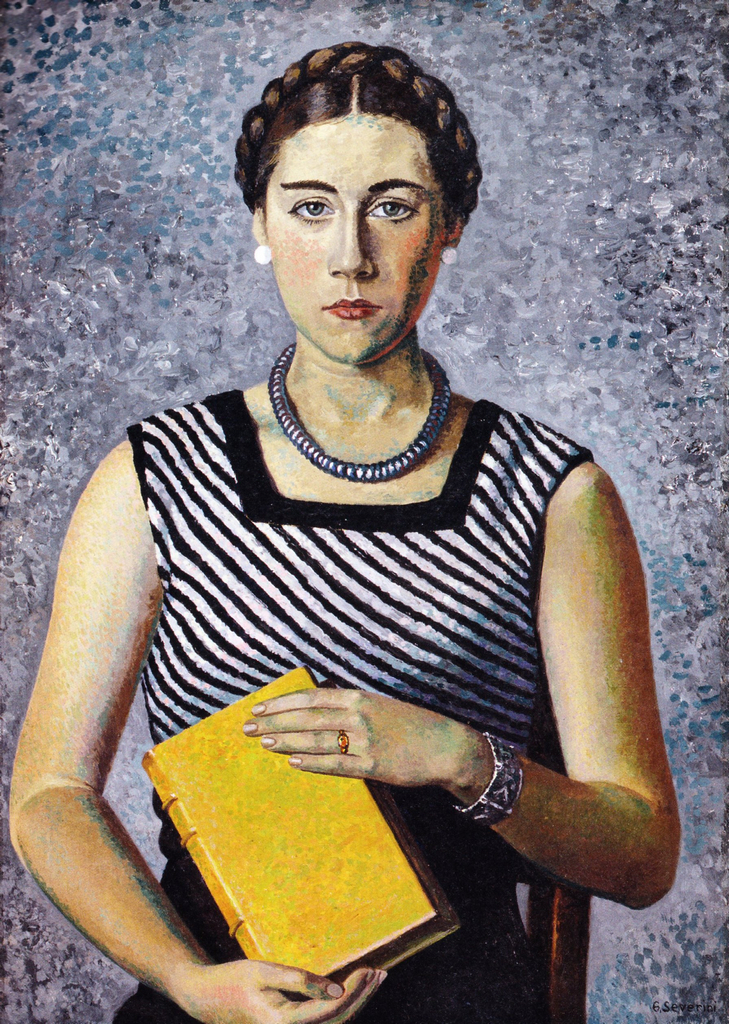
Portrait of Gina Severini — Gino Severini

12273OP1036AU19568

You tell a story because a statement would be inadequate (Flannery O’Connor)

When you can state the theme of a story, when you can separate it from the story itself, then you can be sure the story is not a very good one. The meaning of a story has to be embodied in it, has to be made concrete in it. A story is a way to say something that can’t be said any other way, and it takes every word in the story to say what the meaning is. You tell a story because a statement would be inadequate. When anybody asks what a story is about, the only proper thing is to tell him to read the story. The meaning of fiction is not abstract meaning but experienced meaning, and the purpose of making statements about the meaning of a story is only to help you experience that meaning more fully.

From Flannery O’Connor’s essay “Writing Short Stories.” Collected in Mystery and Manners.

Read — Jeffrey Brown

dvread