Andy and Truman Capote (Andy Warhol Is Santa)

https://i0.wp.com/uploads0.wikipaintings.org/images/andy-warhol/andy-and-truman-capote-1977.jpg

A Christmas Card from Günter Grass

(Via/more)

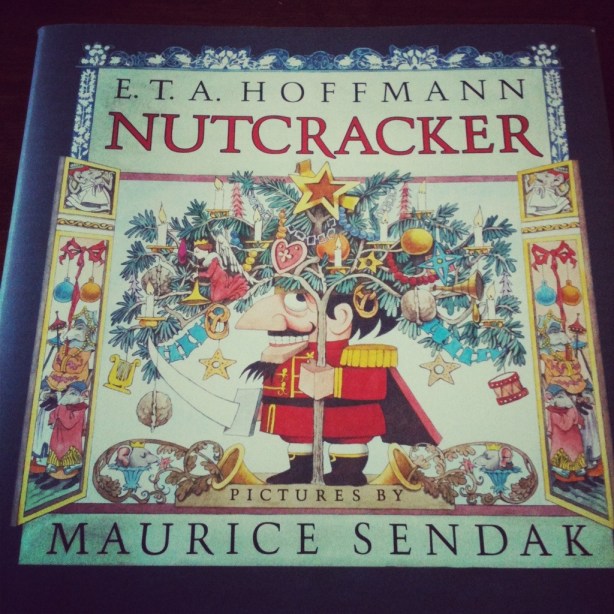
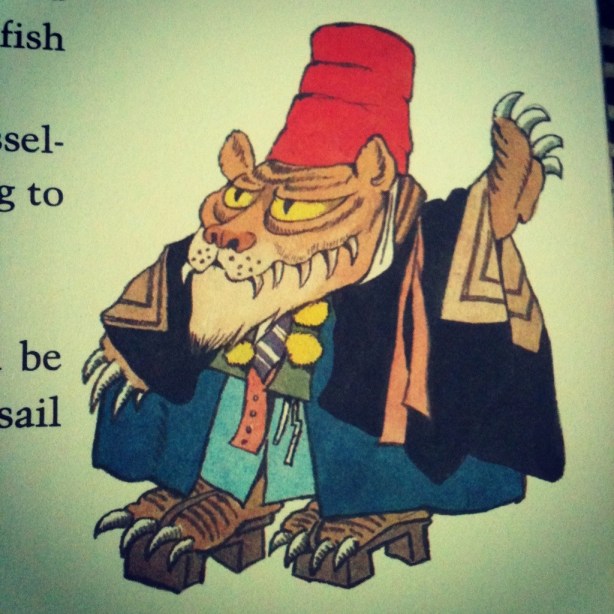
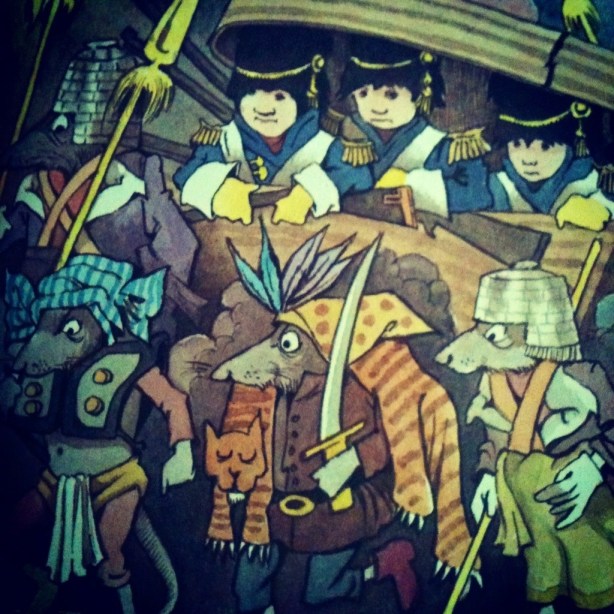
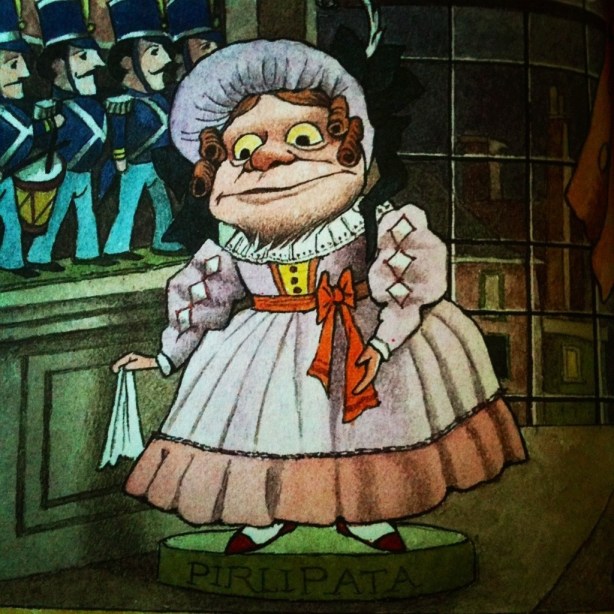
Nutcracker, Illustrated by Maurice Sendak (Book Acquired Some Time in October, 2012)

20121118-123043.jpg

20121118-123054.jpg

20121118-123102.jpg

20121118-123123.jpg

We’ll be running a giveaway contest for one of these beautiful editions of Hoffman’s Nutcracker, featuring illustrations by Maurice Sendak sometime next week.

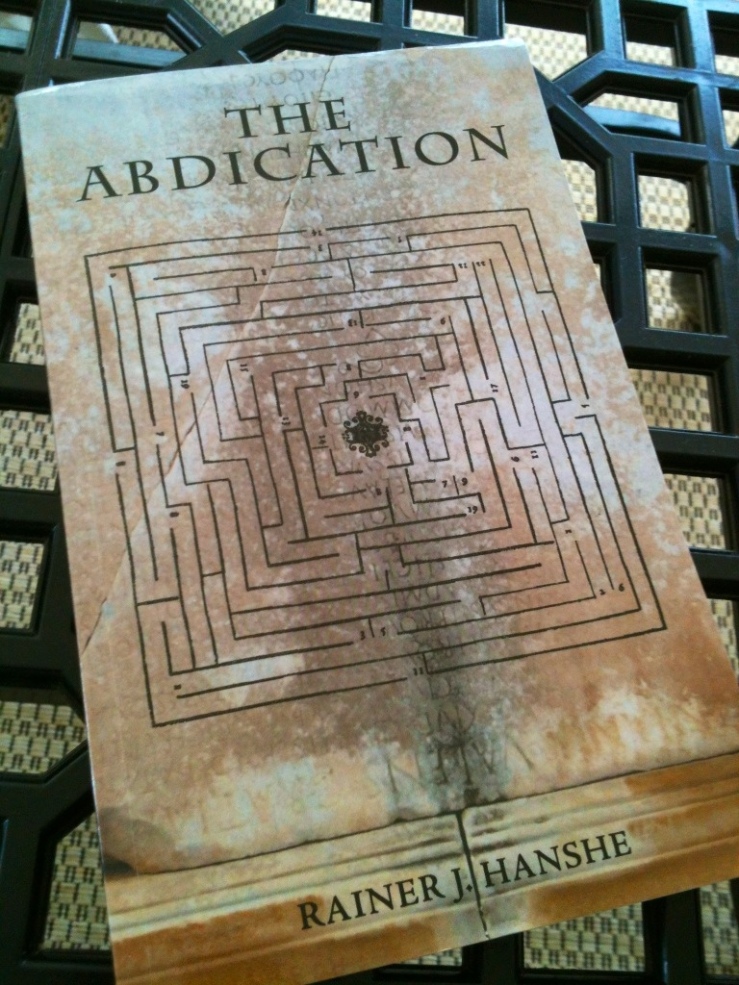
The Abdication (Book/Ero(t)icomic Epic Aquired, Sometime Last Week)

20120606-120115.jpg

Rainer J. Hanshe’s The Abdication. Started this one the yesterday. Very weird, very cool. More thoughts to come, but here’s the blurb:

Spring 2032: an enigmatic bandleader named Triboulet arrives by helicopter in Rome, where his carnivalesque troupe awaits with a legion of animals and unruly kids. When provoking states of joyous panic through their ritualistic frenzies, the troupe’s arrival proves restorative, for the world is beset with famines, plagues, and religious conflicts, which Triboulet seeks to neutralize with freeing laughter. As he and his troupe begin constructing strange edifices in the Eternal City, sacred sites around the world suffer terrible, often beguiling forms of vandalism, and rumors abound that the Christ has actually finally returned.
Although radical Islamic sects claim responsibility for the vandalism, the culprits remain unknown: is it the Jihadists, anarcho-atheist intellectuals, or eco-terrorists? Religious and political authorities grow leery of the troupe and suspicious of Triboulet, whose true identity remains a mystery. The very future of the world is at stake, and while touring Israel during Christmas, Triboulet and his raucous band of pranksters bear witness to the world’s pivotal crossing into a new reality.
Albert Camus noted that ‘the metaphysics of the worst’ expresses itself in a literature of damnation and argued that ‘we have still not yet found the exit’ from such literature. With his second novel, Hanshe has found the way out, offering in fact something not only promising, but astounding, a pathway that is into a new reality, into a ‘physics of the best.’ The Abdication is a true ero(t)icomic epic.

Cormac McCarthy, Unchallenged King of Literary Mule Carnage

In his essay “The Dead Mule Rides Again,” Jerry Leath Mills argues

. . . there is indeed a single, simple, litmus-like test for the quality of southernness in literature, one easily formulated into a question to be asked of any literary text and whose answer may be taken as definitive, delimiting, and final. The test is: Is there a dead mule in it?

Mills’s convincing textual evidence draws on over thirty authors, but declares Cormac McCarthy “unchallenged king of literary mule carnage.” Some proof:

4. Decapitation by irate opera singer. Cormac McCarthy, who far surpasses even Faulkner in the mayhem he visits upon literary mules (see #s 5, 6, 7, 9, 14, 15), includes in his recent novel The Crossing (1994) the following dialogue about a mule whose recalcitrance proves insufferable to the artistic temperament of a singer assigned to tend him in a road company:

What was it he done to the mule?

He tried to cut off the head with a machete. . . .

I wouldn’t have thought you could cut off a mule’s head with a machete.

Of course not. Only a drunken fool would attempt such a feat. When the hacking availed not he began to saw. . . .

What happened to the mule?

The mule? The mule died. Of course

5. Drowning. This is Faulkner’s most commonly employed means of dispatch for the mules in his works. In the flood scenes he renders so effectively, we inevitably find drowned mules floating down river. As opposed to the train-struck animals in “Mule in the Yard” (see # 3), which are instrumental in developing motive and plot, Faulkner’s drowned mules tend to fall into the decorative or ornamental category, employed chiefly for drama, mood, and atmosphere. In As I Lay Dying (1930), for example, Darl recreates a wagon disaster in the surging stream: “Between two hills I see the mules once more. They roll up out of the water in succession, turning completely over, their legs stiffly extended as when they had lost contact with the earth”. In the “Old Man” sections of The Wild Palms (1939), the flood throws forth its “charging welter of dead cows and mules and outhouses and cabins and hencoops,” and Faulkner’s prose strikes an elegiac note as the convict’s skiff rides “even upon the backs of the mules as though even in death they were not to escape that burden-bearing doom with which their eunuch race was cursed”. Before the ordeal ends, the accumulation of mule carcasses reaches almost cosmic proportions as the stranded convict remembers “that other wave, the second wall of water full of houses and dead mules building up behind him in the swamp”.

Robert Morgan’s story “Poinsett’s Bridge” (1989) picks up the drowned mule topos in distinctly Faulknerian terms: “The body of a mule shot by in the current, and then a chicken coop”; but Cormac McCarthy (see #s 4, 6, 7, 9, 14, 15) varies it in Blood Meridian (1985) by having a mule drowned intentionally: “The Yumas were swimming the few sorry mules . . . across the river. . . . Downriver they’d drowned one of the animals and towed it ashore to be butchered”. (On recurrent uses of mules as culinary items see # 14.)

That the image of the drowned mule also occupies a subliterary folk status in the South is perhaps attested by a common simile in which a wealthy person is said to have “enough money to burn up a wet mule.”

6. Falls from cliffs. The novel Blood Meridian (1985) establishes Cormac McCarthy as unchallenged king of literary mule carnage. No fewer than fifty-nine specific mules die in the book, plus dozens more that are alluded to in groups and bunches. Mules are shot, roasted, drowned, knifed, and slain by thirst; but the largest number, 50 out of a conducta of 122 mules carrying quicksilver for mining, plummet from a single cliff during an ambush, performing an almost choreographic display of motion and color, “the animals dropping silently as martyrs, turning sedately in the empty air and exploding on the rocks below in startling bursts of blood and silver as the flasks broke open and the mercury loomed wobbling in the air in great sheets and lobes and small trembling satellites. . . . Half a hundred mules had been ridden off the escarpment”. (See also #s 4, 5, 7, 9, 14, 15.)

. . .

7. Fall into subterranean cavity. Near the conclusion of Cormac McCarthy’s Child of God (1973), “Arthur Ogle was plowing an upland field one evening when the plow was snatched from his hands. He looked in time to see his span of mules disappear into the earth taking the plow with them” (195). These doomed mules qualify as highly functional in the story, since a search for their bodies leads to the discovery of a number of human corpses stored in the caves underground for sexual use by the necrophiliac Lester Ballard. (See also #s 4, 5, 6, 9, 14, 15.)

. . .

9. Gunshot wounds. The high quotient of gunplay in southern fiction quite naturally extends to some of the mules that grace its pages. . . .

Mules absorb lead throughout much of Cormac McCarthy’Blood Meridian (1985), one providing a shield against incoming fire: “He . . . crouched under the ribs of a dead mule and recharged the pistol”.

. . .

14. Stab wounds. . . .

But mules are consumed readily by man, beast, and fowl in Cormac McCarthy‘s Blood Meridian (1985), and a character in Bernice Kelly Harris’s Purslane (1939) finds the practice a perfectly acceptable topic for mealtime conversation: “Uncle Millard near the foot of the table was telling about the Christmas dinner he ate in the pesthouse years ago, declaring it was fried dog and mouse stew with a slice of boiled mule”.

15. Thirst. Alkali flats in Cormac McCarthy‘s Blood Meridian (1985) yield no shortage of “the black and desiccated shapes of horses and mules. . . . These parched beasts had died with their necks stretched in agony in the sand”

. . .

18. Submersion in domestic metaphor. Once again, Cormac McCarthy creates an exclusive category (see # 4) with a scene in Cities of the Plain (1998):

When he turned around Billy [Parham] was standing in the doorway watching him [John Grady Cole].

This the honeymoon suite? he said.

You’re lookin at it.

He leaned in the doorframe and took his cigarettes from his shirtpocket and shucked one out and lit it.

The only thing you ain’t got here is a dead mule in the floor.

Jesus Christ’s Death Mask

Okay. Yes. Obviously this is the Shroud of Turin, which, hey, take it or leave it at your metaphysical will.

On August 29 of 2010 Biblioklept ran an image of Walt Whitman’s death mask; the day happened to be a Sunday, and we’ve run a death mask every Sunday since then, with the exception of Sunday, September 11, 2011, when to do so seemed to be in poor taste.

Over the past year and a half, folks wrote in to tell us repeatedly that the death mask was in fact a life mask, or that the death mask was perhaps of spurious origin, or even just that they liked the death mask. Thanks.

Anyway, Sunday death masks were fun for the past 17 months or so, but next Sunday marks a new year, and today’s Sunday is the last of this year, and it’s Christmas, which makes the Shroud of Turin a nice, easy way of saying: no more death masks, at least not on a regular basis. Maybe we’ll do some other regular Sunday posts (mugshots? bookshelves?) but no more regular death mask Sundays.

Granddad’s Eggnog

Hopefully everyone is happy and with loved ones and friends during these holidays–and what better way to show love and fellowship than sharing a draught of delicious eggnog (alternately, the sad and solitary can drown their lonely sorrows in this high-alcohol, high-calorie treat). This is an old recipe; I remember my cousin and I stealing sips of this nog during my grandparents’ Christmas parties.

You will need:

A bottle of fine bourbon

A bottle of fine rum

A liqueur of your choice (this is optional; coffee, cream, or amaretto all add a nice touch)

A gallon of vanilla ice cream (substitute frozen yoghurt if you’re concerned about calories)

A carton of store-bought eggnog (alternately, you can make your own eggnog from eggs, milk, and sugar, although it’s a genuine pain in the ass and no one will ever know the difference, unless you go around pointing it out to them, which will make you look like an asshole, and you don’t want to look like an asshole, do you?)

Nutmeg, cinnamon, mace, clove (Use whole spices! Any of your favorite holiday spices will do, but I consider these four essential)

To make a one gallon pitcher of eggnog:

Put about 6 cups of ice cream in the pitcher.

Add some cinnamon sticks and cloves; grate some nutmeg and mace into the pitcher.

Add 4 cups of the store-bought eggnog; stir mixture.

Add about 3 and 1/2 cups of bourbon, 1 1/2 cups of rum, and liqueur (about 1/2 a cup will do) to taste; add more spices.

Stir vigorously; cover and allow to set in the freezer for at least 12 hours before serving. Stir vigorously before serving.

To make your guests happy, I suggest serving the nog with both liquor and ice cream at hand; this way those inclined may add either as their taste dictates. (Note for heavy drinkers: if your intention is to get smashed, stop drinking the eggnog after two cups and begin drinking the bourbon straight! The high levels of cream and sugar in this nog will guarantee a hangover–don’t overdo it!).

Drunk History Christmas (With Ryan Gosling, Jim Carrey, and Eva Mendes)

Novels Make Lousy Gifts (But We Should Give Them Anyway)

Novels make lousy gifts.

Now, if you have even a passing acquaintance with this little blog, you know that I love novels, that Biblioklept primarily focuses on novels, and that I love books in general. I am not anti-novel or anti-giving-novels-as-gifts. Send me a novel as a gift. I will appreciate it (or trade it toward another book, which is kinda sorta a form of appreciation).

I went to my favorite bookstore today, in fact, to buy some books for Christmas presents. But I restrained myself from picking up novels as gifts.

If you love books like I do, I’m sure that some of your most favorite gifts ever have been novels. Some of my most favorite gifts have been novels. The remaindered copy of The Lord of the Rings (from the South Barwon Library that some friends of the family gave me on Dec. 5th, 1990 when we visited Melbourne (the one in Australia, not Florida)) is probably one of my all-time favorite gifts. I know the exact date because the nice lady who gave it to me wrote a kind note in book and included the date in her note.

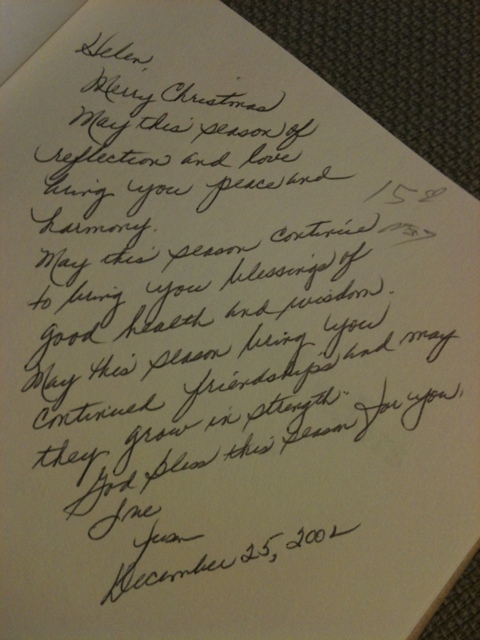
I could never bear to get rid of an inscribed book given as a gift, but lots of people do get rid of inscribed books. This is a monstrous practice, one that attests to just how easily people will discard your oh-so-earnest gifts. If you spend a lot of time in used bookstores (I do) you will come across these sad markings. Because it’s close at hand, and I’m aware of its inscription, I’ll share the note that Jean wrote to Helen (no, of course I know neither of them) in my copy of Balthus’s memoir, Vanished Splendors:
20111220-195619.jpg

I am aware that the memoir of a pervy artist is not the same as a novel, and that, as my first illustrating example, I already seem to be losing my metaphorical balance, but again, it was close at hand, right near the Tolkien in fact (by the bye, Vanished Splendors is pure gold).

In any case, I think Balthus’s memoir “reads” like a novel, which is to say that it’s mostly big chunks of text that require time and energy to decipher, set against the backdrop of TV, internet, movies, etc. It has some pictures, but not many. There’s no gimmick to it. I’m guessing that Helen just wasn’t into Balthus, or, if she had a passing interest in his art, it didn’t translate into wanting to read his memoir. She certainly didn’t read any of it (yes, I have a special sense that tells me when a book has been read. This baby was a virgin). Every time I look over the book, I feel sorta bad for Jean, whose gift seems to have gone unappreciated (by Helen; not by me. I was happy to pick it up used).

To return to an earlier point: yes, some of our favorite gifts ever might be novels. However, most of the life-changing novels I received were rarely given as birthday or Christmas gifts. They weren’t gifts of obligation, if you’ll forgive the ugliness of that term. Most of the great novels that were given to me were handed along free of occasion, given because the giver thought (knew) I should read them.

At Christmas though, we feel obliged to give. Sometimes we get some great novels as gifts. More often though, it seems like that relative who knows you “like to read” gives you a novel by, I dunno, Clive Cussler or Tom Clancy. The worst though are those tiny little hardback books that are designed specifically to be gifts, little faux-tomes of faux-philosophy usually connected to golf or angels or some other bullshit (I was horrified last year when DFW’s “This Is Water” speech got this treatment). Anyway, if you like books, you probably just go trade in this bullshit toward the books you like.

But this post isn’t really about the problem of getting airport novels or gimmick books as gifts. This post is about those of us who insist on giving novels we love to people who we know don’t really love reading novels. Especially really big, somewhat (or very) experimental novels. Important novels. Those novels that we read and decide that everyone needs to read this to become a fully realized human being [gags on that phrase].

I think sometimes we give our friends and relatives novels as gifts because we love them so much and we also love the book so much that we are maybe gunning for an intellectual three-way. We want them to read the novel so that we can share in it together, discuss it, rant about it, argue about it (remember though: that’s what the internet is for).

What often happens though is that these gifted novels (forgive the ambiguous, awkward modifier) tend to lurk about the giftee’s abode, brickishly unread, like dour unwanted houseguests. They skulk at the margins of bookshelves or migrate to the bottom of “to read” stacks; a lucky one might find occasional fingering above a commode. They are ugly reminders to the giftee, signals of how he or she has failed to meet your expectations (your expectations re: 9 or 15 or 25 or 30 hours of her time). (Young people, by which I mean college students in the liberal arts, are the exception here; they probably aren’t going to read the novel, but they are absolutely fine with putting it out for show).

People like books with pictures though, generally.

Even though I think novels tend to make lousy gifts, we should give them to our friends and loved ones anyway, even on those days of obligated giving. We should still offer novels up like they were somehow a part of our own selves in the deluded hope that the giftee will read them and discuss them with us, and that the novel will become an internal, virtual, shared experience. We should give them knowing that it’s likely they’ll go unread, that they may even be a point of shame for the giftee (especially when we ask, “Have you started . . . ?”). We should give them aware that they might point toward our own selfish desires.

Even if a novel may be a gift that implies a certain level of intellectual work, it also implies a  sense of trust and respect toward the giftee, and in this sense, giving a loved novel is a clear way to show love.

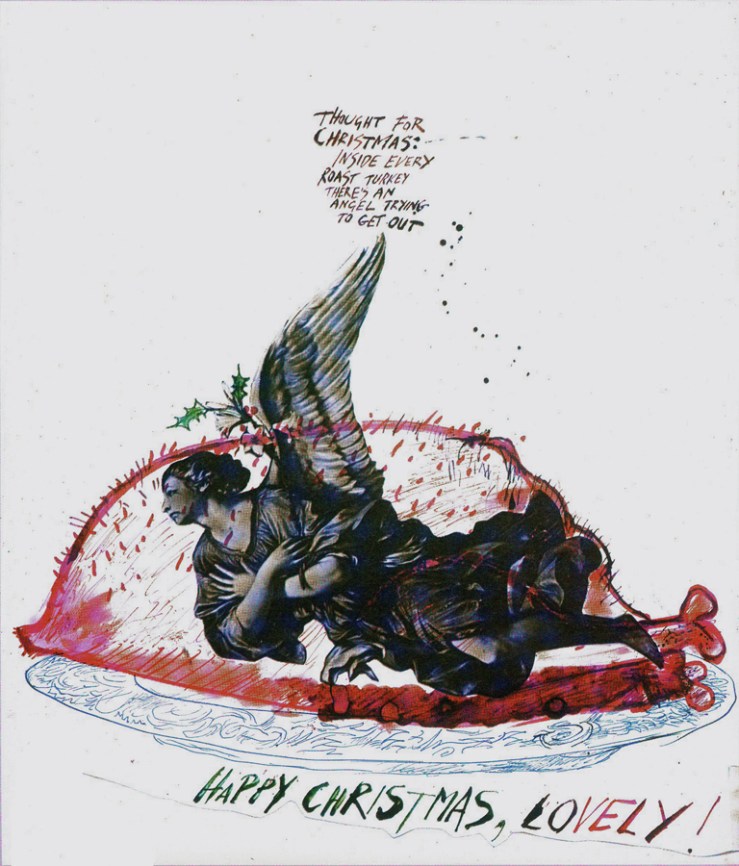
“Happy Christmas, Lovely!” — A Christmas Card from Ralph Steadman

(Thanks to Bblklpt reader JESCIE for the link).

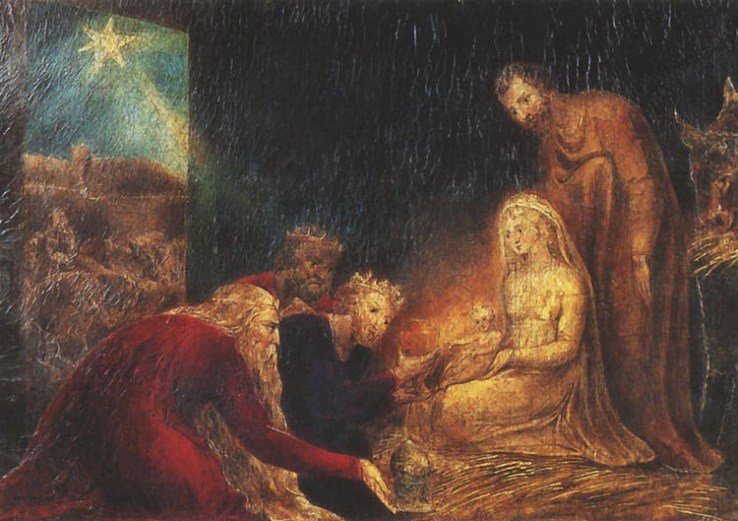
Adoration of the Magi — William Blake

“Peace on Earth/Little Drummer Boy” — Will Ferrell & John C. Reilly

Vodpod videos no longer available.

“Winter Wonderland” — SNL Original Cast

The original SNL cast’s take on “Winter Wonderland” is one of my favorite Christmas recordings ever. It’s from the first season of Saturday Night Live; Candice Bergen is hosting, and you can see her singing along with Gilda Radner, Jane Curtin, and Laraine Newman. The underrated Garrett Morris delivers the powerful lead vocal, and there’s something magical about the moment when the boys — Chevy, Aykroyd, Belushi — come in for support.

When I was a kid, I was always puzzled by the clip. I saw it several times on Comedy Central reruns; this is back when Comedy Central was a fledgling network that ran SNL about 8hrs a day, along with lots of bad ’80s stand up shows, MST3K, and a show I loved called Short Attention Span Theater hosted by some guy named John Stewart. Anyway, I guess what puzzled me so much was that it seemed so damn sincere, and so good. I suppose Morris’s vocal provides much of the earnest authenticity that so baffled me when set against the goofy, ironic sloppiness of those (very) early SNL skits. I guess I was looking for a joke and couldn’t find one. They didn’t seem to be mocking the song. In retrospect, I can see that there’s something of a loving parody at work in their version of “Winter Wonderland,” a gentle poke at old, hokey Christmas musicals, but the emphasis is on loving — it’s almost bizarre in its tenderness and earnest emotion.


Costanza’s Christmas Card

Read Nathaniel Hawthorne’s Short Story “The Christmas Banquet”

“The Christmas Banquet,” a tale from Nathaniel Hawthorne (from Mosses from an Old Manse; it might be, like, an allegory or something):

“I HAVE HERE attempted,” said Roderick, unfolding a few sheets of manuscript, as he sat with Rosina and the sculptor in the summer-house–“I have attempted to seize hold of a personage who glides past me, occasionally, in my walk through life. My former sad experience, as you know, has gifted me with some degree of insight into the gloomy mysteries of the human heart, through which I have wandered like one astray in a dark cavern, with his torch fast flickering to extinction. But this man–this class of men–is a hopeless puzzle.”

“Well, but propound him,” said the sculptor. “Let us have an idea of him, to begin with.”

“Why, indeed,” replied Roderick, “he is such a being as I could conceive you to carve out of marble, and some yet unrealized perfection of human science to endow with an exquisite mockery of intellect; but still there lacks the last inestimable touch of a divine Creator. He looks like a man, and, perchance, like a better specimen of man than you ordinarily meet. You might esteem him wise–he is capable of cultivation and refinement, and has at least an external conscience–but the demands that spirit makes upon spirit, are precisely those to which he cannot respond. When, at last, you come close to him, you find him chill and unsubstantial–a mere vapor.”

Continue reading “Read Nathaniel Hawthorne’s Short Story “The Christmas Banquet””

“Fleck the Walls” — Ren & Stimpy

Mark Twain Disses Santa Claus

In Chapter 31 of his travel piece A Tramp Abroad, Mark Twain wonders (in typical cynical fashion) why dear ole Saint Nick, who abandoned his kids, should deserve a loving reputation:

Presently we passed the place where a man of better odor was born. This was the children’s friend, Santa Claus, or St. Nicholas. There are some unaccountable reputations in the world. This saint’s is an instance. He has ranked for ages as the peculiar friend of children, yet it appears he was not much of a friend to his own. He had ten of them, and when fifty years old he left them, and sought out as dismal a refuge from the world as possible, and became a hermit in order that he might reflect upon pious themes without being disturbed by the joyous and other noises from the nursery, doubtless.

Judging by Pilate and St. Nicholas, there exists no rule for the construction of hermits; they seem made out of all kinds of material. But Pilate attended to the matter of expiating his sin while he was alive, whereas St. Nicholas will probably have to go on climbing down sooty chimneys, Christmas eve, forever, and conferring kindness on other people’s children, to make up for deserting his own. His bones are kept in a church in a village (Sachseln) which we visited, and are naturally held in great reverence. His portrait is common in the farmhouses of the region, but is believed by many to be but an indifferent likeness. During his hermit life, according to legend, he partook of the bread and wine of the communion once a month, but all the rest of the month he fasted.