The first time I read Blood Meridian, I was so appalled that while I was held, I gave up after about 60 pages. I don’t think I was feeling very well then anyway; my health was going through a bad time, and it was more than I could take. But it intrigued me, because there was no question about the quality of the writing, which is stunning. So I went back a second time, and I got, I don’t remember… 140, 150 pages, and then, I think it was the Judge who got me. He was beginning to give me nightmares just as he gives the kid nightmares. And then the third time, it went off like a shot. I went straight through it and was exhilarated. I said, “My God! This reminds me of Thomas Pynchon at his best, or Nathanael West.” It was the greatest single book since Faulkner’s As I Lay Dying.
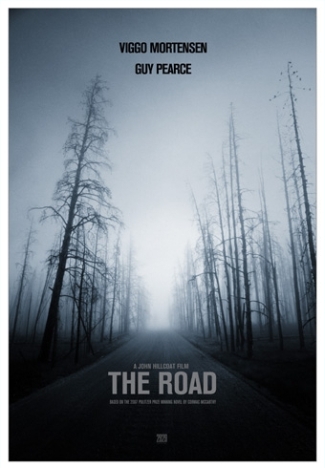
Australian director John Hillcoat’s movie adaptation of Cormac McCarthy‘s bleak and beautiful novel The Roadfinally has a proper trailer as well as (another) release date, October 16th, 2009. Here’s the trailer:
The trailer makes the movie look kinda “big”–explosions, way more people than I remember being in the novel, and what appears to be a heavily expanded role for the wife, played by Cherlize Theron. Still. I wanna see this. At the same time, the trailer seems to scream “Go read the book, now!” And you should. It’s great.
There’s no such thing as life without bloodshed [. . .] I think the notion that the species can be improved in some way, that everyone could live in harmony, is a really dangerous idea. Those who are afflicted with this notion are the first ones to give up their souls, their freedom. Your desire that it be that way will enslave you and make your life vacuous.
Great interview, even if it is almost 17 years old.
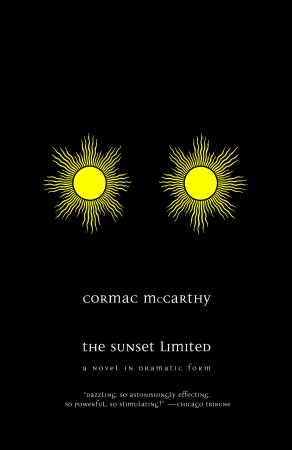
Cormac McCarthy’s The Sunset Limited is a lean, spare dialectic between two characters named simply “Black” and “White.” Black, a recovering addict who found Jesus in prison, saves White, an aging professor, who attempts to kill himself by jumping in front of a commuter train, the Sunset Limited. Black keeps White in his apartment, probing the older man’s justification for suicide. White makes it very clear that he intends to finish the job the moment he can leave Black’s apartment, leading Black to stall the professor through argument and storytelling. As such, Black sustains most of the book’s driving questions about morality, redemption, and love for one’s fellows, until near the end, when White unleashes a tirade of nihilism. As the story charges to its climactic conclusion, it becomes clear that it is not just White’s soul at stake, but also Black’s own spirituality.
The cover of The Sunset Limited attests that the book is “A Novel in Dramatic Form,” a conceit that may divide many of McCarthy’s admirers. The language here is precise and visceral, loaded with meaningful ideas yet also utterly concrete. McCarthy’s grasp of colloquial diction shines through these two voices, carrying the story forward in a hurtling momentum with minimal stage directions. Still, some readers may feel cheated out of McCarthy’s rich prose in this bare story (they need only to pick up Blood Meridian or The Road or All the Pretty Horses, of course). I found the story engaging, poignant, dark, and often surprisingly funny, and I read it in one taut sitting. The Sunset Limited is not the starting place for those interested in McCarthy, but fans who’ve yet to read it will probably enjoy it quite a bit. I’m already anticipating a second reading. Highly recommended.
Not quite two years ago, I wrote some pretty awful things about William Faulkner on this blog. In a review of his first published novel Sancutary, I argued, quite ineffectually, that, “Faulkner as an American Great is nothing but a scam.” Elsewhere, I proffered this ignorant nugget:
“…it seems that a few critics–notably Malcolm Cowley and Cleanth Brooks–decided either that a. Faulkner is really great and/or b. America needs a new master of literary fiction, and it might as well be Faulkner. It seems amazing to me that these two critics conned a whole generation into believing that someone whose books were so unbelievably poorly written was actually, like, a totally awesome and important writer.”
Ouch. At the time I wrote that rant, I was still in grad school, which is to say I was still being assigned reading by well-intentioned professors. I was also laboring under a cruel miscalculation, the mistaken belief that I had actually read most of Faulkner’s great works–As I Lay Dying, The Sound and the Fury, and Absalom, Absalom!–in my high school and undergraduate courses–where said books were assigned reading. The truth, I realize now, is that while Faulkner’s strange, dense, elliptical prose might have passed under my eyes, I completely failed to read his books when I was a young man. It wasn’t until last spring, when I read one of Faulkner’s last novels, Go Down, Moses, that I came to understand the genius of his writing, which is to say I came to learn to read his voices in a non-academic, non-studied fashion, intuitively and rhythmically. Go Down, Moses is strange and sad and funny and truly an achievement, a book that works as a sort of time machine, an attempt to undo or recover the racial and familial (in Faulkner, these are the same) divides of the past.
So. Skip ahead a year.
After reading Bolaño’s stunning 2666, I strategically read Cormac McCarthy’s Child of God, knowing that I’d need a voice at least equal to Bolaño’s in order to not get totally bummed out and sort of paralyzed with that “What do I read next?” feeling. The strategy worked, but of course I needed a follow up book. So I picked up As I Lay Dying, the story of a poor rural family who labor to return their dead matriarch to her family’s home town for burial. I’d “read” the book in high school; I remembered the plot, but I could not in any way comment on it. This time, with the freedom to choose to read it–and perhaps, older, better equipped–I truly entered the book, entered into each of the character’s heads, their eyes, their voices. I “got” it.
I read As I Lay Dying in essentially three or four long sittings, sustained by Faulkner’s incomparable, engrossing language. I realize now that as a high school student, and then again as an undergrad, I resisted the book, attempted to impose my own consciousness into the narrative in order to “understand” the plot, rather than letting the book happen to me–which I believe is how one must read Faulkner. I was amazed how quickly I read the book once I attuned myself to Faulkner’s rhythm, and I was equally amazed at how conflicted and confused I felt about the story. I can’t recall a novel whose characters I’ve ever felt so hateful and sympathetic toward at the same time. Great, great book.
Anyway. The point of this post is to say, “Hey, I was wrong, mistaken, terribly wrong about Faulkner when I said he wasn’t a Great American Writer.” I suppose I’m also implicitly arguing that the necessary evil of assigned reading can sometimes be less necessary and more evil: How many kids are we turning away from the really great stuff forever by forcing it upon them when they are too young, too unequipped to appreciate it? The other side of this logic, of course, is to point out that often assigned reading can turn us on to great writers forever; this was the case for me, with most of what I read in high school. Still, as an English teacher I do worry that in assigning and then dissecting literature–under the pretense of explaining it and appreciating it and learning from it–we always run the risk of killing it, draining it of the very vitality that was the rationale for reading it in the first place. Of course, there’s a simple, simple antidote to reconciling yourself to all those books you hated in high school, those books you were supposed to love and be moved by and learn important and meaningful lessons from–you can read them again for the first time. The worst that could happen is a confirmation of your own prejudice; far more likely, in assigning your own reading, you’ll find something truly great and meaningful.
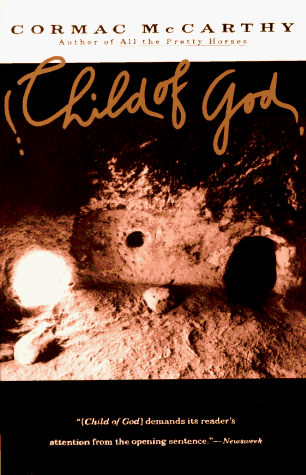
In Greek drama, acts of violence or sex were “ob skena” and had to take place off stage. Thus, the horrific violence of Oedipus gouging out his eyes is not shown, but rather reported by a messenger. We see the same tradition in Shakespeare, of course, as well as the modern novel. And while many writers elide scenes too taboo or offensive to the sensibilities of the general reading public, books like Ulysses, Lolita, and Tropic of Capricorn, demonstrate that novels are often the site of debate over what can and cannot be shown or described or articulated plainly in our culture. Our concept of “the obscene” (the Greek “ob skena” simply translates to “off stage”) demands that certain actions might only be referred to or implied, but not graphically depicted, that the offensive action takes place out of our vision. The great lie or paradox of the obscene then is that in pushing the offensive action off stage, the author necessitates that the audience must envision that very action that was removed, that they must articulate their own understanding or schema or representation of what is taboo. While this strategy can often be quite effective and affecting (think of Tarantino pulling the camera away as Mr. Blonde cuts off the cop’s ear in Reservoir Dogs), in a character-centered novel it can also lead to a larger denial, a larger exclusion. What if one’s whole life was obscene? In his third novel, Child of God, Cormac McCarthy tells the story of a man who has been pushed from life’s stage, who exists in the uncanny and indigent margins of society.
The ersatz protagonist of Child of God, Lester Ballard, is a poor, stooped, abject wretch of a man. The book opens with Ballard losing his house in a humiliating debacle. From there, he wanders the earth, finding an abandoned shack and barely eking out the means to leave. Ballard is an outsider, literally, always looking in at the lives of more normal, more stable people. His voyeurism leads him to creep up to parked cars to spy on the lovers inside. Wanting some connection or sense of love–or perhaps just out of general dejected weirdness–he masturbates against the cars, watching the people inside. His identity as voyeur is magnified in his only apparent skill. Ballard is an ace sharpshooter who carries his rifle almost everywhere he goes, surreptitiously spying on the normal folks through its lethal scope.
As the book develops in McCarthy’s spare, terse prose, Ballard becomes more and more unhinged. Everywhere he goes he is slighted or outright rejected and cheated by his fellow man. The indignities and affronts against Ballard range from being falsely accused of rape to simply being ignored by his neighbors. At the same time, Ballard is a creep, a loser, and seems largely deserving of this treatment. And yet, as McCarthy points out early in the novel, he is a “child of God, much like yourself perhaps.” This early call to identify with Ballard as a fellow human being is constantly strained by his wildly antisocial behavior, and yet it’s McCarthy’s genius as a writer that anchors the novel in some measure of sympathy for such a wretched anti-hero. When a young girl rejects Ballard’s advances, she taunts him, saying, “You ain’t even a man. You’re just a crazy thing.” In many ways, this is the major question of the novel: Is Ballard a man, or a thing? What makes a person a person, and not simply an object estranged from the human race? To test this question, McCarthy has Ballard plumb almost every conceivable taboo, from murder to arson to necrophilia. However, Ballard isn’t the only one in these Tennessee backwoods who behaves despicably: there’s the father who rapes his daughter, the gangster behavior of the Ku Klux Klan, and the mob justice of the townspeople as a whole. Still, Ballard’s descent into violence and madness–graphically portrayed by McCarthy–is the central action in this compelling novel.
Readers looking for redemptive story arcs or tales of heroism will likely be turned off by Child of God, and squeamish readers will probably not get past the first fifty pages. Those interested in McCarthy’s fiction will find more in common here with the visceral grit of The Road or Blood Meridian than the reflective romanticism of his “Border Trilogy” novels (including crowd pleaser All the Pretty Horses). Child of God is in many ways a response to the Gothicisms of Carson McCullers and William Faulkner, and certainly bears favorable comparison to those writers’ works. And like those writers’ works, McCarthy’s novel has its challengers–just as recently as 2007 an English teacher found himself in quite a bit of trouble for loaning the book to a student. Those who see the book as obscene are perhaps right, in the sense that the word implies “that which must be shown off stage.” However, one of the legal definitions of obscenity necessitates that the work “lacks serious literary, artistic, political or scientific value,” a claim that I do not think can be seriously substantiated against Child of God. Don’t believe me? Read it for yourself.
We read many, many books this year, but most of the books we read–especially the very best ones–were not published this year. And as usual, we’re always playing catch up. Case in point: we finally finished Roberto Bolaño’s much-lauded-in-2007 hit The Savage Detectives just last month, and despite feeling that it was kinda overrated we couldn’t help picking up his much-lauded-in-2008 hit 2666 at Green Apple Books in San Francisco this weekend (sidebar that will not surprise any San Francisco reader: San Francisco has the best book shops. Sick). So, we will spend at least the first part of 2009 getting through that massive tome.
Bar none, the best book we read in 2008 was Cormac McCarthy’s masterpiece Blood Meridian, published back in 1985. So good we read it twice, and so should you. We also loved loved loved Philip Pullman’s Nietzschean sci-fi trilogy His Dark Materials. Finally, we must highly recommend E.L. Doctorow’s novel Ragtime, which we finally got around to reading this year (last week, so, no review). This book is great, and you will wonder why you haven’t read it before now. A somewhat neglected classic. But. Let us move on.
There were a couple of fantastic highlights in 2008, of course, most notably Toni Morrison’s A Mercy, a novel on which we cannot heap enough praise. In a time of overstuffed, overlong novels, A Mercy is rich and complex yet lean at just over 170 pages, and, as many critics and reviewers have pointed out, the novel serves as a touching counterpoint for her 1988 masterpiece Beloved.
We also loved–and frequently returned to–Slavoj Žižek’s Violence, a work of cultural criticism that managed to be fun and infuriating and serious and frivolous at the same time. Too often reviewers fall back on hackneyed phrases like “thought provoking,” but Žižek’s work really is provoking, often to the point of confrontation. Like Plato, Nietzsche, and Derrida before him, Žižek is the gadfly, the upsetter, the spoiler. He has earned his haters.
We’d also be remiss not to give props (again) to Wendell Berry’s essay “Faustian Economics,” published in the May, 2008 issue of Harper’s. Berry’s piece is beautiful and sad and timely, and everyone should read it. It was one of the best things we read all year. Speaking of Harper’s, the latest issue includes–along with a touching memorial to critic John Leonard, who died last month–the remarks of those who spoke (including Zadie Smith and Don DeLillo) at David Foster Wallace’s memorial service this October. Wallace’s suicide was and is awful, and remarking on it in a “Best of 2008” section seems tacky, but we can’t help it. We love his work and are sad that there won’t be any more, or at least much more, or at least any “finished” work from the man, but, as George Saunders puts it in his portion of the memorial: “In time–but not yet–the sadness that there will be no new stories from him will be replaced by a deepening awareness of what a treasure we have in the existing work.” So, if we remark on DFW here, it is only because he was one of the best, and he died this year, and in some sense, we need to remark on it yet again, despite having writtentoomuchalready.
But let’s not end on a sad or sour note. Plenty of great reads in 2008, and surely we neglected a tome or three in this rehash, but hey, we’re human, we err, etc. We look forward to more reading in 2009, and perhaps, improbably (we lie to ourselves, who doesn’t though?) we may actually defeat that stack of books by the bed, on the night stand, on the coffee table.
“Having your book turned into a movie is like seeing your oxen turned into bouillon cubes” — John LeCarre
Movies rarely compare favorably to the books from which they are adapted and almost never surpass them. Still, film adaptations of books can be fantastic if handled by the right director–take Mexican director Alfonso Cuarón for example, whose brilliant films Children of Men and Harry Potter and the Prisoner of Azkaban (adaptations of books by P.D James and J.K. Rowling, respectively) convey richly imagined, engrossing worlds. Cuarón’s films join a small stable of adaptations that live up to–if not surpass–the books on which they are based. Most great film adaptations turn good genre fiction into great art. However, great literature doesn’t usually fare so well. Geniuses like Kubrick and Coppola have reconfigured airport reading like Stephen King’s The Shining and Mario Puzo’s The Godfather into cinematic masterpieces, but has anyone ever done justice to Melville or Hemingway or Hawthorne or Fitzgerald (of the four attempts at translating Gatsby to the screen, the 1974 Coppola-produced effort is arguably the best, but consider how short it falls of capturing Fitzgerald’s vision)? Which brings up the question: just how good, bad, or indifferent will the upcoming movie adaptation of Cormac McCarhy’s Pulitzer Prize winnerThe Roadbe? We thought we’d navigate the pros and cons here.
What The Road film adaptation has going for it:
The director: Australian director John Hillcoat’s 2005 feature film debut The Proposition captured the bloody violence and moral ambiguity of a world alienated from civilization. We loved the movie, and not enough people have seen it. The tone Hillcoat achieved in The Proposition seems well matched to McCarthy’s grim vision.
The producer: Nick Wechsler’s list of films includes Sex, Lies, and Videotape, The Player, Requiem for a Dream, 25th Hour, and Drugstore Cowboy–so it seems like he knows how to sit back and let a filmmaker create art without trying to, you know, have a massive Hollywood hit.
The leading man: Viggo Mortensen as the father seems like a great choice. Mortensen brought depth to the role he’s most famous for–Aragorn in The Lord of the Rings trilogy–something of a feat when you consider most of his screen time was devoted to scowling, brooding, or chopping up orcs. He was fantastic in the films he did with David Cronenberg, A History of Violenceand Eastern Promises (his bathhouse fight scene is unbelievable). Mortensen’s a published author who started his own publishing house, Perceval Press, so he probably understands the literary gravity of The Road.
The story: Anyone who’s read The Road knows that it’s a sad and moving and strangely beautiful take on one of the most hackneyed devices of science fiction: the post-apocalyptic wasteland.
Potential problem spots for The Road film adaptation:
The cast: We don’t know much about twelve year old Kodi Smit-McPhee who plays the son, but we do know that that is a major role. Let’s hope Kodi is more Jodie, less Jake Lloyd or (shiver) Dakota Fanning. However, Viggo’s had pretty positive things to say about him. Ringers Robert Duvall and Guy Pearce are also in there, but there aren’t too many other speaking parts in the book besides the father and the son, so it’s hard to predict what they’ll be doing–hopefully Hillcoat hasn’t fiddled with the story too much. Charlize Theron is also in the movie. The wife character showed up in a few dreamy flashbacks, but was more of a shadow than a fleshed out character; again, hopefully Hillcoat hasn’t chosen to expand the role to appease a wider demographic.
The story: Some of the best moments of The Road consist of the father’s inner monologues on memory and loss and very few directors can pull off a voice-over successfully (Terrence Malick is the only one who comes to mind right now). Of course, this problem of language is always the problem of movie adaptation.
All the Pretty Horses: Billy Bob Thornton’s leaden 2000 adaptation of the first of McCarthy’s “border trilogy” is pretty boring. I’ll admit that I’ve never finished the book, despite three attempts [ed. note: I finished the “border trilogy” in spring of ’09. Books are far, far, far superior to the film].
No Country for Old Men: Even though the Coens did a great job with No Country for Old Men, the book was still better than the movie–and No Country is, in some ways, McCarthy’s take on a genre novel, the crime procedural. In this sense, the Coens made a smart move, but they still couldn’t convey the depth and meaning of the book–again, much of it delivered via Sheriff Ed Tom Bell’s inner monologues. Although The Road may appear to have genre fiction elements–namely, the tropes of post-apocalyptic sci-fi–to describe it as such would be a severe limitation, as would be to film it in such a manner.
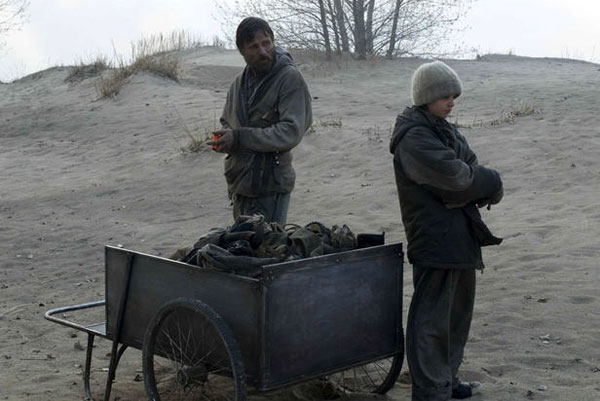
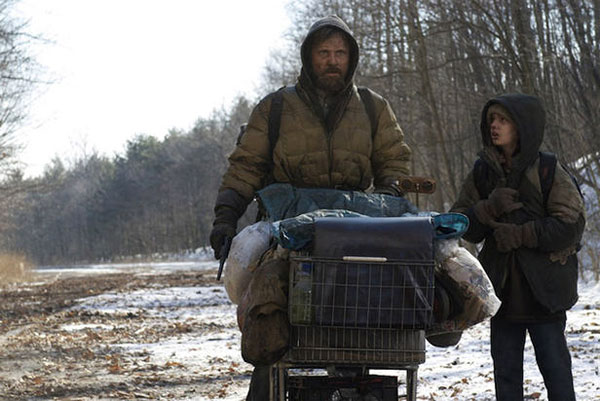
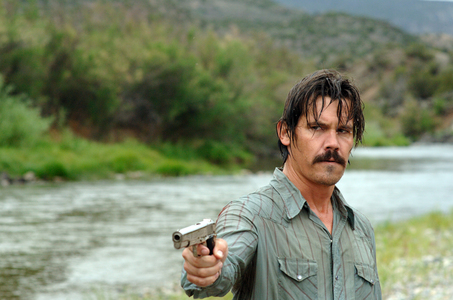
The advance stills: Sure, they’re grim and bleak, but are they grim and bleak enough?
Also, why the stylized cart? If you’ve read the novel, you know what I mean–the cart needs to be a grocery store cart, homeless style! Hang on–
–that’s better! (NB: images link to a gallery of advance images)
Does it seem worth seeing in the theater?
Yes. We’ll be carrying the fire on or around November 26th (and just in time for Thanksgiving!)
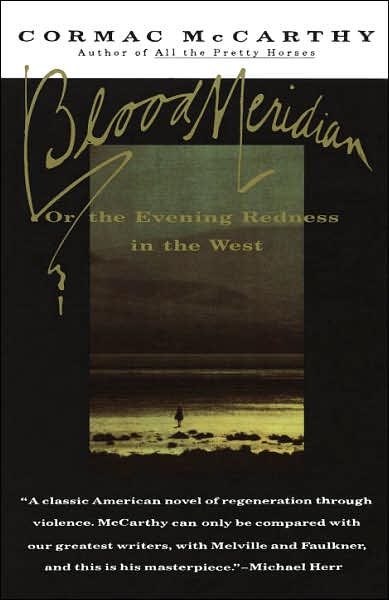
Blood Meridian is a blood-soaked, bloodthirsty bastard of a book, and certainly the most violent piece of literature I’ve read outside of the Bible and certain Greek tragedies. Cormac McCarthy’s 1985 novel passes itself off as a Western–and it is a Western, to be sure–but more than anything, it’s a brutal horror story.
Set predominantly in the 1850s, Blood Meridian chronicles the westward journey of a protagonist we know only as “the kid.” After a few false starts (including getting shot, robbed, arrested, and surviving a Comanche massacre) the kid eventually meets up with John Joel Glanton‘s “expedition”–a group of men of mixed backgrounds hired by Mexican authorities to kill–and scalp–the nomadic Apache that prey upon Mexican villages. However, led by the nefarious, larger-than-life Judge Holden, Glanton’s gang quickly descends into a relentless robbing, raping, and killing spree; they savagely massacre peaceful Indian settlements along with the Mexican villages they were contracted to protect.
I could keep summarizing the book, but I don’t see the point, honestly–a mere description of the plot could never do real justice to the weight of this book. The narrative is taut and fast-paced–in fact, at points the action is so radically condensed that I had to go back and re-read sections–and there’s no shortage of the “men doing men stuff” that McCarthy is so good at detailing–but it’s really the combination of the book’s evocative imagery and philosophical pondering that hook the reader.
Most of that philosophical pondering comes from the Judge, who waxes heavy on everything from space aliens to metallurgy. In his parables and aphorisms, the Judge comes across as part-Mephistophelean, part-Nietzschean, all dark wisdom and irreverent chaos. I found myself re-reading the Judge’s speeches several times and chewing them over, trying to digest them; for me, they were the best part of a great book.
Blood Meridian, like most excellent things, is simply not for everyone, and I don’t mean that in any snobbish, elitist sense. Any reader turned off by its freewheeling violence would be justified, and I’m sure plenty of folks out there would take issue with its ambiguous conclusion. Depictions of genocidal mania that seem to end inconclusively are not for everyone, particularly when they are rife with archaisms, untranslated Spanish, and McCarthy’s signature, apostrophe-free punctuation. I had two false starts with the novel, including one where, at about exactly half way through, I realized I had to go back and start the novel again. I owed it that much. And it was worth it.
Blood Meridian is literally stunning; perhaps the best analogy I can think of is going to see a really, really good band that plays really, really brutal and strange music that sorta melts your face off. After the show you’re sweaty and exhilarated and even unnerved; your ears are ringing and your chest is pounding. And then the band packs up, and the house lights go on, and they pump in music from a CD, of all things, and the music just sounds tinny and pale and blanched of life after the raw power you’ve witnessed. Reading anything else right after finishing Cormac McCarthy’s Blood Meridian, or the Evening Redness in the West is sort of like that. Highly recommended.
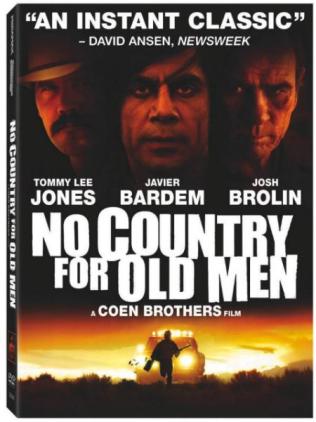
On my Superlatives list at the end of last year, I awarded No Country for Old Men “Most Disappointing Film of 2007.” Here’s what I wrote:
Although it was by no means bad, I was disappointed in the Coen’s adaptation of Cormac McCarthy’s No Country for Old Men. It was a good movie–Javier Badem was fantastic, great pacing and tone–but still it didn’t blow me away like, say, Fargo or Blood Simple or Miller’s Crossing did. Ditto Werner Herzog’s Rescue Dawn. Chalk it up to hyperbolic expectations, I guess. Maybe I need to watch these films again on DVD and reconsider.
Ok. So. I went back and watched No Country on DVD this weekend. One of my criteria for a great film is that it has to be great without the transfixing power of a huge screen and roaring sound system. The Lord of the Rings movies, for example, suffer greatly on TV; the epic magnitude is diminished, and you realize just how much the movies relied on the the modern movie screen. I still like them though. I just don’t think they work too well on small screens (god forbid you watch them on a phone). So how does No Country hold up?
I don’t think it fairs any worse, but I still have to argue that this movie is incredibly overrated. I’d read the book (listened to the audiobook, actually) before I’d seen the film the first time, and watching it again I was doubly-prepared for the film’s decidedly non-Hollywood ending (and non-Hollywood climax, to boot).
Oh, by the way, a few SPOILERS ARE COMING UP. Fair warning, right?
Ok. When I initially saw the film, many of the people of the audience were disappointed and angered at the end of the movie, including my mom’s cousin, a man in his sixties from South Carolina. My uncle zoned out at the end, during Tommy Lee Jones’s last speech. When the movie ended and we walked out of the theater, he asked me to explain what happened. He’d missed the end. Three young men overheard, came up, and started asking me questions– “Did that guy [Llewellyn Moss] die?” etc. My mom’s cousin summed up the way a lot of people probably felt about the end of this movie– “I didn’t like it that the bad guy got away and the good guy died. Why didn’t the Sheriff go get him?” That the film is deeply dissatisfying to our collective sense of justice is kind of a thematic point, and that’s not what bothers me about No Country–although I understand why it would bother many audience members.
The film omits the two scenes we ache to see–the initial massacre that sets events in motion, and the death of Llewellyn Moss. We barely get to identify Llewellyn’s body, in fact. The substitutions for these elisions all involve Anton Chigurh, who pretty much steals the show. His murder of a deputy at the beginning of the film enacts a sacrificial slaughter, a substitution for the greater violence of the drug massacre that we don’t witness. He murders Carson Wells, a silly and ultimately trivial character whose sense of self-importance is quickly put under erasure. Finally, he kills Carla Jean Moss, before becoming the victim of a random violent car accident. An accident–not a just punishment for the atrocities he’s committed. Despite the severe accident, Chigurh is able to get up and walk away; presumably, he will continue to wreak havoc. Before Chigurh leaves the screen he turns two boys against each other. They squabble over a bloodied piece of money, recapitulating the larger theme of the movie–an echo of Fargo–that greed is destructive. The message is not overstated, but plain nonetheless. So what’s wrong with this film? Nothing, really. It’s just not as good–and certainly not as profound–as everyone makes it out to be.
In the book, the third act rests mostly on the “old men”–Tommy Lee Jones’s Sheriff Ed Tom Bell, a fellow sheriff, and Ellis, Ed Tom’s uncle. The film omits much of the book here, including a scene where Ed Tom visits another “old man”–Llewellyn’s father. The film also omits a key story from Ed Tom’s past, an act of cowardice in war. The Coens were right to leave much of this stuff out–there are too many monologues from Ed Tom as it is. Still, the titular point of the book becomes eclipsed, subsumed into Chigurh’s violence. Chigurh is a “new man,” part of what Ed Tom perceives as a new direction in our country–a violent and impersonal world he doesn’t belong in. Ed Tom fails to realize that the country was founded and maintained in many ways via impersonal violence, despite the fact that his own past–as well as the past of his family–is entrenched in this violence. His real problem is with the lack of clear, absolute morality, pure right and wrong, good and evil, an attitude best summed up with his assertion that once people quit saying “Ma’am and Sir,” everything else goes to hell. He brushes off Ellis when the old man tells him that the country has always been violent and difficult. The movie ends the same as the novel, with Ed Tom relating two dreams he had about his father.
The film ultimately fails to relate the depth of the novel, opting instead for a competent depiction of the surface tensions at work. The Coens accurately captures the “men doing stuff” aspect of McCormac’s writing without getting to any of the meaning behind it all. And that’s fine. The movie’s fine. It’s just not as great as everyone is pretending it is. Perhaps we’re all just so happy that the Coens have stepped up from their previous lightweight projects–The Ladykillers and Intolerable Cruelty–that we feel the need to fawn all over No Country. Or maybe I’m wrong–maybe this is a profound thriller, a truly excellent movie; maybe this is the Coens’ masterpiece. But I think not.
Didn’t we write about No Country for Old Mena week or two ago? Yeah, but that was for the upcoming Coen brothers movie; this post is a review of the audiobook, and I’m not creative enough to think of a different title.
So we listened to the entirety of Cormac McCarthy’s No Country for Old Men over the course of two drives: from Jacksonville to St. Pete Beach and back. First off, as far as books-on-CD goes, this one was pretty good. Native Texan Tom Stechshulte manages to get all of the male characters spot on (the women in the novel sound kind of ridiculous though), and the action-filled plot, tight pacing, and simple sentences make for an easy-to-follow-while-driving listening experience (this is my number one criterion for an audiobook–you have to be able to follow the plot while navigating a road littered with truckers and asshole teenagers. F’r’instance, Faulkner’s short stories are almost impossible to follow in audiobook format).
Set in 1980, No Country for Old Men is the story of Llewellyn Moss, a Vietnam vet who stumbles across the aftermath of a drug deal gone bad and a suitcase with 2.4 million dollars in it. Of course, he takes the money and runs. Assassin Chigurh is hot on his heels to collect the drug money, leaving a bloody wake of murder and chaos. Sheriff Bell, a WWII vet who first-person narrates the beginning of each section of the book, is also on the case, trying to track down Llewellyn before he gets himself killed.
The first five discs (of seven) of the book were excellent–an exercise in genre fiction–the crime-suspense novel–that transcends the limits of the genre’s tropes. McCarthy’s spare prose moves at just the right pace, with just the right amount of “literary” interjection. However, the end of the novel morphs (evolves or devolves?) into a meditation on war and the changing nature of America and the American people. McCarthy’s symbols and metaphors seem heavy-handed and downright clunky at times, and in the end, the book becomes something of a reflection on personal failures and regrets, and how these personal failures add up to national failures.
Perhaps because I was driving, and because I had been so involved with characters over the course of five compact discs who suddenly disappeared in the narrative, I was disappointed in the end. Perhaps if I had read the book instead of listening to it on compact disc while driving, I would have found the ending more profound, or even enjoyable. Who knows–reading books vs. listening to them is probably a subject for another post. I do think that the Coen brothers will make a fantastic movie out of this story–potentially on par with Fargo. We’ll see.
I’ve been reading a lot of Faulkner lately. This has nothing to do with me liking Faulkner (I don’t) or thinking that he’s an American master (at this point, I’m convinced that he’s not. Rather, it seems that a few critics–notably Malcolm Cowley and Cleanth Brooks–decided either that a. Faulkner is really great and/or b. America needs a new master of literary fiction, and it might as well be Faulkner. It seems amazing to me that these two critics conned a whole generation into believing that someone whose books were so unbelievably poorly written was actually, like, a totally awesome and important writer). I’m taking a class that requires me to read Faulkner.
Anyway, over the course of my reading, I got to thinking that the Coen brothers, two guys that have made some of the best American films ever (masterful films, certainly) are fond of Faulkner: the flood in O Brother Where Art Thou? hearkens to Faulkner’s novella Old Man (as does the whole milieu of that film really), the slow southern grotesque of Blood Simple is pure Faulknerian, ditto the gloomy doom of The Man Who Wasn’t There, and the failed screenwriter W.P. Mayhew in Barton Fink is essentially a caricature of Faulkner during his days in Hollywood.
So well and anyway, the Coens have a new movie coming out, No Country for Old Men, based on the Cormac McCarthy novel of the same name. Cormac McCarthy is often compared to Faulkner, though I have no idea why. They’re American? That’s it. They’re American. Like I said though, No Country for Old Men. Early reviews suggest that this is a return to form for the Coens, who have either been stumbling or just lazily cashing in lately (see: Intolerable Cruelty; The Ladykillers)–but we’ll have to wait until November to find out. For now, check out the trailer:
At this point, I don’t know if it does any good to anyone for me to throw in my two cents regarding Cormac McCarthy’s latest novel The Road. This book won all sorts of awards and critical praise, topped The Believer‘s 2006 readers’ poll, and even became an Oprah’s Book Club selection. In fact, Cormac McCarthy gave his first ever television interview last month on The Oprah Winfrey Show, and I actually watched the damn thing. I was in the hospital; my daughter had just been born. Anyway, like I was saying, after the publication of The Road, everyone in the field of arts and letters and criticism seems to have simultaneously decided to confer “living master” status on Mr. McCarthy, most noting that he is an American writer. This is something we’re desperate for in American literature–masters of the art. And, if you cannot tell already, I have a somewhat cynical attitude toward this desperation, and a wary if not pessimistic approach to anything so unanimously lauded. So when my mother-in-law gave me a copy of The Road as a belated birthday gift–only a few days after the Oprah interview, in fact–I felt a mixture of intrigue and hesitation. I was reading The Children’s Hospital at the time (#3 on The Believer list, incidentally) which gave me some time and distance from the Oprah interview and some of the hype. When I finally finished The Children’s Hospital, I gave myself a little more distance, reading a few Faulkner short stories and a few magazine articles. Finally, I picked up The Road; I read about half of it in one sitting on a Friday night, finishing the rest of it over that weekend. I had to slow down in the end, because I knew that this book was a tragedy; I knew that (more) bad things were going to happen, and I loved the little boy and the man–the protagonists of the novel–and simply put, I put off reading as a way of putting off their deaths (I did the same with the end of The Children’s Hospital; also, just to get it out of the way, both novels are post-apocalyptic. Done with comparisons).
The premise of The Road will remind you of any number of other post-apocalyptic stories you’ve read or seen: the world is over and everything has gone to shit. However, McCarthy is unrelenting in his refusal to provide an explanation or even description for the epic disaster that precedes the events of the novel. Where most stories in the end-of-the-world genre delight in some sort of mythology, The Road eschews any fantastic back story. Instead, we get fragments, glimpses, the briefest hints. The overall effect of this lack of a reason is a stunning, awesome loneliness. This is an abandoned world, desolate, dead, cold, covered in ash. Nothing can live. Besides, the real story of The Road is the touching relationship between a nameless father and son. These are “the good guys” who “carry the fire”–this is the only mythology of the novel, the father’s only lessons to the son. The pair travels south, although their purpose is simply to stay alive, to not die. A large amount of the text is devoted to the simple day-to-day scavenging that is necessary to live, with occasional encounters with other living people being rare, unexpected, and ultimately meaningless. In a world where living people equal a good source of protein, no one can really help these two; all other people are threats–“the bad guys.” And as the novel progresses, the young boy begins to realize that the world is not so simple, that there may not be such a thing as “good guys” and “bad guys.”
The bond between the father and son, so beautifully expressed in McCarthy’s spartan prose, genuinely moved me. Their relationship propels a narrative absent of all but the dimmest kernel of hope; indeed, it doesn’t seem like there can be any future for these two at all in a world where nothing–no plants, no animals–can live. Which brings me to the last few pages of the book. I have a problem with this. First, I guess I should give a spoiler warning. Honestly, I believe that you can know the end of the book and not have it spoiled for you, but in the interest of etiquette: SPOILER WARNING! SPOILER WARNING! SPOILER WARNING! There. May we continue?
So yes, from the beginning of this book, it’s evident that either the father or the boy or both will die by the end of the book. And yes, the father does die, in a scene so moving that I actually cried. Unbelievably, however, McCarthy cops out in the last few pages of the book, and provides a deus ex machina in the form of a loving surrogate family to protect the boy. I mean, the new father figure comes literally out of nowhere and more or less says: “Okay, you’ll be safe now. Don’t worry readers, the kid is gonna make it!” This improbable resolution seems to contradict the 283 pages or so of the novel that preceded it. It seems far more likely in the world and vision that McCarthy crafted that the boy would be left alone to fend for himself. It’s almost as if McCarthy loved the boy too much to see him on his own, unattended to. And of course, a lot of his readers probably felt the same way–I certainly did. I really did. I wanted to see that kid make it, but at the same time the logic of the narrative does not support the ending that McCarthy wrote. Still, this really is a fantastic book–perhaps a bit overrated, but excellent nonetheless. Highly recommended.








 Biblioklept