“Your first nightmare away from home” (Infinite Jest)

Your first nightmare away from home and folks, your first night at the Academy, it was there all along: The dream is that you awaken from a deep sleep, wake up suddenly damp and panicked and are overwhelmed with the sudden feeling that there is a distillation of total evil in this dark strange subdorm room with you, that evil’s essence and center is right here, in this room, right now. And is for you alone. None of the other little boys in the room are awake; the bunk above yours sags dead, motionless; no one moves; no one else in the room feels the presence of something radically evil; none thrash or sit damply up; no one else cries out: whatever it is is not evil for them. The flashlight your mother name-tagged with masking tape and packed for you special pans around the institutional room: the drop-ceiling, the gray striped mattress and bulged grid of bunksprings above you, the two other bunkbeds another matte gray that won’t return light, the piles of books and compact disks and tapes and tennis gear; your disk of white light trembling like the moon on water as it plays over the identical bureaus, the recessions of closet and room’s front door, door’s frame’s bolections; the cone of light pans over fixtures, the lumpy jumbles of sleeping boys’ shadows on the snuff-white walls, the two rag throw-rugs’ ovals on the hardwood floor, black lines of baseboards’ reglets, the cracks in the Venetian blinds that ooze the violet nonlight of a night with snow and just a hook of moon; the flashlight with your name in maternal cursive plays over every cm. of the walls, the rheostats, CD, Inter-Lace poster of Tawni Kondo, phone console, desks’ TPs, the face in the floor, posters of pros, the onionskin yellow of the desklamps’ shades, the ceiling-panels’ patterns of pinholes, the grid of upper bunk’s springs, recession of closet and door, boys wrapped in blankets, slight crack like a creek’s course in the eastward ceiling discernible now, maple reglet border at seam of ceiling and walls north and south no floor has a face your flashlight showed but didn’t no never did see its eyes’ pupils set sideways and tapered like a cat’s its eyebrows’ \ / and horrid toothy smile leering right at your light all the time you’ve been scanning oh mother a face in the floor mother oh and your flashlight’s beam stabs jaggedly back for the overlooked face misses it overcorrects then centers on what you’d felt but had seen without seeing, just now, as you’d so carefully panned the light and looked, a face in the floor there all the time but unfelt by all others and unseen by you until you knew just as you felt it didn’t belong and was evil: Evil.

And then its mouth opens at your light.

And then you wake like that, quivering like a struck drum, lying there awake and quivering, summoning courage and spit, roll to the right just as in the dream for the nametagged flashlight on the floor by the bed just in case, lie there on your shank and side, shining the light all over, just as in the dream. Lie there panning, looking, all ribs and elbows and dilated eyes. The awake floor is littered with gear and dirty clothes, blond hardwood with sealed seams, two throw-rugs, the bare waxed wood shiny in the windows’ snowlight, the floor neutral, faceless, you cannot see any face in the floor, awake, lying there, faceless, blank, dilated, playing beam over floor again and again, not sure all night forever unsure you’re not missing something that’s right there: you lie there, awake and almost twelve, believing with all your might.

From David Foster Wallace’s Infinite Jest.

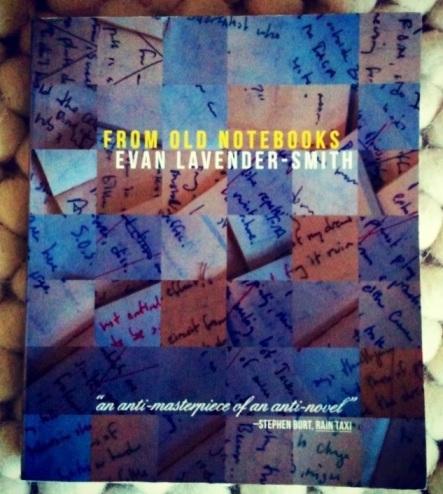
I Anti-Review Evan Lavender-Smith’s Anti-Novel, From Old Notebooks

20130202-121935.jpg

The style of this review is probably a bad idea.

In fact, it’s such a bad idea that it’s probable someone has already done it. Or considered doing it but had the good sense to refrain.

From Old Notebooks as the presentation of a subject through his daily jotting downs.

To clarify: All block quotes—like the one above—belong to Evan Lavender-Smith’s From Old Notebooks.

Which I read twice last month.

And am writing about here.

From Old Notebooks: A Novel: An Essay.

From Old Notebooks: An Essay: A Novel.

From Old Notebooks blazons its anxiety of influence: Ulysses, Infinite Jest, Nietzsche, Wittgenstein. Shakespeare.

Joycespeare.

References, critiques, ideas about Joyce, DFW, Wittgenstein, Nietzsche repeatedly evince in From Old Notebooks—and yet David Markson, whose format E L-S so clearly borrows, is evoked only thrice—and not until page 74 (this in a book of 201 pages):

I count David Markson’s literary-anecdote books among the few things I want to read over and over again, yet I have no idea whether they are actually any good. They’re like porn for English majors.

And then again on page 104:

If David Markson hadn’t written his literary-anecdote novels, would I have ever thought to consider F.O.N. a novel? Would I have ever thought to write such a book?

(I should point out that the page numbers I cite are from Dzanc Book’s first edition of From Old Notebooks; Dzanc’s 2012 printing puts the book back in print).

Like Markson’s anti-novels (Reader’s Block, This Is Not a Novel, Vanishing Point, The Last Novel), E L-S’s F.O.N. is constantly describing itself.

There may be some question as to F.O.N.’s status as fiction, poetry, philosophy, nonfiction, etc., but hopefully there will be no question about its status as a book.

Is E L-S’s book postmodern? Post-postmodern?

Perhaps there is nothing quintessentially postmodern about the self-reflexivity, fragmentation and pastiche of F.O.N., if only because all of it follows from form.

From Old Notebooks as a document constantly performing its self-critique:

If there were a Viking Portable Lavender-Smith containing an abridgment of F.O.N., I would be very interested to read it, because there’s no reason that the total value of the book wouldn’t be gained, through editorial happenstance, with much greater efficiency.

From Old Notebooks as a document of authorial anxiety.

A reader could make a case that there are a number of elided texts within or suggested by From Old Notebooks, including the one that gives the author the authority to write such a book.

F.O.N. is also a generative text, bustling with ideas for short stories, novels, plays, films, pamphlets, somethings—it is E L-S’s notebook after all (maybe). Just one very short example—

Novel about a haunted cryonics storage facility.

F.O.N.’s story ideas reminded me of my favorite Fitzgerald text, his Notebooks.

Reading From Old Notebooks is a pleasurable experience.

Personal anecdote on the reading experience:

Reading the book in my living room, my daughter and wife enter and begin doing some kind of mother-daughter yoga. My wife asks if they are distracting me from reading. I suggest that the book doesn’t work that way. The book performs its own discursions.

I shared the tiniest morsel here of my family; E L-S shares everything about his family in F.O.N.:

I know that the reconciliation of my writing life and my family life is one of the things that F.O.N. is finally about, but I can’t actually see it in the book; I don’t imagine I could point to an entry and say, Here is an example of that.

It would be impossible for me not to relate to the character of the author or novelist or narrator of F.O.N. (let me call him E L-S as a simple placeholder): We’re about the same age, we both have a son and a daughter (again of similar ages); we both teach composition. Similar literary obsessions. Etc. After reading through F.O.N. the first time I realized how weird it was that I didn’t feel contempt and jealousy for what E L-S pulls off in F.O.N.—that I didn’t hate him for it. That I felt proud of him (why?) and liked him.

There are moments where our obsessions diverge; the E L-S of F.O.N. is preoccupied with death to an extent that I simply don’t connect to. He:

1) Think always about sex. 2) Have a family. 3) Think always about death.

I:

1) Think always about sex. 2) Have a family. 3) Think always about sex.

But generally I get and feel and empathize with his descriptions of his son and daughter and wife.

And his work. Big time:

Getting up the motivation to grade student essays is like trying to pass a piece of shit through the eye of a needle.

Or

I have perfected my lecture after giving it for the third time, but my fourth class never gets to realize it because my voice is hoarse and I’m so tired from giving the same lecture four times in one day, so their experience of my perfect lecture at 8-9:40 PM is of approximately equal value to that of my students receiving my imperfect lecture at 8-9:40 AM, as well as my students at 2:30-3:55 and 5:30-7:10—and it all evens out to uniform mediocrity in the end.

The novel is not jaded or cynical or death-obsessed though (except when it is).

What E L-S is trying to do is to remove as much of the barrier between author and reader as possible:

Contemporary authors who construct a thick barrier between themselves and their readers such that authorial vulnerability is revealed negatively, i.e., via the construction of the barrier.

Perhaps my suggestion that E L-S tries to remove the barrier is wrong. Maybe instead: E L-S’s F.O.N. maps the barrier, points to the barrier’s structure, does not try to deny the barrier, but also tries to usher readers over it, under it, through its gaps—-and in this way channels a visceral reality that so much of contemporary fiction fails to achieve.

I really, really liked this book and will read it again.


Note on Infinite Jest — Evan Lavender-Smith

Essay describing the structure of Infinite Jest as Hofstadterian strange loop, the novel’s structure being that of a circle with a missing section—between the last and first pages—which must be filled in by the reader who has been, by the end of the novel, prepared, practiced, coached to do so, just as life allegedly teaches one how to die.

From Evan Lavender-Smith’s From Old Notebooks.


D.T. Max and James Wood Talk About David Foster Wallace

“Every lengthy, literary novel that has been published since Infinite Jest lives in its shadow” — Matt Bucher on David Foster Wallace

When Infinite Jest was published in 1996 and David Foster Wallace set the literary world on fire, he was the epitome of cool. He looked like Ethan Hawke and Kurt Cobain’s brother—and he was authentic, not just some poseur. And his talent could blow your mind; he was bona fide, high-brow literary, and important people called him a genius because they couldn’t think of a better word. Every lengthy, “literary” novel that has been published since Infinite Jest lives in its shadow. Is Adam Levin the next David Foster Wallace? Marisha Pessl? Zadie Smith? Eugenides? Is House of Leaves as good as Infinite Jest? How does Freedom or Witz compare? Safran Foer? Who is the female DFW? The thing is, at that moment, Wallace could have taken another direction. He could’ve gone on The Today Show or Good Morning America or been on a billboard in Times Square. He could’ve done some self-promotion and become the most famous young writer in America. But it’s not like he turned Pynchon and disappeared—he struggled with his gift and the image of himself. He winced on Charlie Rose and then went back to teaching in Illinois.

Do yourself a favor and read Matt Bucher’s essay “Consider the Year of David Foster Wallace.


Tom McCarthy & D.T. Max Discuss David Foster Wallace

A Riff on What I Read (And Didn’t Read) in 2012

20121218-132128.jpg

I didn’t really read that many new books—by which I mean books published in 2012—this year.

The highlight of the new books I did read was Chris Ware’s Building Stories, the moving story of the lives of several people (and a bee!) who live in the titular building (and other places. And other buildings. Look, it’s difficult to describe). Building Stories is a strange loop, a collection of 14+ elements (the big box it comes in is part of the puzzle) that allows the reader to reconstruct the narratives in different layers.

I also really dug the second installment of Charles Burns’s trilogy, The Hive; Burns and Ware are two of the most talented American writers working right now, suggesting that some of the most exciting stuff happening in American literature is happening in comic books.

Speaking of second installments in ongoing trilogies, I also listened to Hilary Mantel’s Bring Up the Bodies, which I liked, and read Lars Iyer’s Dogma and liked it as well—sort of like Beavis & Butthead Do America by way of Samuel Beckett.

I read Dogma at the beach the same week I read Michel Houellebecq’s The Map & The Territory, an uneven but engaging novel about art; the novel eventuually shifts into a strange murder procedural before exploring a fascinating vision of what a post-consumer future might look like. I dig Houellebecq and look forward to whatever he’ll spring on us next.

Another strange book I liked very much was Phi by Giulio Tononi, an exploration of consciousness written as a kind of Dante’s Inferno of the brain. A beautiful and perhaps overlooked book of 2012.

Indie presses in general tend to get overlooked—not in the sense that their books don’t have a community of readers, but in that their books don’t always reach the wider audience they deserve. I liked new books this year by Matt Bell (Cataclysm Baby), Matt Mullins (Three Ways of the Saw), and Jared Yates Sexton (An End to All Things). These books are all very different in style and content, but all marked by precise, unpretentious writing. Good stuff.

Like I said though, I didn’t read that many books published in 2012—even when I intended to. Like George Szirtes’s English translation of László Krasznahorkai’s novel Satantango, for instance. I was right in the middle of something when I got my review copy, and by the time I started it the hype surrounding it was almost unbearable—the sort of palate-clouding noise (to mix and misuse metaphors) that deafens a fair reading. (To be clear: I blame myself. I could easily refrain from Twitter and quit following lit news online). By the time Hari Kunzru documented the hype in a mean-spirited (but hilarious) article forThe Guardian, I knew I’d have to set Satantango aside for a bit. It’s worth noting here that Hari Kunzru’s own novel Gods without Men had been lingering in my to read stack for some time at that point, but his Satantango article managed to get it shelved. Still, I’m interested in reading it—maybe sometime late next year.

There were plenty of top listed writers who put out books this year that I probably would’ve been excited to read six or seven years ago or at least feel obligated to read and write about two or three years ago. But by 2012 I just don’t care anymore. At the risk of sounding overly dismissive (not my intention), I just can’t make time for another middling Michael Chabon novel, or another bloated tome from Zadie Smith, or another empty exercise in style from Junot Diaz, or another whatever from Dave Eggers.

Most of the great new stuff I read in 2012 was really just playing catch up to 2011—I loved Teju Cole’s Open City, found Nicholson Baker’s House of Holes to be an amusing diversion, and declared Denis Johnson’s Train Dreams a perfect novella. I also read Adam Johnson’s The Orphan Master’s Son, and used it, along with Jeffrey Eugenides’s The Marriage Plot as a kind of springboard to discuss lit criticism (which everyone in my particular echo chamber wanted to spar about this year) and what I want from books these days.

Two books I pretty much hated: Joshua Cody’s clever but empty memoir [sic] and Alain de Botton’s facile self-help book Religion for Atheists.

On the whole though, most of what I read in 2012 was fantastic and most of what I read in 2012 was published before 2012.

The major highlight of the year was finally reading William Gaddis’s novels The Recognitions and J R. I also read Gaddis’s posthumous novella AgapēAgape, an erudite rant that purposefully echoes the work of Thomas Bernhard, another cult writer I finally got to in 2012. His novels Correction and The Loser challenged me, made me laugh, and occasionally disturbed me.

And while I’m on Bernhard, perhaps I should squeeze in the collection I read by one of his predecessors, Robert Walser, and the poetry collection (After Nature) I read by one of his followers, W.G. Sebald. Both were excellent. And while I’m squeezing stuff in—or perhaps showing how writers lead me to read other writers—I’ll admit that I hadn’t read Thomas Browne’s Urn Burial (referenced heavily in Sebald’s The Rings of Saturn) until this year.

Another book that I finally got to this year that blew me away was John Williams’s lucid and sad novel Stoner. Reading Stoner, produced one of those can’t-believe-I-haven’t-read-it-before moments, which I experienced again even more intensely with Flann O’Brien’s The Third Policeman, a surreal comic masterpiece which may be the best book I read in 2012. I also finally read—and was blown away by—Fyodor Dostoevsky’s Crime and Punishment (why had I not read it yet? Maybe I read it before. Not sure. In any case, if I did read it before it’s clear to me that I didn’t really read it). I took another shot at Marcel Proust but it didn’t take. Again.

Clarice Lispector received some much-deserved attention from the English-speaking world this year when New Directions released four new translations of her work. I found her novella The Hour of the Star sad, funny, and captivating. Also on the novellas-by-South-Americans: I’m working my ways through Alvaro Mutis’s Maqroll novellas and they are fantastic.

I also finally got to David Markson’s so-called “note card novels,” devouring them in a quick stretch. I reviewed the last one, The Last Novel.Markson’s novels are often called “experimental,” a term I kind of hate, but perhaps serves as easy tag for many of the novels I enjoyed best this year, including Ben Marcus’s The Age of Wire and String and Barry Hannah’s hilarious tragedy Hey Jack!

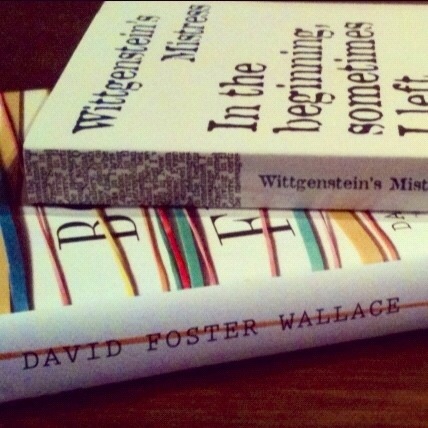
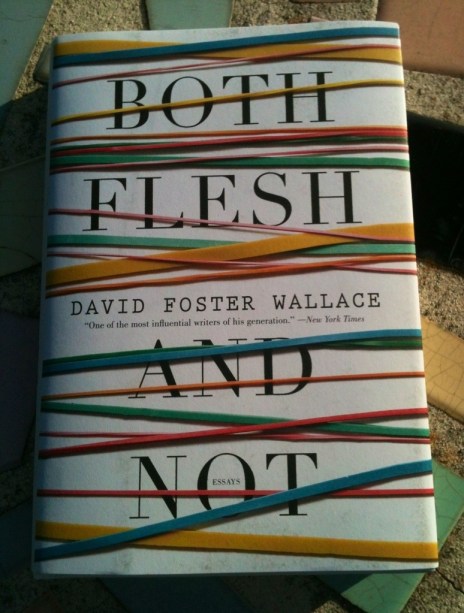
Hey, did you know David Foster Wallace wrote an essay on David Markson? The previous sentence is an extremely weak attempt to transition to Both Flesh and Not, a spotty collection from the late great writer; it showcases some brilliant moments along with undercooked material and a few throwaways probably better left uncollected. I fretted about the book on Election Night.

The posthumous book mill also kept pumping out stuff from Roberto Bolaño, including an unfinished novel called The Woes of the True Policeman that seems like a practice sketch for 2666 (I haven’t read Woes and don’t feel particularly compelled to). I did read and enjoy The Secret of Evil, a book that might not be exactly essential but nevertheless contains some pieces that further expand (and darken and complicate) the Bolañoverse. Going back to that Bolañoverse was a highlight of the year for me—rereading 2666proved to be tremendously rewarding, yielding all kinds of new grotesque insights. I also reread The Savage Detectives, and while it’s hardly my favorite by RB, I got more out of it this time.

I also revisited The Hobbit this year and somehow decided it’s a picaresque novel. Definitely a picaresque: Blood Meridian, which I reread as well. In fact, I’ve reread it at least once a year since the first time I read it, and it gets funnier and richer and more devastating with each turn. I also reread Herman Melville’s “Bartleby” and tried to make sense out of it. I will reread Moby-Dick next year, although it’s not “Bartleby” that sparked the desire—chalk it up to Charles Olson’s amazing study Call Me Ishmael.

Olson’s study reminds me to bring up some of the nonfiction I enjoyed this year: Stephen Bronner’s Modernism at the Barricades, Robert Hughes’s Goya biography, the parts of William T. Vollmann’s Imperial that I read, Patti Smith’s memoir Just Kids,and big chunks of William Gass’s collection Finding a Form.

Perhaps the most significant change in my reading habits this year was embracing an e-reader. I got a Kindle Fire for Christmas last year and wound up reading from it—a lot. About half the books I read this year I read on the Kindle. I also read lots of comics on it with my daughter, including all of Jeff Smith’s Bone, much of Tintin, and all of Carl Barks’s Donald Duck stuff. (I also read several hard to find volumes from Moebius via the Kindle).

And while I love my Kindle and it’s become my go-to for night reading (it’s lightweight and self-illuminating), I can’t see it replacing physical books. To return to where I started: Chris Ware’s Building Stories, an innovative, sprawling delight simply would not be reproducible in electronic form. Ware’s book (if it is a book (which it is)) reminds us that the aesthetics of reading—of the actual physical process of reading—can be tremendously rewarding as a tactile, messy, sprawling experience.

Perhaps because I’ve freed myself from the anxiety of trying to write on this blog about everything that I read, and perhaps because I’ve freed myself from trying to write traditional reviews on this blog, and perhaps because I’ve freed myself from trying to cover contemporary literary fiction on this blog—perhaps because of all of this, I’ve enjoyed reading more this year than I can remember ever having enjoyed it before.

A Seven Point Riff on David Foster Wallace’s David Markson Essay

20121119-170748.jpg

1. Like many David Foster Wallace fans, I’d already read many of the essays collected in the posthumous Both Flesh and Not. I hadn’t read “The Empty Plenum: David Markson’s Wittgenstein’s Mistress” though, originally published in a 1990 issue of The Review of Contemporary Fiction.

I suspect that the Markson essay hasn’t been collected up until now because it is so focused on Wittgenstein’s Mistress—this in contrast to, say “How Tracy Austin Broke My Heart” (Consider the Lobster) which is nominally about Austin’s autobiography but really about much bigger frying fish, like fan-idol relationships and ghostwriting and genre, or “Greatly Exaggerated,” which, again is nominally a review of Dix’s Morte d’Author: An Autopsy but is really more about postmodernism in general. I can’t recall exactly—maybe in his Charlie Rose interview—but Wallace said that he wanted the pieces in his books to be about more than just the ephemeral surface-level topic at hand; like most writers, he was contending for posterity. Wallace’s Markson essay is about Wittgenstein’s philosophy and the state of postmodern or experimental writing in the late 1980s and certain feminist analytic approaches to literature—but mostly it’s a detailed review of Markson’s novel—and it’s not trying to be anything more—which is actually really nice.

2. I read Wittgenstein’s Mistress on David Foster Wallace’s recommendation (I could add the modifier “like many David Foster Wallace fans” here again, I suspect). (That recommendation– “Five direly underappreciated U.S. novels >1960”—is also reprinted in Flesh (perhaps superfluously)). (While I’m getting all parenthetical: I read all five books Wallace recommended and all were excellent).

Here’s Wallace’s recommendation:

“W’s M” is a dramatic rendering of what it would be like to live in the sort of universe described by logical atomism. A monologue, formally very odd, mostly one-sentence 6s. Tied with “Omensetter’s Luck” for the all-time best U.S. book about human loneliness. These wouldnt constitute ringing endorsements if they didnt happen all to be simultaneously true — i.e., that a novel this abstract and erudite and avant-garde that could also be so moving makes “Wittgenstein’s Mistress” pretty much the high point of experimental fiction in this country.

—This is in some ways a condensation of his essay “The Empty Plenum,” where he writes:

Markson’s is not a pop book, and it’s not decocted philosophy or a docudrama-of-the-week. Rather, for me, the novel does artistic & emotional justice to the politico-ethical implications of Ludwig Wittgenstein’s abstract mathematical metaphysics , makes what is designed to be a mechanism pulse, breathe, suffer, live, etc. In so doing, it pays emotional tribute to a philosopher who by all evidence lived in a personal spiritual torment over the questions too many of his academic followers have made into elaborate empty exercises.

3. After Wittgenstein’s Mistress, Markson wrote four more novels, or anti-novels, if you like, sometimes called the note-card novels, novels “of intellectual reference and allusion, so to speak minus much of the novel,” as Novelist puts it in The Last Novel. I read these novels after WM: better-if-not-as-precise (in its metaphoricity) verb: I devoured them. Refinement isn’t exactly the right word, but Markson’s last four novels distill the elliptical and monotone style that he began in WM into a kind of word collage, a frieze of loops, motifs, ideas that the reader has the privilege/burden to construct meaning from. At the beginning of his essay on WM, Wallace posits that the novel is an “INTERPRET-ME” novel; the four novels after WM go beyond INTERPRET-ME—they ask the reader to construct-me, build-me, make-me. These late novels cast away the onus of a narrator; they jettison the already-jettisoned figure of Kate, narrator of Wittgenstein’s Mistress, the last person on earth. And perhaps because of all this, I’ve come to think that they are in many ways superior to WM (or at least showcase a clear evolution in Markson’s style)—that they more purely enact the canon-making, curatorial process that I take to be the core of Markson’s last five books.

4. Here’s Wallace on Markson’s curatorial curve:

The curator’s job—to recall, choose, arrange: to impose order & so communicate meaning—is marvelously synechdochic of the life of the solipsist, of the survival strategies apposite one’s existence as monad in a world of diffracted fact.

Except a big question is: whence facts, if the world is “empty”?

And then Wallace goes about answering this question w/r/t (am I borrowing too many Wallacian shortcuts here?) Wittgenstein’s philosophy. (And this I will not attempt to summarize here).

5. But I will quote Wallace again:

[Wittgenstein] never actually wrote anything about the exquisite tensions between atomism & attendant solipsism on the one hand & distinctively human values & qualities on the other. But, see, this is exactly what Mr. Markson does in WM; and in this way Markson’s novel succeeds in speaking where Wittgenstein is mute, weaving Kate’s obsession with responsibility (for the world’s emptiness) gorgeously into the character’s mandala of cerebral conundrum & spiritual poverty.

6. The greatest weaknesses of Wallace’s essay:

a). He doesn’t do a great job of explicating specifically how Wittgensteinian philosophy—or even themes—are alluded to by Markson in WM. (Or maybe I’m just a weak reader).

b). He gets bogged down in a long discussion of WM as a male-authored text featuring a female narrator w/r/t passivity vs. agency and object vs. subject and Helen vs. Eve (etc.) that I think is ultimately the kind of business far better sorted out in the novel itself.

7. The greatest strength of Wallace’s essay:

He made me want to reread Wittgenstein’s Mistress.

David Foster Wallace on INTERPRET-ME Novels

Certain novels not only cry out for what we call “critical interpretations” but actually try to help direct them . . .  Books I tend to associate with this INTERPRET-ME phenomenon include stuff like Candide, Witold Gombrowicz’s Cosmos, Hesse’s The Glass Bead Game, Sartre’s Nausea, Camus’s The Stranger. These five are works of genius of a particular kind: they shout their genius. Mr. Markson, in Wittgenstein’s Mistress, tends rather to whisper, but his w.o.g.’s no less successful . . . Clearly the book was/is in some way “about” Wittgenstein, given the title. This is one of the ways an INTERPRET-ME fiction clues the critical reader in about what the book’s to be seen as on a tertiary level “about”: the title: Ulysses’s title, its structure as Odyssean/Telemachean map (succeeds); Goldstein’s The Mind-Body Problem (really terrible); Cortázar’s Hopscotch (succeeds exactly to the extent that one ignores the invitation to hop around in it); Burroughs’s Queer and Junkie (fail successfully (?)). 

From David Foster Wallace’s essay “The Empty Plenum: David Markson’s Wittgenstein’s Mistress,” which is collected in Both Flesh and Not.

Why I’m Not Particularly Interested in Reading a DFW Biography

(Think about it — the personal lives of most people who spend 14 hours a day sitting there alone, reading and writing, are not going to be thrill rides to hear about.)

–David Foster Wallace on literary biography in general and Edwin Williamson’s Borges: A Life in particular; from “Borges on the Couch,” a 2004 NYT piece republished this month in the David Foster Wallace collection Both Flesh and Not.

“The Great Bridge Between Modernism and Post-modernism” — David Foster Wallace on Jorge Luis Borges

. . . Borges is arguably the great bridge between modernism and post-modernism in world literature. He is modernist in that his fiction shows a first-rate human mind stripped of all foundations in religious or ideological certainty — a mind turned thus wholly in on itself. His stories are inbent and hermetic, with the oblique terror of a game whose rules are unknown and its stakes everything.

And the mind of those stories is nearly always a mind that lives in and through books. This is because Borges the writer is, fundamentally, a reader. The dense, obscure allusiveness of his fiction is not a tic, or even really a style; and it is no accident that his best stories are often fake essays, or reviews of fictitious books, or have texts at their plots’ centers, or have as protagonists Homer or Dante or Averroes. Whether for seminal artistic reasons or neurotic personal ones or both, Borges collapses reader and writer into a new kind of aesthetic agent, one who makes stories out of stories, one for whom reading is essentially — consciously — a creative act. This is not, however, because Borges is a metafictionist or a cleverly disguised critic. It is because he knows that there’s finally no difference — that murderer and victim, detective and fugitive, performer and audience are the same. Obviously, this has postmodern implications (hence the pontine claim above), but Borges’s is really a mystical insight, and a profound one. It’s also frightening, since the line between monism and solipsism is thin and porous, more to do with spirit than with mind per se. And, as an artistic program, this kind of collapse/transcendence of individual identity is also paradoxical, requiring a grotesque self-obsession combined with an almost total effacement of self and personality. Tics and obsessions aside, what makes a Borges story Borgesian is the odd, ineluctable sense you get that no one and everyone did it.

—From “Borges on the Couch,” a 2004 NYT piece republished this month in the David Foster Wallace collection Both Flesh and Not.


I Try to Riff on Both Flesh and Not, DFW’s New Essay Collection, Which I Haven’t Read, as I Drink Red Wine to Numb the Election Coverage (Book Acquired, 11.06.2012)

20121106-203121.jpg

1. Today, I picked up Both Flesh and Not, a collection of David Foster Wallace essays and short pieces. I specifically ordered this book from my local bookstore (I didn’t get a review copy), and I bought it in hardback (I generally dislike hardbacks).

2. I should be reading it now—I’d like to be reading it—but I’m flicking between the five or six channels I have, usually stopping on PBS, and then scanning Twitter and other online media, because, hey, it’s Election Day in America.

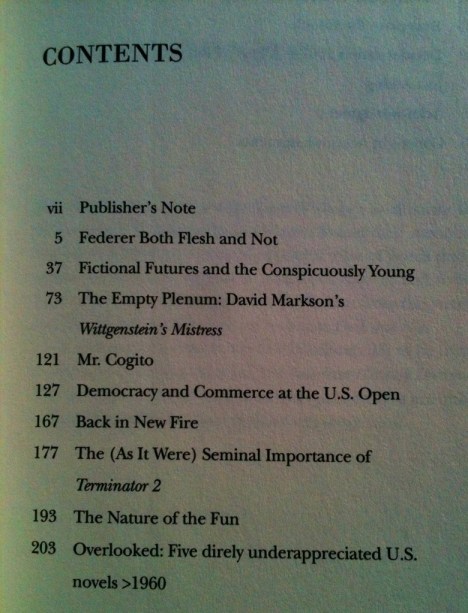
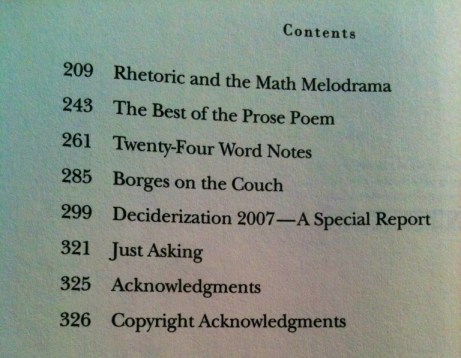
3. I’ve already read several of the pieces in Both Flesh. You might have too. Here’s the table of contents:

20121106-203459.jpg

20121106-203507.jpg

4. But a lot of it I haven’t read. I’m eager to dig into the piece on David Markson, and the piece on Brat Pack writers, “Fictional Futures,” which was later repurposed in “E Unibus Pluram.”

5. I spent most of the afternoon riffling through it, trying not to think about the election results that would be coming in the next few years. I played outside with my kids, building a strange hut out of giant elephant leaves and then a small nest out of pine straw. I photographed the planes that daily fly over our neighborhood, slow, heavy supply planes that drift in lazy routine arcs from the nearby naval base, not loud as jets, but bulky. Elephant mothers, pregnant.

20121106-211636.jpg

6. I remembered that Wallace killed himself in an election year, in September. I remember how I felt.

7. (Please don’t think this riff is really about anything. I’m distracted. I’ve imbibed some wine. Some Xanax might be involved).

8. Speaking of posts in 2008—

I went back just now, and riffled through the site’s archives from November of 2008. (Back when I’d post like three, maybe four times a week. Once a day at most).

A lot of vitriol there. A lot of vitriol for Palin, and a lot of vitriol for the emerging sentiment that would galvanize in what would become the Tea Party movement.

I wrote about the Election Night too. About Jesse Jackson’s tears. I even wrote about finding some respite from cynicism in Obama’s election. (Don’t worry, I’m as cynical as ever. Moreso—

9. —but

I remember watching the inauguration in 2009. I was still teaching high school. I had third period planning and I watched the whole shebang in an empty lab on the school’s third floor with my friend Derek, a black Muslim who taught history in the classroom next to mine. It was cold up there and empty. I remember he asked me if the election poem was good and I asked him what he thought (I thought it was good). I remember we cried a little in spite of ourselves and clutched at each other. The world seemed so much more possible. I’m clutching to this memory now, which is deep and rich and I hope to keep forever. It presents through pinot and Xanax).

10. Is this a bait and switch? I apologize. Look, I love you reader. Really, I do. I do.

11. So, another detail from the Wallace collection:

The selections are intercut with definitions from his vocabulary list for The American Heritage Dictionary. Like so:

20121106-203548.jpg

12. What was I doing here? I don’t know. Let me just wrap it up. I should be writing about DFW and the book but I can’t. Distracted. I’ll schedule the post. Let it stand. Let it roll at 11:11am tomorrow? (To clarify–it’s 9:55pm on 11/06/2012).

Okay, I’ll do that. Finish the rest in the comments? Sure. And some more, of course, about the book.

D.T. Max Talks About His David Foster Wallace Biography

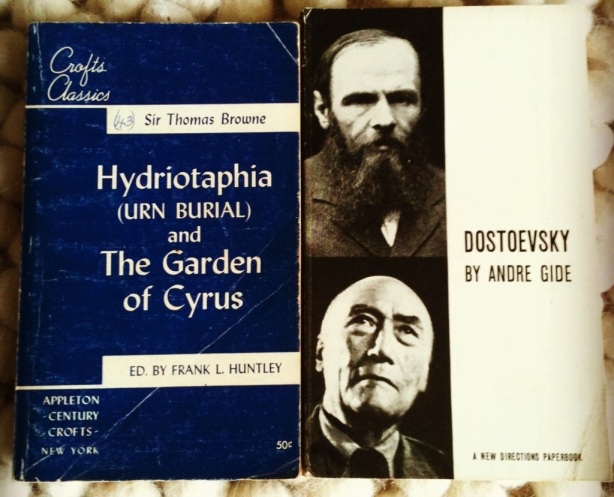
Thomas Browne’s Hydriotaphia, Gide’s Dostoevsky, David Foster Wallace’s AIDS Essay (Books Acquired, 10.25.2012)

20121025-161723.jpg

Needing more books like I need another hole in my head, I nevertheless visited my local bookshop (after an impressive three week abstinence period).

No, I haven’t read Thomas Browne’s Urn Burial yet. I’m a sucker for New Directions’ back stock, I just finished Crime & Punishment, and Gide’s book looks cool. Plus it was like a dollar.

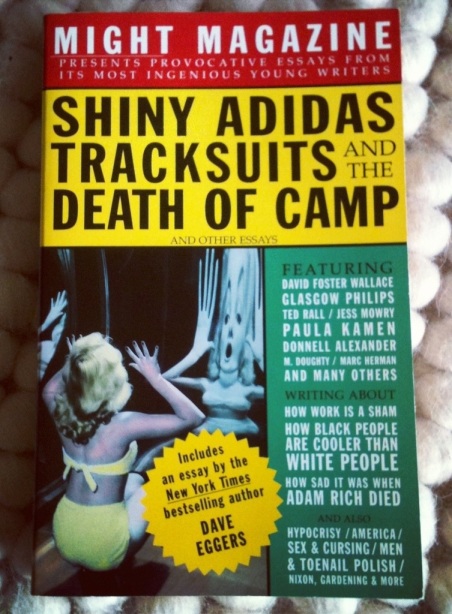
I spied the Might Magazine collection—I knew Might as Dave Eggers’s first venture. I picked it up for the (very short) David Foster Wallace essay “Hail the Returning Dragon, Clothed in New Fire”—which, incidentally, doesn’t appear to be is collected in the forthcoming collection Both Flesh and Not under the new not-as-Game of Thronesish title “Back in New Fire.” 

20121025-161730.jpg

I Didn’t Like Joshua Cody’s Memoir [sic]

20121023-160233.jpg

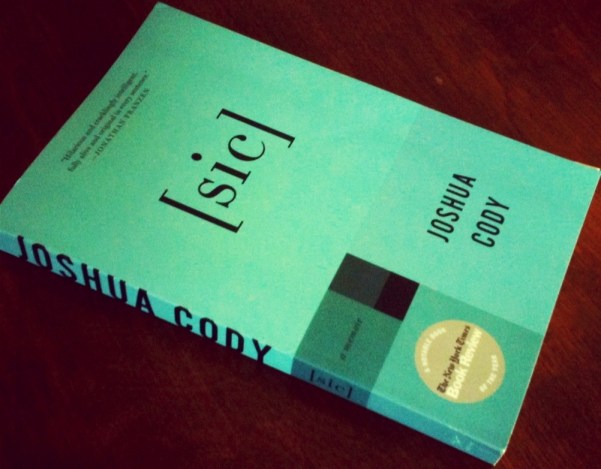
Joshua Cody’s memoir [sic] showed up at Biblioklept World Headquarters a few weeks ago and despite my prejudices, I coasted through it over a few afternoons.

Those prejudices:

1) It’s a memoir.

2) There’s a Jonathan Franzen blurb on the cover.

3) The title [sic] is an unbearably too-clever pun (and this from a guy who loves puns).

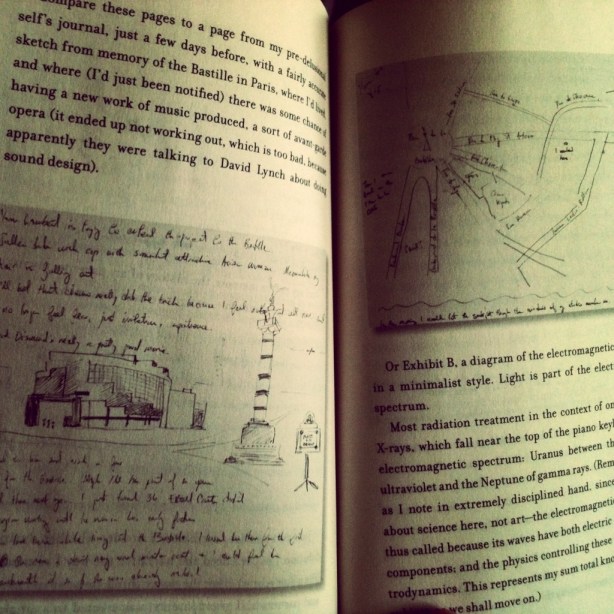
The first thing I noticed about [sic] were the pictures : paintings, maps, charts, sketches, lists, collages, other texts, and so on interspersed throughout the text. I like pictures in books.

20121023-160240.jpg

The way that Cody uses these illustrations at first reminded me of  W.G. Sebald, who employed pictures in novels like Austerlitz and The Rings of Saturn in an oblique, documentary approach.

Cody is less oblique than Sebald, and perhaps flippant too. He doesn’t namecheck Sebald, at any rate, unlike David Byrne, who openly admitted to following Sebald’s path in his 2008 memoir Bicycle Diaries. (Cody does namecheck David Byrne though).

Then I edged my way into the plot, such as it is. I’ll lazily let publisher W.W. Norton summarize:

Joshua Cody, a brilliant young composer, was about to receive his PhD when he was diagnosed with an aggressive form of cancer. Facing a bone marrow transplant and full radiation, he charts his struggle: the fury, the tendency to self-destruction, and the ruthless grasping for life and sensation; the encounter with beautiful Ariel, who gives him cocaine and a blow job in a Manhattan restaurant following his first treatment; the detailed morphine fantasy complete with a bride called Valentina while, in reality, hospital staff are pinning him to his bed.

Moving effortlessly between references to Don Giovanni and the Rolling Stones, Ezra Pound and Buffalo Bill, and studded with pages from his own diaries and hospital notebooks, [sic] is a mesmerizing, hallucinatory glimpse into a young man’s battle against disease and a celebration of art, language, music, and life.

20121023-160248.jpg

As Norton’s summary suggests, Cody’s memoir is highly discursive and playful, loaded with references to art, music, and literature. Digressions on figures like David Foster Wallace, Orson Welles, or Alexander Theroux lard the book—indeed, they often seem to edge out the story Cody intends to tell, his cancer memoir. He seems reticent to fully engage his own feelings, instead layering reference upon reference. These references become insufferable at times—are we supposed to care that Cody met David Lynch and would like to be his friend, or that Cody briefly studied ancient Greek? Cody is so busy trying to impress the reader that he forgets to express meaning.

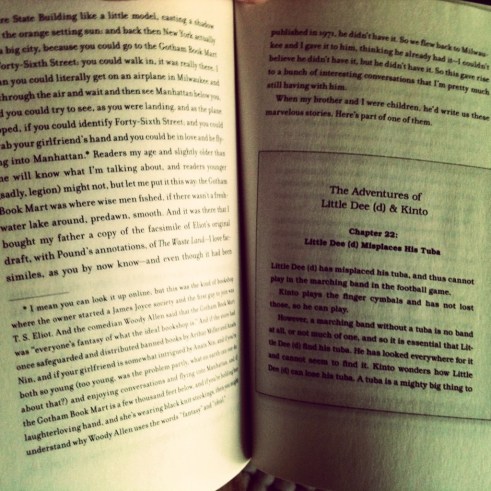
We see this reticence, this turning away from, here over two pages: Cody moves from a story about buying a facsimile copy of Pound’s notes on the original draft of The Wasteland to a lengthy footnote that manages to name drop James Joyce, T.S. Eliot, Woody Allen, Anaïs Nin, and Henry Miller (in just two sentences!) and then into a facsimile reproduction of one of the stories his brother would write for him as a child:

20121023-160254.jpg

The big problem with Cody’s memoir is that it never feels particularly real. I enjoy discursive referential postmodernism as much as the next fella, but [sic] often fails to cohere around a central idea, let alone an emotion. When Cody describes dating a stripper/dominatrix, it feels like a party trick, an inflated anecdote—there’s no emotional core, no contemplative connection to his illness. Other sexual episodes read like a parody of Henry Miller.

As its title suggests, [sic] is a dodge, a bait-and-switch, an evasion. Cody is clearly very clever—but a dazzling display of cleverness can’t sustain a narrative.

Chris Ware on DFW’s Novel The Pale King

Crippled Robot painting by Chris Ware

Cartoonist/graphic novelist/chronicler of shame and despair Chris Ware wrote about his favorite books for Foyles bookstore. The list includes UlyssesMoby-Dick, and works by cartoonists like Lynda Barry and Ivan Brunetti. Here’s what Ware wrote about David Foster Wallace’s posthumous novel The Pale King:

The first great novel of the 21st century uses the sinister beauty of the American Tax Code as a springboard from which to launch into a genuinely serious discussion of the origins and importance of civic responsibility amidst the hazy, blurred stupidity of a country in quick decline. Contrary to many reviews, I don’t think it’s about boredom, and it’s certainly not boring. Another posthumous editor-to-manuscript resuscitation, the book hangs heavy with the clotted spectre of Wallace’s suicide, which makes the writing glow all the more painfully through it.

List with No Name #10

1. 2666, Roberto Bolaño

2. The Pale King, David Foster Wallace

3.  Train Dreams, Denis Johnson

4. The Last Novel, David Markson

5. Samuel Johnson Is Indignant, Lydia Davis

6. Agapē Agape, William Gaddis

7. C, Tom McCarthy

8. No Country for Old Men, Cormac McCarthy

9. Sandokan, Nanni Balestrini

10. Open City, Teju Cole