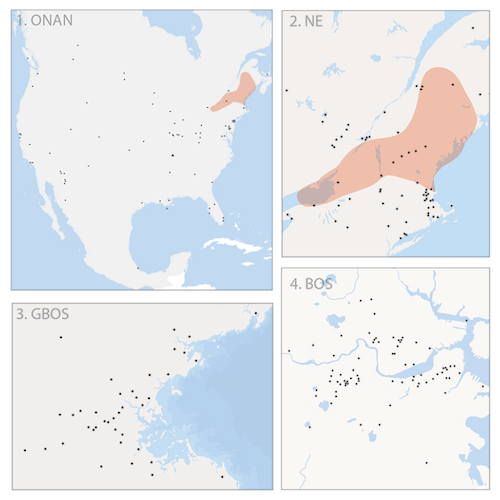
For the past few years, D.C.-based artist William Beutler has been mapping the real and fictional locations of David Foster Wallace’s giant novel Infinite Jest in a project called Infinite Atlas, a Google Maps-based guide to over 600 locations described in Infinite Jest. Beutler’s project has sprawled (appropriately) to include several dimensions, including Infinite Map (shown above), which identifies and describes 250 locations from the novel and Infinite Boston, a travel blog of sorts that documents and reflects on Beutler’s Wallace-based trip to Boston. Beutler was kind enough to talk to me about his projects over a series of emails.
Biblioklept: How did the Infinite Atlas project start?
William Beutler: I think, like a lot of long-term projects, I’d point to a few different points of inspiration. The first is just going back and reading Infinite Jest for a second time in 2009, after I’d say it went from being a favorite novel to my actual favorite novel. I’d also become interested in infographics, I suppose as a kind of art form based on the expression of data—and what better stockpile of data than a thousand-page, encyclopedic novel? I cycled through a lot of ideas, finding that some of them had already been done before, and then finally deciding to focus on geography.
Biblioklept: How did the geography focus come about?
WB: The geography focus owes to a few different things. One is simply that I wasn’t the first to arrive at the idea of creating an infographic based on Infinite Jest, so I had to take that into consideration. Sam Potts, who is the designer of John Hodgman’s books, had released an elaborate graphic drawing connections between the various characters in the novel. I’d been considering that when his came out, but he did that pretty definitively, so I went with one oft he other. And hey, I just like maps. I started my career in political journalism, where districts are always being redrawn, and maps are always being shaded this much red or this much blue, so it was a natural focus in that regard. And there’s always been something I’ve liked about adding a layer of information to geographic features. I don’t know that I could have credibly called myself a geography enthusiast before this—but I have friends who definitely are, and even some who work with GIS professionally. They helped me figure out what I was doing.
Biblioklept: Did you consciously start using Google Maps? Was Google Maps a starting point in and of itself or just a tool?
A shot of Infinite Map in development
WB: Google Maps was probably one of the very last decisions we made. And all the web development was relatively late in the process, starting about early summer of this year. Most of the work before that was simply building the database, which lived in Google Docs for most of this research period. The decision to use Google Maps wasn’t necessarily random, although I had actually made an early conscious decision to not use it. I’d suggested Open Street Maps, partly because I like open source projects, and Foursquare had switched to it, which seemed like a noteworthy endorsement. But my developers said Google Maps was going to be less time-consuming, and less expensive, and I was willing to take this advice.
Biblioklept: Can you talk a bit about how you put the atlas together? What was your approach? How did you start?
WB: In the very early going, it was as simple and painstaking as going page-by-page through the book, scanning each one for proper nouns, and taking notes down in Google Docs. This was myself and another friend who had read the book, Olly Ruff, who is one of the credited editorial advisers. We debated what really counted as a “location”—Orin’s “Norwegian deep-tissue therapist” lives “1100 meters up in the Superstition Mountains,” overlooking Mesa-Scottsdale. So is that one location, or two?And once we realized we had so many locations, this was about the time I realized the original idea, which was just the map, was not going to be the comprehensive accounting for the novel’s locations I had imagined. Once I decided we had to explore an interactive version as well, then we had to decide which locations were just going on the map, and how many. Then we had to figure out where certain locations were actually located, and that was a considerable amount of research as well. Sometimes it was very obvious-—Harvard Square is very easy to find, but some places I didn’t even know were real until I visited Boston. We also had to figure out how to show both the scope of North America alongside the detail of central Boston, and this just took an agonizingly long time. This is where some of my friends who worked with maps for a living proved helpful. The further into this I got, the bigger of a project it kept revealing itself to be. And since the point of no return was never clear, I just kept at it, never entirely sure how long it would all take, until we actually started working with designers.
Biblioklept: How did actually visiting Boston help to inform the project?
WB: About a year into the research, I realized that I was hitting a wall with some of the local details in Boston, which has the greatest concentration of locations of anywhere in the novel. More specifically, the neighborhoods of Allston and Brighton already kind of run together, and then Wallace invented a whole new unincorporated community called Enfield, where most of the primary characters live, and its relationship to Allston-Brighton was very confusing. The trip helped me get a better sense for what was Enfield and what was Brighton, although there’s only textual support for boundary lines to the east and south.Also regarding certain locations, I knew the Brighton Marine hospital complex was the basis for Enfield Marine, and I knew that the hill behind it was where the Enfield Tennis Academy would be, if it existed, but Google Maps and Google Street View have some pretty obvious limitations. So putting boots on the ground was really the only way to be sure about some of these places. I was surprised by some things I found: there’s a “Professional Building” mentioned as being at one intersection when it’s really another, which I had no idea until I walked right up to it. And the Infinite Boston Tumblr simply couldn’t have existed without the trip, but the trip was also absolutely necessary for getting a lot of details right for Infinite Atlas and Infinite Map.
Biblioklept: How long have you been working on the Infinite Boston blog?
WB: The Boston trip was in July 2011, and the notion of doing a Tumblr travelogue to the project was probably in the back of my head at the time, but I didn’t really start thinking about seriously doing it until earlier this year. I’d been sifting through the photos—I came back with about 4,000—since then, and in the spring I started making decisions about what I had acceptable photos of, and what I had enough to write about, then I started planning the sequence in June, and putting together notes in early July. And though I had quite a few entries planned out weeks in advance to begin with, these days I’m finishing them the night before, or up to the last few minutes before publishing.
Biblioklept: The Infinite projects clearly will resonate with fans of Wallace’s novel. What do you hope they take away from your work?
Portrait of the artist
WB: I can’t begin to tell you the number of people who’ve told me they started Infinite Jest, and gave up after making it a surprisingly long way through it. One friend of mine spent the better part of a decade having read to at least page 600 before finally finishing it earlier this year. (He ended up helping out as a backup researcher.) I’ve heard it said that the book doesn’t really start coming together until about 400 pages, and it’s been much too long since I first read it for me to remember, but I know the feeling of hopelessness that goes along with struggling early in a long novel (I’m still working myself back up to revisiting Gravity’s Rainbow and Europe Central…). I think a project like this can serve as a kind of promise to the uninitiated that there really is something here that people feel very strongly about, that it rewards the effort one must put into it. There’s much more to it than just being a hipster status symbol. And then I think it can help those who are reading it, both to confirm details they may have misread the first time or—better still—to make connections they might never have made without this kind of tool. And of course to visualize it as David Foster Wallace surely did, if they’re so inclined. That said, I’m not sure the Atlas is a resource I would have consulted when I first read the book. I tend to be very spoiler-sensitive, oftentimes purposefully going into a novel or a film or television series trying to know as little as possible. Of course, I know now that Infinite Jest can’t be “ruined” by knowing about a particular story arc, and I’m sure that others so wracked with fear over knowing that two storylines connect, so I hope they’ll find this a useful resource.
Biblioklept: I’m curious if you’ve read Houellebecq’s novel The Map and the Territory?
WB: I have not actually read any Houellebecq; I’m primarily familiar with him for various controversies, and I do remember the allegations that he had plagiarized Wikipedia for The Map and the Territory, and the possibility then that his book would be judged a Creative Commons-licensed work. Anyhow, I am familiar with the map-territory relationship as described by Alfred Korzybski, and Infinite Jest was my introduction to it. I think it’s very relevant here, not that anyone would necessarily mistake the atlas as anything but a supplement to the novel. Actually, one of my early working titles for the project was “Map / Territory,” and the website includes a kind of epigraph, taken from the Eschaton section: “The real world’s what the map here stands for!”
Biblioklept: I figured the Eschaton episode clearly resonated with your project. What sections or characters of IJ stand out as favorites to you?
WB: Believe it or not, Eschaton was one of the last location segments that I added to the Atlas. Early on we’d focused on real places where scenes actually took place, or references to North American locations that fell inside the confines of the map. And Chris Ayers of Poor Yorick Entertainment had already made a pretty nifty Eschaton infographic, so I was hesitant to do too much with that. But it became clear that we were going to take a maximalist approach, and really locate absolutely everything that could be located, so then I went through and included everything from Eschaton as best I could.If I had to name a favorite section, it might be the very last, with Gately and Fackelman holed up with Mt. Dilaudid, avoiding the wrath of Whitey Sorkin. It’s just beautifully written, and for whatever criticisms anyone might still make about the novel lacking a proper ending plot-wise, it makes perfect sense emotionally. In close contention, though, is Gately’s first chapter, about the disastrous burglary in a “wildly upscale part of Brookline” that turns his life around. It’s the first section in the story really that took my breath away—that or I was holding my breath waiting in vain for a paragraph break to exhale. Anyway, the unsurprising answer regarding my favorite character is Don Gately. He’s maybe DFW’s single greatest creation.
Biblioklept: I agree with you on Gately being Wallace’s greatest achievement—I love the sections you mention as well. I think many people who can’t get into IJ probably don’t get to that burglary/toothbrush episode quick enough.
WB: I don’t know, the number of people who have made it to halfway or further and then still give up, just speaking anecdotally, is staggering. I’ve personally given up on much shorter books, which is probably every book I’ve given up on, considering I haven’t bothered to try Imperial or some of Vollmann’s other longer stuff. Plus, it’s not like there isn’t grabby material early on: the “where was the woman who said she’d come” scene with Erdedy is very dense, but I think immediately rewarding in a way some of the Hal and Orin material up front is not. And there’s no way around the fact it’s just a months-long project in a way few novels are.
Biblioklept: Have you had any response from Wallace’s estate about your project?
WB: I haven’t, nor have I solicited any. In development on the project, I had considered reaching out to Bonnie Nadell, but I didn’t really know what I’d be asking. This wasn’t going to be the first infographic project or fan art based on the book, so I didn’t think permission was an issue. A friend had offered to put me in contact with D.T. Max, if I needed, but I didn’t want to bother him, either. The most response I’ve had is two retweets and one reblog from whomever’s running social media for Little, Brown, and it’s more than I would have asked for.
Biblioklept: Do you have another project on the horizon after this one?
WB: To be honest, I’m not even sure I’m totally done with Infinite Jest yet. I’m still writing Infinite Boston on a daily basis through the end of this month, and we’re actually putting in some further refinements on the Infinite Atlas website. Besides that, I’d been editing a very short film when I turned to focus on this, so I’d like to complete that now. And I’m sure this isn’t my last map, either.
Biblioklept: Have you ever stolen a book?
WB: Haha, that’s a great question. And the answer is yes. One that comes to mind in particular I found in a teacher’s lounge in the j-school at the University of Oregon, where I worked and never quite completed my journalism double major. And I don’t have it handy—I’m afraid I’ve left stolen property on a shelf at my parents’ house—but it was called something like The Declining American Newspaper and its publication date could have been no later than 1965. Even when I found it, this was still early days of the Internet. I wasn’t sure whether it was prophetic or preposterous, which is basically why I pocketed it. Less a book, more a conversation piece. Next visit, I’ll try to make partial amends by actually reading it.
A description of Infinite Map from artist/creator William Beutler’s site, Infinite Boston:
A geographic infographic poster depicting the “territorially reconfigured North America” of the novel and identifying 250 of the most interesting locations with a color-coded dot and corresponding footnote. As you can see from the acromegalic thumbnail above, the 24”x36” print includes four telescoping map insets: O.N.A.N.’s North America, Northeast U.S. & Canada, Greater Boston and Metro Boston. The red shading represents my own painstaking, overdetermined conclusions about the most probable outline of the Great Concavity. In the upper right corner is the Great Seal of O.N.A.N., based on the description from page 153, and the map labels throughout include sometimes-obscure references to the novel’s the text. This image is the principal result of a long-term collaboration between myself and the Los Angeles-based creative design agency JESS3, whose technical ability and patience with yrstruly knows no bounds.
Biblioklept will run an interview with Beutler about his graphic work with David Foster Wallace’s Infinite Jest next week.
The only thing Wallace knew for sure was that he desperately wanted to be a novelist again but some piece of him still felt too fragile to attempt an effort so key to his well-being. The problem, he felt, was not really the words on the page; he had lost confidence not in his ability to write so much as the need to have written. Jonathan Franzen, with whom he had struck up an epistolary friendship, offered to get together that April when he was in Boston. Wallace said fine but stood him up after they made plans. But because one tenet of recovery is to make amends to those you have wronged, he wrote to his friend explaining his behavior. “The bald fact is that I’m a little afraid of you right now,” he wrote. He begged to be allowed to bow out of their embryonic competition, to declare a truce against this writer who was so “irked by my stuff,” because Wallace was no longer “a worthy opponent in some kind of theoretical chess-by-mail game from which we can both profit by combat.”
He went on: “Right now I am a pathetic and very confused young man, a failed writer at 28, who is so jealous, so sickly searingly envious of you and Vollmann and Mark Leyner and even David F–kwad Leavitt and any young man who is right now producing pages with which he can live … that I consider suicide a reasonable—if not at this point a desirable—option with respect to the whole wretched problem.”
From D.T. Max’s forthcoming David Foster Wallace biography Every Love Story Is a Ghost Story. Read the rest of the excerpt.
‘I have to admit it was a big reason for marrying her, thinking I wasn’t likely going to do better than this because of the way she had a good body even after she’d had a kid. Trim and good and good legs—she’d had a kid but wasn’t all blown out and veiny and sagged. It probably sounds shallow, but it’s the truth. I’d always had this major dread of marrying some good-looking woman and then we have a kid and it blows her body out but I still have to have sex with her because this is who I’ve signed on to have sex with the whole rest of my life. This probably sounds awful, but in her case it was like she was pre-tested—the kid didn’t blow her body out, so I knew she’d be a good bet to sign on and have kids with and still try to have sex. Does that sound shallow? Tell me what you think. Or does the real truth about this kind of thing always sound shallow, you know, everybody’s real reasons? What do you think? How does it sound?’
“Brief Interview #30” by David Foster Wallace. From Brief Interviews with Hideous Men.
Neal Stephenson’s 1992 novel Snow Crash opens with an extended scene in which the book’s protagonist races to deliver a pizza on time for the mafia. The scene is thrilling and ridiculous, establishing the book’s frenetic, ironic tone and painting a rough outline of Snow Crash’s milieu. Like many sprawling works of speculative fiction, Snow Crash is more interested in rendering its milieu in vibrant, hyperkinetic color than it is concerned with delivering plot and character development. Snow Crash’s plot is the sort of joyfully convoluted careening mess that makes a reviewer (okay, this reviewer) shudder at the thought of having to successfully paraphrase, so I’m not even going to make an earnest effort. Let’s get to that milieu and the cartoon characters who inhabit it.
Snow Crash is set in the early 21st century, primarily in Los Angeles, which is no longer part of the United States. Actually, there isn’t much of a United States to speak of, really—and not even a municipal Los Angeles, per se. Instead, the terrain is totally privatized. Privatized roads, privatized spaces. People (who can afford to) live in franchised burbclaves protected by hired mercenaries or private militias or robots that keep out the undesirables. (The white folks who live in New South Africa want “racial purity,” while some franchise nations, like Mr. Lee’s Greater Hong Kong are open to anyone who can trade information). Authority is for sale. Conditions are so laissez-faire that the Mafia is truly a Legitimate Business now (complete with their own CosaNostra Pizza University). In fact, all business is legitimate; several times in Snow Crash, a character will refer to “the old days when they had laws.” Without regulation, hyperinflation is the norm; the homeless use trillion-dollar bills to light their campfires.
There’s a hard-edged griminess to the world Stephenson conjures in Snow Crash, but the book is never grim or dour, and instead embraces the anarchic-capitalism it proposes. Perhaps this is because Stephenson’s heroes are such radically exceptional people. The book’s hero is named Hiro Protagonist, the kind of Pynchonian goof that characterizes Snow Crash’s zany tone. Hiro meets the book’s other protagonist, a fifteen year old blonde who goes by Y.T. (“Yours Truly,” although most of the folks tend to hear “whitey”). Y.T. is a Kourier, a skateboarding delivery person who harpoons vehicles to catch a free ride. She helps Hiro deliver that pizza in the opening scene and the two team up after Hiro gives her his business card. It reads: “Last of the Freelance Hackers / Greatest swordfighter in the world / Stringer, Central Intelligence Corporation. Specializing in Software related Intel. (Music, Movies & Microcode.)” Did I neglect to mention that Hiro carries two samurai swords with him wherever he goes?
Hiro’s pretty handy with those swords, but his real skill is hacking, and he spends a good deal of time in the Metaverse, a virtual reality-based internet space where avatars go to bars and chat and sell &c. It’s sort of like a mix between Facebook and World of War Craft. In 1992 (earlier, I suppose), Stephenson’s way ahead of the curve. Here, he describes avatars:
Your avatar can look any way you want it to, up to the limitations of your equipment. If you’re ugly, you can make your avatar beautiful. If you’ve just gotten out of bed, your avatar can still be wearing beautiful clothes and professionally applied makeup. You can look like a gorilla or a dragon or a giant talking penis in the Metaverse. Spend five minutes walking down the Street and you will see all of these.
There are plenty of passages like this, where Stephenson pegs some aspect of internet culture ten years before it actually happens. (I couldn’t help but think about Wikipedia during Hiro’s conversations with a program called Librarian). It’s probably fair to say that the Wachowskis lifted as much from Snow Crash as they did from William Gibson’s cyberpunk trilogies.
While I’m there, I might as well lazily point out that Snow Crash would fit neatly at home on a shelf with Neuromancer or Mona Lisa Overdrive. There’s also a heavy dose of Philip K. Dick weirdness in Snow Crash, particularly when the book settles into its major metaphysical plot about ancient Sumerian gods and goddesses and linguistic viruses and the Tower of Babel. Stephenson’s Snow Crash is zanier than William Gibson’s dark depictions or Dick’s mindmelted milieux, and it would hardly do to call what he does here light—but there is something joyful, playful about his satire. I invoked Pynchon earlier and I’ll do it again; parts of Snow Crash also reminded me of David Foster Wallace’s opus Infinite Jest. Both IJ and SC obsess over the minutest details of speculative technologies and how people might react to such technologies. This is often what sets Snow Crash heads and shoulders above run of the mill cyberpunk. In just one instance, Stephenson parodies the language of bureaucratic speech at length; Y.T.’s mom, who works for what’s left of the Federal Government, is subjected to a memo about toilet paper usage that goes on for pages. The passage is hilarious, and adds absolutely nothing to the plot development—it simply helps to flesh out the contours of the world that Stephenson has imagined.
All of this detailed imagining unfortunately comes at the expense of a plot that only coheres through massive exposition dumps. About a third of the way into the novel, the major conflict is finally established, but only through a dialog between Hiro and the Librarian that reads almost like a catechism. As the book reaches its climax, Hiro actually explains what’s going on to a few of the other major characters—and the reader, of course. It’s a cringe-worthy moment, the sort of rhetorical weakness that smacks of genre fiction; even worse, the plot’s action ultimately hangs on some fairly basic hoary old tropes that wouldn’t be unfamiliar to anyone who’s ever played a video game. The book lags under a juvenile obsession with weapons and badassery in general. And the book’s resolution . . . well, let’s just say that Stephenson sticks the ending, but it all feels too pat and too slight after the dazzling weight of the world that he’s established. Still, at its finest, Stephenson’s prose is zippy, shining, hilarious stuff, and his employment of multiple character perspectives moves the book with an addictive energy. Snow Crash is beach reading for folks who like some humor with their dystopia.
A film adaptation of Snow Crash is supposedly going into production soon, with British director Joe Cornish taking charge. I liked Cornish’s last film Attack the Block, and Snow Crash clearly has a highly-imagistic, cinematic feel to it—but I think a film is not the way to go. Simply put, Snow Crash is too big, too larded with characters and details (so many that I failed to touch on in this review) to translate well onscreen. I think an eight part miniseries on HBO (or a similar network) would be perfect, even if it came at the expense of special effects—-a miniseries would give the filmmakers time to build Stephenson’s nuanced world. I’m afraid otherwise we’ll get a travesty like the adaptation of The Golden Compass, or something like The Hunger Games film, where all but the most basic plot points are elided. But I suppose a miniseries is not as lucrative as a blockbuster film. I hope the filmmakers at least split the book in two. In any case, I’ll be interested to check out the results.
In Powers of Horror philosopher Julia Kristeva describes the idea with which she’s most closely identified, the abject, the intense horror our subjective psychology—and our bodies—experience when faced with corporeal reality: the edges of our body: filth, vomit, shit, blood, death: the me that is not me. Breakdown of subject and object: abject.
Julia Kristeva shows up as a character, a phantom from a photograph in Roberto Bolaño’s story “Labyrinth,” collected in The Secret of Evil, new from New Directions.
(Can there be a more Bolañoesque title than “Labyrinth”?)
This is ostensibly a review of that Bolaño collection, but I’ll be riffing on some other things.
Bolaño created his own genre. His oeuvre, piecemeal and posthumous at times, is nevertheless a complete fiction or discourse of its own. Think of the Bolañoverse like Middle Earth, like Yoknapatawpha County, like dark Narnia with no Aslan to redeem it.
The Bolañoverse is abject. Consider the pile of bodies that heap like rubbish in “The Part About the Crimes,” the cruel center of 2666—has ever a book repeated the phrase “vaginally and anally raped” so many times?
Kristeva, in Powers of Horror:
The corpse, seen without God and outside of science, is the utmost of abjection. It is death infecting life. Abject. It is something rejected from which one does not part, from which one does not protect oneself as from an object. Imaginary uncanninness and real threat, it beckons to us and ends up engulfing us.
It is thus not lack of cleanliness or health that causes abjection but what disturbs identity, system, order. What does not respect borders, positions, rules. The in-between, the ambiguous, the composite. The traitor, the liar, the criminal with a good conscience, the shameless rapist, the killer who claims he is a savior . . . Any crime, because it draws attention to the fragility of the law, is abject, but premeditated crime, cunning murder, hypocritical revenge are even more so because they heighten the display of such fragility.
Sex Murder, Otto Dix
But I promised to remark upon The Secret of Evil; I used the term “review” even.
A few things:
It’s a beautiful book (I mean the physical book itself; the cover, the design). The name is perfect.
Much of what’s collected here is perhaps unfinished—-scraps, riffs, bits of tales, sketches.
But also:
Much of what’s here is finished, or, more to the point, much of what’s here—scratch that, all of what’s collected in The Secret of Evil—fits into the Bolañoverse, fleshes it out, or stretches it, or condenses it maybe (let me have my paradoxes, will you?).
Bolaño’s friend (and literary executor) Ignacio Echevarría puts it aptly in his introduction to The Secret of Evil:
Bolaño’s work as a whole remains suspended over the abysses that it dares to sound. All his narratives, not just The Secret of Evil, seem to be governed by a poetics of inconclusiveness. The eruption of horror seems to determine the interruption of the storytelling; or perhaps it is the other way around: the interruption of the telling suggests the imminence of horror.
I have been slowly, slowly rereading my way through 2666, edging my way into it in the latest of hours. I’m nearing the end, or the end of “The Part About Archimboldi,” and what I find most remarkable upon rereading is how precise, how tight it seems this time, how each book seems to answer to the other. (Take, for instance the female politician who, at the end of “The Part About the Crimes,” seems to peer through a strange mirror into the future (past?) to see the English critic Norton, who, in “The Part About the Critics,” in turn gazes into (the same?) mirror at a woman—not herself but surely the politician. Or take another instance: The visitations to madhouses made by peripheral characters to even more peripheral characters: artists, suspects, lovers, poets, teachers. Or take all the abysses. Or the labyrinths. Or mirrors. Or dreams. Or murders. Maybe I’m tipping into a simple recitation of motifs and themes now).
But no, what I want to remark on is how The Secret of Evil is part and parcel of the Bolañoverse, how it answers backward and forward and throughout Bolaño’s “poetics of inconclusiveness,” his “eruption[s] of horror.” Fragments like “The Secret of Evil” and “Crimes,” with their journalist heroes and noir lighting seem to dance around the same central mysteries that pulse through 2666. The strange literary criticism of “Vagaries of the Literature of Doom” and “Scholars of Sodom” answers not only to “The Part About the Critics,” but to the entire course of Bolaño’s work as well. And continuing—
Of course Arturo Belano appears in The Secret of Evil, as does his erstwhile partner Ulisses Lima. How could they not? They roam the Bolañoverse beyond their own narrative proper, The Savage Detectives (that is what detectives do), even popping up (unnamed) in 2666 where they father (both of them figuratively and one of them literally) that other savage detective, Lalo Cura.
And then (back to The Secret of Evil) there’s “The Colonel’s Son,” a sketch of a zombie film, a B-movie, shades of Robert Rodriguez’s Planet Terror (recall that Rodriguez is given a vague credit for a surreal porno horror film that plays in “The Part About Fate” in 2666). “The Colonel’s Son” shows Bolaño’s poetics of inconclusiveness at their sharpest. Our narrator describes a terrible film he sees on late night TV, only he misses the beginning, so we are without context, without rationale or reason for the awful onslaught that happens. There’s a labyrinth, 0f course, a dark twisting complex of passageways that hide secrets under a military facility, and then a twin labyrinth, a sewer system. There’s love, familial and romantic. There are Kristevan bodies, zombies, corpses infected with life (or is it the other way around). There’s horrific indeterminancy.
I’ve used the word Lynchian repeatedly when writing about Bolaño, in reference to the American film director David Lynch—whose name is in fact directly evoked in 2666, in “The Part About Fate.” In his essay “David Lynch Keeps His Head,” David Foster Wallace provides a succinct description of David Lynch’s powers of horror, a description that I believe applies to Bolaño as well:
Characters are not themselves evil in Lynch movies—evil wears them. This point is worth emphasizing. Lynch’s movies are not about monsters (i.e. people whose intrinsic natures are evil) but about hauntings, about evil as environment, possibility, force. This helps explain Lynch’s constant deployment of noirish lighting and eerie sound-carpets and grotesque figurants: in his movies’ world, a kind of ambient spiritual antimatter hangs just overhead. It also explains why Lynch’s villains seem not merely wicked or sick but ecstatic, transported: they are, literally, possessed.
The Bolañoverse is darkly haunted, comically haunted, savagely haunted, haunted by history and the present as well. The crimes of the Nazis, maddeningly, expertly elided in “The Part About Archimboldi” extend in “The Part About the Crimes” to Santa Teresa, fictional stand-in to real-life murder capital Juarez—and Nazism percolates out into neo-fascism, into the horrific confessions in By Night in Chile or the art-terror of Distant Star, or to the absurdity of Nazi Literature of the Americas. Throughout it all though, Bolaño crafts his powers of horror not so much through evil individuals (although they are easy to find there) but through, to use Wallace’s term, “evil as environment.”
How often do the characters in 2666 look out on the desert in a horror approaching madness?
And then madness, too, madness as a type of possession, but also madness as a kind of inescapable outcome, or madness as even a type of salvation, the sense that we might end up mad or dead (murder or suicide).
Let me try to connect these last few points in a citation from late in“The Part About the Crimes,” a few lines from our female politician trying to find justice for her friend Kelly who soon learns about the extensive victimization of women in Santa Teresa:
As I learned about other cases, however, as I heard other voices, my rage began to assume what you might call mass stature, my rage became collective or the expression of something collective, my rage, when it allowed itself to show, saw itself as the instrument of vengeance of thousands of victims. Honestly, I think I was losing my mind. Those voices I heard (voices, never faces or shapes) came from the desert. In the desert, I roamed with a knife in my hand. My face was reflected in the blade. I had white hair and sunken cheeks covered with tiny scars. Each scar was a little story that I tried and failed to recall. I ended up taking pills for my nerves.
We see here the descent into madness, the rage of it all, the violence of the landscape, the great ventriloquist act of insanity.
Bolaño, master ventriloquist, authors the heteroglossic Bolañoverse with an abyssal void at its invisible center. His characters wish to speak some kind of truth or name or answer to this void, but it exists outside of the realm of language, of possibility, accessible instead only in dreams or nightmares or mirrors or strange transmissions, psychic or otherwise. It’s terrifying, of course.
But it’s a mistake to cast Bolaño as some kind of malevolent puppet master, confounding his ventriloquized characters and driving them mad (not to mention his poor readers!). Perhaps it’s instructive to dip into Kristeva again, who gives us the deject to go with her abject. From Powers of Horror:
The one by whom the abject exists is thus a deject who places (himself), separates (himself), situates (himself), and therefore strays, instead of getting his bearings, desiring, belonging, or refusing. Situationist in a sense, and not without laughter—since laughing is a way of placing or displacing abjection.
. . . wishing to know his abjections is not at all unaware of them. Often, moreover, he includes himself among them, casting within himself the scalpel that carries out his separations. . . the space that engrosses the deject, the excluded, is never one, nor homogeneous, nor totalizable, but essentially divisible, foldable, and catastrophic. A deviser of territories, languages, works, the deject never stops demarcating his universe whose fluid confines—for they are constituted of a nonobject, the abject–constantly questions his solidity and impel him to start afresh. A tireless builder, the deject is in short a stray.
Bolaño the exile. Bolaño the stray.
This riff has swollen now, ballooned up, mutated; I can no longer wrangle the rest of my outline into cohesion at this point. Save it for later.
I’ll try to end more sensibly, or at least more practically. The Secret of Evil is not some grand intertextual key that unlocks the secret of the Bolañoverse; the “secret” in the title is not a revelation but a synonym for “mystery”. Fans will find some sharp moments here, but it’s not a good starting place for those unfamiliar with his writing (try Last Evenings on Earth or Distant Star). For completists only—but completists will find dark joy here.
I recently listened to Hachette’s new audiobook version of David Foster Wallace’s essay collection A Supposedly Fun Thing I’ll Never Do Again, a collection of essays that I’ve read and enjoyed several times. My outline and notes for a review of the Fun Thing audiobook quickly swelled into an ugly, unmanageable bruise sporting a lengthy intro and dithering asides, when what I really intend to say boils down to “The audiobook is not very good.”
Why is it not very good? I hate to rest all the blame on voice talent Paul Garcia, because I’m sure that there were other people involved—a director, a producer, etc.—who also abetted this thing. If you’ve heard Wallace read—and I had to go back and listen to the few essays from Lobster that he reads to reconfirm this (more on that in a minute)—-if you’ve heard Wallace read his own stuff, you know that he brings this wonderfully restrained not-quite-affectless tone and rhythm to his work. I hesitate to call it naturalistic, but I guess that’s the closest word I can think of for what I’m trying to describe. Another way of putting this might be that when you hear Wallace reading his work, there’s a conversational tone to it, and that even when he’s reading something that is grossly hyperbolic or soaked in venom, he restrains himself from over-emoting these positions. It’s as if a barrier is removed between reader and auditor. In contrast, Paul Garcia mugs and hams his way through the essays in Fun Thing as if he’s doing bad dinner theater. He seems to delight in overzealously stressing every other syllable. The affectations tend to highlight how a certain way of reading—or perhaps hearing Wallace, in reality—can make him seem like a pompous, verbose asshole.
I suppose what I’m getting at is that hearing Garcia read Wallace’s first-person pronoun essays made me hear a different version of Wallace, one that I’d never heard in my own head when I’d read these pieces. Garcia made me hear a version of Wallace that I often disliked—finicky, vituperative, arrogant—one at odds with my own reading.
Reaching for an antidote, I then audited a few of the essays Wallace reads in Consider the Lobster—“Big Red Son,” recounting his trip to the AVN (porn film) awards in Las Vegas, and “Consider the Lobster,” where he visits the Maine Lobster Festival. These two essays balance neatly with the pair that likely stands out the most in Fun Thing: the title essay, Wallace’s infamous documentation of a luxury cruise, and “Getting Away from Already Being Pretty Much Away from It All,” an account of the Illinois State Fair. (I think “David Lynch Keeps His Head,” a rumination on Lynch’s place in cinema set against the backdrop of the filming of Lost Highway also holds up remarkably well—even in Garcia’s reading—but I’ve used some notes on it for another essay I’m working on about Roberto Bolaño and evil, so I’ll hold off any discussion). In any case, these four essays together illustrate the pattern Wallace’s reportage is most often identified with: Wallace goes to some place that he’s not really familiar with and writes about it, usually in obsessive, personal detail, mixing both humor and pathos as he details its absurdities and contradictions.
Several themes unify A Supposedly Fun Thing I’ll Never Do Again (one of the biggest is Wallace’s ever-present agon with irony), but what stood out most in going through the essays again was the sense of despair, the strange sadness that Wallace expresses when he shows us what happens when large groups of people get together for a good time. One of my favorite lines from pop music comes from Pulp’s “Common People,” where crooner Jarvis Cocker gently snarls, “Everybody hates a tourist.” I guess I love the line because I think it’s true, and it’s especially true in its own self-awareness of what it means to be a tourist—that a true tourist must be either oblivious (and thus hated) or self-hating (and thus in despair). So much of David Foster Wallace’s travel writing (if you want to call it that; I mean, it’s not travel writing, it’s more writing-about-mass-groups-of-people-in-contrived-situations) seems to be trying to work out these strange poles, to somehow understand what he is witnessing and overcome the hatred and disgust he feels at the vulgar, venal displays he’s seeing. In a footnote in “Consider the Lobster, Wallace lays it all out better than I can:
I confess that I have never understood why so many people’s idea of a fun vacation is to don flip-flops and sunglasses and crawl through maddening traffic to loud hot crowded tourist venues in order to sample a “local flavor” that is by definition ruined by the presence of tourists. This may (as my Festival companions keep pointing out) all be a matter of personality and hardwired taste: The fact that I just do not like tourist venues means that I’ll never understand their appeal and so am probably not the one to talk about it (the supposed appeal). But, since this note will almost surely not survive magazine-editing anyway, here goes:
As I see it, it probably really is good for the soul to be a tourist, even if it’s only once in a while. Not good for the soul in a refreshing or enlivening way, though, but rather in a grim, steely-eyed, let’s-look-honestly-at-the-facts-and-find-some-way-to-deal-with-them way. My personal experience has not been that traveling around the country is broadening or relaxing, or that radical changes in place and context have a salutary effect, but rather that intranational tourism is radically constricting, and humbling in the hardest way—hostile to my fantasy of being a real individual, of living somehow outside and above it all. (Coming up is the part that my companions find especially unhappy and repellent, a sure way to spoil the fun of vacation travel:) To be a mass tourist, for me, is to become a pure late-date American: alien, ignorant, greedy for something you cannot ever have, disappointed in a way you can never admit. It is to spoil, by way of sheer ontology, the very unspoiledness you are there to experience. It is to impose yourself on places that in all noneconomic ways would be better, realer, without you. It is, in lines and gridlock and transaction after transaction, to confront a dimension of yourself that is as inescapable as it is painful: As a tourist, you become economically significant but existentially loathsome, an insect on a dead thing.
I suppose it’s too easy, maybe even intellectually lazy to gravitate to Wallace’s despair in the cold light of his suicide, but this despair nevertheless is a thick vein that runs through his work. Just a few paragraphs above I offered a bit of bad logic, wherein I suggested that being a tourist is always an either/or position (oblivious, ignorant, smiling or hyper-aware and self- and other-loathing); if I’m more honest I suppose there are third and fourth ways, maybe fifth and sixth, but they become hard to imagine.
Frankly, I’ve always liked Wallace’s essays so much because I relate so strongly to his first-person pronoun’s experience of other people. When Wallace tries to navigate his contempt for the rubes at the Illinois State Fair (“Kmart People,” he calls them!) against the idea that he should try to understand and empathize with other human beings as, like, real human beings with complex inner-lives, hopes, dreams, desires, despairs, I get all that. I’ve been there. Every damn day. But it’s these complex articulations that put Wallace’s travel journalism in such a desperate position. Unlike Hunter S. Thompson, who fully embraced nihilism, Wallace couldn’t simply write off the people around him as creeps, mutants, and lizards; neither could he fully empathize or love them the way that William Vollmann seems to. In the essay “A Supposedly Fun Thing I’ll Never Do Again,” a wistful Wallace admits that he would love to jump from one ship to another in “a bold and William T. Vollmannish bit of journalistic derring-do” — but of course such a feat would never even be on Wallace’s radar (aside from a literary reference): this guy will spend the entire last day of the cruise alone in his room not talking to anyone. Which again, would probably be me.
I quoted a pop song above so I’ll indulge myself and cite another one. I love The Breeders’ fantastic 1993 LP Last Splash, and the song “Saints” is a great jam, but I’ve always felt a little alienated by its opening lyrics, where Kim Deal howls: “I like all the different people / I like sticky everywhere / Look around, you bet I’ll be there!” I guess I couldn’t hang with Kim Deal at the fair, because, if I’m honest, I don’t like all the different people, and I don’t like sticky everywhere. And even when I can enjoy a carnival atmosphere, there is usually some mediating substance like alcohol or irony involved.
This is perhaps a long-winded way of saying that I relate to the central discomfort-cum-despair that runs through Wallace’s essays about having to be in the midst of large groups of people. And while comfort isn’t the sign of great art or great writing (Wallace handles this issue as well in his Lynch essay, but more on that another time), I feel admittedly comfortable in his essays. Which is perhaps why I didn’t care for the Garcia-read audiobook: it made me feel like a tourist.
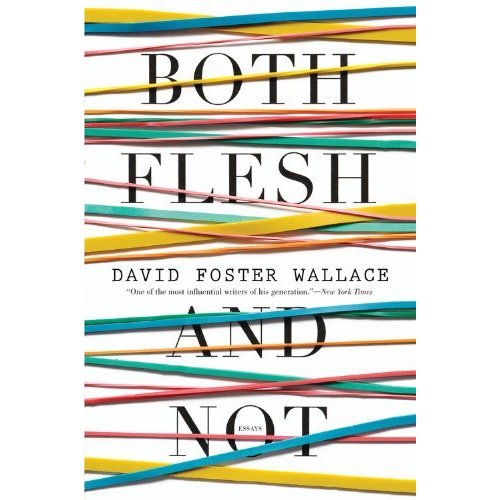
Not really news, but I somehow missed this: Both Flesh and Not has a cover, apparently, as well as a product description:
Beloved for his epic agony, brilliantly discerning eye, and hilarious and constantly self-questioning tone, David Foster Wallace was heralded by both critics and fans as the voice of a generation. BOTH FLESH AND NOT gathers 15 essays never published in book form, including “Federer Both Flesh and Not,” considered by many to be his nonfiction masterpiece; “The (As it Were) Seminal Importance of Terminator 2,” which deftly dissects James Cameron’s blockbuster; and “Fictional Futures and the Conspicuously Young,” an examination of television’s effect on a new generation of writers.
Both Flesh and Not is due around Thanksgiving this year.
Book shelves series #21, twenty-first Sunday of 2012: William T. Vollmann and David Foster Wallace
Sorry about the glare in the photo above. As I seem to attest weekly, photography is hard. Photographing books is hard. Lighting issues, glare etc. Anyway, this shelf is half Vollmann, half DFW. I’ve written so extensively about these guys on the site that I won’t bother linking to anything here. A few months ago, Gaddis’s JR and The Recognitions was hanging out here, but then I put Expelled and Imperial on the shelf, bought Everything and More, and also picked up some more Gaddis, and, well, anyway, had to move him up with Joyce, where he seems to belong. The paperback of The Pale King is a review copy; it has additional stuff. Maybe I should part with the hardback. It seems ridiculous to have them both.
The copy of Girl with Curious Hair is extremely important to me, as silly as that sounds. It was one of the first books I ever “reviewed” on this blog, back when I still focused almost entirely on books I’d stolen or books I’d never returned to. From that review:
Scott Martin was kind enough to loan me this book. Did he know that it would forever change the way I read? It was the first semester of my freshman year in college, and I was slowly reaching beyond stuff like Henry Miller, Wm Burroughs and Franz Kafka. David Foster Wallace’s short story collection Girl With Curious Hair introduced me to a whole new world of writing. Reading DFW is like having a very witty friend tell you a moving and funny story over a few beers. He’s hilarious, thought-provoking, and not nearly as hard to read as people seem to think.
I leave the bookmark I’ve been using in almost every book I read. When I pulled Girl from the shelf, I found a Polaroid of my cat:
He’s just a kitten here. His name is Remy. He no longer lives with us, but he’s still around. We moved a year ago from a bungalow set above the ground (i.e. with cat crawl space) to a ranch on a block (i.e. no crawl space). He didn’t want to move because he was having this romance with a stray my daughter named Pearly. I eventually trapped him and moved him to the new place, but I foolishly forgot he’d have no place to run and hide while getting acclimated. He ran away. A few months later I found him down the street. He looked happy and came up and talked to us. He followed us back to the new place and we gave him some people food treats. Then he left again. We seem him every now and then. He’s gotten surprisingly fat and seems to like the new people he’s taken up with. They have two boys, a little older than my kids. Sometimes I miss my cat.
From David Foster Wallace’s essay “A Supposedly Fun Thing I’ll Never Do Again,” collected in the book of the same name:
The word’s overused and banalified now, despair, but it’s a serious word, and I’m using it seriously. For me it denotes a simple admixture—a weird yearning for death combined with a crushing sense of my own smallness and futility that presents as a fear of death. It’s maybe close to what people call dread or angst. But it’s not these things, quite. It’s more like wanting to die in order to escape the unbearable feeling of becoming aware that I’m small and weak and selfish and going without any doubt at all to die. It’s wanting to jump overboard.
From David Foster Wallace’s essay “David Lynch Keeps His Head,” collected in A Supposedly Fun Thing I’ll Never Do Again:
TIDBIT: HOW LYNCH AND HIS CINEMATOGRAPHER FOR BV FILMED THAT HELLACIOUS FORCED “JOYRIDE” IN FRANK BOOTH’S CAR, THE SCENE WHERE FRANK AND JACK NANCE AND BRAD DOURIF HAVE KIDNAPPED JEFFREY BEAUMONT AND ARE MENACING HIM INSIDE THE CAR WHILE THEY’RE GOING WHAT LOOKS LIKE 100+ DOWN A DISMAL RURAL TWO-LANER: The reason it looks like the car’s going so fast is that lights outside the car are going by so fast. In fact the car wasn’t even moving. A burly grip was bouncing madly up and down on the back bumper to make the car jiggle and roll, and other crewpeople with hand-held lamps were sprinting back and forth outside the car to make it look like the car was whizzing past streetlights. The whole scene’s got a claustrophobia-in-motion feel that they never could have gotten if the car’d actually been moving (the production’s insurance wouldn’t have allowed that kind of speed in a real take), and the whole thing was done for about $8.95.
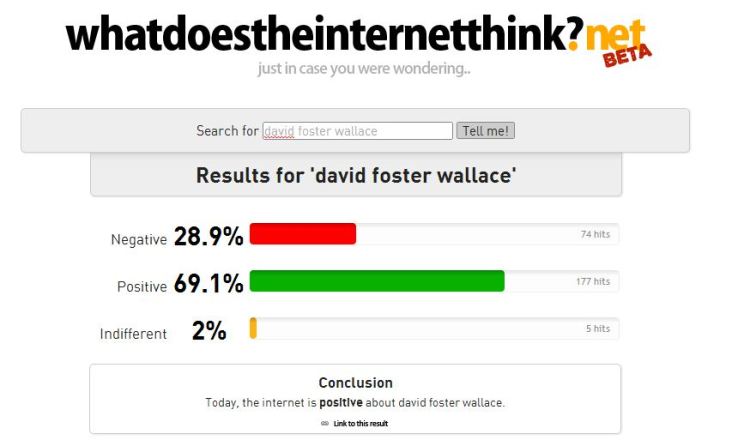
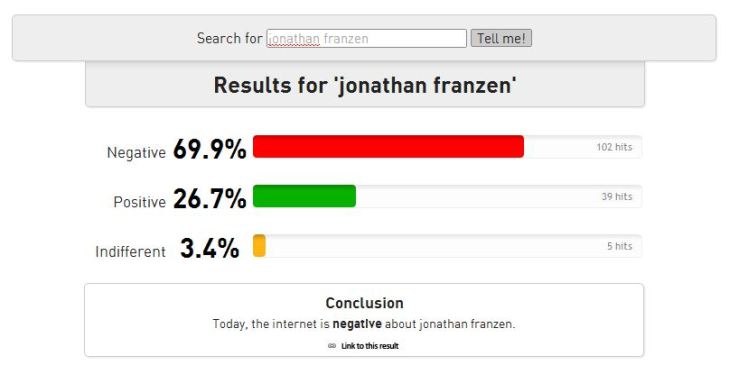
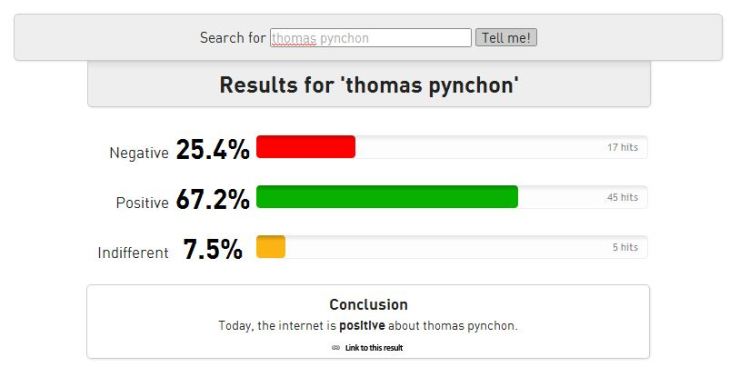
What Does the Internet Think? is a somewhat addictive site that aggregates and analyzes opinions on the internet — I’m not sure exactly how it does this, but it’s fun. I plugged in a few writers this morning (when I should have been working) and here share the results (and, yes, I know that this means almost nothing. Just for fun).
I have absolutely no idea. I rarely got closer than five feet away from him and never talked to him. One of the minor reasons Asymmetrical Productions let me onto the set is that I don’t even pretend to be a journalist and have no idea how to interview somebody and saw no real point in trying to interview Lynch, which turned out perversely to be an advantage, because Lynch emphatically didn’t want to be interviewed while Lost Highway was in production, because when he’s shooting a movie he’s incredibly busy and preoccupied and immersed and has very little attention or brain-space available for anything other than the movie. This may sound like PR bullshit, but it turns out to be true—e.g.:
The first time I lay actual eyes on the real David Lynch on the set of his movie, he’s peeing on a tree. I am not kidding. This is on 8 January in West LA’s Griffith Park, where some of Lost Highway’s exteriors and driving scenes are being shot. Lynch is standing in the bristly underbrush off the dirt road between the Base Camp’s trailers and the set, peeing on a stunted pine. Mr. David Lynch, a prodigious coffee-drinker, apparently pees hard and often, and neither he nor the production can afford the time it’d take him to run down the Base Camp’s long line of trailers to the trailer where the bathrooms are every time he needs to pee. So my first sight of Lynch is only from the back, and (understandably) from a distance. Lost Highway’s cast and crew pretty much ignore Lynch’s urinating in public, and they ignore it in a relaxed rather than a tense or uncomfortable way, sort of the way you’d ignore a child’s alfresco peeing.
David Foster Wallace, “David Lynch Keeps His Head” (A Supposedly Fun Thing I’ll Never Do Again)
A few years ago, to celebrate 4/20, Sam Munson at the Daily Beast wrote an article praising “The Best Stoner Novels.” Not a bad list—Wonder Boys, sure, Invisible Man, a bit of a stretch, The Savage Detectives, a very big stretch, but sure, why not. Anyway, six more stoner novels (not that we advocate the smoking of the weed)—
Junkie, William Burroughs
Burroughs’s (surprisingly lucid) early novel Junkie may take its name from heroin, but it’s full of weed smoking. Lesson: weed smoking leads to heroin. And the inevitable search for yage.
Doc Sportello, the wonky PI at the off-center of Pynchon’s California noir, is always in the process of lighting another joint, if not burning his fingers on the edges of a roach. A fuzzy mystery with smoky corners.
Infinite Jest, David Foster Wallace
Hal Incandenza, protagonist of Wallace’s opus, spends much of his time hiding in the tunnels of Enfield Tennis Academy, feeding his bizarre marijuana addiction, which is, in many ways, more of an addiction to a secret ritual than to a substance. Hal’s hardly the only character in IJ who likes his Mary Jane; there’s a difficult section near the novel’s beginning that features a minor character preparing to go on a major weed binge. His pre-smoking anxiety works as a challenge to any reader seeking to enter the world of Infinite Jest.
I kind of hated Chronic City, a novel where characters seem to light up joints on every other page. It seems to have been written in an ambling, rambling fog, absent of any sense of immediacy, urgency, or, uh, plot. Bloodless stuff, but, again, very smoky.
Okay. Stoner has nothing to do with marijuana. But, hey, it’s called Stoner, right?
Bonus short story: Raymond Carver’s “Cathedral”
Carver’s classic story features a myopic narrator who comes up against his own shortcomings when he meets an old friend of his wife, a blind man who ironically sees deeper than he does. After drinking too much booze, they spark up, share a doob, and take in a documentary about European cathedrals. Great stuff.











 Biblioklept