Mass-market Monday | David R. Bunch’s Moderan


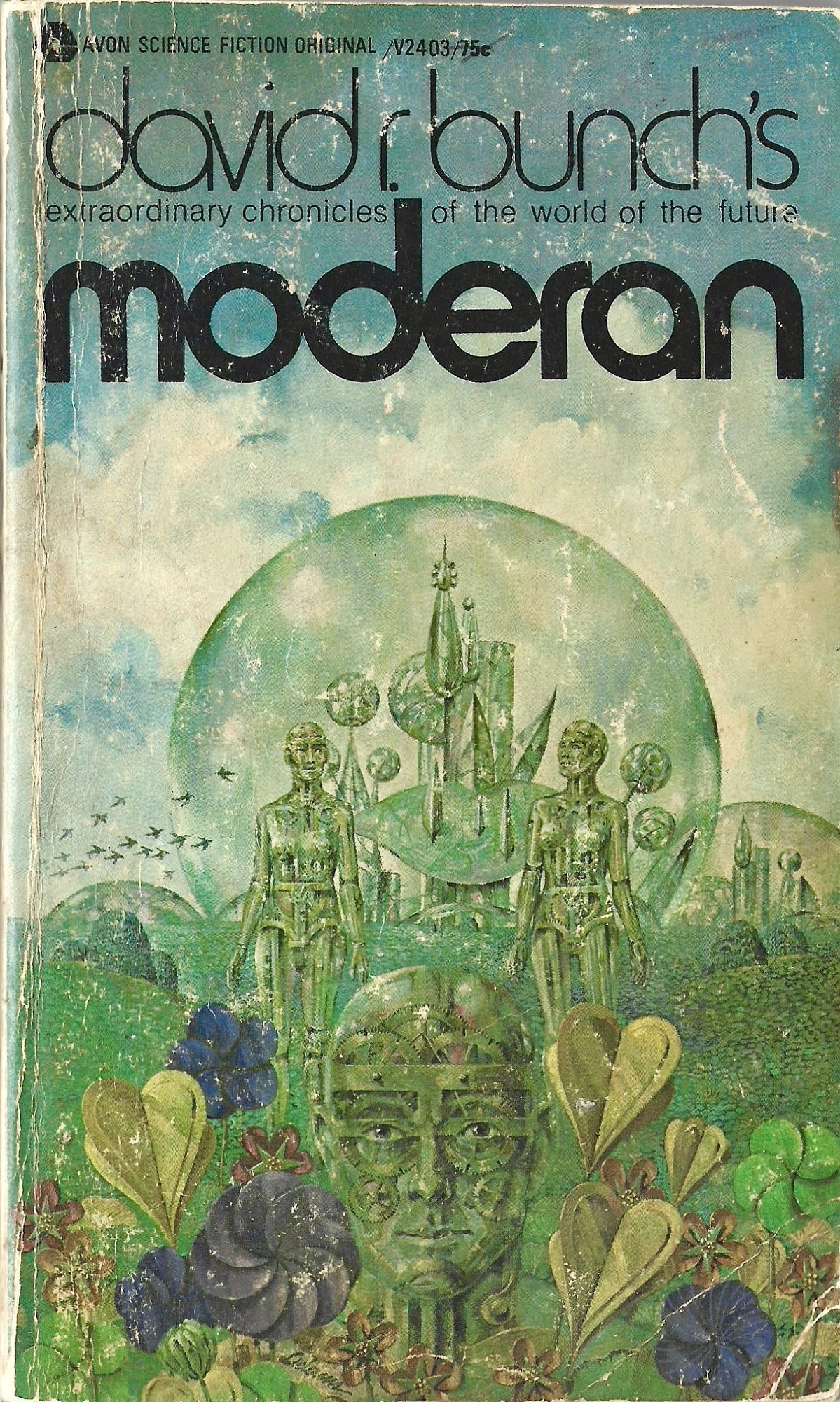
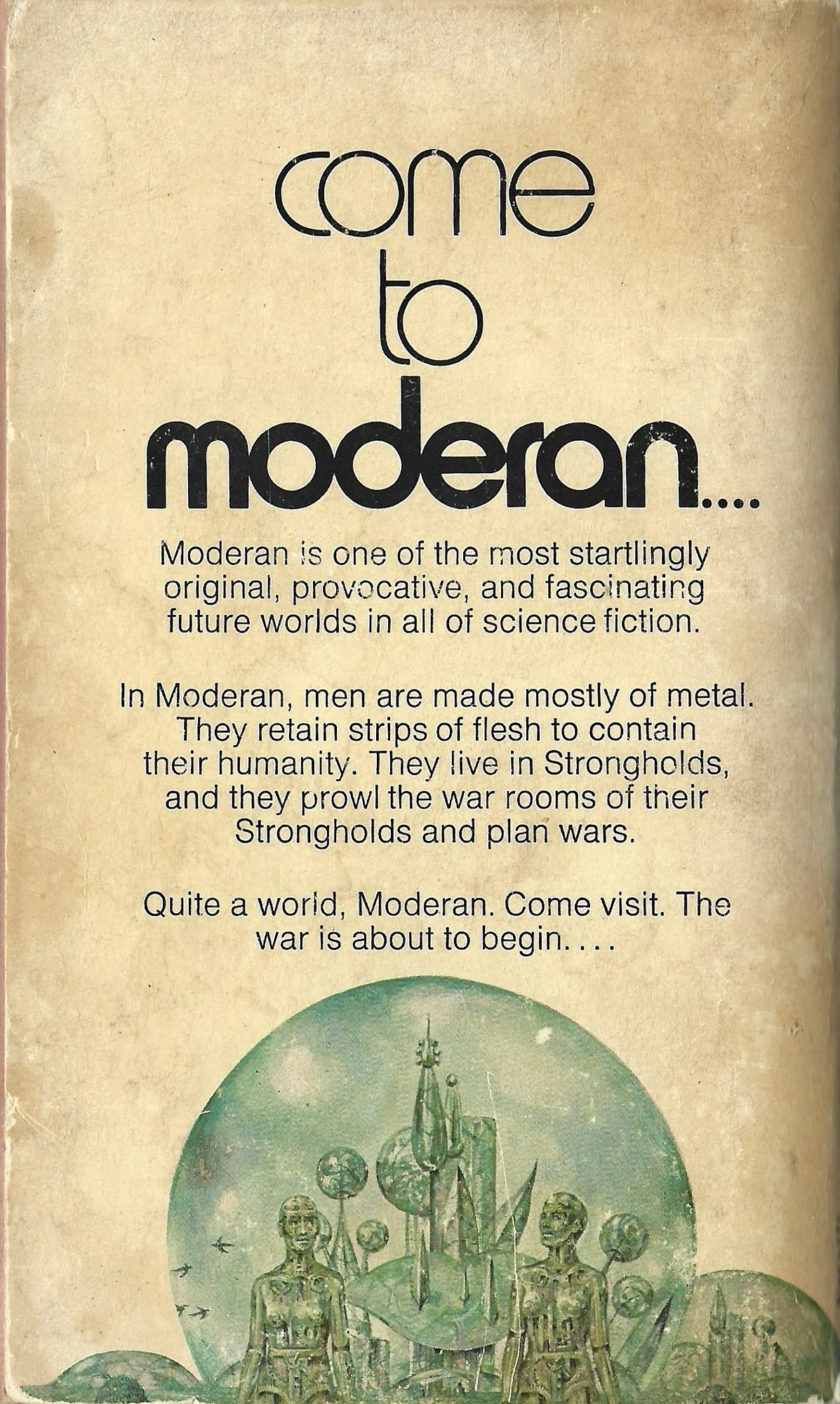
Moderan, David R. Bunch. Avon Books, first edition (1971). No cover artist credited. 240 pages.

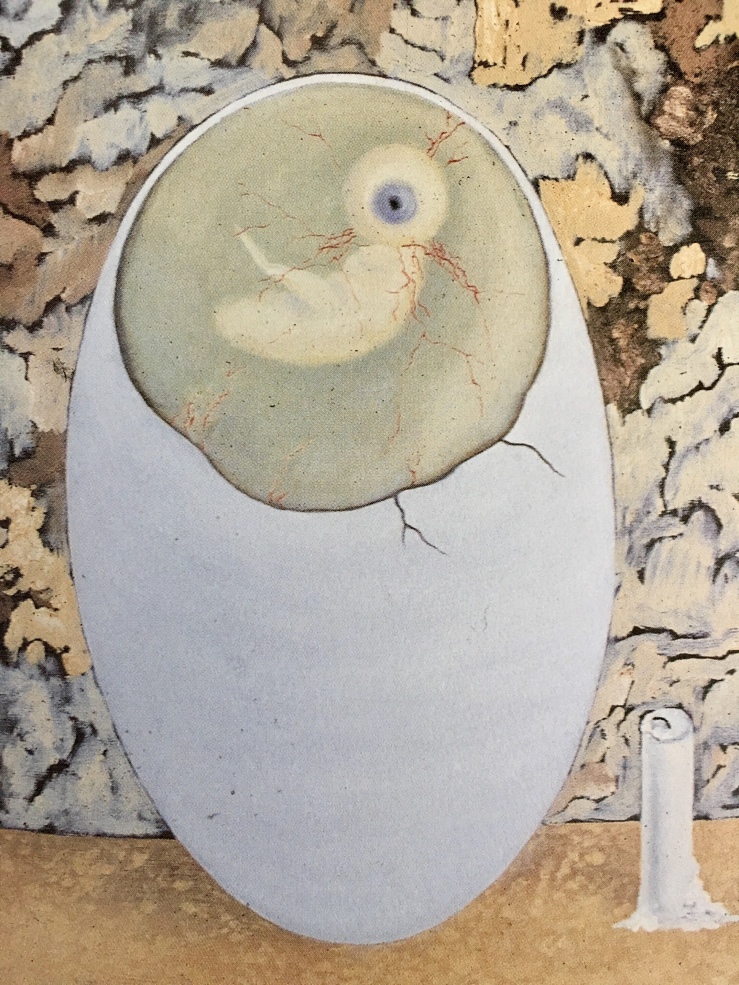
The uncredited Boschian cover for this 1971 mass-market paperback edition of Moderan is by Norman Adams. (Adams did a similar cover in 1972 for Jack Williamson’s novel The Humanoids.)

I think copies of this volume were expensive and hard to find previous to NYRB’s 2018 release of a new edition of Moderan (which included eleven new tales). That’s the version I read—although I was happy to snap this old paperback up for three bucks at a used bookstore. I wrote of the novel in my 2018 reading round-up:

Moderan works as a post-nuke dystopian satire on toxic masculinity. The tropes here might seem familiar—cyborgs and dome homes, caste systems and ultraviolence, a world of made and not born ruled by manunkind (to steal from E.E. Cummings)—it’s the way that Bunch conveys this world that is so astounding. Moderan is told in its own idiom; the voice of our narrator Stronghold-10 booms with a bravado that’s ultimately undercut by the authorial irony that lurks under its surface. The book seems equal to the task of satirizing the trajectory of our zeitgeist in a way that some contemporary satirists have failed to.

“A Little Girl’s Xmas in Moderan” — David R. Bunch

img_1036

“”A Little Girl’s Xmas in Moderan”

by

David R. Bunch

from Moderan


IT WAS in Jingle-Bell weather that Little Sister came across the white yard, the snow between her toes all gray and packed and starting to ball up like the beginnings of two snowmen. For clothing she had nothing, her tiny rump sticking out red-cold, and blue-cold, and her little-jewel knees white almost as bones. She stuck up ten stiff fingers, and she said, “Daddy! Something is wrong at my place! Come see!” She lisped a little perhaps and did not say it all as precisely as grownups, because she was just past four.

He turned like a man in the bottom third of bad dreaming; he pointed two bored eyes at her. Damn the kid, he thought. “What the hell deal has Mox got us into now?” he said. And he sang the little rhyme that made the door come open. Then as she stepped toward him he saw the snowballs on her feet. They were melting now, making deep furrows in the green rug spread across his spacious thinking room. The tall nap, like flooded grass now along little canals bending away from her feet, was speckled white here and there with crumpled paper balls. His trial plans and formulas peeped out like golf balls.

Coming back across the iron fields of nightmare that always rose to confront him at such times, he struggled to make the present’s puzzling moment into sense. Damn the kid, he thought, didn’t wipe her feet. All flesh, as yet—her own—and bone and blood, and didn’t wipe her feet. The snow melts!

He motioned her to him. “Little Sister,” he began in that tired dull-tinny voice that was his now, and must be his, because his larynx was worked all in gold against cancer, “tell me slowly, Little Sister. Why don’t you stay in your plastic place more? Why don’t you use the iron Mox more? Why do you bother me at all? Tell me slowly.”

“Daddy!” she cried and started to jig up and down in the fits that he hated so, “come over to my place, you old boogie. Something needs fixing.”

So they went across the big white yard to her place, past Mother’s place, past Little Brother’s place, with her snow-hurt limping and naked, and him lumbering in strange stiff-jointedness, but snug in a fire-red snuggie suit of fine insulation with good black leather space high-tops. Arrived at her place he whistled at the door the three sharp notes. The door moved into the wall and Mox the iron one stood sliding the iron sections of his arms up into one another until he had only hands hanging from shoulders. It was his greeting way. He ogled with bulb eyes and flashed his greeting code. Continue reading ““A Little Girl’s Xmas in Moderan” — David R. Bunch”

Bunch’s Moderan/Ginzburg’s Dry Heart (Books acquired, 14 July 2023)

Picked up two on Friday—

I’ve been wanting to read Natalia Ginzburg for a while, and when I saw a used copy of her novella The Dry Heart (translated by Frances Frenaye), it seemed like a good entry point. It was really the description on the back that grabbed me:

The Dry Heart begins and ends with the matter-of-fact pronouncement: “I shot him between the eyes.” As the tale—a plunge into the chilly waters of loneliness, desperation, and bitterness—proceeds, the narrator’s murder of her flighty husband takes on a certain logical inevitability. Stripped of any preciousness or sentimentality, Natalia Ginzburg’s writing here is white-hot, tempered by rage. She transforms the unhappy tale of an ordinary dull marriage into a rich psychological thriller that seems to beg the question: why don’t more wives kill their husbands?

I read NYRB’s collected Moderan a few years ago, but I couldn’t pass up this Avon Bard mass market paperback.

Opening track:

“THINKING BACK (OUR GOD IS A HELPING GOD!)”

by

David R. Bunch


FLESH seemed doomed that year; death’s harpies were riding down. The once-beautiful, sweet and life-sustaining air was tinged with poison now, and man drank at his peril from the streams that had once been pure. He prayed to a God that was said to be in all things good, true and beautiful, but especially was thought to be all sternness and goodness, justice and loving-care, in some milk-white place far away, “On High.” And those prayers if answered were answered very obliquely indeed. For the air got deeper in poison from the tinkering with lethal things the flesh-man indulged in when not praying, and the water got fuller with danger as each new explosion pounded the bomb-fevered air. There was talk of the End; great discussions were handled in great halls across the land. Treaties were signed among statesmen to help the air get better, to allow the streams to recover and run pure once again. But even as the flesh-hands grasped the pens to scrawl the marks of good faith in some countries, fear lashed at capitals in other countries. Arsenals were tested anew. Things done were undone. The air got sicker; the streams ran not pure but pure danger—There seemed no chance for flesh-man, and his God seemed entirely silent wherever He was, wherever His white throne was. The HOPELESS signs were out everywhere. Little children asked that they be allowed to go quickly and not grow up hurting and maimed. Adults in what should have been the full flower of brave manhood and fair womanhood quaked, looked heavenward for some hopeful sign and, finding none, fell down and cried bitterly. The aged ones, quavering and whining now, finally decided that yes, truly they were most glad that they were so very old. The flesh billions courted at the Palace of Danger so ardently had turned against them and the mass wedding of Death and Destruction seemed now all but assured.

And then—and then this chance! Offered to all. It came first as small hope, the rumor of it, a faint faint breath of a chance seeping through the flesh-fouled metropolises. And then it was confirmed as glowing fact when the tour went round that year, year of the Greatest Darkness. And yet—and yet they scoffed, scoffed by the billions at this man working his hinges and braces, would not believe his heart was an ever-last one, had no credulity for his new wonderful lungs that could breathe him a forever-life even in bomb-tainted air. When they saw that his hands were steel they yelled robot! robot! When they saw that his eyes were wide-range, mechanism-helped, and that he’d a phfluggee-phflaggee button on his talker that he pressed from time to time to aid in his speech expression they laughed and yelled . . . Continue reading “Bunch’s Moderan/Ginzburg’s Dry Heart (Books acquired, 14 July 2023)”

Blog about November reading (and blogging) goals

img_1447

For the past few days I’ve felt as if I would never put one word after another again, that I would never put together a sentence, string together clauses and sling them out into the world. This previous statement is hyperbole and I am silly—but even simple emails have seemed the acme of wretched futility to compose. Chalk it up to a mild head cold; chalk it up to too many essays to grade; chalk it up to anxiety of (fear of) writing. But I feel like I used to want to feel like I needed to write, right? On 1 Oct. 2018 I wrote a silly post on this weblog called “Blog about October reading (and blogging) goals,” in which I set a goal to blog “every day, even about nothing,” which I failed to achieve.

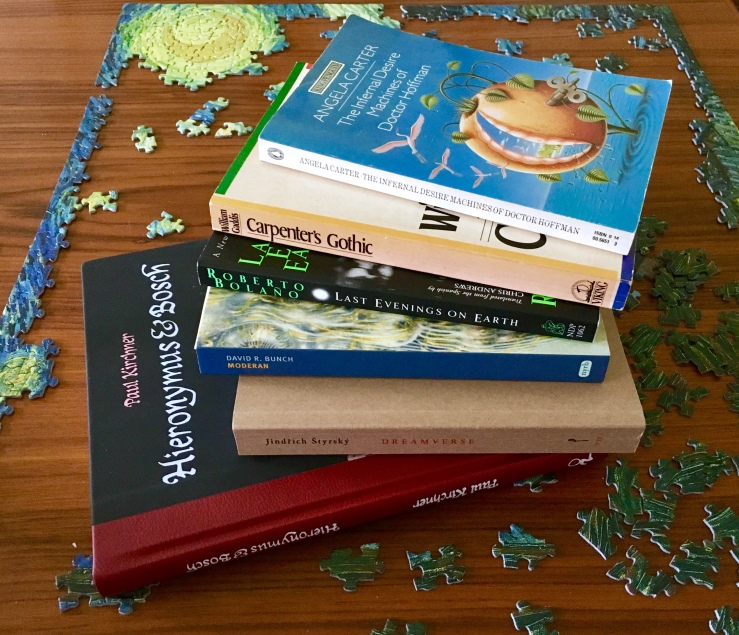
did actually achieve some of the reading goals expressed in that October goals blog though: I finished George Eliot’s Silas Marner; I made a bigger dent in Moderan, David R. Bunch’s cult dystopian novel; I finally read William Gaddis’s novel Carpenter’s Gothic; I actually returned and did not keep forever a book I borrowed from a friend; I did not gobble up Paul Kirchner’s Hieronymus & Bosch but rather limited myself to one or two cartoon strips a day (or sometimes, like, five).

So for November—

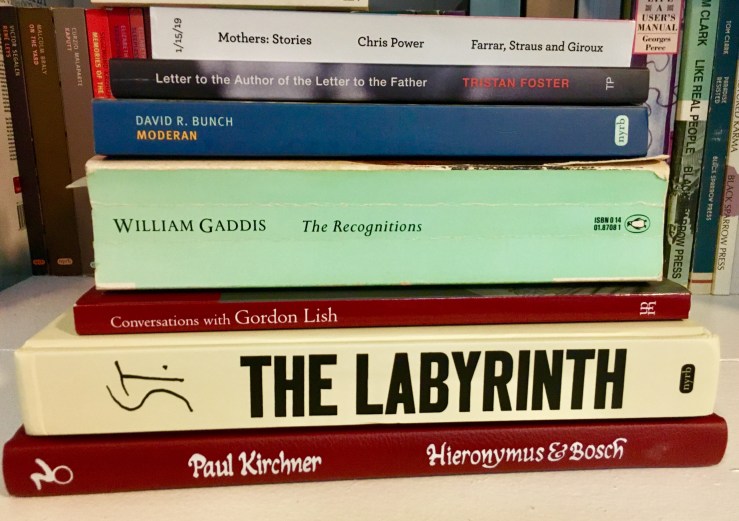
I’ve read the first two stories in Chris Power’s debut collection Mothers and they are good (the collection is available in the US in January 2019; I should have a full review then).

Tristan Foster’s collection Letter to the Author of the Letter to the Father is very much my weird cup of weird tea.

David Bunch’s Moderan deserves a big proper essay. I’ve suggested that our zeitgeist surpasses the parodic powers of postmodernism’s toolkit, but Moderan anticipates and slices up Our Bad Times.

Part of my anxiety about writing comes from having failed three times now to write a proper review of Conversations with Gordon Lish, which is the kind of self-deconstructing performance of writing about writing that is difficult to describe or analyze; it’s the sort of thing you simply want the reader to read.

I started the audiobook of William Gaddis’s novel The Recognitions, and have ended up not only reading my Penguin edition in tandem—a sort of re-rereading—but have also been flirting with The Gaddis Tapes1 and Letters of William Gaddis.  (This summer I said I’d reread The Recognitions: is this that?). I don’t really know what I want from this material, and I certainly don’t suggest it as anything approaching ancillary or auxiliary “help” with Gaddis’s project—I mean, in his Paris Review interview Gaddis paraphrases his hero and explains why we shouldn’t look for keys to art in the artist:

I’d go back to The Recognitions where Wyatt asks what people want from the man they didn’t get from his work, because presumably that’s where he’s tried to distill this “life and personality and views” you speak of. What’s any artist but the dregs of his work: I gave that line to Wyatt thirty-odd years ago and as far as I’m concerned it’s still valid.

—but hey look I know what I just did—took my cue from the artist in explaining the artist’s art. So. Oh, hey, here’s a great little segment from a letter Gaddis to his mama (from Mexico City) in April, 1947:

Could you then do this?: Send, as soon as it is conveniently possible, to me at Wells-Fargo:

My high-heeled black boots.

My spurs.

a pair of “levis”—those blue denim pants, if you can find a whole pair

the good machete, with bone handle and wide blade—and scabbard—if

this doesn’t distend package too much.

Bible, and paper-bound Great Pyramid book from H—Street.

those two rather worn gabardine shirts, maroon and green.

Incidentally I hope you got my watch pawn ticket, so that won’t be lost.

PS My mustache is so white and successful I am starting a beard.

The same day I got The Labyrinth, a collection of mid-century cartooning by Saul Steinberg (new from NYRB, I read a passage in The Gaddis Tapes where Gaddis quotes his friend, Saul Steinberg. That same day my son, eight, went through the whole volume, and asked me what it was, how I was supposed to write about it, etc. Still not sure, but it’s great, heroic, etc. and I hope to post a review at The Comics Journal later this month. Here is Steinberg’s Quixote:

img_1444

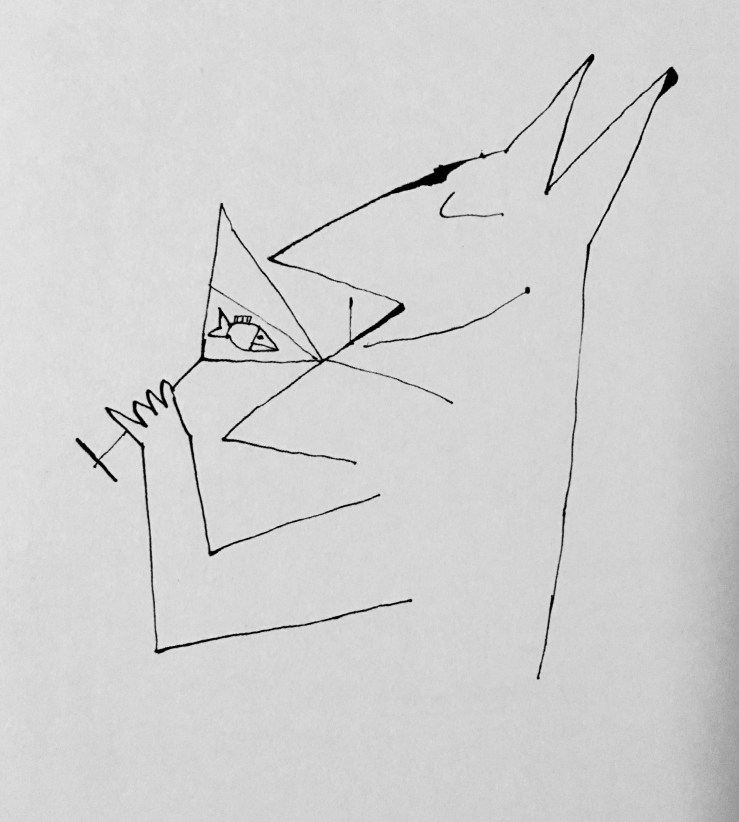
And I like to pretend this is his illustration of some Gaddis character at a party in The Recognitions (even if I recognize it is not):
img_1445

Bottom of the stack is Paul Kirchner’s latest Hieronymus & Bosch, a sort of MAD Magazine take on eternal damnation that puts the scatology in eschatology. Great stuff.

Not pictured in the stack is Angela Carter’s 1972 novel The Infernal Desire Machines of Doctor Hoffman, which is by my bed and which I keep falling asleep to. It deserves better from me; or maybe it’s a bit of evidence in the emerging truth that I can’t read before bed most of the time most of these days. (Separate blog post, perhaps—chalk it up to a head cold; chalk it up to too many essays to grade; chalk it up to two kids; chalk it up to too much read wine; chalk chalk chalk).

Hope to do better than this in the next 29 days.


Knight, Christopher J., William Gaddis, and Tom Smith. “The New York State Writers Institute Tapes: William Gaddis.” Contemporary Literature 42, no. 4 (2001): 667-93. doi:10.2307/1209049.

Blog about some recent reading

img_1305

I ended up reading the last two chapters of William Gaddis’s novel Carpenter’s Gothic a few times, trying to figure out exactly what happened. I then read Steven Moore’s excellent essay on the novel, “Carpenter’s Gothic or, The Ambiguities.” (If you have library access to the Infobase database Bloom’s Literature, you can find the essay there; if not, here’s a .pdf version). Moore offers a tidy summary of Carpenter’s Gothic—a summary which should be avoided by anyone who wants to read the novel. Because Carpenter’s Gothic isn’t so much about what happens but how it happens. Moore writes:

As is the case with any summary of a Gaddis novel, this one not only fails to do justice to the novel’s complex tapestry of events but also subverts the manner in which these events are conveyed. Opening Carpenter’s Gothic is like opening the lid of a jigsaw puzzle: all the pieces seem to be there, but it is up to the reader to fit those pieces together. …Even after multiple readings, several events remain ambiguous, sometimes because too little information is given, sometimes because there are two conflicting accounts and no way to confirm either.

Moore then lays out the novel’s theme in clear, precise language:

Such narrative strategies are designed not to baffle or frustrate the reader but to dramatize the novel’s central philosophic conflict, that between revealed truth versus acquired knowledge. Nothing is “revealed” by a godlike omniscient narrator in this novel; the reader learns “what really happens” only through study, attention, and the application of intelligence.

Quite frankly, Moore has written an essay that I wish I had written myself. I had been sketching parallels between Carpenter’s Gothic and Leslie Fiedler’s classic study Love and Death in the American Novel all throughout my reading; Moore ends up citing Fiedler a few times in his essay, in particularly working from Fiedler’s idea of how Gothicism manifests in American writing. (Moore does not bring up Fiedler’s critique of masculinity though, which opens up an occasion for me to write—once I’ve reread the puzzle though).

Anyway—I loved loved loved Carpenter’s Gothic, and I read it at just about the right time: It’s a Halloween novel. Great stuff.

In line with the Halloween theme: I had been working on a post about horror, about how I love scary films, grotesque literature, and weird art, because fantasy evocations of terror offer a reprieve from anxiety, from true dread, etc. Like, you know, a climate change report—I mean, that’s genuinely horrifying. But scary films and scary stories almost never really scare me. So I was thinking about literature that does produce dread in me, anxiety in me, and listing out examples in my draft, and so well anyway I reread Roberto Bolaño’s short story “Last Evenings on Earth.” I wrote about the collection named for the story almost a decade ago on this blog, focusing on the “ebb and flow between dread and release, fear and humor, ironic detachment and romantic idealism” in the tales:

In “Last Evenings on Earth,” B takes a vacation to Acapulco with his father. Bolaño’s rhetoric in this tale is masterful: he draws each scene with a reportorial, even terse distance, noting the smallest of actions, but leaving the analytical connections up to his reader. Even though B sees his holiday with his dad heading toward “disaster,” toward “the price they must pay for existing,” he cannot process what this disaster is, or what paying this price means. The story builds to a thick, nervous dread, made all the more anxious by the strange suspicion that no, things are actually fine, we’re all just being paranoid here. (Not true!)

I’m not sure if I’ll get the essay I was planning together any time soon, but I’m glad I reread “Last Evenings.”

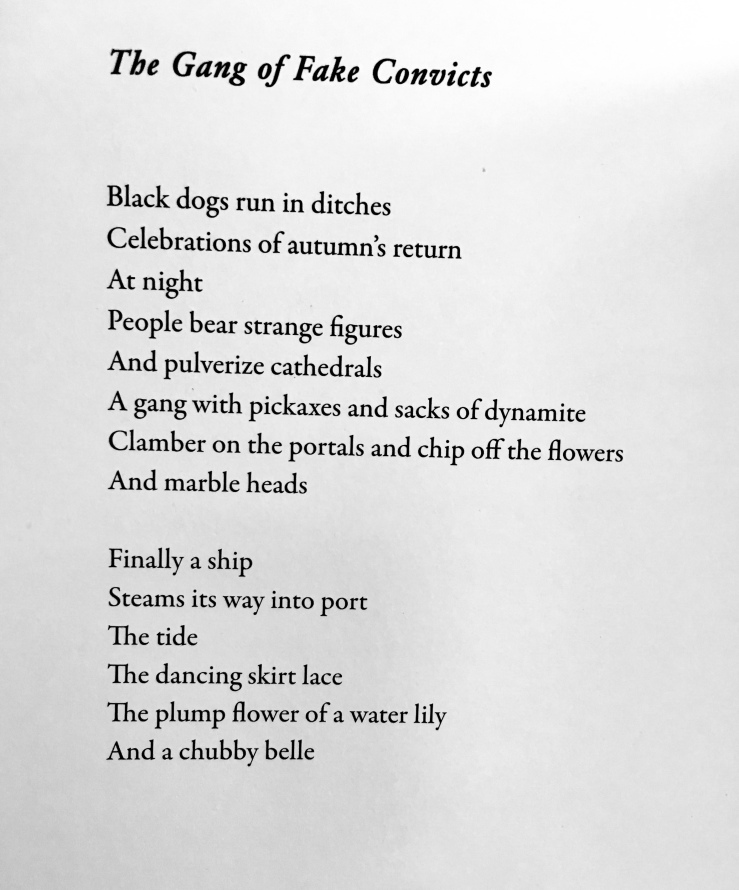
There’s a strange background plot in “Last Evenings” in which Bolaño’s stand-in “B” dwells over a book of French surrealist poets, one of whom disappears mysteriously. Jindřich Štyrský isn’t French—he’s Czech—but he was a surrealist poet (and artist and essayist and etc.), so I couldn’t help inserting him into Bolaño’s story. I’ve been reading Dreamverse, which ripples with sensual horror. I wrote about it here. Here’s one of Štyrský’s poems (in English translation by Jed Slast); I think you can get the flavor from this one:

img_1307

And here’s a detail from his 1937 painting Transformation:

img_1308

I’ve finished the first section of David Bunch’s Moderan, which is a kind of post-nuke dystopia satire on toxic masculinity. While many of the tropes for these stories (most of which were written in the 1960s and ’70s) might seem familiar—cyborgs and dome homes, caste systems and ultraviolence, a world of made and not born ruled by manunkind (to steal from E.E. Cummings)—it’s the way that Bunch conveys this world that is so astounding. Moderan is told in its own idiom; the voice of our narrator Stronghold-10 booms with a bravado that’s ultimately undercut by the authorial irony that lurks under its surface. I will eventually write a proper review of Moderan, but the book seems equal to the task of satirizing the trajectory of our zeitgeist.

I started Angela Carter’s novel The Infernal Desire Machines of Doctor Hoffman last night and the first chapter is amazing.

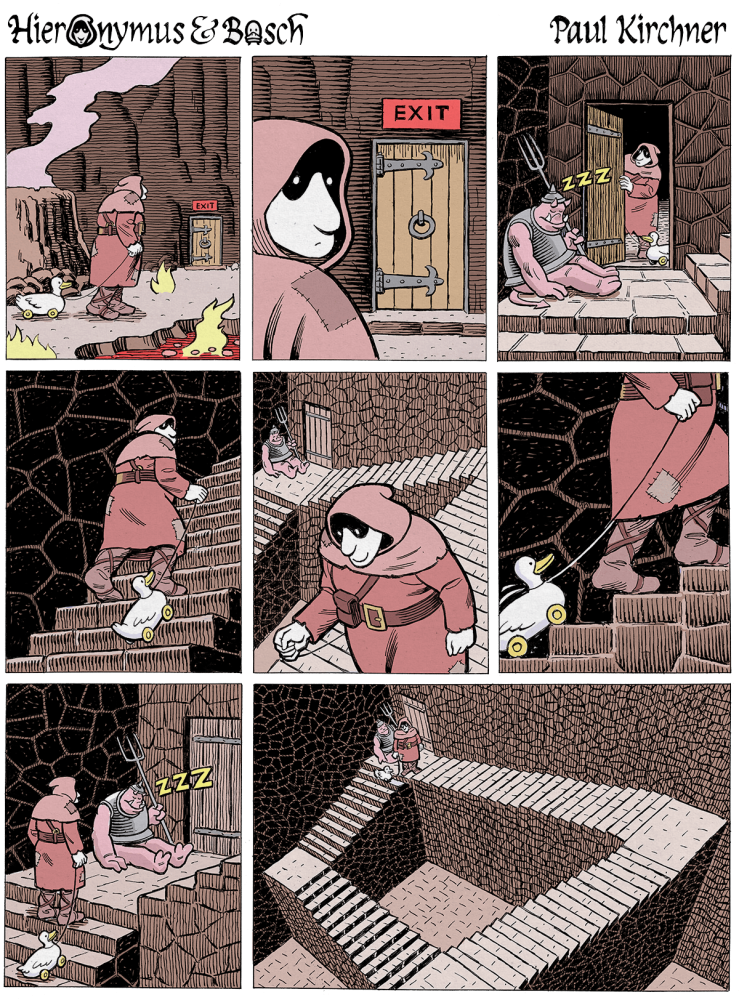
Finally, I got a hard copy of Paul Kirchner’s new collection, Hieronymus & Bosch which finds humor in the horror of hell. The collection is lovely—I should have a post about it here later this week and hopefully a review at The Comics Journal later this month. For now though, a sample strip:

hieronymus26bosch-angels-laugh36

Blog about October reading (and blogging) goals

On 1 April 2018 I set the silly goal of blogging about something every day of the month. I actually wound up meeting the goal, and it was fun (if sometimes exhausting). The April “Blog about” thing allowed me to just write in a way that was freeing. I have a tendency to let riffs and reviews languish, to leave my half-assed remarks on whatever I’m reading left unremarked, etc.

Anyway. Lately I’ve been Not Writing–in part because I’ve been extraordinarily busy with work and family, but also because it’s incredibly hot in Florida. (If this does not make sense to you, don’t worry. Look—sometimes it’s just too hot). So well anyway—I’m going to use 1 October 2018 as an occasion to declare my good intent to blog about something—books, film, art—every day or nearly every day. I’m not sure how it will go.

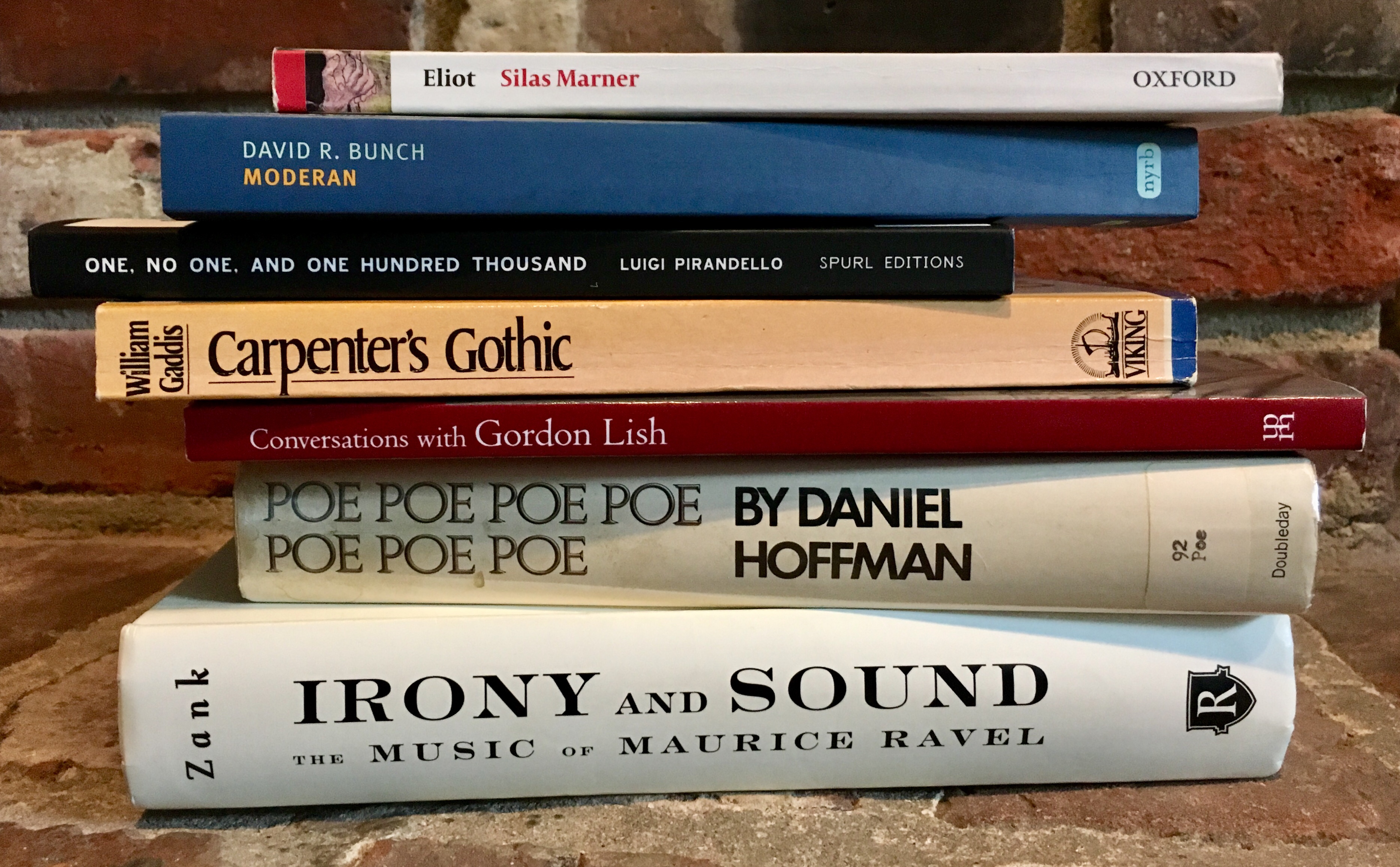
For now, some October reading goals, in no way prioritized:

Finish George Eliot’s Silas Marner.

This probably should have been the first Eliot novel I read—it’s more approachable (and let’s be honest, much, much shorter) than Middlemarch. Eliot’s major skill, it seems to me, is in evoking consciousness-in-action—that’s the impression I got after finishing Middlemarch, anyway. Like MiddlemarchSilas Marner is also a thoroughly convincing evocation of place. And, in its treatment of anxiety, it also seems to me an easy pre-Modern Modern novel.

Make a bigger dent in David R. Bunch’s Moderan.

Bunch’s Moderan stories connect into a strange novel told in a thoroughly singular voice. “Thoroughly singular voice” is a total cliché, but it’s true here: Bunch’s New Metal Man Stronghold 10 paints his plastic-coated post-apocalyptic world as if it were a perfect paradise. The language, the voice, is its own idiom—barking, visceral, phallic—perfectly suited to conjure a postnuked dystopian world. The great trick of it all is that the narrator Stronghold 10 views this dystopia as a utopia, resulting in a layer of ironic distance between author and speaker that creates a bizarre comic tension that’s ripe for misreading. The voice’s singularity though means that’s a very particular flavor; one doesn’t always want Stronghold 10 booming in one’s ear. I hope to do a few posts on Moderan this month, but if your interest is piqued, check out Rob Latham’s thorough review at the Los Angeles Review of Books.

Check out Luigi Pirandello’s One, No One, and One Hundred Thousand.

A review copy from Spurl Editions of William Weaver’s translation of Pirandello’s final novel arrived late last week but I haven’t made much time to check it out.

Finally read Carpenter’s Gothic by William Gaddis.

It will happen.

Do a few posts on Conversations with Gordon Lish (ed. by David Winters and Jason Lucarelli).

I tried not to gobble most of these Lish interviews up too quickly—the experience of reading them is something closer to reading an essay or a transcript of a performance than a staid interview.

Read more of Poe Poe Poe Poe Poe Poe Poe.

I unexpectedly dipped into Daniel Hoffman’s biography-criticism-memoir Poe x 7 this weekend, after randomly flicking to a page where Hoffman comments on Poe commenting on Hawthorne (all on allegory already aye?). The book is so strange and intriguing.

Return a book to a friend.

I asked a colleague, a musicologist, what he thought of Ravel’s Bolero and he loaned me Stephen Zank’s Irony and Sound: The Music of Maurice Ravel, and then narrowed his eyes a bit and clarified that the book should be returned. (Hardback U of P books ain’t cheap, people). A lot of it is way over my head, but Zank’s analysis often turns to literature—Baudelaire shows up as much in the index as Debussy—so there’s that.

Try not to gobble up all of Paul Kirchner’s forthcoming collection Hieronymus & Bosch.

You might have read some of Biblioklept favorite Paul Kirchner’s comic strips Hieronymus & Bosch at Adult Swim Comics. This Fall, French publisher Tanibis Editions will release a 100-page collection of Kirchner’s comic riff on life in hell. The digital advance they sent me looks great—I’ve tried to restrain myself from eating it all up at once.

unnamed (1)

Blog every day, even about nothing.

David R. Bunch’s Moderan (Book acquired, 13 Sept. 2018)

img_1036

I’ve enjoyed dipping into the first few stories in NYRB’s collection of David R. Bunch’s Moderan stories over the past few days. Bunch’s weird world has meshed nicely with the Strugatsky’s The Snail on the Slope, which I finished today. More to come on Moderan, but here’s NRYB’s blurb for now:

Welcome to Moderan, world of the future. Here perpetual war is waged by furious masters fighting from Strongholds well stocked with “arsenals of fear” and everyone is enamored with hate. The devastated earth is coated by vast sheets of gray plastic, while humans vie to replace more and more of their own “soft parts” with steel. What need is there for nature when trees and flowers can be pushed up through holes in the plastic? Who requires human companionship when new-metal mistresses are waiting? But even a Stronghold master can doubt the catechism of Moderan. Wanderers, poets, and his own children pay visits, proving that another world is possible.

“As if Whitman and Nietzsche had collaborated,” wrote Brian Aldiss of David R. Bunch’s work. Originally published in science-fiction magazines in the 1960s and ’70s, these mordant stories, though passionately sought by collectors, have been unavailable in a single volume for close to half a century. Like Anthony Burgess in A Clockwork Orange, Bunch coined a mind-bending new vocabulary. He sought not to divert readers from the horror of modernity but to make us face it squarely.

This volume includes eleven previously uncollected Moderan stories.