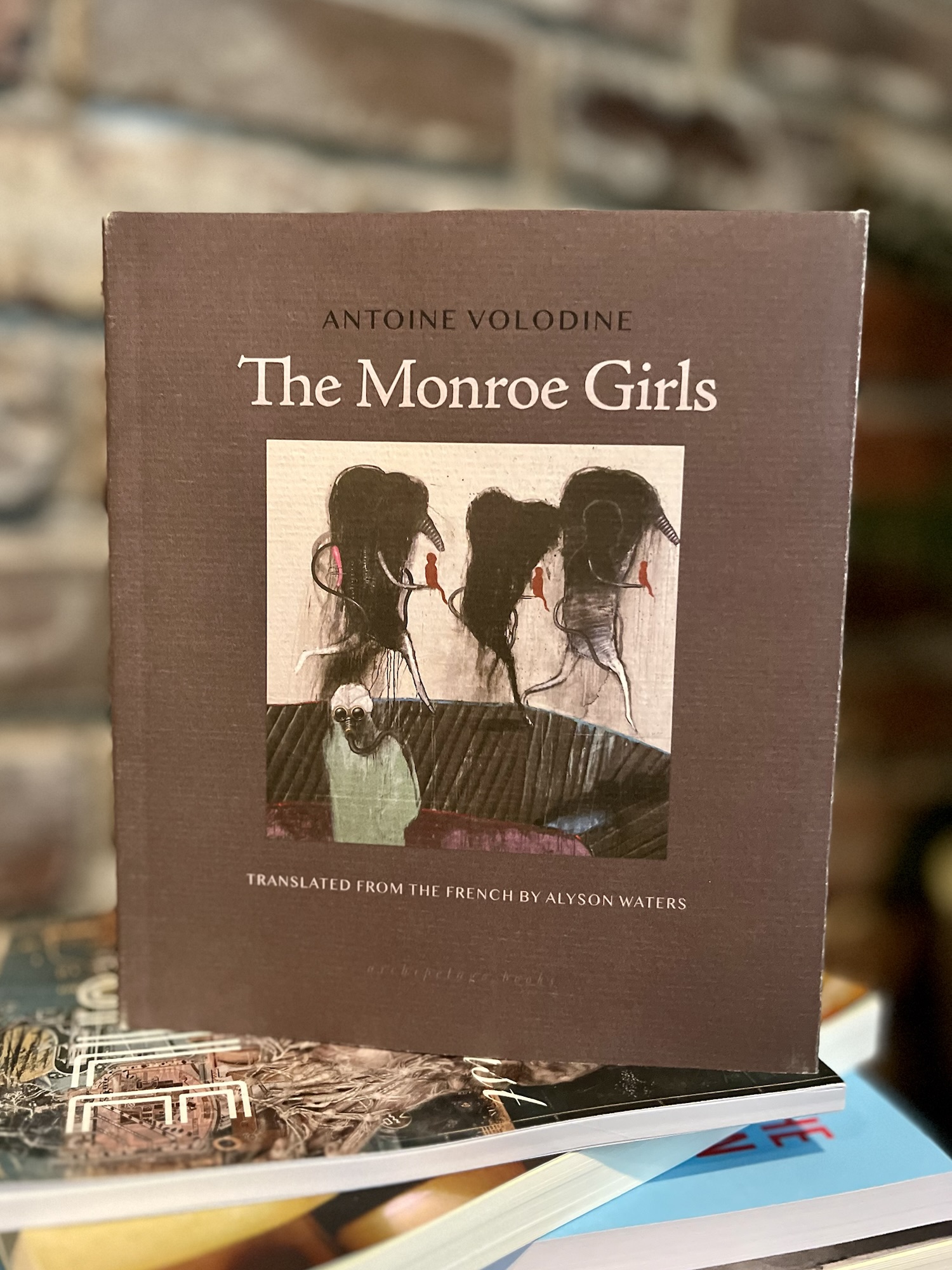
There is an old saying, some may say a cliche, but nevertheless it rings as wisdom in my waxy ears: The best time to read a Volodine was twenty years ago. The second best time is now. Maybe start with Volodine’s 2021 novel The Monroe Girls, forthcoming in translation by Alyson Waters from Archipelago. Their jacket copy:
Breton has seen brighter days. Now his body sags as he pulls a pair of binoculars to his withered face. He peers from the grimy window of a near-empty psychiatric compound—one of the last buildings standing after an unspecified disaster—spying rue Dellwo below, dreary in perpetual rain. Into this world of devastation drop the Monroe girls—paramilitaries trained in the “dark place” by Monroe, a dissident executed long ago. Their mission to revamp the Party is futile in this bleak, decaying world. Breton, our schizophrenic narrator, is tasked (and tortured) by what remains of the Party to locate and identify the Monroe girls using special optical equipment and his powers of extrasensory perception. Breton’s journey through a bardo-like, hostile labyrinth invites us into a sensual swirl of bodily decay, political acquiescence, and civilizational collapse. In this derelict setting, Volodine ruminates on identity, surveillance, life after death, and love (which, alas, does not conquer all). An urgent and blistering tale, beautifully rendered with Volodine’s distinct pathos and humor.
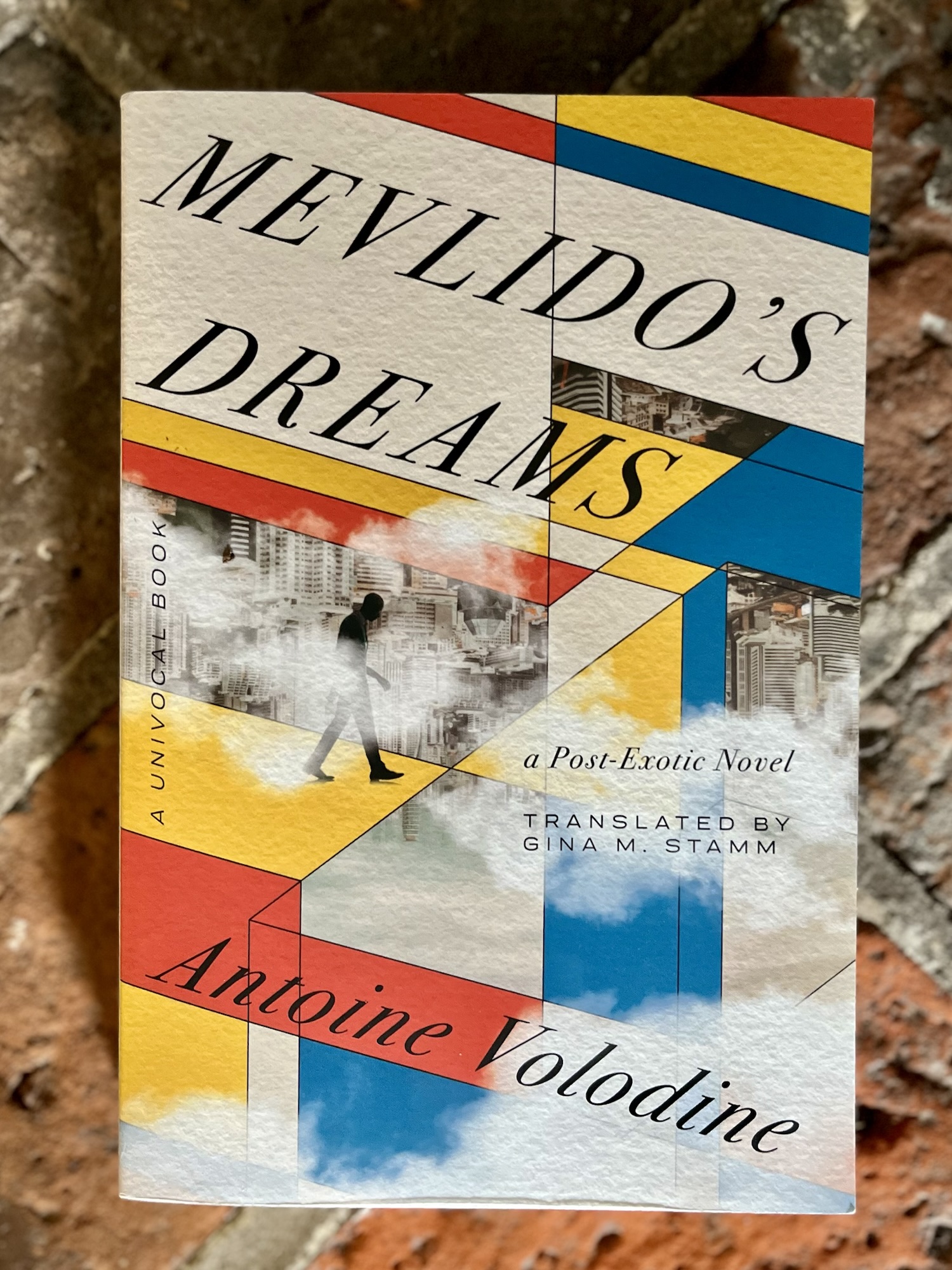
Antoine Volodine’s 2007 novel Mevlido’s Dreams is a bleak, dystopian noir novel set several centuries in the future in the ruined city-state of Oulang-Oulane. Here, weary revolutionary Mevlido lives in a decaying ghetto called Henhouse Four, an eerie quarter inhabited by indigents, junkies, and other remnants of failed uprisings who must contend with the giant mutated birds who terrorize the borough.
Once a soldier of the revolution, Mevlido now serves as a policeman, yet he may also be a double or even triple agent, a sleeper sent through time from a kind of liminal afterlife, a bardo between death and rebirth. The novel drifts between waking and dream states, war memories and spectral futures, as Mevlido’s fragmented consciousness becomes a vessel for Volodine’s haunting post-exotic vision of history, language, and apocalypse.
About halfway through the novel, Mevlido’s bardo boss offers a handy summary of the apocalypse:
They’ve become an inexplicable species. They are just getting out of multiple wars of extermination, but a new conflict is already in sight. The population has decreased by a hundredfold, even more. Entire continents are currently uninhabitable. Those who have survived remain socially organized, but they no longer believe in themselves, or in society. They’ve inherited political systems to which they’ve lost the keys; for them ideology is a prayer devoid of meaning. The ruling classes have become criminalized, the poor obey them. Both classes act as if they were already dead. And as if, on top of that, they don’t even care. … Something in them has changed. You’d think that they no longer have the ability to differentiate between life, dreams, and death.
Our hero will be reborn into this turmoil, his consciousness a roiling mess of anxious irreality. “Even if I’m dreaming, I’m in reality,” he concludes at one point, as if to anchor himself in his mission. What that mission is, exactly, is never fully clear to Mevlido or the reader. Or perhaps the mission is very clear; as translator Gina M. Stamm puts it in her introduction, the plot of Mevlido’s Dreams “has the elements of a fairly classic tragic romance: man and woman are in love, the world prevents their being together, man descends into tragic circumstances.” This motif repeats in dreamlike iterations in the novel; Mevlido drifts through a post-exotic wasteland following orders no one remembers giving, haunted by his dead wife Verena Becker, whose presence threads through his days like a recurring dream or a flickering film reel.
We come to learn that Verena Becker died cruelly, murdered by the “child soldiers” who were pressed in to service by agents of the exploitative upper class. In Mevlido’s present time (or, more specifically one of Mevlido’s present times), the child soldiers are now “ex-child soldiers,” reviled refugees who hide under new identities, hoping to avoid the vengeance of people like Mevlido. The vengeance is not aimed just at these foot soldiers though; one of the novel’s heroes, Sonia Wolguelane, plots the assassination of the upper-echelon genociders who, now absolved of their war crimes, continue to rule the city-state with their one-time political foes. Here is Volodine’s description of one of the men Wolguelane assassinates:
Toni Müller, forty-nine years old, delegate to the Office of Fuel, policy officer during the final project of pacification of the remaining zones, initiator of the so-called controlled genocide practice, threatened with legal action after the disappearance of the Wongres, the Spanish, and the Myrzes, sued for not having been able to provide an explanation for the mysterious annihilation of the inhabitants of the Philippines. Amnestied. Director of the petroleum trusts in the remaining zones, billionaire, numerous books of economics published in his name, numerous honorific titles. During his last self-criticism, he admitted having constantly hidden from the masses the fact that he didn’t share the household chores with his wife.
While the apocalyptic stakes here are swollen to hyperbolic levels, Volodine’s critique of how the ruling class wields power nevertheless applies neatly to our own 21st-century blues. Henry Kissinger, for example, died fat and happy. I’m reminded too here of Thomas Pynchon’s critique of power, particularly in Gravity’s Rainbow, where the narrator laments that the Nazi war criminal Weissmann will not be punished but rather elevated, set to sit “among the successful academics, the Presidential advisers, the token intellectuals who sit on boards of directors. He is almost certainly there. Look high, not low.” Look low for the preterite heroes of Mevlido’s Dreams though. They are the “faded zombies, probably candidates for another hallucinatory expedition, left-behinds who imagine they will be able to leave again.”
I am making the novel sound too grim. It is rich, and much of that richness comes from a bureaucratic, deadpan humor, the laughter of exhausted ideologues trapped in their own paperwork. But what happens to faith in any ideology when it is sundered from observable reality? Consider this exchange, in which a lost Mevlido tries to communicate with a band of men who fail to recognize him as a human being:
“Incredible,” says one of the normal ones, “it’s still talking.”
“And what is it talking about?” asks the red cap.
“About the night,” says the fat one.
“It’s talking about the night?” the bare-chested one asks, surprised.
“Yes, it must still believe in night,” says one of the normal ones.
“Incredible,” says the other normal one, “it still believes in night.”
And beneath the satire, there’s love. Volodine writes love as a metaphysical condition, a persistence that outlasts ideology, memory, and even death. The tenderness between Mevlido and Verena gives the novel its pulse. It’s the one human rhythm left in a mechanical world. Stamm’s translation conveys this rhythm in clipped, moody sentences, wounded and precise.
Like Volodine’s 2014 novel Radiant Terminus, Mevlido’s Dreams operates in the twilight between horror and tenderness. But Mevlido’s Dreams is quieter, more interior—a story of a single man’s dissolution told in flickering vignettes. It reads like the afterimage of a life projected on a cracked wall.
That light, dim and trembling, is what Volodine and Stamm preserve. Mevlido’s Dreams reads not like a film script but like a film itself: shadowy scenes unfolding in silence, broken by bursts of deadpan dialogue and ghostly humor. You can see the ash swirling, hear the echo of curses in an alley haunted by mutant birds.
Oulang-Oulane feels shot through a grim lens, intense, ugly, beautiful, like something from Tarkovsky’s Stalker or a Béla Tarr film, with scenes of desolation punctuated by tenderness. Volodine isn’t cinematic because he borrows film tropes, but because he composes through atmosphere and rhythm. His sentences drift like a camera through fog and memory.
That line above—“it still believes in night”—could be the novel’s credo. Dreaming isn’t retreat; it’s resistance. Writing, too. Mevlido’s Dreams works as both a political fable and a séance for the lost, a way of keeping consciousness flickering in the dark. Highly recommended.
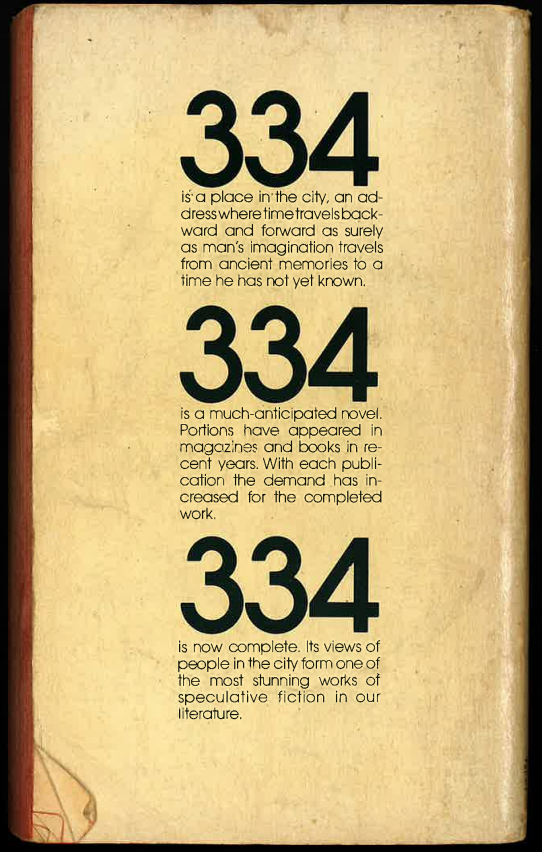
334, 1972, Thomas M. Disch. Avon Bard (1974). No cover designer or artist credited. 269 pages.
Disch’s dystopian novel 334 is comprised of five separate but related novellas. The stories are set in and around the year 2025. Here’s “The Teevee,” the first vignette of the last novella in the collection, 334:
“The Teevee (2021)”
Mrs. Hanson liked to watch television best when there was someone else in the room to watch with her, though Shrimp, if the program was something she was serious about—and you never knew from one day to the next what that might be—, would get so annoyed with her mother’s comments that Mrs. Hanson usually went off into the kitchen and let Shrimp have the teevee to herself, or else to her own bedroom if Boz hadn’t taken it over for his erotic activities. For Boz was engaged to the girl at the other end of the corridor and since the poor boy had nowhere in the apartment that was privately his own except one drawer of the dresser they’d found in Miss Shore’s room it seemed the least she could do to let him have the bedroom when she or Shrimp weren’t using it.
With Boz when he wasn’t taken up with l‘amour, and with Lottie when she wasn’t flying too high for the dots to make a picture, she liked to watch the soaps. As the World Turns. Terminal Clinic. The Experience of Life. She knew all the ins and outs of the various tragedies, but life in her own experience was much simpler: life was a pastime. Not a game, for that would have implied that some won and others lost, and she was seldom conscious of any sensations so vivid or threatening. It was like the afternoons of Monopoly with her brothers when she was a girl: long after her hotels, her houses, her deeds, and her cash were gone, they would let her keep moving her little lead battleship around the board collecting her $200, falling on Chance and Community Chest, going to Jail and shaking her way out. She never won but she couldn’t lose. She just went round and round. Life.
But better than watching with her own children she liked to watch along with Amparo and Mickey. With Mickey most of all, since Amparo was already beginning to feel superior to the programs Mrs. Hanson liked best—the early cartoons and the puppets at five-fifteen. She couldn’t have said why. It wasn’t just that she took a superior sort of pleasure in Mickey’s reactions, since Mickey’s reactions were seldom very visible. Already at age five he could be as interior as his mother. Hiding inside the bathtub for hours at a time, then doing a complete U-turn and pissing his pants with excitement. No, she honestly enjoyed the shows for what they were—the hungry predators and their lucky prey, the good-natured dynamite, the bouncing rocks, the falling trees, the shrieks and pratfalls, the lovely obviousness of everything. She wasn’t stupid but she did love to see someone tiptoeing along and then out of nowhere: Slam! Bank! something immense would come crashing down on the Monopoly board scattering the pieces beyond recovery. “Pow!” Mrs. Hanson would say and Mickey would shoot back, “Ding-Dong!” and collapse into giggles. For some reason “Ding-Dong!” was the funniest notion in the world.
To enter out into that silence that was the city at eight o’clock of a misty evening in November, to put your feet upon that buckling concrete walk, to step over grassy seams and make your way, hands in pockets, through the silences, that was what Mr Leonard Mead most dearly loved to do. He would stand upon the corner of an intersection and peer down long moonlit avenues of sidewalk in four directions, deciding which way to go, but it really made no difference; he was alone in this world of 2053 A.D., or as good as alone, and with a final decision made, a path selected, he would stride off, sending patterns of frosty air before him like the smoke of a cigar. Continue reading “Read “The Pedestrian,” a short story by Ray Bradbury”→
Cover art for Parable of the Sower by John Jude Palencar
Octavia Butler’s 1993 novel Parable of the Sower imagines what a radical affirmation of life might look like set against a backdrop of impending extinction. Set between 2024 and 2027, Parable of the Sower conjures a crumbling America. Hyperinflation abounds, infrastructure is falling apart, water is scarce, environmental collapse is imminent, and the social institutions that bind the nation have all but frayed.
When we first meet our narrator Lauren Olamina, she is one of the lucky few who has a life of moderate comfort, stability, and security. Lauren lives in a gated community in a sort of compound with her brothers, stepmother, and father, an academic/preacher. Lauren’s father is the ersatz leader of this community, He leads the neighborhood’s shooting practices, trains them in survival skills, and organizes a perimeter watch against the thieves and arsonists that constantly threaten their survival. He is the central role model for Lauren, who takes his lessons to heart. When the community finally fragments under an attack it can’t endure, Lauren is the only one of her family to survive. She even has the presence of mind to grab her bug-out bag.
After this initial staging of events, Parable of the Sower turns into a road novel. Lauren and two other survivors of the compound head north along the California freeways, slowly gathering followers. Lauren’s leadership drives the novel and inspires those around her. She offers her followers an alternative to the predation around them, a predation most strongly figured in the roving bands of arsonists that prey on travelers and communities alike. She offers her followers the prospect of belonging to a We—an interracial, inter-generational collective.
Lauren’s leadership capability derives from two strands. The first strand is the religion she is creating, an idea she calls “Earthseed.” The basic premise of Earthseed (one that the novel repeats ad nauseum) is that “God is Change.” Another tenet is that people are the seeds of the earth (like, uh, Earthseed—get it?). Lauren’s long-term vision is that humanity might seed a new planet. The post-WW2 dream of NASA and the futurity of exploration—a Manifest Destiny of the stars—glows in the background of Sower, and often points to a more interesting conclusion than the novel finally musters.
The second source of Lauren’s drive comes from a condition she suffers called hyperempathy or “sharing,” a mutation that’s the result of her birth-mother’s drug addiction during pregnancy. Simply put, when Lauren witnesses another person’s injury, she feels their pain. This affliction is a devastating weakness in a predatory, violent (non)society: for Lauren, self-defense entails self-harm. At the same time, Lauren’s hyperempathy is a strength—it makes her understand, at the most visceral level, the need for a community to work together in order to thrive in a world that seems to be dying.
Perhaps the greatest strength of Butler’s novel is that she shows her readers what Lauren can never quite see—namely that Lauren’s hyperempathy is a strength. Sower assumes the form of a journal, Lauren’s first-person recollections scrawled out in rare moments of respite from the terrors of the road. While her first-person perspective is generously broad (she seems to see a lot), she still never quite realizes that her hyperempathy contributes to her strength as a leader. Lauren’s hyperempathy necessitates imaginative forethought; it also entails a need to act decisively in times of crisis. And Parable of the Sower is all crisis, all the time.
Lauren’s journal style mixes the high with the low. She cribs the poetry of her Earthseed religion from the King James Version of the Bible, with often corny results. (I am pretty sure the corniness is unintentional). She’s also occasionally psychologically introspective, going through thought experiments to better understand those around her.
Despite its Earthseed flights into poetical musings and boldly-declared profundities, most of Lauren’s narrative is strangely mundane in its accounting of a slow apocalypse though. There are seemingly-endless lists of supplies to be bought or scavenged, survival chores to be checked off, and California roads to be traversed (sections of Parable of the Sower often reminded me more of the SNL recurring sketch “The Californians” than, say, Cormac McCarthy’s The Road). The bulk of Butler’s book hovers around disaster prepping, finding temporary shelter, and looting bodies, motifs that won’t seem strange to contemporary audiences reared on cable television and addicted to battle royale video games.
Lauren is 15 at the novel’s outset in 2024, yet she seems fully mature. If this was a coming-of-age novel, I missed it—Lauren, while far from perfect, is generally self-assured in her powers of decision making. At a quite literal level, she commands the narrative, propelling it forward without any of the wishy-washiness we might get from the narrator of, say, The Handmaid’s Tale. If Lauren second-guesses herself, she doesn’t bother to second-guess her second guesses. Butler seems to envision her rather as a hero-model for the coming disaster the novel anticipates. Much of Parable of the Sower reads like a checklist of What To Do After the End of Civilization.
The novel’s biggest weakness is that it can’t quite articulate just how bad things have gotten. Is this actually The End of Civilization? Butler paints a bleak picture. Drought is the new norm. Most Americans are illiterate. Work is hard to find. The roads are too dangerous to travel at night. Packs of feral dogs hunt down humans. Packs of feral children eat humans. Women live with the constant threat of rape. Overt racism is fully normalized. Company towns make a comeback, issuing scrip instead of currency, leading to indentured servitude. Water is a commodity to literally kill for, the police are essentially an organized gang, and a large portion of the population are addicted to a drug that makes setting fires better than sex. Murder is an open business, and there is no recourse to any established justice.
And at the same time that it evokes all of these apocalyptic images and themes, Butler’s novel points to tinges of normalcy—a presidential election carried out sans violence, the sense that a university system is still in play, various notations of different regulatory bodies. Parable of the Sower often reads like The Walking Dead or The Road, but then it might turn a weird corner to uncanny normalcy, where characters shop in a Walmart-like (if hyperbolized) superstore. As one character puts it,
Federal, state, and local governments still exist— in name at least— and sometimes they manage to do something more than collect taxes and send in the military. And the money is still good. That amazes me. However much more you need of it to buy anything these days, it is still accepted. That may be a hopeful sign— or perhaps it’s only more evidence of what I just said: We haven’t hit bottom yet.
Perhaps what I perceive here is simply Butler showing her narrator’s essential naivete, a naivete that doesn’t evince on the surface of the first-person narration. Lauren doesn’t know what she doesn’t know. She doesn’t fully understand how bad things have gotten because she doesn’t fully understand the potential in America that existed before her own life. But she does intuit how bad things are. Despite her intuition, she’s hopeful. This hope, and the despair that foregrounds it, evinces strongly in the final moments of the book. Lauren has finally made it to a kind of promised-land, a frontier-space where she can create a new life with a new love, a much-older man named Bankole. Bankole was a doctor in his old life, but now he’s a survivor. At the end of the novel, he mourns the American dream, the American we, and mourns that Lauren cannot mourn it with him:
He said nothing for a while. Then he stopped and put his hand on my shoulder to stop me. At first he only stood looking at me, almost studying my face. “You’re so young,” he said. “It seems almost criminal that you should be so young in these terrible times. I wish you could have known this country when it was still salvageable.”
“It might survive,” I said, “changed, but still itself.”
“No.” He drew me to his side and put one arm around me. “Human beings will survive of course. Some other countries will survive. Maybe they’ll absorb what’s left of us. Or maybe we’ll just break up into a lot of little states quarreling and fighting with each other over whatever crumbs are left. That’s almost happened now with states shutting themselves off from one another, treating state lines as national borders. As bright as you are, I don’t think you understand—I don’t think you can understand what we’ve lost. Perhaps that’s a blessing.”
Banokole’s summary of America in the late 2020s seems like a dire if hyperbolic prognostication of our current trajectory. More than a quarter century ago, Butler knew what was up. Butler also offered an answer to the problem in her mouthpiece Lauren, who replies to her (way-too-much older) lover Bankole, “We’ve got work to do.”
Parable of the Sower is not a particularly fun novel, although of course, it never intends to be. The dour tone is appropriate to its subject matter, I suppose, but that grim tone can become exhausting. The novel’s trajectory and moral vision keep it from falling into an exercise in nihilism or apocalypse porn, like, say, The Walking Dead. But like The Walking Dead, Butler’s novel often plods along. Maybe this is a rhetorical feature—maybe Butler intends her reader to feel just as weary and depressed as Lauren.
Parable of the Sower was published just a year after a superficially-similar novel, Neal Stephenson’s Snow Crash, which also presciently envisions a fragmenting America where like-groups seal themselves off from each other. In contrast though, Stephenson’s novel is zany and vibrant, a cartoon world devoid of any hyperempathy that might get in the way of anarchic fun. Over 25 years old now, many of the tropes in both Snow Crash and Parable of the Sower have so fully infiltrated our media—books and video games, films and television shows—that their initial vital strangeness is hard to detect.
The dystopian tropes of Parable of the Sower don’t feel particularly fresh in 2019, but the novel’s prescience still has an alarming bite. (Her sequel, Parable of the Talents, features a right-wing Presidential candidate who runs on the promise to “Make America great again”). Sower works best as an extended thought experiment on what might happen to society—to democracy in particular—when impending ecological collapse threatens our very existence. And Butler proposes a solution to the problems posed in her thought experiment: “We’ve got work to do.”
“We’ve got work to do” not only summarizes Parable of the Sower’s central message, it also describes current zeitgeist. Lauren would have been born in 2009; my daughter was born in 2007 and my son in 2010. She could be one of their classmates; she could be my own daughter. The novel’s vision of hyperempathy in the face of brutality and creeping fascism points back to that phrase — “We’ve got work to do” — which of course, requires a We. The we here is a radical affirmation, an echo even of the We the People that so boldly engendered a U.S. America. But Butler’s vision, conveyed through Lauren, is far more pluralistic and diverse than the We the framers evoked in the Preamble to the Constitution. Butler’s we names the namelessness of a coming society, a society that seems impossible and yet is possible, its possibility instantiated in the simple proof that it can be imagined. Parable of the Sower ultimately points toward the seeds of that imagining.
[Ed. note—Biblioklept first published this review in March of 2019.]
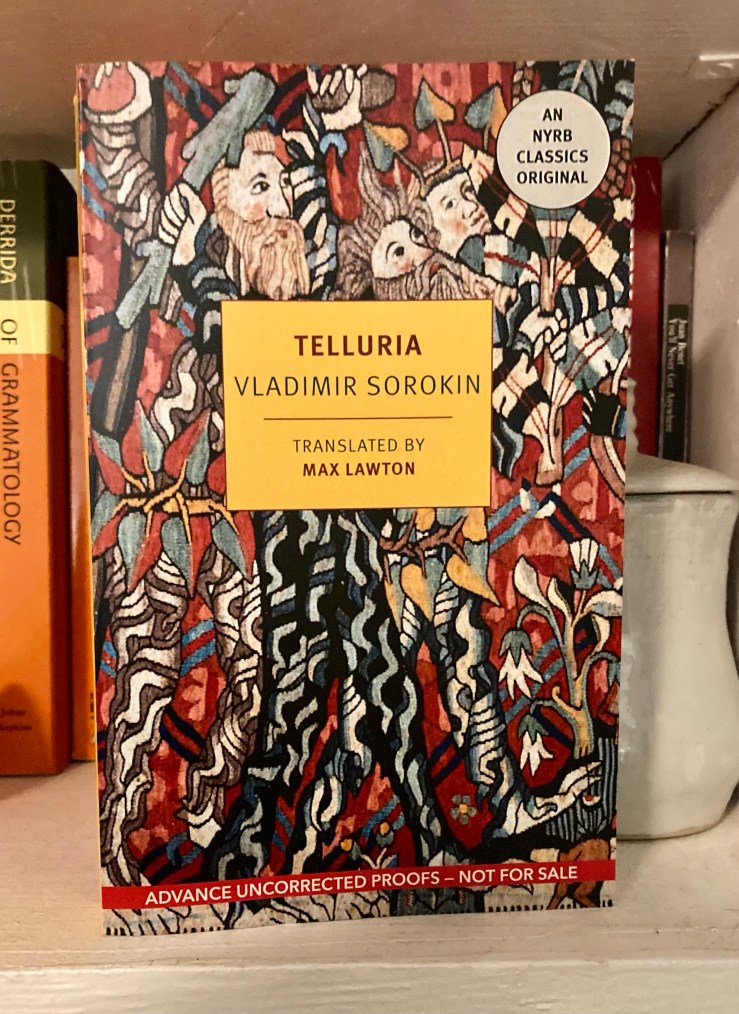
I read the first few bits of Vladmir Sorokin’s postapocalyptic novel Telluria today. The book is forthcoming from NYRB in translation by Max Lawton. The fantastic blurb captured my interest right away:
Telluria is set in the future, when a devastating holy war between Europe and Islam has succeeded in returning the world to the torpor and disorganization of the Middle Ages. Europe, China, and Russia have all broken up. The people of the world now live in an array of little nations that are like puzzle pieces, each cultivating its own ideology or identity, a neo-feudal world of fads and feuds, in which no one power dominates. What does, however, travel everywhere is the appetite for the special substance tellurium. A spike of tellurium, driven into the brain by an expert hand, offers a transforming experience of bliss; incorrectly administered, it means death.
The fifty chapters of Telluria map out this brave new world from fifty different angles, as Vladimir Sorokin, always a virtuoso of the word, introduces us to, among many other figures, partisans and princes, peasants and party leaders, a new Knights Templar, a harem of phalluses, and a dog-headed poet and philosopher who feasts on carrion from the battlefield. The book is an immense and sumptuous tapestry of the word, carnivalesque and cruel, and Max Lawton, Sorokin’s gifted translator, has captured it in an English that carries the charge of Cormac McCarthy and William Gibson.
Telluria is forthcoming this summer; NYRB plans to publish three more by Sorokin, including Blue Lard, “which included a sex scene between clones of Stalin and Khrushchev [and] led to public demonstrations against the book and to demands that Sorokin be prosecuted as a pornographer.”
Benedikt had arranged all the shelves in the storeroom a long time ago: you could see right away what was where. Father-in-law had Gogol right next to Chekhov–you could look for a hundred years and you’d never find it. Everything should have its own science, that is, its own system. So you don’t have to fuss around here and there to no good end, instead you can just go and find what you need.
Number eight wasn’t there. Well, maybe he made a mistake and put it in the wrong place … that happens … Here’s The Northern Herald, here’s The Herald of Europe, Russian Wealth, The Urals, Lights of the Urals, Beekeeping … no, not here … Banner, Literary Bashkortostan, New World … he’d read them, Turgenev, he’d read it, Yakub Kolas, read it, Mikhalkov, A Partisan’s Handbook, Petrarch, The Plague, The Plague of Domestic Animals: Fleas and Ticks, Popescu, Popka-the-Fool–Paint It Yourself, Popov, another Popov, Poptsov, The Iliad, Electric Current, he’d read it, Gone With the Wind, Russo-Japanese Poly-technical Dictionary, Sartakov, Sartre, Sholokhov: Humanistic Aspects, Sophocles, Sorting Consumer Refuse, Sovmorflot–60 Years, Stockard, Manufacture of Stockings and Socks, he’d read that one, that one and that one …
Chalk Farm, Chandrabkhangneshapkhandra Lal, vol. 18, Chaucer, John Cheever; The Black Prince, aha, a mistake, that didn’t go there, Chekhov, Chapchakhov, Chakhokhbili in Kar-sian, Chukh-Chukh: For Little People.
Chen-Chen: Tales of the Congo, Cherokee Customs, Chewing Gum Stories, Chingachguk the Giant Serpent, Chipmunks and Other Friendly Rodents, Chkalov, Chrysanthemums of Armenia Part V, Chukotka: A Demographic Review, Chukovsky, Chum– Dwelling of the Peoples of the Far North, Churchill: The Early Years, read it. Kafka, Kama River Steamboats, Kashas Derived from Whole Grain. Dial M for Murder, Murder in Mesopotamia, Murder on the Orient Express, Kirov’s Murder, Laudanum: The Poetic Experience, Lilliputians and Other Little People, Limonov, Lipchitz, Lipid-protein Tissue Metabolism … he’d read it all.
The Red and the Black, Baa Baa Black Sheep, The Blue and the Green, The Adventure of the Blue Carbuncle, The Blue Cup, Island of the Blue Dolphins, The Chocolate Prince, The Crimson Flower .. . that’s a good one … The Crimson Letter, Crimson Sails, Little Red Riding Hood, The Yellow Arrow, The Five Orange Pips, The White Steamboat, White Clothes, White Bim– Black Ear, T. H. White, The Woman in White, The Purple Island, The Black Tower, Black Sea Steamboats: Registry, this is where The Black Prince goes. Now …
The Vampire’s Embrace, The Dragon’s Embrace, The Foreigner’s Embrace, The Fatal Embrace, Passion’s Embrace, Fiery Embraces, The All-Consuming Flame of Passion … The Dagger’s Blow, The Poisoned Dagger, The Poisoned Hat, Poisoned Clothes, With Dagger and Poison, Poisonous Mushrooms of Central Russia, Golden-haired Poisoners, Arsenic and Old Lace, Death of a Salesman, Death Comes for the Archbishop, Death Comes at Midnight, Death Comes at Dawn, The Bloody Dawn. . .
Children of the Arbat, Vanya’s Children, Children of the Underground, Children of the Soviet Land, Kids in Cages, Children on Christ, The Boxcar Children, Nikita’s Childhood.
Marinina, Marinating and Pickling, Marine Artists, Marinetti –the Ideologist of Fascism, Mari-El Grammar: Uses of the Instrumental Case.
Klim Voroshilov, Klim Samgin, Ivan Klima, K. Li, Maximal Load in Concrete Construction: Calculations and Tables (dissertation).
Anais Nin, Nina Sadur, Nineveh: An Archeological Collection. Ninja in a Bloody Coat, Mutant Ninja Turtles Return, Papanin, Make Life from Whom?
Hamlet, Prince of Denmark, Tashkent–City of Bread, Bread –A Common Noun, Urengoi– The Land of Youth, Uruguay– An Ancient Land, Kustanai– The Steppe Country, Scabies–An Illness of Dirty Hands,.
Foot Hygiene on the Road, F. Leghold, Ardent Revolutionaries, The Barefoot Doctors, Flat Feet in Young Children, Claws: New Types, Shoe Polish Manufacture, Grow Up, Friend: What a Young Man Needs to Know about Wet Dreams, Hands Comrade!, Sewing Trousers, The Time of the Quadrupeds, Step Faster!, How the Millipede Made Porridge, Marinating Vegetables at Home, Faulkner, Fiji: Class Struggle, Fyodor’s Woe, Shakh-Reza-Pahlevi, Shakespeare, Shukshin.
Mumu, Nana, Shu-shu: Tales of Lenin, Gagarin: We Remember Yura, Tartar Women’s Costumes, Bubulina–A Popular Greek Heroine, Boborykin, Babaevsky, Chichibabin, Bibigon, Gogol, Dadaists Exhibition Catalogue, Kokoschka, Mimicry in Fish, Vivisection, Tiutiunnik, Chavchavadze, Lake Titicaca, Popocatepetl, Raising Chihuahuas, The Adventures of Tin Tin.
Afraid of guessing, Benedikt went through the treasures with shaking hands; he was no longer thinking about issue number eight. It’s not here, I’ll live. But book after book, journal after journal–he’d already seen this, read this, this, this, this, this … So what did this mean? Had he already read everything? Now what was he going to read? And tomorrow? A year from now?
His mouth went dry and his legs felt weak. He lifted the candle high; its bluish light parted the darkness and danced on the shelves along the books’ covers … maybe, up on the top …
Plato, Plotinus, Platonov, Plaiting and Knitting Jackets, Herman Plisetsky, Maya Plisetskaya, Plevna: A Guide, Playing with Death, Plaints and Songs of the Southern Slavs, Playboy. Plinths: A Guidebook, Planetary Thinking, Plan for Popular Development in the Fifth Five-year Plan. Plebeians of Ancient Rome. Plenary Sessions of the CPSU, The Horn of Plenty in Oil Painting, Pleurisy. Pliushka, Khriapa, and Their Merry Friends. Plying the Arctic Waters. The Pilgrims at Plymouth Rock. He’d read them all.
From The Slynx by Tatyana Tolstaya. English translation by Jamey Gambrell.
I’ve been wanting to read Tatyana Tolstoya’s post-apocalyptic novel The Slynx for a few years now. I finally broke down and ordered a copy through my local book store, and started it yesterday—fantastic stuff: gross, grimy, raw, inventive, perplexing, upsetting, and very very funny. Jamey Gambrell’s translation transmits the playful noisy distortions that must surely be in the original Russian. I’m about fifty pages in, and so far it reminds me of the Strugatski brothers’ stuff—pessimistic, wry, earthy, as well as Russell Hoban’s Riddley Walker, and Gely Korzhev’s mutant paintings.
Here’s NYRB’s blurb:
Two hundred years after civilization ended in an event known as the Blast, Benedikt isn’t one to complain. He’s got a job—transcribing old books and presenting them as the words of the great new leader, Fyodor Kuzmich, Glorybe—and though he doesn’t enjoy the privileged status of a Murza, at least he’s not a serf or a half-human four-legged Degenerator harnessed to a troika. He has a house, too, with enough mice to cook up a tasty meal, and he’s happily free of mutations: no extra fingers, no gills, no cockscombs sprouting from his eyelids. And he’s managed—at least so far—to steer clear of the ever-vigilant Saniturions, who track down anyone who manifests the slightest sign of Freethinking, and the legendary screeching Slynx that waits in the wilderness beyond.
Tatyana Tolstaya’s The Slynx reimagines dystopian fantasy as a wild, horripilating amusement park ride. Poised between Nabokov’s Pale Fire and Burgess’s A Clockwork Orange, The Slynx is a brilliantly inventive and shimmeringly ambiguous work of art: an account of a degraded world that is full of echoes of the sublime literature of Russia’s past; a grinning portrait of human inhumanity; a tribute to art in both its sovereignty and its helplessness; a vision of the past as the future in which the future is now.
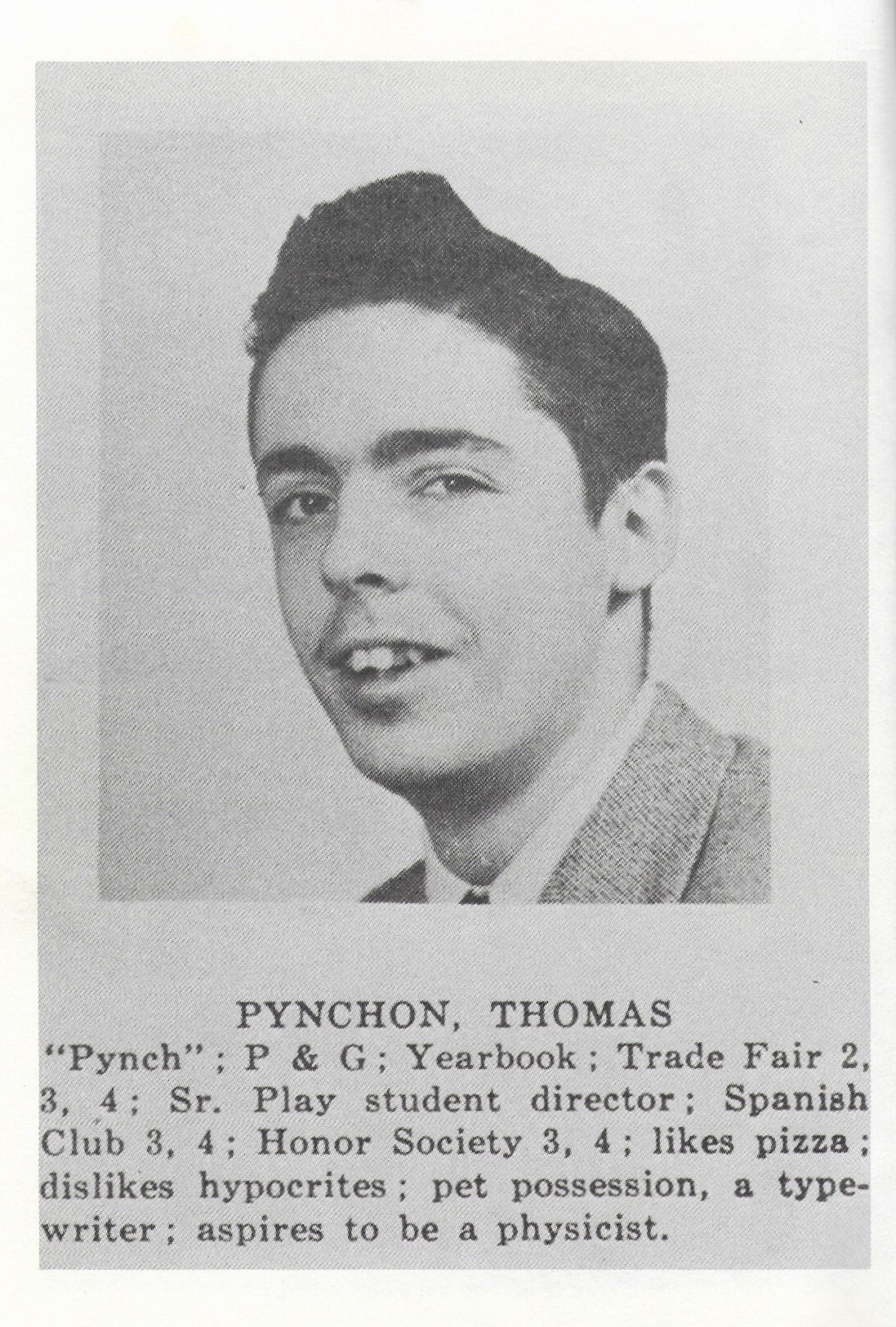
Thomas Pynchon beat out J.G. Ballard, earning 61% of 337 votes of my totally-scientific and not-at-all arbitrary twitter poll to become the Champion of the 2020 Tournament of Zeitgeisty Writers. Mr. Pynchon’s trophy is at Biblioklept World Headquarters here in Florida. After this whole quarantine business is over I’m sure he’ll arrange to pick it up.
2020 Tournament of Zeitgeisty Writers, FINAL MATCH
My gut feeling is that the people who follow me on twitter are skewed toward Pynchon more than Ballard. Either of the pair could have taken the prize and I’d have been happy.
J.G. Ballard described the late twentieth century as good as anyone, and anticipated almost every aspect of our zeitgeist. The dude not only understood the intersection of commerce and politics and sex and art, but he could convey it in wild (and wildly-entertaining, forgive the cliche) stories and novels of the blackest and bleakest humor. There are any number of great starting places for Ballard, but if you haven’t read him yet, I’d recommend High-Rise or Concrete Island before jumping into the more challenging Crash. Then: The Atrocity Exhibition, the earlier novels (1962’s The Drowned World is particularly prescient) and the early stories of Vermilion Sands. Actually, if you can get a hold of The Complete Short Stories of J.G. Ballard, go for it. (I riffed on reading all the stories back in 2014.) I don’t recommend starting with the later novels—Ballard’s descriptions are so prescient that there’s this weird drop off in quality when reality catches up to him. In the meantime, why not read “The Secret Autobiography of J G B”? (It was composed in 1981 but published in 2009; it took autofiction a few decades to catch up with the Notorious JGB.) Ballard is great.
Thomas Pynchon’s novels are famously byzantine, shaggy, esoteric, and paranoid. He captures both the zaniness and the menace of our zeitgeist. His protagonists are often straight figures who go crooked, insiders pushed to the outside through maladventure and adventure alike. Pynchon places a premium on the underdog who resists the Them—the technocracy, the war machine, the military-industrial-entertainment complex. His most famous (and probably best) novel Gravity’s Rainbow is an indictment of war and capitalism; although it’s set in WW2, it also addresses itself, ultimately, to that war’s hangover and the Nixonian evil contemporary with its publication. Pynchon’s loose California trilogy—The Crying of Lot 49, Vineland, and Inherent Vice—document, describe, and deconstruct the myth of the American cultural revolution of the 1960s. Pynchon’s “historical novels,” Mason & Dixon and Against the Day are probably my favorites. Both analyze American history as a series of strange mistakes, big blunders, and minor foibles. His longest (and strangely, most accessible) novel Against the Day is also his clearest attack on the nebulous Them who oppose freedom, progress, and, ultimately, love. The humor and intelligence of Pynchon’s writing often softens the core anger of his work, an anger directed at the invisible forces that cry out, to steal from the Dead Kennedys, “Give me convenience or give me death!” He is a national treasure and I hope he lives forever—which he will, through his works.
Finally: I hope that everyone who participated in this thing had (at least the tiniest of sliver of) fun. I don’t think pitting writers against each other has anything to do with literature. I missed college basketball in March, so this is what I did. It also helped me drift off into other places for a while. Ballard is gone but I would love to read his quarantine novel. And I’ll read anything else we get from Pynchon.
Got your e-mail, kid. Sorry for handwriting in reply. Not sure e-mailing is the best move, considering the topic, but, of course (you being nearly six foot now, your mother says?), that’s up to you, dear, although, you know: strange times.
The rest of the letter, mostly through hints and intimations, gives us a sketch of those “strange times”: namely, a future of our now in which Trump, after having won a second election, is succeeded by “the son” in a “total sham election.” These “strange times” are saturated in paranoia and marked by arrests for dissension, as well as the detainment of persons for reasons not always clearly stated.
Indeed, Robbie’s email to his grandfather was in request of help for his friend “J.,” who has been detained. The following paragraph shows Saunders’ method and gives an adequate overview of the story’s tone:
Where is J. now? Do you know? State facility or fed? That may matter. I expect “they” (loyalists) would (with the power of the courts now behind them) say that although J. is a citizen, she forfeited certain rights and privileges by declining to offer the requested info on G. & M. You may recall R. & K., friends of ours, who gave you, for your fifth (sixth?) birthday, that bronze Lincoln bank? They are loyalists, still in touch, and that is the sort of logic they follow. A guy over in Bremerton befriended a guy at the gym and they would go on runs together and so forth, and the first guy, after declining to comment on what he knew of his friend’s voting past, suddenly found he could no longer register his work vehicle (he was a florist, so this proved problematic). R. & K.’s take on this: a person is “no patriot” if he refuses to answer a “simple question” from his “own homeland government.”
There’s a lot here: the codified language (“‘they,'” “loyalists,” “certain rights and privileges,” “‘no patriot,'” etc.), the use of anonymizing initials in lieu of names, and plenty of imagistic details to flesh out the epistle (“Love Letter” is full of little details like “that bronze Lincoln bank,” a bid toward realism I suspect).
The grandfather’s use of initials is, of course, to help protect them if the letter were to fall into the hands of any “loyalists” who might cause further problems for J. and the other persons mentioned. He also insists that Robbie destroy the letter after reading it. (I find it interesting and somewhat inexplicable that he names Robbie.)
As I noted above, the impetus for the grandfather’s reply is his grandson’s request for help for J. “Love Letter” reads like a thought experiment in dystopian ethics, with the central questions of What to do? and How to do it? reverberating throughout. Through the accretion of details, the reader comes to realize that the grandfather was likely born sometime during the 1950s, is comfortably middle class, subscribes to left-leaning politics, and likely lives in California. We also come to find out that during the period when the “loyalists” ascended—our near now—the grandfather, preoccupied with his own life (work, hobbies, his “dental issues”), did next-to-nothing to protect democracy:
Seen in retrospect, yes: I have regrets. There was a certain critical period. I see that now.
He protests to his grandson that he tried things like calling and writing his senator, and donated money to “certain people running for office,” but these actions weren’t actiony enough. He also shares this bit of protest:
I beg you not to underestimate the power/danger of this moment. Perhaps I haven’t told you this yet: in the early days, I wrote two letters to the editor of the local rag, one overwrought, the other comic. Neither had any effect. Those who agreed with me agreed with me; those who did not remained unpersuaded.
In a typically-postmodern move, Saunders’ hero is a writer (of letters).
“Little St. Don” exemplifies just how limited contemporary literature’s toolkit is when it comes to acutely skewering our zeitgeist. Trump’s rhetoric purposefully surpasses absurdity; indeed, Trump’s rhetoric is nihilistically absurd, the ur-huckster’s argot that distills over two centuries of American con-artist culture for a 21st-century mass media environment. Ahistorical and amoral, Trump’s rhetoric oozes outside the bounds of allegorical satire. His rhetoric is already kitsch, part and parcel of a self-ironizing aesthetic that is always only-joking-but-hey-not-really-joking. This rhetorical aesthetic is post-postmodern, and Saunders’ postmodern techniques in “Little St. Don” cannot lance it, deflate it, or expose it—Trump’s rhetoric is already exposed. Saunders here is simply describing it, repeating it, and reframing it within preëxisting literary genres.
Mashing up these genres is a typical 20th-century postmodernist move, one that Saunders’ audience in The New Yorker could expect. Indeed, it seems that connecting with an audience is Saunders’ main concern. But he’s preaching to the choir. The story is like a mediocre cover band’s copy of a terrible greatest hits record. In his mash-up we already know all the tunes, all the rhythms, and all the tones. Hell, we even know the mash-up’s not-so-secret formula. Saunders simply confirms the emotional and intellectual gestures that preëxist in his New Yorker audience. His story is there to assure us of our own moral rectitude.
I was taken then by the grandfather’s admission that his “comic” letter to “the local rag” had no effect: “Those who agreed with me agreed with me; those who did not remained unpersuaded.”
A moment later in “Love Letter” strikes me as another correction to the glib posturing of “Little St. Don”:
Every night, as we sat across from each other, doing those puzzles, from the TV in the next room blared this litany of things that had never before happened, that we could never have imagined happening, that were now happening, and the only response from the TV pundits was a wry, satirical smugness that assumed, as we assumed, that those things could and would soon be undone and that all would return to normal—that some adult or adults would arrive, as they had always arrived in the past, to set things right. It did not seem (and please destroy this letter after you have read it) that someone so clownish could disrupt something so noble and time-tested and seemingly strong, that had been with us literally every day of our lives.
It’s that “wry, satirical smugness” that stuck out to me, a smugness that’s part and parcel of the sense that “some adult or adults would arrive…to set things right.” Saunders is not only describing an attitude shared by millions of Americans, but also describing the implicit tone of his story “Little St. Don.”
Both “Elliott Spencer,” with its rhetorical innovations, and “Love Letter” serve as noticeable improvements on “Little St. Don” (if not correctives). “Love Letter” also feels like something new from Saunders—the dystopia is more subdued, less zany. Scarier. And as I write this, I realize it’s because the dystopia “Love Letter” evokes seems far too close to our own reality.
I claimed in my essay on “Little St. Don” that the story’s biggest failure was that
Saunders loves his reader too much. The story wants to make us feel comfortable now, comfortable, at minimum, in our own moral agency and our own moral righteousness. But comfort now will not do.
“Love Letter,” as the name clearly states, radiates with love—confused love, troubled love, love that wavers in concrete action but never in its abstracted purity. We feel both the grandfather’s love for his grandson as well as Saunders’ love for his reader. We also feel a deep, melancholy love for democracy, or at least the postwar democracy of the latter half of the twentieth century.
Saunders’ narrator is never critical of that twentieth-century democracy, let alone the predatory capitalism it eventually engendered. This is, after all, a letter to a grandson, not a polemic. Saunders, as he often does in so many of his stories, collapses the absurdity of the contemporary world into the personal problems of some hapless patriarch or other. The narrator’s compassion and love come through in “Love Letter,” but so does the narrator’s radical ambivalence to real action.
It might be possible to read the story as a critique of the narrator’s inaction, but any such reading would have to ultimately dismiss the sympathy and love with which Saunders’ crafts this grandfather. In short, it’s difficult to read “Love Letter” as a satire, the genre with which Saunders has been most closely identified. Instead, “Love Letter” reads like a thought experiment with no real conclusion, no solid answer. Or, rather, the solution is there in the title: love. But is that enough?
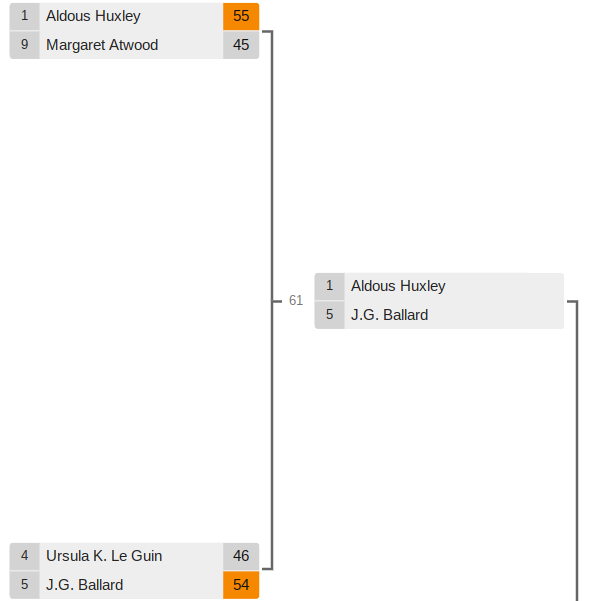
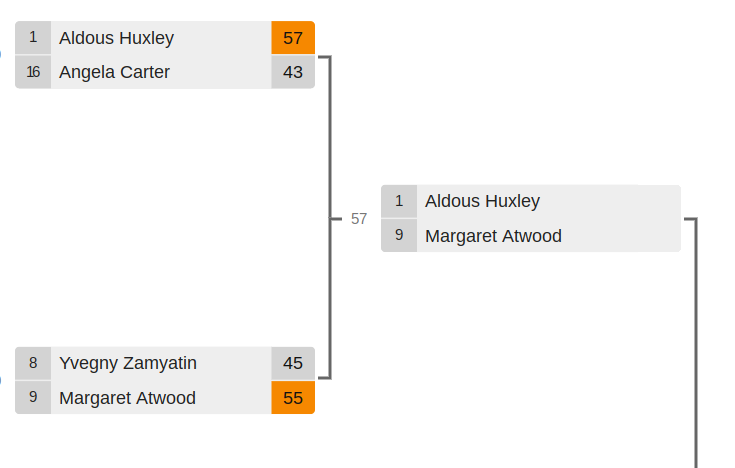
Margaret Atwood kept it close with Aldous Huxley, but lost in the end. I was rooting for her. I’m a huge fan of Huxley’s under-read apocalyptic pre-postmodernist Ape and Essence, but I have to admit I was rooting for Atwood.
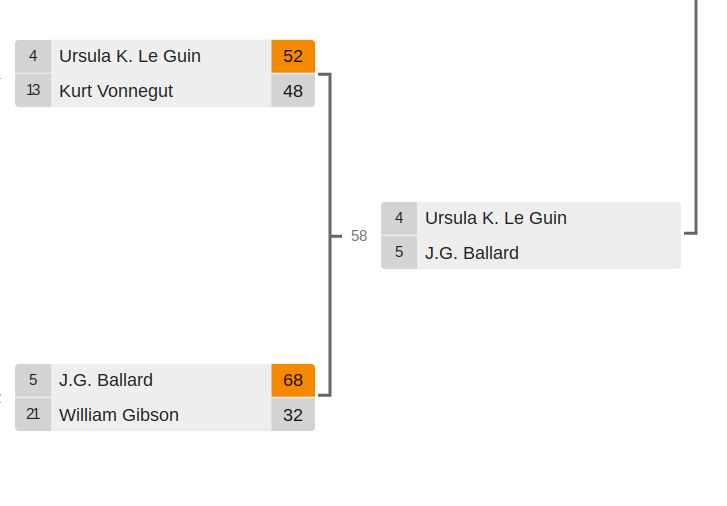
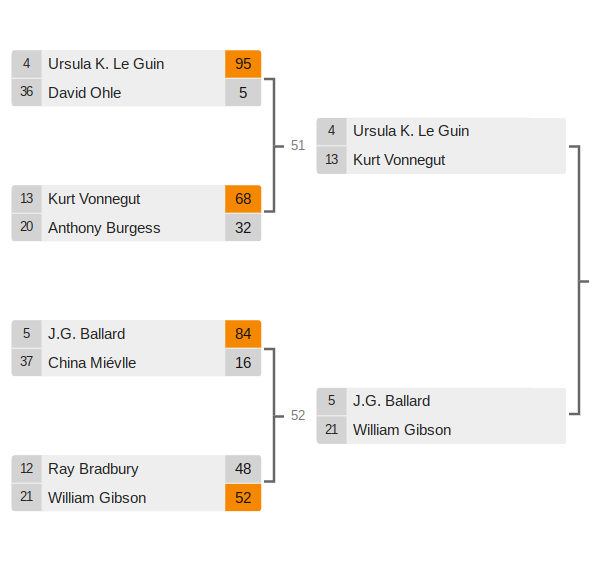
I was torn between Ballard and LeGuin in the second bracket—both authors described and diagnosed our zeitgeist. Ballard prevailed.
2020 Tournament of Zeitgeisty Writers, Round 4, Bracket 2
Ballard will square off against Huxley in the Dead British Writers bracket of the Final Four.
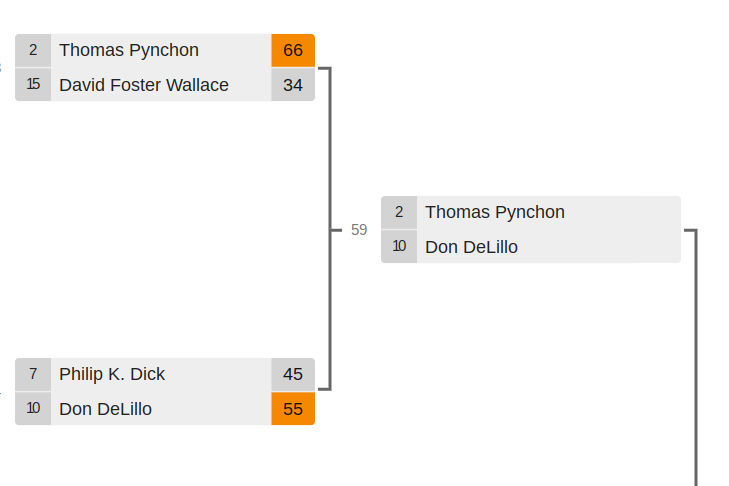
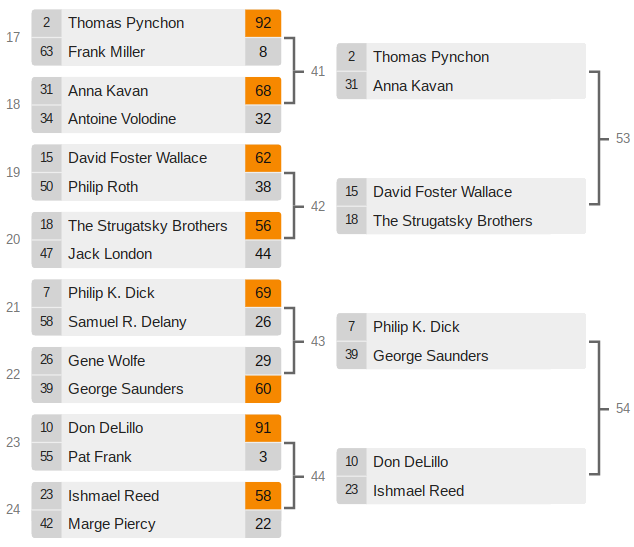
Pynchon and DeLillo both had tough roads to the Final Four. Pynchon beat out Anna Kavan and David Foster Wallace to get to the Elite Eight; DeLillo bested Pat Frank and Philip K. Dick. All of these writers are great, and, more importantly to our rubric, seemed to presciently capture the current dystopia the 20th century was brewing. (Okay, Frank isn’t great, but.)
Pynchon beat DeLillo easily though.
2020 Tournament of Zeitgeisty Writers, Round 4, Bracket 3
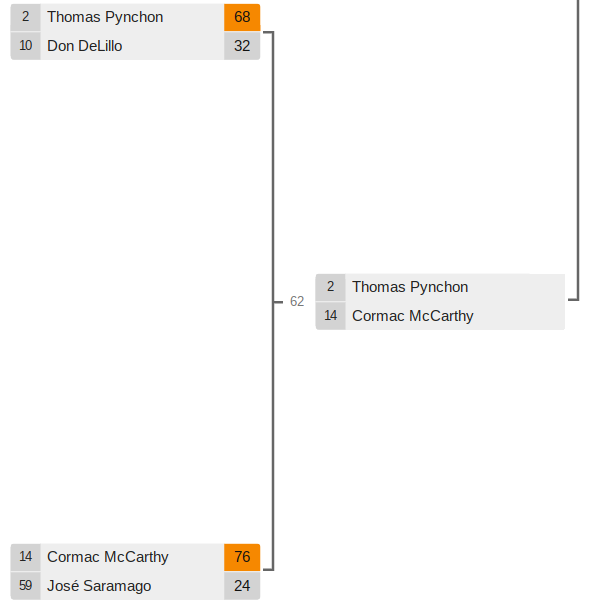
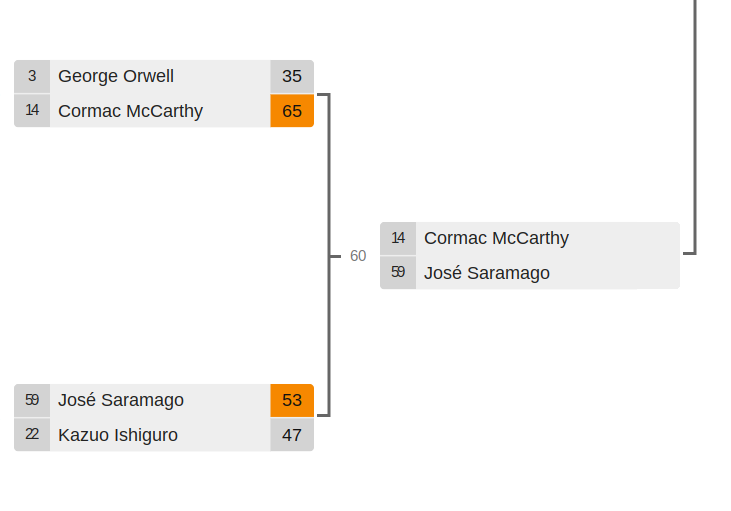
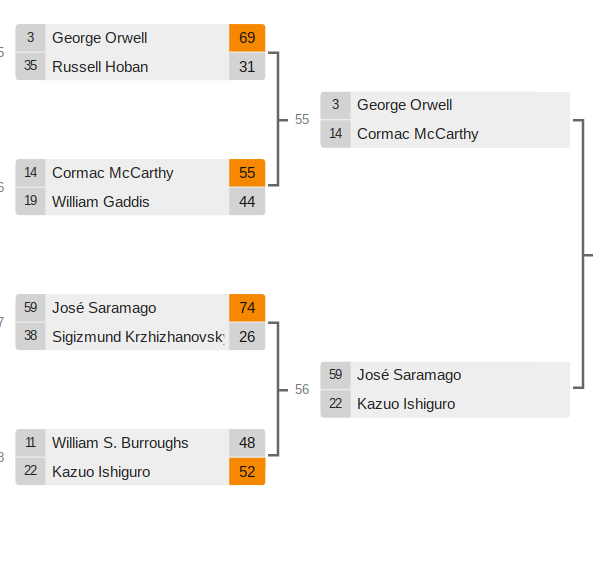
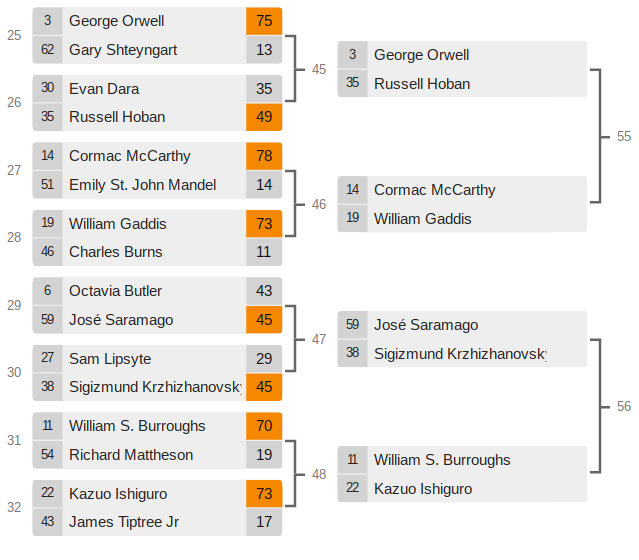
Like Pynchon, Cormac McCarthy pretty much thumped everyone he was matched against, including low seed José Saramago in the Elite Eight. While I’m sure a ton of folks will cite The Road as his zeitgeistiest novel, I’d argue it’s Blood Meridian (or even No Country for Old Men).
2020 Tournament of Zeitgeisty Writers, Round 4, Bracket 4
Pynchon will contend with McCarthy in the White American Authors in Their Eighties bracket of the Final Four. I’m not sure how to vote. In some ways, this is like, the final bracket for me.
The results of the Apocalyptic Sweet Sixteen of the 2020 Tournament of Zeitgeisty Writers are in.
Round Three had some really tight match-ups. Dark horse José Saramago, whom I seeded 59 of the initial 64 writers, was neck-and-neck with recent Nobel Prize winner Kazuo Ishiguro, but surged near the end of the poll to win.
2020 Tournament of Zeitgeisty Writers, Round 3, Bracket 8
Philip K. Dick was competitive against Don DeLillo, but never got out ahead. My gut feeling is that PKD might’ve advanced if he’d ended up against someone else, but I guess the same is true of most of these brackets.
After initially trailing for a few hours in the poll, Aldous Huxley surged past Angela Carter, who never caught up again.
Yvegny Zamyatin kept it close with Margaret Atwood, but never took the lead on her.
Three of the match-ups were decisive victories. J.G. Ballard beat William Gibson by a healthy margin, Tommy Pynchon bested DFW, and Cormac McCarthy came out strong over George Orwell.
Here are the results of the Apocalyptic Sweet Sixteen, as well as the match-ups for Round Four, the Elite Armageddon Eight:
For me, the most interesting match-up is going to be Pyncon vs. DeLillo.
As always, this is only meant to be dumb distracting fun.
Full twitter poll results:
2020 Tournament of Zeitgeisty Writers, Round 3, Bracket 1
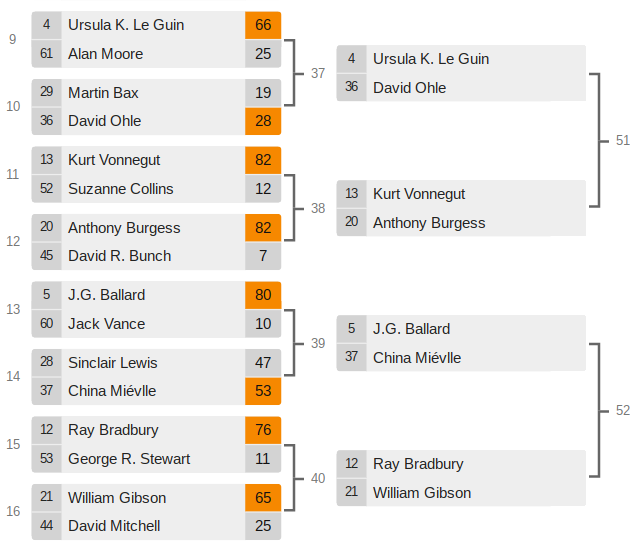
Hey! Today in Distracting Dumb Ephemeral Fun, we hit the Apocalyptic Sweet Sixteen of the 2020 Tournament of Zeitgeisty Writers. Round Two saw some fascinating match-ups between thirty-two writers. Perhaps the most interesting was the Cormac McCarthy-William Gaddis showdown:
2020 Tournament of Zeitgeisty Writers, Round 2, Bracket 14
This bracket garnered more votes than any match-up to date in the tournament, and split more than a few folks (including me—I’ll declare how I voted after this whole thing shakes out).
Other matches were also very close: Ray Bradbury—William Gibson, and William S. Burroughs—Kazuo Ishiguro.
Ishiguro is perhaps a bit of a dark horse at this point, as is José Saramago, whom I seeded at 59 of 64. Saramago handily beat out the under-read Sigizmund Krzhizhanovsky to face off with Ishiguro in the Terrible Awful Sweet Sixteen of Apocalyptica.
I find all of the match-ups interesting at this point, but David Foster Wallace vs. Thomas Pynchon has a wonderfully oedipal vibe.
And again, this is all just meant to be stupid distracting fun.
Brackets below, followed by tweet results:
Tweet polls:
2020 Tournament of Zeitgeisty Writers, Round 2, Bracket 1
On Sunday, I came up with a list of 64 writers that have written novels or stories that either anticipate, reflect, or otherwise describe our zeitgeist. The first dozen or so seeds (as well as the bottom dozen or so) came rather intuitively to me, but the writers in the middle were seeded somewhat randomly. I used Twitter’s poll feature to determine the winners of Round One. In most of my polls, I included a third option, where voters could choose just to see the poll results instead of actually voting; I won’t be doing that going forward, because the data looks, if not exactly skewed, well, just a little off-putting, as in Round 1, Bracket 8 below:
2020 Tournament of Zeitgeisty Writers, Round 1, Bracket 8
My intuition is that Disch (Camp Concentration) and Walter Miller (A Canticle for Leibowitz) were either too obscure for many folks, or at least not writers very many people are passionate about.
Sinclair Lewis (It Can’t Happen Here) tied with China Miéville (Marxism, steampunk, Perdido Street Station, bold baldness) and went to a tie (I managed to misspell China Miéville’s name in both tweets)—
2020 Tournament of Zeitgeisty Writers, Round 1, Bracket 14
I was also surprised by top-ten seed Octavia Butler (Kindred, Parable of the Sower) losing to José Saramago (Blindness). I suppose I seeded Saramago too low.
2020 Tournament of Zeitgeisty Writers, Round 1, Bracket 29











 Biblioklept