Book Acquired, 1.18.2011 (Matt Mullins/Chainsaw Short Fiction Edition)

20120120-163945.jpg

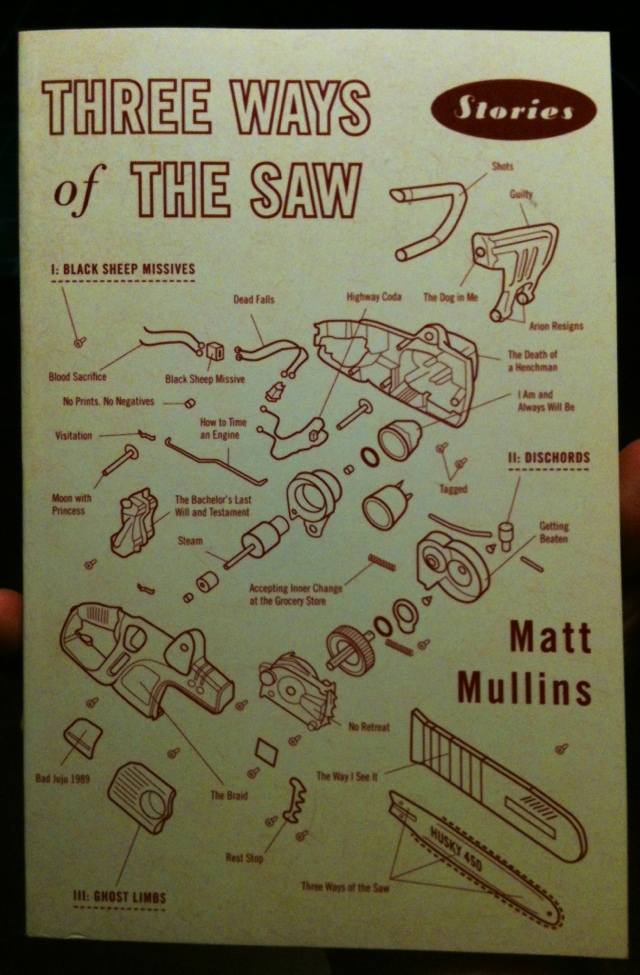
Matt Mullins’s Three Ways of the Saw (new in February from Atticus): Spent a few afternoons sifting through this volume, intrigued by its outstanding cover (I use the word “outstanding” literally; over a dozen titles came into Bblklpt Wrld Hdqrtrs this fine week). Mullins’s volume, stocked with short and short-short (and micro-) stories, bristles with boozy energy, grit, ugly druggy nervy episodes, shenanigans, dirty hi-jinks, breaking families, bad sons, bad people, broken people, desperate people . . . There’s a strong Bukoswkiish vibe to the business, with less ego, more concrete imagery, more Denis Johnson. I like this book.

I Review The Avian Gospels, Adam Novy’s Dystopian Novel About Family, Torture, Rebellion, and Birds

20111127-205427.jpg

Adam Novy’s novel The Avian Gospels synthesizes dystopian themes with magical realism to tell the story of an unnamed city, in an unnamed time, afflicted by plagues of birds and bands of Gypsies. The novel is marvelous, surreal and very strange, disorienting in its tones and unnerving in its subjects; it’s at once a confounding allegory of torture, suppression, and rebellion, and at the same time a study in intrafamily relationships.

There are two families at the heart of The Avian Gospels. The aristocratic Giggs are led by the Judge, a ruthless patriarch who is both inheritor and perpetrator of endless war. Judge Giggs controls the city through fear, torture, and his fascist personal guard, the RedBlacks. While Judge Giggs seems to hold illimitable power in the city, it isn’t enough to retain the love or even respect of his family. His wife veers into a manic depressive breakdown, brought on in large part by the death of her elder son, who was killed during the last (foolish) war. His second son, Mike, is a loutish ne’er-do-well, a bully who fails to win his father’s approval. The Judge’s daughter Katherine is the apple of his eye, but as she matures in her adolescence, she begins to perceive the violent disconnect between her privileged life and the suppression and poverty forced on the city’s Gypsy population.

The other family (perhaps more of a duo, really) comprises Zvominir, an immigrant claiming to hail from Sweden, and his son Morgan, a petulant teen of an age with Katherine. Routinely beaten bloody by Mike Giggs and his RedBlack goons, Morgan develops a visceral hatred of the Judge’s regime, one that leads the lad to repeatedly (and rashly) lash out against the violent injustice he perceives around him. Zvominir and Morgan live in sad, motherless squalor, separated not only from the suburban greenzoned upper-class, but also from the Gypsies; Zvominir, who leads most of his life genuflecting to or cowering from power, will not even allow his son the joy of partaking in the Gypsies vibrant customs (like rowdy ska music and barbecues).

Most of all, Zvominir tries to contain his son’s bizarre power, a power that he shares with the boy: they can telepathically control the birds. This gift becomes both blessing and curse as the city is overrun by flocks of birds that block out the sun and make roads unnavigable. Zvominir, always kowtowing to power, agrees to employ his gift to “sweep” the city (particularly the area where the rich folks live) of the bird hordes; Morgan agrees to help, but only under the condition that he be allowed to show off his talent in the public square, where eager crowds (of Gypsies and suburbanites alike) gather to marvel at the spectacle of his “birdshows.” In time, Morgan begins writing dissent into his performances:

Birdshows were generally narrative, and featured a bird-made Morgan being chased through the streets by a soldier who was torn to bits by swans, though the swans were made of pigeons, and the soldier of flesh-colored plovers, his uniform of cardinals and crows. Swans would also be pursued through ghetto canyons by flying tigers made of orioles. These were his intentions for the birdshows, at any rate, but Zvominir would censor when the images betrayed but a hint of dangerous content, obscuring Morgan’s work with birdclouds, or worse, laughing babies made of birds. The audience found these touches psychedelic, and weren’t pacified so much as confused, so their passion turned to mumbles. The elder’s power over birds was superior, and Morgan couldn’t stop his father from suppressing the transgressive. It infuriated him.

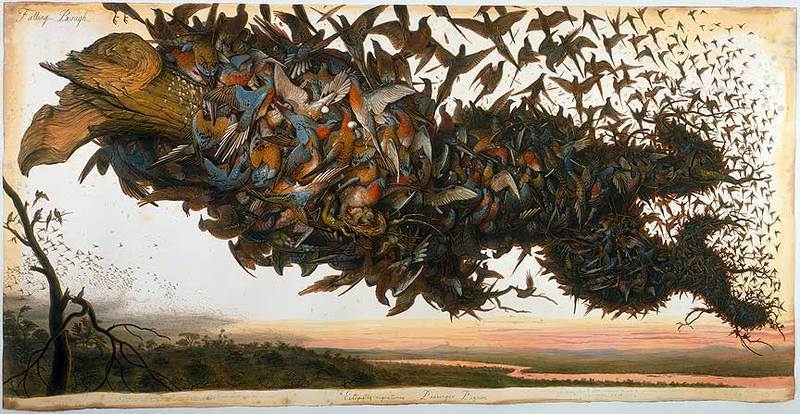
Falling Bough -- Walton Ford

Zvominir isn’t the only authority figure prone to parental censorship; as the poor old man tries to keep his son safe by “suppressing the transgressive,” the Judge in turn does all in his power to keep his precious daughter Katherine blind and ignorant to the violence and inequality that has purchased her material comfort. However, Katherine meets and becomes fascinated by Morgan, just as the young man’s rebellious attitude comes to find definition and ideology thanks to the Gypsy rebel Jane. Jane harnesses Morgan’s raw anger, turning him into the figurehead of a Gypsy resistance against the Judge’s terrible regime. She literally ushers him into the Gypsy underworld, a surreal setting of nightplants and black markets and ecstatic ska music and donkeys, sprawling in a labyrinthine network of caves and caverns and tunnels under the unnamed city. From this subterranean site, Jane becomes mastermind of a terrorist plot to overthrow the fascist Judge:

They—we—were helpless, and we knew it. She would do to us what Hungary had done, but with stealth; this terror stuff is easy, she mused. Who needs armies? She was poor, and lived in sewers, so nothing could be taken but her life, while we had homes, jobs, children, hopes, dreams and possessions we adored, which all gave meaning to our lives. There was no end to that of which she could deprive us. Our privilege made us vulnerable.

Now seems as reasonable a time as any to remark upon the narrator of The Avian Gospels, as its pronouns color much of the passage I just cited. A first-person plural “we” tells the story, a “we” whose contours and guts alike become more evident as the book unfolds. Much of the joy (and bewilderment and occasional frustration) I felt reading The Avian Gospels came from puzzling out just who this “we” is. As the book progresses, it becomes clear that, like the collective first plural person who narrates, say, William Faulkner’s “A Rose for Emily,” the narrator is part and parcel of the storyis the story, perhaps—and that Novy’s dystopian vision is realized not just in the book’s content, but also in the telling of that content. Calling the narrator unreliable is beside the point; the narrator is the ideology itself that Novy critiques. Rebel Jane provides a very real ideological anesthesia to the narrator’s methods, the Judge’s power, and Morgan’s artistic ambitions:

. . . Jane felt suspicious of beauty, which trafficked in desire, not in justice, and left you lonelier and sadder. It made you feel worse in the guise of feeling better, and left you hungry for more beauty. Further. It enfeebled you politically, by pointing at some hypothetical catharsis, a transcendence that could not be achieved, for who could really say they had communed with a non-religious paradise of aesthetics? The beauty effect: a crescendo of nothing. Beauty distracted from things that were important—the rights of disadvantaged people—in the name of something it claimed was more important, and which didn’t actually exist. It was a cognitive conspiracy, a con that disempowered.

If Jane seems a bit shrewish—and what zealot isn’t?—it’s worth pointing out that her ideas might be the novel’s thesis, a thesis ironically couched in the very beauty that Jane would make us wary of. She’s the cold conscience in a book filled with passions. And she’s a terrorist.

While The Avian Gospels surpasses any allegorical schema we might try to impose upon it, it’s still very much a response to America’s post-9/11 zeitgeist. Novy’s Judge is a figure of malevolence glossed in benevolence. If he’s a sicko who takes dull delight in torturing Gypsies in his Boom Boom Room, he’s also a family man with problems that most of us can relate to. He’s an authoritarian who maintains order in a fractured society through violence and suppression—but he delivers what the suburban greenzoners want from a leader. So what if security comes at the expense of justice, and on the backs of a displaced population to boot?

The Gypsies, refugees from countless wars afflicting the world of The Avian Gospels, aren’t the only displaced persons in the narrative. Novy displaces the readers as well. The Avian Gospels erupts with uncanny moments where the material of our recognizable world overlaps with the crumbled reality of the narrative. Social structures, attitudes, cultural norms and ideals—these remain, more or less. But how to puzzle out a world where China, Bolivia, Angloa, and Oklahoma are among the nations that surround the unnamed city? Or where technology has regressed to the point that the automobile is a thing of the past? (Guns remain). And, uh, the birds, of course.

Novy’s dystopian novel skews more fantasy (or, more properly, magical realism) than sci-fi, but it’s the novel’s strange, shifting tones that most likely will paradoxically estrange and engage most readers. There’s a violent zaniness to The Avian Gospels, but the zaniness is never tinted with even a hint of whimsy. The first-person plural “we” that narrates the text juxtaposes dense, poetic images against the teenspeak of the street. At times, the narrator staggers into a mordant lament, only to retreat into cruel, blackly ironic prose. The effect is disorienting and compelling. Novy’s writing moves rhythmically with a complex energy that I’m faltering to describe. You should probably just read the book.

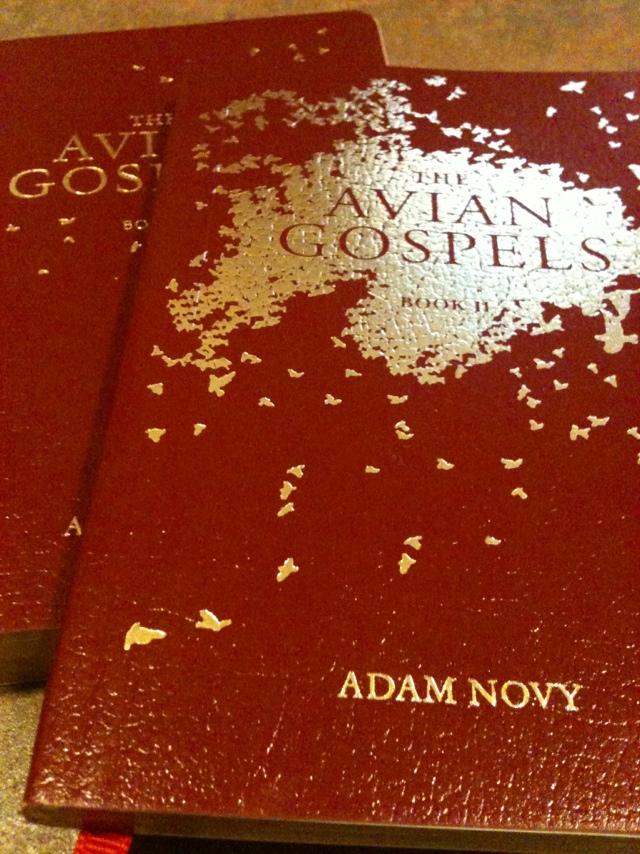
I’ve neglected thus far to comment on the actual physical books that comprise The Avian Gospels. They are beautiful, compact, oxblood volumes with gilded edges and bookmarks, reminiscent of Gideon bibles, I suppose, but more lovely. They’re also very small, the sort of thing that fits easily into a pocket or a purse. I love books like that.

The Avian Gospels deserves a place on the shelf (or in the pocket) of any fan of cult or dystopian novels. It’s a story about cyclical violence, power and powerlessness, and political and cultural repression. It’s also a story about family and parent-child relationships and what it means to love another person in the face of radical danger, a novel that foregrounds the very real stakes of rebellion, both Oedipal and political. It’s a strange book, one that offers little comfort to its readers and certainly proffers no simple answers. Deeply moving and highly original, I strongly recommend this book.

The Avian Gospels is available now from Hobart. Read my interview with Adam Novy.

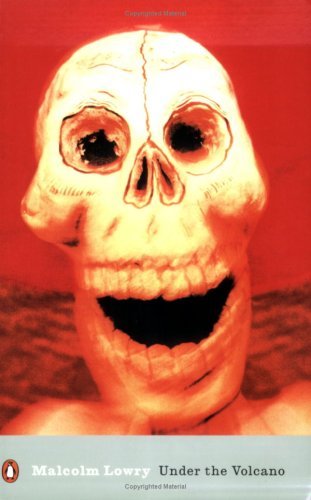
Under the Volcano — Malcolm Lowry

Most of Malcolm Lowry’s dense, depressing novel Under the Volcano takes place over the course of November 2nd, 1938, the Mexican Day of the Dead. Like a reticent, dour Virgil, Lowry guides the reader through the day’s tragic arc, floating between the minds of his novel’s three protagonists: Geoffrey Firmin, his half-brother Hugh, and Geoffrey’s estranged wife Yvonne. Geoffrey is British Consul to Mexico — ex-Consul, really, as British-Mexican relations sour against the backdrop of Spanish fascism and the rise of nationalism in Mexico — but he is almost always referred to as “the Consul,” a blackly ironic title. See, the Consul bears little authority aside from an extreme expertise on how to stay drunk (or “drunkly sober un-drunk”) 24/7. He’s ambassador to bar stools, a manager of mescal and little else (certainly not his own life; certainly not diplomatic affairs). The Consul is a wreck, an alcoholic to put Hemingway and Fitzgerald’s (and even Bukowski’s) alter-egos to shame.

After a first chapter that seems to derail all but the most patient readers, the narrative conflict arrives when Yvonne returns to Quauhnahuac, Mexico, a year after leaving (and divorcing) the Consul. She arrives to find the Consul (“Geoffrey,” as he’s called when the free indirect style inhabits her mind) drinking whiskey in a hotel bar in order to sober up (yep). It’s not immediately clear why Yvonne has returned to the Consul, but it seems that she hopes to save him from drowning in a drunken downward spiral. As the pair walks to the Consul’s house, they pass numerous advertisements for a boxing match; a child’s funeral proceeds down the avenue. These motifs of fighting, death, and futility permeate the novel.

During the walk we learn that Yvonne is not the only one concerned about the Consul’s health; his (much) younger brother Hugh has come to stay with him in the hopes of sobering him up. (Hugh employs a revolting and unsuccessful “strychnine cure”). That Hugh has also returned doubly complicates the plot. Much of Under the Volcano remains implicit, unnamed, hinted at, and this seems especially true of the implication that Yvonne cheated on the Consul with Hugh in the recent past (this implication may have been stated conclusively at some point in the novel, but I’ve only read the book once, which is perhaps like not having read it at all). What’s certainly clear is that Yvonne cheated on the Consul with a French filmmaker, Jacques Laruelle, a man whom the Consul, through sheer bizarre coincidence (but of course it isn’t sheer bizarre coincidence), spent a childhood summer with, an experience which bonded them as brothers in an Edenic holiday that eventually (inevitably) soured.

Despite her infidelities, Yvonne is generally present (I choose the verb “present” over “presented as” to highlight Lowry’s impeccable Modernist style) as a sympathetic character. Still, it is hard not to identify with the Consul (with “Geoffrey,” I suppose, if we are going to be familiar), the dark soul of this novel, and his complicated, painful feelings for Yvonne form the core of Volcano’s tragedy. He longs for her, pines for a complete life with her, yet resents her, cannot forgive her, hates her. For what? For leaving him. For betraying him. But perhaps foremost, he despises her inability to understand his alcoholism (he is particularly upset when she refuses to share a morning libation with him when they meet for the first time in a year). I’ll quote a passage at length now, one that showcases Lowry’s free indirect style, and one that reveals the strange indignities of the Consul’s sense of his own alcoholism. For context, dear reader, you must only know that Yvonne has suggested that she and the Consul might make long-term plans when he is sober “in a day or two”—

The Consul sat perfectly still staring at the floor while the enormity of the insult passed into his soul. As if, as if, he were not sober now! Yet there was some elusive subtlety in the impeachment that still escaped him. For he was not sober. No, he was not, not at this very moment he wasn’t! But what had that to do with a minute before, or half an hour ago? And what right had Yvonne to assume it, assume either that he was not sober now, or that, far worse, in a day or two he would be sober? And even if he were not sober now, by what fabulous stages, comparable indeed only to the paths and spheres of the Holy Cabbala itself, had he reached this stage again, touched briefly once before this morning, this stage at which alone he could, as she put it, “cope,” this precarious precious stage, so arduous to maintain, of being drunk in which alone he was sober! What right had she, when he had sat suffering the tortures of the damned and the madhouse on her behalf for fully twenty-five minutes on end without having a decent drink, even to hint that he was anything but, to her eyes, sober? Ah, a woman could not know the perils, the complications, yes, the importance of a drunkard’s life! From what conceivable standpoint of rectitude did she imagine she could judge what was anterior to her arrival? And she knew nothing whatever of what all too recently he had gone through, his fall in the Calle Nicaragua, his aplomb, coolness, even bravery there—the Burke’s Irish whiskey! What a world! And the trouble was she had now spoiled the moment.

The “fall in the Calle Nicaragua” the Consul references is quite literally a drunkard’s blackout (followed by the aforementioned fortifying whiskey, courtesy of a tourist), but it — falling — is perhaps the dominant motif in a novel crammed with motifs. In allegorical terms, if we want to ruin a good book (I don’t recommend this, of course), Volcano is pure Faust-stuff: end of innocence, fall of man, intractability of the human condition, ethical peril, moral inertia. While the Consul’s fall dominates the novel, Lowry brings this decline into dramatic relief in a late, climactic episode when his (anti-)heroic trio encounter a dying (dead?) man on the side of the road. Hugh tries to help, but the Darwinian venality of Mexican commonplace law makes his attempt impotent. Yvonne and the Consul are basically paralyzed.

Hugh’s attempt to save the man is a desperate call to action, an endeavor to perform some good in a world dominated by war and fascism. Hugh’s character fascinates. We learn of his past in one of the novel’s most intriguing episodes, a mini-bildungsroman that finds young Hugh working in the merchant marine as a calculated ploy to lend romance to his persona — he longs to prevail as a songwriter. He returns to find that no one cares about — has even heard — his guitar compositions; his publicity stunt fails. Although Hugh is only twenty-nine, he already seems himself as a failure, a fallen hero; he obsesses over the Battle of Ebro, daydreaming of helming a ship laden with hidden arms that he will deliver to the Loyalists who oppose the Fascists. Hugh’s greatest pain — and perhaps (only perhaps) Lowry’s greatest cruelty — is the awareness that the idealism of romantic heroism is intrinsically bound to a kind of selfish egoism. Hugh, perhaps with the visceral signal of his half-brother as a kind of radical prescience, can already see his own fall; his parts in Volcano are in a sense a constant meditation on falling. Hugh tries to save the dying man on the road, the cold double of his brother, whom he also tries to save — and yet it is all to little avail.

In Lowry’s world, in the volcano-world, there is only expulsion from the Eden. Lowry spells out this theme near the middle of his novel in a strange episode. The Consul wanders into his neighbor’s garden and reads a sign —

¿LE GUSTA ESTE JARDÍN?
¿QUE ES SUYO?
¡EVITE QUE SUS HIJOS LO DESTRUYAN!

The Consul stared back at the black words on the sign without moving. You like this garden? Why is it yours? We evict those who destroy! Simple words, simple and terrible words, words which one took to the very bottom of one’s being, words which, perhaps a final judgement on one, were nevertheless unproductive of any emotion whatsoever, unless a kind of colourless cold, a white agony, an agony chill as that iced mescal drunk in the Hotel Canada on the morning of Yvonne’s departure.

Significantly, either the sign is posted with improper punctuation, or (and?) the Consul’s translation is wrong — in either case a meaningful misreading occurs. We later receive the “proper” version of the sign: “¿Le gusta este jardín, que es suyo? ¡Evite que sus hijos lo destruyan! – “Do you like this garden that is yours? See to it that your children do not destroy it!”  The Consul’s first reading is a corruption, a cruel misreading that questions humanity’s right to happiness, and, tellingly, he connects the sign to the end of his relationship with Yvonne. The second version of the sign, while still foreboding, perhaps signals a kernel of hope in Lowry’s bleak work — the idea that a garden might be preserved, might be tended to; that children might be raised who do not kill, cheat, steal, rape, enslave, or otherwise prey on each other. Still, Lowry refuses to imagine what such a world might look like for us. Did I mention that Volcano is really, really sad?

For all its bleak, bitter bile, Volcano contains moments of sheer, raw beauty, especially in its metaphysical evocations of nature, which always twist back to Lowry’s great themes of Eden, expulsion, and death. Lowry seems to pit human consciousness against the naked power of the natural world; it is no wonder then, against such a grand, stochastic backdrop, that his gardeners should fall. The narrative teems with symbolic animals — horses and dogs and snakes and eagles — yet Lowry always keeps in play the sense that his characters bring these symbolic identifications with them. The world is just the world until people walk in it, think in it, make other meanings for it.

In many ways, Under the Volcano is an antipodal response to Joyce’s Ulysses. Both novels stream through a number of consciousnesses over the course of one day; both novels invert and subvert mythical frameworks against diurnal concerns; both novels point to the ways that the smallest meannesses — and kindnesses — can color and affect our lives. And while there are many divergences (chiefest, I believe, the spirit of redemption in Ulysses that seems entirely absent from Volcano), the greatest similarity may be their difficulty. Simply put, Lowry, like Joyce, throws his readers into the deep end. The first chapter of the novel inhabits the mind of Jacques Laruelle and takes place exactly one year after the events of the rest of the novel. It is both overture and context for all that follows, and yet it is radically alienating; indeed, it only fully makes sense after one finishes the novel and goes back and reads it again, realizing it is the rightful coda, the sad epilogue of a sad story. Lowry leads with his conclusion, show us the fall-out up front, the splinters and shards of the narrative to come. Picking up these pieces is hardly easy and never joyful, but it is a rewarding experience. Very highly recommended.

[Editorial note: Biblioklept ran this review in March of 2011; we run it again in honor of The Day of the Dead]

 

Books Removed from Stack, 10.07.2011

20111006-144432.jpg

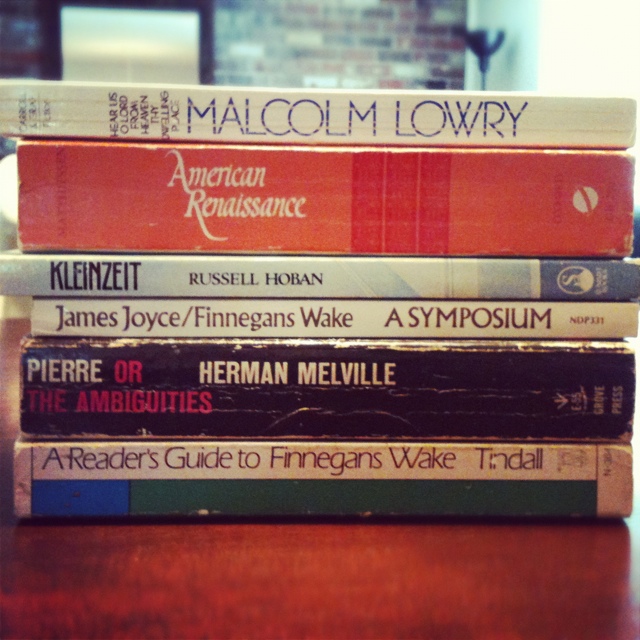
Summer wanes into fall; time to clean out the stack of books in my nightstand. Most volumes were permitted to stay, but I’m going to go ahead and find shelf space for these fellows.

The Lowry book, Hear Us O Lord from Heaven Thy Dwelling Place collects short stories and other writings. It’s a muddled, unfinished affair, and I muddled through not very much of it, leaving it unfinished.

F.O. Matthiessen’s American Renaissance: Art and Expression in the Age of Emerson and Whitman is full of insight and keen writing, but its voluminous scope and long essays kept making me wonder why I wasn’t just reading Hawthorne and Melville themselves. No knock on lit crit, but it seems wiser to spend reading time on the originals.

Speaking of Melville—I gave his incest novel Pierre another (third?) serious shot this summer, influenced by the Matthiessen, I guess. No go. Got distracted. It’s long.

I did finish Kleinzeit by Russell Hoban, a baffling schizophrenic novel that has thwarted every attempt of mine to review it. Here’s a review: it’s a strange, funny novel, a cult novel without a big enough cult.

I read several of the essays in A Symposium (ones by Beckett and William Carlos Williams), as well as the letters it includes (attacking Finnegans Wake) and Sylvia Beach’s reluctant intro. An interesting book but sometimes dry. Its inclusion, along with Tindall’s A Reader’s Guide to Finnegans Wake remind me of the brave week I spent trying to get a handle on Joyce’s language vortex. For whatever reason, I left the Wake in the stack. A dare? A dare.

“I Write Stories About a Submerged Population” — Raymond Carver on Fiction, Class, and Political Writing

Raymond Carver talks about the political scope (or lack thereof) in his writing in a 1987 interview

A writer ought to speak about things that are important to him. As you know, I’ve taught in universities, in fact for some fifteen years. I had time there for other work, and I never wrote a single story about university life because it’s an experience that left no mark on my emotional life. I tend to go back to the time and the people I knew well when I was younger and who made a very strong impression on me . . . Some of my recent stories deal with executives. (For example, that one in The New Yorker, “Whoever Was Using This Bed,” where the people discuss things the characters in my earlier stories would never discuss). He’s a businessman, and so on. But most of the people in my stories are poor and bewildered, that’s true. The economy, that’s important . . . I don’t feel I’m a political writer and yet I’ve been attacked by right-wing critics in the U.S.A. who blame me for not painting a more smiling picture of America, for not being optimistic enough, for writing stories about the people who don’t succeed. But these lives are as valid as those of the go-getters. Yes, I take unemployment, money problems, and marital problems as givens in life. People worry about their rent, their children, their home life. That’s basic. That’s how 80-90 percent, or God knows how many people live. I write stories about a submerged population, people who don’t always have someone to speak for them. I’m sort of a witness, and, besides, that’s the life I myself lived for a long time. I don’t see myself as a spokesman but as a witness to these lives. I’m a writer.

Book Acquired, 9.09.11 — Or, I Buy Yet Another William T. Vollmann Book Against My Better Judgment

20110909-044233.jpg

I like William T. Vollmann the persona probably more than I like William T. Vollmann the writer. That isn’t to say that I haven’t thought that the handful of books I’ve read by him were brilliant, strange, and engrossing—because they are—but I’ll admit that his methods, his back story, his sheer and absolute not-giving-a-fuckness is a major attraction. Voluminous Vollmann, unreadable Vollmann; smartypants Vollmann, fragile Vollmann. Vollmann, producer of travelogues, alternate histories, hagiographies for hookers; Vollmann, Ice Age chronicler; saga-slinging Vollmann. I can’t think of a writer who does more and says more and, because of his maximalist approach, will be largely unread, both for his career and for posterity—unless he concedes to edit. I think the irony is that, in wanting to give everything to his reader and wanting to preserve everything about his subjects—an act of love, compassion, empathy, what have you—in these grand, hopeless gestures, Vollmann paradoxically displays that intrinsic not-giving-a-fuckness. He needs an editor.

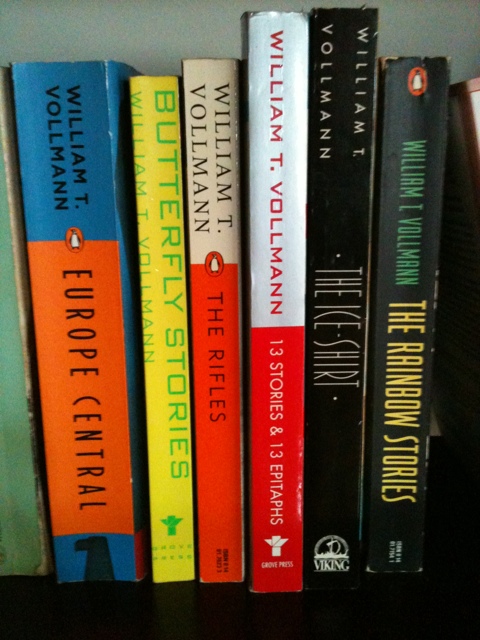
So, this afternoon, browsing at my favorite bookshop, a labyrinthine twisty thing, I ambled innocently past the ‘V’s of General Fiction, looking for a novel by Karel Capek in the sci-fi section, which abuts said ‘V’ aisle. Again, this was all innocence. I had no intention of picking up anything by Vollmann, despite the huge stack of his works there, used testaments to the futility of trying to read Vollmann perhaps—at least a dozen souls who said “fuck it” to Europe Central. Here are the Vollmann volumes (volmumes?) I possess—

20110909-044243.jpg

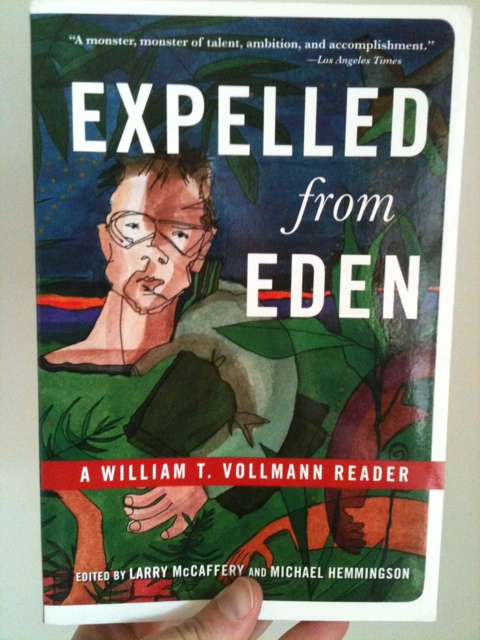
I’ve read Butterfly Stories, The Rifles, and The Ice-Shirt; I’ve read most of 13 Stories & 13 Epitaphs. I’ve read bits of The Rainbow Stories and mostly nothing of Europe Central, which migrated out of the “to read” stack a few years ago. So, yeah, I wasn’t looking for another Vollmann. But I’m too frequent a visitor at this particular labyrinthy, somewhat famous North Florida bookshop, so I noticed a “new” Vollmann in the stack, Expelled from Eden. And I started thumbing through it. Against my better judgment. 20 minutes later I was brainstorming reasons not to pick it up, but honestly, the credit in book trade I have with the store nails most economic arguments, and really, I’m thinking this is exactly what I wanted someone to do with Vollmann: edit that shit.

Larry McCaffrey and Michael Hemmingson have excised, chopped, moved around, and pulled from all over Vollmann’s massive world, putting together a book organized around Vollmann’s grand themes—travel writing; war; violence; prostitution; literature. There are lists, drawings, photographs. There is biography. I came home and read for an hour. I’m sure I’ll be sharing some citations down the road.

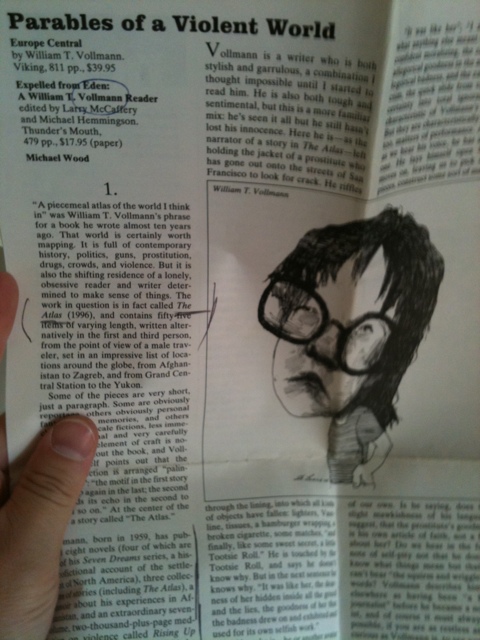
As a sort of bonus—and I always love to pick up a book where something is neatly tucked away—is an entire 2005 feature from The New York Review on Vollmann, focusing on Expelled from Eden and Europe Central.

20110909-044253.jpg

Read “Town of Cats,” a Story by Haruki Murakami

Today, The New Yorker shares “Town of Cats,” a short story by Haruki Murakami. First paragraph—

At Koenji Station, Tengo boarded the Chuo Line inbound rapid-service train. The car was empty. He had nothing planned that day. Wherever he went and whatever he did (or didn’t do) was entirely up to him. It was ten o’clock on a windless summer morning, and the sun was beating down. The train passed Shinjuku, Yotsuya, Ochanomizu, and arrived at Tokyo Central Station, the end of the line. Everyone got off, and Tengo followed suit. Then he sat on a bench and gave some thought to where he should go. “I can go anywhere I decide to,” he told himself. “It looks as if it’s going to be a hot day. I could go to the seashore.” He raised his head and studied the platform guide.

At that point, he realized what he had been doing all along.

Fun fact: I used to live in Shin-Koenji, right near Koenji, and I took the Chuou to work every day.

“Home” — George Saunders

From “Home,” a new George Saunders story in The New Yorker—-

Like in the old days, I came out of the dry creek behind the house and did my little tap on the kitchen window.

“Get in here, you,” Ma said.

Inside were piles of newspapers on the stove and piles of magazines on the stairs and a big wad of hangers sticking out of the broken oven. All of that was as usual. New was: a water stain the shape of a cat head on the wall above the fridge and the old orange rug rolled up halfway.

“Still ain’t no beeping cleaning lady,” Ma said.

I looked at her funny.

“Beeping?” I said.

“Beep you,” she said. “They been on my case at work.”

It was true Ma had a pretty good potty mouth. And was working at a church now, so.

We stood there looking at each other.

Then some guy came tromping down the stairs: older than Ma even, in just boxers and hiking boots and a winter cap, long ponytail hanging out the back.

“Who’s this?” he said.

“My son,” Ma said shyly. “Mikey, this is Harris.”

“What’s your worst thing you ever did over there?” Harris said.

“What happened to Alberto?” I said.

“Alberto flew the coop,” Ma said.

“Alberto showed his ass,” Harris said.

“I hold nothing against that beeper,” Ma said.

“I hold a lot against that fucker,” Harris said. “Including he owes me ten bucks.”

“Harris ain’t dealing with his potty mouth,” Ma said.

“She’s only doing it because of work,” Harris explained.

“Harris don’t work,” Ma said.

“Well, if I did work, it wouldn’t be at a place that tells me how I can talk,” Harris said. “It would be at a place that lets me talk how I like. A place that accepts me for who I am. That’s the kind of place I’d be willing to work.”

“There ain’t many of that kind of place,” Ma said.

“Places that let me talk how I want?” Harris said. “Or places that accept me for who I am?”

“Places you’d be willing to work,” Ma said.

“How long’s he staying?” Harris said.

“Long as he wants,” Ma said.

“My house is your house,” Harris said to me.

“It ain’t your house,” Ma said.

“Give the kid some food at least,” Harris said.

“I will but it ain’t your idea,” Ma said, and shooed us out of the kitchen.

“Great lady,” Harris said. “Had my eyes on her for years. Then Alberto split. That I don’t get. You got a great lady in your life, the lady gets sick, you split?”

“Ma’s sick?” I said.

“She didn’t tell you?” he said.

He grimaced, made his hand into a fist, put it upside his head.

“Lump,” he said. “But you didn’t hear it from me.”

Ma was singing now in the kitchen.

“I hope you’re at least making bacon,” Harris called out. “A kid comes home deserves some frigging bacon.”

“Why not stay out of it?” Ma called back. “You just met him.”

“I love him like my own son,” Harris said.

“What a ridiculous statement,” Ma said. “You hate your son.”

“I hate both my sons,” Harris said.

“And you’d hate your daughter if you ever meet her,” Ma said.

Harris beamed, as if touched that Ma knew him well enough to know he would inevitably hate any child he fathered.

Ma came in with some bacon and eggs on a saucer.

“Might be a hair in it,” she said. “Lately it’s like I’m beeping shedding.”

“You are certainly welcome,” Harris said.

“You didn’t beeping do nothing!” Ma said. “Don’t take credit. Go in there and do the dishes. That would help.”

“I can’t do dishes and you know that,” Harris said. “On account of my rash.”

“He gets a rash from water,” Ma said. “Ask him why he can’t dry.”

“On account of my back,” Harris said.

“He’s the King of If,” Ma said. “What he ain’t is King of Actually Do.”

“Soon as he leaves I’ll show you what I’m king of,” Harris said.

“Oh, Harris, that is too much, that is truly disgusting,” Ma said.

Harris raised both hands over his head like: Winner and still champ.

“We’ll put you in your old room,” Ma said.

“A Fable for the Living” — Single Sentence Animation

Info–

Kim Young Ha animates this otherworldly sentence from Kevin Brockmeier’s “A Fable for the Living,” featured in Electric Literature No. 5. The sentence reads: “She watched them flare and shimmer through their skin, their bones going off like bombs, every limb a magnificent firework of carbon, phosphorus, and calcium.” Single Sentence Animations are creative collaborations. The writer selects a favorite sentence from his or her work and the animator creates a short film in response. Electric Literature is an anthology of short fiction dedicated to reinvigorating the short story using new media and innovative distribution. Visit us at http://www.electricliterature.com/

Download Chamber Four’s New Literary Magazine, C4

Chamber Four has a new literary magazine called C4. You can get the inaugural issue in several formats here.

New in Paperback: Ali Shaw Does Creepy Fables, Cathleen Schine Channels Jane Austen, and Joan Schenkar Plumbs Patricia Highsmith

The Girl with Glass Feet is the début novel from British author Ali Shaw. Set in the remote archipelago of St. Hauda’s Land and steeped in the traditions of English folklore, Shaw’s novel works in the idiom of magical realism. His titular girl Ida Maclaird suffers from a strange affliction: she’s slowly turning into glass. She returns to St. Hauda’s land in the winter (after a previous summer holiday there) in the hopes of finding a cure. There she meets Midas Crook (whose symbolically overdetermined name seems part and parcel of Shaw’s program), a photographer fascinated by his father’s ghost stories about the isolated archipelago who is trying to capture something of its haunted spirit in his pictures. Together (and with the help of some strange locals) the pair tries to find answers against a melancholy and magical backdrop of tiny winged cows, albino crows, and other grotesques. A sample ghost story, one of many in Glass Feet

His father had once told him a legend: lone travelers on overgrown paths would glimpse a humanoid glow that ghosted between trees or swam in a still lake. And something, some impulse from the guts, would make the traveler lurch off the path in pursuit, into the mazy trees or deep water. When they pinned it down it would take shape. Sometimes it would form a flower of phosphorescent petals. Sometimes it drew a bird of sparks whose tail feathers fizzled embers. Sometimes it became like a person and they’d think they saw, under a nimbus like a veil, the features of a loved one long lost. Always the light grew steadily brighter until–in a flash–they’d be blinded. Midas’s father hadn’t needed to elaborate on what happened to them after that. Lost and alone in the cold of the woods.

In The Three Weissmanns of Westport, Cathleen Schine transposes the Dashwoods of Jane Austen’s Sense and Sensibility to a dilapidated beach cottage in Westport, Connecticut. When 78 year old Joseph divorces his 75 year old wife Betty, and his mistress essentially forces her from their high-end NYC apartment, Betty rallies by moving to the beach cottage with her daughters, impulsive Miranda, a literary agent, and practical Annie, a library director. The premise may sound like the domain of that most maligned of genres, “chick lit,” a fact that many reviewers tackled when it debuted in hardback last year. Here’s Dominique Browning in The New York Times
Schine sets her novel squarely in the most appealing part of chick-lit territory — its light-hearted readability — and then thumbs her nose as she starts kicking up the dust. The strange thing about the Jane brigade is that most of its practitioners have raided only her plots, apparently not quite up to the task of honoring the essence of Austen. But Schine’s homage has it all: stinging social satire, mordant wit, delicate charm, lilting language and cosseting materialistic detail.

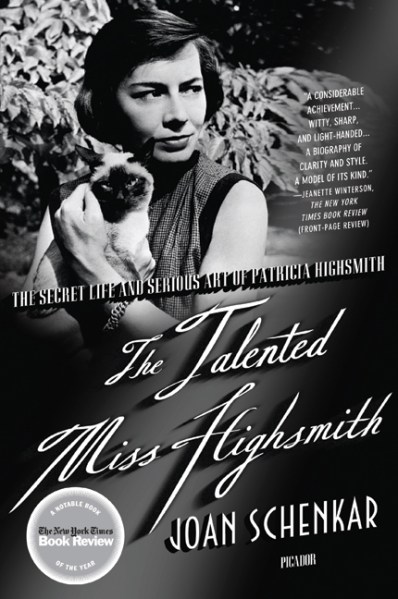
Before looking over Joan Schenkar’s exhaustive biography of Patricia Highsmith, The Talented Miss Highsmith: The Secret Life and Serious Art of Patricia Highsmith, I have to admit that I thought of the writer primarily as a practitioner of pulp fiction, the kind of lurid crime tales at home in airport bookshops. In recent years, I’ve come to reevaluate my stance on crime noir in particular (which I wrote about here), a genre whose conventions I find increasingly more apparent in the “literary fiction” that I enjoy. Anyway, Schenkar’s book places much stress on the Serious Art section of Highsmith’s biography. I knew Highsmith mainly from her Ripley novels, which I’ve never read, but gather to be smart and psychologically complex. I didn’t know that Highsmith wrote Strangers on a Train, adapted by Hitchcock into a noir classic. I didn’t know that she wrote comic books for years — the weird crime ones that stirred up so much commotion in the fifties. I didn’t know that she worked homoerotic themes into her novels, and wrote one very openly lesbian novel that was published during her lifetime (albeit under a pseudonym), The Price of Salt. Schenkar makes a case for a Highsmith as an underappreciated novelist, a contemporary of Mailer and Capote who never got her due (even if her novels were bestsellers), a writer in the tradition of Kafka and Freud. Rounding out the biography is a complex investigation of Highsmith’s strange relationship with her mother, a look at her long list of lovers, and plenty of charts, diagrams, and photos (Schenkar even sneaks a topless pic in, if that piques your interest).
All three titles are new in trade paperback from Picador.

Pig Earth — John Berger

People exaggerate the changes in nature so as to make nature seem lighter. Nature resists change. If something changes, nature waits to see whether the change can continue, and it it can’t, it crushes it with all its weight!  Ten thousand years ago the trout in the stream would have been exactly the same as today.

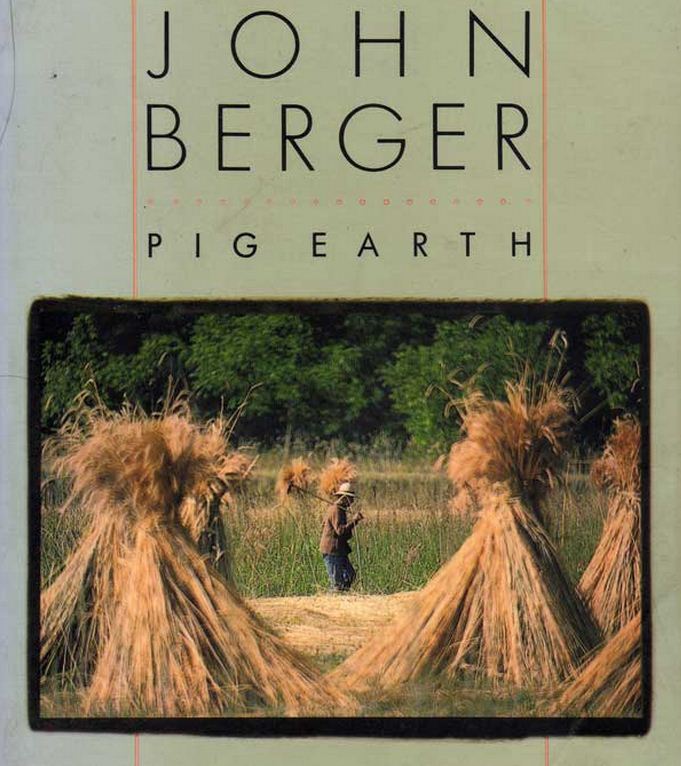
Stasis and disruption and the relation between people and their natural and urban surroundings are the themes John Berger writes about in his 1979 collection of essays, poems and short stories, Pig Earth.  Having moved from England, where he enjoyed considerable renown as an art critic and fiction writer, to the peasant villages of the French Alps, Berger settled into his role as an active participant in rural life, not only turning hay but observing and documenting the disappearance of a way of a once-pervasive mode of life.  Pig Earth was one result of his labors, the first book of a trilogy that took some fifteen-odd years to complete, a moving but not uncritical account of humanity’s struggle to conquer nature by symbiosis.

Maybe symbiosis isn’t the proper term if we agree that humanity is part of nature’s whole, but Berger juxtaposes the frailty of humanity with the earth’s uncaring and often violent strength.  Survival for the family of the subsistence farmer depends upon that family’s ability to tend to the needs of the plant and animal world (as well as more than a little bit of luck).  In the collection’s first true story, “A Calf Remembered,” a baby cow is delivered on a dark winter’s night. Here, Berger stresses the protections that nature and man have designed to ensure the survival of a young, vulnerable animal:  mucus, barn, salt, and sense.  The human spends his night in the barn protecting his property because it provides him not only with sustenance in the forms of milk and meat, but also companionship and a sense of duty.  When daily living requires acts that might mean life or death, the conscious and the instinct converge.

He sat on a milking stool in the dark.  With his head in his hands, his breathing was indistinguishable from that of the cows. The stable itself was like the inside of an animal.  Breath, water, cud were entering it:  wind, piss, shit were leaving.

Pig Earth is a book worth studying as people attempt to make sense of a world transitioning from one type of living to another and fuss over the sources of their own limited strength and vitality. Berger may not have been looking to pioneer a slow-living locavore lifestyle, but his subjects worry about their increasing isolation from the circles of power and industry.  They fret over the pointlessness of passing their knowledge to their children who need entirely different skills to survive in the rapidly encroaching urban wage economy.  In “The Value of Money” a father refuses a tractor, branded “The Liberator” by the manufacturer, that his son has purchased for him because it will render his faithful work-horse obsolete.  This same farmer kidnaps local tax officials because they want to confiscate the products of his labor without compensation for value that he exclusively created.  Unable to make them understand their wrongdoing, he sets them free because “you can only take revenge on those who are your own.”

The final story, “The Three Lives of Lucy Cabrol,” is the lengthiest and perhaps most poignant narrative in the book. It follows the life of a bright, tenacious, physically stunted woman as she grows from young girl to town outcast.  While Berger admired much of the life in the peasant village, he would fail in his duty as critic and chronicler if he ignored its darker sides. Berger often sets the title character’s pluck against the resignation and superstition endemic to village life. When life requires struggle, most people choose to hoard.  When poor choices may lead to death or family hardship, capitulation to those in power, whether those rulers be the town’s big man or Nazi collaborators, can often seem the only obvious choice.  Lucy shows us that cowardice, no matter the circumstances, only seems easy. Pig Earth is highly recommended.

“Guadalupe in the Promised Land” — Sam Shepard

“Guadalupe in the Promised Land” — a very short story by Sam Shepard.

Guadalupe hit the skids and fishtailed into a ditch, crawled out of the wreck bleeding from the neck, saw the moon, laid his head in a mud puddle, said “Todo el Mundo” three times and snuffed out. Him and Manolete got together after that and Manolete told him it wasn’t enough just to be a man. The thing was to shoot for sainthood. He said he almost hit it. A saint of the cape. Jackson Pollock joined them and told Manolete he was full of shit. A man was good enough. That was harder than sainthood. There’s too many saints anyway. Guadalupe didn’t know what to think. He ran into Jimmy Dean and Jimmy just looked confused. Marilyn Monroe had no opinion. Brecht kept talking about Germany and shame. Satchmo kept wiping his sweat and shuffling. Janis wanted more. Crazy Horse said: “Fight and die young.” Brian Jones just played the harpoon. Dylan Thomas said “Rage.” Jimi Hendrix said “Slide.” Big Bopper said “What?” Johnny Ace said “Shoot.” And Davey Moore said “Take it all on.” That made sense to Guadalupe. And with that he lay down for a nice long rest.

(From Micro Fiction, edited by Jerome Stern).

“Welcome” — Deb Olin Unferth

“Welcome,” a short story by Deb Olin Unferth, published in Vice’s annual fiction issue. A sample–

I finally figured it out and I said it: You want me to leave?

I said this because I did have small evidences. The day before they had gotten a little meaner, one of them especially, the bigger one, the one who had earlier been my champion. But I didn’t understand. I had been having such a nice time. I was bewildered. Why did they suddenly not love me?

And then the next morning it happened again. The big one had a mean look on his face. The other figured she didn’t need to have an ugly look on her face because the big one was taking care of it, so she could just stand to the side and look on, bemused. But I was so stupid, I still didn’t understand. I looked at the littler one as if to say, Why is he acting this way?

The Best Books of 2010

Here are our favorite books published in 2010 (the ones that we read–we can’t read every book, you know).

Sandokan — Nanni Balestrini

A dark, elliptical treatise on the mundane and inescapable violence wrought by the Camorra crime syndicate in southern Italy.

Everything Ravaged, Everything Burned — Wells Tower (trade paperback)

Tower’s world is a neatly drawn parallel reality populated by down-on-their-luck protagonists who we always root for, despite our better judgment, even as they inadvertently destroy whatever vestiges of grace are bestowed upon them.

The Union Jack — Imre Kertész

Kertész’s slim novella explores a storyteller’s inability to accurately and properly communicate spirit and truth against the backdrop of an oppressive Stalinist regime.

BodyWorld — Dash Shaw

Shaw’s graphic novel is sardonically humorous in its psychoanalytic/post-apocalyptic visions. It’s a sweet and sour subversion of 1950’s comics and contemporary conformist groupthink politics. Witty and poignant, it advances its medium.

The Thousand Autumns of Jacob de Zoet — David Mitchell

An unexpected historical romance from postmodern poster boy David Mitchell. Thousand Autumns is a big fat riff on storytelling and history and adventure–but mostly, Mitchell’s Shogunate-era Japan is a place worth getting lost in.

C — Tom McCarthy

“I see what I’m doing as simply plugging literature into other literature,” McCarthy said in an interview this year. “For me, that’s what literature’s always done.” C, our favorite novel of 2010, seems plugged into the past and the present, pointing to the future.

Wolf Hall — Hilary Mantel (trade paperback)

Who knew that we needed to hear the Tudor saga again? Who knew that Thomas Cromwell could be a good guy?

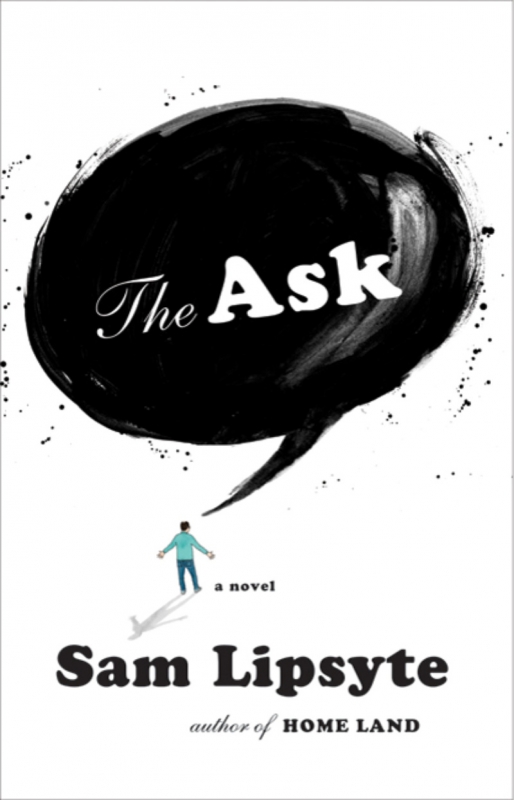
The Ask — Sam Lipsyte

A mean, sad, hilarious novel that simultaneously eulogizes, valorizes, and mocks the American Dream.

X’ed Out — Charles Burns

Charles Burns does Tintin in William Burroughs’s Interzone. ‘Nuff said.

The Collected Stories of Lydia Davis — Lydia Davis

An epic compendium of, jeez, I don’t know, how do you define or explain what Davis does? Inspection, perception, mood, observation. Tales, fables, riffs, annotations, skits, jokes, japes, anecdotes, journals, thought experiments, epigrams, half-poems, and would-be aphorisms. Great stuff.

“Hostess” — Amy Hempel

“Hostess” by Amy Hempel–

She swallowed Gore Vidal. Then she swallowed Donald Trump. She took a blue capsule and a gold spansule–a B-complex and an E–and put them on the tablecloth a few inches apart. She pointed the one at the other. “Martha Stewart,” she said, “meet Oprah Winfrey.” She swallowed them both without water.

(From Micro Fiction, edited by Jerome Stern).

The Ask — Sam Lipsyte

I listened to the audiobook version of Sam Lipsyte’s hilarious, wistful, mean, and devastating novel The Ask last week. I invented chores and took any scenic route available when driving to get more of the book faster, frequently laughing out loud, or grimacing, or even feeling weird and shameful pangs of remorseful identification with the book’s protagonist and narrator, Milo Burke. I’m going to do my best to unpack the book’s themes–particularly the way it simultaneously eulogizes, valorizes, and mocks the American Dream–but first I need to get something out-of-the-way, a mea culpa of sorts.

As I mentioned, I listened to the book, but I don’t have a copy, so, shamefully, I can’t really quote any of Lipyste’s marvelous sentences. He is a master stylist, capable of zapping our dead modern idioms with the kind of alarming twists that highlight just how vacant language has become. Lipsyte also has a gift for rhythm, tone, and cadence, and he’s a master of the deadpan punchline. While the sentences in his last novel Home Land sometimes felt overly fussed over, straining under their own polish, The Ask showcases an effortless style that both seduces and repels. Lipsyte reads The Ask audiobook himself, yet lets the tone and cadence of his words dictate the tone and timbre of his voice. It’s all very good. And you’ll have to just take my word for all that as I have nothing to quote now (I’m sure I’ll re-review the book when I pick it up in paperback, though).

The plot is rather thin: Milo Burke, who once aspired to being a celebrated painter, now works for the grants department of a mediocre liberal arts college. His job, essentially, is to beg wealthy parents and alumni to donate massive gifts of cash to the school — this is “the ask.” Or rather, that was his job before he got fired for losing his cool with the spoiled brat daughter of a major patron. This leaves Milo moping around Queens, drinking too much, and pissing off the wife he is slowly becoming estranged from. Which is a shame, because he’s trying to be a good husband and father to his young son; despite his own shitty childhood–boozing, philandering father, emotionally absent mother–Milo is doing his best to give his family the American Dream. He’s more or less abandoned his own dreams of being a painter, and along with it, the weird faith he located in the various theorists–Marxists, feminists, deconstructionists, etc.–who informed his art school years. Much of the novel finds Milo pondering not just on the value (or lack thereof) in his liberal arts education, but also on the friends and anti-friends who he slummed with in those days. Just as the narrator of Home Land dwells on his high school days, Milo Burke can’t quit thinking about his college years in The Ask.

That past returns in the form of Purdy, a rich kid who slummed with Milo and his druggy art kid friends back in their college days. Purdy is incredibly wealthy even after the stock market crashes of the late 2000s, and has Milo specifically reinstated by the university to officiate an intended “give” (the answer to “the ask”). Purdy’s real intention though is to turn Milo into a kind of bag man, a go-between to deliver large sums of cash to Purdy’s caustically embittered illegitimate son Don, an Iraq War vet who’s lost both his legs to an IED. This arrangement thrusts Milo into Purdy’s surreal world of privilege and power, but also puts him into contact with a deranged, maimed, and deeply, deeply hurt young man who will, essentially, change the way that he examines the world and his role in it.

I’m now going to gloss over much of the book: there are many, many very funny situations, strange characters, and wonderful little insights. And now that theme I mentioned: the death of the American Dream.

Late in the novel, Milo calls America “Dead America.” Earlier in the novel, he complains that America never got to be Rome; that America is a dying, crumbling empire that never even got to revel in its hedonist excesses. Milo is keenly aware that his own white, white-collar, privileged, urban existence as a liberal-arts-educated American puts him in a position of greater material comfort than 99.9% of the rest of the people in the world, yet this fact does nothing to assuage his despair–in fact, it exacerbates it. Milo is ashamed of his despair, too-cognizant of its implications. His shame becomes a meta-, self-referential shame, and it leads to Milo essentially surrendering any power or agency he might have claimed in the universe. His liberal arts education and his own sensitivities render him feckless and bitter, always grumbling over the cosmic injustice of modern, Dead America. He is a walking, rambling critique of power, yet–as his wife likes to point out–he never does anything about the injustice he perceives. It’s only after interacting with Don that Milo begins to see an inroad to agency.

Don is, it must be said, a miserable, caustic human being, a racist blackmailer, and perennially cruel to anyone who extends a hand. He’s also performed the most real “give” in the novel–he’s lost his legs for Dead America, sacrificing his own mobility and freedom (those constituents of the dream) for the freedom of others, or at least for the illusion of other people’s freedom. Don’s toxic behavior makes him utterly repellent and thoroughly anti-heroic, but in Milo’s identification with the young man–and in Milo’s willingness to lose financial security and familial stability by essential siding with Don over Purdy– there is a glimmer (just a glimmer) of redemption and agency for Milo. Don embodies everything about America that Milo (and presumably Lipsyte) hates, yet he has also answered “the ask,” both literally and symbolically. The novel invokes then not just scathing ironic attack on the American Dream, but also a pity that reveals an intrinsic (and perhaps childish) wish to believe, a wish to make Dead America live again. The novel ends with Milo reclaiming (or maybe just claiming) some degree of agency, beginning with getting back an old war knife his father had given him, a clear symbol of paternal, phallic power (the kind that his liberal arts education told him was bad, bad, bad). And yet there’s no resolution, no pat answers–how could there be? Instead, the novel ends in another crisis–not Milo’s this time, but Don’s. But I won’t spoil that, because, hey, you’re going to read this now, aren’t you? Very highly recommended.