Self-Portrait as Ishmael — Bo Bartlett

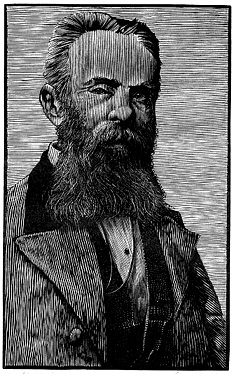
Herman Melville (Portrait) — Barry Moser

Book Shelves #3, 1.15.2012

Book shelves series #3, third Sunday of 2012: In which we revisit the master bedroom corner piece bookshelf in the southwest corner; two tiers + top shelf.

So, in last week’s engrossing installment our hero photographed and discussed some of the books in this bookshelf:

20120115-103251.jpg

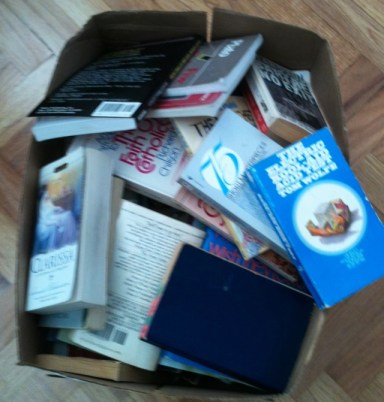
The post optimistically concluded: “So we’ve made it out of my bedroom” — but not so, dear reader, as post-Christmas/New Year cleaning up type activities led to a box of books, still in a storage room in the back of my house, needing to finally be shelved or ejected from the house. Said box:

20120115-103300.jpg

Most of the volumes herein are aesthetically-challenged/of a certain sentimental value: lots of books from my youth and the youth of my wife; lots of books that taught me how to read, books that weirded me out, books that I hope my kids will want to read in a few years. The corner piece bookshelf had the most (only, really) free space for shelving; it’s also tucked away from public view where an eyesore like my crumbling copy of Vonnegut’s Cat’s Cradle won’t sore eyes:

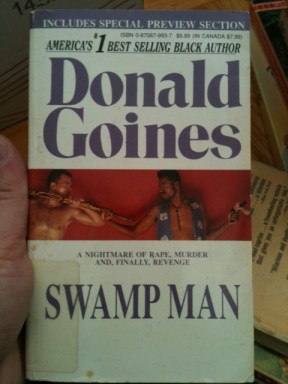
20120115-103312.jpg

I actually read Goines’s Swamp Man. It’s not the Deliverance knock off you might expect, although it is singularly horrific.

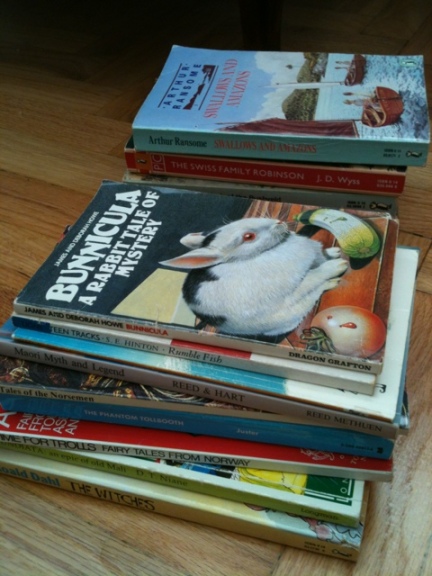
20120115-103322.jpg

Some beloved childhood classics. Arthur Ransome, S.E. Hinton, various myths and legends, Roald Dahl, etc.:

20120115-103331.jpg

Two books I hated. Hated. I keep them as badges of a strange honor, a sort of “I did it, okay?”:

20120115-103343.jpg

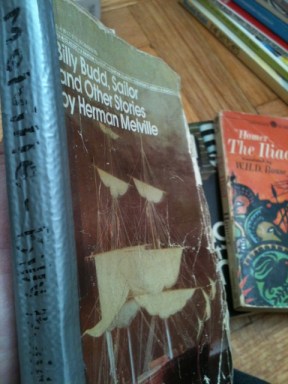
Melville stories held together with duct tape. This was the copy my 11th grade teacher assigned; I stole it of course. I used it in numerous subsequent courses and the annotations I made are somehow (unduly) precious to me. I can’t part with it even though I have at least two other volumes of Melville stories;

20120115-103358.jpg

Never sure where to shelve this RAW volume:

20120115-103428.jpg

Not sure if you can make out the title of this one, but it’s Alcoholic Anonymous’s Big Book. I found it on the beach one night when I was maybe 17 or 18. It’s full of highlighted passages and annotations and I’ve always been intrigued at what led the former owner to cast it away into cattailed dunes, as if the person couldn’t wait to be rid of it but couldn’t bear to bury it in a garbage can. Anyway, I picked it up because I pick up any discarded book, but I’ve kept it because I don’t know why I’ve kept it. Maybe it helped inform my reading of Infinite Jest, I don’t know:

20120115-103503.jpg

And here’s the “after” shot. I’ll try not to fret over re-shooting shelves again. But moving the box of books yesterday, knowing I was going to do the book shelf post today, I couldn’t help but photograph some of these as I went.

20120115-103518.jpg

Enjoy Thanksgiving with Our Literary Recipes Roundup

Happy Thanksgiving! Enjoy Turkey Day with Biblioklept’s menu of literary recipes:

F. Scott Fitzgerald’s Turkey Twelve Ways

Zora Neale Hurston’s Mulatto Rice

Ian McEwan’s Fish Stew

James Joyce’s Burnt Kidney Breakfast

Herman Melville’s Whale Steaks

Ernest Heminway’s Absinthe Cocktail, Death in the Afternoon

Vladimir Nabokov’s Eggs à la Nabocoque

Thomas Pynchon’s Banana Breakfast

Cormac McCarthy’s Turtle Soup

Robert Crumb’s Macaroni Casserole

Christmas Bonus:  George Orwell’s Recipes for Plum Cake and Christmas Pudding

Herman Melville’s Whale Steaks

Another entry in our ongoing series of literary recipes to celebrate Thanksgiving.

In Chapter LXIV of Herman Melville’s Moby-Dick, Stubb, second mate of the Pequod, demands whale steaks for dinner. He’s not happy with how the cook has prepared the steaks though, complaining they are too tender and overdone — his taste is closer to the sharks who are making a racket outside the ship–

“Cook,” said Stubb, rapidly lifting a rather reddish morsel to his mouth, ” don’t you think this steak is rather overdone? You’ve been beating this steak too much, cook; it’s too tender. Don’t I always say that to be good, a whalesteak must be tough? There are those sharks now over the side, don’t you see they prefer it tough and rare? What a shindy they are kicking up! Cook, go and talk to ’em; tell ’em they are welcome to help themselves civilly, and in moderation, but they must keep quiet. Blast me, if I can hear my own voice. Away, cook, and deliver my message. Here, take this lantern,” snatching one from his sideboard; ” now, then, go and preach to ’em! “

Stubb then instructs the cook on the best way to prepare whale steaks, a process involving a hot live coal. Oh, and he likes his fins pickled and his flukes soused–

“Well then, cook, you see this whale-steak of yours was so very bad, that I have put it out of sight as soon as possible; you see that, don’t you? Well, for the future, when you cook another whale-steak for my private table here, the capstan, I’ll tell you what to do so as not to spoil it by overdoing. Hold the steak in one hand, and show a live coal to it with the other; that done, dish it; d’ye hear? And now to-morrow, cook, when we are cutting in the fish, be sure you stand by to get the tips of his fins; have them put in pickle. As for the ends of the flukes, have them soused, cook. There, now ye may go.”

Eleven Encyclopedic Books, Overstuffed with References, That Compel Compulsive Reading

Eleven Encyclopedic Books, Overstuffed with References, That Compel Compulsive Reading

1. Moby-Dick, Herman Melville

2. Finnegans Wake, James Joyce

3. Expelled from Eden, A WilliamVollmann Reader

4. Species of Spaces and Other Pieces, Georges Perec

5. Wittgenstein’s Mistress, David Markson

6. The Silmarillion, J.R.R. Tolkien

7. Foucault’s Pendulum, Umberto Eco

8. The Rings of Saturn, W.G. Sebald

9. The Recognitions, William Gaddis

10. Between Parentheses, Roberto Bolaño

11.  The Architecture of the Arkansas Ozarks, Donald Harrington


Why I Abandoned Chad Harbach’s Over-Hyped Novel The Art of Fielding After Only 100 Pages

Genre fiction gets a bad rap from some readers and critics because it often rigidly follows a set of formal conventions, from plot to character to prose, to satisfy reader expectations. One mark of literary fiction, in opposition to genre fiction, might be that the literary work disrupts or destabilizes these conventions (works that get called experimental tend to explode these conventions or radically recombine them). Harold Bloom, in The Western Canon (and elsewhere), argues that it is the strangeness and originality of a work that confers its literary power; in some cases, he argues, this strangeness assimilates us (the readers, the culture) to the point that we can no longer recognize its strangeness. While Bloom may be a pompous windbag (and really, what literary critic worth his salt isn’t?), and I don’t always agree with him (especially in his unrelenting agon with “The School of Resentment”), I think he’s given us a good rubric by which to measure or understand what sets great literature apart from the ordinary, the conventional, the ephemeral.

I bring all of this up because it seems to me that literary fiction is its own genre, one with its own conventions, tropes, and formulations. The genre of literary fiction is as much a marketing tool, of course, as it is a set of conventions, and publishers release these books because the author’s Great Ambition and Sterling Prose and Big Ideas (in theory) cast esteem back on the publisher. And while there are plenty of great books with major houses behind them, many books claiming to be “literary fiction” are simply conventional retreads of an antiquated formula, outfitted in the grand themes of the day (these days, that tends to “identity”). These books offer no strangeness, make no attempt to open the realm of literary possibility. They are intellectual comfort food. And there’s nothing wrong with that, just as there’s nothing wrong with a good mystery novel. But I think we lie to ourselves when we overinflate the powers of our “literary” novelists. I enjoyed Jeffrey Eugenides’s middlebrow Middlesex as much as the next lad, for example, but still find it wildly overrated. Another example: Michael Chabon is not my cup of tea, but I wouldn’t argue against his talent. Still, even when he attempts the strange (The Yiddish Policemen’s Union, for example), he’s blandly trying territory already colonized by others. Give me Philip K. Dick or George V. Higgins any day.

My favorite novels tend toward strangeness; they upset or confound or baffle me. I love it when I have no idea what the novelist is doing. And while reckless innovation or experimentation for its own sake can sometimes fall flat (or fall apart), an interesting failure is better than another complacent, forgettable entry in the non-canon of contemporary “literary fiction.”

Which brings me to Chad Harbach’s wildly over-hyped novel The Art of Fielding.

Let me be up front: Yes, this is backlash. The acclaim directed at this novel deserves backlash—although I’d like to be clear up front that I’m not trying to attack the novel itself; that would be like attacking a run-of-the-mill sci-fi novel for indulging in run-of-the-mill sci-fi tropes. My aim is simply to point out that Harbach’s book is no great feat of literature, no work of astounding genius—it’s just run-of-the-mill literary fiction. And yes, I didn’t read past page 100, which conveniently is the last page of chapter 11. Why would I slog it out through 400 more pages when there are so many great books in the world that I haven’t read and precious little time in which to read them? And that’s the point of the rant that follows.

The book is not entirely terrible. It just isn’t very good, certainly not good enough to warrant the excessive praise that’s been heaped upon it. Cardboard characters, cliché after cliché (plot, character, prose), and plenty of bad writing. The dialogue is particularly heinous; I’m fine with unrealistic speech, but Harbach lacks subtlety or style. In fact, the book lost me on page 18, when the character Owen Dunne introduces himself to the protagonist Henry Skrimshander with this groan-inducing nugget: “My name’s Owen Dunne. I’ll be your gay mulatto roommate.” I suppose that the line is meant to be heard in a perhaps ironically self-reflexive sense—a metafictive gesture that extends from Dunne to the audience, like a knowing wink (and bypassing poor boring Henry), but it strikes me instead as utterly tone-deaf, showing us nothing about Dunne and his (supposed hip) cleverness and everything about Harbach’s inability to create concrete, real characters.

Dunne is a particularly grating character in a novel full of grating characters. The worst aspect of this character is that he is presented as an intellectual, but Harbach fails to harness his intellect in the text. We are told the names of some of the authors in his library; we hear some of his pretentious speech; he tells us how smart he is, and one senses that Harbach would have us believe him—only at no point in the first 100 pages are we treated to any real aspect of his intelligence. Critics, or people who write about books, have bent over backwards to call Fielding a smart book, to liken it to Jonathan Franzen or David Foster Wallace or, Jesus Christ, even Herman Melville. But Dunne is the simplest illustration that Harbach’s bench isn’t very deep; there is nothing here to approximate the mind of Hal Incandenza or the heart of Don Gately; there’s certainly no one here on par with Ishmael. But this is hardly Harbach’s fault, of course. Who can make an Ishmael?

If I appear to be attacking Harbach, please let me clarify: I think that he’s written a passable novel in the genre of “literary fiction” (which I contrast here now, for the sake of clarity, with strong literature or even canonical literature, if you like). But this book isn’t another Infinite Jest or Moby-Dick (as if one could even speak of “another” Moby-Dick); it isn’t even in the same league, and its champions do it no favors in overpraising it.

Let’s take a peek at some of that purple praise:

Here’s Michiko Kakutani in The New York Times, who, granted, manages to be wrong about almost everything all the time, but her gushing here is especially egregious—

Chad Harbach’s book “The Art of Fielding” is not only a wonderful baseball novel — it zooms immediately into the pantheon of classics, alongside “The Natural” by Bernard Malamud and “The Southpaw” by Mark Harris — but it’s also a magical, melancholy story about friendship and coming of age that marks the debut of an immensely talented writer.

Mr. Harbach, a co-founder and co-editor of the literary journal n + 1, has the rare abilities to write with earnest, deeply felt emotion without ever veering into sentimentality, and to create quirky, vulnerable and fully imagined characters who instantly take up residence in our own hearts and minds. He also manages to rework the well-worn, much-allegorized subject of baseball and make us see it afresh, taking tired tropes about the game (as a metaphor for life’s dreams, disappointments and hopes of redemption) and injecting them with new energy. In doing so he has written a novel that is every bit as entertaining as it is affecting.

She gets a few things right: Harbach’s characters are “quirky,” in the completely-unrealistic-and-totally-annoying sense; also, yes, the book is full of “tired tropes.” But the rest? I metaphorically throw up in my brain when I read her claim that these “vulnerable and fully imagined characters . . .  instantly take up residence in our own hearts and minds.” Get me the fuck out of your pronouns, Kakutani. Because Kakutani’s honeyed spewing was not enough, for some reason, the Times ran another glowing review just a few days later, where Gregory Clowes suggests—

Measured against other big, ambitious debuts by striving young writers (Harbach is a founder and editor of the literary magazine n+1), “The Art of Fielding” is surprisingly old-fashioned and almost freakishly well behaved. There’s some strained humor in the early going, when Harbach seems unsure of his register, but once he settles into a mildly satiric mode of psychological realism — the mode of latter-day Jonathan Franzen, rather than the high turbulence of David Foster Wallace — the book assumes an attractive, and fitting, 19th-century stateliness.

Franzen, whose blurb blazons Fielding’s cover, is an apt comparison (over-hyped, turgid, boring, middle class, middlebrow). And even though Wallace’s The Pale King was over-hyped in the wake of his suicide, I think the Franzen/Wallace disjunction is informative here: Wallace’s work is challenging, disruptive, strange.

When Clowes points out how “old-fashioned and almost freakishly well behaved” Fielding is, he signals the same sense of comfort that Kakutani finds in the work: Like most middling works of the “literary fiction” genre, Fielding provides its audience a sense of comfort, a confirmation that the literary constructions (and worldviews) of yore still exist.

Clowes then brings up the Herman Melville references in Fielding, which aren’t so much allusions as they are lazy infodumps about more interesting books. At least Clowes has the good sense not to find parallels between Melville’s grand, strange writing and Harbach’s bland business, unlike Ellen Wernecke at The AV Club, who wrote—

Harbach takes plenty of cues from other great baseball novels, like Bernard Malamud’s The Natural and Philip Roth’s The Great American Novel, but more so from Melville, in a display of cleverness that wraps around Westish life.

Harbach’s “display of cleverness” is absolutely the problem. Who wants a display of cleverness? To me, the first fifth of Fielding reads like a self-congratulatory wankfest of cleverness, where the audience is invited to alternately smirk or nod sagely (blankly), with protagonist Henry playing the small town rube (butt of the joke) and the fish out of water (audience surrogate in what is supposed to be the fascinating world of Westish, a stand-in for Harvard in the Midwest, which, let me just stop to say, is one of the more unconvincing settings I’ve ever read). There is no challenge to the reader; even worse, Harbach seems to rely on some sense of fellow-feeling or shared common ground from his readers to land his points. Home games are always easier. The reward Harbach offers seems to be a simple reconfirmation of the forms and tropes and tired language of the “literary fiction” genre.

I detest negative book reviews as much as I hate overpraise, so let me conclude by offering a short list of relatively contemporary books (past thirty or fifty years) that I think will challenge readers who want more from their novels than a retread of the old-fashioned and well behaved: Roberto Bolaño’s 2666, Renata Adler’s Speedboat, David Foster Wallace’s novels and short stories, Cormac McCarthy’s novels (especially Blood Meridian and Suttree), Russell Hoban’s Riddley Walker or Kleinzheit, Barry Hannah’s Airships and Ray, anything by W.G. Sebald, William T. Vollmann’s The Rifles or Butterfly Stories, Sam Lipsyte’s The Ask,  Lars Iyer’s Spurious, PK Dick’s The Man in the High Castle, Gordon Lish’s short stories, Denis Johnson’s Angels, Thomas Pynchon’s V, Don DeLillo’s Underworld or White Noise . . . but now I am riffing wankerishly—never my intent here. Just didn’t want to end on a negative note. I’d love to hear what I missed on this list.
“Don’t Kill Whales” — The Animaniacs Confront Captain Ahab

The Origin of “Moby Dick”

Where did Herman Melville get the strange, marvelous name of the leviathan at the center of his strange, marvelous novel Moby-Dick? The name of the great white whale derives from  an 1839 article by Jeremiah Reynolds, “Mocha Dick: or The White Whale of the Pacific” (originally published in Knickerbocker Magazine). As the editors of Melville.org point out though (and thanks be unto them for all their hard, excellent work), how “Mocha Dick” morphed into “Moby Dick” remains “some strange piece of hermetic Melvillean arcana.” From Reynolds’s article

But to return to Mocha Dick — which, it may be observed, few were solicitous to do, who had once escaped from him. This renowned monster, who had come off victorious in a hundred fights with his pursuers, was an old bull whale, of prodigious size and strength. From the effect of age, or more probably from a freak of nature, as exhibited in the case of the Ethiopian Albino, a singular consequence had resulted — he was white as wool! Instead of projecting his spout obliquely forward, and puffing with a short, convulsive effort, accompanied by a snorting noise, as usual with his species, he flung the water from his nose in a lofty, perpendicular, expanded volume, at regular and somewhat distant intervals; its expulsion producing a continuous roar, like that of vapor struggling from the safety-valve of a powerful steam engine. Viewed from a distance, the practised eye of the sailor only could decide, that the moving mass, which constituted this enormous animal, was not a white cloud sailing along the horizon. On the spermaceti whale, barnacles are rarely discovered; but upon the head of this lusus naturae, they had clustered, until it became absolutely rugged with the shells. In short, regard him as you would, he was a most extraordinary fish; or, in the vernacular of Nantucket, “a genuine old sog”, of the first water.

“I am like one of those seeds taken out of the Egyptian Pyramids” — Herman Melville Writes to Nathaniel Hawthorne

From Herman Melville’s June 1851 letter to Nathaniel Hawthorne (read the whole letter here)—

But I was talking about the “Whale” [“Moby-Dick”]. As the fishermen say, “he’s in his flurry” when I left him some three weeks ago. I’m going to take him by his jaw, however, before long, and finish him up in some fashion or other. What’s the use of elaborating what, in its very essence, is so short-lived as a modern book? Though I wrote the Gospels in this century, I should die in the gutter. — I talk all about myself, and this is selfishness and egotism. Granted. But how help it? I am writing to you; I know little about you, but something about myself so I write about myself, — at least, to you. Don’t trouble yourself, though, about writing; and don’t trouble yourself about visiting; and when you do visit, don’t trouble yourself about talking. I will do all the writing and visiting and talking myself — By the way, in the last “Dollar Magazine” I read “The Unpardonable Sin.” He was a sad fellow, that Ethan Brand. I have no doubt you are by this time responsible for many a shake and tremor of the tribe of “general readers.” It is a frightful poetical creed that the cultivation of the brain eats out the heart. But it’s myprose opinion that in most cases, in those men who have fine brains and work them well, the heart extends down to hams. And though you smoke them with the fire of tribulation, yet, like veritable hams, the head only gives the richer and the better flavor. I stand for the heart. To the dogs with the head! I had rather be a fool with a heart, than Jupiter Olympus with his head. The reason the mass of men fear God, and at bottom dislike Him, is because they rather distrust His heart, and fancy Him all brain like a watch. (You perceive I employ a capital initial in the pronoun referring to the Deity; don’t you think there is a slight dash of flunkeyism in that usage?) Another thing. I was in New York for four-and-twenty hours the other day, and saw a portrait of N.H. And I have seen and heard many flattering (in a publisher’s point of view) allusions to the “Seven Gables.” And I have seen “Tales,” and “A New Volume” announced, by N.H. So upon the whole, I say to myself, this N.H. is in the ascendant. My dear Sir, they begin to patronize. All Fame is patronage. Let me be infamous: there is no patronage in that. What “reputation” H.M. has is horrible. Think of it ! To go down to posterity is bad enough, any way; but to go down as a “man who lived among the cannibals”! When I speak of posterity, in reference to myself, I only mean the babies who will probably be born in the moment immediately ensuing upon my giving up the ghost. I shall go down to some of them, in all likelihood. Typee will be given to them, perhaps, with their gingerbread. I have come to regard this matter of Fame as the most transparent of all vanities. I read Solomon more and more, and every time see deeper and deeper and unspeakable meanings in him. I did not think of Fame, a year ago, as I do now. My development has been all within a few years past. I am like one of those seeds taken out of the Egyptian Pyramids, which, after being three thousand years a seed and nothing but a seed, being planted in English soil, it developed itself, grew to greenness, and then fell to mould. So I. Until I was twenty-five, I had no development at all. From my twenty-fifth year I date my life. Three weeks have scarcely passed, at any time between then and now, that I have not unfolded within myself. But I feel that I am now come to the inmost leaf of the bulb, and that shortly the flower must fall to the mould. It seems to be now that Solomon was the truest man who ever spoke, and yet that he a little managed the truth with a view to popular conservatism; or else there have been many corruptions and interpolations of the text. — In reading some of Goethe’s sayings, so worshipped by his votaries, I came across this, “Live in the all.” That is to say, your separate identity is but a wretched one, — good; but get out of yourself, spread and expand yourself, and bring to yourself the tinglings of life that are felt in the flowers and the woods, that are felt in the planets Saturn and Venus, and the Fixed Stars. What nonsense! Here is a fellow with a raging toothache. “My dear boy,” Goethe says to him, “you are sorely afflicted with that tooth; but you must live in the all, and then you will be happy!” As with all great genius, there is an immense deal of flummery in Goethe, and in proportion to my own contact with him, a monstrous deal of it in me.

H. Melville.

P.S. “Amen!” saith Hawthorne.

N.B. This “all” feeling, though, there is some truth in. You must often have felt it, lying on the grass on a warm summer’s day. Your legs seem to send out shoots into the earth. Your hair feels like leaves upon your head. This is the all feeling. But what plays the mischief with the truth is that men will insist upon the universal application of a temporary feeling or opinion.

P.S. You must not fail to admire my discretion in paying the postage on this letter.

Herman Melville’s Lifetime Literary Earnings

The chart below is from The Life and Works of Herman Melville.

Note: This chart does not represent Melville’s entire literary production. It does not list earnings for the magazine articles or for Israel PotterThe Piazza Tales, and The Confidence-Man, for which surviving records are incomplete; nor does it give figures for the volumes of poetry that were published at private expense.

		    UNITED STATES	       UNITED KINGDOM		      TOTALS

		Copies       	            Copies       	        Total       Total
Title		Sold	     Earnings	    Sold	 Earnings (a)   Sales       Earnings
--------------------------------------------------------------------------------------------
Typee		9,598	     1,138.61	    6,722	   708.40	16,320	    1,847.01

Omoo		7,403	     1,719.78	    5,932	   644.00	13,335	    2,363.78

Mardi		2,900	       740.88	    1,000	   970.65	 3,900      1,711.53

Redburn		4,718	       683.57	      750	   484.00	 5,468	    1,167.57

White-Jacket	4,922	       969.44	    1,000	   968.00	 5,922	    1,937.44

Moby-Dick	3,215	       556.37	      500	   703.08	 3,715	    1,259.45

Pierre		1,821	       157.75	      --	      --	 1,821	      157.75
Battle-Pieces	  471	     - 229.71 (b)     --	      --	   471	    - 229.71
	       ------	     --------	   ------	 --------	------	   ---------
TOTALS	       35,048	     5,736.69 	   15,905	 4,478.13       50,953	   10,214.82

Herman Melville on Hawthorne and Shakespeare’s Darkness

A passage from Herman Melville’s appreciation of Nathaniel Hawthorne, “Hawthorne and His Mosses”

Now it is that blackness in Hawthorne, of which I have spoken, that so fixes and fascinates me. It may be, nevertheless, that it is too largely developed in him. Perhaps he does not give us a ray of his light for every shade of his dark. But however this may be, this blackness it is that furnishes the infinite obscure of his background,–that background, against which Shakespeare plays his grandest conceits, the things that have made for Shakespeare his loftiest, but most circumscribed renown, as the profoundest of thinkers. For by philosophers Shakespeare is not adored as the great man of tragedy and comedy.–“Off with his head! so much for Buckingham!” this sort of rant, interlined by another hand, brings down the house,–those mistaken souls, who dream of Shakespeare as a mere man of Richard-the-Third humps, and Macbeth daggers. But it is those deep far-away things in him; those occasional flashings-forth of the intuitive Truth in him; those short, quick probings at the very axis of reality:–these are the things that make Shakespeare, Shakespeare. Through the mouths of the dark characters of Hamlet, Timon, Lear, and Iago, he craftily says, or sometimes insinuates the things, which we feel to be so terrifically true, that it were all but madness for any good man, in his own proper character, to utter, or even hint of them. Tormented into desperation, Lear the frantic King tears off the mask, and speaks the sane madness of vital truth. But, as I before said, it is the least part of genius that attracts admiration. And so, much of the blind, unbridled admiration that has been heaped upon Shakespeare, has been lavished upon the least part of him. And few of his endless commentators and critics seem to have remembered, or even perceived, that the immediate products of a great mind are not so great, as that undeveloped, (and sometimes undevelopable) yet dimly-discernible greatness, to which these immediate products are but the infallible indices. In Shakespeare’s tomb lies infinitely more than Shakespeare ever wrote. And if I magnify Shakespeare, it is not so much for what he did do, as for what he did not do, or refrained from doing. For in this world of lies, Truth is forced to fly like a scared white doe in the woodlands; and only by cunning glimpses will she reveal herself, as in Shakespeare and other masters of the great Art of Telling the Truth,–even though it be covertly, and by

Herman Melville’s 1856 Passport Application

(More).

The Sopranos Discuss Melville’s Billy Budd

“Nobody can be more clownish, more clumsy and sententiously in bad taste, than Herman Melville” — D.H. Lawrence on Moby-Dick

From D.H. Lawrence’s Studies in Classic American Literature, Chapter XI, “Herman Melville’s Moby-Dick“–

A hunt. The last great hunt.

For what ?

For Moby Dick, the huge white sperm whale: who is old, hoary, monstrous, and swims alone; who is unspeakably terrible in his wrath, having so often been attacked; and snow- white.

Of course he is a symbol.

Of what ?

I doubt if even Melville knew exactly. That’s the best of it.

He is warm-blooded, he is lovable. He is lonely Leviathan, not a Hobbes sort. Or is he ?

But he is warm-blooded and lovable. The South Sea Islanders, and Polynesians, and Malays, who worship shark, or crocodile, or weave endless frigate-bird distortions, why did they never worship the whale? So big!

Because the whale is not wicked. He doesn’t bite. And their gods had to bite.

He’s not a dragon. He is Leviathan. He never coils like the Chinese dragon of the sun. He’s not a serpent of the waters. He is warm-blooded, a mammal. And hunted, hunted down.

It is a great book.

At first you are put off by the style. It reads like journalism. It seems spurious. You feel Melville is trying to put something over you. It won’t do.

And Melville really is a bit sententious: aware of himself, self-conscious, putting something over even himself. But then it’s not easy to get into the swing of a piece of deep mysticism when you just set out with a story.

Nobody can be more clownish, more clumsy and sententiously in bad taste, than Herman Melville, even in a great book like Moby Dick. He preaches and holds forth because he’s not sure of himself And he holds forth, often, so amateurishly.

The artist was so much greater than the man. The man is rather a tiresome New Englander of the ethical mystical- transcendentalist sort: Emerson, Longfellow, Hawthorne, etc. So unrelieved, the solemn ass even in humour. So hopelessly au grand serieux, you feel like saying: Good God, what does it matter? If life is a tragedy, or a farce, or a disaster, or any- thing else, what do I care! Let life be what it likes. Give me a drink, that’s what I want just now.

For my part, life is so many things I don’t care what it is. It’s not my affair to sum it up. Just now it’s a cup of tea. This morning it was wormwood and gall. Hand me the sugar.

One wearies of the grand serieux. There’s something false about it. And that’s Melville. Oh dear, when the solemn ass brays! brays! brays!

But he was a deep, great artist, even if he was rather a sententious man. He was a real American in that he always felt his audience in front of him. But when he ceases to be American, when he forgets all audience, and gives us his sheer apprehension of the world, then he is wonderful, his book commands a stillness in the soul, an awe.


Books I Am Always (Re-)Reading

Trudging through a very long book the other night–never mind the title, at least now anyway–it occurred to me that I’d rather be reading from 2666; that, at that particular moment, I’d rather re-read from “The Part About the Crimes.” I don’t know if it was the effete dullness of the first volume that made me want to pick up Bolaño’s epic, perhaps trying to zap some life into my waning eyeballs; perhaps it was just the sense that I was wasting my time with the merely good, which, after all, is mediocrity when set against genius (yes, these are subjective terms).

Anyway, I didn’t have to go looking for 2666 — I have a copy (yes, I have two) right there jammed into my nightstand, along with a few other books that I realize that I’m always reading. Furthermore, I’m always reading these books in the most discontinuous, stochastic fashion, often picking them up at random and thumbing through them. I think I use these books to clear my literary palate, to get a bad (or worse, boring) taste out of my brain, to inspire me, to suggest another book. Some of these books, like 2666 are big, fat volumes, volumes that I set close at hand in the hopes of rereading in full. Sometimes I’ve met this goal; in the case of Moby-Dick, I’ve read the book through at least three times now, and yet never tire of it. I’m always picking it up again and again, sometimes to find Elijah’s rant or to dip into Ahab’s mad monologue or perhaps just to hear Stubb comment on the proper preparation of shark steaks. Of a piece with those big novels is David Foster Wallace’s Infinite Jest, which I turn to repeatedly, reading over a riff or two at a time, perhaps still trying to figure out the ending, or some clue of the ending, perhaps trying to figure out why Hal can’t speak (you know, beyond like, a a metaphorical level).

There’s also Blood Meridian.

A book I always keep proximal is D.H. Lawrence’s Studies in Classic American Literature, which, if this were a dictatorship under Biblioklept might replace the Constitution (jaykay, Tea Partiers!). Tellingly, I’ve never managed to finish one of Lawrence’s novels (I even struggle through his much-anthologized piece, “The Rocking Horse Winner”), but I consider his dissertations on Hawthorne, Poe, and Melville indispensable (and creative in their own right). I guess I just like lit crit; Harold Bloom’s too-huge volume The Western Canon is a book I return to again and again. Sometimes I find myself throwing it to the ground, quite literally (if I’ve enjoyed a drink or two, that is), in disgust. Bloom’s battle with “The School of Resentment” can be maddening, especially when he’s so up front about essentially making Shakespeare God. Still, Shakespeare doesn’t seem like a bad God to have.

I should point out that I’ve made no attempt to read The Western Canon the whole way through; in fact, I’ve never made a single attempt to read it systematically. I just sort of pick it up, thumb through it, occasionally plumb the index. There are several books that I am always rereading in this category: Books That I Am Always Reading and Yet Have Never Finished. Foremost among these is Nietzsche’s Human, All Too Human, a book that I probably, at this point, have read in full, but never fully through. Its aphorisms beg to be read discontinuously; I think Nietzsche wet-dreamed about his fragmentary works being literally fragmented and then later found, read piecemeal against some newer, more garish culture. Or perhaps that’s just my metaphorical wet dream.

Other Books That I Am Always Reading and Yet Have Never Finished — The Life and Opinions of Tristram Shandy, Gentleman stands out, as does Finnegans Wake. Sterne’s book is such an oddity: I remember picking it up in a stack of books to be shelved at my college library, thumbing through it, bewildered, thinking that it must be contemporary with John Barth. A bit of research left me even more perplexed. Like Tristram, who can’t seem to finish his story, I can’t seem to actually finish it, but I’m okay with picking it up again and again. Similarly, Finnegans Wake strikes me as an unfinished-unfinishable volume (I do not mean this literally; I know that Joyce “finished” the book as an infinite strange loop, just as I know that the book can be read). I have an audio recording of Finnegans Wake that I like to listen to occasionally (especially while driving), as well as William York Tindall’s  guide (which is fun), but I’d rather just sort of grab the thing at random and read a page or two. I know, in an intellectual sense, that is, that I could easily read the book in a calendar year by committing to three pages a day (plus a few pages of Tindall), but I don’t think that I can read books in an intellectual sense. I think, at the risk of sounding unbearably corny, that books have to call to their readers in an emotional and perhaps even spiritual sense. Otherwise, what’s the point?

Enjoy Thanksgiving with Our Literary Recipes Roundup

Happy Thanksgiving!

Enjoy Turkey Day (sans turkey) with Biblioklept’s menu of literary recipes:

Zora Neale Hurston’s Mulatto Rice

Ian McEwan’s Fish Stew

James Joyce’s Burnt Kidney Breakfast

Herman Melville’s Whale Steaks

Ernest Heminway’s Absinthe Cocktail, Death in the Afternoon

Vladimir Nabokov’s Eggs à la Nabocoque

Thomas Pynchon’s Banana Breakfast

Cormac McCarthy’s Turtle Soup

Robert Crumb’s Macaroni Casserole