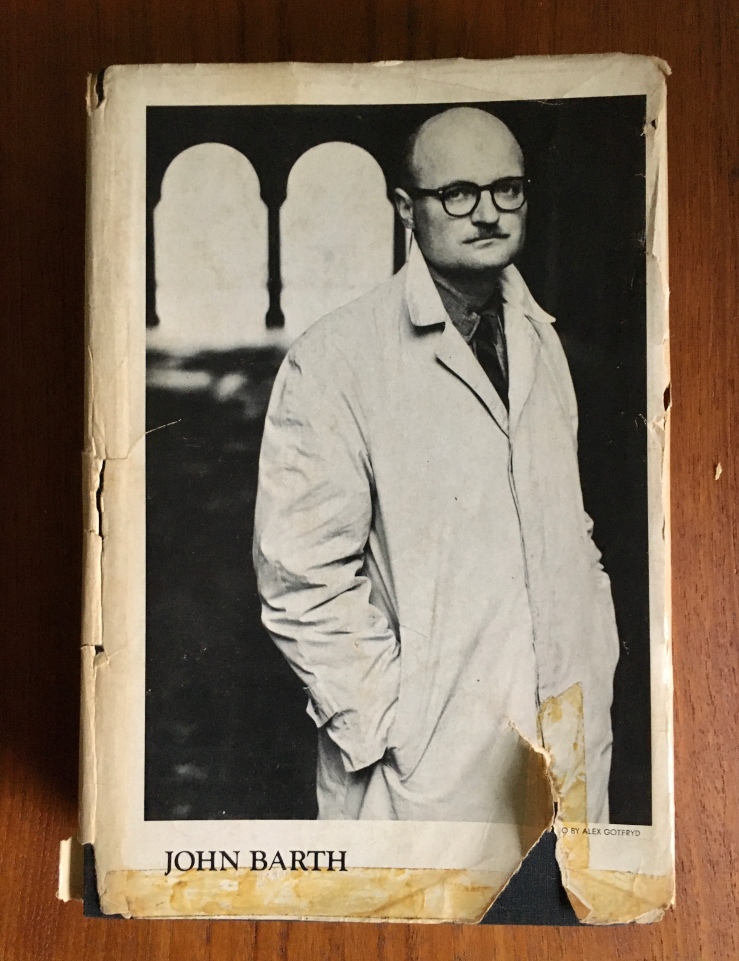
John Barth’s Chesapeake Bay Recipes

FIVE CHESAPEAKE BAY RECIPES

Oysters Chesapeake
1. Tong oysters.
2. Shuck.
3. Eat.

Softshell Clams Chesapeake
1. Dig softshell clams.
2. Steam.
3. Eat.

Cherrystone Clams Chesapeake
See recipe for Softshell Clams Chesapeake

Blue Crabs Chesapeake
1. Net blue crabs.
2. Steam.
3. Eat.

Champagne Chesapeake
1. Pop champagne.
2. Toast.
3. Drink.

John Barth’s “Five Chesapeake Bay Recipes.”

From The Great American Writers’ Cookbook (ed. Dean Faulkner Wells, 1981).

Mass-market Monday | John Barth’s End of the Road

End of the Road, 1958, by John Barth. Avon Books (1960). No cover artist or designer credited. 158 pages.

I already owned a more attractive edition of John Barth’s The End of the Road (or End of the Road as the title is given in this edition), but I couldn’t pass up on the odd rounded corners.

RE: April 23 | John Barth writes to Vladimir Nabokov

To: V. Nabokov, Montreux, Switzerland

FROM: J. Barth, Buffalo, U.S.A.

RE: April 23

Dear Mr. N.:

Today we lost Cervantes, St. George, and Shakespeare, but recouped Shakespeare and are clear ahead by Viscount Allenby, Admiral Anson, Hazel Brown, Sandra Dee, J. P. Donleavy, J. A.

Froude, Raymond Huntley, Margaret Kennedy, Ngaio Marsh, Max Planck, I like Max Planck, Sergei Prokofiev, Henry Sherek, Vladimirs Sikorski and Yourself, Dame Ethel Smyth, Shirley Temple, and J. M. W. Turner. I guess we’re OK. If the chaps on Nu Ophiuchi have their scopes trained just now upon 47, Morskaya, St. Petersburg, they may catch the p. f. of your first birthday candle—unless the east curtain’s drawn, Russia cloudy, or the family gone a-Mondaying to Vyra, or that tot was after all born yesterday, despite the evidence a Saturday’s child.

He’ll go far in time! My wish for him, before he outs that one brief candle: let today in 2899, when Earth sets about his Millennial Festschrift, Betelgeuse count a hundred on his cake!

Yours truly,


Barth’s piece was published in the Winter 1970 issue of TriQuarterly. The issue was dedicated to Nabokov on his 70th birthday.

Disjunction, simultaneity, irrationalism, anti-illusionism, self-reflexiveness, medium-as-message, political olympianism, and a moral pluralism approaching moral entropy | John Barth

Disjunction, simultaneity, irrationalism, anti-illusionism, self-reflexiveness, medium-as-message, political olympianism, and a moral pluralism approaching moral entropy—these are not the whole story either.

A worthy program for postmodernist fiction, I believe, is the synthesis or transcension of these antitheses, which may be summed up as premodernist and modernist modes of writing. My ideal postmodernist author neither merely repudiates nor merely imitates either his twentieth-century modernist parents or his nineteenth-century premodernist grandparents. He has the first half of our century under his belt, but not on his back. Without lapsing into moral or artistic simplism, shoddy craftsmanship, Madison Avenue venality, or either false or real naïveté, he nevertheless aspires to a fiction more democratic in its appeal than such late-modernist marvels (by my definition) as Beckett’s Texts for Nothing or Nabokov’s Pale Fire. He may not hope to reach and move the devotees of James Michener and Irving Wallace—not to mention the great mass of television-addicted non-readers. But he should hope to reach and delight, at least part of the time, beyond the circle of what Mann used to call the Early Christians: professional devotees of high art.

I feel this in particular for practitioners of the novel, a genre whose historical roots are famously and honorably in middle-class popular culture. The ideal postmodernist novel will somehow rise above the quarrel between realism and irrealism, formalism and “contentism,” pure and committed literature, coterie fiction and junk fiction. Alas for professors of literature, it may not need as much teaching as Joyce’s or Nabokov’s or Pynchon’s books, or some of my own. On the other hand, it will not wear its heart on its sleeve, either; at least not its whole heart. (In a recent published exchange between William Gass and John Gardner, Gardner declares that he wants everybody to love his books; Gass replies that he would no more want his books to be loved by everybody than he’d want his daughter to be loved by everybody, and suggests that Gardner is confusing love with promiscuity.) My own analogy would be with good jazz or classical music: One finds much on successive listenings or close examination of the score that one didn’t catch the first time through; but the first time through should be so ravishing—and not just to specialists—that one delights in the replay.

Lest this postmodern synthesis sound both sentimental and impossible of attainment, I offer two quite different examples of works which I believe approach it, as perhaps such giants as Dickens and Cervantes may be said to anticipate it. The first and more tentative example (it is not meant to be a blockbuster) is Italo Calvino’s Cosmicomics (1965): beautifully written, enormously appealing space-age fables—“perfect dreams,” John Updike has called them—whose materials are as modern as the new cosmology and as ancient as folktales, but whose themes are love and loss, change and permanence, illusion and reality, including a good deal of specifically Italian reality. Like all fine fantasists, Calvino grounds his nights in local, palpable detail: Along with the nebulae and the black holes and the lyricism, there is a nourishing supply of pasta, bambini, and good-looking women sharply glimpsed and gone forever. A true postmodernist, Calvino keeps one foot always in the narrative past—characteristically the Italian narrative past of Boccaccio, Marco Polo, or Italian fairy tales—and one foot in, one might say, the Parisian structuralist present; one foot in fantasy, one in objective reality, etc. It is appropriate that he has, I understand, been chastized from the left by the Italian communist critics and from the right by the Italian Catholic critics; it is symptomatic that he has been praised by fellow authors as divergent as John Updike, Gore Vidal, and myself. I urge everyone to read Calvino at once, beginning with Cosmicomics and going right on, not only because he exemplifies my postmodernist program, but because his fiction is both delicious and high in protein.

An even better example is Gabriel García Márquez’s One Hundred Years of Solitude (1967): as impressive a novel as has been written so far in the second half of our century and one of the splendid specimens of that splendid genre from any century. Here the synthesis of straightforwardness and artifice, realism and magic and myth, political passion and nonpolitical artistry, characterization and caricature, humor and terror, are so remarkably sustained that one recognizes with exhilaration very early on, as with Don Quixote and Great Expectations and Huckleberry Finn, that one is in the presence of a masterpiece not only artistically admirable, but humanly wise, lovable, literally marvelous. One had almost forgotten that new fiction could be so wonderful as well as so merely important. And the question whether my program for postmodernism is achievable goes happily out the window, like one of García Márquez’s characters on flying carpets. Praise be to the Spanish language and imagination! As Cervantes stands as an exemplar of premodernism and a great precursor of much to come, and Jorge Luis Borges as an exemplar of dernier cri modernism and at the same time as a bridge between the end of the nineteenth century and the end of the twentieth, so Gabriel García Márquez is in that enviable succession: an exemplary postmodernist and a master of the storyteller’s art.


From John Barth’s 1980 essay “The Literature of Replenishment.”

A gifted writer is likely to rise above what he takes to be his aesthetic principles | John Barth

It goes without saying that critical categories are as more or less fishy as they are less or more useful. I happen to believe that just as an excellent teacher is likely to teach well no matter what pedagogical theory he suffers from, so a gifted writer is likely to rise above what he takes to be his aesthetic principles, not to mention what others take to be his aesthetic principles. Indeed, I believe that a truly splendid specimen in whatever aesthetic mode will pull critical ideology along behind it, like an ocean liner trailing seagulls. Actual artists, actual texts, are seldom more than more or less modernist, postmodernist, formalist, symbolist, realist, surrealist, politically committed, aesthetically “pure,” “experimental,” regionalist, internationalist, what have you. The particular work ought always to take primacy over contexts and categories. On the other hand, art lives in human time and history, and general changes in its modes and materials and concerns, even when not obviously related to changes in technology, are doubtless as significant as the changes in a culture’s general attitudes, which its arts may both inspire and reflect. Some are more or less trendy and superficial, some may be indicative of more or less deep malaises, some perhaps healthy correctives of or reactions against such malaises.

From John Barth’s 1980 essay “The Literature of Replenishment.”

Who are the postmodernists? | John Barth

Who are the postmodernists? By my count, the American fictionists most commonly included in the canon, besides the three of us at Tubingen, are Donald Barthelme, Robert Coover, Stanley Elkin, Thomas Pynchon, and Kurt Vonnegut, Jr. Several of the critics I read widen the net to include Saul Bellow and Norman Mailer, different as those two writers would appear to be. Others look beyond the United States to Samuel Beckett, Jorge Luis Borges, and the late Vladimir Nabokov as engendering spirits of the “movement”; others yet insist upon including the late Raymond Queneau, the French “new novelists” Nathalie Sarraute, Michel Butor, Alain Robbe-Grillet, Robert Pinget, Claude Simon, and Claude Mauriac, the even newer French writers of the Tel Quel group, the Englishman John Fowles, and the expatriate Argentine Julio Cortázar. Some assert that such filmmakers as Michelangelo Antonioni, Federico Fellini, Jean-Luc Godard, and Alain Resnais are postmodernists. I myself will not join any literary club that doesn’t include the expatriate Colombian Gabriel García Márquez and the semi-expatriate Italian Italo Calvino, of both of whom more presently. Anticipations of the “postmodernist literary aesthetic” have duly been traced through the great modernists of the first half of the twentieth century—T. S. Eliot, William Faulkner, André Gide, James Joyce, Franz Kafka, Thomas Mann, Robert Musil, Ezra Pound, Marcel Proust, Gertrude Stein, Miguel de Unamuno, Virginia Woolf—through their nineteenth-century predecessors—Alfred Jarry, Gustave Flaubert, Charles Baudelaire, Stephane Mallamd, and E. T. A. Hoffmann—back to Laurence Sterne’s Tristram Shandy (1767) and Miguel de Cervantes’s Don Quixote (1615).

On the other hand, among certain commentators the sifting gets exceedingly fine. Professor Jerome Klinkowitz of Northern Iowa, for example, hails Barthelme and Vonnegut as the exemplary “postcontemporaries” of the American 1970s and consigns Pynchon and myself to some 1960ish outer darkness. I regard the novels of John Hawkes as examples of fine late modernism rather than of postmodernism (and I admire them no less for that). Others might regard most of Bellow, and Mailer’s The Naked and the Dead, as comparatively premodernist, along with the works of such more consistently traditionalist American writers as John Cheever, Wallace Stegner, William Styron, or John Updike, for example (the last of whom, however, Ihab Hassan calls a modernist), or those of most of the leading British writers of this century (as contrasted with the Irish), or those of many of our contemporary American women writers of fiction, whose main literary concern, for better or worse, remains the eloquent issuance of what the critic Richard Locke has called “secular news reports.” Even among the productions of a given writer, distinctions can be and often are invoked. Joyce Carol Oates writes all over the aesthetical map. John Gardner’s first two published novels I would call distinctly modernist works; his short stories dabble in postmodernism; his polemical nonfiction is aggressively reactionary. Italo Calvino, on the other hand, began as an Italian new-realist (in The Path to the Nest of Spiders, 1947) and matured into an exemplary postmodernist (with e.g., Cosmicomics, 1965, and The Castle of Crossed Destinies, 1969) who on occasion rises, sinks, or merely shifts to modernism (e.g., Invisible Cities, 1972). My own novels and stories seem to me to have both modernist and postmodernist attributes, even occasional premodernist attributes.

One certainly does have a sense of having been through this before. Indeed, some of us who have been publishing fiction since the 1950s have had the interesting experience of being praised or damned in that decade as existentialists and in the early 1960s as black humorists. Had our professional careers antedated the Second World War, we would no doubt have been praised or damned as modernists, in the distinguished company listed above. Now we are praised or damned as postmodernists.


From John Barth’s 1980 essay “The Literature of Replenishment.”

RIP John Barth

img_4537

RIP John Barth, 1930-2024

John Barth died yesterday at the age of 93. Between 1956 and 2011, he published thirteen novels and four short story collections. He also published a quartet of nonfiction books—his “Friday” books—that collected the many essays, introductions, lectures, and other pieces he wrote in his life time. The title of the last collection of nonfiction, 2022’s Postscripts (or Just Desserts): Some Final Scribblings, consciously pointed to the end of his road.

Barth will most likely be remembered for the novels and stories he published in the 1960s and 1970s, when he began practicing the metaficitonal arts. Critics and reviewers have alternately accused Barth of being a fabulist, an anti-novelist, a black humorist, a goddamn nihilist (or at least a creator of nihilist fiction), but most predominately, as a postmodernist.

Barth’s run from 1960-1972 is particularly impressive: The Sot-Weed FactorGiles Goat-BoyLost in the Funhouse, and Chimera. In these works, Barth helped to create a new postmodernist tradition in U.S. fiction. Like most postmodern practitioners of his era, he was ambivalent and perhaps suspicious of the term postmodern. But Barth’s 1967 essay “The Literature of Exhaustion”, oft-cited as a postmodernist manifesto, called for a new literature in the face of “the used-upness of certain forms or exhaustion of certain possibilities,” which he cheerfully noted was “by no means necessarily a cause for despair.” (It’s a fine read, but not really a manifesto so much as a love letter to his hero Jorge Luis Borges.)

Many readers have interpreted “The Literature of Exhaustion” as a rebuke to realist fiction; Barth’s first two novels, The Floating Opera (1956) and The End of the Road (1958) are thus surprisingly realistic, at least for the reader who finds himself coming to them after, say, the metafictional fireworks of Lost in the Funhouse or Chimera (that reader was me, reader). 1960’s The Sot-Weed Factor marked a massive shift for Barth–in tone, complexity, structure, themes, and, quite frankly, length.

Interestingly, Barth claimed in his introduction to the 1987 reprint of Giles Goat-Boy that he regarded his first three novels “as a loose trilogy,” noting that in producing The Sot-Weed Factor,

I had put something behind me and moved into new narrative country. Just what that movement was, I couldn’t quite have said; today it might be described as the passage made by a number of American writers from the Black Humor of the Fifties to the Fabulism of the Sixties. For four years, writing Sot-Weed, I’d been more or less immersed in the sometimes fantastical documents of U.S. colonial history: in the origins of “America,” including the origins of our literature. This immersion, together with the suggestion by some literary critics that that novel was a reorchestration of the ancient myth of the Wandering Hero, led me to reexamine that myth closely: the origins not of a particular culture but of culture itself; not of a particular literature, but of the very notion of narrative adventure, especially adventure of a transcendental, life-changing and culture-changing sort.

Barth above offers a concise description of the trajectory of the next few decades of his writing.

In my memory, I’m most fond of The Sot-Weed Factor, a sprawling satire of American colonialism and storytelling itself, simultaneously rich and bloated. In my memory, I think of it as a companion to and forerunner of Pynchon’s masterpiece Mason & Dixon. Revisiting my review earlier today—composed nearly thirteen years ago—I see that I was quite unkind to the novel at times, describing it at one point as “the literary equivalent of a very bright writer jacking off to his own research.” Ah well. I was no doubt exhausted by the assy-turvy thing’s 800 pages.

Giles Goat-Boy (1966) is also very long—Barth would go on to write many long novels—and I think it’s probably the consensus favorite of Barth acolytes. Barth described Giles Goat-Boy as “the adventures of a young man sired by a giant computer upon a hapless but compliant librarian and raised in the experimental goat-barns of a universal university, divided ideologically into East and West Campuses.” Like The Sot-Weed Factor, Giles Goat-Boy is a parodic picaresque of displaced identity. It’s in Giles Goat-Boy that Barth begins his life-long practice of metafiction.

Barth’s metafiction evinces in more bite-sized doses in the collection Lost in the Funhouse (1966). This was the first Barth I read, sometime in the 1990s, and I suspect many readers found their way to it the same way I did, via David Foster Wallace; specifically, through Wallace’s novella Westward the Course of Empire Takes Its Way, an intertextual response to FunhouseLost in the Funhouse is the perfect starting place for anyone interested in Barth’s metafictional postmodernism (and it might also be the last stop for some readers).

I think the next one I read was Chimera (1972), a book that daunted me so much when I was younger that I broke into sweats reading it. Revisiting a few years ago I found it far funnier, sillier, and comprehensible than I would have thought. At the outset of Chimera, Barth inserts himself as a somewhat-feckless genie who appears before Scheherazade and Dunyazade and, in a wonderful time-loop conceit, gives Scheherazade the “1001 Nights” gambit of story-telling-as-a-method-to-stave-off-rape-and-murder. Barth inserts himself into a frame tale around a frame tale around a frame tale. A reread of Chimera’s initial frame tale reveals realistic autofictional tinges into Barth’s metafictional gambit. The Genie–Barth–laments that “At one time…people in his country had been fond of reading; currently, however, the only readers of artful fiction were critics, other writers, and unwilling students who, left to themselves, preferred music and pictures to words.” Barth’s Genie has writer’s block, but he’s unsure “if his difficulty might be owing to his own limitations, his age and stage and personal vicissitudes; how much to the general decline of letters in his time and place; and how much to the other crises with which his country (and, so he alleged, the very species) was beset.” Modernist existential despair was never really exhausted, right? It just found new forms.

I’ll admit that I didn’t read much of Barth’s post-1970’s work, aside from the occasional essay or short story. I didn’t make any kind of dent into the near-800 pages 1979’s LETTERS (in fairness, I find even short epistolary novels tedious), and the last one I took a crack at was 1987’s The Tidewater Tales, making it somewhere farther into its near-700 pages before turning my poor attention elsewhere.

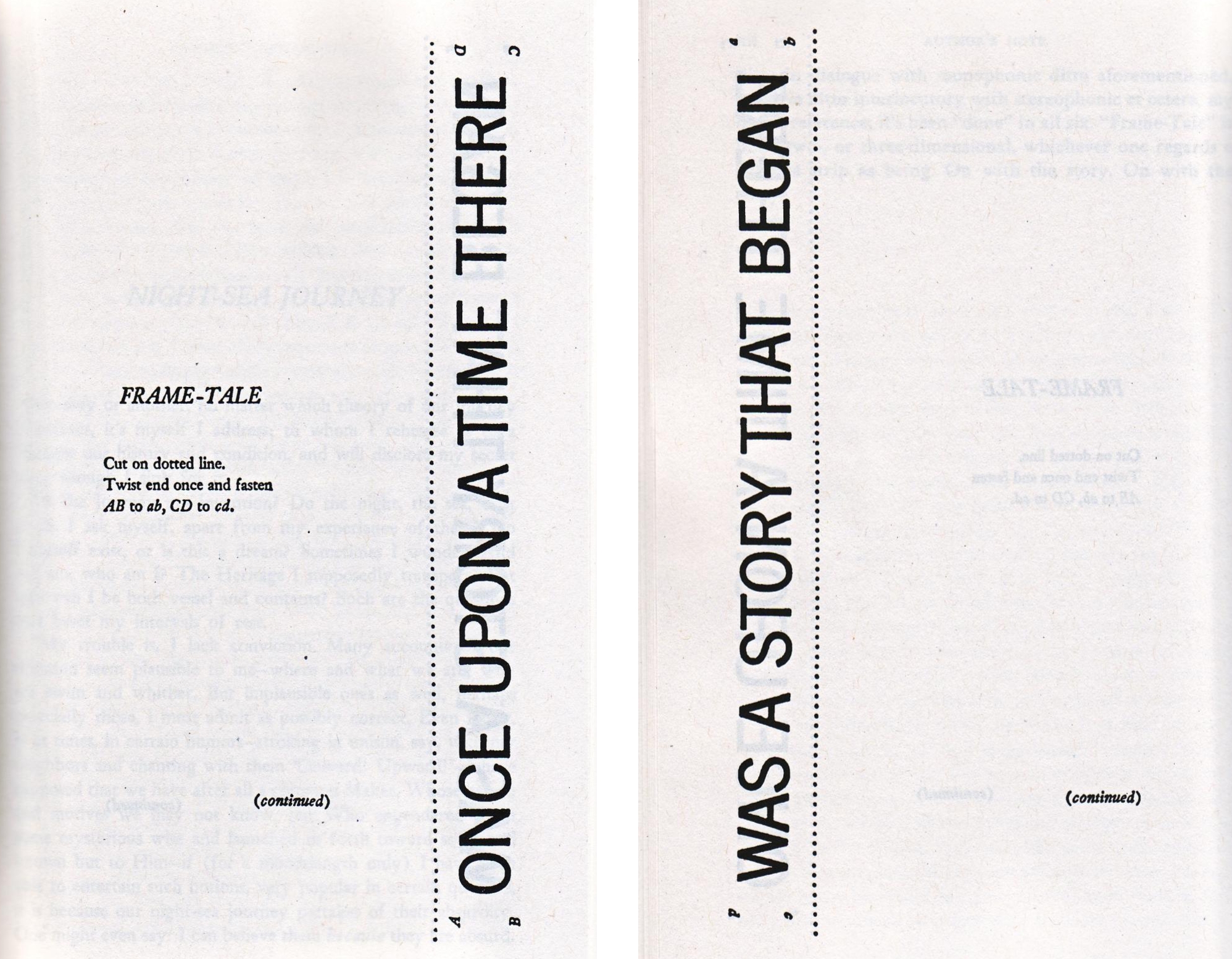
Like many readers, Barth’s 1960s and 1970s was a gateway drug for me to postmodernist writers like William Gaddis, Thomas Pynchon, William Gass, and Robert Coover. Most of that generation of American postmodernists are gone, but I like to think that their stories will go on. I’ll leave it with the opening piece from Lost in the Funhouse, “Frame-Tale.” The story never ends.
I couldn’t think of anything worth saying in literature that can’t be said in 806 pages | John Barth on The Recognitions

Q: Do you find some such qualities in a neglected novel, William Gaddis’ The Recognitions?

Barth: I know that book only by sight. 950 pages: longer than The Sot-Weed Factor. Somebody asked me to review the new reprint of it, but I said I couldn’t think of anything worth saying in literature that can’t be said in 806 pages.

John Barth’s brief description of Donald Barthelme’s so-called postmodernist dinners

1fa8c7cbf8dc977653f7750905725da4
Photograph from “The Postmodernists Dinner,” 1983 by Jill Krementz (b. 1940)

In John Barth’s 1989 New York Times eulogy for Donald Barthelme, Barth gives a brief description of two so-called postmodernist dinners, both of which I’ve written on this blog before.

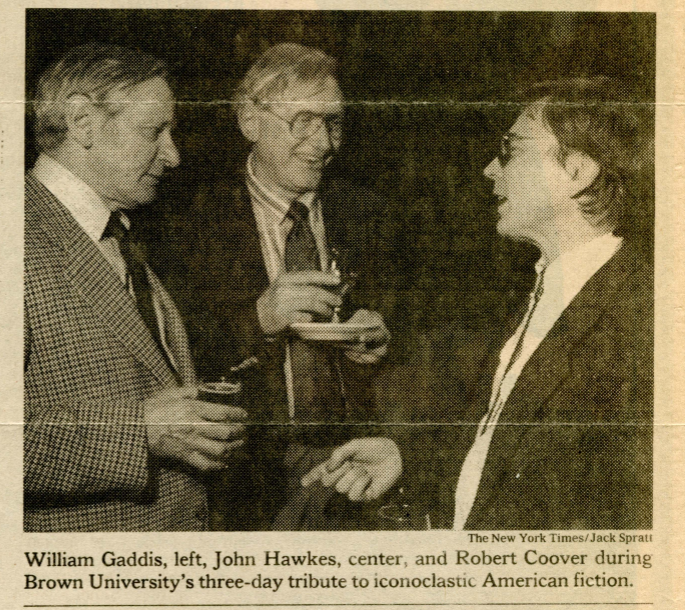
…though [Barthelme] tsked at the critical tendency to group certain writers against certain others ”as if we were football teams” – praising these as the true ”post-contemporaries” or whatever, and consigning those to some outer darkness of the passe – he freely acknowledged his admiration for such of his ”teammates,” in those critics’ view, as Robert Coover, Stanley Elkin, William Gaddis, William Gass, John Hawkes, Thomas Pynchon and Kurt Vonnegut, among others. A few springs ago, he and his wife, Marion, presided over a memorable Greenwich Village dinner party for most of these and their companions (together with his agent, Lynn Nesbit, whom Donald called ”the mother of postmodernism”). In 1988, on the occasion of John Hawkes’s academic retirement, Robert Coover impresarioed a more formal reunion of that team, complete with readings and symposia, at Brown University. Donald’s throat cancer had by then already announced itself – another, elsewhere, would be the death of him – but he gave one more of his perfectly antitheatrical virtuoso readings.

More on the first dinner here.

More on the second dinner here.

You don’t consciously see yourself as John Barth, the postmodernist?

Q: You don’t consciously see yourself as John Barth, the postmodernist?

JOHN BARTH: Oh no, no, and the term now has become so stretched out of shape. I did a good deal of reading on the subject for a postmodernist conference in Stuttgart back in 1991, and I think I had a fairly solid grasp of the term then. At the time, there seemed to be a general agreement that, whatever postmodernism was, it was made in America and studied in Europe. At my end, I would say the definitions advanced by such European intellectuals as Jean Baudrillard and Jean- Francois Lyotard have only a kind of a grand overlap with what I think I mean when I am talking about it.g about it. They apply the term to disciplines and fields other than art-their thoughts about postmodern science, for instance, are very interesting-but when the subject is postmodern American fiction, things get murkier. So often we’re told, “You know, it’s Coover, Pynchon, Barth, and Barthelme,” but that’s just pointing at writers. Perhaps that’s all you can do. It led me to say once, “If postmodern is what I am, then postmodernism is whatever I do.” You get a bit wary about these terms. When The Floating Opera came out, Leslie Fiedler called it “provincial American existentialism.” With End of the Road, I was most often described as a black humorist, and with The Sot-Weed Factor, Giles Goat-Boy, and Lost in the Funhouse, I became a fabulist. Bill Gass resists the term “postmodernist,” and I understand his resistance. But we need common words to talk about anything. “Impressionism” is a very useful term which helps describe the achievements of a number of important artists. But when you begin to look at individual impressionist painters, the term becomes less meaningful. You find yourself contemplating a group of artists who probably have as many differences as similarities. I recall a wonderful old philosophy professor of mine who used to talk about the difference between the synthetic temperament and the analytical temperament. With the synthetic, the similarities between things are more impressive than the differences; with the analytical, the differences are more impressive than the similarities. We need them both; you can’t do without either. In that context, once you’ve come up with some criteria that describe what has been going on in a certain type of fiction composed during the sixties, seventies, eighties, and nineties, I think the differences among Donald Barthelme, Angela Carter, and Italo Calvino are probably more interesting than the similarities.

From an interview with Barth conducted by Charlie Reilly in the journal Contemporary Literature, Vol. 41, No. 4 (Winter, 2000).

Books acquired, 26 Jan. 2024

Last Friday, I drove across a bridge to a library on the other side of the city for a Friends of the Library sale. I was hoping for a nice leisurely afternoon browse, figured I’d find a few titles worth my efforts, and I’d fill out the 10 dollar brown paper grocery bag with books I could trade for store credit elsewhere. I ended up filling the bag almost immediately, mostly with heavy hardbacks, resulting in my weak arm quickly settling into a painful fatigue that killed my browsing vibe.

Here are the books I picked up:

–A paperback copy of Thomas S. Klise’s cult classic The Last Western. It was in the “nonfiction” section, which I didn’t really browse that studiously, but its cover nevertheless stood out to me. I bought a copy of it from an online used bookseller online six years ago (and was very disappointed that the seller had appended a retail barcode sticker to its cover).

–A paperback omnibus of Salem Kirban’s early seventies “prophecy” apocalypse novels 666 and its sequel 1000. I’d thumbed through a worn copy of 666 sometime last year—the title of and its cracked spine calling to me from the shelf of the sci-fi section. Kirban’s “novel” is a millennialist screed conveyed in a tawdry postmodern manner, and it didn’t seem worth the eight bucks the used bookstore was asking at the time—but I didn’t mind snuggling it into the paper bag last Friday, oddity that it is.

–A hardback copy of Don DeLillo’s novel Zero K. I skipped it when it came out, and I don’t think DeLillo’s done anything good since Point Omega.

–A hardback copy of John Barth’s novel Every Third Thought. I think that Barth’s best work is decades behind him, but every now and then I try something newer, and this 2011 novel is one of his shorter recentish efforts.

–A hardback copy of Leni Zumas’ novel Red Clocks. I had never heard of this book, but the spine enticed me enough to pick it up when I was browsing the “sci fi” section at the booksale, and the premise–America has outlawed and criminalized abortion–seemed depressingly dystopian enough to take it with me.

–A hardback copy of Sven Birkert’s collection of literary criticism, An Artificial Wilderness. Includes chapters on Thomas Bernhard, Umberto Eco, Borges, and “The School of Gordon Lish” among many, many others.

–A Vintage Contemporaries Edition of Raymond Carver’s Where I’m Calling From, a collection I have not read in over two decades.

–A hardback copy of Jesse Ball’s novel How to Set a Fire and Why. I liked his 2011 novel The Curfew, so maybe I’ll like this?

–A hardback copy of Jeanette Winterson’s novel Frankisstein; reviews of this 2019 novel intrigued me at the time it was published (and I do like a good Frankenstein riff).

–A hardback copy of Robert Coover’s novel Huck Out West. An amazing sequel to Twain’s novel; I reviewed it on this site years ago. This handsome edition shall replace the ugly advance copy I got years ago. I might need to revisit it in anticipation of Percival Everett’s take on Twain’s Huck’s Jim—James.

–A hardback copy of Lawrence Ferlinghetti’s late novel Little Boy, which The Guardian described as a “novel-cum-memoir-cum-grand finale.” (Too much cum, The Guardian.)

–A Library of America edition of The Complete Novels of Eudora Welty. I hate to admit what I will now admit: I love love love Welty’s short stories, but have never read one of her novels.

–A hardback copy of Walker Percy’s Thanatos Syndrome. Again, a late-period work by old master, likely not his finest stuff, but hey. I burned through his first four novels a few years ago—Lancelot was my favorite.

HELP! A Stereophonic Narrative for Authorial Voice — John Barth


“HELP! A Stereophonic Narrative for Authorial Voice” by John Barth.

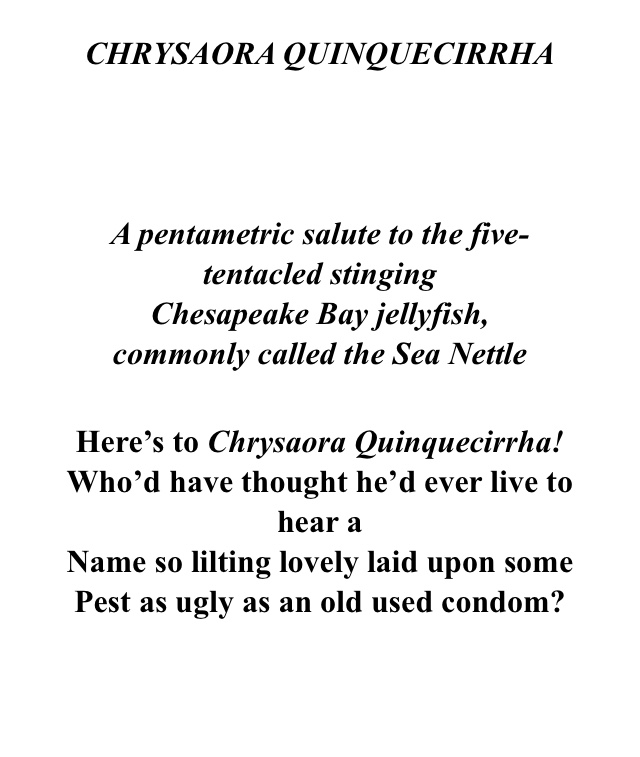
“Chrysaora Quinquecirrha” — John Barth

You don’t consciously see yourself as John Barth, the postmodernist?

Q: You don’t consciously see yourself as John Barth, the postmodernist?

JOHN BARTH: Oh no, no, and the term now has become so stretched out of shape. I did a good deal of reading on the subject for a postmodernist conference in Stuttgart back in 1991, and I think I had a fairly solid grasp of the term then. At the time, there seemed to be a general agreement that, whatever postmodernism was, it was made in America and studied in Europe. At my end, I would say the definitions advanced by such European intellectuals as Jean Baudrillard and Jean- Francois Lyotard have only a kind of a grand overlap with what I think I mean when I am talking about it.g about it. They apply the term to disciplines and fields other than art-their thoughts about postmodern science, for instance, are very interesting-but when the subject is postmodern American fiction, things get murkier. So often we’re told, “You know, it’s Coover, Pynchon, Barth, and Barthelme,” but that’s just pointing at writers. Perhaps that’s all you can do. It led me to say once, “If postmodern is what I am, then postmodernism is whatever I do.” You get a bit wary about these terms. When The Floating Opera came out, Leslie Fiedler called it “provincial American existentialism.” With End of the Road, I was most often described as a black humorist, and with The Sot-Weed Factor, Giles Goat-Boy, and Lost in the Funhouse, I became a fabulist. Bill Gass resists the term “postmodernist,” and I understand his resistance. But we need common words to talk about anything. “Impressionism” is a very useful term which helps describe the achievements of a number of important artists. But when you begin to look at individual impressionist painters, the term becomes less meaningful. You find yourself contemplating a group of artists who probably have as many differences as similarities. I recall a wonderful old philosophy professor of mine who used to talk about the difference between the synthetic temperament and the analytical temperament. With the synthetic, the similarities between things are more impressive than the differences; with the analytical, the differences are more impressive than the similarities. We need them both; you can’t do without either. In that context, once you’ve come up with some criteria that describe what has been going on in a certain type of fiction composed during the sixties, seventies, eighties, and nineties, I think the differences among Donald Barthelme, Angela Carter, and Italo Calvino are probably more interesting than the similarities.

From an interview with Barth conducted by Charlie Reilly in the journal Contemporary Literature, Vol. 41, No. 4 (Winter, 2000).

John Barth’s brief description of Donald Barthelme’s so-called postmodernist dinners

1fa8c7cbf8dc977653f7750905725da4
Photograph from “The Postmodernists Dinner,” 1983 by Jill Krementz (b. 1940)

In John Barth’s 1989 New York Times eulogy for Donald Barthelme, Barth gives a brief description of two so-called postmodernist dinners, both of which I’ve written on this blog before.

…though [Barthelme] tsked at the critical tendency to group certain writers against certain others ”as if we were football teams” – praising these as the true ”post-contemporaries” or whatever, and consigning those to some outer darkness of the passe – he freely acknowledged his admiration for such of his ”teammates,” in those critics’ view, as Robert Coover, Stanley Elkin, William Gaddis, William Gass, John Hawkes, Thomas Pynchon and Kurt Vonnegut, among others. A few springs ago, he and his wife, Marion, presided over a memorable Greenwich Village dinner party for most of these and their companions (together with his agent, Lynn Nesbit, whom Donald called ”the mother of postmodernism”). In 1988, on the occasion of John Hawkes’s academic retirement, Robert Coover impresarioed a more formal reunion of that team, complete with readings and symposia, at Brown University. Donald’s throat cancer had by then already announced itself – another, elsewhere, would be the death of him – but he gave one more of his perfectly antitheatrical virtuoso readings.

More on the first dinner here.

More on the second dinner here.

Five books Donald Barthelme recommended to the attention of aspiring American fiction writers

I have heard Donald referred to as essentially a writer of the American 1960’s. It may be true that his alloy of irrealism and its opposite is more evocative of that fermentatious decade, when European formalism had its belated flowering in North American writing, than of the relatively conservative decades since. But his literary precursors antedate the century, not to mention its 60’s, and are mostly non-American. ”How come you write the way you do?” a Johns Hopkins apprentice writer once asked him. ”Because Samuel Beckett already wrote the way he did,” Barthelme replied. He then produced for the seminar his ”short list”: five books he recommended to the attention of aspiring American fiction writers. No doubt the list changed from time to time; just then it consisted of Rabelais’s ”Gargantua and Pantagruel,” Laurence Sterne’s ”Tristram Shandy,” the stories of Heinrich von Kleist, Flaubert’s ”Bouvard and Pecuchet” and Flann O’Brien’s ”At Swim-Two-Birds” – a fair sample of the kind of nonlinear narration, sportive form and cohabitation of radical fantasy with quotidian detail that mark his own fiction. He readily admired other, more ”traditional” writers, but it is from the likes of these that he felt his genealogical descent.

From John Barth’s 1989 eulogy for Donald Barthelme, first published in The New York Times.

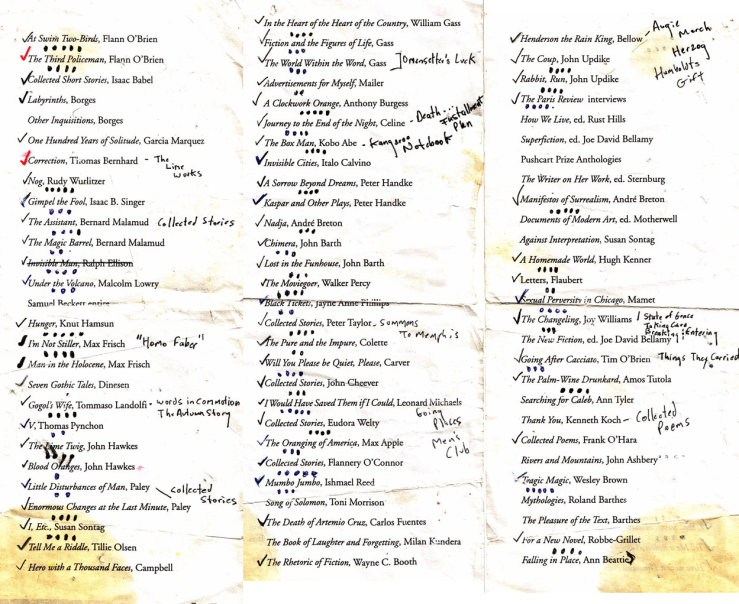
Barthelme had a longer list too, of course:

Three Books (Books acquired, 16 Oct. 2020–John Barth, Walker Percy, and Padgett Powell)

Chimera by John Barth. First edition 1973 hardback from Random House. Jacket design by George Giusti.

I couldn’t pass up this pristine first edition Barth today when browsing the used bookstore with my kids. I first read Chimera twenty or more years ago, as an undergrad, and it broke my brain a bit.

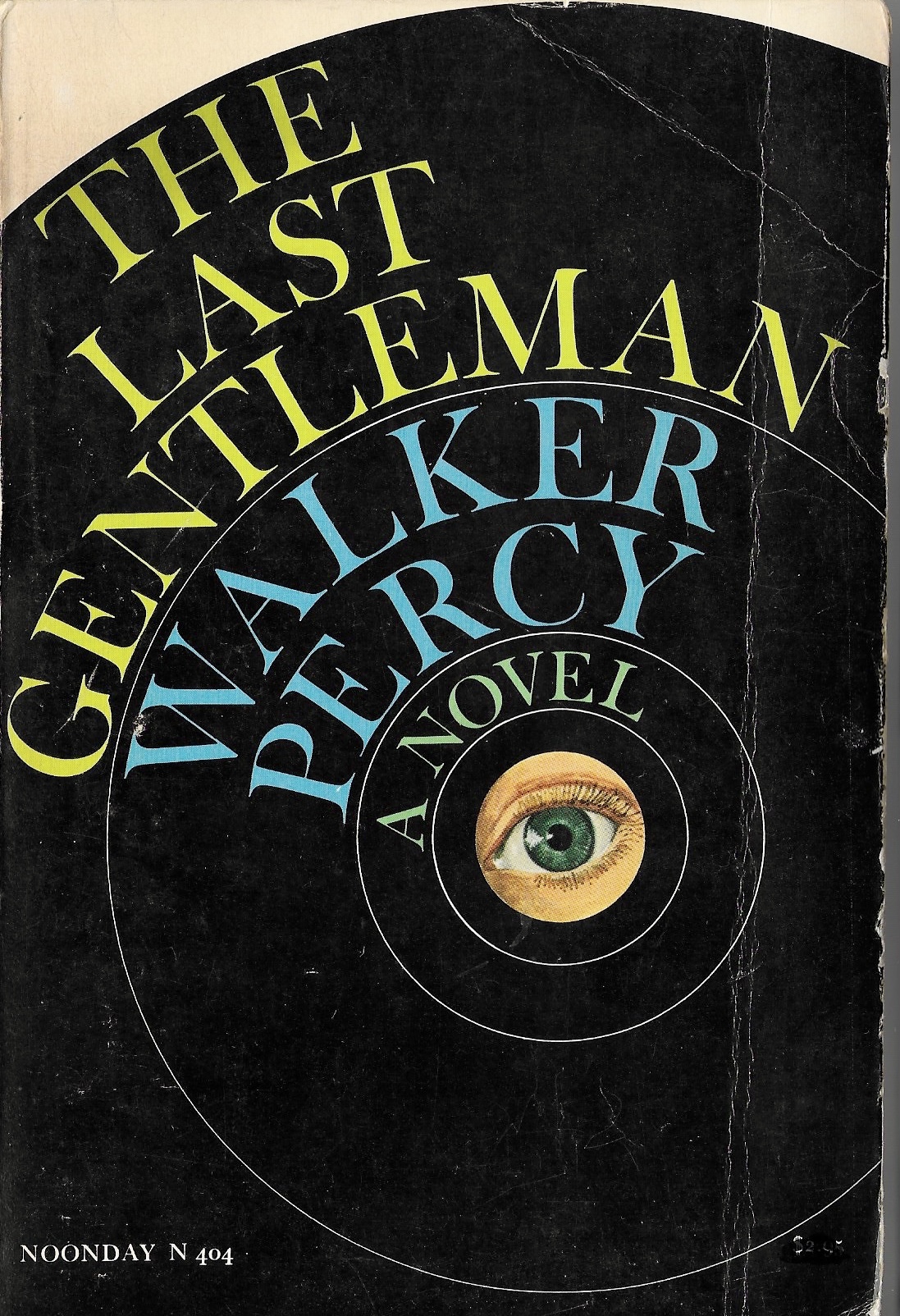
The Last Gentleman by Walker Percy. Second printing 1972 trade paperback from Noonday. Cover design by Janet Halverson.

Earlier this year in the same used bookshop I came across a first edition hardback copy of Percy’s 1971 novel Love in the Ruins. I hadn’t read Percy at the time (I’ve since loved his later novel Lancelot and been kinda sorta iffy on his famous debut The Moviegoer), but Janet Halverson’s oh-so-seventies Schoolhouse Rock!ish cover grabbed my attention. I really wish I’d bought it now (I think it was six bucks). Two weeks ago I came across two more Percys (Percies?) with Halverson covers, but let them be. But not today—at least not for this copy of The Last Gentleman.

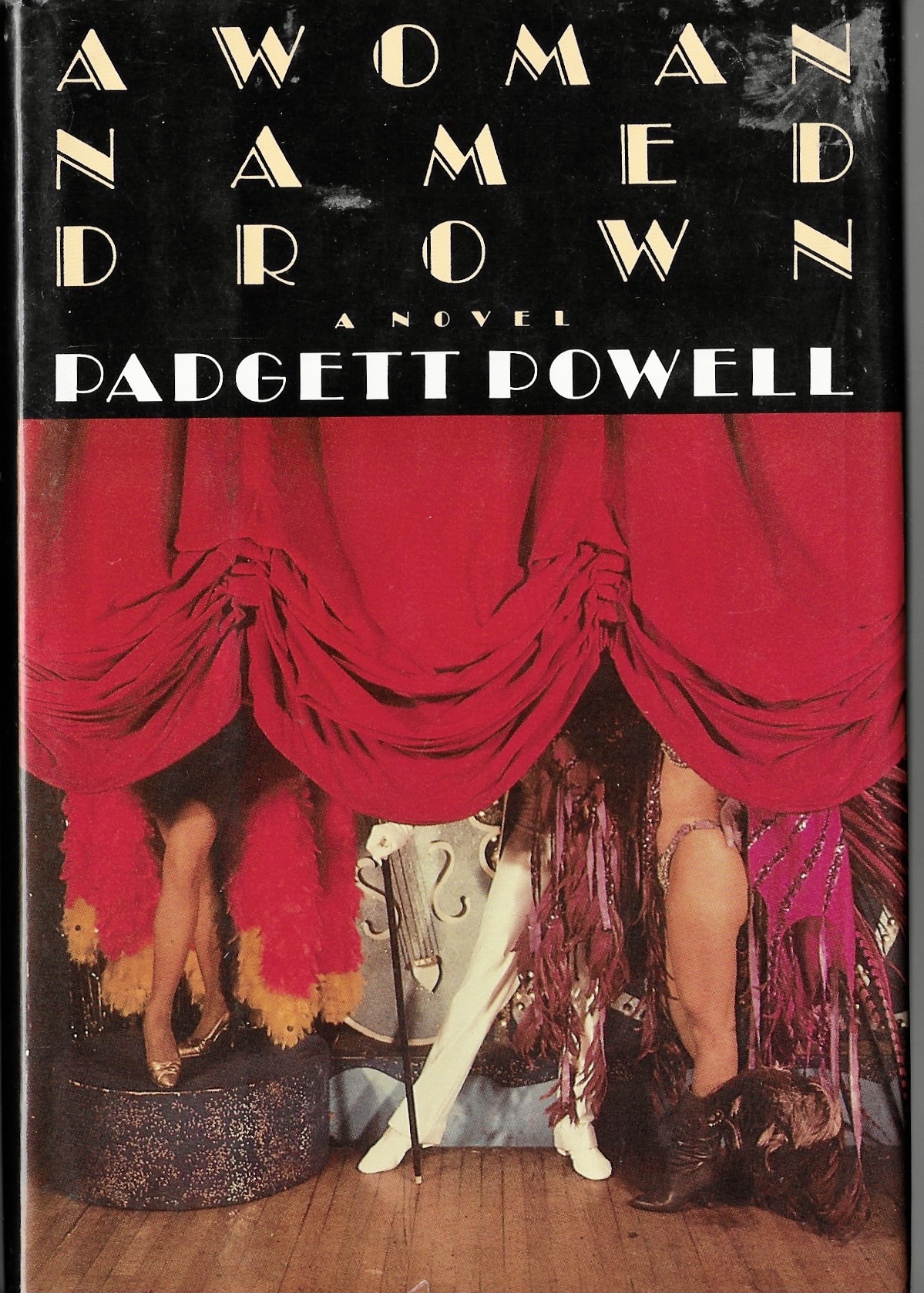
A Woman Named Drown by Padgett Powell. First edition 1987 hardback from FS&G.. Jacket design by Cynthia Krupat, using a photograph by William Wegman.

On the aforementioned-fortnight-last trip to the bookstore, I picked up, somewhat at random, Padgett Powell’s first novel Edisto. I finished it in three days, enjoying it very much, so I couldn’t pass up this copy of his slim second novel today.