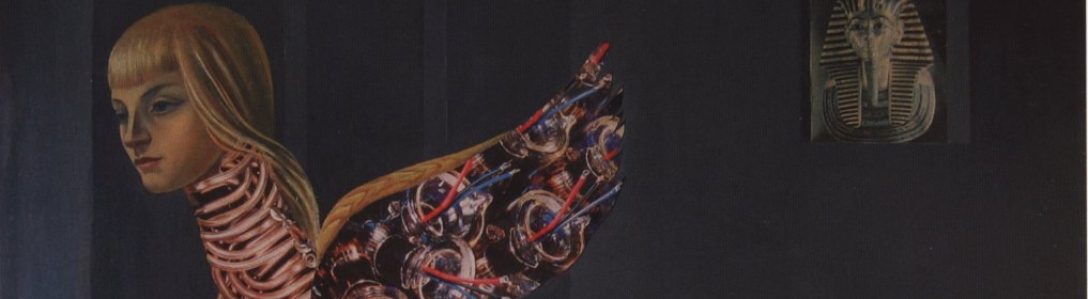
Nathaniel Hawthorne’s journal entry for July 4th, 1838

July 4th.–A very hot, bright, sunny day; town much thronged; booths on the Common, selling gingerbread, sugar-plums, and confectionery, spruce beer, lemonade. Spirits forbidden, but probably sold stealthily. On the top of one of the booths a monkey, with a tail two or three feet long. He is fastened by a cord, which, getting tangled with the flag over the booth, he takes hold and tries to free it. He is the object of much attention from the crowd, and played with by the boys, who toss up gingerbread to him, while he nibbles and throws it down again. He reciprocates notice, of some kind or other, with all who notice him. There is a sort of gravity about him. A boy pulls his long tail, whereat he gives a slight squeak, and for the future elevates it as much as possible. Looking at the same booth by and by, I find that the poor monkey has been obliged to betake himself to the top of one of the wooden joists that stick up high above. There are boys going about with molasses candy, almost melted down in the sun. Shows: A mammoth rat; a collection of pirates, murderers, and the like, in wax. Constables in considerable number, parading about with their staves, sometimes conversing with each other, producing an effect by their presence, without having to interfere actively. One or two old salts, rather the worse for liquor: in general the people are very temperate. At evening the effect of things rather more picturesque; some of the booth-keepers knocking down the temporary structures, and putting the materials in wagons to carry away; other booths lighted up, and the lights gleaming through rents in the sail-cloth tops. The customers are rather riotous, calling loudly and whimsically for what they want; a young fellow and a girl coming arm in arm; two girls approaching the booth, and getting into conversation with the folks thereabout. Perchance a knock-down between two half-sober fellows in the crowd: a knock-down without a heavy blow, the receiver being scarcely able to keep his footing at any rate. Shoutings and hallooings, laughter, oaths,–generally a good-natured tumult; and the constables use no severity, but interfere, if at all, in a friendly sort of way. I talk with one about the way in which the day has passed, and he bears testimony to the orderliness of the crowd, but suspects one booth of selling liquor, and relates one scuffle. There is a talkative and witty seller of gingerbread holding forth to the people from his cart, making himself quite a noted character by his readiness of remark and humor, and disposing of all his wares. Late in the evening, during the fire-works, people are consulting how they are to get home,–many having long miles to walk: a father, with wife and children, saying it will be twelve o’clock before they reach home, the children being already tired to death. The moon beautifully dark-bright, not giving so white a light as sometimes. The girls all look beautiful and fairy-like in it, not exactly distinct, nor yet dim. The different characters of female countenances during the day,–mirthful and mischievous, slyly humorous, stupid, looking genteel generally, but when they speak often betraying plebeianism by the tones of their voices. Two girls are very tired,–one a pale, thin, languid-looking creature; the other plump, rosy, rather overburdened with her own little body. Gingerbread figures, in the shape of Jim Crow and other popularities.

In the old burial ground, Charter Street, a slate gravestone, carved round the borders, to the memory of “Colonel John Hathorne, Esq.,” who died in 1717. This was the witch-judge. The stone is sunk deep into the earth, and leans forward, and the grass grows very long around it; and, on account of the moss, it was rather difficult to make out the date. Other Hathornes lie buried in a range with him on either side. In a corner of the burial-ground, close under Dr. P—-‘s garden fence, are the most ancient stones remaining in the graveyard; moss-grown, deeply sunken. One to “Dr. John Swinnerton, Physician,” in 1688; another to his wife. There, too, is the grave of Nathaniel Mather, the younger brother of Cotton, and mentioned in the Magnalia as a hard student, and of great promise. “An aged man at nineteen years,” saith the gravestone. It affected me deeply, when I had cleared away the grass from the half-buried stone, and read the name. An apple-tree or two hang over these old graves, and throw down the blighted fruit on Nathaniel Mather’s grave,–he blighted too. It gives strange ideas, to think how convenient to Dr. P—-‘s family this burial-ground is,–the monuments standing almost within arm’s reach of the side windows of the parlor,–and there being a little gate from the back yard through which we step forth upon those old graves aforesaid. And the tomb of the P. family is right in front, and close to the gate. It is now filled, the last being the refugee Tory, Colonel P—-, and his wife. M. P—- has trained flowers over this tomb, on account of her friendly relations with Colonel P—-.

It is not, I think, the most ancient families that have tombs,–their ancestry for two or three generations having been reposited in the earth before such a luxury as a tomb was thought of. Men who founded families, and grew rich, a century or so ago, were probably the first.

There is a tomb of the Lyndes, with a slab of slate affixed to the brick masonry on one side, and carved with a coat of arms.

Nathaniel Hawthorne’s journal entry for July 4th, 1838. From Passages from the American Note-Books.

“July Stories” — Roberto Bolaño

July has been a strange month. The other day I went to the beach and I saw a woman of about thirty, pretty, wearing a black bikini, who was reading standing up. At first I thought she was about to lie down on her towel, but when I looked again she was still standing, and after that I didn’t take my eyes off her. For two hours, more or less, she read standing up, walked over to the water, didn’t go in, let the waves lap her shins, went back to her spot, kept reading, occasionally put the book down while still standing, leaned over a few times and took a big bottle of Pepsi out of a bag and drank, then picked up the book again, and, finally, without ever bending a knee, put her things away and left. Earlier the same day, I saw three girls, all in thongs, gorgeous, one of them had a tattoo on one buttock, they were having a lively conversation, and every once in a while they got in the water and swam and then they would lie down again on their mats, basically a completely normal scene, until all of a sudden, a cell phone rang, I heard it and thought it was mine until I realized it had been a while since I had a cell phone, and then I knew the phone belonged to one of them. I heard them talking. All I can say is that they weren’t speaking Catalan or Spanish. But they sounded deadly serious. Then I watched two of them get up, like zombies, and walk toward some rocks. I got up too and pretended to brush the sand off my trunks. On the rocks, I watched them talk to a huge, hideously ugly man covered in hair, in fact one of the hairiest men I’ve ever seen in my life. They knelt before him and listened attentively without saying a word, and then they went back to where their friend was waiting for them and everything went on as before, as if nothing had happened. Who are these women? I asked myself once it was dark and I had showered and dressed. One drank Pepsi. The others bowed down to a bear. I know who they are. But I don’t really know.

From Roberto Bolaño’s Between Parentheses: Essays, Articles and Speeches, 1998-2003.

A graceful little beast | Nathaniel Hawthorne’s journal entry for June 18, 1838

 June 18th.–A walk in North Salem in the decline of yesterday afternoon,–beautiful weather, bright, sunny, with a western or northwestern wind just cool enough, and a slight superfluity of heat. The verdure, both of trees and grass, is now in its prime, the leaves elastic, all life. The grass-fields are plenteously bestrewn with white-weed, large spaces looking as white as a sheet of snow, at a distance, yet with an indescribably warmer tinge than snow,–living white, intermixed with living green. The hills and hollows beyond the Cold Spring copiously shaded, principally with oaks of good growth, and some walnut-trees, with the rich sun brightening in the midst of the open spaces, and mellowing and fading into the shade,–and single trees, with their cool spot of shade, in the waste of sun: quite a picture of beauty, gently picturesque. The surface of the land is so varied, with woodland mingled, that the eye cannot reach far away, except now and then in vistas perhaps across the river, showing houses, or a church and surrounding village, in Upper Beverly. In one of the sunny bits of pasture, walled irregularly in with oak-shade, I saw a gray mare feeding, and, as I drew near, a colt sprang up from amid the grass,–a very small colt. He looked me in the face, and I tried to startle him, so as to make him gallop; but he stretched his long legs, one after another, walked quietly to his mother, and began to suck,–just wetting his lips, not being very hungry. Then he rubbed his head, alternately, with each hind leg. He was a graceful little beast.

I bathed in the cove, overhung with maples and walnuts, the water cool and thrilling. At a distance it sparkled bright and blue in the breeze and sun. There were jelly-fish swimming about, and several left to melt away on the shore. On the shore, sprouting amongst the sand and gravel, I found samphire, growing somewhat like asparagus. It is an excellent salad at this season, salt, yet with an herb-like vivacity, and very tender. I strolled slowly through the pastures, watching my long shadow making grave, fantastic gestures in the sun. It is a pretty sight to see the sunshine brightening the entrance of a road which shortly becomes deeply overshadowed by trees on both sides. At the Cold Spring, three little girls, from six to nine, were seated on the stones in which the fountain is set, and paddling in the water. It was a pretty picture, and would have been prettier, if they had shown bare little legs, instead of pantalets. Very large trees overhung them, and the sun was so nearly gone down that a pleasant gloom made the spot sombre, in contrast with these light and laughing little figures. On perceiving me, they rose up, tittering among themselves. It seemed that there was a sort of playful malice in those who first saw me; for they allowed the other to keep on paddling, without warning her of my approach. I passed along, and heard them come chattering behind.

Nathaniel Hawthorne’s journal entry for June 15, 1838. From Passages from the American Note-Books.
A reading madman about to lose his soul to the seductions of a sentence (William H. Gass)

Stendhal’s The Red and the Black

Boston, 1943. I am about to go down to the submarine base to test out for the school there. I have come into possession of the Liveright Black and Gold edition. (What a wonderful series. I loved them all. There was Jules Romain’s The Body’s Rapture, a kooky, overwrought book, I know now, but it was sex, and it was French. There was Remy de Gourmont’s The Natural Philosophy of Love, more sex, more French. There was Balzac’s The Physiology of Marriage, more sex, more French. There was Stendhal’s own On Love, ditto. There was The Collected Works of Pierre Loüys, double dots, double ditto. There was Alexandre Dumas’s The Journal of Madame Giovanni, which was simply French, a disappointment. And The Red and the Black, like checker squares.) Anyway, I am lining up New London in my train table’s sights, and scanning the novel I have bought because of the series it is in, thinking that I’m not going to like climbing a rope through all that water, and thinking that the first chapter, a description of a small town, is commonplace, ho-hum, and will I be put in a pressure chamber at sub school like a canned tomato? When suddenly, I am suckered into Stendhal, and no longer read words (against all the rules of right reading I will later give myself), but barrel along like my own train, a runaway, holding my breath oftener and oftener, aware only of a insistently increasing tension, and it is not because I am underwater; it is because I am inside the magic of this narrative master. The Charterhouse of Parma would do exactly the same thing to me, except that I didn’t let a sub school come between us, but covered its lengthy length as nearly in one sitting as might be managed, snacking at the edge of it as though it were on a TV tray. That sort of gluttonous read is rare, and never happens to me now, when I read, because I read to write or teach or otherwise to talk, and not because I am a reading madman about to lose his soul to the seductions of a sentence.

From William H. Gass’s “Fifty Literary Pillars,” part of A Temple of Texts (2006). The essay in question is not so much an essay as it is/was a catalog to “inaugurate the International Writers Center” at Washington University.

The last sentence is what matters most to me; when I read it I nodded, or maybe didn’t nod, maybe just acquiesced in some other way, physically.

Who wouldn’t love to read like that again?

(Maybe persons young enough to not know that they are in fact reading like madpersons, seduced, etc.).

I tip my glass for gluttonous reads.

I would love to be a reading madman again, and not one who reads to write or read or otherwise talk.


Men will the laws of nature (From Stanley Elkin’s novel The Franchiser)

They drove up to the Broadmoor, a pink Monaco castle at the foot of the Rockies, and he showed her the hotel in a proprietary way, taking her through the nifty Regency public rooms with their beautiful sofas, the striped, silken upholstery like tasteful flags. He showed her huge tiaras of chandelier, soft plush carpets. “Yes,” she said, “carpets were our first floors, our first highways.”

“I didn’t know that.”

“We call the rug in the hall a ‘runner.’ It’s where the runners or messengers waited in the days of kings and emperors.”

“I never made the connection.”

“It’s an insight. Chandeliers must have come in with the development of lens astronomy at the beginning of the seventeenth century. I should think it was an attempt to mimic rather than parody the order of the heavens, to bring the solar system indoors.”

“Really?”

“Well, where, to simple people, would the universe seem to go during the daylight hours, Ben?”

“But chandeliers give light.”

“Not during the daytime. The chandelier is a complex invention—a sculpture of the invisible stars by day, a pragmatic mechanism by night. But a much less daring device finally than carpeting.”

“Why, Patty?”

“Because carpeting—think of Oriental rugs—was always primarily ornamental and decorative. It was a deliberate expression of what ground—our first flooring, remember, and incidentally we have to regard tile, too, as a type of carpeting—ought to be in a perfect world. Order, symmetry, design. And since rugs came in before lens telescopy, how could they know? Oh, carpeting’s much more daring. A leap of will.”

“Of will?”

“Men will the laws of nature.”

From Stanley Elkin’s 1976 novel The Franchiser.


From this darkness packs of mad dogs will emerge, vipers, scorpions, enormous sea serpents (From Ferrante’s The Story of a New Name)

I made the dark descent. Now the moon was visible amid scattered pale-edged clouds; the evening was very fragrant, and you could hear the hypnotic rhythm of the waves. On the beach I took off my shoes, the sand was cold, a gray-blue light extended as far as the sea and then spread over its tremulous expanse. I thought: yes, Lila is right, the beauty of things is a trick, the sky is the throne of fear; I’m alive, now, here, ten steps from the water, and it is not at all beautiful, it’s terrifying; along with this beach, the sea, the swarm of animal forms, I am part of the universal terror; at this moment I’m the infinitesimal particle through which the fear of every thing becomes conscious of itself; I; I who listen to the sound of the sea, who feel the dampness and the cold sand; I who imagine all Ischia, the entwined bodies of Nino and Lila, Stefano sleeping by himself in the new house that is increasingly not so new, the furies who indulge the happiness of today to feed the violence of tomorrow. Ah, it’s true, my fear is too great and so I hope that everything will end soon, that the figures of the nightmares will consume my soul. I hope that from this darkness packs of mad dogs will emerge, vipers, scorpions, enormous sea serpents. I hope that while I’m sitting here, on the edge of the sea, assassins will arrive out of the night and torture my body. Yes, yes, let me be punished for my insufficiency, let the worst happen, something so devastating that it will prevent me from facing tonight, tomorrow, the hours and days to come, reminding me with always more crushing evidence of my unsuitable constitution. Thoughts like that I had, the frenzied thoughts of girlish discouragement. I gave myself up to them, for I don’t know how long.

From Elena Ferrante’s 2012 novel The Story of a New Name. English translation by Ann Goldstein.

Nathaniel Hawthorne’s journal entry for May 11, 1838

May 11, 1838.–At Boston last week. Items:–A young man, with a small mustache, dyed brown, reddish from its original light color. He walks with an affected gait, his arms crooked outwards, treading much on his toes. His conversation is about the theatre, where he has a season ticket,–about an amateur who lately appeared there, and about actresses, with other theatrical scandal.–In the smoking-room, two checker and backgammon boards; the landlord a great player, seemingly a stupid man, but with considerable shrewdness and knowledge of the world.– F—-, the comedian, a stout, heavy-looking Englishman, of grave deportment, with no signs of wit or humor, yet aiming at both in conversation, in order to support his character. Very steady and regular in his life, and parsimonious in his disposition,–worth $50,000, made by his profession.–A clergyman, elderly, with a white neck-cloth, very unbecoming, an unworldly manner, unacquaintance with the customs of the house, and learning them in a childlike way. A ruffle to his shirt, crimped.–A gentleman, young, handsome, and sea-flushed, belonging to Oswego, New York, but just arrived in port from the Mediterranean: he inquires of me about the troubles in Canada, which were first beginning to make a noise when he left the country,–whether they are all over. I tell him all is finished, except the hanging of the prisoners. Then we talk over the matter, and I tell him the fates of the principal men,–some banished to New South Wales, one hanged, others in prison, others, conspicuous at first, now almost forgotten.–Apartments of private families in the hotel,–what sort of domesticity there may be in them; eating in public, with no board of their own. The gas that lights the rest of the house lights them also, in the chandelier from the ceiling.–A shabby-looking man, quiet, with spectacles, at first wearing an old, coarse brown frock, then appearing in a suit of elderly black, saying nothing unless spoken to, but talking intelligently when addressed. He is an editor, and I suppose printer, of a country paper. Among the guests, he holds intercourse with gentlemen of much more respectable appearance than himself, from the same part of the country.–Bill of fare; wines printed on the back, but nobody calls for a bottle. Chairs turned down for expected guests. Three-pronged steel forks. Cold supper from nine to eleven P.M. Great, round, mahogany table, in the sitting-room, covered with papers. In the morning, before and soon after breakfast, gentlemen reading the morning papers, while others wait for their chance, or try to pick out something from the papers of yesterday or longer ago. In the forenoon, the Southern papers are brought in, and thrown damp and folded on the table. The eagerness with which those who happen to be in the room start up and make prize of them. Play-bills, printed on yellow paper, laid upon the table. Towards evening comes the “Transcript.”

Nathaniel Hawthorne’s journal entry for May 11, 1848. From Passages from the American Note-Books.
The body of the bride Lila appeared cruelly shredded (From Elena Ferrante’s novel The Story of a New Name)

It was a beautiful warm evening; the brilliant lights of the shop’s interior spread their glow into the square. The gigantic image of Lila in her wedding dress could be seen at a distance, leaning against the center wall. Stefano parked, we went in, making our way among the boxes of shoes, piled up haphazardly, cans of paint, ladders. Marcello, Rino, Gigliola, and Pinuccia were visibly irritated: for varying reasons they had no wish to submit yet again to Lila’s caprices. The only one who greeted us cordially was Michele, who turned to my friend with a mocking laugh. “Lovely signora, will you let us know, at last, what you have in mind or do you just want to ruin the evening?”

Lila looked at the panel leaning against the wall, asked them to lay it on the floor. Marcello said cautiously, with the dark timidity that he always showed toward Lila, “What for?”

“I’ll show you.”

Rino interrupted: “Don’t be an idiot, Lina. You know how much this thing cost? If you ruin it, you’re in trouble.”

The Solaras laid the image on the floor. Lila looked around, with her brow furrowed, her eyes narrowed. She was looking for something that she knew was there, that perhaps she had bought herself. In a corner she spied a roll of black paper, and she took a pair of big scissors and a box of drawing pins from a shelf. Then, with that expression of extreme concentration which enabled her to isolate herself from everything around her, she went back to the panel. Before our astonished and, in the cases of some, openly hostile eyes, she cut strips of black paper, with the manual precision she had always possessed, and pinned them here and there to the photograph, asking for my help with slight gestures or quick glances.

I joined in with the devotion that I had felt ever since we were children. Those moments were thrilling, it was a pleasure to be beside her, slipping inside her intentions, to the point of anticipating her. I felt that she was seeing something that wasn’t there, and that she was struggling to make us see it, too. I was suddenly happy, feeling the intensity that invested her, that flowed through her fingers as they grasped the scissors, as they pinned the black paper.

Finally, she tried to lift the canvas, as if she were alone in that space, but she couldn’t. Marcello readily intervened, I intervened, we leaned it against the wall. Then we all backed up toward the door, some sneering, some grim, some appalled. The body of the bride Lila appeared cruelly shredded. Much of the head had disappeared, as had the stomach. There remained an eye, the hand on which the chin rested, the brilliant stain of the mouth, the diagonal stripe of the bust, the line of the crossed legs, the shoes.

Gigliola began, scarcely containing her rage: “I cannot put a thing like that in my shop.”

“I agree,” Pinuccia exploded. “We have to sell here, and with that grotesque thing people will run away. Rino, say something to your sister, please.”

Rino pretended to ignore her, but he turned to Stefano as if his brother-in-law were to blame for what was happening. “I told you, you can’t reason with her. You have to say yes, no, and that’s it, or you see what happens? It’s a waste of time.”

Stefano didn’t answer, he stared at the panel leaning against the wall and it was evident that he was looking for a way out. He asked me, “What do you think, Lenù?”

I said in Italian, “To me it seems very beautiful. Of course, I wouldn’t want it in the neighborhood, that’s not the right place for it. But here it’s something else, it will attract attention, it will please. In Confidenze just last week I saw that in Rossano Brazzi’s house there is a painting like this.”

Hearing that, Gigliola got even angrier. “What do you mean? That Rossano Brazzi knows what’s what, that you two know everything, and Pinuccia and I don’t?”

At that point I felt the danger. I had only to glance at Lila to realize that, if when we arrived at the shop she had really felt willing to give in should the attempt prove fruitless, now that the attempt had been made and had produced that image of disfigurement she wouldn’t yield an inch. Those minutes of work on the picture had broken ties: at that moment she was overwhelmed by an exaggerated sense of herself, and it would take time for her to retreat into the dimension of the grocer’s wife, she wouldn’t accept a sigh of dissent. In fact, while Gigliola was speaking, she was already muttering: Like this or not at all. And she wanted to quarrel, she wanted to break, shatter, she would have happily hurled herself at Gigliola with the scissors.

From Elena Ferrante’s 2012 novel The Story of a New Name. English translation by Ann Goldstein. I’m not sure how well the passage stands free of any context—I know there are a lot of characters here with backgrounds that won’t be clear to anyone who hasn’t read Ferrante’s novel (read it!)—but I love this passage, where brilliant friends Lila and Lenù collaborate to turn advertising into art, to artistically—and violently, perhaps—erase Lila’s body from the patriarchal order into which she has been inscribed.

William T. Vollmann talks sex and death; reads from Last Stories and Other Stories

Sadko in the Underwater Kingdom — Ilya Repin

8Oˆ

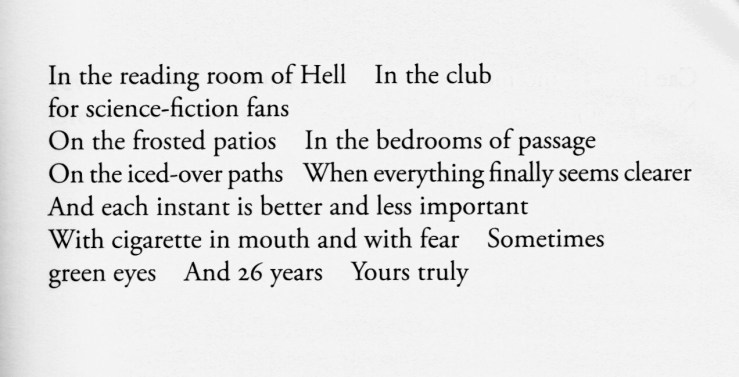
“In the reading room of Hell” — Roberto Bolaño

img_2118-1

Stanley Elkin and William Gass on the mythic mode, Faulkner, etc.

From Washington University’s marvelous Modern Literature Collection YouTube channel.

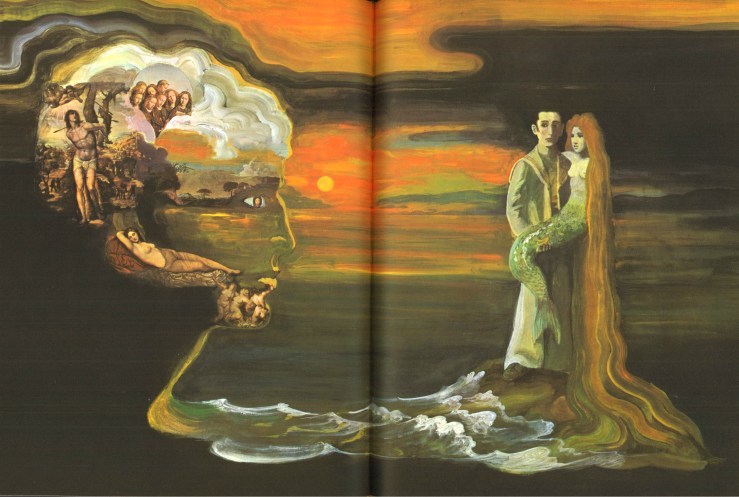
Illustration for Oscar Wilde’s “The Fisherman and His Soul” — James Hill

fisherman and his soul
James Hill’s illustration for “The Fisherman and His Soul” by Oscar Wilde. From The Short Stories of Oscar Wilde, Heritage Press, 1968. 

“The Fisherman and His Soul”

by

Oscar Wilde


Every evening the young Fisherman went out upon the sea, and threw his nets into the water.

When the wind blew from the land he caught nothing, or but little at best, for it was a bitter and black-winged wind, and rough waves rose up to meet it.  But when the wind blew to the shore, the fish came in from the deep, and swam into the meshes of his nets, and he took them to the market-place and sold them.

Every evening he went out upon the sea, and one evening the net was so heavy that hardly could he draw it into the boat.  And he laughed, and said to himself, ‘Surely I have caught all the fish that swim, or snared some dull monster that will be a marvel to men, or some thing of horror that the great Queen will desire,’ and putting forth all his strength, he tugged at the coarse ropes till, like lines of blue enamel round a vase of bronze, the long veins rose up on his arms.  He tugged at the thin ropes, and nearer and nearer came the circle of flat corks, and the net rose at last to the top of the water.

But no fish at all was in it, nor any monster or thing of horror, but only a little Mermaid lying fast asleep.

Her hair was as a wet fleece of gold, and each separate hair as a thread of fine gold in a cup of glass.  Her body was as white ivory, and her tail was of silver and pearl.  Silver and pearl was her tail, and the green weeds of the sea coiled round it; and like sea-shells were her ears, and her lips were like sea-coral.  The cold waves dashed over her cold breasts, and the salt glistened upon her eyelids.

So beautiful was she that when the young Fisherman saw her he was filled with wonder, and he put out his hand and drew the net close to him, and leaning over the side he clasped her in his arms.  And when he touched her, she gave a cry like a startled sea-gull, and woke, and looked at him in terror with her mauve-amethyst eyes, and struggled that she might escape.  But he held her tightly to him, and would not suffer her to depart.

And when she saw that she could in no way escape from him, she began to weep, and said, ‘I pray thee let me go, for I am the only daughter of a King, and my father is aged and alone.’

But the young Fisherman answered, ‘I will not let thee go save thou makest me a promise that whenever I call thee, thou wilt come and sing to me, for the fish delight to listen to the song of the Sea-folk, and so shall my nets be full.’

‘Wilt thou in very truth let me go, if I promise thee this?’ cried the Mermaid.

‘In very truth I will let thee go,’ said the young Fisherman.

So she made him the promise he desired, and sware it by the oath of the Sea-folk.  And he loosened his arms from about her, and she sank down into the water, trembling with a strange fear.

Read the rest of Wilde’s “The Fisherman and His Soul” at Project Gutenberg.

The reason the Dead do not return nowadays is the boredom of it | “On the Return of the Dead,” Hilaire Belloc

“On the Return of the Dead”

by

Hilaire Belloc

from On Nothing and Kindred Subjects (1908)


The reason the Dead do not return nowadays is the boredom of it.

In the old time they would come casually, as suited them, without fuss and thinly, as it were, which is their nature; but when such visits were doubted even by those who received them and when new and false names were given them the Dead did not find it worth while. It was always a trouble; they did it really more for our sakes than for theirs and they would be recognised or stay where they were.

I am not certain that they might not have changed with the times and come frankly and positively, as some urged them to do, had it not been for Rabelais’ failure towards the end of the Boer war. Rabelais (it will be remembered) appeared in London at the very beginning of the season in 1902. Everybody knows one part of the story or another, but if I put down the gist of it here I shall be of service, for very few people have got it quite right all through, and yet that story alone can explain why one cannot get the dead to come back at all now even in the old doubtful way they did in the ’80’s and early ’90’s of the last century.

There is a place in heaven where a group of writers have put up a colonnade on a little hill looking south over the plains. There are thrones there with the names of the owners on them. It is a sort of Club.

Rabelais was quarrelling with some fool who had missed fire with a medium and was saying that the modern world wanted positive unmistakable appearances: he said he ought to know, because he had begun the modern world. Lucian said it would fail just as much as any other way; Rabelais hotly said it wouldn’t. He said he would come to London and lecture at the London School of Economics and establish a good solid objective relationship between the two worlds. Lucian said it would end badly. Rabelais, who had been drinking, lost his temper and did at once what he had only been boasting he would do. He materialised at some expense, and he announced his lecture. Then the trouble began, and I am honestly of opinion that if we had treated the experiment more decently we should not have this recent reluctance on the part of the Dead to pay us reasonable attention.

In the first place, when it was announced that Rabelais had returned to life and was about to deliver a lecture at the London School of Economics, Mrs. Whirtle, who was a learned woman, with a well-deserved reputation in the field of objective psychology, called it a rumour and discredited it (in a public lecture) on these three grounds:

(a) That Rabelais being dead so long ago would not come back to life now.

(b) That even if he did come back to life it was quite out of his habit to give lectures.

(c) That even if he had come back to life and did mean to lecture, he would never lecture at the London School of Economics, which was engaged upon matters principally formulated since Rabelais’ day and with which, moreover, Rabelais’ “essentially synthetical” mind would find a difficulty in grappling. Continue reading “The reason the Dead do not return nowadays is the boredom of it | “On the Return of the Dead,” Hilaire Belloc”

“Memoirs of a Madman” — Nikolai Gogol

Poprishchin, Ilya Repin (1882)


“Memoirs of a Madman”

by

Nikolai Gogol

English translation by Claud Field

from The Mantle and Other Stories


October 3rd. — A strange occurrence has taken place today. I got up fairly late, and when Mawra brought me my clean boots, I asked her how late it was. When I heard it had long struck ten, I dressed as quickly as possible.

To tell the truth, I would rather not have gone to the office at all today, for I know beforehand that our department-chief will look as sour as vinegar. For some time past he has been in the habit of saying to me, “Look here, my friend; there is something wrong with your head. You often rush about as though you were possessed. Then you make such confused abstracts of the documents that the devil himself cannot make them out; you write the title without any capital letters, and add neither the date nor the docket-number.” The long-legged scoundrel! He is certainly envious of me, because I sit in the director’s work-room, and mend His Excellency’s pens. In a word, I should not have gone to the office if I had not hoped to meet the accountant, and perhaps squeeze a little advance out of this skinflint.

A terrible man, this accountant! As for his advancing one’s salary once in a way — you might sooner expect the skies to fall. You may beg and beseech him, and be on the very verge of ruin — this grey devil won’t budge an inch. At the same time, his own cook at home, as all the world knows, boxes his ears.

I really don’t see what good one gets by serving in our department. There are no plums there. In the fiscal and judicial offices it is quite different. There some ungainly fellow sits in a corner and writes and writes; he has such a shabby coat and such an ugly mug that one would like to spit on both of them. But you should see what a splendid country-house he has rented. He would not condescend to accept a gilt porcelain cup as a present. “You can give that to your family doctor,” he would say. Nothing less than a pair of chestnut horses, a fine carriage, or a beaver-fur coat worth three hundred roubles would be good enough for him. And yet he seems so mild and quiet, and asks so amiably, “Please lend me your penknife; I wish to mend my pen.” Nevertheless, he knows how to scarify a petitioner till he has hardly a whole stitch left on his body. Continue reading ““Memoirs of a Madman” — Nikolai Gogol”

Scissors-and-paste man | William Gaddis’s notes toward composing J R

eb1b6f6b730cf59966ae75f4247bec94f055c992e8bf39d5915fc20aaae4672a

William Gaddis’s cut-and-paste notes toward composing his novel J R. Check out more of Gaddis’s notes for J R at the Modern Literature Collection at Washington University. (They also have a really cool new YouTube channel).

Gaddis’s cut-and-paste technique evinces in J R, particularly in the authorial stand-in Jack Gibbs, who muddles about with scraps of ideas in his pockets—scraps that perhaps eventually become (a version of) Gaddis’s last novel Agapē Agape.

I wrote about Agapē Agape here and a recent rereading of J R here.

Read a 1970 microfiction by Thomas Bernhard, new in English translation by Douglas Robertson

Thomas Bernhard’s (short) short story “The Woman from the Foundry and the Man with the Rucksack” (“Die Frau aus dem Gusswerk und der Mann mit dem Rucksack”) is new in translation from Douglas Robertson.The story was first published (in Bernhard’s German, of course) in 1970. Robertson’s ongoing project to bring untranslated Bernhard into English is marvelous. Here are the first four (of fourteen) sentences—read the whole thing here.

THE WOMAN FROM THE FOUNDRY AND THE MAN WITH THE RUCKSACK

The woman, who is employed at the foundry, found her eye caught by a fairly old man who, with a fully-packed rucksack was pacing up and down the riverbank, a man who was wearing buckskin lederhosen tied up at the ankles, a pair of high-topped lace-up boots, a coat made of milled cloth, and a sturdy felt hat on his head.  She thought there was something terrifying about the face of the man, who seemed, like her, to be impatiently awaiting the arrival of the train, this man who now and then would quite unwarrantably shove another person out of the way in order to keep his own path clear.  She had already observed the man on her way to the stop and begun forming thoughts about him.  The man was a complete stranger to her.