“Titles for Unwritten Articles, Essays, and Stories” — Samuel Butler

“Titles for Unwritten Articles, Essays, and Stories”

from Samuel Butler’s Note-Books

  1. The Art of Quarrelling.
  2. Christian Death-beds.
  3. The Book of Babes and Sucklings.
  4. Literary Struldbrugs.
  5. The Life of the World to Come.
  6. The Limits of Good Faith.
  7. Art, Money and Religion.
  8. The Third Class Excursion Train, or Steam-boat, as the Church of the Future.
  9. The Utter Speculation involved in much of the good advice that is commonly given—as never to sell a reversion, etc.
  10. Tracts for Children, warning them against the virtues of their elders.
  11. Making Ready for Death as a Means of Prolonging Life.  An Essay concerning Human Misunderstanding.  So McCulloch [a fellow art-student at Heatherley’s, a very fine draughtsman] used to say that he drew a great many lines and saved the best of them.  Illusion, mistake, action taken in the dark—these are among the main sources of our progress.
  12. The Elements of Immorality for the Use of Earnest Schoolmasters.
  13. Family Prayers: A series of perfectly plain and sensible ones asking for what people really do want without any kind of humbug.
  14. A Penitential Psalm as David would have written it if he had been reading Herbert Spencer.
  15. A Few Little Crows which I have to pick with various people.
  16. The Scylla of Atheism and the Charybdis of Christianity.
  17. The Battle of the Prigs and Blackguards.
  18. That Good may Come.
  19. The Marriage of Inconvenience.
  20. The Judicious Separation.
  21. Fooling Around.
  22. Higgledy-Piggledy.
  23. The Diseases and Ordinary Causes of Mortality among Friendships.
  24. The finding a lot of old photographs at Herculaneum or Thebes; and they should turn out to be of no interest.
  25. On the points of resemblance and difference between the dropping off of leaves from a tree and the dropping off of guests from a dinner or a concert.
  26. The Sense of Touch: An essay showing that all the senses resolve themselves ultimately into a sense of touch, and that eating is touch carried to the bitter end.  So there is but one sense—touch—and the amœba has it.  When I look upon the foraminifera I look upon myself.
  27. The China Shepherdess with Lamb on public-house chimney-pieces in England as against the Virgin with Child in Italy.
  28. For a Medical pamphlet: Cant as a means of Prolonging Life.
  29. For an Art book: The Complete Pot-boiler; or what to paint and how to paint it, with illustrations reproduced from contemporary exhibitions and explanatory notes.
  30. For a Picture: St. Francis preaching to Silenus.  Fra Angelico and Rubens might collaborate to produce this picture.
  31. The Happy Mistress.  Fifteen mistresses apply for three cooks and the mistress who thought herself nobody is chosen by the beautiful and accomplished cook.
  32. The Complete Drunkard.  He would not give money to sober people, he said they would only eat it and send their children to school with it.
  33. The Contented Porpoise.  It knew it was to be stuffed and set up in a glass case after death, and looked forward to this as to a life of endless happiness.
  34. The Flying Balance.  The ghost of an old cashier haunts a ledger, so that the books always refuse to balance by the sum of, say, £1.15.11.  No matter how many accountants are called in, year after year the same error always turns up; sometimes they think they have it right and it turns out there was a mistake, so the old error reappears.  At last a son and heir is born, and at some festivities the old cashier’s name is mentioned with honour.  This lays his ghost.  Next morning the books are found correct and remain so.
  35. A Dialogue between Isaac and Ishmael on the night that Isaac came down from the mountain with his father.  The rebellious Ishmael tries to stir up Isaac, and that good young man explains the righteousness of the transaction—without much effect.
  36. Bad Habits: on the dropping them gradually, as one leaves off requiring them, on the evolution principle.
  37. A Story about a Freethinking Father who has an illegitimate son which he considers the proper thing; he finds this son taking to immoral ways, e.g. he turns Christian, becomes a clergyman and insists on marrying.
  38. For a Ballad: Two sets of rooms in some alms-houses at Cobham near Gravesend have an inscription stating that they belong to “the Hundred of Hoo in the Isle of Grain.”  These words would make a lovely refrain for a ballad.
  39. A story about a man who suffered from atrophy of the purse, or atrophy of the opinions; but whatever the disease some plausible Latin, or imitation-Latin name must be found for it and also some cure.
  40. A Fairy Story modelled on the Ugly Duckling of Hans Andersen about a bumptious boy whom all the nice boys hated.  He finds out that he was really at last caressed by the Huxleys and Tyndalls as one of themselves.
  41. A Collection of the letters of people who have committed suicide; and also of people who only threaten to do so.  The first may be got abundantly from reports of coroners’ inquests, the second would be harder to come by.
  42. The Structure and Comparative Anatomy of Fads, Fancies and Theories; showing, moreover, that men and women exist only as the organs and tools of the ideas that dominate them; it is the fad that is alone living.
  43. An Astronomical Speculation: Each fixed star has a separate god whose body is his own particular solar system, and these gods know each other, move about among each other as we do, laugh at each other and criticise one another’s work.  Write some of their discourses with and about one another.

Continue reading ““Titles for Unwritten Articles, Essays, and Stories” — Samuel Butler”

“Good God, What a Night That Was” — Petronius

Capture(Translation by Kenneth Rexroth)

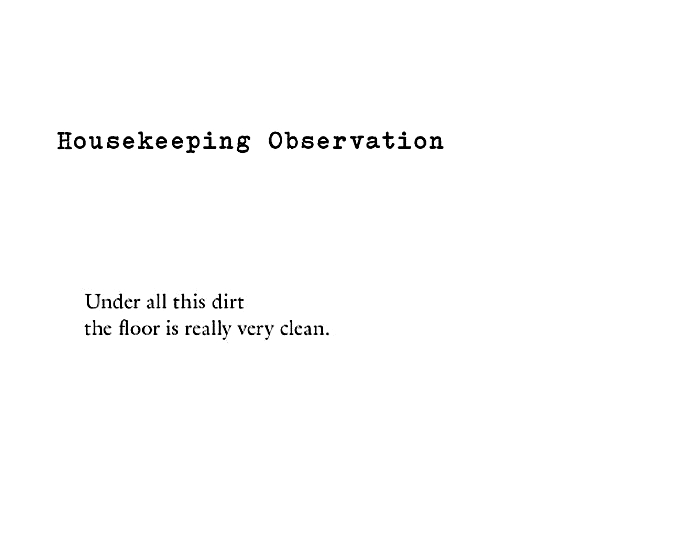
“Housekeeping Observation” — Lydia Davis

Capture

Read “Beliefs Reasonable, Unreasonable Beliefs,” Maxims by Gilbert Sorrentino

Reading Gilbert Sorrentino’s riff/story/essay “Beliefs Reasonable, Unreasonable Beliefs,” I couldn’t help but think of his correspondent, David Markson, whose 1996 novel Reader’s Block is anticipated in the structure of Sorrentino’s piece. Obviously Markson’s project and Sorrentino’s riff have literary roots that go way way back—maxims and riffs are hardly novel. Still, there’s something about the tone, rhythm, and content of the piece that reminds me of Markson’s tetralogy. A few samples below; read the whole thing in the Fall ’93 issue of Conjunctions.

I have never read a review of a play by Samuel Beckett in which the reviewer’s ignorance of Beckett’s fiction was not made clear.

All popular culture is essentially the same, i.e., it cannot transcend its audience-attentive whatness, nor can it escape the universe of camp toward which it is pointed at the moment of its birth. Lawrence Welk really is the same as Mick Jagger and “Saturday Night Live” the “Ed Sullivan Show”‘s other face.

No fatal disease is privileged, and all disease is as natural as health. To believe otherwise is to believe that we are “supposed to” die in a certain, “reasonable” way, sans pain and sadness. This attitude toward mortality makes for a lot of misery.

That Charles Olson made indisputably great poetry does not obviate the fact that he was also the Wizard of Oz.

There are few things more disgusting than a superior, mocking, self-important review of a trashy book by a hack writer.

Abstract love and generalized compassion increase in direct proportion to organized social viciousness.

Frank O’Hara is the saddest of all postwar American poets.

My father didn’t speak English until he was eleven, at which time he left school and went to work on the Brooklyn waterfront. His letters, despite an occasional spelling error or grammatical gaffe, are written in a better prose than can be managed by most of the university undergraduates I’ve taught. He was far from unique.

If, as Goethe’s Mephistopheles says, all theory is gray, theory concerning theory is Joycean brown.

Artists who pretend that they are no more than workers in the arts are neither artists nor workers.

To say that most book reviewers are lazy, illread and addicted to the banal is like saying “war is hell” or “greed is the root of evil.” These remarks hide their truths behind the deadening familiarity of their verbal representations; but they are truths nevertheless.

Popular art reflects and flatters popular culture, or, if you prefer, the Zeitgeist. In retrospect, it sometimes seems as if it leads and influences the true culture, or the innate wisdom of a people, but this isn’t so.

Italo Calvino Profiled on the BBC TV Show Book Mark in 1985

“A Poem to Read in August” — Gilbert Sorrentino

IMG_3021

The thinning of language (Doris Lessing)

I am in a mood that gets more and more familiar: words lose their meaning suddenly. I find myself listening to a sentence, a phrase, a group of words, as if they are in a foreign language—the gap between what they are supposed to mean, and what in fact they say seems unbridgeable. I have been thinking of the novels about the breakdown of language, like Finnegans Wake. And the preoccupation with semantics. The fact that Stalin bothers to write a pamphlet on this subject at all is just a sign of a general uneasiness about language. But what right have I to criticize anything when sentences from the most beautiful novel can seem idiotic to me? 

… I made tea, and then I remembered a story that was sent to me last week. By a comrade living somewhere near Leeds. When I first read it, I thought it was an exercise in irony. Then a very skilful parody of a certain attitude. Then I realized it was serious—it was at the moment I searched my memory and rooted out certain fantasies of my own. But what seemed to me important was that it could be read as parody, irony or seriously. It seems to me this fact is another expression of the fragmentation of everything, the painful disintegration of something that is linked with what I feel to be true about language, the thinning of language against the density of our experience.

From Doris Lessing’s novel The Golden Notebook.

The headless corpse. Love kills penguin. Pig got rheumatism. Nagged Bible reader slays wife. (William Gaddis)


After the injection, he picked up his newspaper. The Sunday edition, still in the rack beside him, required fifty acres of timber for its “magic transformation of nature into progress, benefits of modern strides in transportation, communication, and freedom of the press: public information. (True, as he got into the paper, the average page was made up of a half-column of news, and four-and-one-half columns of advertising.) A train wreck in India, 27 killed, he read; a bus gone down a ravine in Chile, 1 American and 11 natives; avalanche in Switzerland, death toll mounts . . . This evening edition required only a few acres of natural grandeur to accomplish its mission (for it carried less advertising). Mr. Pivner read carefully. Kills father with meat-ax. Sentenced for slaying of three. Christ died of asphyxiation, doctor believes. Woman dead two days, invalid daughter unable to summon help. Nothing escaped Mr. Pivner’s eye, nor penetrated to his mind; nothing evaded his attention, as nothing reached his heart. The headless corpse. Love kills penguin. Pig got rheumatism. Nagged Bible reader slays wife. “Man makes own death chair, 25,000 volts. “Ashamed of world,” kills self. Fearful of missing anything, he read on, filled with this anticipation which was half terror, of coming upon something which would touch him, not simply touch him but lift him and carry him away.Every instant of this sense of waiting which he had known all of his life, this waiting for something to happen (uncertain quite what, and the Second Advent intruded) he brought to his newspaper reading, spellbound and ravenous. Man fights lion in zoo, barefisted. Cow kills woman. Rooster kills woman. Dogs eat Eskimo. As he turned the pages, folding them smartly back over the bulk of the newspaper, he relaxed a little at his comparative safety away from the news, drew comfort from the train wreck (he was not in it), the bus accident in Chile (nor in that), the meat-ax slaying (he had not done it), the headless corpse (not his), and so the newspaper served him, externalizing in the agony of others the terrors and temptations inadmissible in himself. Even though the evening paper repeated the news of the morning paper, he read attentively again, reworded, of the hunt for the unknown person who was releasing birds from an uptown zoo, of the discovery of two priceless art treasures, original paintings of Dierick Bouts, in a pawnshop in Hell’s Kitchen, of the murder trial in Mouth, Mississippi, where just that morning the husband’s heart had been exhibited in court. All of these civilized wonders were brought together, he was made to feel, expressly for him, by the newspaper. True, they kept him in such a state that he often bought late editions of the same newspaper, seeing different headlines than those tucked under his arm, only to read the story from column six suddenly elevated to a banner across columns one to four. True, often the only way he could know whether he had read a newspaper was to turn to the comic strips, where life flowed in continuum; and recognizing them, he knew that he must have read everything else closely and avidly, that nothing had evaded his eye, nor penetrated to his heart round which he had built that wall called objectivity without which he might have gone mad. As the tales of violence seemed daily to increase it hardly occurred to him that he was living in such unnatural density of population that it daily supported disasters sufficient for a continent. Added to this came the blood of the world, piped in on wires, and wireless, teletype, undersea cables, and splashed without a drop lost in transit upon Mr. Pivner, who sat, hard, patient, unbending, wiped it from his eyes, and waited for more.

An inhumanity museum from William Gaddis’s The Recognitions. I’m citing part of the passage for a bigger thing I’m working on now—it’s a bit too long for that thing, but too good not to share in full.

Read “Jumping the Line,” A Very Short Story by Mikhail Bulgakov

“Jumping the Line”

by

Mikhail Bulgakov

There was a line outside the Moscow Criminal Investigations Department.
“Oh. . . Geez . . . all this waiting and waiting!”
“Even here there’s a line!”
“What can you do? Do you happen to be a bookkeeper, if you don’t mind my asking?”
“Nope, I’m a cashier.”
“Did you come to get arrested?”
“Yeah, what else!”
“That’s good. So how much were you caught with, if you don’t mind my asking?”
“Three thousand smackers.”
“That’s nothing, young man. You’ll just get a year. But if you take your heartfelt repentance into consideration . . . and the fact that the Bolshevik Anniversary is coming up . . . so, all in all, you’ll do three months, and then, the sweet bird of freedom!”
“You sure? You’re comforting me no end. I was already real desperate. Yesterday I went to see a lawyer, and he scared the living daylights out of me–the article, he tells me, is such that you won’t get away with less than two years’ hard labor.
“Pure twaddle, young man! Trust my experience. Hey, you there! Where do you think you’re going? Get back in line!”
“Citizens! Let me pass! I filched some official money! My con- science is biting me!”
“Everyone’s conscience is biting them! You’re not the only one!”
“I squandered the entire holdings of the Moscow Agrarian Industry Store in drink!” a low voice kept mumbling.
“Quite a fellow, aren’t you! You’ll pay for it now! You’ll never see the light of day again!”
“That’s not true! What if I’m ignorant? And not educated? And there are hereditary social conditions, huh? And my previous con- viction? And being an alcoholic?”
“How come they put you, an alcoholic, in charge of the wine store?”
“I did warn them!”
“Hey you! Where do you think you’re going?”
“Citizen Officer! I am tortured by remorse!”
“Hey, stop pushing! I’m tortured too!”
“Excuse me! I’ve been waiting here since ten in the morning to get arrested!”
“Just give me your last name, place of employment, amount!”
“Fioletov, Misha, tortured by remorseful conscience!”
“How much?”
“In Makrettrest–two hundred smackers.”
“Sidorchuk! Process this Fioletov!”
“May I take my toothbrush with me?”
“You may! And you, what was the amount?”
“Seven people.”
“A family?”
“Exactly.”
“And how much was it you took?”
“Two hundted in cash, a robe, a watch and some candlesticks.”
“I don’t get it. An official’s robe?”
“What do you mean? Us guys don’t deal with officials. It was a private family. Shtippelman.”
“You’re Shtippelman?”
“Me? No!”
“Then what’s Shtippelman got to do with it?”
“What he’s got to do with it is we knifed him. I’m reporting seven people: his wife, five children and their granny.”
“Sidorchuk! Kakhrushin! Take preventive measures! Now!”
“Excuse me, Citizen Officer! Why is this man getting preferential treatment?”
“Please, citizens! Be conscientious! this man is a murderer!”
“Big deal! You’re telling us he’s a big shot or something? For all you know I might have blown up a state institution!”
“This is an outrage! Bureaucracy! We will complain!”

Translated from Russian by Anneta Greenlee and published in the Fall ’98 issue of Conjunctions—read more Bulgakov stories there.

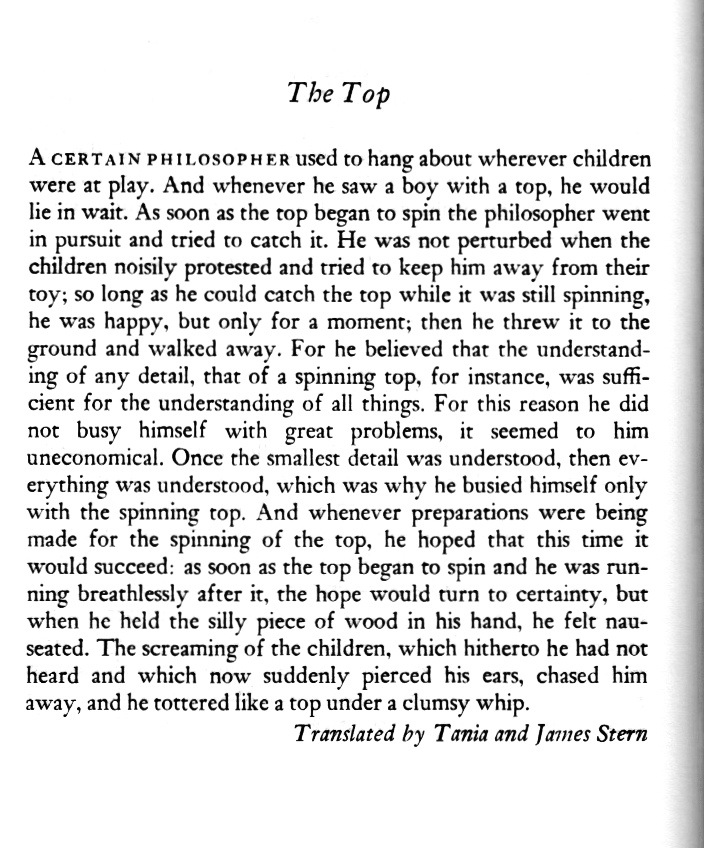
“The Top” — Franz Kafka

20140721-162337-59017474.jpg

Biblioklept’s Dictionary of Literary Terms

AUTEUR

French for author, this term denotes a film director who makes the same film again and again and again.

BIBLIOGRAPHY

A detailed list of the books from which the author plundered all his or her good ideas.

CIRCUMLOCUTION

The rhetorical device of circumlocution can be seen by the reader or made evident to the reader when a writer chooses to compose phrases, clauses, or sentences that are inordinately complex, exaggerated, long-winded, or otherwise unnecessarily verbose in order to demonstrate, convey, show, or express an idea, image, or meaning that might have been demonstrated, conveyed, shown, or expressed via the use of shorter, simpler, more direct phrases, clauses, or sentences that demonstrate brevity.

Inexperienced writers, especially composition students, are advised to use circumlocution to pad their writing and meet the assigned word count.

DESCRIPTIVIST

A grammarian who holds strong opinions and judgments about prescriptivists.

EXPOSITION

Telling without showing. Exposition can be extremely useful to the reader, who will slight the author who successfully employs it.

FREE INDIRECT STYLE

James Wood Approved!™

GOLDEN AGE

A comforting, nebulous fantasy.

HAGIOGRAPHY

A biography composed entirely of distortions, half-truths, and outright lies.

INNUENDO

The funny dirty bits that make you feel clever.

JARGON

Trade-specific diction employed (preferably clumsily) to confuse the average reader and offend the expert reader.

KINDLE

Early 21st-century reading device, often mistaken as a harbinger of literary doom.

LITERALLY

An adverb that most often means figuratively.

MYTH

The most enduring—and therefore most true—kind of story.

NEGATIVE CAPABILITY

A writer’s ability to just chill and not know. (Also useful for lazy frauds).

OBJECTIVE POINT OF VIEW

A comforting, nebulous fantasy.

PRESCRIPTIVIST

A grammarian who holds strong opinions and judgments about descriptivists.

QUEST

The story-teller’s scheme. Make it up as you go along. Steal as necessary.

REALISM

A comforting, nebulous fantasy.

SEBALDIAN

An adjective used to describe a literary work that is not quite as good as anything by W.G. Sebald.

TRAGEDY

A work often mistaken as more serious or more important or more literary than a comedy.

UNIVERSAL SYMBOL

A comforting, nebulous fantasy.

VULGARITY

A specific type of lucidity that authors sometimes use.

WELTSCHMERZ

The emotional byproduct of attempting to maintain comforting, nebulous fantasies.

XANAX

A stop-gap for bouts of Weltschmerz.

YOKNAPATAWPHA COUNTY

Faulkner’s Middle-earth.

ZYZZYVA

Zyzzyva is a real word, and this fact should give us all some small measure of hope..

(Previous entries here and here and here.).

Herman Melville Paper Doll

melville

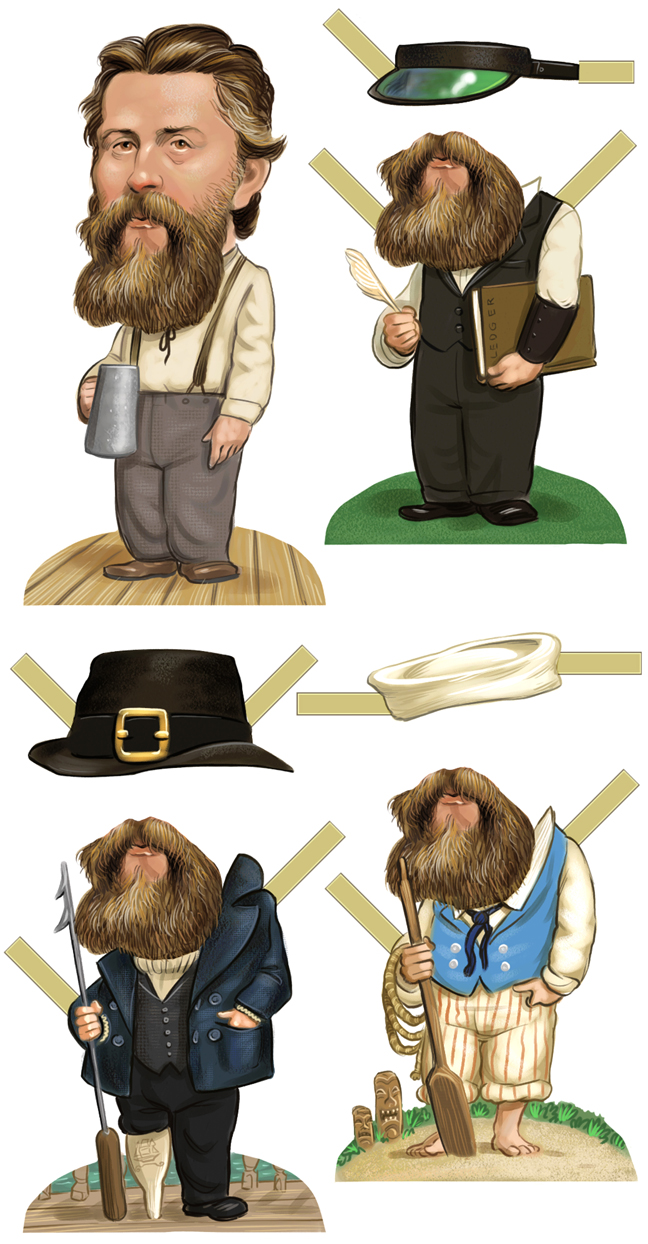
Herman Melville paper doll by Tim Foley.

Four Notes from Nathaniel Hawthorne’s Note-Books

  1. Punishment of a miser,–to pay the drafts of his heir in his tomb.
  2. A series of strange, mysterious, dreadful events to occur, wholly destructive of a person’s happiness. He to impute them to various persons and causes, but ultimately finds that he is himself the sole agent. Moral, that our welfare depends on ourselves.
  3. The strange incident in the court of Charles IX. of France: he and five other maskers being attired in coats of linen covered with pitch and bestuck with flax to represent hairy savages. They entered the hall dancing, the five being fastened together, and the king in front. By accident the five were set on fire with a torch. Two were burned to death on the spot, two afterwards died; one fled to the buttery, and jumped into a vessel of water. It might be represented as the fate of a squad of dissolute men.
  4. A perception, for a moment, of one’s eventual and moral self, as if it were another person,–the observant faculty being separated, and looking intently at the qualities of the character. There is a surprise when this happens,–this getting out of one’s self,–and then the observer sees how queer a fellow he is.

From Nathaniel Hawthorne’s American Note-Books.

That long long, bloated epicene tract “The Waste Land” by Eliot (Barry Hannah)

That long long, bloated epicene tract “The Waste Land” by Eliot—the slideshow of some snug librarian on the rag—was nothing, unworthy, in the notes that every sissy throws away. I would not talk to students about it. You throw it down like pickled eggs with nine Buds and move on to giving it to the preacher’s wife on a hill while she spits on a photograph of her husband.

From Barry Hannah’s short story “Ride, Fly, Penetrate, Loiter.” Collected in Captain Maximus. (Captain Maximus is the narrator here, by the bye).

“July Stories” — Roberto Bolaño

July has been a strange month. The other day I went to the beach and I saw a woman of about thirty, pretty, wearing a black bikini, who was reading standing up. At first I thought she was about to lie down on her towel, but when I looked again she was still standing, and after that I didn’t take my eyes off her. For two hours, more or less, she read standing up, walked over to the water, didn’t go in, let the waves lap her shins, went back to her spot, kept reading, occasionally put the book down while still standing, leaned over a few times and took a big bottle of Pepsi out of a bag and drank, then picked up the book again, and, finally, without ever bending a knee, put her things away and left. Earlier the same day, I saw three girls, all in thongs, gorgeous, one of them had a tattoo on one buttock, they were having a lively conversation, and every once in a while they got in the water and swam and then they would lie down again on their mats, basically a completely normal scene, until all of a sudden, a cell phone rang, I heard it and thought it was mine until I realized it had been a while since I had a cell phone, and then I knew the phone belonged to one of them. I heard them talking. All I can say is that they weren’t speaking Catalan or Spanish. But they sounded deadly serious. Then I watched two of them get up, like zombies, and walk toward some rocks. I got up too and pretended to brush the sand off my trunks. On the rocks, I watched them talk to a huge, hideously ugly man covered in hair, in fact one of the hairiest men I’ve ever seen in my life. They knelt before him and listened attentively without saying a word, and then they went back to where their friend was waiting for them and everything went on as before, as if nothing had happened. Who are these women? I asked myself once it was dark and I had showered and dressed. One drank Pepsi. The others bowed down to a bear. I know who they are. But I don’t really know.

From Roberto Bolaño’s Between Parentheses: Essays, Articles and Speeches, 1998-2003.

Anagogical vision (Flannery O’Connor)

The kind of vision the fiction writer needs to have, or to develop, in order to increase the meaning of his story is called anagogical vision, and that is the kind of vision that is able to see different levels of reality in one image or one situation. The medieval commentators on Scripture found three kinds of meaning in the literal level of the sacred text: one they called allegorical, in which one fact pointed to another; one they called tropological, or moral, which had to do with what should be done; and one they called anagogical, which had to do with the Divine life and our participation in it. Although this was a method applied to biblical exegesis, it was also an attitude toward all of
creation, and a way of reading nature which included most possibilities, and I think it is this enlarged view of the human scene that the fiction writer has to cultivate if he is ever going to write stories that have any chance of becoming a permanent part of our literature. It seems to be a paradox that the larger and more complex the personal view, the easier it is to compress it into fiction.

From Flannery O’Connor’s essay “The Nature and Aim of Fiction.”

Three activated sensuous strokes (Flannery O’Connor)

A lady who writes, and whom I admire very much, wrote me that she had learned from Flaubert that it takes at least three activated sensuous strokes to make an object real; and she believes that this is connected with our having five senses. If you’re deprived of any of them, you’re in a bad way, but if you’re deprived of more than two at once, you almost aren’t present.

All the sentences in Madame Bovary could be examined with wonder, but there is one in particular that always stops me in admiration. Flaubert has just shown us Emma at the piano with Charles watching her. He says, “She struck the notes with aplomb and ran from top to bottom of the keyboard without a break. Thus shaken up, the old instrument, whose strings buzzed, could be heard at the other end of the village when the window was open, and often the bailiff’s clerk, passing along the highroad, bareheaded and in list slippers, stopped to listen, his sheet of paper in his hand.”

The more you look at a sentence like that, the more you can learn from it. At one end of it, we are with Emma and this very solid instrument “whose strings buzzed,” and at the other end of it we are across the village with this very concrete clerk in his list slippers. With regard to what happens to Emma in the rest of the novel, we may think that it makes no difference that the instrument has buzzing strings or that the clerk wears list slippers and has a piece of paper in his hand, but Flaubert had to create a believable village to put Emma in. It’s always necessary to remember that the fiction writer is much less immediately concerned with grand ideas and bristling emotions than he is with putting list slippers on clerks.

Now of course this is something that some people learn only to abuse. This is one reason that strict naturalism is a dead end in fiction. In a strictly naturalistic work the detail is there because it is natural to life, not because it is natural to the work. In a work of art we can be extremely literal, without being in the least naturalistic. Art is selective, and its truthfulness is the truthfulness of the essential that creates movement.

From Flannery O’Connor’s essay “The Nature and Aim of Fiction.”