“Hairs Wanted” — Flann O’Brien

hairs

RIP Doris Lessing

doris_lessing

RIP Doris Lessing, 1919-2013.

“There is a river of girls and women in our streets” (Donald Barthelme)

THERE is a river of girls and women in our streets. There are so many that the cars are forced to use the sidewalks. The women walk in the street proper, the part where, in other cities, trucks and bicycles are found. They stand in windows too unbuckling their shirts, so that we will not be displeased. I admire them for that. We have voted again and again, and I think they like that, that we vote so much. We voted to try the river in the next town. They have a girl-river there they don’t use much. We slipped into the felucca carrying our baggage in long canvas tubes tied, in the middle, with straps. The girls groaned under the additional weight. Then Hubert pushed off and Bill began to beat time for the rowers. We wondered if Snow White would be happy, alone there. But if she wasn’t, we couldn’t do anything about it. Men try to please their mistresses when they, men, are not busy in the countinghouse, or drinking healths, or having the blade of a new dagger chased with gold. In the village we walked around the well where the girls were dipping their trousers. The zippers were rusting. “Ha ha,” the girls said, “we could tear this down in a minute, this well.” It is difficult to defeat that notion, the one the village girls hold, that the boy who trembles by the wall, against the stones, will be Pope someday. He is not even hungry; his family is not even poor.

From Donald Barthelme’s novel Snow White.


Review: Tim O’Brien’s Novel The Things They Carried, Read by Bryan Cranston

thingsI’ve used Tim O’Brien’s short story “The Things They Carried” in the classroom for so many years now that I’ve perhaps become immune to any of the tale’s rhetorical force.Trekking through the story again with a new group of students can occasionally turn up new insights—mostly these days from veterans going back to school after tours in Iraq and Afghanistan—but for the most part, the story “The Things They Carried” is too blunt in its symbols, too programmatic in its oppositions of the physical and metaphysical, too rigid in its maturation plot. There’s no mystery to it, unlike other oft-anthologized stories which can withstand scores of rereadings (I think of Hawthorne or O’Connor here; when I reread “A Good Man Is Hard to Find,” for example, I always understand it or misunderstand it in a new, different way).

But my students invariably love “The Things They Carried,” and I love reading it with them.

Despite reading the story “The Things They Carried” semester after semester, I hadn’t gone back to the novel The Things They Carried in years, until the kind people at Audible sent me a new audiobook version read by character actor Bryan Cranston (Malcolm in the MiddleSeinfeld). I enjoyed the audiobook over a week of commutes.

The Things They Carried is a loose collection of stories that centers on a character named Tim O’Brien and his time with Alpha Company during the Vietnam War. The book also focuses on O’Brien’s experiences, as well as the experiences of some of his fellow soldiers, before and after Vietnam. O’Brien ties the book around a few major stories, fleshing it out with fragments, and telling tales from different viewpoints and even different chronologies. If a character dies in one story, he’s welcome to show up in a later story or vignette. That’s how memory works. And when memory fails, there are stories:

Forty-three years old, and the war occurred half a lifetime ago, and yet the remembering makes it now. And sometimes remembering will lead to a story, which makes it forever. That’s what stories are for. Stories are for joining the past to the future. Stories are for those late hours in the night when you can’t remember how you got from where you were to where you are. Stories are for eternity, when memory is erased, when there is nothing to remember except the story.

O’Brien’s major concern in The Things They Carried isn’t just the experiences of regular soldiers in the Vietnam War. He’s also deeply concerned with how to frame, recall, tell, and retell those experiences. In this sense, the formal aspects of the novel—its fragmentary, decentered structure—carry out its themes. The result is a strange beast, a novel that is simultaneously postmodern metafiction and dirty realism. Almost every single story in The Things They Carried attempts to suss out its own telling; indeed, how to tell, how to witness to (horror, violence, war) is probably the book’s real aim. Nowhere is this more evident than in “How to Tell a True Story”:

A true war story is never moral. It does not instruct, nor encourage virtue, nor suggest models of proper human behavior, nor restrain men from doing the things men have always done. If a story seems moral, do not believe it. If at the end of a war story you feel uplifted, or if you feel that some small bit of rectitude has been salvaged from the larger waste, then you have been made the victim of a very old and terrible lie. There is no rectitude whatsoever. There is no virtue. As a first rule of thumb, therefore, you can tell a true war story by its absolute and uncompromising allegiance to obscenity and evil.

The notation of a “rule of thumb” there is a dark little sick joke, a thread that O’Brien picks up from the opening title story. Moments like these, little threads, little images, help the work to cohere as a novel, even as O’Brien does his damnedest to fracture the whole business. His hand-wringing about truth and fiction and reality begins to wear on the reader. It’s not that O’Brien isn’t right to be concerned about these issues, but The Things They Carried spends a bit too much time dithering over its own right to imagine a truth.

O’Brien is better at the dirty realism, I think, which we can see in the brutal vivid details in “Sweetheart of the Song Tra Bong,” a story about a guy who brings his teenage girlfriend to Vietnam. “Vietnam was full of strange stories, some improbable, some well beyond that,” O’Brien writes at the beginning, “but the stories that will last forever are those that swirl back and forth across the border between trivia and bedlam, the mad and the mundane.” In “Sweetheart,” O’Brien toes that line to great effect. The story culminates in imagery that seems borrowed from Cormac McCarthy’s Blood Meridian. I’m tempted to share the story’s strongest image but won’t. No spoilers.

“Sweetheart” is less concerned with the frames and edges of its own telling than some of the other stories in The Things They Carried, but O’Brien still highlights the essential problem of witnessing:

“Patience, man. Up to now, everything I told you is from personal experience, the exact truth, but there’s a few other things I heard secondhand. Thirdhand, actually. From here on it gets to be … I don’t know what the word is.”

“Speculation.”

I think it helped me to hear The Things They Carried in a different voice, a different tone or mode or mood than my own. Bryan Cranston does a wonderful job here. I’ve written before about how a good reader makes all the difference in an audiobook. Cranston, surely most famous for his iconic performance as hapless father Hal in Malcolm in the Middle, telegraphs O’Brien’s tales in a straightforward but sonorous voice, injecting pathos and wry humor at the appropriate moments. Cranston inhabits each voice in The Things They Carried, imbuing every character with his own tone and rhythm. The result is a compelling and moving interpretation of The Things They Carried. Cranston opens up what I had thought to be a more-or-less closed book.

This new audiobook features a bonus essay called “The Vietnam in Me” which recounts O’Brien’s 1994 return to Vietnam with his young girlfriend. The essay reads as a condensation, repetition, and extension of the book that precedes it, with O’Brien repeatedly admitting as much—reminding us again and again of the relationship between memory and story. O’Brien reads the essay himself in a reedy, often shaky voice. The recording quality seems to depart from the clean studio perfection of the book proper—there’s more hiss, more crackly, longer gaps. More dirty realism. Strangely, O’Brien’s quaver suggests a man less in control of the story than alter-ego Cranston’s confidence suggested. The divergence in the two readers underscores the book’s core theme, reminding us that it’s not just the story that matters, but the storyteller

You can see/hear Cranston read bits of the book in this video:

“The first thing the baby did wrong” — Donald Barthelme

“The first thing the baby did wrong” by Donald Barthelme

The first thing the baby did wrong was to tear pages out of her books. So we made a rule that each time she tore a page out of a book she had to stay alone in her room for four hours, behind the closed door. She was tearing out about a page a day, in the beginning, and the rule worked fairly well, although the crying and screaming from behind the closed door were unnerving. We reasoned that that was the price you had to pay, or part of the price you had to pay. But then as her grip improved she got to tearing out two pages at a time, which meant eight hours alone in her room, behind the closed door, which just doubled the annoyance for everybody. But she wouldn’t quit doing it. And then as time went on we began getting days when she tore out three or four pages, which put her alone in her room for as much as sixteen hours at a stretch, interfering with normal feeding and worrying my wife. But I felt that if you made a rule you had to stick to it, had to be consistent, otherwise they get the wrong idea. She was about fourteen months old or fifteen months old at that point. Often, of course, she’d go to sleep, after an hour or so of yelling, that was a mercy. Her room was very nice, with a nice wooden rocking horse and practically a hundred dolls and stuffed animals. Lots of things to do in that room if you used your time wisely, puzzles and things. Unfortunately sometimes when we opened the door we’d find that she’d torn more pages out of more books while she was inside, and these pages had to be added to the total, in fairness.

The baby’s name was Born Dancin’. We gave the baby some of our wine, red, whites and blue, and spoke seriously to her. But it didn’t do any good.

I must say she got real clever. You’d come up to her where she was playing on the floor, in those rare times when she was out of her room, and there’d be a book there, open beside her, and you’d inspect it and it would look perfectly all right. And then you’d look closely and you’d find a page that had one little corner torn, could easily pass for ordinary wear-and-tear but I knew what she’d done, she’d torn off this little corner and swallowed it. So that had to count and it did. They will go to any lengths to thwart you. My wife said that maybe we were being too rigid and that the baby was losing weight. But I pointed out to her that the baby had a long life to live and had to live in a world with others, had to live in a world where there were many, many rules, and if you couldn’t learn to play by the rules you were going to be left out in the cold with no character, shunned and ostracized by everyone. The longest we ever kept her in her room consecutive was eighty-eight hours, and that ended when my wife took the door off its hinges with a crowbar even though the baby still owed us twelve hours because she was working off twenty five pages. I put the door back on its hinges and added a big lock, one that opened only if you put a magnetic card in a slot, and I kept the card.

But things didn’t improve. The baby would come out of her room like a bat out of hell and rush to the nearest book, Goodnight Moon or whatever, and begin tearing pages out of it hand over fist. I mean there’d be thirty-four pages of Goodnight Moon on the floor in ten seconds. Plus the covers. I began to get a little worried. When I added up her indebtedness, in terms of hours, I could see that she wasn’t going to get out of her room until 1992, if then. Also, she was looking pretty wan. She hadn’t been to the park in weeks. We had more or less of an ethical crisis on our hands.

I solved it by declaring that it was all right to tear pages out of books, and moreover, that it was all right to have torn pages out of books in the past. That is one of the satisfying things about being a parent-you’ve got a lot of moves, each one good as gold. The baby and I sit happily on the floor, side by side, tearing pages out of books, and sometimes, just for fun, we go out on the street and smash a windshield together.

[Via Jaessamyn’s excellent Barthelme page].

“Full” — Robert Walser

“Full” by Robert Walser

Translated by Susan Bernofsky

So many times, as I rode through the streets and hubbub of Berlin in the quaint, lumbering, and yet buoyantly plodding horse-drawn omnibus, which never failed to invigorate and charm me anew, I would hear the aging, good-natured conductor humbly and humorously uttering a single insignificant and yet also at that moment quite significant word, which in addition, by the way, was written for the sake of correctness and order upon a panel that could be either concealed or displayed. When the inscription

FULL

was hanging tidily and properly in its place, people knew that for the time being no one else would be allowed to climb and clamber aboard because the gondola or pleasure palace rolling along on its wheels was already packed suffocatingly full, a regrettable circumstance that was announced in no uncertain terms by the warning placard: “Stop! Whosoever they may be, this line they shall not cross!: At times, however, despite the rejecting, dismissive plaque, there would be a crowd pressing forward, expressing the impetuous desire to climb up and be carried off. And then someone, such as the chamberlain on duty, would say in a courteous voice,”Folks, we’re full up,” or he would say,”No shoving, please. It won’t do any good,” or perhaps it would occur to him to say, “With the greatest pleasure, ladies and gentlemen, would I invite you to climb aboard and take your seats, but it is my harsh duty to draw your attention to the fact that the car is already stuffed to the cracks with passengers. I do beg your pardon for having to deny you access and entry.” Sallies and attacks on one side, rebuffs and refusals on the other, the vessel continues to sail calmly and gaily through all the metropolitan traffic, which almost resembles an ocean.

Once again some hasty hothead is about to leap aboard, and once again an imperturbable”Full!” resounds in the daredevil’s ears, whereupon he is obliged to circumspectly remove his foot from the footboard once more. Once when the omnibus was cruising full steam ahead, everything proceeding smoothly and properly, and with no one even remotely plotting an ambush or violent coup, someone slipped aboard; a person who apparently had been accustomed from an early age to go through thick and thin and strike down anyone and anything that got in his way.

“Full up, sir,” the official remarked.

“Stupid, ridiculous nonsense,” replied Monsieur Dreadnought. He was without a doubt the sort of person who thought it advisable to engage in the most ruthless power politics. “I beg your pardon, did you not hear what I said?” the good carman inquired. But now a veritable downpour of invectives was unleashed upon his unfortunate head. This powerful flood of unforeseen unpleasantnesses was so overwhelming that the good man was forced to give in. All the same he complained, saying: “It’s just not right, not right at all, and it’s a good thing not all people are like this gentleman who’s cursing me even though all I did was tell him we were full. It was my duty to tell him so, but certain people insist on trampling and flattening everything once they’ve made up their minds to do something. I don’t go around saying ‘full’ for my own amusement, or because I want to antagonize people, or out of Schadenfreude. Every person has his tasks to perform and his duties to fulfill, and it just happens to be my duty to tell people ‘full’ when the car is full up. It isn’t fair for a person to take offense like that. It’s downright preposterous how quick some people are to fly into a rage. Well then! I’ll stick with the ones who have some sense; thanks and praises be to God, there are still some of them left.”

This is what the conductor said as the omnibus unhurriedly trundled on its way.


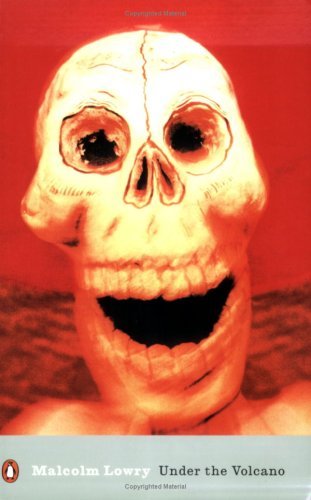
Under the Volcano, Malcolm Lowry’s Antipodal Odyssey of Despair

Most of Malcolm Lowry’s dense, depressing novel Under the Volcano takes place over the course of November 2nd, 1938, the Mexican Day of the Dead. Like a reticent, dour Virgil, Lowry guides the reader through the day’s tragic arc, floating between the minds of his novel’s three protagonists: Geoffrey Firmin, his half-brother Hugh, and Geoffrey’s estranged wife Yvonne. Geoffrey is British Consul to Mexico — ex-Consul, really, as British-Mexican relations sour against the backdrop of Spanish fascism and the rise of nationalism in Mexico — but he is almost always referred to as “the Consul,” a blackly ironic title. See, the Consul bears little authority aside from an extreme expertise on how to stay drunk (or “drunkly sober un-drunk”) 24/7. He’s ambassador to bar stools, a manager of mescal and little else (certainly not his own life; certainly not diplomatic affairs). The Consul is a wreck, an alcoholic to put Hemingway and Fitzgerald’s (and even Bukowski’s) alter-egos to shame.

After a first chapter that seems to derail all but the most patient readers, the narrative conflict arrives when Yvonne returns to Quauhnahuac, Mexico, a year after leaving (and divorcing) the Consul. She arrives to find the Consul (“Geoffrey,” as he’s called when the free indirect style inhabits her mind) drinking whiskey in a hotel bar in order to sober up (yep). It’s not immediately clear why Yvonne has returned to the Consul, but it seems that she hopes to save him from drowning in a drunken downward spiral. As the pair walks to the Consul’s house, they pass numerous advertisements for a boxing match; a child’s funeral proceeds down the avenue. These motifs of fighting, death, and futility permeate the novel.

During the walk we learn that Yvonne is not the only one concerned about the Consul’s health; his (much) younger brother Hugh has come to stay with him in the hopes of sobering him up. (Hugh employs a revolting and unsuccessful “strychnine cure”). That Hugh has also returned doubly complicates the plot. Much of Under the Volcano remains implicit, unnamed, hinted at, and this seems especially true of the implication that Yvonne cheated on the Consul with Hugh in the recent past (this implication may have been stated conclusively at some point in the novel, but I’ve only read the book once, which is perhaps like not having read it at all). What’s certainly clear is that Yvonne cheated on the Consul with a French filmmaker, Jacques Laruelle, a man whom the Consul, through sheer bizarre coincidence (but of course it isn’t sheer bizarre coincidence), spent a childhood summer with, an experience which bonded them as brothers in an Edenic holiday that eventually (inevitably) soured.

Despite her infidelities, Yvonne is generally present (I choose the verb “present” over “presented as” to highlight Lowry’s impeccable Modernist style) as a sympathetic character. Still, it is hard not to identify with the Consul (with “Geoffrey,” I suppose, if we are going to be familiar), the dark soul of this novel, and his complicated, painful feelings for Yvonne form the core of Volcano’s tragedy. He longs for her, pines for a complete life with her, yet resents her, cannot forgive her, hates her. For what? For leaving him. For betraying him. But perhaps foremost, he despises her inability to understand his alcoholism (he is particularly upset when she refuses to share a morning libation with him when they meet for the first time in a year). I’ll quote a passage at length now, one that showcases Lowry’s free indirect style, and one that reveals the strange indignities of the Consul’s sense of his own alcoholism. For context, dear reader, you must only know that Yvonne has suggested that she and the Consul might make long-term plans when he is sober “in a day or two”—

The Consul sat perfectly still staring at the floor while the enormity of the insult passed into his soul. As if, as if, he were not sober now! Yet there was some elusive subtlety in the impeachment that still escaped him. For he was not sober. No, he was not, not at this very moment he wasn’t! But what had that to do with a minute before, or half an hour ago? And what right had Yvonne to assume it, assume either that he was not sober now, or that, far worse, in a day or two he would be sober? And even if he were not sober now, by what fabulous stages, comparable indeed only to the paths and spheres of the Holy Cabbala itself, had he reached this stage again, touched briefly once before this morning, this stage at which alone he could, as she put it, “cope,” this precarious precious stage, so arduous to maintain, of being drunk in which alone he was sober! What right had she, when he had sat suffering the tortures of the damned and the madhouse on her behalf for fully twenty-five minutes on end without having a decent drink, even to hint that he was anything but, to her eyes, sober? Ah, a woman could not know the perils, the complications, yes, the importance of a drunkard’s life! From what conceivable standpoint of rectitude did she imagine she could judge what was anterior to her arrival? And she knew nothing whatever of what all too recently he had gone through, his fall in the Calle Nicaragua, his aplomb, coolness, even bravery there—the Burke’s Irish whiskey! What a world! And the trouble was she had now spoiled the moment.

The “fall in the Calle Nicaragua” the Consul references is quite literally a drunkard’s blackout (followed by the aforementioned fortifying whiskey, courtesy of a tourist), but it — falling — is perhaps the dominant motif in a novel crammed with motifs. In allegorical terms, if we want to ruin a good book (I don’t recommend this, of course), Volcano is pure Faust-stuff: end of innocence, fall of man, intractability of the human condition, ethical peril, moral inertia. While the Consul’s fall dominates the novel, Lowry brings this decline into dramatic relief in a late, climactic episode when his (anti-)heroic trio encounter a dying (dead?) man on the side of the road. Hugh tries to help, but the Darwinian venality of Mexican commonplace law makes his attempt impotent. Yvonne and the Consul are basically paralyzed.

Hugh’s attempt to save the man is a desperate call to action, an endeavor to perform some good in a world dominated by war and fascism. Hugh’s character fascinates. We learn of his past in one of the novel’s most intriguing episodes, a mini-bildungsroman that finds young Hugh working in the merchant marine as a calculated ploy to lend romance to his persona — he longs to prevail as a songwriter. He returns to find that no one cares about — has even heard — his guitar compositions; his publicity stunt fails. Although Hugh is only twenty-nine, he already seems himself as a failure, a fallen hero; he obsesses over the Battle of Ebro, daydreaming of helming a ship laden with hidden arms that he will deliver to the Loyalists who oppose the Fascists. Hugh’s greatest pain — and perhaps (only perhaps) Lowry’s greatest cruelty — is the awareness that the idealism of romantic heroism is intrinsically bound to a kind of selfish egoism. Hugh, perhaps with the visceral signal of his half-brother as a kind of radical prescience, can already see his own fall; his parts in Volcano are in a sense a constant meditation on falling. Hugh tries to save the dying man on the road, the cold double of his brother, whom he also tries to save — and yet it is all to little avail.

In Lowry’s world, in the volcano-world, there is only expulsion from the Eden. Lowry spells out this theme near the middle of his novel in a strange episode. The Consul wanders into his neighbor’s garden and reads a sign —

¿LE GUSTA ESTE JARDÍN?
¿QUE ES SUYO?
¡EVITE QUE SUS HIJOS LO DESTRUYAN!

The Consul stared back at the black words on the sign without moving. You like this garden? Why is it yours? We evict those who destroy! Simple words, simple and terrible words, words which one took to the very bottom of one’s being, words which, perhaps a final judgement on one, were nevertheless unproductive of any emotion whatsoever, unless a kind of colourless cold, a white agony, an agony chill as that iced mescal drunk in the Hotel Canada on the morning of Yvonne’s departure.

Significantly, either the sign is posted with improper punctuation, or (and?) the Consul’s translation is wrong — in either case a meaningful misreading occurs. We later receive the “proper” version of the sign: “¿Le gusta este jardín, que es suyo? ¡Evite que sus hijos lo destruyan! – “Do you like this garden that is yours? See to it that your children do not destroy it!”  The Consul’s first reading is a corruption, a cruel misreading that questions humanity’s right to happiness, and, tellingly, he connects the sign to the end of his relationship with Yvonne. The second version of the sign, while still foreboding, perhaps signals a kernel of hope in Lowry’s bleak work — the idea that a garden might be preserved, might be tended to; that children might be raised who do not kill, cheat, steal, rape, enslave, or otherwise prey on each other. Still, Lowry refuses to imagine what such a world might look like for us. Did I mention that Volcano is really, really sad?

For all its bleak, bitter bile, Volcano contains moments of sheer, raw beauty, especially in its metaphysical evocations of nature, which always twist back to Lowry’s great themes of Eden, expulsion, and death. Lowry seems to pit human consciousness against the naked power of the natural world; it is no wonder then, against such a grand, stochastic backdrop, that his gardeners should fall. The narrative teems with symbolic animals — horses and dogs and snakes and eagles — yet Lowry always keeps in play the sense that his characters bring these symbolic identifications with them. The world is just the world until people walk in it, think in it, make other meanings for it.

In many ways, Under the Volcano is an antipodal response to Joyce’s Ulysses. Both novels stream through a number of consciousnesses over the course of one day; both novels invert and subvert mythical frameworks against diurnal concerns; both novels point to the ways that the smallest meannesses — and kindnesses — can color and affect our lives. And while there are many divergences (chiefest, I believe, the spirit of redemption in Ulysses that seems entirely absent from Volcano), the greatest similarity may be their difficulty. Simply put, Lowry, like Joyce, throws his readers into the deep end. The first chapter of the novel inhabits the mind of Jacques Laruelle and takes place exactly one year after the events of the rest of the novel. It is both overture and context for all that follows, and yet it is radically alienating; indeed, it only fully makes sense after one finishes the novel and goes back and reads it again, realizing it is the rightful coda, the sad epilogue of a sad story. Lowry leads with his conclusion, show us the fall-out up front, the splinters and shards of the narrative to come. Picking up these pieces is hardly easy and never joyful, but it is a rewarding experience. Very highly recommended.

[Editorial note: Biblioklept ran a version of this review in March of 2011; we run it again in honor of The Day of the Dead]

Fantastical Fictive Beers

big

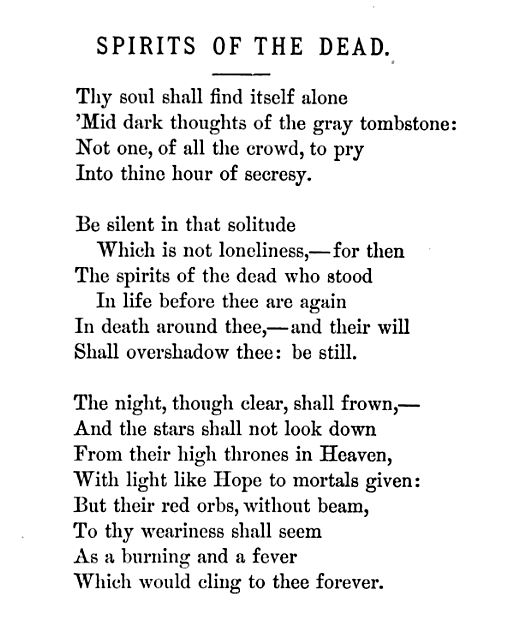
“Spirits of the Dead” — Edgar Allan Poe

spirits

“Horror Demands Laughter” | This Is Not a Review of Thomas Bernhard’s Novel Frost

The Blind Man, Albert Bloch

I.

Thomas Bernhard’s first novel Frost is (unless I’m mistaken) his longest, and of the several I’ve now read, the most taxing on the reader—bitter, caustic, depressive, nihilistic.

It’s also terribly funny, the story of a young doctor hell-bent on making a career for himself who heads to the remote village of Weng to spy on Strauch, “the painter,” on behalf of Strauch’s brother, who can presumably further the narrator’s medical career. The painter, long-estranged from his family, his health deteriorating, lives (if it can be called that) in a vile inn at the bottom of a gorge. The painter’s brother dispatches the narrator to report back in the minutest detail: “Watch the way my brother holds his stick, I want a precise description of it.”

II.

A word I learned reading Frost: “knacker.” A knacker is a person who renders, buries, or otherwise disposes of dead animals. The knacker of Weng is one of the main characters of Frost. He’s having an affair with the innkeeper, a symbolically overdetermined plot device (in a basically plotless book) that thematically ties death to hearthFrost is savagely morbid, its blank white snow the perfect canvas for Bernhard’s bloody strokes. The abject violence of his next novel Gargoyles seems refined in comparison to the brutality of Frost. The painter declares that “the abattoir is the only essentially philosophical venue. The abattoir is the classroom and the lecture hall. The only wisdom is abattoir wisdom!” Frost is an abattoir.

III.

Frost is also a stage play of sorts—like the other Bernhard novels I’ve read, it takes something of its form from the conventions drama: limited sets, just a handful of characters, and dialogue that usually veers into monologue. Through the course of the novels, these monologues (usually delivered by an obsessive, sanity-challenged older man) eventually ventriloquize the ostensible narrator/auditor, a stand-in for the reader’s own consciousness. Bernhard designs, builds, destroys, and then rebuilds these consciousnesses; when the painter of Frost declares that he has mastered “perspectivelessness . . . because I am so full of different perspectives,” he offers us a condensation of Bernhard’s analysis of first-person perspective and its attendant imaginative capacity as simultaneously creative and destructive.

IV.

Indeed, as novelist Ben Marcus points out in his review of Frost:

Bernhard is an architect of consciousness more than a narrative storyteller. His project is not to reference the known world, stuffing it with fully rounded characters who commence to discover their conflicts with one another, but to erect complex states of mind—usually self-loathing, obsessive ones—and then set about destroying them. Bernhard’s characters are thorough accomplices in their own destruction, and they are bestowed with a language that is dementedly repetitive and besotted with the appurtenances of logical thinking. The devious rationality of Bernhard’s language strives for a severe authority, and it tends to make his characters seem believable, no matter how unhinged their claims. Phrases don’t get repeated so much as needled until they yield graver meanings, with incremental changes introduced as though a deranged scientist were adding and removing substances in the performance of an experiment.

V.

I can’t do better than Marcus, and Frost is too long a performance to try. I will say: Gargoyles or The Loser are probably better starting places for those interested in Bernhard’s work. This suggestion isn’t meant to slight the book at all—but it does read a bit like a first novel, occasionally weighed down by (what I perceive to be) its authors need to say it all, all of it, here and now. Of course, Frost features prose-passages that any first-time novelist would be proud (and probably terrified) to have in their debuts; I’ve featured several on the site already.

VI.

But this isn’t really a review of Frost. A proper analysis of Bernhard would take the time to work through his language. I marked so much in Frost, highlighted so many passages that I’m not really sure how to go about synthesizing it.

My initial thought was to dodge it all by making a sarcastic post, a parody of the so-called “listicle,” those non-articles that seek to boil a work down to a digestible (and forgettable) summation of quotes, often with the intention of offering the reader a modicum of self-help (under the pretense of “wisdom”). Something like “Forty Inspiring Quotes from Thomas Bernhard’s Frost” or “Timeless Wisdom from Thomas Bernhard” or some such nonsense. Anyway, the next section, VII, comprises 40 citations from Frost, mostly excellent one-liners too good not to share. I’ve enumerated them and lumped them into one big block quote; they are listed in the order they come in the text. I think that they offer a painful and funny overview of the novel.

VII.

  1. Suddenly I heard the story of a lineman who had been asphyxiated in a snowstorm, which ended: “He never cared about anything.”
  2. It’s the same disgust I felt when I was a child and had to vomit outside the open doors of the slaughterhouse.
  3. “Nature is bloody,” he said, “but bloodiest toward her own finest, most remarkable, and choicest gifts. She grinds them down without batting an eyelid.”
  4. Is it permissible for suicide to be a sort of secret pleasure to a man?
  5. Something was splendid, and the next thing was brutal, much more brutal than the first had been splendid.
  6. “You’ll get to meet a whole series of monsters here.”
  7. “Even dreams die. Everything turns into cold. The imagination, everything.”
  8. “People who make a new person are taking an extraordinary responsibility upon themselves. All unrealizable. Hopeless. It’s a great crime to create a person, when you know he’ll be unhappy, certainly if there’s any unhappiness about. The unhappiness that exists momentarily is the whole of unhappiness. To produce solitude just because you don’t want to be alone anymore yourself is a crime.”
  9. People don’t have favorite children, they just have a lot of them.
  10. I’m sure imagination is an illness. An illness that you don’t catch, merely because you’ve always had it. An illness that is responsible for everything, and particularly everything ridiculous and malignant. Do you understand the imagination? What is imagination?
  11. “There is a pain center, and from that pain center everything radiates out,” he said; “it’s somewhere in the center of nature. Nature is built up on many centers, but principally on that pain center.”
  12. “Nothing is progressive, but nothing is less progressive than philosophy. Progress is tripe. Impossible.”
  13. Helping and mankind, the distance between those two terms.
  14. Who had the idea of letting people walk around on the planet, or something called a planet, only to put them in a grave, their grave, afterward?
  15. By and by it comes to your attention: the world around you, nothing but corruption, colossal misrule.
  16. “How everything has crumbled, how everything has dissolved, how all the reference points have shifted, how all fixity has moved, how nothing exists anymore, how nothing exists, you see, how all the religions and all the irreligions and the protracted absurdities of all forms of worship have turned into nothing, nothing at all, you see, how belief and unbelief no longer exist, how science, modern science, how the stumbling blocks, the millennial courts, have all been thrown out and ushered out and blown out into the air, how all of it is now just so much air … Listen, it’s all air, all concepts are air, all points of reference are air, everything is just air …” And he said: “Frozen air, everything just so much frozen air …”
  17. What is pain, if not pain?
  18. “I used to take sleeping pills,” he said, “and slowly boosted the number of pills I took. In the end, they had absolutely no effect on me, and I could have gulped any number of them, and still not have got to sleep. I repeatedly took such high dosages, I should have died. But I only ever vomited them up.”
  19. Everything torments me now.
  20. Man is an ideal hell to his fellow men.
  21. He was just scraps of words and dislocated phrases.
  22. Things have lost their power to disgust me.
  23. The human race was the unfruitful thing, “the only unfruitful thing in the whole world. It serves no purpose. It can’t be made into anything. It can’t be eaten. It isn’t a raw material for some process outside itself.”
  24. “Men like rats, chopped up by street sweepers’ shovels. Too many negotiations with humans have done me in.”
  25. The ruin of mankind had been a child’s dream.
  26. The food had been better than for any corpse she could remember.
  27. “The frost eats everything up,” said the painter, “trees, humans, animals, and whatever is in the trees and the humans and the animals. The blood stalls, and at great speed. You can break apart a frozen human like a piece of stale bread.”
  28. There were no real humans anymore, just death masks of real humans.
  29. The nightmarish sweat of fear, that’s the air.
  30. Truth leads downhill, points downhill, truth is always an abyss.
  31. The abattoir is the classroom and the lecture hall. The only wisdom is abattoir wisdom!
  32. You wake up, and you feel molested.
  33. Everything is barbarous kitsch.
  34. “And when I saw the grisly chopped-up animals, I had to burst out laughing, I burst out into extraordinary laughter. Do you know what that means? It means horror demands laughter!”
  35. Various venerable old families would assemble “in a spirit of megalomania, to shoot holes in nature.
  36. It’s a mistake to count on people.
  37. Every object I see hurts me.
  38.  ” . . . hopelessness … There is only one way to go, through the snow and ice into despair; past the adultery of reason.”
  39. “The world is a progressive dimming of light,.”
  40. The breeding of a human being (thinking most rigorously of himself) is the decision of the father (first and foremost) and of the mother (as well) to sponsor the suicide of their offspring, the child, the sudden premonition “of having created a new suicide.”

Wherein I Suggest Dracula Is a Character in Roberto Bolaño’s Novel 2666

The Self Seers (Death and Man), Egon Schiele

1. Here’s my thesis:

Dracula is a character in Roberto Bolaño’s dark opus 2666.

Specifically, I’m suggesting that Dracula (like, the Count Dracula) is the unnamed SS officer in “The Part About Archimboldi” who hosts a strange party in a Romanian castle.

2. I’m willing to concede that my idea is probably full of holes and more than a little silly, but I think there’s some textual support for such a claim.

3. I’ve already suggested on this blog that 2666 is full of lycanthropic transformations, and in that earlier essay, I linked werewolves to vampires (using the work of mythologist Sabine Baring-Gould).

I also suggested on this blog that 2666 is a dark ventriloquist act, full of forced possessions and psychic hauntings.

It’s a work of mesmerism and transformation—vampire powers. Dracula showing up is a winking sick joke, a satire.

4. In his post “Castle Dracula” at Infinite Zombies, Daryl L. L. Houston connects the many strands of vampirism that run through 2666, suggesting that “Bolaño is using the vampirism in the story, and Dracula in particular, to tie together some of the threads he’s been unwinding pertaining to insiders and outsiders, parasitism and consumption of people, and a sort of larger parasitism of nations.” Hence Aztec blood rituals, the Holocaust, the murder of helpless, marginalized women in Santa Teresa . . .

5. Okay, so back to that thesis. Let’s start with the first appearance of the unnamed SS officer:

At midmorning they came to a castle. The only people there were three Romanians and an SS officer who was acting as butler and who put them right to work, after serving them a breakfast consisting of a glass of cold milk and a scrap of bread, which some soldiers left untouched in disgust. Everyone, except for four soldiers who stood guard, among them Reiter, whom the SS officer judged ill suited for the task of tidying the castle, left their rifles in the kitchen and set to work sweeping, mopping, dusting lamps, putting clean sheets on the beds.

Fairly banal, right? Also, “midmorning” would entail, y’know, sunlight, which is poison for most vampires. Let me chalk this up to the idea that the SS officer is inside the castle, which is sufficiently gloomy and dark enough to protect him (I’m not going to get into any vampire rules that might spoil my fun, dammit!). In any case, hardly noteworthy. Indeed, the SS officer—a butler commanding house chores—seems hardly a figure of major importance.

6. Next, we get the Romanian castle explicitly identified as “Dracula’s castle” and meet the actors for this milieu:

“And what are you doing here, at Dracula’s castle?” asked the baroness.

“Serving the Reich,” said Reiter, and for the first time he looked at her.

He thought she was stunningly beautiful, much more so than when he had known her. A few steps from them, waiting, was General Entrescu, who couldn’t stop smiling, and the young scholar Popescu, who more than once exclaimed: wonderful, wonderful, yet again the sword of fate severs the head from the hydra of chance.

(I love Popescu’s line here).

7. Our principals soon take a tour of castle and environs, led by the SS officer (boldface emphasis is mine):

Soon they came to a crypt dug out of the rock. An iron gate, with a coat of arms eroded by time, barred the entrance. The SS officer, who behaved as if he owned the castle, took a key out of his pocket and let them in. Then he switched on a flashlight and they all ventured into the crypt, except for Reiter, who remained on guard at the door at the signal of one of the officers.

So Reiter stood there, watching the stone stairs that led down into the dark, and the desolate garden through which they had come, and the towers of the castle like two gray candles on a deserted altar. Then he felt for a cigarette in his jacket, lit it, and gazed at the gray sky, the distant valleys, and thought about the Baroness Von Zumpe’s face as the cigarette ash dropped to the ground and little by little he fell asleep, leaning on the stone wall. Then he dreamed about the inside of the crypt. The stairs led down to an amphitheater only partially illuminated by the SS officer’s flashlight. He dreamed that the visitors were laughing, all except one of the general staff officers, who wept and searched for a place to hide. He dreamed that Hoensch recited a poem by Wolfram von Eschenbach and then spat blood. He dreamed that among them they had agreed to eat the Baroness Von Zumpe.

He woke with a start and almost bolted down the stairs to confirm with his own eyes that nothing he had dreamed was real.

When the visitors returned to the surface, anyone, even the least astute observer, could have seen that they were divided into two groups, those who were pale when they emerged, as if they had glimpsed something momentous down below, and those who appeared with a half smile sketched on their faces, as if they had just been reapprised of the naivete of the human race.

Bolaño concludes the crypt passage by highlighting an essential ambiguity that courses throughout the entire “Castle Dracula” episode, a strange axis of horror/humor, romance/banality. What has been revealed in the crypt? We don’t know, of course, but our surrogate Reiter allows us access to a few visions of what might have happened, including terror and fear and cannibalism. (He employs Hawthorne’s escape hatch too—it was all a dream).

The Knight of Death, Salvador Dali

8. Then, supper time:

That night, during dinner, they talked about the crypt, but they also talked about other things. They talked about death. Hoensch said that death itself was only an illusion under permanent construction, that in reality it didn’t exist. The SS officer said death was a necessity: no one in his right mind, he said, would stand for a world full of turtles or giraffes. Death, he concluded, served a regulatory function.

Clearly it’s easy to link any of the dinnertime comments about death to Dracula, but note that the SS officer’s idea that death is a “regulatory function” is terribly banal, is quite literally regular—this idea contrasts with Hoensch’s more poetic notion that death is an illusion (an illusion that the SS officer, if he is in fact Count Dracula, would realize in a perfectly mundane way that foreclosed the necessity of metaphor).

9. Dinner conversation turns to murder—obviously one of the central themes of 2666:

The SS officer said that murder was an ambiguous, confusing, imprecise, vague, ill-defined word, easily misused.

Again, ambiguity: on one hand, sure, an SS officer’s job was in large part about coordinating and executing mass murder. At the same time, we might appreciate that murder is a vague term if people are one’s lunch.

10. Then conversation turns to culture:

The SS officer said culture was the call of the blood, a call better heard by night than by day, and also, he said, a decoder of fate.

I’m pretty sure that this was the moment I started entertaining the fancy that the SS officer might be Dracula.

11. Popescu the intellectual also seems to reconsider the SS officer:

The intellectual Popescu remained standing, next to the fireplace, observing the SS officer with curiosity.

12. Then, they finally riff on Dracula. Significantly, the SS officer believes that Dracula is a good German (bold emphasis mine):

First they praised the assortment of little cakes and then, without pause, they began to talk about Count Dracula, as if they had been waiting all night for this moment. It wasn’t long before they broke into two factions, those who believed in the count and those who didn’t. Among the latter were the general staff officer, General Entrescu, and the Baroness Von Zumpe. Among the former were Popescu, Hoensch, and the SS officer, though Popescu claimed that Dracula, whose real name was Vlad Tepes, aka Vlad the Impaler, was Romanian, and Hoensch and the SS officer claimed that Dracula was a noble Teuton, who had left Germany accused of an imaginary act of treason or disloyalty and had come to live with some of his loyal retainers in Transylvania a long time before Vlad Tepes was born, and while they didn’t deny Tepes a real historical or Transylvanian existence, they believed that his methods, as revealed by his alias or nickname, had little or nothing to do with the methods of Dracula, who was more of a strangler than an impaler, and sometimes a throat slitter, and whose life abroad, so to speak, had been a constant dizzying spin, a constant abysmal penitence.

The SS officer is the noble Teuton. More importantly, we get language that connects Dracula to the murders in Santa Teresa, most of which are stranglings; we also get the idea that Dracula has had a “life abroad”—one outside of time—a life that might see his spirit inhabit and ventriloquize an industrial city in the north of Mexico. (Or not. I know. Look, I’m just riffing here).

We also get the idea of an abyss (this is the structure of 2666), as well as the idea of Dracula as a penitent of sorts.

So, let us recall that early in “The Part About the Crimes,” detective Juan de Dios Martinez is searching for a criminal dubbed The Penitent who desecrates churches and has committed a few murders in the process. He goes to psychologist Elvira Campos for help:

Sacraphobia is fear or hatred of the sacred, of sacred objects, especially from your own religion, said Elvira Campos. He thought about making a reference to Dracula, who fled crucifixes, but he was afraid the director would laugh at him. And you believe the Penitent suffers from sacraphobia? I’ve given it some thought, and I do. A few days ago he disemboweled a priest and another person, said Juan de Dios Martinez.

This is the first mention of Dracula in 2666, and he’s explicitly likened to the Penitent; later, as we see above, Dracula will be explicitly linked to penitence.

(I’m not suggesting that the Penitent is Dracula traveled to Mexico to piss in churches. What I want to say is that Dracula’s dark spirit ventriloquizes the text of 2666).

(I’m also suggesting, again, that 2666 be read intertextaully).

Riding with Death, Jean-Michel Basquiat

13. Our other principals continue to discuss Dracula, but I won’t belabor that discussion (I’d prefer you, dear reader, to return to the text).

I will summarize though: Popescu sees Dracula in nationalistic terms (“a Romanian patriot” who repels the Turks), and General Entrescu goes on a long rant about heroism and villainy and history, culminating in a lengthy digression on Jesus Christ (recall now that Entrescu will be crucified JC-style by his men).

One aside on the SS officer bears mentioning: we learn that “the fastidious SS officer” is the most sober conversant as he “scarcely wet his lips with alcohol.” (Because he’s a vampire who prefers blood! Muahahahaha!)

14. Fast forward a few hours. Our man Reiter, among fellow soldiers, sets out to explore the secret crannies and passageways of Castle Drac and play voyeur:

The room they came to was empty and cold, as if Dracula had just stepped out. The only thing there was an old mirror that Wilke lifted off the stone wall, uncovering a secret passageway.

Dracula’s spirit leaves the room, creating an opening, behind the ever-symbolic mirror. (Muahahahaha!). (2666: Mirror, tunnels, chambers, labyrinths).

They enter the passageway and come first upon our supposed Dracula, the SS officer:

And so they were able to look into the room of the SS officer, lit by three candles, and they saw the SS officer up, wrapped in a robe, writing something at a table near the fireplace. The expression on his face was forlorn. And although that was all there was to see, Wilke and Reiter patted each other on the back, because only then were they sure they were on the right path. They moved on.

15. Dracula, the epistolary novel. Count Dracula, troubled writer of letters, will author the following scenes, his spirit ventriloquizing the principals all: Here, we find Reiter and his homeboy Wilke, lurking in a secret passage, jerking off to werewolf-cum-Jesus-Christ-figure Gen. Entrescu screwing the lovely Baroness Von Zumpe and reciting poetry (emphasis per usual mine):

Then Wilke came on the wall and mumbled something too, a soldier’s prayer, and soon afterward Reiter came on the wall and bit his lips without saying a word. And then Entrescu got up and they saw, or thought they saw, drops of blood on his penis shiny with semen and vaginal fluid, and then Baroness Von Zumpe asked for a glass of vodka, and then they watched as Entrescu and the baroness stood entwined, each with a glass in hand and an air of distraction, and then Entrescu recited a poem in his tongue, which the baroness didn’t understand but whose musicality she lauded, and then Entrescu closed his eyes and cocked his head as if to listen to something, the music of the spheres, and then he opened his eyes and sat at the table and set the baroness on his cock, erect again (the famous foot-long cock, pride of the Romanian army), and the cries and moans and tears resumed, and as the baroness sank down onto Entrescu’s cock or Entrescu’s cock rose up into the Baroness Von Zumpe, the Romanian general recited a new poem, a poem that he accompanied by waving both arms (the baroness clinging to his neck), a poem that again neither of them understood, except for the word Dracula, which was repeated every four lines, a poem that might have been martial or satirical or metaphysical or marmoreal or even anti-German, but whose rhythm seemed made to order for the occasion, a poem that the young baroness, sitting astride Entrescu’s thighs, celebrated by swaying back and forth, like a little shepherdess gone wild in the vastness of Asia, digging her nails into her lover’s neck, scrubbing the blood that still flowed from her right hand on her lover’s face, smearing the corners of his lips with blood, while Entrescu, undeterred, continued to recite his poem in which the word Dracula sounded every four lines, a poem that was surely satirical, decided Reiter (with infinite joy) as Wilke jerked off again.

I contend that the poem is the work of the SS officer, psychic mesmerist, the poet Dracula, a poem no one in the scene can understand, a dark satire that might also be a war poem or a love poem or an elegy, but definitely a dark satire, written in violence and sex and blood, a poem that ventriloquizes not only Entrescu, phallic delivery device, but also the baroness, and also Reiter and Wilke. And perhaps the reader.

16. Where to go after such a climax? Maybe point out that Dracula infects Reiter and Wilke, of whom we learn:

Some of their battalion comrades dubbed them the vampires.

(But better to return I think to our strange figure, the SS officer).

17. Here, his last appearance:

The next morning the detachment left the castle after the departure of the two carloads of guests. Only the SS officer remained behind while they swept, washed, and tidied everything. Then, when the officer was fully satisfied with their efforts, he ordered them off and the detachment climbed into the truck and headed back down to the plain. Only the SS officer’s car—with no driver, which was odd—was left at the castle. As they drove away, Reiter saw the officer: he had climbed up to the battlements and was watching the detachment leave, craning his neck, rising up on tiptoe, until the castle, on the one hand, and the truck, on the other, disappeared from view.

Dracula stays in Dracula’s castle; his spirit, his seed, his blood seeps out.

[Ed. note: Biblioklept ran a version of this essay in September of 2012; I’m running it again in the healthy, evil spirit of Halloween]

Moby-Dick(s)

20131019-174532.jpg

These are (as near as I can tell) all the versions (translations, if you will) of Herman Melville’s Moby-Dick at our house.

20131019-174553.jpg

This is my beloved copy, a hardback Signet Classic edition that’s the size of a mass market paperback.

I love this copy because it was the one that I read when I really read Moby-Dick (I also kinda sorta ‘klept it).

20131019-174611.jpg

These abridged versions for young readers are the same, despite the cooler updated cover on the right, which I guess fooled my wife into buying another copy for me to read with my daughter. (She liked it the first time though, so….). Even the illustrations are the same:

20131019-174620.jpg

20131019-174629.jpg

More of a resource than a reading copy—although as Norton Critical Editions go, this one’s footnotes aren’t too obtrusive. Handy dictionary of nautical terms.

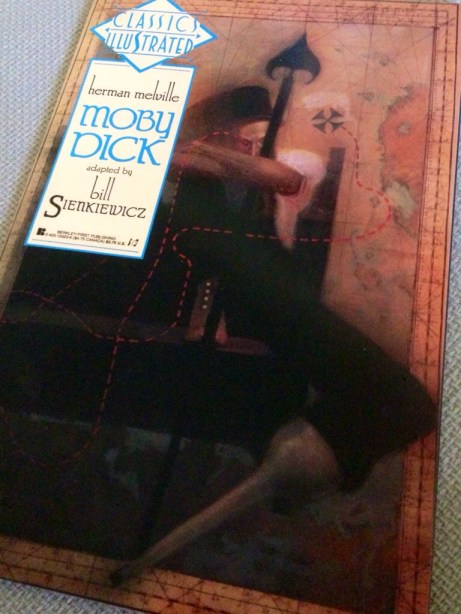
20131019-174637.jpg

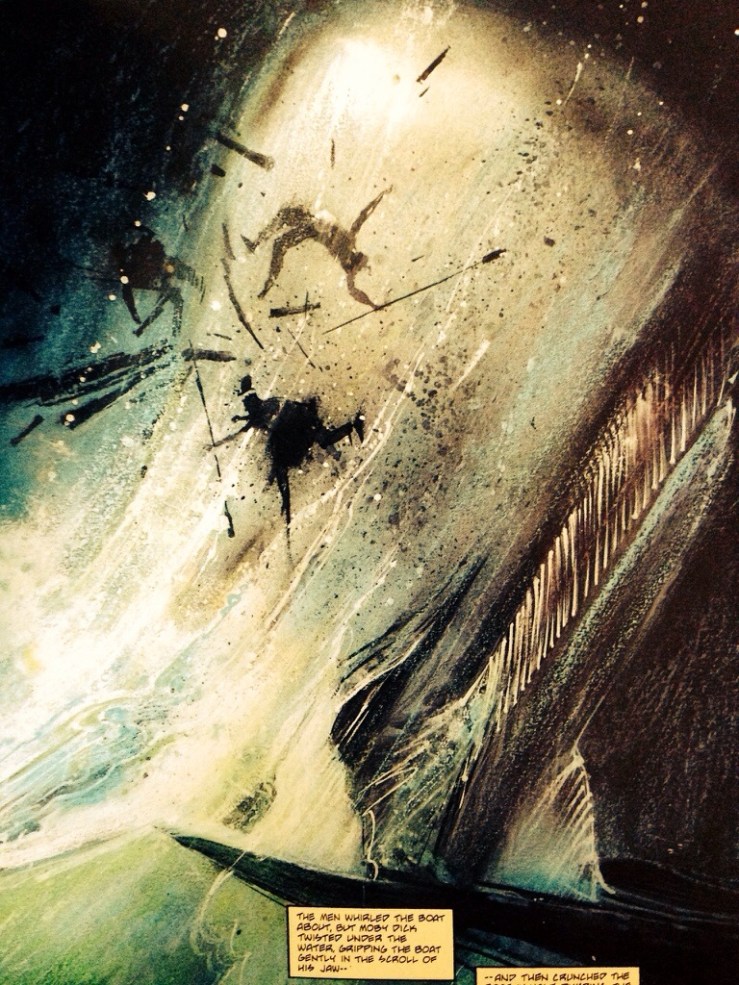
I am a huge fan of Bill Sienkiewicz. And Moby-Dick. I wish his Moby-Dick adaptation had no words though.

20131019-174646.jpg

20131019-174655.jpg

My dad’s childhood adaption, a Grosset & Dunlap from the early ’60s.

20131019-174705.jpg

20131019-174716.jpg

Sam Ita’s fantastic pop-up adaptation fails to mention Herman Melville’s name at all.

Despite the gross oversight, it’s given me hours of joy with my kids.

20131019-174740.jpg

20131019-174748.jpg

Moby-Dick was published on October 18th, 1851 in England.

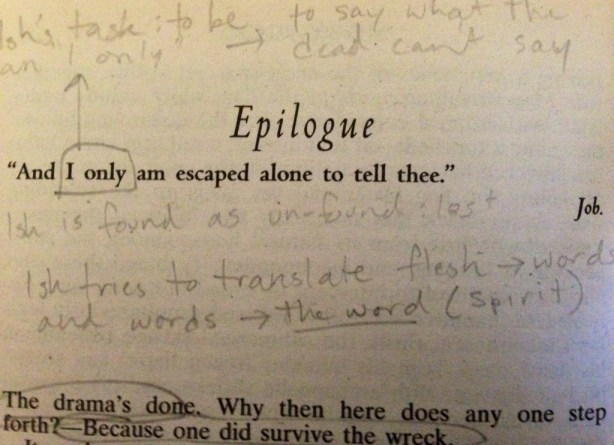
The English printer Peter Bentley’s text contained numerous errors, including leaving out the epilogue, where we learn that Ishmael survives to bear witness to disaster.

Although the American printing in November of 1851 emended many of these errors, the early reviews of Moby-Dick were scathing, and Melville’s career and reputation deteriorated.

It wasn’t until the advent of literary modernism in the first decades of the twentieth century that the world caught up to Moby-Dick.

20131019-174756.jpg

“The Huldrefish,” A Weird Tale of the Northern Seas

THE HULDREFISH

“The Huldrefish” by Jonas Lie; Translated from Norwegian by Nisbet Bain (Illustration by Laurence Housman)

It was such an odd trout that Nona hauled in at the end of his fishing-line. Large and fat, red spotted and shiny, it sprawled and squirmed, with its dirty yellow belly above the water, to wriggle off the hook. And when he got it into the boat, and took it off the hook, he saw that it had only two small slits where the eyes should have been.

It must be a huldrefish, thought one of the boatmen, for rumour had it that that lake was one of those which had a double bottom.

But Nona didn’t trouble his head very much about what sort of a fish it was, so long as it was a big one. He was ravenously hungry, and bawled to them to row as rapidly as possible ashore so as to get it cooked.

He had been sitting the whole afternoon with empty lines out in the mountain lake there; but as for the trout, it was only an hour ago since it had been steering its way through the water with its rudder of a tail, and allowed itself to be fooled by a hook, and already it lay cooked red there on the dish.

But now Nona recollected about the strange eyes, and felt for them, and pricked away at its head with his fork. There was nothing but slits outside, and yet there was a sort of hard eyeball inside. The head was strangely shaped, and looked very peculiar in many respects.

He was vexed that he had not examined it more closely before it was cooked; it was not so easy now to make out what it really was. It had tasted first-rate, however, and that was something.

But at night there was, as it were, a gleam of bright water before his eyes, and he lay half asleep, thinking of the odd fish he had pulled up.

He was in his boat again, he thought, and it seemed to him as if his hands felt the fish wriggling and sprawling for its life, and shooting its snout backwards and forwards to get off the hook.

All at once it grew so heavy and strong that it drew the boat after it by the line.

It went along at a frightful speed, while the lake gradually diminished, as it were, and dried up.

There was an irresistible sucking of the water in the direction the fish went, which was towards a hole at the bottom of the lake like a funnel, and right into this hole went the boat.

It glided for a long time in a sort of twilight along a subterranean river, which dashed and splashed about him. The air that met him was, at first, chilly and cellar-like; gradually, however, it grew milder and milder, and warmer and warmer.

The stream now flowed along calmly and quietly, and broadened out continually till it fell into a large lake.

Beyond the borders of this lake, but only half visible in the gloom, stretched swamps and morasses, where he heard sounds as of huge beasts wading and trampling. Serpent like they rose and writhed with a crashing and splashing and snorting amidst the tepid mud and mire.

By the phosphorescent gleams he saw various fishes close to his boat, but all of them lacked eyes.

And he caught glimpses of the outlines of gigantic sea-serpents stretching far away into the darkness. He now understood that it was from down here that they pop up their heads off the coast in the dog days when the sea is warm.

The lindworm, with its flat head and duck’s beak, darted after fish, and crept up to the surface of the earth through the slimy ways of mire and marsh.

Through the warm and choking gloom there came, from time to time, a cooling chilling blast from the cold curves and winds of the slimy and slippery greenish lichworm, which bores its way through the earth and eats away the coffins that are rotting in the churchyards.

Horrible shapeless monsters, with streaming manes, such as are said to sometimes appear in mountain tarns, writhed and wallowed and seized their prey in the fens and marshes.

And he caught glimpses of all sorts of humanlike creatures, such as fishermen and sailors meet and marvel at on the sea, and landsmen see outside the elfin mounds.

And, besides, that there was a soft whizzing and an endless hovering and swarming of beings, whose shapes were nevertheless invisible to the eye of man.

Then the boat glided into miry pulpy water, where her course tended downwards, and where the earth-vault above darkened as it sank lower and lower.

All at once a blinding strip of light shot down from a bright blue slit high, high, above him.

A stuffy vapour stood round about him. The water was as yellow and turbid as that which comes out of steam boilers.

And he called to mind the peculiar tepid undrinkable water which bubbles up by the side of artesian wells. It was quite hot. Up there they were boring down to a world of warm watercourses and liquid strata beneath the earth’s crust.

Heat as from an oven rose up from the huge abysses and dizzying clefts, whilst mighty steaming waterfalls roared and shook the ground.

All at once he felt as if his body were breaking loose, freeing itself, and rising in the air. He had a feeling of infinite lightness, of a wondrous capability for floating in higher atmospheres and recovering equilibrium.

And, before he knew how it was, he found himself up on the earth again.


“Everything human is pathetic” (Mark Twain)

human

“The Already Wildly Implausible Real We’re All Struggling to Absorb” | Carl Shuker Talks to Biblioklept About His Novel Anti Lebanon

New Zealand writer Carl Shuker is the author of four novels, including Three Novellas for a Novel, cult novel The Lazy Boys, and The Method Actors. His latest novel is Anti Lebanon (Counterpoint Press) is a strange work of surreal horror, set primary in Lebanon in the immediate fallout of the Arab Spring.  In my review, I wrote that Anti Lebanon’s “trajectory repeatedly escapes the reader’s expectations, driving into increasingly alien terrain.”

Carl was kind enough to talk about his work over a series of emails. He was especially kind in letting Biblioklept publish the short story “Fiction” which he mentions in the first part of this interview.

Carl Shuker Author Photo B&W

Biblioklept: How did Anti Lebanon begin? Did you set out to write about a Lebanese Christian? Tell us about the genesis of the novel and your research process.

Carl Shuker: Anti Lebanon started with the words, and the disjunction between my sense memories of the words, the place names and the language, and the atrocity exhibition of the Lebanese civil war of ‘75-’90 (which we are reliving now in the Syrian civil war).

I was brought up moderately conservative Anglican, which early on involved a lot of Bible stories and Sunday school. I had a very deep and powerful connection with the vocabulary. I remember tasting the words in a totally engrossing synesthesia: lying in bed in a small town in the South Island of New Zealand, ten years old and waiting for sleep and saying the words to myself.

Lebanon, for example, was thick milk and Alpine honey (as Nabokov once described his life). You can taste it in those pregnant Bs, those labile Ls and sonorous Os and Ns. And Syria and Damascus—with the latter I had generated some fertile misprision, I think, because into it I had somehow conflated “alabaster.” So the city had the word within it, and these cool and chalky white walls I felt up under my fingernails were as real to me as the blanket at my cheek. Jounieh, Jtaoui, and Bsharre; Ehden, and Zghorta.

Sometime in late 2006 I lost my agent (of only two years), via a one-paragraph email entitled, chillingly, “Cutting back.” He was a bit older and I hadn’t made him any money so it was understandable.

I saw, after eight years of trying to get it published, that although it did well critically and got a very cult following of some very cool and interesting people (a lot of eastern European teenage girls, pleasingly), that The Lazy Boys (2006) was not going to be any kind of breakthrough. There would be no musical. That book does sometimes feel to me like a cursed chalice. Another two years of querying agents for my Three Novellas for a Novel project had not gotten me representation again. I had no publisher for it. A long-gestating film project with a director and producer finally fell through due to funding and all the difficulties surrounding that. (The screenplay for The Lazy Boys is sitting humming in my drawer.)  I was running out of money I had from a prize and I felt after nearly ten years of work I was back almost at square one. Currently I have no agent and I think I’m fortunate to have gotten through the current convulsions in publishing under my own steam. I don’t know what I’d advise a young writer right now, about getting represented.

With writing and publishing, which is a tough and demanding ambient, the cliché is very useful: you get bitter or you get better. Working on a new thing is the best and only antidote to publishing an old thing. It’s always and only the writing that saves you. I started looking around for a new project. Though I don’t write short stories I wrote a suicide note for the lit-fict writer of the time and of the writer I’d almost become, a short story called “Fiction” that started to encompass elements of this new obsession with Lebanon, and to extend it to the consequences of that obsession.

I’m intuitive and a weird hybrid of deeply elemental and playful and airy fairy when I look around for a new project. But I’ve learned to identify and focus in on my obsessions, which is an important skill for a novelist. And usually it is what is troubling me; what I can’t figure out.

Etienne Sakr, a Christian militia leader in the civil war, who has been subsequently exiled and tarred as a rightist and racist and has not emerged from the post-war period at all well, wrote, “Politics is not the art of the possible. Politics, like all great art forms, is the art of the impossible. Otherwise there is no problem to resolve.”

Like all great art forms. This was a conception of the novel as well. The writing is a resolving of unresolved and seemingly irresolvable elements—it’s a tension, also, that can sustain you through the long period of composing something as big and demanding as a novel. Solving some problem you couldn’t any other way.

And the solution was the mode I think I am refining, that I work in by default anyhow. Freud in The Interpretation of Dreams: “Contradictory thoughts do not try to eliminate one another, but continue side by side, and often combine to form condensation products, as though no contradiction existed.”

In Anti Lebanon it was: how to resolve and express this deep but wordless feeling I have for the words of this country, the bloody holy dirt of this country, and the tropes and gestures of the vampire, the monster?

I prepped and read as much as I could on the civil war, and went to Beirut in May 2008 to taste the dirt. This was the same month I published the Three Novellas in serial online for a limited time for free or more, a la Radiohead’s In Rainbows, clearing the decks for something new (These were rereleased with a new introduction, for all ebook formats, in 2011: http://www.threenovellasforanovel.com).

And while I was there Hezbollah invaded Beirut, and I was given my novel to the sound of gunfire in the west, to the sight of an old Christian making fun of the Ashura and of the Shi’a who now owned his city and his country, wearing a comedy fez and mock self-flagellating with a plastic whip.

Biblioklept: Was it always in your head to introduce the vampire element into the plot? How did that come about?

CS: Well, when I started Anti Lebanon I started with the scene in the amusement park with my protagonist Leon, a security guard there who’s fallen asleep and wakes up to “a dead and freakish still.” I had all these materials in my head for the book:

I had the country, my obsession with it. I had the this amazing historical moment when Hezbollah took over, in response to the Sunni-heavy government under Saad Hariri trying to control them, to shut down their illegal communications network. The revenge of the Shia in Lebanon against the Sunni who have always looked down upon them. And the first time the seemingly untouchable Hezbollah turned their guns against fellow Lebanese. It was a complex contemporary political and military moment that I think novels have a particular genius in showing us, if novelists would only look at them.

I had Christians in Lebanon after the civil war. All the tragedy and the bloodthirstiness of Lebanese Christianity. The decline of things, which I’m very attracted to: pride in decline. And I had this character of Leon’s father very powerfully in mind: a big Christian, both physically and in personality; a security guard, a burly, charismatic, working man and leader and a civil war veteran. A man I became friendly with in east Beirut. One of those powerful male figures in our lives we feel are untouchable and always right. (“Three times jujitsu champion of Lebanon during the civil war; when? who remembers; who knows now.”) I had the contradictions creeping into his life, as the Hezbollah he has to support, because the Christian party he supports has aligned with them, do something very ambiguous and worrying.

But there was something missing, some binding element, or catalyst, some next level shit that could help the novel embody the whole messy idea. Somehow represent the addiction to violence, the ancestral handing-down of this kind of obligation to violence, and the sense of the blood in the soil always under your feet in Beirut. Walking a particular corner, looking at the men outside Phalange headquarters, and knowing Black Saturday started here where you stand. I had always wanted to write a vampire, one day. It was right in front of me, begging me to see it.

When I finally realised it, that was when the problems started.

Biblioklept: Okay—you can’t just stop there. Tell us about those problems.

CS: Oh my God. It would seem so silly and all writers’ problems when it comes to actually writing are the same or similar. Not finding a voice. Doubting your own voice. Time. Jobs. Debt. Money. Doubt, principally. The only mentionable and salvageable things, because they are, in retrospect, possibly funny, are the symptoms: I became convinced I was losing my hair. I went to an ER one day and had to abashedly (I was then a 36-year-old heavy smoker) tell the doctor (kind of leaning into him, and making an “I know this sounds stupid” face) that I thought I might be having a heart attack.

You don’t want to go into the emotions you feel when you enter a hospital ER thinking you’re having a heart attack and leave with some over-the-counter Gaviscon and one rogue ECG electrode still stuck to your ribs.

There were pressures. The worst were probably internal. But when my daughter was born she slept a lot of the time and I had a sudden superhuman burst of clarity and focus and went through the entire manuscript again stem to stern, took two weeks off work to rewrite one of the Japan sequences where Beirut and Lebanon had slipped off the page and the book had gotten floaty and lost, and then almost immediately I submitted it to Jack Shoemaker.

Anti_lebanon_CAT

Biblioklept: The final third of the book, those Japan sequences and the Israel bit, those are some of my favorites. I think there’s a lot of picaresque energy there. Was Jack Shoemaker your editor as well as publisher?

CS: Jack is my first reader, then there’s a second, but he’s never edited me as a copy editor edits. He’s always been my greatest advocate and is an amazing reader (and his list speaks for itself) but I don’t even know if he edits anyone any more. My editor on the first two books was the incomparable Trish Hoard, who was then one half of Shoemaker and Hoard before Jack got Counterpoint back.

Biblioklept: Were you ever pressured or tempted to play up the vampire aspect of the novel as a means to, I don’t know, bolster its commercial appeal?

CS: Well I started the book in 2008 and very soon after Twilight hunched and slouched and pouted into my awareness and after about six seconds of thinking “oh cool, trickledown” I realised it was an unmitigated disaster for me. Not only was my vampirism in Anti Lebanon supposed to be truly terrifying – and geopolitical, and religious – plus it had to do with sex but was also kind of unsexy in the easier ways (in that the sex in the book is constrained by religion, and is difficult and a bit sad and more about relief and frustration), but it was also the kind of vampirism I actually believed in: a nearly physical manifestation of a metaphor that is so persistent and pervasive and persuasive: a shade.

So I asked myself would the audience of Twilight and True Blood really want to broaden their fun base into a novel about Beirut, Hezbollah, the Lebanese civil war and the Christian exodus, and I decided probably not. So I thought so I’m writing the wrong kind of vampirism to speak to these people, and too much vampirism to speak to everybody else who’s thoroughly sick of it, and I’m screwed when it comes to publication.

But the metaphor was so true and so right and the novel started to click “like a fucking Geiger counter” as dfw would have it, so I really had no choice. I stuck by the kind of vampire the book was into and the kind of questions the book was asking: is he or is he not a vampire? What is a vampire really? If the historical record clearly demonstrates so many acts that are far, far worse and the cause of so much more blood spilled than any act of vampirism, then what kind of creature is a vampire? Is he mourning?

Late in the war a Christian priest was quoted as saying, “For a long time it was fun. Playing in our own blood.”  I put alongside this a Patrick Chauvel photograph of a priest in robes standing in a pile of shells firing a 50-cal. machine gun in south Lebanon in 1985. The glee on his face. A soldier beside him with his face in his hand. The material in the “pyr” chapter, about PLO soldiers ransacking the the Christian mausoleums in Damour: it was all true. What more evidence did I need? All good lit, music, film goes against what prevailing fashions, even if they’re dealing in the same ostensible material.

And here we recognize conclusive evidence of pyr: The process of exection extended to the dead. The Damour cemetery was invaded and it was a rout. They rooted out the corpsesnipers from the mausoleums, dragged the skeletonsoldiers from their elaborate Christian coffins, stripped them of their mortuary best, murdered their cadavers, pulling rib from rib, penetrating the vacant insides to locate and despoil and exect the very Christian soul.

Anti Lebanon – 150

Plus, in terms of “commercial appeal”, Etienne Sakr said another smart thing:

“When you are fighting you either follow the cause and don’t get the money, or you follow the money and lose the cause.”

Biblioklept: There’s a lot in the book that makes the reader go, “Wait, what?” Is this real? Is this really happening to Leon? Is this in his head?” The section in Israel for example . . .

CS: The idea became for me the discipline of this particular novel, which was to attempt to analogise contemporary Christian Lebanon while invoking and revitalising the vampire genre. [Note: some spoilers follow in this response only]

Leon is a young Christian in a very precarious situation. Yet paradoxically he and his father are security guards. (The novel is riddled with them – and Leon kills one later.) With some fellow Christians he commits, through a fin de siècle hedonism, accident and the absence of inhibition bred of desperation and overfamiliarity, a violent crime against, not a rival sect, but a fellow Christian. This is the vulnerable, damaged Armenian jeweller Frederick Zakarian. And, believing him dead, as they try to dispose of his body Zakarian, tied up but seemingly still alive, bites him. With the only weapon Zakarian has any longer. Teeth.

It is here (though for close readers the inevitability is triggered at the threshold to Zakarian’s workshop) that the narrative attempts to successfully double or mirror Leon – as vampire, as criminal, as victim, failed son, inheritor of paternal sin and a psychology overdetermined by violence, and simply as mourning brother. To me, being undead and mourning share a lot of the same qualities.

There was a wonderful 1984 Playboy interview with the Druze leader Walid Jumblatt (despite the blood and compromise on his hands a very interesting polymath and political genius, who showed William Dalrymple the rooms of priceless religious artifacts he’d saved from the war – see Dalrymple’s excellent From the Holy Mountain). I had it as an epigraph for a time:

Q: How do you deal with those feelings on a personal level? How does it feel not to know if you or your family will live through another day?

A: We become inhuman. We no longer respond to normal human feelings.

—interview with Walid Jumblatt, Playboy 1984

Leon flees Lebanon when it becomes clear the Armenians, missing their man and the jewels he was working on (destined for Iranians), are talking to the Christians of Beirut who have decades-old scores to settle against Leon’s father for his alliances in the civil war. The factions begin to align around money. Leon’s flight from Lebanon also simply mirrors in a particular sense the horrible inevitability of the more general Christian flight after 1400 continuous years of settlement in that one place.

The scenes in Israel you mention, that feature a psychic during immigration questioning at the Allenby Bridge border: these are simply in-context extrapolations of the already wildly implausible real we’re all struggling to absorb.

Biblioklept: Can you tell us what you’re working on now? I know you’ve been working on something new…

CS: [sotto voce] Right now I’m writer in residence at Victoria University of Wellington’s International Institute of Modern Letters, and the generosity and good company of students and staff here have allowed me to get 60,000 words into a new novel set in a medical journal in London. It’s a social comedy in the world of work, with a Straw Dogs strand and a healthy skepticism for the whole project of “a social comedy in the world of work” driving the plot—like Saki meeting Julio Cortazar in an argument over grammar and style in a London pub full of eccentric, driven healthcare professionals.

Biblioklept: Have you ever stolen a book?

CS: I once rescued Burroughs’ Cities of the Red Night (in English) from a trashcan in Tokyo (and stole a great nickname for one of my dark drinking lazy boys: “Pazuzu, of the rotting genitals’). I was also prohibited from graduating from Victoria due to more than $1000 in overdue fees from the library. One of the books was David Bergamini’s astonishing Japan’s Imperial Conspiracy. So I have no regrets.

Biblioklept’s Dictionary of Literary Terms

ALLEGORY

Didactic extended metaphor, best enjoyed amorally.

BIOGRAPHY

The sordid and lurid details of an author’s life; use as a critical rubric if the author’s work seems beyond comprehension.

CATACHRESIS

Mixed or imprecise metaphor. When an author stretches her words like taffy across the loom of meaning.

DEATH OF THE NOVEL

Declare the novel dead every few weeks. Resuscitate as necessary.

EPIC

Originally used to denote lengthy narrative works concerning serious subjects, this term may now be applied freely to modify failure, coffee, tacos, kittens, etc.

FANTASY

An inventive and imaginative style of fiction eschewed and denigrated by serious readers and writers.

GNOMIC POETRY

Poetry composed in the secret language of garden gnomes, inaudible to mortal ears.

HUBRIS

Defining common characteristic of all politicians.

IRONY

Dominant mode of much of 21st century communication (including, lamentably, this list).

JOYCEAN

Hyperbole used to describe lengthy works of contemporary authors. Use to disappoint potential readers.

KENNING

Circumlocution of meaning. E.g. “feed the eagle” for “kill,” “battle-sweat” for “blood,” “tube of garbage” for “internet.”

LEONINE VERSE

Poetry about lions.

MORAL

Each reader’s personal misunderstanding of the meaning of a work of literature.

NONFICTION

What your father reads.

OPEN LETTER

A solipsistic bid for attention delivered under the pretense of reaching out to another entity.

PASTORAL

Use to describe any work of literature set outside of a city.

QUATRAIN

A stanza

or poem

composed of

four lines.

RED HERRING

A false clue employed by an author to distract the reader. A novel where all points of evidence are red herrings (preferable) is a shaggy dog story.

STRUCTURALISM

Grab bag of theories you learned in college.

TRILOGY

Elevate any degraded work of pop culture by repeating it twice. Reboot as necessary.

UNRELIABLE NARRATOR

This narrator cannot be depended upon to pick you up from the airport, water your plants while you’re away, meet you on time for a beer or coffee, return small loans, etc.

VICTORIANISM

Indicative of literature of the prudish, uptight Victorian Era. Famous Victorian works include Venus in FursThe Pearl, and The Lustful Turk.

WITTGENSTEIN

Twentieth-century philosopher. Quote the first and last lines of his book Tractatus Logico-Philosophicus frequently (don’t worry about reading anything in between).

XENOPHOBIA

Fear of warrior princesses.

YELP

The pinnacle of contemporary criticism.

ZEUGMA

The list ended with zeugma and disappointment.

(Previous entries here and here).

“everything has crumbled…everything has dissolved…” (Thomas Bernhard)

Before he retired to his room, “not to sleep, but to howl to myself in the silence of horror,” he said: “How everything has crumbled, how everything has dissolved, how all the reference points have shifted, how all fixity has moved, how nothing exists anymore, how nothing exists, you see, how all the religions and all the irreligions and the protracted absurdities of all forms of worship have turned into nothing, nothing at all, you see, how belief and unbelief no longer exist, how science, modern science, how the stumbling blocks, the millennial courts, have all been thrown out and ushered out and blown out into the air, how all of it is now just so much air … Listen, it’s all air, all concepts are air, all points of reference are air, everything is just air …” And he said: “Frozen air, everything just so much frozen air …”

From Thomas Bernhard’s novel Frost.