“Why Read the Classics?” — Italo Calvino

From Italo Calvino’s The Uses of Literature

  1. The classics are the books of which we usually hear people say, “I am rereading . . . ” and never “I am reading . . . “
  2. We use the words “classics” for books that are treasured by those who have read and loved them; but they are treasured no less by those who have the luck to read them for the first time in the best conditions to enjoy them
  3. The classics are books that exert a peculiar influence, both when they refuse to be eradicated from the mind and when they conceal themselves in the folds of memory, camouflaging themselves as the collective or individual unconscious.
  4. Every rereading of a classic is as much a voyage of discovery as the first reading.
  5. Every reading of a classic is in fact a rereading.
  6. A classic is a book that has never finished saying what it has to say.
  7. The classics are the books that come down to us bearing the traces of readings previous to ours, and bringing in their wake the traces they themselves have left on the culture or cultures they have passed through (or, more simply, on language and customs).
  8. A classic does not necessarily teach us anything we did not know before. In a classic we sometimes discover something we have always known (or thought we knew), but without knowing that this author said it first, or at least is associated with it in a special way. And this, too, is a surprise that gives much pleasure, such as we always gain from the discovery of an origin, a relationship, an affinity.
  9. The classics are books which, upon reading, we find even fresher, more unexpected, and more marvelous than we had thought from hearing about them.
  10. We use the word “classic” of a book that takes the form of an equivalent to the universe, on a level with the ancient talismans. With this definition we are approaching the idea of the “total book,” as Mallarmé conceived of it.
  11. Your classic author is the one you cannot feel indifferent to, who helps you to define yourself in relation to him, even in dispute with him.
  12. A classic is a book that comes before other classics; but anyone who has read the others first, and then reads this one, instantly recognizes its place in the family tree.
  13. A classic is something that tends to relegate the concerns of the moment to the status of background noise, but at the same time this background noise is something we cannot do without.
  14. A classic is something that persists as a background noise even when the most incompatible momentary concerns are in control of the situation.


Ezra Pound Weighs Chaucer and Shakespeare

Ezra Pound’s ABC of Reading, hardly short on strong opinions, contains a fantastic chapter on Chaucer, who Pound submits is superior in some ways to Shakespeare. A taste—

Sloth is the root of much bad opinion. It is at times difficult for the author to retain his speech within decorous bounds.

I once heard a man, how has some standing as writer and whom Mr. Yeats was wont to defend, assert that Chaucer’s language wasn’t English, and that one ought not to use it as basis of discussion, ETC. Such was the depth of London in 1910.

Anyone who is too lazy to master the comparatively small glossary necessary to understand Chaucer deserves to be shut out from the reading of good books for ever.

As to the relative merits of Chaucer and Shakespeare, English opinion has been bamboozled for centuries by a love of the stage, the glamour of the theatre, the love of bombastic rhetoric and of sentimentalizing over actors and actresses; these, plus the national laziness and unwillingness to make the least effort, have completely obscured values. People even read translations of Chaucer into a curious compost, which is not modern language but which uses a vocabulary comprehended of sapheads

Wat se the kennath

Chaucer had a deeper knowledge of life than Shakespeare.

Let the reader contradict that after reading both authors, if he chooses to do so.

Roberto Bolaño on William Burroughs

Here’s Roberto Bolaño on William Burroughs (from New Directions’ forthcoming collection of Bolaño’s essays, newspaper columns, and other ephemera Between Parentheses)—

For some of those of my generation, William Burroughs was the affectless man, the shard of ice that never melted, the eye that never closed. They say he possessed every vice there was, but I think he was a saint who attracted all the sinners in the world because he was gracious and unwise enough never to shut his door. Literature, his livelihood for the last thirty years, interested him, but not too much, and in that regard he was like other classic American figures who focused their efforts on observing life or on experience. When he talked about what he read one got the impression that he was remembering vague stretches of time in prison.

“I Learn as Much from Painters About How to Write as from Writers” — Hemingway on His Literary Forebears

Ernest Hemingway describes his influences in his 1958 interview with George Plimpton at The Paris Review

INTERVIEWER

Who would you say are your literary forebears—those you have learned the most from?

HEMINGWAY

Mark Twain, Flaubert, Stendhal, Bach, Turgenev, Tolstoy, Dostoyevsky, Chekhov, Andrew Marvell, John Donne, Maupassant, the good Kipling, Thoreau, Captain Marryat, Shakespeare, Mozart, Quevedo, Dante, Virgil, Tintoretto, Hieronymus Bosch, Brueghel, Patinir, Goya, Giotto, Cézanne, Van Gogh, Gauguin, San Juan de la Cruz, Góngora—it would take a day to remember everyone. Then it would sound as though I were claiming an erudition I did not possess instead of trying to remember all the people who have been an influence on my life and work. This isn’t an old dull question. It is a very good but a solemn question and requires an examination of conscience. I put in painters, or started to, because I learn as much from painters about how to write as from writers. You ask how this is done? It would take another day of explaining. I should think what one learns from composers and from the study of harmony and counterpoint would be obvious.


Don DeLillo Reads from Mao II

“Defending Walt Whitman” — Sherman Alexie

“Defending Walt Whitman,” a poem by Sherman Alexie

Basketball is like this for young Indian boys, all arms and legs
and serious stomach muscles. Every body is brown!
These are the twentieth-century warriors who will never kill,
although a few sat quietly in the deserts of Kuwait,
waiting for orders to do something, to do something.

God, there is nothing as beautiful as a jumpshot
on a reservation summer basketball court
where the ball is moist with sweat,
and makes a sound when it swishes through the net
that causes Walt Whitman to weep because it is so perfect.

Continue reading ““Defending Walt Whitman” — Sherman Alexie”

“The Reader Is a Person You Need to Charm” — Writing Advice from George Saunders

“The Other Place” — New Fiction from Mary Gaitskill

The New Yorker has published “The Other Place,” a new short story from Mary Gaitskill. A taste–

My son, Douglas, loves to play with toy guns. He is thirteen. He loves video games in which people get killed. He loves violence on TV, especially if it’s funny. How did this happen? The way everything does, of course. One thing follows another, naturally.

Naturally, he looks like me: shorter than average, with a fine build, hazel eyes, and light-brown hair. Like me, he has a speech impediment and a condition called “essential tremor” that causes involuntary hand movements, which make him look more fragile than he is. He hates reading, but he is bright. He is interested in crows because he heard on a nature show that they are one of the only species that are more intelligent than they need to be to survive. He does beautiful, precise drawings of crows.

Mostly, though, he draws pictures of men holding guns. Or men hanging from nooses. Or men cutting up other men with chainsaws—in these pictures there are no faces, just figures holding chainsaws and figures being cut in two, with blood spraying out.

My wife, Marla, says that this is fine, as long as we balance it out with other things—family dinners, discussions of current events, sports, exposure to art and nature. But I don’t know. Douglas and I were sitting together in the living room last week, half watching the TV and checking e-mail, when an advertisement for a movie flashed across the screen: it was called “Captivity” and the ad showed a terrified blond girl in a cage, a tear running down her face. Doug didn’t speak or move. But I could feel his fascination, the suddenly deepening quality of it. And I don’t doubt that he could feel mine. We sat there and felt it together.

And then she was there, the woman in the car. In the room with my son, her black hair, her hard laugh, the wrinkled skin under her hard eyes, the sudden blood filling the white of her blue eye. There was excited music on the TV and then the ad ended. My son’s attention went elsewhere; she lingered.

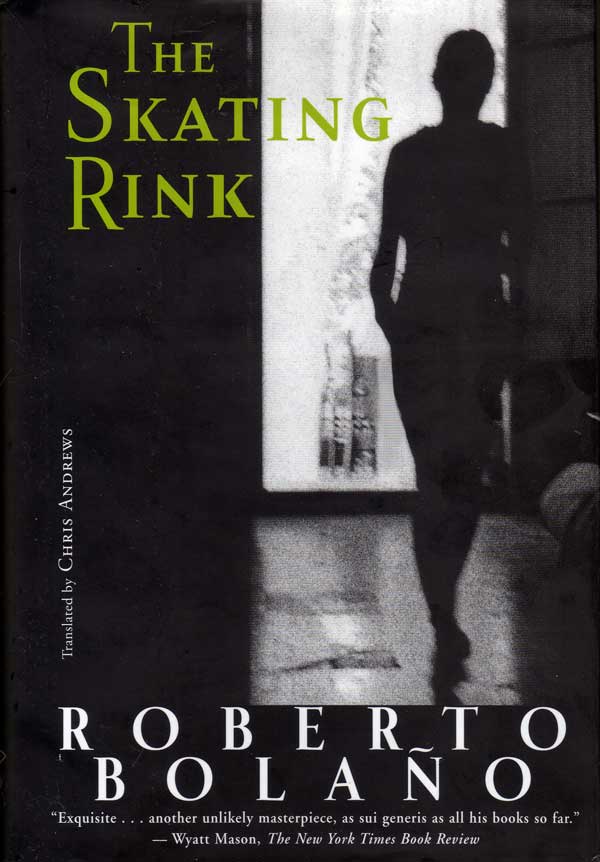
The Skating Rink — Roberto Bolaño

The Skating Rink was the first novel Roberto Bolaño published, a murder mystery in Spanish, all the way back in 1993.  It’s a short novel, but full of devices and ideas that readers will recognize from the late Chilean master’s later and better-known works. Characters who populate the novel recount events as if speaking extemporaneously to a reporter or a detective and discuss ideas and themes that the author would return to again and again:  obsession, alienation, lack of national identity, underappreciated poets, homelessness, and homicide.  The Skating Rink is a brief novel at 179 sharp and engaging pages. It wouldn’t be incorrect to call it a minor novel, but it would be a mistake to consider it merely a warm-up for the more intricate routines that the writer would perfect in the future.

The novel is about the construction and existence of a clandestine ice rink built in a deserted mansion on the cliffs of a seaside resort town in Catalonia, Spain. Erected to please Nuria Marti, a beautiful figure skater cut from the Spanish Olympic team, the rink and its inspiration are reserved and glacial while the locals who populate the seasonally bustling city are, with varying degrees of success, just trying to hold everything together. When the body of an itinerant singer is discovered in the middle of the ice deep within the labyrinthine halls of the decaying house, everything the characters have strained to preserve begins to fall apart.

The book is narrated by three men who represent different strata of Spanish society. Enric Rosquelle is an outwardly arrogant bureaucrat in charge of the city’s various social service agencies whose desperate need for love leads him to embezzle the funds  in order to build the skating facility for the athlete he knows will never return his feelings. Gaspar Heredia is an illegal Chilean immigrant who works in a campground for tourists and falls for a homeless woman who never relinquishes the kitchen knife she keeps tucked in her jeans.  Remo Moran, a legal arrival from Chile, has enjoyed success as a businessman and as a poet and is anxious about his own precarious sexual relationship with Nuria. Each man is more or less aware of his shortcomings and they utilize similar Bolañesque (Bolañan?) digressions to explain their motivations and feelings. They come to know and discuss each other in their retelling of events and so become interesting, sympathetic, and full characters.  Enric is jealous of Remo and suspicious that South Americans in general trade in filth and drugs.  Gaspar relies on his old friend Remo for his job and secretly watches Enric coaching Nuria.

The sense of loneliness and the failure to take advantage of fleeting opportunities are palpable. In a number of places, the narrative and the novel’s setting evoke a Wong Kar-wai movie. In slow motion, men follow women through cobblestone streets, not quite able to grasp that thing they desire. Hang-gliders dance in the sky and while everyone else is watching the fliers against the cool blue sky, we’re being told about how she’s just disappeared through a door down a side street. Solitary women stroll up cliff-side highways while our narrators limp behind. I almost expect Gaspar to sit down next to Tony Leung while cellos or Chinese versions of well-known pop tunes play from a nearby jukebox.  Unlike Wong Kar-wai though, Bolaño sees the single-minded pursuit of unrequited love as pathological and often a precursor to violence. The men in The Skating Rink, like any number of other men who populate Bolaño’s novels, are unable to resist the wills of the women they love or submit to personally or professionally. Two men here are willing to sublimate their own wishes for those of Nuria, whose choice of profession illustrates her own desire to overcome the normal limitations of geography, climate, and national history. As they seek her favor, they find themselves acting in unfamiliar ways, on uncertain paths and  unconcerned with appearance or ethics.

Like most of Bolaño’s work, endings (and beginnings and middles) are ambiguous. Readers are left unsure as to what has actually happened and the murder remains (I think) unsolved.  The Skating Rink could serve as an easy introduction to the writer’s more complex creations because it deals with time and plot in a relatively conventional manner. The characters get to say proper good-byes and reflect on the things that have happened to them. Like a standard mystery, most of the knots have been untangled.  But because real understanding sits just outside of consciousness, this reader is still waiting for the feeling that my task is complete. There are occasional missteps, like when Bolaño compares an elderly woman’s voice to a locker room, but passages lodge in your head like slow songs on repeat in dark comfortable places. Like those jams, The Skating Rink might be a masterpiece or something to be forgotten when something better comes along.  It’s short, so listen to it a couple times and decide for yourself.

William Burroughs Plays the Drums

“Walking in the Footsteps of W.G. Sebald” — Stuart Jeffries Retraces The Rings of Saturn

Stuart Jeffries retraces W.G. Sebald’s coastal walk from The Rings of Saturn. Video after the jump. Continue reading ““Walking in the Footsteps of W.G. Sebald” — Stuart Jeffries Retraces The Rings of Saturn”

The Instructions — Adam Levin

Adam Levin’s début novel The Instructions is long. It’s very long. It’s too long.

Or, more to the point, it’s too long to be so mediocre.

This is not a fair criticism, especially considering that I have only read about 35.5% of the book. 8 chapters. 366 pages. I have no conclusive evidence that the next 664 pages won’t be the kind of mind-blowing read that can justify taking up over a thousand pages. Significantly though, there’s nothing in the first 366 pages that especially compels me to continue reading. I give up. I abandon it. Although reading is hardly a quantitative experience — reading and digesting a page of Melville requires more sustained concentration and energy than a page of, say, Bukowski — it stands to reason that I can read two or three novels in the time it would take finish The Instructions. And if I spend my (limited, I am a human and am going to die at some point) reading time reading three novels instead of finishing Levin’s book, it’s likely that at least one of them might be good, even great, while I’m pretty sure that The Instructions is going to continue its middling trajectory.

So what’s it about? It must have had an interesting premise for me to read 366 pages, right?

Gurion ben-Judah Maccabee is a 10 year-old seventh grader (he’s been promoted, sort of) who is forced to attend a special program called “The Cage” after being expelled from his first three schools for various violent acts. Gurion is a hyper-intelligent, budding rabbinical scholar with serious Torah-interpreting skills. He’s also pretty much the toughest kid at Aptakisic Junior High, where, despite being only ten, he kicks ass left and right (his mom is a former Israeli commando). The novel takes place over four days in 2006, as Gurion declares his love for June Watermark, meets a new friend, and begins to rally the behavioral disorder kids against The Cage’s totalitarianism.

The opening scene of the novel is an engaging piece — Gurion and two friends take turns simulating water boarding on each other during a gym class held in a pool. Then, in the locker room, a fight. Gurion loves to fight, despite his inkling — or, at least the inkling of others — that he may be the potential messiah. This obsession with Jewish (“Israelite,” Gurion would correct me) identity seems to be the main thrust of the novel. Gurion, who is the “author” of the novel (which he refers to as “scripture”) speaks authoritatively and eruditely about Torah and religious philosophy. In fact, he speaks like a fully matured scholar who has taught and studied religious philosophy for decades. One can allow this conceit of the novel: sure, Gurion is special, he can fight, he’s a genius, sure, that’s what drives the plot–but Levin wants to extend this genius, or at least rhetorical flair, to almost every other character.

The effect is by turns grating and numbing, as we are subjected to page after page of dialog that is meant to sound witty or empathetic or just plain flavorful but is more often silly or inauthentic or, at worst, too fucking precious for words. The cartoonish dialog, rife with fake slang that no middle school kids ever used, wouldn’t be so bad on its own; in fact, it seems to go hand in hand with Levin’s goal, which appears to be slapstick of some kind. Only he (or Gurion) repeatedly calls attention to the slapstick, commenting on it, even pointing out how the reader should appreciate it.

This meta-textual attention is at work at all times. In particular, it’s there in the long (oh my god are they long) descriptions of each and every action that takes place in the prose. Gurion feels the need to analyze every last little detail, to load it with preternatural significance; these lengthy passages scream for an editor. The arrangement of the text is of course meta-textual as well: it purports to be a work of Gurion’s authorship, and includes a variety of texts from his “personal file” including emails, detention records, essay assignments, and, in one glaring case of squandered potential, a psychological report. And yet in all these documents, there does not seem to be any perspective outside of Gurion’s; when Gurion’s therapist comments on his behavior we learn nothing new, nothing different — we only see a confirmation of Gurion’s highly perceptive intelligence. It is grand solipsism on the largest of scales.

Which brings me to the David Foster Wallace comparisons, which are probably what got me interested in The Instructions in the first place. Granted, The Instructions may have facile similarities to Infinite Jest, but the books differ tremendously in how the reader must engage them. IJ is pluralistic and heteroglossic; The Instructions is essentially a monologue. IJ invites the reader to play, to pursue mystery; The Instructions, despite its volume, seems to contain just one mind. And maybe that’s the problem. Reviewers have compared Gurion to Hal Incandenza — and it’s true, both are bright, troubled young men — but The Instructions seems to be lacking a Don Gately.

Looking over my comments, they seem harsher than I perhaps intended. I believe that Levin has great talent and is surely a keen intellect with stories worth sharing. More to the point, I think that there might be a good novel somewhere inside of The Instructions — only I’m pretty sure it’s much, much shorter.

The Instructions is new in hardback from McSweeney’s.

“An Account of Sharing an Ambien with a Girl I Met One Week Prior at a Party” — Tao Lin

“An Account of Sharing an Ambien with a Girl I Met One Week Prior at a Party” is a short short story (?) by Tao Lin published this week at Thought Catalog. An excerpt–

We went into her room ~6:55PM. She asked if I wanted wine and I said no. She asked again and I said no. I said “I brought the Ambien.” She said something about Tiger Woods and I felt confused and said “we should see if it’s okay with alcohol.” She typed “ambient” into Google. I said “no, that’s the music, delete the t, ambient music.” She laughed and typed “ambien and alcohol and klonopin and” and grinned and said “just kidding.” She deleted all but “ambien and alcohol.” The first result said not to combine Ambien and alcohol. Every result seemed to say that. She clicked the first result. It said not to combine Ambien and alcohol. She said she drank a lot so it was okay.

Lydia Davis Reads Five of Her Short Stories

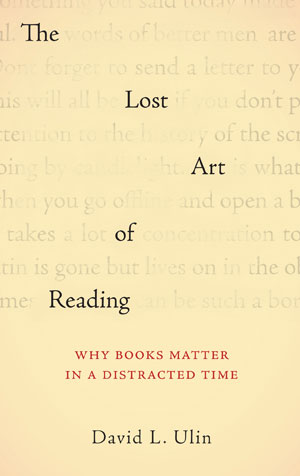
The Lost Art of Reading — David L. Ulin

“One evening not long ago, my fifteen-year-old son, Noah, told me that literature was dead,” begins David L. Ulin’s new book-length essay, The Lost Art of Reading. Noah is not enjoying The Great Gatsby; or, perhaps more accurately, he’s not enjoying how his English teacher is having him analyze the book. Noah’s experience with Gatsby is probably not too different from many young readers who are told that they must appreciate a book, break it down, reckon and account for all of its subtleties — all in the context of a classroom, for a grade. Reading literature is just a means to an end then, a way to pass a class; unlike Ulin, who “frame[s] the world through books,” Noah’s “inner-life is entwined within the circuits of his laptop.” Noah’s pronouncement that literature is dead is fraught with cultural and technological significance. And while such declarations are hardly new, the idea that books — literary works in particular — not only do not hold the place they once did in our society, but now cannot hold a place of significance seems to hold more water than it did even ten years ago. Books are no longer the dominant media. Discourse is frenetic, fractured, shallow. Accordingly, Ulin subtitles his book Why Books Matter in a Distracted Time.

Gatsby — and Ulin’s conversations with his son about it — become organizing touchstones throughout the essay, along with Frank Conroy’s memoir Stop-Time, Faulkner’s obsession with time, and Thomas Paine’s Common Sense — a tract that Ulin points out might be “the most important book ever published in America.” It’s this consideration of Common Sense, along with his son’s declaration that lit is dead, that prompts Ulin to ask, “Could a book, any book, have this kind of impact in contemporary society? What about a movie or a website?” The questions continue–

How do things stick to us in a culture where information and ideas flare up so quickly that we have no time to assess one before another takes place? How does reading maintain its hold on our imagination, or is that question even worth asking anymore?

Ulin sets out to address these questions, drawing examples and analyses from a dizzying pool of books, websites, movies, and other media to do so. One of the highlights of The Lost Art of Reading is its confidence in defining reading as a meaningful art. Ulin tells us that–

Reading is an act of contemplation, perhaps the only act in which we allow ourselves to merge with the consciousness of another human being. We possess the books we read, animating the waiting stillness of their language, but they possess us also, filling us with thoughts and observations, asking us to make them part of ourselves.

And a few pages later–

This is what literature, at its best and most unrelenting, offers: a slicing through of all the noise and the ephemera, a cutting to the chase. There is something thrilling about it, this unburdening, the idea of getting at a truth so profound that, for a moment anyway, we become transcendent in the fullest sense. I’m not talking here about posterity, which is its own kind of fantasy, in which we regard books as tombstones instead of souls. No, I’m thinking more of literature as a voice of pure expression, a cry in the dark.

And yet Ulin admits to becoming, increasingly, a distracted reader, a reader who too quickly puts down his book to pick up his laptop or smart phone. This distraction seems endemic, environmental, even professionally necessary — and admittedly very, very familiar. The costs are also familiar–

. . . to read, we need a certain kind of silence, an ability to filter out the noise. That seems increasingly elusive in our overnetworked society, where every buzz and rumor is instantly blogged and tweeted, and it is not contemplation we desire but an odd sort of distraction, distraction masquerading as being in the know. In such a landscape, knowledge can’t help but fall prey to illusion, albeit an illusion that is deeply seductive, with its promise that speed can lead us to more illumination, that it is more important to react than to think deeply, that something must be attached to every bit of time. Here, we have my reading problem in a nutshell, for books insist we take the opposite position, that we immerse, slow down.

It’s key to note that Ulin is hardly a Luddite or a reactionary; when he writes “my reading problem” this is not a generalization — he is referring to his first-person experience as a reader. He is also open to the ways in which new media enhances literature. He writes, for example, of the ways in which Facebook and other websites create virtual platforms in which to honestly engage literature. He also discusses times when one habit of distraction — stopping to reference what he’s reading on YouTube or elsewhere on the net (a habit I fully identify with) — genuinely enriches his reading. However, Ulin’s greater fear is not so much his own personal distraction, but the costs of a permanently distracted populace–

This is how we interact now, by mouthing off, steering every conversation back to our agendas, skimming the surface of each subject looking for an opportunity to spew. We see it on blogs and in e-mails, on television talk shows, in public meetings and community forums; we are a culture that seems unable to concentrate, to pursue a line of thought or tolerate a conflicting point of view.

Wallowing through the comments section of any politicized news story is pretty much a recipe for depression, or at least a loss of faith in Americans’ ability, as Fitzgerald says ” to hold two opposed ideas in the mind at the same time, and still retain the ability to function.”

I should admit my bias — Ulin had little work to do to convince me that a decline in “deep” reading — and meaningful, reflective discussion about that reading — can only further contribute to an increasingly shallow, trivial, and openly anti-intellectual society. So what is at stake here?–

Stories, after all — whether aesthetic or political — require sustained concentration; we need to approach them as one side of a conversation in which we play a part. If we don’t, we end up susceptible to manipulation, emotional or otherwise. In February 1946, Hermann Goering told the judges of the Nuremberg tribunal, ‘Naturally the common people don’t war . . . But, after all, it is the leaders of a country who determine policy, and it is always a simple matter to drag people along, whether it is a democracy, or a fascist dictatorship, or parliament, or a communist dictatorship. All you have to do is tell them they are being attacked, and denounce the pacifists for lack of patriotism and exposing the country to danger. It works the same in every country.’ Such a statement is chilling on all sorts of levels, but nowhere more than in its recognition of the fact that we are complicit in our fate.

One solution for Ulin (and I’m apt to agree) is reading, “an act of resistance in a landscape of distraction, a matter of engagement in a society that seems to want nothing more than for us to disengage.” Best of all, Ulin’s book is the act of criticism — both cultural and literary — that makes one want to read. He reminds us that the currency of ideas is always open to us if we put in the effort, and that the moments of enlightenment, of transcendence that we might gain from literature are part of what makes a life worth living. Recommended.

The Lost Art of Reading is available now from Sasquatch Books.

Terrible Ideas

There’s a new Bowdlerized edition of Huckleberry Finn.

James Franco thinks he can adapt Faulkner’s As I Lay Dying and Cormac McCarthy’s Blood Meridian.

Snooki is a novelist.

James Frey tops The Guardian’s “Best Books of 2011” list.

Also, Frey’s MFA fiction factory scam is landing the guy movie deals.

Clarence Thomas’s ex to publish a “sexually driven” memoir.

Amy Hempel on Gordon Lish and Barry Hannah

Amy Hempel talks Gordon Lish and Barry Hannah (among other things) in a new interview with Vice. A taste–

Do you think about readers when you’re writing? Do you personify them?
I do. I always have, and it’s always been a handful of other writers. Sometimes it has changed, but yes, I really do think of a few actual people. It makes it a little bit easier since I know them, and I know that, well, if this person will find it funny, then I’ve succeeded, or some such thing. It makes it more like trading confidences. I think it’s daunting to think of writing for one’s readers, whoever they may be, so I bring it down to something manageable—a few people whose standards I know and whose work I very much admire—and that makes it more like, almost, a letter to the person. That helps me set the course.

So do you think like, “I’m going to change this here. I’m sure Gordon Lish would love it”?
[laughs] Well, I often have in mind Barry Hannah, and in fact when you phoned me just now, I was working on some remarks I’m going to make at a sort of memorial tribute to Barry, who died last March. This is something that will be held just outside Boston, two nights from now. A bunch of writers who adored him, just paying tribute to him. Barry Hannah was always on my list of people I knew, writers I admired immensely, and just thinking, you know, Barry Hannah might read this, it seemed to focus me when I was writing.

Writing is an extremely solitary activity, but at the same time it’s also very intense. One analogy that I always think of is swimming—it’s something that you do on your own, and the only standard of success you have is your last lap.
I agree 100 percent. And yet there are writers who hold themselves up and compare themselves to other writers. I think that’s useless. As you say, you’re only trying to beat your own best time. That’s the only relevant competition as far as I’m concerned.

Is your past with Lish something that still has an influence on you?
You know, it was a long time ago. I was a student of his at Columbia and then privately and then his author back in the early 80s. I did two books with him. Working with him was a crucial formative experience, but it was a long time ago. There are other writers who have sort of stepped in. Interestingly, Barry Hannah was one and Mary Robison is another, and they are both his authors, too, and were at the time that I was being published by him. So, yes, [Lish] had a terrific impact on my writing very early on. I don’t think he’s writing any more, but he’s still present among writers who really do care about writing at the sentence level. His impact there has certainly endured.

What about the so-called golden age of American short stories? I don’t really know if it’s accurate, or even intelligent, to define it that way.
Well, I think it was a phenomenon in publishing, with a lot of critics rightly going to Raymond Carver—who was also Gordon’s author—and people like Mary Robison. You know—some of the story writers who really, really opened things up again for stories as a commercially viable kind of writing as well as something that was important to a lot of readers.