New Books from Dinaw Mengestu, Stephen-Paul Martin, and Susan Straight

Dinaw Menestu’s new novel How to Read the Air tells the story of a family over two generations. The novel opens in the 1970s as Mariam and Josef, a young married couple from Ethiopia, take a road trip through the American heartland. The pair has been separated for over three years–after just one year of marriage–and they hope that the trip will help renew their bonds and in some way forge their new identities as Americans. But they don’t really know each other, and perhaps they can’t; the violence they sought to escape in Ethiopia’s communist revolution recapitulates in their own marriage, eventually sundering it. Nearly 30 years later, their son Jonas–the introspective, sensitive, and inventive narrator of this novel–tries to come to terms with his own crumbling marriage, job, and identity, by re-examining the past. By literally recreating his parents’ journey, Jonas tries to convert his father’s pain and fear into a stable identity in this moving novel about family, place, and the need to move both our bodies and our souls. How to Read the Air is new in hardback from Riverhead Books.

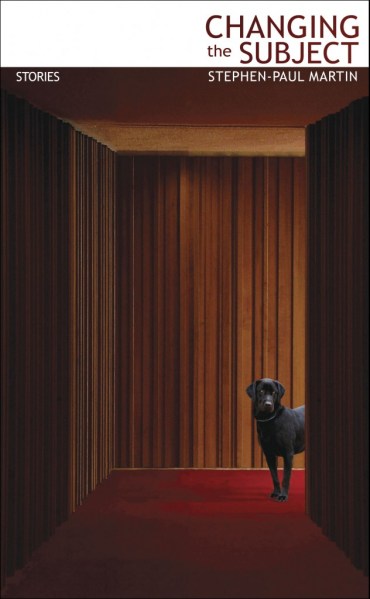
There’s a thread of vengeful anger that runs through Stephen-Paul Martin’s new collection of stories, Changing the Subject. Although a tidy portion of that anger is reserved for George W. Bush and his nefarious gang (the stories seem to have been composed under last decade’s regime), Martin’s various characters also aim their anger at scientists, whalers, cell phones, born-again Christians, college students, journalists, fast food restaurants, Americans, and all the people of the world. That anger works best when working in a reflective mode, especially when Martin blends his vitriol with humor. The opening paragraph of the first story “Safety Somewhere Else” provides a nice illustration of Martin at his finest–

The greatest mistake of all time took place thousands of years ago, when God let Noah’s family survive the flood. God’s plan was to start a new human race with a man he though he could trust, but the limits of Noah’s moral awareness were obvious right from the start. No sooner had God’s rainbow vanished into the clouds than Noah was getting drunk and cursing his grandson, declaring that Canaan’s descendants–one-third of the human race–would be the lowest of slaves, a monstrous over-reaction that would have tragic consequences for countless generations of innocent people. Clearly, Noah wasn’t the man God thought he was.

The story then shifts into a bizarre picaresque involving revenge against a scientist who uses animals as research subjects (there’s also an attack on a whaling vessel, a fascinating reading of The Odyssey, and a woman whose son was consumed by a bear). Great stuff, but I think I would have been just as happy to hear more of Martin’s thoughts (or, his narrator’s thoughts, to be fair) on the Old Testament. Changing the Subject is new in trade paperback from Ellipsis Press.


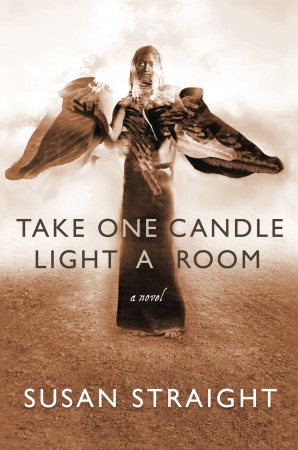
Susan Straight’s
new novel Take One Candle Light a Room explores the physical and psychic traumas that evince from America’s long, painful, complicated history of race relations. FX Antoine, the novel’s narrator, is an LA-based travel writer who found herself, as a young girl, transplanted from rural Louisiana to California at the end of the fifties, in order to escape the rapes perpetrated by a local plantation owner on three of her sisters. In 2005, FX–Fantine to her friends and family–watches over Victor, her godson, a recent community college graduate. Fantine encourages Victor to expand his unlikely success (he is the son of a crack-addicted murder victim, one of Fantine’s childhood friends) by applying to four-year schools; however, after Victor is implicated in a shooting (wrong place, wrong time), he runs away to Louisiana. Fantine follows, attempting to save the young man and find some sense of personal redemption as well. The novel’s climax is set against the devastating backdrop of Hurricane Katrina. For more on Take One Candle, read Francesca Mari’s review at The New York Times. Take One Candle Light a Room is new in hardback from Pantheon Books.

A Selection from “Hierogylphic Silence” by William S. Burroughs

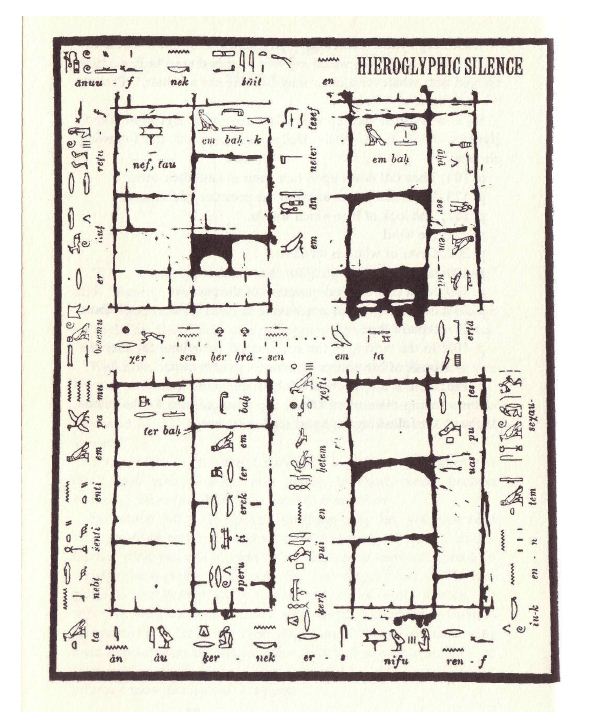
The following selection is from William S. Burroughs’s “Hieroglyphic Silence,” collected in the totally out-of-print volume The Third Mind, a book of cut-ups Burroughs co-authored with Brion Gysin (you can access the book here via extralegal means). From “Hieroglyphic Silence”–

“I am the Egyptian,” he said, looking all flat and silly, and I said: “Really, Bradford, don’t be tiresome.”

All right, let’s put it apple-pie simple with a picture of a wedge of apple pie there, containing fifty-three grams of carbohydrates.(See the L-C diet.)

Well now, if you don’t know the word for apple pie where you happen to be and want it, you can point to it or you can draw it. So, when and why do you need a word for it? When and why do you need to say, I want apple pie, if you just don’t care how fat you get?

You need to say it when it isn’t there to point to and when you don’t have your drawing tools handy\ In short, words become necessary when the object they refer to is not there.

No matter what the spoken language may be, you can read hieroglyphs, a picture of a chair or what have you; makes no difference what you call it, right? You don’t need subvocal speech to register the meaning of hieroglyphs. Learning a hieroglyphic language is excellent practice in the lost art of inner silence. “It would be well, today, if children were taught a good many Chinese ideograms and Egyptian hieroglyphs as a means of enhancing their appreciation of our alphabet.” If you are able to look at what is in front of you in silence, you will be able to write about it from a more perceptive viewpoint.

What keeps you from seeing what is in front of you? Words for what is in front of you, which are not what is there. As Korzybski pointed out: whatever a chair may be, it is not a “chair.” That is,it is not the label “chair.”So, now try this: pick up your Easy Lessons in Egyptian Hieroglyphics, by Sir E. A. Wallis Budge, and copy out the following phrases:

p. 104; They fall down upon face their in land their own.

p. 173; Stood the prince alone in the presence of the gods.

p. 181; The lock of hair which was in.

p. 79; the wind

p. 202; Giver of winds is its name.

p. 190; coming forth waiting for thee from of  old

p. 200; night that of the destruction of the enemies

p. 208; come thou to us not having thy memories of evil come thou in thy form

p. 103; In the writing of the god himself he writeth for thee the book of breathings with his fingers his own.

p. 195; Shall it be that thou wilt be silent about it.

Now, having memorized the above passage, turn to the hieroglyphs on the following page and read in silence.

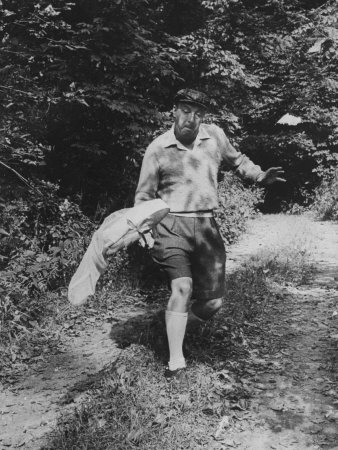
Vladimir Nabokov, Butterfly Hunter

Oh my god. Look at that poise. That athleticism. That self-assurance. That spark of incandescent grace vibrating through his form. The lower lip lunging over the upper. The short pants.  Vladimir Nabokov, hunting butterflies. See the whole set.

William Faulkner and Phil Stone

2001: Art History with Metaphor

(Via).

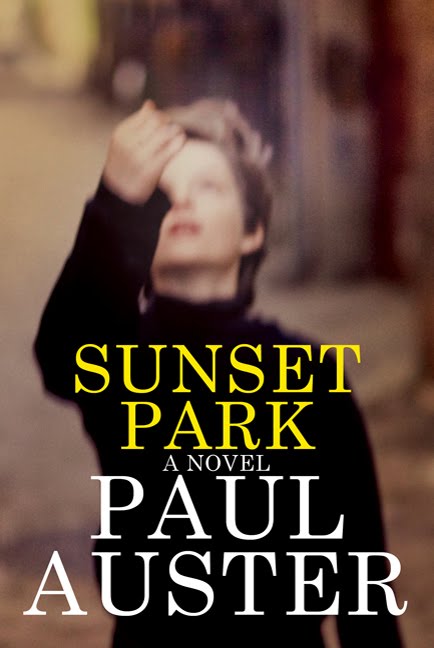
Sunset Park — Paul Auster

At the end of Paul Auster’s new novel Sunset Park, the narrative inhabits the mind of young protagonist Miles Heller. Riding in the back of a cab through Brooklyn, Miles’s thoughts glide through a slippery tangle of ideas. In a long sentence that runs on for almost two pages, Miles’s consciousness shifts from his own physical pain to a character in the movie The Best Years of Our Lives, a soldier named Homer who returns home with hooks for hands. This thought blends into a riff on the poet Homer, which in turn leads Miles, long estranged from his family, to figure himself a Telemachus now reunited with his father. And yet the homecoming cannot be; thoughts of Homer slip into thoughts about homelessness, his own homelessness, his friends’ homelessness, not metaphorical but literal. He then thinks about the homeless and displaced people across the country (Sunset Park is set square in the middle of the recent Great Recession), causing his mind to move back to the beginning of the novel, when he worked “trashing out” foreclosed homes in South Florida. The idea of “home” transmutes finally to “hope” as the cab crosses the Brooklyn Bridge–yet the idea (and the novel) is suspended in a strange, sad limbo.

I begin my review with Auster’s final sentence because it delineates many of Sunset Park’s themes, settings, and motifs. At its core–if such a novel can be said to have a core–Sunset Park asks its readers what “home” might mean. Is home a geographic location, a center that resonates with personal and cultural significance? Is home a place with a person you love? Can home be in your head? Is home where your family is? And, even more problematic, what exactly constitutes a family?

The founding trauma of the book, which is to say Miles’s founding trauma, is a radically ambiguous moment of violence: as a teenager, in a heated fight with his step-brother on a country road, Miles pushes the boy. At the same moment, a car flies down the road and kills him. Did Miles mean to kill his brother? At the moment of his anger, how could he not psychologically, if only temporarily, wish for the young man’s death? Did he know the car was coming? Miles cannot deal with the trauma and soon drops out of college and drops out of life. Unlike the biblical Cain, Miles’s exile is self-imposed. He breaks contact with his parents and thus breaks a family that was already twice broken; first, in his parents’ divorce and his mother’s move across the country to California; and second, in the death of his step-brother. Miles relegates himself to hard and unrewarding manual labor, wandering aimlessly around the country. It’s only after he meets a young girl named Pilar that he is able to reconstitute the idea of a family–of a self who can be in a family.

Pilar is a high school student. She is a minor. Auster does little to justify the social acceptability of Miles’s love for (and sodomy of) Pilar; instead, he repeatedly invokes the idea that other characters see the “truth” of the love by simply watching the pair. This is easily the book’s greatest weakness. Auster wants to communicate the idea that in loving Pilar, Miles is able to love a young version of himself–and thus forgive his young self (significantly, Pilar is the same age that Miles was when he pushed his step-brother)–yet the essential predatory narcissism of this “love” remains largely unremarked upon. Even Pilar’s caretaker, her oldest sister, is amenable to the romance–that is, until Miles refuses to keep bringing her high-end items that he recovers from the foreclosed homes he’s “trashing out.” Miles is again exiled, this time from his makeshift home with Pilar. He returns for the first time in seven years to New York City to stay in a squatter’s house with three other twentysomethings.

There’s a kind of silly Bohemian romanticism to the squat in Sunset Park. The project is helmed by would-be avant-jazzman, Bing Nathan, a notorious ranter who improbably subsists on funds he obtains from running his store, the Hospital for Broken Things, where he repairs typewriters and other antique artifacts. Bing thinks his friend Miles will be a perfect fit in the house–and he’s right: the other squatters love him. There’s Ellen, a skittish realtor (!) who aspires to become a pornographic painter, and Alice, an ABD trying to finish her doctoral thesis (on The Best Years of Our Lives, of course). Both women fall for Miles in different ways, although Auster’s writing never once shows why this might be.

Bing has other reasons for getting Miles back to NYC–he wants to reunite the Heller family. He’s been secretly communicating with Miles’s father Morris for years. Morris, who runs his own literary publishing house, is easily the most achieved character in Sunset Park, or at least its most realistic. Although the plot gets bogged down with his own marital difficulties (and other sundry tragedies that echo the “loss of children” theme), Morris’s narrative is the most focused and convincing section of the novel. His sad tone moves beyond melancholy but halts at bitterness, even as he reflects upon the myriad regrets of his life and the fearful future that yawns ahead (things are going badly with his wife; the publishing industry is in peril). Although Miles’s mother Mary-Lee figures less in the novel, she is also a more convincing and sympathetic character than the young people who squat in Sunset Park. Like Morris, she’s reflective, distanced enough from the young self who abandoned her only son, yet analytical enough to comprehend its traumatic effect. Mary-Lee and Morris, with their regrets and fears and hopes are far more aesthetically concrete and satisfying than the novel’s twentysomethings, who at times seem like caricatures or puppets or placeholders.

In Auster’s hands, the Sunset Park gang reflects an unrealistic idealization of youthful and artistic resistance to a predatory capitalist culture. Still, they provide him occasion for some of Sunset Park’s finest riffs, whether he’s ventriloquizing Bing (rage, rage against the lies of the man) or exploring Ellen’s enchanting perversions. Alice’s thesis on The Best Years of Our Lives (a film that somehow everyone in the book has not just seen but seen repeatedly and even analyzed) gives Auster ample material to explore how different generations face trauma, whether it’s the alienation experienced by WWII soldiers returning to a world that seems to have left them behind, or the crises of young people trying find homes in an America tottering on financial collapse.

With its ironic title, The Best Years pairs nicely with the other narrative that informs Sunset Park, Samuel Beckett’s play Happy Days-a play that Mary-Lee just happens to be performing on Broadway at the time of Miles’s return. Auster–through his erudite characters–riffs frequently and wisely on both the film and the play, and these are some of the finer moments of Sunset Park; one almost wishes that Auster would have abandoned the conceit of a novel completely and just write some kind of essay with his material. Sunset Park repeats the themes of alienation, loneliness, separation, and stasis that we find in Happy Days and The Best Years, yet it veers closer to the film’s melodrama than Beckett’s absurdity. Perhaps this is a fault of form: overloaded with characters, Sunset Park sags at times, asking its reader to care about yet another over-educated, privileged New Yorker whose artistic ambitions have stalled out. A concession to Beckett’s minimalism would have done wonders, and perhaps deflated some of Sunset Park’s murky self-seriousness.

The highlight of the novel is Auster’s syntax. His keen sentences, often unfurling for pages at a time, move from concrete to abstract, to present to past to future, to inside and outside, with a precision and skill that is admirable to say the least. Sure, he hits the occasional clunker–some of the book’s early dialog in Florida is particularly painful, as is a moment late in the book when Morris refers to his wife and friend as “the walking wounded,” a cliché that neither Morris or Auster should let slip–but there’s a smoothness of vision that unites the book from sentence to sentence.

Still, syntax is not content, and Sunset Park left me wanting something–more? Something different? I’m not sure what that something is, which is a precarious criticism at best. Auster’s vision of stasis, of limbo, of the impossibility of a real homecoming runs deeply contrary to the traditions and conventions of Western story-telling: in short, we are trained to desire and look for resolution. Auster’s observations–a continuation of Happy Days and The Best Years, in this sense–are precisely the right kind of psychological dissatisfaction we must experience for this novel to be “true” in an artistic sense. However, the aesthetic dissatisfaction I experienced at the end of the book seems of a separate nature. Chalk it up to too many characters and subplots, perhaps. In any case, Sunset Park made me think and made me feel, which is really the job of art–even if those thoughts and feelings are often negative and unpleasant. Perhaps it’s my own critical failing, but in the end I wanted a light to lead me out of the Auster’s  limbo.

Sunset Park is new in hardback this month from Henry Holt.

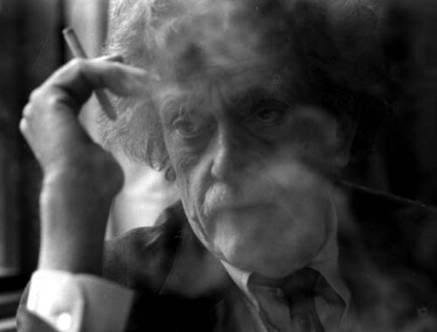
“I Had Made a Bad Trade” — Kurt Vonnegut on Quitting (and Resuming) Smoking

From The Paris Review interview archive: Kurt Vonnegut discusses quitting smoking and then starting again and then quitting and then stating again–

INTERVIEWER: Have you ever stopped smoking?

VONNEGUT: Twice. Once I did it cold turkey, and turned into Santa Claus. I became roly-poly. I was approaching two hundred and fifty pounds. I stopped for almost a year, and then the University of Hawaii brought me to Oahu to speak. I was drinking out of a coconut on the roof of the Ili Kai one night, and all I had to do to complete the ring of my happiness was to smoke a cigarette. Which I did.

INTERVIEWER: The second time?

VONNEGUT: Very recently—last year. I paid Smokenders a hundred and fifty dollars to help me quit, over a period of six weeks. It was exactly as they had promised—easy and instructive. I won my graduation certificate and recognition pin. The only trouble was that I had also gone insane. I was supremely happy and proud, but those around me found me unbearably opinionated and abrupt and boisterous. Also: I had stopped writing. I didn’t even write letters anymore. I had made a bad trade, evidently. So I started smoking again. As the National Association of Manufacturers used to say, “There’s no such thing as a free lunch.”

Cormac McCarthy’s Bloody Mary and Other Author Cocktails

At HTML, chief mixologist Jimmy Chen has concocted a satirical round of writer cocktails. Here’s “Cormac McCarthy’s Bloody Mary” (which calls for something called a “salary stick” — not sure what that is, but we suggest a celery stalk if you can’t find one)–

This is fun-mean–

And this is just mean-mean–


Single Sentence Animation from Ben Stroud’s “Byzantium”

Peter Lundren animates a sentence from Ben Stroud’s short story “Byzantium,” published in Electric Literature No. 4. Music by William “Lucky” Lee.

The sentence reads: “There I would watch others taking their pleasure—keeping to the shadows, my hand hidden, as I studied a chariot racer leaning into a prostitute, her leg wrapped round his torso, or libertines goading a gilded crocodile in the bearpit, their bodies slurred by powders from the east.”

From Hell — Alan Moore & Eddie Campbell

Earlier this week, I pulled out From Hell with the bold intention of re-reviewing it for this site. I love Halloween and I love Alan Moore and Eddie Campbell’s epic revision of the Jack the Ripper murders, so this seemed as good an occasion as any for a reread (especially considering the “review”  I wrote back in October of 2006 is so lazy that I won’t even link to it). Alas, I misjudged or misremembered the sheer density of From Hell–so, on Halloween day, I’m still only half way through, despite staying up way past my bed time, crouching under my sheets with a quavering flashlight, scanning Moore’s erudite words and Campbell’s scratchy inks (okay, that image is an exaggeration). I’ve read it at least thrice before, so I’ll review it anyway.

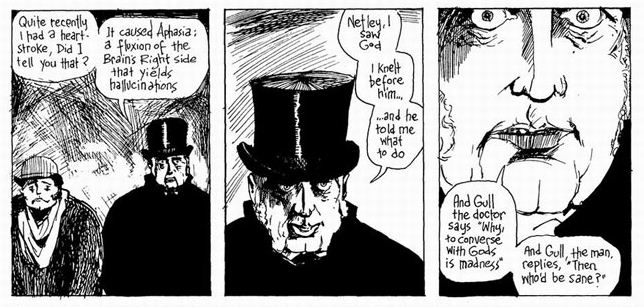
From Hell posits Sir William Gull, a physician to Queen Victoria, as the orchestrator of the Jack the Ripper murders that terrified Londoners at the end of the 19th century. Although the murders initially arise out of the need to cover up the knowledge of the existence of an illegitimate son begat by foolish Prince Albert, Victoria’s grandson. However, for Gull the murders represent much more–they are part of the continued forces of “masculine rationality” that will constrain “lunar female power.” Gull is a high-level Mason; during a stroke, he experiences a vision of the Masonic god Jahbulon, one which prompts him to his “great work”–namely, the murders that will reify masculine dominance.

One of the standout chapters in the book is Gull’s tour of London, with his hapless (and witless) sidekick Netley. In a trip that weds geography, religion, politics, and mythology, Gull riffs on a barbaric, hermetic history of London, revealing the gritty city as an ongoing site of conflict between paganism and orthodoxy, artistic lunacy and scientific rationality, female and male, left brain and right brain. The tour ends with a plan to commit the first murder. From there, the book picks up the story of Frederick Abberline, the Scotland Yard inspector charged with solving the murders. Of course, the murders are unsolvable, as the hierarchy of London–from the Queen down to the head of police–are well aware of who the (government-commissioned) murderer is. The police procedural aspects of the plot are fascinating and offer a balanced contrast with Gull’s mystical visions–visions that culminate in a climax of a sort of time-travel, in which Gull not only sees London at the end of the twentieth century, but also receives a guarantee that his murder plot has had its intended effect. From Hell takes many of its cues from the idea that history is shaped not by random events, but rather by tragic conspiracies that force people to willingly give up freedom to a “rational” authority. The book points repeatedly to the 1811 Ratcliffe Highway murders, which led directly to the world’s first modern police force. In our own time, if we’re open to conspiracy theories, we might find the same pattern in the 21st century responses to terrorism (Patriot Act, anyone?).

Although From Hell features moments of supernatural horror in Gull’s mysticism, it is the book’s grimy realism that is far more terrifying. London in the late 1880s is no place you want to be, especially if you are poor, especially if you are a woman. The city is its own character, a labyrinth larded with ancient secrets the inhabitants of which cannot hope to plumb. Despite the nineteenth century’s claims for enlightenment and rationality, this London is bizarrely cruel and deeply unfair. Campbell’s style evokes this London and its denizens with a surreal brilliance; his dark inks are by turns exacting and then erratic, concentrated and purposeful and then wild and severe. The art is somehow both rich and stark, like the coal-begrimed London it replicates. Although Moore has much to say, he allows Campbell’s art to forward the plot whenever possible. Moore is erudite and fascinating; even when one of his characters is lecturing us, it’s a lecture we want to hear. His ear for dialog and tone lends great sympathy to each of the characters, especially the unfortunate women who must turn to prostitution to earn their “doss” money. And while Abberline’s frustrations at having to solve a crime that no higher-ups want solve make him the hero of this story, Gull’s mystic madness makes him the narrative’s dominant figure. Rereading this time, I realized there is no character he reminds me of as much as Judge Holden from Cormac McCarthy’s Blood Meridian. I’m also reading Joseph Conrad’s The Secret Agent now, a book that dovetails neatly with From Hell, both in its time and setting, but also in its exploration of social unrest and duplicitous authority. Both novels feature detectives fighting a complacent system, and both novels feature a working class that threatens to erupt in socialist or anarchist rebellion.

From Hell is a fantastic starting place for anyone interested in Moore’s work, more self-contained than his comics that reimagine superhero myths, like Watchmen or Swamp Thing, and more satisfying and fully achieved than Promethea or V Is for Vendetta. Be forewarned that it is a graphic graphic novel, although I do not believe its violence is gratuitous or purposeless. Indeed, From Hell aspires to remark upon the futility and ugliness of cyclical violence, and it does so with wisdom and verve. Highly recommended.

Aurorarama — Jean-Christophe Valtat

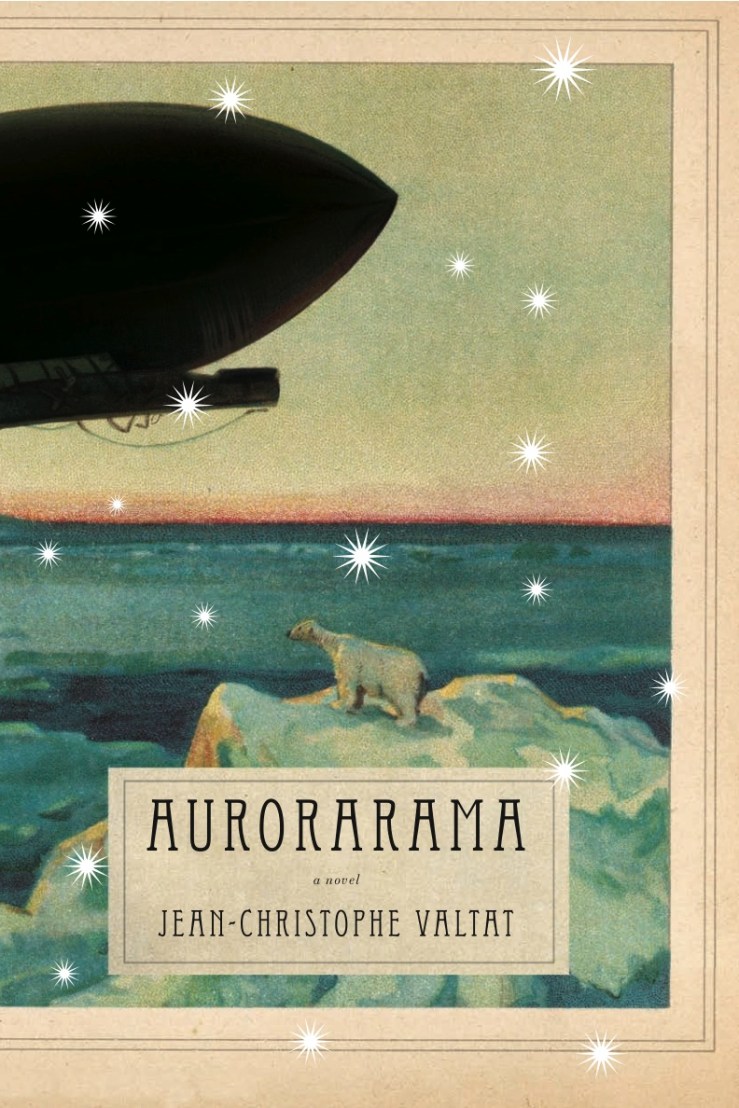
In Aurorarama, Jean-Christophe Valtat imagines an alternate world where the strange wilderness of the Arctic north has been colonized. The centerpiece of this world is New Venice, a bizarre metropolis on ice, bustling with a hodgepodge of cultures and brimming with dire conspiracies. New Venice showcases a kind of steampunk technology that surpasses its otherwise post-Victorian-era manners and mores: there are airships and pneumatic tubes, dream chambers and psychedelic drugs (lots and lots of drugs). Those drugs are part of New Venice’s underground, a subculture that also features a “Polar Pop” scene (although most of the groups seem to make art-noise-dirge-weird music, not pop). Beyond the subversive art scene, however, more sinister forces are at work in New Venice. The city lies under the shadow of a mysterious black zeppelin; a samizdat Utopian text is circling the underground, challenging the establishment’s authority–and causing the secret police, the Gentlemen of the Night, to shake down suspects left and right; the native Inuit are preparing to revolt; the secretive Scavengers have found a dead woman in a mysterious automotive sled. If this sounds awfully complex, it is. Thrown into the middle of the mess are the book’s protagonists. Duke Brentford Orsini, a reserved and idealistic man, is ostensibly the director of the city’s greenhouse–although he seems to spend most of his time juggling the various political (or, in the book’s terms, “poletical”) problems that surge and resurge in New Venice. Brentford’s levelheadedness contrasts with his friend Gabriel d’Allier’s rakish charm. Gabriel is a literature professor on the edge of collapse–not that that gets in the way of his frequent drug binges and sexual escapades. Valtat alternates his chapters between the pair, forwarding the plot via Brentford’s mounting political (and supernatural!) problems and Gabriel’s libertine snags.

Valtat’s world is as thick as polar ice, with its own history, mythology, culture, and political science. The events in Aurorarama are essentially in media res; the adventure begins at the tail-end of a previous disaster. Valtat has given himself plenty of space here to expand the story–both in sequels and prequels (a novel detailing the founding of New Venice, an event alluded to in Aurorarama, would be fascinating). Valtat also exhibits a playful sense of humor, both in the story’s plot, but also in his tone, which often plays off of stodgy Victorian tropes in humorous ways, particularly in the chapters featuring Gabriel. At the same time, Valtat’s book is quite serious, as he labors to evoke a wholly-realized, wholly-strange world. Sometimes his sentences strain under this pressure, no doubt in part because Valtat is a native French speaker; this is his first novel composed in English. The occasionally over-long or clunky phrase does not, however, detract much from the pleasures of Aurorarama, which rest rather in Valtat’s vital imagination. This is an intelligent work of speculative fiction, steeped in the tradition of Jules Verne and H.G. Wells; it also readily recalls The Difference Engine (by William Gibson and Bruce Sterling), Philip Pullman’s His Dark Materials trilogy, and even, in some of its strong imagery, the steampunk visions of Hayao Miyazaki. Recommended.

Aurorarama is new in hardback from Melville House.

“Sexy Vampire Ladies!” — Kate Beaton Does Dracula

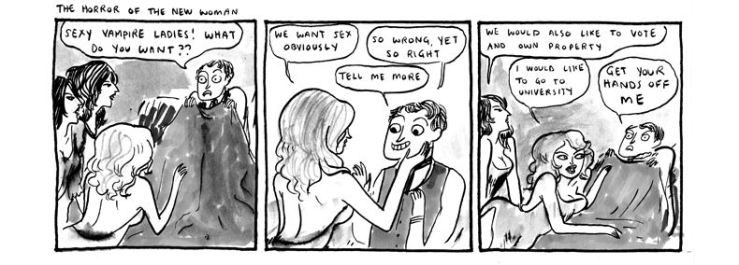
At Hark, A Vagrant!, cartoonist Kate Beaton riffs on Bram Stoker’s Dracula. Here’s a sample, but all of her comics are funny–


"The Horror of the New Woman" - Kate Beaton


“Some Demon’s Mistress, Or the Demon’s Self” — From Keats’s Lamia

John Keats’s long poem Lamia (or “Lamia,” I suppose) is a fantastic supernatural romance narrative. Give it a read–like Twilight, only, y’know, good

She was a gordian shape of dazzling hue,
Vermilion-spotted, golden, green, and blue;
Striped like a zebra, freckled like a pard,
Eyed like a peacock, and all crimson barr’d;
And full of silver moons, that, as she breathed,
Dissolv’d, or brighter shone, or interwreathed
Their lustres with the gloomier tapestries–
So rainbow-sided, touch’d with miseries,
She seem’d, at once, some penanced lady elf,
Some demon’s mistress, or the demon’s self.
Upon her crest she wore a wannish fire
Sprinkled with stars, like Ariadne’s tiar:
Her head was serpent, but ah, bitter-sweet!
She had a woman’s mouth with all its pearls complete:
And for her eyes: what could such eyes do there
But weep, and weep, that they were born so fair?
As Proserpine still weeps for her Sicilian air.
Her throat was serpent, but the words she spake
Came, as through bubbling honey, for Love’s sake,
And thus; while Hermes on his pinions lay,
Like a stoop’d falcon ere he takes his prey.

You can read the whole poem here.

Happy Halloween Links

A letter by Poe showcasing his prominent signature.

Make this cool Edgar Allan Poe toy.

Cannibal Man cover praised; plot summarized.

Seven horror novels masquerading in other genres.

H.P. Lovecraft’s creepy little short story “The Outsider.”

“Slicin’ up eyeballs / Oh oh oh oh.”

Excellent gallery of illustrated horror film posters.

Stephen King explains how to make vampires scary again.

Stephen King sucks.

Hot freaks.

28 Weeks Later is a good film, but it hates children.

Harry Clarke illustrates Faust.

The gang from The Office makes a slasher film.

On Michael Jackson’s Ghosts.

Brendon Small (Metalocalypse, Home Movies) schedules 24 hours of horror films.

“You are tearing me apart Lisa!”

Jack Nicholson.

Kate Mosse’s top 10 ghost stories.

Three Takes on Nosferatu

Here’s F.W. Murnau’s seminal 1922 vampire film, Nosferatu, in full, thanks to public domain laws. Nosferatu is a horrifying and beautiful example of German expressionism at its finest. Max Schreck is terrifying as the vampire Count Orlok (an adaptation of Bram Stoker’s character Dracula). Observe–

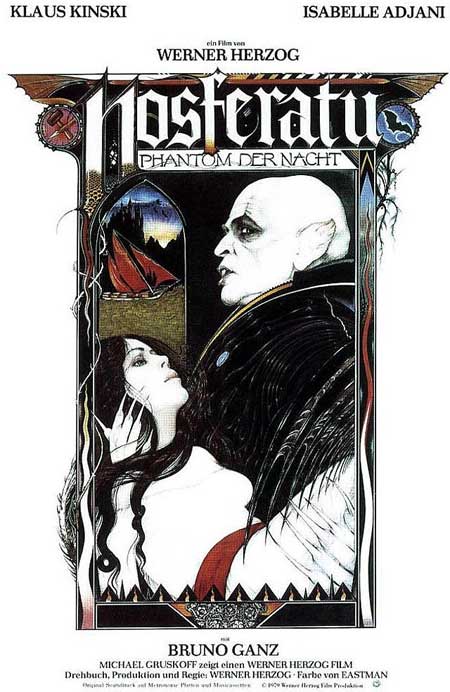
Werner Herzog’s 1979 remake is also gorgeous, but employs a more naturalistic style. Klaus Kinski plays Dracula. Two scenes–

In 2000, director E. Elias Merhige gave us the underrated gem Shadow of the Vampire, a fictionalized account of the making Murnau and his crew making the original Nosferatu. Willem Dafoe is amazing as Max Schreck–or really, as Orlok, rather, as he stays in makeup and costume for the entirety of the production. The movie is both hilarious and frightening, and at times even sadistic. It’s also of a piece with the wave of meta-textual films that surged in the last decade,like Being John Malkovich, I Heart Huckabees, and Adaptation.

“It Comes Straight from Freud” — Tom McCarthy Talks about His Novel C

The National Post profiles Tom McCarthy about his new novel C. Here are a few choice lines from McCarthy–

  • “I think the historical thing is a red herring. I don’t see C as a historical novel. I see it as completely contemporary. It’s about media and our relation to media and to emerging new media and to networks.”
  • “It comes straight from Freud. Trauma is the condition of our identity. Trauma is the most basic condition of our existence.”
  • “It’s a dual trauma, Serge’s seduction by Sophie his sister and then the loss of the sister.”
  • “The way I got the idea with the book was I had a long-standing fascination with this movie by Jean Cocteau, Orphée, his retelling of the Orpheus myth.”
  • “Orpheus in this movie interfaces with the underworld via a radio and what he picks up are the voices of the dead poets.”

From Cocteau’s Orphée–

“Between Scotch and nothing, I’ll take Scotch” — William Faulkner on the Ideal Artistic Environment

The Paris Review’s 1956 interview with William Faulkner is amazing. An excerpt–

INTERVIEWER: Then what would be the best environment for a writer?

FAULKNER: Art is not concerned with environment either; it doesn’t care where it is. If you mean me, the best job that was ever offered to me was to become a landlord in a brothel. In my opinion it’s the perfect milieu for an artist to work in. It gives him perfect economic freedom; he’s free of fear and hunger; he has a roof over his head and nothing whatever to do except keep a few simple accounts and to go once every month and pay off the local police. The place is quiet during the morning hours, which is the best time of the day to work. There’s enough social life in the evening, if he wishes to participate, to keep him from being bored; it gives him a certain standing in his society; he has nothing to do because the madam keeps the books; all the inmates of the house are females and would defer to him and call him “sir.” All the bootleggers in the neighborhood would call him “sir.” And he could call the police by their first names.

So the only environment the artist needs is whatever peace, whatever solitude, and whatever pleasure he can get at not too high a cost. All the wrong environment will do is run his blood pressure up; he will spend more time being frustrated or outraged. My own experience has been that the tools I need for my trade are paper, tobacco, food, and a little whiskey.

INTERVIEWER: Bourbon, you mean?

FAULKNER: No, I ain’t that particular. Between Scotch and nothing, I’ll take Scotch.