Lydia Davis Reads “Jane and the Cane”; Talks to Ben Marcus

“Jane and the Cane” by Lydia Davis; collected in Collected Stories:

Capture

“Brief Incident in Short a, Long a, and Schwa” — Lydia Davis

“Brief Incident in Short a, Long a, and Schwa” by Lydia Davis

Cat, gray tabby, calm, watches large, black ant.  Man, rapt, stands staring at cat and ant.  Ant advances along path.  Ant halts, baffled.  Ant back-tracks fast—straight at cat.  Cat, alarmed, backs away.  Man, standing, staring, laughs.  Ant changes path again.  Cat, calm again, watches again.

(Read more Davis shorties/via).


“A Different Man” — Lydia Davis

“Examples of Remember” — Lydia Davis

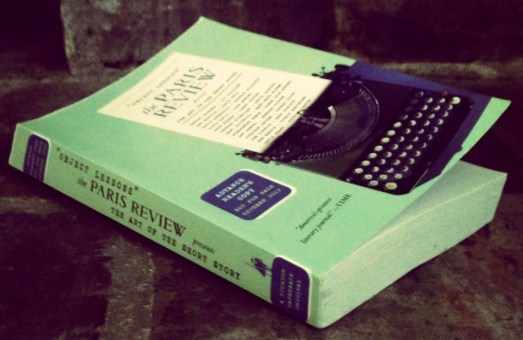
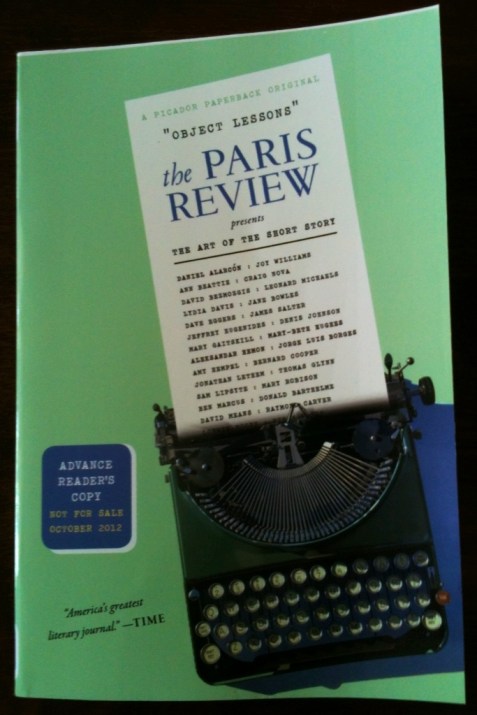
I Review Object Lessons, Where 20 Contemporary Authors Select and Introduce 20 Short Stories from The Paris Review

20120902-135314.jpg

Object Lessons anthologizes 20 stories published in the Paris Review over the past fifty years. “It is not a greatest hits anthology,” advises the brief editor’s note, “Instead, we asked twenty masters of the genre to choose a story from the Paris Review archives—a personal favorite—and to describe the key to its success as a work of fiction.” Hence, we get Ann Beattie introducing Craig Nova’s “Another Drunk Gambler,” Amy Hempel introducing Bernard Cooper’s “Old Birds,” and Sam Lipsyte introducing Mary Robinson’s “Likely Lake.”

Most of the introductions are short—most are fewer than three pages—and each author approaches his or her selection differently. Ben Marcus, prefacing “Several Garlic Tales,” tells us that, “Donald Barthelme was a magician of language, and it would be most respectful, perhaps even ethical, not to look too closely into the workings of his magic.” Marcus proposes a few approaches to find meaning in Barthelme’s surreal tale, but never over-explicates. In contrast, Lydia Davis’s surprisingly long intro to Jane Bowles’s “Emmy Moore’s Journal” is a sentence-to-paragraph close reading; Davis interrogates Bowles’s diction and syntax and concludes her little essay by situating Bowles’s (underappreciated) place in the canon. Davis’s insights are compelling, but one wonders if they wouldn’t be better appreciated after reading the story.

Davis also appears as author of one of the selected stories—Ali Smith picks Davis’s excellent number “Ten Stories from Flaubert.” Smith’s intro is wonderful, explaining the genesis of “Ten Stories,” which “came about when Davis (who is also a translator) was working on a a new translation of Madame Bovary and reading through Flaubert’s letters to his friend and lover Louise Colet.” I’m a huge fan of Lydia Davis, whose work defies easy definition. Smith wonders about her selection: “Are they translations? Are they by Flaubert? Are they by Davis?” The questions are better than answers.

Occasionally an author veers close to spoiling the story he introduces, as does Jeffrey Eugenides when he gracelessly steps all over Denis Johnson’s already-much-anthologized classic “Car Crash While Hitch Hiking.” Elsewhere, Jonathan Lethem mashes and minces misplaced metaphors in his confusing and forgettable introduction to Thomas Glynn’s story “Except for the Sickness I’m Quite Healthy Now. You Can Believe That.” Lethem’s sloppy, unrestrained attempt to dazzle is regrettable. He’s like the warm-up act that tries too hard to show up the headliner and winds up falling on his face.

For the most part though, the introductions simply allow readers new ways to see a story they’ve perhaps read before, as in Aleksandar Hemon’s preface to Jorge Luis Borges’s “Funes the Memorious” or David Means’s preface to Raymond Carver’s “Why Don’t You Dance.” Means suggests that “A great story is like an itch that has to be scratched eternally . . . We’re left with more questions than answers, and more answers than questions; therefore, the paradoxical quality of a good story is that it seems to give us everything we need and yet not quite enough to fulfill a sense of having been shown a full life.” Surprisingly good is Dave Eggers’s intro to James Salter’s “Bangkok,” which reads almost like a loose riff of notes that a harried but talented adjunct might bring to his Creative Writing 101 workshop. Eggers showcases keen intuition about Salter’s narrative coupled with an eagerness that makes one want to read the story.

And what about those stories? If I’ve focused more on the introductions than the stories themselves, it’s perhaps because I’ve taken for granted that the selections are solid for an anthology. Sure, any reader might have his or her gripes, but the range of talent here is undeniable, and the spectrum of stories is satisfying. Object Lessons would make a fine addition to the syllabus of any beginning writing course, and any young person interested in honing her craft could do worse than attending the examples collected here. To be clear, Object Lessons is in no way some master course in How to Write a Short Story, but it does provide the most valuable writer’s tool—good reading.

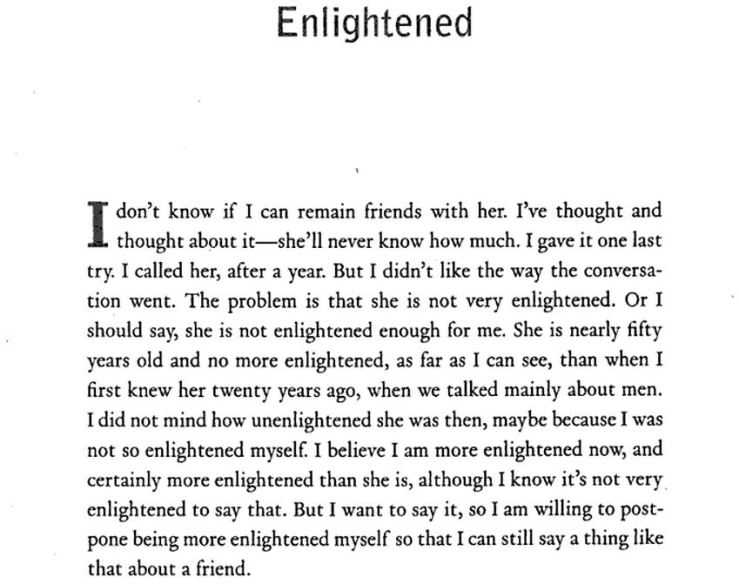
“Enlightened” — Lydia Davis

Unknown Pleasures (I Riff a Bit on Marcel Proust’s Swann’s Way)

20120809-105603.jpg

1. I was an undergrad in college when I first tried to read Marcel Proust. It was one of those things I did on my own, which is another way of saying that none of his writing was ever assigned to me; neither do I recall any of his writings even appearing in any of the anthologies I was assigned in high school; neither do I recall any of his writings appearing in any of the anthologies I’ve used as a teacher.

2. My initial interest in Proust, late in high school, when the name alone seemed so damn romantic, was aroused, like most people I’ll bet, by the fact that this guy basically wrote one long book, a book that seemed to have at least three names, not counting the names of the individual books and book-length chapters in those individual books.

3. But, like I said, I didn’t try to read Proust until college when I checked out the first volume from the university library. I think it might have actually been a compendium of two or more books that make up the Recherche. Anyway, I can’t recall much, except that I slugged it out through that interminable first chapter, “Combray,” getting absolutely nothing out of it.

4. Since then I’ve read a lot about Proust and his writing, enough to perhaps understand that my first foray into Swann’s Way was probably not from the best angle. I was into decidedly different stuff then—lots of the American postmodernists, English and Irish modernists, etc.—and Proust’s modernism was totally lost on me.

5. Re: Point 4: Perhaps a better way to put it would be to borrow Harold Bloom’s notion that strong/strange writers so assimilate their readers that the readers can no longer see the strangeness/strength. I was assimilated.

6. Wandering through the used book store I frequent, I spotted Lydia Davis’s translation of Swann’s Way and snapped it up, not because of any real interest in trying Proust again but because of a fannish devotion to Davis, or the idea that Davis would make Proust accessible.

7. (A brief fantasy I had as my hand hovered over the book, before my hand touched the book:

I imagined that Davis had turned Swann’s Way into a series of her own vignettes, that she had parsed and ventriloquized Proust, that her translation would be akin to “Ten Stories from Flaubert.”

This is not the case).

8. (While I’m being parenthetical: This riff started as a “books acquired” post, a post where I take a lousy photograph to document a new book that somehow arrives at Biblioklept World Headquaters. But I read so much of Swann’s Way that the original idea riffed out into this thing. Actually, go ahead and skip Point 8, if you haven’t already. Sorry).

9. The day after buying Davis’s translation I read “Combray” over two short airline trips.

10. Or should it be Combray?—it seems like a self-contained novel.

11. The opening paragraphs of “Combray” are an amazing and strange meditation on sleeping, or rather going to sleep, filled with wonderful little digressions. They are a simultaneously alienating and inviting way to open a book.

Proust writes—

Sometimes, as Eve was born from one of Adam’s ribs, a woman was born during my sleep from a cramped position of my thigh. Formed from the pleasure I was on the point of enjoying, she, I imagined, was the one offering it to me. My body, which felt in hers my own warmth, would try to find itself inside her, I would wake up.

Such a lovely set of images.

I marked it and moved on without trying to figure out exactly what it might mean.

12. Other moments are more lucid, penetrating, insightful:

Even the very simple act that we call “seeing a person we know” is in part an intellectual one. We fill the physical appearance of the individual we see with all the notions we have about him, and of the total picture that we form for ourselves, these notions certainly occupy the greater part.

“Combray” is full of these wonderful, subtle moments, and it includes some of the finest passages on reading and the transformative powers and pleasures of reading that I’ve encountered.

13. The phrase “unknown pleasures” pops out early in the book—is this where Joy Division got the album name?

14. Proust seems to hit on the idea of unknown pleasures again and again, speculative pleasures, idealized pleasures.

15. Introduced to the writer Bergotte by Swann and Bloch, the young narrator muses:

One of these passages by Bergotte, the third or fourth that I had isolated from the rest, filled me with a joy that could not be compared to the joy I had discovered in the first one, a joy I felt I was experiencing  in a deeper, vaster, more unified region of myself, from which all obstacles and partitions had been removed.

The passage concludes with the narrator deciding that he has accessed the “‘ideal passage’ by Bergotte,” an idealization through which he finds his mind “enlarged.”

16. Cataloging the meditations on unknown pleasures in the book would take forever though, and I’m just riffing here.

17. (Although I do love and will thus bring up a late passage where the narrator longs to walk in the woods with “a peasant girl,” one like a “local plant” (!), through which he will access new and individual and unknown pleasures, “Obscurely awaited, immanent and hidden. . . “).

18. Stray note: Swann is described as having a “Bressant-style” haircut, which the end notes describe as “a crew cut in front and longer in the back.” Is this not known colloquially as a mullet? Am I to understand that Swann sports a Kentucky waterfall?

19. Proust’s greatest strength in “Combray” seems to be his ability to move from the physical to the metaphysical, from object to memory. And then back again.

20. An empty statement: The writing is beautiful.

21.  Still, there’s something irksome about the narrator (Marcel?): I stopped writing “mama’s boy” in the margin after the third such notation.

22. Re: Point 21: Is this why I never stuck it out with Proust? Is this why, despite acknowledging “The writing is beautiful,” I am not particularly inclined to see what happens next? (And next and next and next . . .)

23. Re: Point 22: I think here of Cormac McCarthy’s assertion in a 1992 New York Times interview that Proust is “not literature” because it doesn’t “deal with issues of life and death.” McCarthy’s quote may or may not be out of context (not here; here it’s in perfectly sound context. I’m talking about proper context in the interview, which is to say that he may or may not have been riffing off the cuff).

24. Okay, from the McCarthy interview:

 His list of those whom he calls the “good writers” — Melville, Dostoyevsky, Faulkner — precludes anyone who doesn’t “deal with issues of life and death.” Proust and Henry James don’t make the cut. “I don’t understand them,” he says. “To me, that’s not literature. A lot of writers who are considered good I consider strange.”

25. Maybe I bring it up because I’ve read so much of McCarthy and the heroes on his list above and find them so compelling, find the protagonists and antagonists so compelling, and while Proust’s narrator is hardly repellent, I find myself occasionally wanting to give him a wedgie.

26. (Never having had the desire to give Ishmael a wedgie, or the underground man a wedgie, or Lucas Beauchamp a wedgie, or Cornelius Suttree a wedgie).

27. Okay. The sentiment I’ve just expressed seems cruel.

28. The same sensitivity I find occasionally overbearing in the narrator is exactly what makes so many of the passages and insights in the text so extraordinary.

29. The narrator is some kind of specialized receptive organic instrument, a psyche keenly attuned to the physical world who mediates that world through emotion, memory, psychological projection—language.

30. The narrator is some kind of membrane but also a self, his articulations winding from reader to self through memory to the natural world, to its phenomena, and back through desire, thought, anticipation, idealization, all back through memory again, back to the reader again. And if tracing these articulations is exhausting, the process also undeniably yields unknown pleasures.

“In a House Besieged” — Lydia Davis

In a house besieged lived a man and a woman. From where they cowered in the kitchen the man and woman heard small explosions. “The wind,” said the woman. “Hunters,” said the man. “The rain,” said the woman. “The army,” said the man. The woman wanted to go home, but she was already home, there in the middle of the country in a house besieged.

“In a House Besieged,” from Lydia Davis’s first collection Break It Down (1986); available in The Collected Stories.

“Losing Memory” — Lydia Davis

“Losing Memory” by Lydia Davis:

You ask me about Edith Wharton.
Well, the name is very familiar.

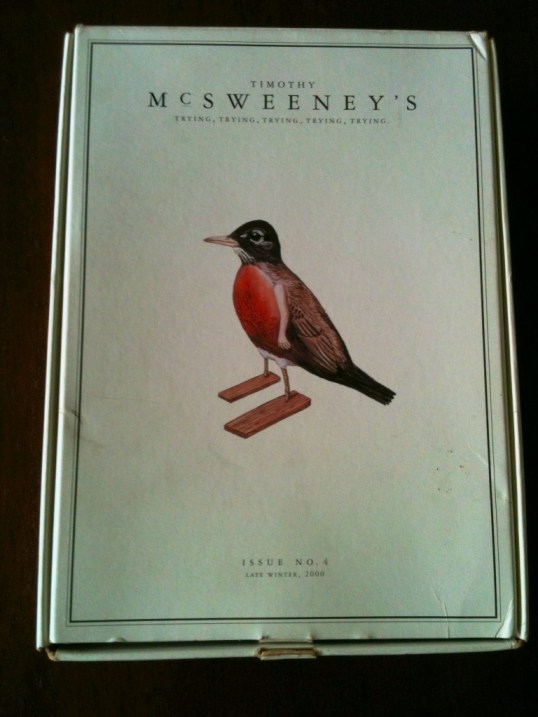
McSweeney’s #4 (Box of Books Acquired 6.14.2012)

20120626-095248.jpg

The novelist John Warner (The Funny Man), in an act of incredible kindness, sent me a copy of McSweeney’s #4, which he helped to put out years ago. In one of our emails, John offers the following:

It could be the best issue ever, a kind of platonic ideal of the McSweeney’s aesthetic before people started saying that things had a McSweeney’s aesthetic, a more innocent time if you will. My memory is that we were selling them at a live event at the Ethiopian Diamond restaurant in Chicago that we set up to help promote Neal Pollack’s book, and somehow the leftovers wound up in my trunk and I’ve been hauling them place to place ever since. . .

It’s a sort of fun artifact of the early/carefree days of McSweeney’s before Dave was DAVE, and the whole thing was still very haphazard.

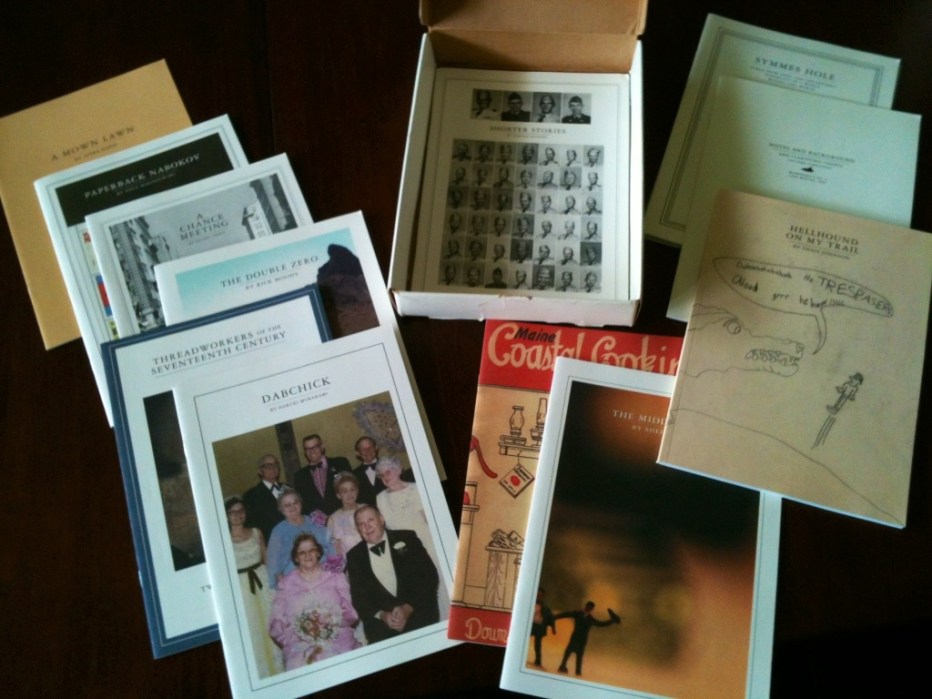
It’s difficult to overstate the range of writers here: Lydia Davis, Jonathan Lethem, George Saunders, Rick Moody, Haruki Murakami, a three-act play by Denis Johnson, and much, much more:

20120626-100530.jpg

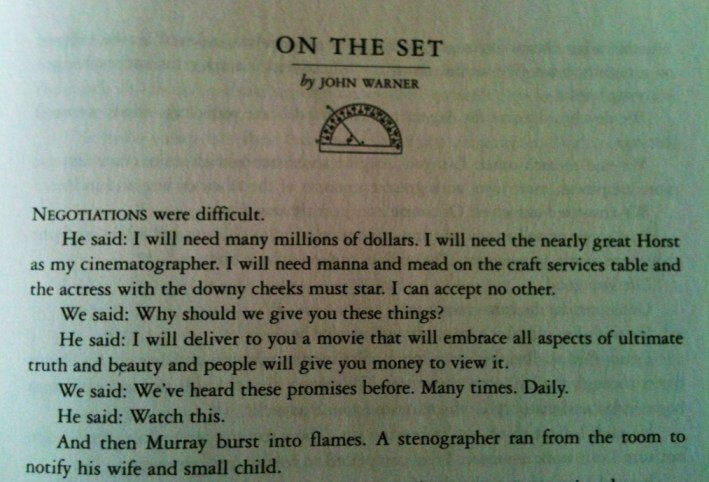
 There are also many short stories, including “On the Set” by John Warner, his second published story:

20120626-100545.jpg

It’s wonderfully absurd.

To read something hilarious and absurd and ultimately kind of touching, read John’s interview with critic Kevin Morris, who hated The Funny Man.

Object Lessons from The Paris Review, Where Writers Present Some of Their Favorite Short Stories from Other Writers (Book Acquired, 6.11.2012)

20120611-150824.jpg

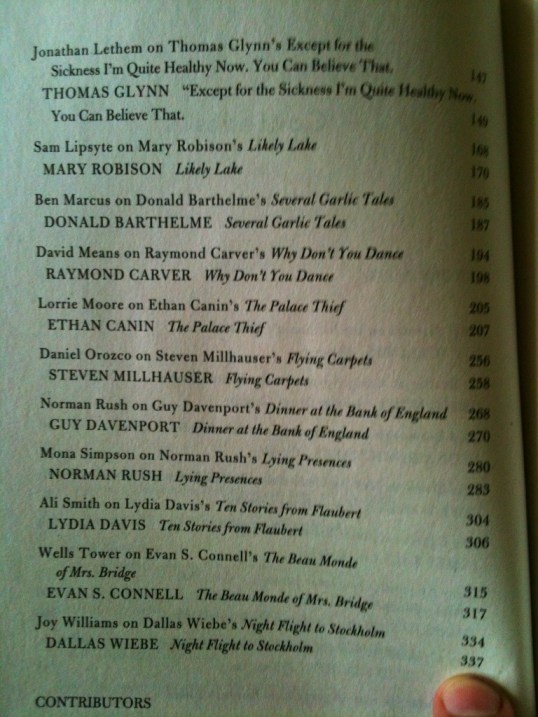
Okay: This one is really cool: Object Lessons features a bunch of short stories, some you may have read, each with a short lead-in (two-five pages) by another writer. So, we get Jeffrey Eugenides on Denis Johnson, or Ben Marcus on Donald Barthelme, or Lydia Davis on Jane Bowles, or Ali Smith on Lydia Davis. You know what, let me just share the table of contents (review down the line):

20120611-150831.jpg

20120611-150837.jpg

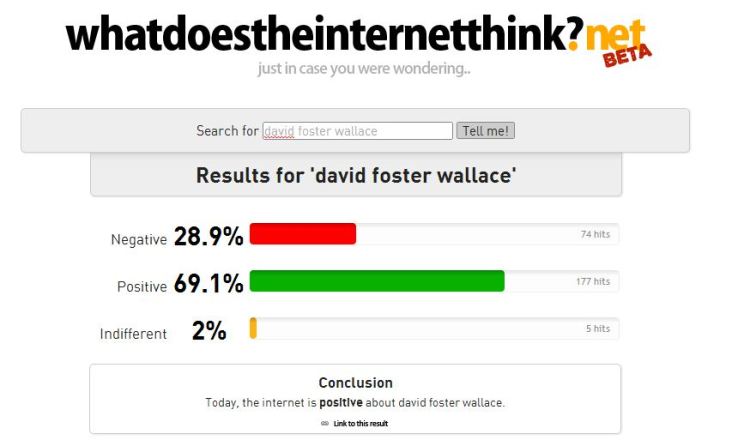
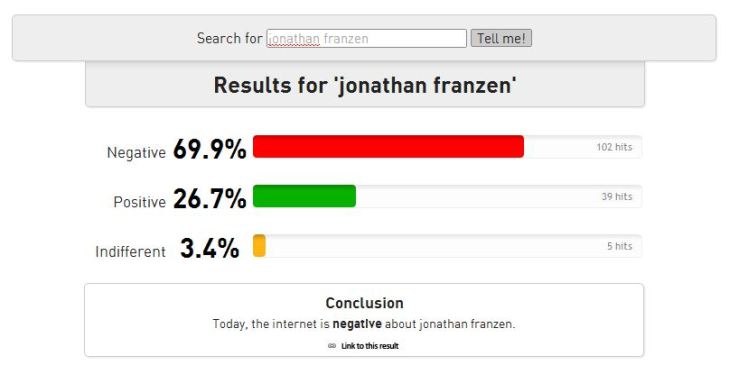
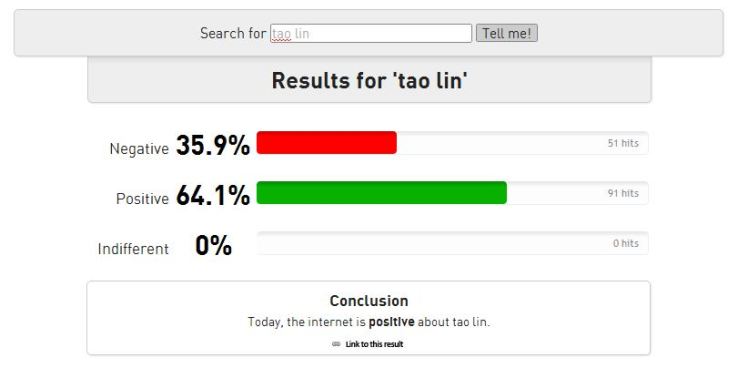
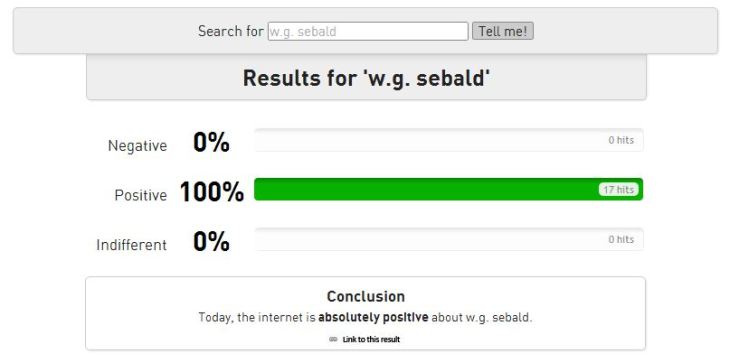
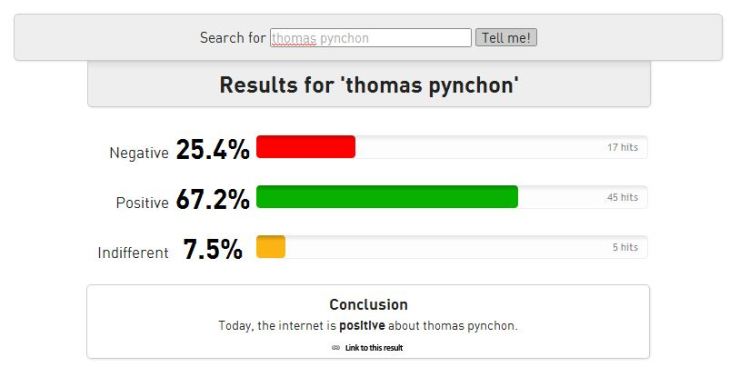
What Does the Internet Think About DFW, Franzen, Lydia Davis, Bolaño, Atwood, and Some Other Contemporaryish Writers?

What Does the Internet Think? is a somewhat addictive site that aggregates and analyzes opinions on the internet — I’m not sure exactly how it does this, but it’s fun. I plugged in a few writers this morning (when I should have been working) and here share the results (and, yes, I know that this means almost nothing. Just for fun).


Books Acquired, 2.16.2012

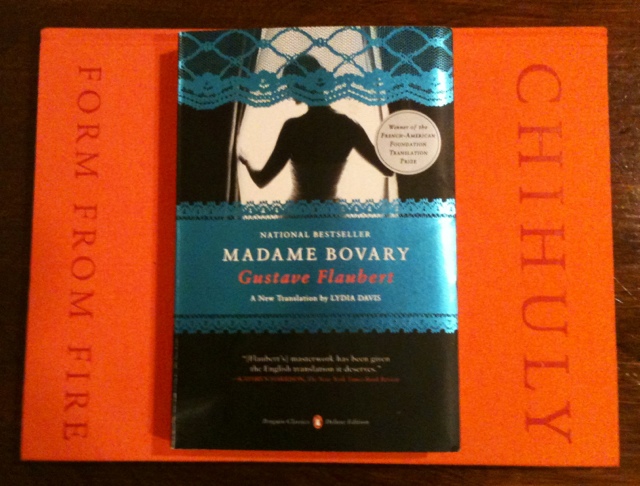
20120216-191500.jpg

The Chihuly book was too beautiful not to pick up for my wife—cloth bound and so orange. I picked it up along with Lydia Davis’s translation of Madame Bovary this afternoon at my fave used bookshop; ostensibly, I was searching for a copy of the Mutis book Noquar reviewed here this week, but who really needs a legit reason to browse the stacks?

20120216-192716.jpg

“The Mice” — Lydia Davis

“The Mice” a very short story by Lydia Davis (read our review of The Collected Stories of Lydia Davis)—

Mice live in our walls but do not trouble our kitchen. We are pleased but cannot understand why they do not come into our kitchen where we have traps set, as they come into the kitchens of our neighbors. Although we are pleased, we are also upset, because the mice behave as though there were something wrong with our kitchen. What makes this even more puzzling is that our house is much less tidy than the houses of our neighbors. There is more food lying about in our kitchen, more crumbs on the counters and filthy scraps of onion kicked against the base of the cabinets. In fact, there is so much loose food in the kitchen I can only think the mice themselves are defeated by it. In a tidy kitchen, it is a challenge for them to find enough food night after night to survive until spring. They patiently hunt and nibble hour after hour until they are satisfied. In our kitchen, however, they are faced with something so out of proportion to their experience that they cannot deal with it. They might venture out a few steps, but soon the overwhelming sights and smells drive them back into their holes, uncomfortable and embarrassed at not being able to scavenge as they should.

“Some Factors Determining the Quality of a Translation” — Lydia Davis

From Lydia Davis’s insightful and entertaining essay “Some Notes on Translation and on Madame Bovary,” from issue 198 of The Paris Review

The quality and nature of a translation (let’s say from the French) depends on at least three things: the translator’s knowledge of French language, history, and culture; his or her conception of the task of the translation; and his or her ability to write well in English. These three variables have subsets that can recombine infinitely, which is why one work can have such widely differing translations. Publishers selecting a translator seem to proceed on the assumption that the most important qualification is the first. “Let’s ask Professor X, head of the French department at Y!” Often they completely ignore the second factor—how will Professor X approach the task of translating?—and certainly the third—what is Professor X’s writing style like? All three factors are vital, but in many instances, if one has to rank them, the third—how well the translator writes—may be the most important qualification, followed closely or equaled by the second—how he or she approaches translating, and it is the first that comes in last place, since minor lapses in a knowledge of the language, history, and culture may result in mistakes that are, in a beautifully written, generally faithful version, fairly easily corrected, whereas a misconception of the task of the translator and, worse, an inability to write well will doom the entire book through its every sentence.

Lydia Davis Reads Dream Stories

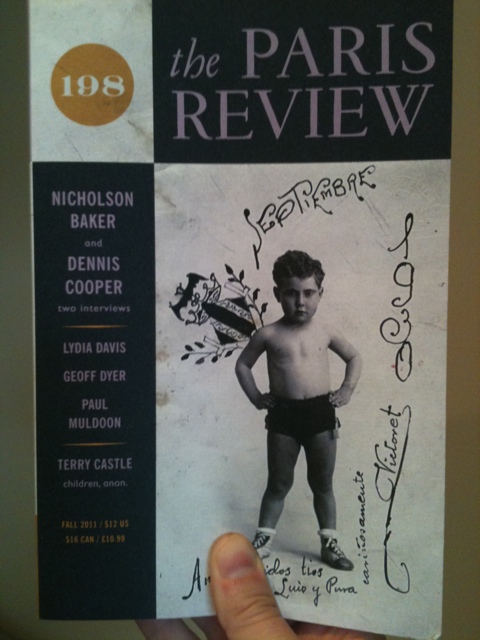
Book Acquired, 9.22.2011

20110922-040608.jpg

Hey! Sex! Nicholson Baker, Dennis Cooper! Lydia Davis, Geoff Dyer (maybe  not so sex). You can read the cover. Bolaño didn’t make the cover this time, and the third installment of The Third Reich is kinda skinny, but, sure, hey, another intriguing issue.