Reading Chris Ware’s Building Stories / Two Short Loops

20121201-162412.jpg

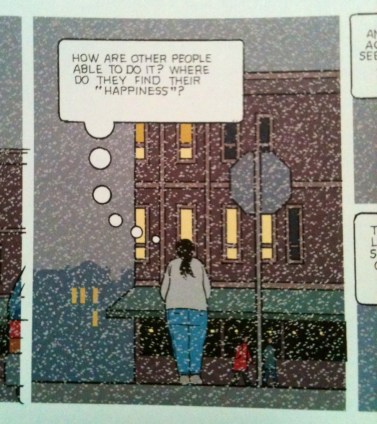
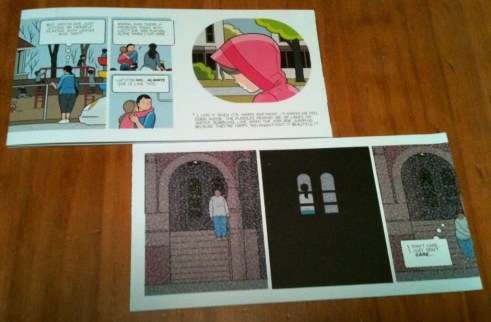
These two shorties in Chris Ware’s Building Stories showcase the novel’s thematic recursion, a recursion doubled in both its metastructure (14 pieces that the reader can read in any order) as well as the structure of many of the individual pieces. In the case of the two parts pictured above, we get Möbius strips that become richer with rereading. The strips seem to twin each other not just in their format, but also in their theme.

Both strips feature Lonely Girl, who perhaps emerges as the dominant protagonist of Building Stories. The one pictured at the top gives a voice to her daughter, a girl who seems to repeat some of her mother’s tendencies toward isolation and depression.

20121201-162435.jpg

Ware’s strength here (and always elsewhere) is the economy of storytelling: He packs entire short stories into just a few panels, coloring his narrative:

20121201-162443.jpg

The second loop features a solitary Lonely Girl who trudges through the snowy night in a near-suicidal despair:

20121201-162451.jpg

Read recursively, the strip dooms Lonely Girl to an endless loop of despair—and it’s at moments like these that I’m happy there are other parts to Building Stories—some kind of existential “out” for our poor heroine.


Read “A Tree, A Rock, A Cloud,” a Short Story by Carson McCullers

“A Tree, A Rock, A Cloud” by Carson McCullers

It was raining that morning, and still very dark. When the boy reached the streetcar café he had almost finished his route and he went in for a cup of coffee. The place was an all-night café owned by a bitter and stingy man called Leo. After the raw, empty street, the café seemed friendly and bright: along the counter there were a couple of soldiers, three spinners from the cotton mill, and in a corner a man who sat hunched over with his nose and half his face down in a beer mug. The boy wore a helmet such as aviators wear. When he went into the café he unbuckled the chin strap and raised the right flap up over his pink little ear; often as he drank his coffee someone would speak to him in a friendly way. But this morning Leo did not look into his face and none of the men were talking. He paid and was leaving the café when a voice called out to him:

“Son! Hey Son!”

He turned back and the man in the corner was crooking his finger and nodding to him. He had brought his face out of the beer mug and he seemed suddenly very happy. The man was long and pale, with a big nose and faded orange hair.

“Hey Son!”

The boy went toward him. He was an undersized boy of about twelve, with one shoulder drawn higher than the other because of the weight of the paper sack. His face was shallow, freckled, and his eyes were round child eyes.

“Yeah Mister?”

The man laid one hand on the paper boy’s shoulders, then grasped the boy’s chin and turned his face slowly from one side to the other. The boy shrank back uneasily.

“Say! What’s the big idea?”

The boy’s voice was shrill; inside the café it was suddenly very quiet.

The man said slowly. “I love you.”

All along the counter the men laughed. The boy, who had scowled and sidled away, did not know what to do. He looked over the counter at Leo, and Leo watched him with a weary, brittle jeer. The boy tried to laugh also. But the man was serious and sad.

“I did not mean to tease you, Son,” he said. “Sit down and have a beer with me. There is something I have to explain.”

Cautiously, out of the corner of his eye, the paper boy questioned the men along the counter to see what he should do. But they had gone back to their beer or their breakfast and did not notice him. Leo put a cup of coffee on the counter and a little jug of cream.

“He is a minor,” Leo said. Continue reading “Read “A Tree, A Rock, A Cloud,” a Short Story by Carson McCullers”

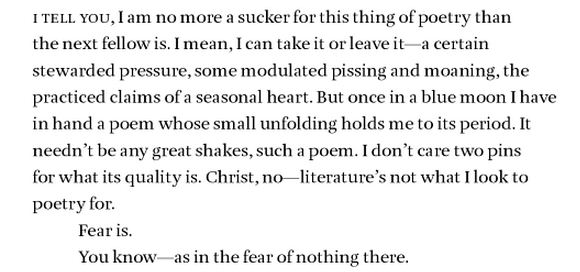
“Some Modulated Pissing and Moaning” (Gordon Lish on Poetry)


From Gordon Lish’s story “How to Write a Poem.”

Read “The Werewolf,” A Short Fable by Angela Carter

“The Werewolf,” a short story by Angela Carter (collected in The Bloody Chamber and Burning Your Boats):

It is a northern country; they have cold weather, they have cold hearts.Cold; tempest; wild beasts in the forest. It is a hard life. Their houses are built of logs, dark and smoky within. There will be a crude icon of the virgin behind a guttering candle, the leg of a pig hung up to cure, a string of drying mushrooms. A bed, a stool, a table. Harsh, brief, poor lives.To these upland woodsmen, the Devil is as reals as you or I. More so; they have not seen us nor even know that we exist, but the Devil they glimpse often in the graveyards, those bleak and touching townships of the dead where the graves are marked with portraits of the deceased in the naif style and there are no flowers to put in front of them, no flowers grow there, so they put out small votive offerings, little loaves, sometimes a cake that the bears come lumbering from the margins of the forests to snatch away. At midnight, especially on Walpurgisnacht, the Devil holds picnics in the graveyards and invites the witches; then they dig up fresh corpses, and eat them. Anyone will tell you that.Wreaths of garlic on the doors keep out the vampires. A blue-eyed child born feet first on the night of St. John’s Eve will have second sight. When they discover a witch – some old woman whose cheeses ripen when her neighbours’ do not, another old woman whose black cat, oh, sinister! follows her about all the time, they strip the crone, search for her marks, for the supernumerary nipple her familiar sucks. They soon find it. Then they stone her to death.

Winter and cold weather.

Go and visit grandmother, who has been sick. Take her the oatcakes I’ve baked for her on the hearthstone and a little pot of butter.

The good child does as her mother bids – five miles’ trudge through the forest; do not leave the path because of the bears, the wild boar, the starving wolves. Here, take your father’s hunting knife; you know how to use it.

The child had a scabbby coat of sheepskin to keep out the cold, she knew the forest too well to fear it but she must always be on her guard. When she heard that freezing howl of a wolf, she dropped her gifts, seized her knife, and turned on the beast.

It was a huge one, with red eyes and running, grizzled chops; any but a mountaineer’s child would have died of fright at the sight of it. It went for her throat, as wolves do, but she made a great swipe at it with her father’s knife and slashed off its right forepaw.

The wolf let out a gulp, almost a sob, when it saw what had happened to it; wolves are less brave than they seem. It went lolloping off disconsolately between the trees as well as it could on three legs, leaving a trail of blood behind it. The child wiped the blade of her knife clean on her apron, wrapped up the wolf’s paw in the cloth in which her mother had packed the oatcakes and went on towards her grandmother’s house. Soon it came on to snow so thickly that the path and any footsteps, track or spoor that might have been upon it were obscured.

She found her grandmother was so sick she had taken to her bed and fallen into a fretful sleep, moaning and shaking so that the child guessed she had a fever. She felt the forehead, it burned. She shook out the cloth from her basket, to use it to make the old woman a cold compress, and the wolf’s paw fell to the floor.

But it was no longer a wolf’s paw. It was a hand, chopped off at the wrist, a hand toughened with work and freckled with old age. There was a wedding ring on the third finger and a wart in the index finger. By the wart, she knew it for her grandmother’s hand.

She pulled back the sheet but the old woman woke up, at that, and began to struggle, squawking and shrieking like a thing possessed. But the child was strong, and armed with her father’s hunting knife; she managed to hold her grandmother down long enough to see the cause of her fever. There was a bloody stump where her right hand should have been, festering already.

The child crossed herself and cried out so loud the neighbours heard her and come rushing in. They know the wart on the hand at once for a witch’s nipple; they drove the old woman, in her shift as she was, out into the snow with sticks, beating her old carcass as far as the edge of the forest, and pelted her with stones until she fell dead.

Now the child lived in her grandmother’s house; she prospered.

Read “The Outsider,” A Short Tale of Weird Horror by H.P. Lovecraft

“The Outsider,” by H.P. Lovecraft:

Unhappy is he to whom the memories of childhood bring only fear and sadness. Wretched is he who looks back upon lone hours in vast and dismal chambers with brown hangings and maddening rows of antique books, or upon awed watches in twilight groves of grotesque, gigantic, and vine-encumbered trees that silently wave twisted branches far aloft. Such a lot the gods gave to me – to me, the dazed, the disappointed; the barren, the broken. And yet I am strangely content and cling desperately to those sere memories, when my mind momentarily threatens to reach beyond to the other.

I know not where I was born, save that the castle was infinitely old and infinitely horrible, full of dark passages and having high ceilings where the eye could find only cobwebs and shadows. The stones in the crumbling corridors seemed always hideously damp, and there was an accursed smell everywhere, as of the piled-up corpses of dead generations. It was never light, so that I used sometimes to light candles and gaze steadily at them for relief, nor was there any sun outdoors, since the terrible trees grew high above the topmost accessible tower. There was one black tower which reached above the trees into the unknown outer sky, but that was partly ruined and could not be ascended save by a well-nigh impossible climb up the sheer wall, stone by stone.

I must have lived years in this place, but I cannot measure the time. Beings must have cared for my needs, yet I cannot recall any person except myself, or anything alive but the noiseless rats and bats and spiders. I think that whoever nursed me must have been shockingly aged, since my first conception of a living person was that of somebody mockingly like myself, yet distorted, shrivelled, and decaying like the castle. To me there was nothing grotesque in the bones and skeletons that strewed some of the stone crypts deep down among the foundations. I fantastically associated these things with everyday events, and thought them more natural than the coloured pictures of living beings which I found in many of the mouldy books. From such books I learned all that I know. No teacher urged or guided me, and I do not recall hearing any human voice in all those years – not even my own; for although I had read of speech, I had never thought to try to speak aloud. My aspect was a matter equally unthought of, for there were no mirrors in the castle, and I merely regarded myself by instinct as akin to the youthful figures I saw drawn and painted in the books. I felt conscious of youth because I remembered so little.

Outside, across the putrid moat and under the dark mute trees, I would often lie and dream for hours about what I read in the books; and would longingly picture myself amidst gay crowds in the sunny world beyond the endless forests. Once I tried to escape from the forest, but as I went farther from the castle the shade grew denser and the air more filled with brooding fear; so that I ran frantically back lest I lose my way in a labyrinth of nighted silence.

So through endless twilights I dreamed and waited, though I knew not what I waited for. Then in the shadowy solitude my longing for light grew so frantic that I could rest no more, and I lifted entreating hands to the single black ruined tower that reached above the forest into the unknown outer sky. And at last I resolved to scale that tower, fall though I might; since it were better to glimpse the sky and perish, than to live without ever beholding day.

In the dank twilight I climbed the worn and aged stone stairs till I reached the level where they ceased, and thereafter clung perilously to small footholds leading upward. Ghastly and terrible was that dead, stairless cylinder of rock; black, ruined, and deserted, and sinister with startled bats whose wings made no noise. But more ghastly and terrible still was the slowness of my progress; for climb as I might, the darkness overhead grew no thinner, and a new chill as of haunted and venerable mould assailed me. I shivered as I wondered why I did not reach the light, and would have looked down had I dared. I fancied that night had come suddenly upon me, and vainly groped with one free hand for a window embrasure, that I might peer out and above, and try to judge the height I had once attained.

All at once, after an infinity of awesome, sightless, crawling up that concave and desperate precipice, I felt my head touch a solid thing, and I knew I must have gained the roof, or at least some kind of floor. In the darkness I raised my free hand and tested the barrier, finding it stone and immovable. Then came a deadly circuit of the tower, clinging to whatever holds the slimy wall could give; till finally my testing hand found the barrier yielding, and I turned upward again, pushing the slab or door with my head as I used both hands in my fearful ascent. There was no light revealed above, and as my hands went higher I knew that my climb was for the nonce ended; since the slab was the trapdoor of an aperture leading to a level stone surface of greater circumference than the lower tower, no doubt the floor of some lofty and capacious observation chamber. I crawled through carefully, and tried to prevent the heavy slab from falling back into place, but failed in the latter attempt. As I lay exhausted on the stone floor I heard the eerie echoes of its fall, hoped when necessary to pry it up again.

Believing I was now at prodigious height, far above the accursed branches of the wood, I dragged myself up from the floor and fumbled about for windows, that I might look for the first time upon the sky, and the moon and stars of which I had read. But on every hand I was disappointed; since all that I found were vast shelves of marble, bearing odious oblong boxes of disturbing size. More and more I reflected, and wondered what hoary secrets might abide in this high apartment so many aeons cut off from the castle below. Then unexpectedly my hands came upon a doorway, where hung a portal of stone, rough with strange chiselling. Trying it, I found it locked; but with a supreme burst of strength I overcame all obstacles and dragged it open inward. As I did so there came to me the purest ecstasy I have ever known; for shining tranquilly through an ornate grating of iron, and down a short stone passageway of steps that ascended from the newly found doorway, was the radiant full moon, which I had never before seen save in dreams and in vague visions I dared not call memories.

Fancying now that I had attained the very pinnacle of the castle, I commenced to rush up the few steps beyond the door; but the sudden veiling of the moon by a cloud caused me to stumble, and I felt my way more slowly in the dark. It was still very dark when I reached the grating – which I tried carefully and found unlocked, but which I did not open for fear of falling from the amazing height to which I had climbed. Then the moon came out.

Most demoniacal of all shocks is that of the abysmally unexpected and grotesquely unbelievable. Nothing I had before undergone could compare in terror with what I now saw; with the bizarre marvels that sight implied. The sight itself was as simple as it was stupefying, for it was merely this: instead of a dizzying prospect of treetops seen from a lofty eminence, there stretched around me on the level through the grating nothing less than the solid ground, decked and diversified by marble slabs and columns, and overshadowed by an ancient stone church, whose ruined spire gleamed spectrally in the moonlight.

Half unconscious, I opened the grating and staggered out upon the white gravel path that stretched away in two directions. My mind, stunned and chaotic as it was, still held the frantic craving for light; and not even the fantastic wonder which had happened could stay my course. I neither knew nor cared whether my experience was insanity, dreaming, or magic; but was determined to gaze on brilliance and gaiety at any cost. I knew not who I was or what I was, or what my surroundings might be; though as I continued to stumble along I became conscious of a kind of fearsome latent memory that made my progress not wholly fortuitous. I passed under an arch out of that region of slabs and columns, and wandered through the open country; sometimes following the visible road, but sometimes leaving it curiously to tread across meadows where only occasional ruins bespoke the ancient presence of a forgotten road. Once I swam across a swift river where crumbling, mossy masonry told of a bridge long vanished.

Over two hours must have passed before I reached what seemed to be my goal, a venerable ivied castle in a thickly wooded park, maddeningly familiar, yet full of perplexing strangeness to me. I saw that the moat was filled in, and that some of the well-known towers were demolished, whilst new wings existed to confuse the beholder. But what I observed with chief interest and delight were the open windows – gorgeously ablaze with light and sending forth sound of the gayest revelry. Advancing to one of these I looked in and saw an oddly dressed company indeed; making merry, and speaking brightly to one another. I had never, seemingly, heard human speech before and could guess only vaguely what was said. Some of the faces seemed to hold expressions that brought up incredibly remote recollections, others were utterly alien.

I now stepped through the low window into the brilliantly lighted room, stepping as I did so from my single bright moment of hope to my blackest convulsion of despair and realization. The nightmare was quick to come, for as I entered, there occurred immediately one of the most terrifying demonstrations I had ever conceived. Scarcely had I crossed the sill when there descended upon the whole company a sudden and unheralded fear of hideous intensity, distorting every face and evoking the most horrible screams from nearly every throat. Flight was universal, and in the clamour and panic several fell in a swoon and were dragged away by their madly fleeing companions. Many covered their eyes with their hands, and plunged blindly and awkwardly in their race to escape, overturning furniture and stumbling against the walls before they managed to reach one of the many doors.

The cries were shocking; and as I stood in the brilliant apartment alone and dazed, listening to their vanishing echoes, I trembled at the thought of what might be lurking near me unseen. At a casual inspection the room seemed deserted, but when I moved towards one of the alcoves I thought I detected a presence there – a hint of motion beyond the golden-arched doorway leading to another and somewhat similar room. As I approached the arch I began to perceive the presence more clearly; and then, with the first and last sound I ever uttered – a ghastly ululation that revolted me almost as poignantly as its noxious cause – I beheld in full, frightful vividness the inconceivable, indescribable, and unmentionable monstrosity which had by its simple appearance changed a merry company to a herd of delirious fugitives.

I cannot even hint what it was like, for it was a compound of all that is unclean, uncanny, unwelcome, abnormal, and detestable. It was the ghoulish shade of decay, antiquity, and dissolution; the putrid, dripping eidolon of unwholesome revelation, the awful baring of that which the merciful earth should always hide. God knows it was not of this world – or no longer of this world – yet to my horror I saw in its eaten-away and bone-revealing outlines a leering, abhorrent travesty on the human shape; and in its mouldy, disintegrating apparel an unspeakable quality that chilled me even more.

I was almost paralysed, but not too much so to make a feeble effort towards flight; a backward stumble which failed to break the spell in which the nameless, voiceless monster held me. My eyes bewitched by the glassy orbs which stared loathsomely into them, refused to close; though they were mercifully blurred, and showed the terrible object but indistinctly after the first shock. I tried to raise my hand to shut out the sight, yet so stunned were my nerves that my arm could not fully obey my will. The attempt, however, was enough to disturb my balance; so that I had to stagger forward several steps to avoid falling. As I did so I became suddenly and agonizingly aware of the nearness of the carrion thing, whose hideous hollow breathing I half fancied I could hear. Nearly mad, I found myself yet able to throw out a hand to ward off the foetid apparition which pressed so close; when in one cataclysmic second of cosmic nightmarishness and hellish accident my fingers touched the rotting outstretched paw of the monster beneath the golden arch.

I did not shriek, but all the fiendish ghouls that ride the nightwind shrieked for me as in that same second there crashed down upon my mind a single fleeting avalanche of soul-annihilating memory. I knew in that second all that had been; I remembered beyond the frightful castle and the trees, and recognized the altered edifice in which I now stood; I recognized, most terrible of all, the unholy abomination that stood leering before me as I withdrew my sullied fingers from its own.

But in the cosmos there is balm as well as bitterness, and that balm is nepenthe. In the supreme horror of that second I forgot what had horrified me, and the burst of black memory vanished in a chaos of echoing images. In a dream I fled from that haunted and accursed pile, and ran swiftly and silently in the moonlight. When I returned to the churchyard place of marble and went down the steps I found the stone trap-door immovable; but I was not sorry, for I had hated the antique castle and the trees. Now I ride with the mocking and friendly ghouls on the night-wind, and play by day amongst the catacombs of Nephren-Ka in the sealed and unknown valley of Hadoth by the Nile. I know that light is not for me, save that of the moon over the rock tombs of Neb, nor any gaiety save the unnamed feasts of Nitokris beneath the Great Pyramid; yet in my new wildness and freedom I almost welcome the bitterness of alienage.

For although nepenthe has calmed me, I know always that I am an outsider; a stranger in this century and among those who are still men. This I have known ever since I stretched out my fingers to the abomination within that great gilded frame; stretched out my fingers and touched a cold and unyielding surface of polished glass.


Read “55 Miles to the Gas Pump,” a Lovely Horrific Short Story by Annie Proulx

“55 Miles to the Gas Pump” is a very short story by Annie Proulx.

Rancher Croom in handmade boots and filthy hat, that walleyed cattleman, stray hairs like the curling fiddle string ends, that warm-handed, quick-foot dancer on splintery boards or down the cellar stairs to a rack of bottles of his own strange beer, yeasty, cloudy, bursting out in garlands of foam, Rancher Croom at night galloping drunk over the dark plain, turning off at a place he knows to arrive at a canyon brink where he dismounts and looks down on tumbled rock, waits, then steps out, parting the air with his last roar, sleeves surging up, windmill arms, jeans riding over boot tops, but before he hits he rises again to the top of the cliff like a cork in a bucket of milk.

Mrs. Croom on the roof with a saw cutting a hole into the attic where she has not been for twelve years thanks to old Croom’s padlocks and warnings, whets to her desire, and the sweat flies as she exchanges the saw for a chisel and hammer until a ragged slab peak is free and she can see inside: just as she thought: the corpses of Mr. Croom’s paramours – she recognizes them from their photographs in the paper: MISSING WOMAN – some desiccated as jerky and much the same color, some moldy from lying beneath roof leaks, and, all of them used hard, covered with tarry handprints, the marks of boot heels, some bright blue with remnants of paint used on the shutters years ago, one wrapped in newspaper nipple to knee.

When you live a long way out you make your own fun.

Mo Yan Wins the 2012 Nobel Prize in Literature

https://i0.wp.com/www.granta.com/dyn/1334837960936.jpegChinese author Mo Yan has won the 2012 Nobel Prize in Literature, who, according to the committee, “with hallucinatory realism merges folk tales, history and the contemporary.”
From Nobel’s biography:

“As a twelve-year-old during the Cultural Revolution he left school to work, first in agriculture, later in a factory. In 1976 he joined the People’s Liberation Army and during this time began to study literature and write. His first short story was published in a literary journal in 1981. His breakthrough came a few years later with the novella Touming de hong luobo (1986, published in French as Le radis de cristal1993).”

You can read an interview with Mo Yan at Granta.
Here’s a Time profile of the author.
And another profile at China Through a Lens.

Read Edgar Allan Poe’s Story “A Descent into the Maelström”


“A Descent into the Maelström” by Edgar Allan Poe—

The ways of God in Nature, as in Providence, are not as our ways; nor are the models that we frame any way commensurate to the vastness, profundity, and unsearchableness of His works, which have a depth in them greater than the well of Democritus.
Joseph Glanville.

WE had now reached the summit of the loftiest crag. For some minutes the old man seemed too much exhausted to speak.

“Not long ago,” said he at length, “and I could have guided you on this route as well as the youngest of my sons; but, about three years past, there happened to me an event such as never happened before to mortal man –or at least such as no man ever survived to tell of –and the six hours of deadly terror which I then endured have broken me up body and soul. You suppose me a very old man –but I am not. It took less than a single day to change these hairs from a jetty black to white, to weaken my limbs, and to unstring my nerves, so that I tremble at the least exertion, and am frightened at a shadow. Do you know I can scarcely look over this little cliff without getting giddy?”

The “little cliff,” upon whose edge he had so carelessly thrown himself down to rest that the weightier portion of his body hung over it, while he was only kept from falling by the tenure of his elbow on its extreme and slippery edge –this “little cliff” arose, a sheer unobstructed precipice of black shining rock, some fifteen or sixteen hundred feet from the world of crags beneath us. Nothing would have tempted me to within half a dozen yards of its brink. In truth so deeply was I excited by the perilous position of my companion, that I fell at full length upon the ground, clung to the shrubs around me, and dared not even glance upward at the sky –while I struggled in vain to divest myself of the idea that the very foundations of the mountain were in danger from the fury of the winds. It was long before I could reason myself into sufficient courage to sit up and look out into the distance.

“You must get over these fancies,” said the guide, “for I have brought you here that you might have the best possible view of the scene of that event I mentioned –and to tell you the whole story with the spot just under your eye.”

“We are now,” he continued, in that particularizing manner which distinguished him –“we are now close upon the Norwegian coast –in the sixty-eighth degree of latitude –in the great province of Nordland –and in the dreary district of Lofoden. The mountain upon whose top we sit is Helseggen, the Cloudy. Now raise yourself up a little higher –hold on to the grass if you feel giddy –so –and look out beyond the belt of vapor beneath us, into the sea.” Continue reading “Read Edgar Allan Poe’s Story “A Descent into the Maelström””

Read “Bobok,” a Short Story by Fyodor Dostoevsky

“Bobok,” a short story by Fyodor Dostoevsky:

Bobok — From Somebody’s Diary

Semyon Ardalyonovitch said to me all of a sudden the day before yesterday: “Why, will you ever be sober, Ivan Ivano- vitch? Tell me that, pray.”

A strange requirement. I did not resent it, I am a timid man; but here they have actually made me out mad. An artist painted my portrait as it happened: “After all, you are a literary man,” he said. I submitted, he exhibited it. I read: “Go and look at that morbid face suggesting insanity.”

It may be so, but think of putting it so bluntly into print. In print everything ought to be decorous; there ought to be ideals, while instead of that…

Say it indirectly, at least; that’s what you have style for. But no, he doesn’t care to do it indirectly. Nowadays humour and a fine style have disappeared, and abuse is accepted as wit. I do not resent it: but God knows I am not enough of a literary man to go out of my mind. I have written a novel, it has not been published. I have written articles – they have been refused. Those articles I took about from one editor to another; everywhere they refused them: you have no salt they told me. “What sort of salt do you want?” I asked with a eer. “Attic salt?”

They did not even understand, For the most part I translate from the French for the booksellers. I write advertisements for shopkeepers too: “Unique opportunity! Fine tea, from our own plantations… ” I made a nice little sum over a panegyric on his deceased excellency Pyotr Matveyitch. I compiled the “Art of pleasing the ladies”, a commission from a bookseller. I have brought out some six little works of this kind in the course of my life. I am thinking of making a collection of the bons mobs of Voltaire, but am afraid it may seem a little flat to our people. Voltaire’s no good now; nowadays we want a cudgel, not Voltaire. We knock each other’s last teeth out nowadays. Well, so that’s the whole extent of my literary activity. Though indeed I do send round letters to the editors gratis and fully signed. I give them all sorts of counsels and admonitions, criticise and point out the true path. The letter I sent last week to an editor’s office was the fortieth I had sent in the last two years. I have wasted four roubles over stamps alone for them. My temper is at the bottom of it all.

I believe that the artist who painted me did so not for the sake of literature, but for the sake of two symmetrical warts on my forehead, a natural phenomenon, he would say. They have no ideas, so now they are out for phenomena. And didn’t he succeed in getting my warts in his portrait – to the life. That is what they call realism.

Continue reading “Read “Bobok,” a Short Story by Fyodor Dostoevsky”

Read “Clara,” a Short Story by Roberto Bolaño


“Clara,” a short story by Roberto Bolaño:

She had big breasts, slim legs, and blue eyes. That’s how I like to remember her. I don’t know why I fell madly in love with her, but I did, and at the start, I mean for the first days, the first hours, it all went fine; then Clara returned to the city where she lived, in the south of Spain (she’d been on vacation in Barcelona), and everything began to fall apart.

One night I dreamed of an angel: I walked into a huge, empty bar and saw him sitting in a corner with his elbows on the table and a cup of milky coffee in front of him. She’s the love of your life, he said, looking up at me, and the force of his gaze, the fire in his eyes, threw me right across the room. I started shouting, Waiter, waiter, then opened my eyes and escaped from that miserable dream. Other nights I didn’t dream of anyone, but I woke up in tears. Meanwhile, Clara and I were writing to each other. Her letters were brief. Hi, how are you, it’s raining, I love you, bye. At first, those letters scared me. It’s all over, I thought. Nevertheless, after inspecting them more carefully, I reached the conclusion that her epistolary concision was motivated by a desire to avoid grammatical errors. Clara was proud. She couldn’t write well, and she didn’t want to let it show, even if it meant hurting me by seeming cold.

(Read the rest at The New Yorker)


“The Kiss” — Kate Chopin


“The Kiss,” a short story by Kate Chopin—

It was still quite light out of doors, but inside with the curtains drawn and the smouldering fire sending out a dim, uncertain glow, the room was full of deep shadows.

Brantain sat in one of these shadows; it had overtaken him and he did not mind. The obscurity lent him courage to keep his eyes fastened as ardently as he liked upon the girl who sat in the firelight.

She was very handsome, with a certain fine, rich coloring that belongs to the healthy brune type. She was quite composed, as she idly stroked the satiny coat of the cat that lay curled in her lap, and she occasionally sent a slow glance into the shadow where her companion sat. They were talking low, of indifferent things which plainly were not the things that occupied their thoughts. She knew that he loved her—a frank, blustering fellow without guile enough to conceal his feelings, and no desire to do so. For two weeks past he had sought her society eagerly and persistently. She was confidently waiting for him to declare himself and she meant to accept him. The rather insignificant and unattractive Brantain was enormously rich; and she liked and required the entourage which wealth could give her.

During one of the pauses between their talk of the last tea and the next reception the door opened and a young man entered whom Brantain knew quite well. The girl turned her face toward him. A stride or two brought him to her side, and bending over her chair—before she could suspect his intention, for she did not realize that he had not seen her visitor—he pressed an ardent, lingering kiss upon her lips.

Brantain slowly arose; so did the girl arise, but quickly, and the newcomer stood between them, a little amusement and some defiance struggling with the confusion in his face.

“I believe,” stammered Brantain, “I see that I have stayed too long. I—I had no idea—that is, I must wish you good-by.” He was clutching his hat with both hands, and probably did not perceive that she was extending her hand to him, her presence of mind had not completely deserted her; but she could not have trusted herself to speak.

“Hang me if I saw him sitting there, Nattie! I know it’s deuced awkward for you. But I hope you’ll forgive me this once—this very first break. Why, what’s the matter?”

“Don’t touch me; don’t come near me,” she returned angrily. “What do you mean by entering the house without ringing?”

“I came in with your brother, as I often do,” he answered coldly, in self-justification. “We came in the side way. He went upstairs and I came in here hoping to find you. The explanation is simple enough and ought to satisfy you that the misadventure was unavoidable. But do say that you forgive me, Nathalie,” he entreated, softening.

“Forgive you! You don’t know what you are talking about. Let me pass. It depends upon—a good deal whether I ever forgive you.”

At that next reception which she and Brantain had been talking about she approached the young man with a delicious frankness of manner when she saw him there.

“Will you let me speak to you a moment or two, Mr. Brantain?” she asked with an engaging but perturbed smile. He seemed extremely unhappy; but when she took his arm and walked away with him, seeking a retired corner, a ray of hope mingled with the almost comical misery of his expression. She was apparently very outspoken.

“Perhaps I should not have sought this interview, Mr. Brantain; but—but, oh, I have been very uncomfortable, almost miserable since that little encounter the other afternoon. When I thought how you might have misinterpreted it, and believed things”—hope was plainly gaining the ascendancy over misery in Brantain’s round, guileless face—”Of course, I know it is nothing to you, but for my own sake I do want you to understand that Mr. Harvy is an intimate friend of long standing. Why, we have always been like cousins—like brother and sister, I may say. He is my brother’s most intimate associate and often fancies that he is entitled to the same privileges as the family. Oh, I know it is absurd, uncalled for, to tell you this; undignified even,” she was almost weeping, “but it makes so much difference to me what you think of—of me.” Her voice had grown very low and agitated. The misery had all disappeared from Brantain’s face.

“Then you do really care what I think, Miss Nathalie? May I call you Miss Nathalie?” They turned into a long, dim corridor that was lined on either side with tall, graceful plants. They walked slowly to the very end of it. When they turned to retrace their steps Brantain’s face was radiant and hers was triumphant.

Harvy was among the guests at the wedding; and he sought her out in a rare moment when she stood alone.

“Your husband,” he said, smiling, “has sent me over to kiss you.”

A quick blush suffused her face and round polished throat. “I suppose it’s natural for a man to feel and act generously on an occasion of this kind. He tells me he doesn’t want his marriage to interrupt wholly that pleasant intimacy which has existed between you and me. I don’t know what you’ve been telling him,” with an insolent smile, “but he has sent me here to kiss you.”

She felt like a chess player who, by the clever handling of his pieces, sees the game taking the course intended. Her eyes were bright and tender with a smile as they glanced up into his; and her lips looked hungry for the kiss which they invited.

“But, you know,” he went on quietly, “I didn’t tell him so, it would have seemed ungrateful, but I can tell you. I’ve stopped kissing women; it’s dangerous.”

Well, she had Brantain and his million left. A person can’t have everything in this world; and it was a little unreasonable of her to expect it.


“Three Questions,” a Short Story by Leo Tolstoy

“Three Questions” by Leo Tolstoy —

It once occurred to a certain king, that if he always knew the right time to begin everything; if he knew who were the right people to listen to, and whom to avoid; and, above all, if he always knew what was the most important thing to do, he would never fail in anything he might undertake.

And this thought having occurred to him, he had it proclaimed throughout his kingdom that he would give a great reward to any one who would teach him what was the right time for every action, and who were the most necessary people, and how he might know what was the most important thing to do.

And learned men came to the King, but they all answered his questions differently.

In reply to the first question, some said that to know the right time for every action, one must draw up in advance, a table of days, months and years, and must live strictly according to it. Only thus, said they, could everything be done at its proper time. Others declared that it was impossible to decide beforehand the right time for every action; but that, not letting oneself be absorbed in idle pastimes, one should always attend to all that was going on, and then do what was most needful. Others, again, said that however attentive the King might be to what was going on, it was impossible for one man to decide correctly the right time for every action, but that he should have a Council of wise men, who would help him to fix the proper time for everything.

But then again others said there were some things which could not wait to be laid before a Council, but about which one had at once to decide whether to undertake them or not. But in order to decide that, one must know beforehand what was going to happen. It is only magicians who know that; and, therefore, in order to know the right time for every action, one must consult magicians.

Equally various were the answers to the second question. Some said, the people the King most needed were his councillors; others, the priests; others, the doctors; while some said the warriors were the most necessary.

To the third question, as to what was the most important occupation: some replied that the most important thing in the world was science. Others said it was skill in warfare; and others, again, that it was religious worship.

All the answers being different, the King agreed with none of them, and gave the reward to none. But still wishing to find the right answers to his questions, he decided to consult a hermit, widely renowned for his wisdom.

The hermit lived in a wood which he never quitted, and he received none but common folk. So the King put on simple clothes, and before reaching the hermit’s cell dismounted from his horse, and, leaving his body-guard behind, went on alone.

When the King approached, the hermit was digging the ground in front of his hut. Seeing the King, he greeted him and went on digging. The hermit was frail and weak, and each time he stuck his spade into the ground and turned a little earth, he breathed heavily.

The King went up to him and said: “I have come to you, wise hermit, to ask you to answer three questions: How can I learn to do the right thing at the right time? Who are the people I most need, and to whom should I, therefore, pay more attention than to the rest? And, what affairs are the most important, and need my first attention?”

The hermit listened to the King, but answered nothing. He just spat on his hand and recommenced digging.

“You are tired,” said the King, “let me take the spade and work awhile for you.”

“Thanks!” said the hermit, and, giving the spade to the King, he sat down on the ground.

When he had dug two beds, the King stopped and repeated his questions. The hermit again gave no answer, but rose, stretched out his hand for the spade, and said:

“Now rest awhile-and let me work a bit.”

But the King did not give him the spade, and continued to dig. One hour passed, and another. The sun began to sink behind the trees, and the King at last stuck the spade into the ground, and said:

“I came to you, wise man, for an answer to my questions. If you can give me none, tell me so, and I will return home.”

“Here comes some one running,” said the hermit, “let us see who it is.”

The King turned round, and saw a bearded man come running out of the wood. The man held his hands pressed against his stomach, and blood was flowing from under them. When he reached the King, he fell fainting on the ground moaning feebly. The King and the hermit unfastened the man’s clothing. There was a large wound in his stomach. The King washed it as best he could, and bandaged it with his handkerchief and with a towel the hermit had. But the blood would not stop flowing, and the King again and again removed the bandage soaked with warm blood, and washed and rebandaged the wound. When at last the blood ceased flowing, the man revived and asked for something to drink. The King brought fresh water and gave it to him. Meanwhile the sun had set, and it had become cool. So the King, with the hermit’s help, carried the wounded man into the hut and laid him on the bed. Lying on the bed the man closed his eyes and was quiet; but the King was so tired with his walk and with the work he had done, that he crouched down on the threshold, and also fell asleep–so soundly that he slept all through the short summer night. When he awoke in the morning, it was long before he could remember where he was, or who was the strange bearded man lying on the bed and gazing intently at him with shining eyes.

“Forgive me!” said the bearded man in a weak voice, when he saw that the King was awake and was looking at him.

“I do not know you, and have nothing to forgive you for,” said the King.

“You do not know me, but I know you. I am that enemy of yours who swore to revenge himself on you, because you executed his brother and seized his property. I knew you had gone alone to see the hermit, and I resolved to kill you on your way back. But the day passed and you did not return. So I came out from my ambush to find you, and I came upon your bodyguard, and they recognized me, and wounded me. I escaped from them, but should have bled to death had you not dressed my wound. I wished to kill you, and you have saved my life. Now, if I live, and if you wish it, I will serve you as your most faithful slave, and will bid my sons do the same. Forgive me!”

The King was very glad to have made peace with his enemy so easily, and to have gained him for a friend, and he not only forgave him, but said he would send his servants and his own physician to attend him, and promised to restore his property.

Having taken leave of the wounded man, the King went out into the porch and looked around for the hermit. Before going away he wished once more to beg an answer to the questions he had put. The hermit was outside, on his knees, sowing seeds in the beds that had been dug the day before.

The King approached him, and said:

“For the last time, I pray you to answer my questions, wise man.”

“You have already been answered!” said the hermit, still crouching on his thin legs, and looking up at the King, who stood before him.

“How answered? What do you mean?” asked the King.

“Do you not see,” replied the hermit. “If you had not pitied my weakness yesterday, and had not dug those beds for me, but had gone your way, that man would have attacked you, and you would have repented of not having stayed with me. So the most important time was when you were digging the beds; and I was the most important man; and to do me good was your most important business. Afterwards when that man ran to us, the most important time was when you were attending to him, for if you had not bound up his wounds he would have died without having made peace with you. So he was the most important man, and what you did for him was your most important business. Remember then: there is only one time that is important– Now! It is the most important time because it is the only time when we have any power. The most necessary man is he with whom you are, for no man knows whether he will ever have dealings with any one else: and the most important affair is, to do him good, because for that purpose alone was man sent into this life!”

“The Yellow Paint” — Robert Louis Stevenson


“The Yellow Paint,” a short fable by Robert Louis Stevenson—

In a certain city there lived a physician who sold yellow paint. This was of so singular a virtue that whoso was bedaubed with it from head to heel was set free from the dangers of life, and the bondage of sin, and the fear of death for ever. So the physician said in his prospectus; and so said all the citizens in the city; and there was nothing more urgent in men’s hearts than to be properly painted themselves, and nothing they took more delight in than to see others painted. There was in the same city a young man of a very good family but of a somewhat reckless life, who had reached the age of manhood, and would have nothing to say to the paint: “Tomorrow was soon enough,” said he; and when the morrow came he would still put it off. She might have continued to do until his death; only, he had a friend of about his own age and much of his own manners; and this youth, taking a walk in the public street, with not one fleck of paint upon his body, was suddenly run down by a water-cart and cut off in the heyday of his nakedness. This shook the other to the soul; so that I never beheld a man more earnest to be painted; and on the very same evening, in the presence of all his family, to appropriate music, and himself weeping aloud, he received three complete coats and a touch of varnish on the top. The physician (who was himself affected even to tears) protested he had never done a job so thorough.

Some two months afterwards, the young man was carried on a stretcher to the physician’s house.

“What is the meaning of this?” he cried, as soon as the door was opened. “I was to be set free from all the dangers of life; and here have I been run down by that self-same water-cart, and my leg is broken.”

“Dear me!” said the physician. “This is very sad. But I perceive I must explain to you the action of my paint. A broken bone is a mighty small affair at the worst of it; and it belongs to a class of accident to which my paint is quite inapplicable. Sin, my dear young friend, sin is the sole calamity that a wise man should apprehend; it is against sin that I have fitted you out; and when you come to be tempted, you will give me news of my paint.”

     “Oh!” said the young man, “I did not understand that, and it seems rather disappointing. But I have no doubt all is for the best; and in the meanwhile, I shall be obliged to you if you will set my leg.”

“That is none of my business,” said the physician; “but if your bearers will carry you round the corner to the surgeon’s, I feel sure he will afford relief.”

Some three years later, the young man came running to the physician’s house in a great perturbation. “What is the meaning of this?” he cried. “Here was I to be set free from the bondage of sin; and I have just committed forgery, arson and murder.”

“Dear me,” said the physician. “This is very serious. Off with your clothes at once.” And as soon as the young man had stripped, he examined him from head to foot. “No,” he cried with great relief, “there is not a flake broken. Cheer up, my young friend, your paint is as good as new.”

“Good God!” cried the young man, “and what then can be the use of it?”

“Why,” said the physician, “I perceive I must explain to you the nature of the action of my paint. It does not exactly prevent sin; it extenuates instead the painful consequences. It is not so much for this world, as for the next; it is not against life; in short, it is against death that I have fitted you out. And when you come to die, you will give me news of my paint.”

“Oh!” cried the young man, “I had not understood that, and it seems a little disappointing. But there is no doubt all is for the best: and in the meanwhile, I shall be obliged if you will help me to undo the evil I have brought on innocent persons.”

     “That is none of my business,” said the physician; “but if you will go round the corner to the police office, I feel sure it will afford you relief to give yourself up.”

Six weeks later, the physician was called to the town gaol.

“What is the meaning of this?” cried the young man. “Here am I literally crusted with your paint; and I have broken my leg, and committed all the crimes in the calendar, and must be hanged tomorrow; and am in the meanwhile in a fear so extreme that I lack words to picture it.”

“Dear me,” said the physician. “This is really amazing. Well, well; perhaps, if you had not been painted, you would have been more frightened still.”


“Hot Springs” — F. Scott Fitzgerald


Hot Springs:
In a Spring vacation hotel the rain is bad news indeed. The hundred French windows of the great galleries led the eye out to ink-and-water pines snivelling listlessly on to raw brown tennis courts, to desolate hills against soiled white sky. There was “nothing to do” for hotel and resort were one and the same and no indoor activity was promised on the bulletin board until the concert of the Princeton Glee Club Easter Monday. Women who had come to breakfast in riding clothes rushed to the hairdresser instead; at eleven the tap-k’tap of ping-pong balls was the only sound of life in the enormous half empty hotel.
The girl was one of a pair in white skirts and yellow sweaters who walked down the long gallery after breakfast. Her face reflected the discontent of the weather, reflected darkly and resentfully. Looking at her Deforrest Colman thought: “Bored and fierce,” and then as his eyes continued to follow her, “No, proud and impatient. Not that either, but what a face—vitality and hand cuffs—where’s this getting me—liver and bacon, Damon and Pythias, Laurel and Hardy.

A fragment from F. Scott Fitzgerald’s Notebooks.


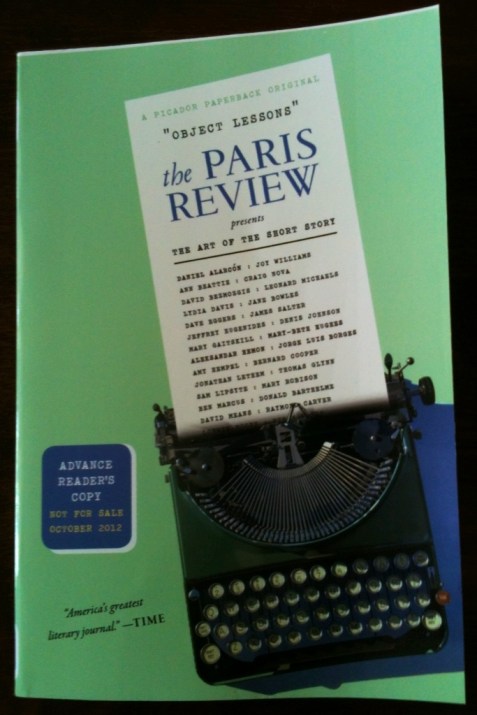
Object Lessons from The Paris Review, Where Writers Present Some of Their Favorite Short Stories from Other Writers (Book Acquired, 6.11.2012)

20120611-150824.jpg

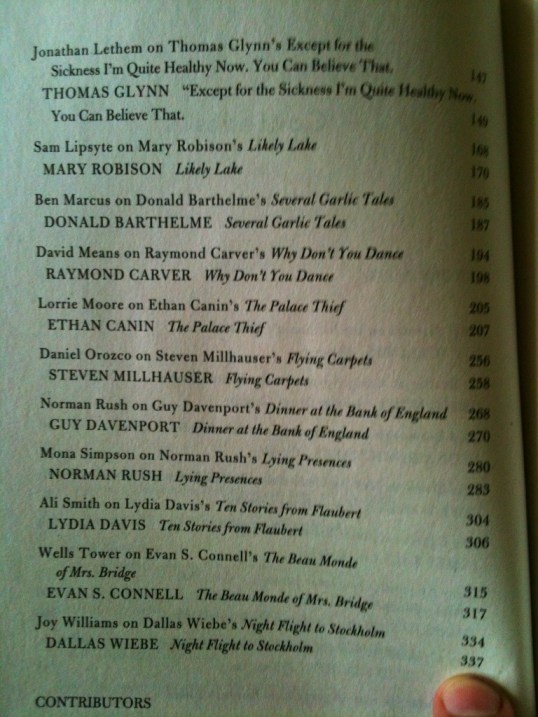
Okay: This one is really cool: Object Lessons features a bunch of short stories, some you may have read, each with a short lead-in (two-five pages) by another writer. So, we get Jeffrey Eugenides on Denis Johnson, or Ben Marcus on Donald Barthelme, or Lydia Davis on Jane Bowles, or Ali Smith on Lydia Davis. You know what, let me just share the table of contents (review down the line):

20120611-150831.jpg

20120611-150837.jpg

Read “The Werewolf,” A Short Fable by Angela Carter

“The Werewolf,” a short story by Angela Carter (collected in The Bloody Chamber and Burning Your Boats):

It is a northern country; they have cold weather, they have cold hearts.Cold; tempest; wild beasts in the forest. It is a hard life. Their houses are built of logs, dark and smoky within. There will be a crude icon of the virgin behind a guttering candle, the leg of a pig hung up to cure, a string of drying mushrooms. A bed, a stool, a table. Harsh, brief, poor lives.To these upland woodsmen, the Devil is as reals as you or I. More so; they have not seen us nor even know that we exist, but the Devil they glimpse often in the graveyards, those bleak and touching townships of the dead where the graves are marked with portraits of the deceased in the naif style and there are no flowers to put in front of them, no flowers grow there, so they put out small votive offerings, little loaves, sometimes a cake that the bears come lumbering from the margins of the forests to snatch away. At midnight, especially on Walpurgisnacht, the Devil holds picnics in the graveyards and invites the witches; then they dig up fresh corpses, and eat them. Anyone will tell you that.Wreaths of garlic on the doors keep out the vampires. A blue-eyed child born feet first on the night of St. John’s Eve will have second sight. When they discover a witch – some old woman whose cheeses ripen when her neighbours’ do not, another old woman whose black cat, oh, sinister! follows her about all the time, they strip the crone, search for her marks, for the supernumerary nipple her familiar sucks. They soon find it. Then they stone her to death.

Winter and cold weather.

Go and visit grandmother, who has been sick. Take her the oatcakes I’ve baked for her on the hearthstone and a little pot of butter.

The good child does as her mother bids – five miles’ trudge through the forest; do not leave the path because of the bears, the wild boar, the starving wolves. Here, take your father’s hunting knife; you know how to use it.

The child had a scabbby coat of sheepskin to keep out the cold, she knew the forest too well to fear it but she must always be on her guard. When she heard that freezing howl of a wolf, she dropped her gifts, seized her knife, and turned on the beast.

It was a huge one, with red eyes and running, grizzled chops; any but a mountaineer’s child would have died of fright at the sight of it. It went for her throat, as wolves do, but she made a great swipe at it with her father’s knife and slashed off its right forepaw.

The wolf let out a gulp, almost a sob, when it saw what had happened to it; wolves are less brave than they seem. It went lolloping off disconsolately between the trees as well as it could on three legs, leaving a trail of blood behind it. The child wiped the blade of her knife clean on her apron, wrapped up the wolf’s paw in the cloth in which her mother had packed the oatcakes and went on towards her grandmother’s house. Soon it came on to snow so thickly that the path and any footsteps, track or spoor that might have been upon it were obscured.

She found her grandmother was so sick she had taken to her bed and fallen into a fretful sleep, moaning and shaking so that the child guessed she had a fever. She felt the forehead, it burned. She shook out the cloth from her basket, to use it to make the old woman a cold compress, and the wolf’s paw fell to the floor.

But it was no longer a wolf’s paw. It was a hand, chopped off at the wrist, a hand toughened with work and freckled with old age. There was a wedding ring on the third finger and a wart in the index finger. By the wart, she knew it for her grandmother’s hand.

She pulled back the sheet but the old woman woke up, at that, and began to struggle, squawking and shrieking like a thing possessed. But the child was strong, and armed with her father’s hunting knife; she managed to hold her grandmother down long enough to see the cause of her fever. There was a bloody stump where her right hand should have been, festering already.

The child crossed herself and cried out so loud the neighbours heard her and come rushing in. They know the wart on the hand at once for a witch’s nipple; they drove the old woman, in her shift as she was, out into the snow with sticks, beating her old carcass as far as the edge of the forest, and pelted her with stones until she fell dead.

Now the child lived in her grandmother’s house; she prospered.

“The Jockey,” A Short Story by Carson McCullers

“The Jockey” by Carson McCullers

The jockey came to the doorway of the dining room, then after a moment stepped to one side and stood motionless, with his back to the wall. The room was crowded, as this was the third day of the season and all the hotels in the town were full. In the dining room bouquets of August roses scattered their petals on the white table linen and from the adjoining bar came a warm, drunken wash of voices. The jockey waited with his back to the wall and scrutinized the room with pinched, crêpy eyes. He examined the room until at last his eyes reached a table in a corner diagonally across from him, at which three men were sitting. As he watched, the jockey raised his chin and tilted his head back to one side, his dwarfed body grew rigid, and his hands stiffened so that the fingers curled inward like gray claws. Tense against the wall of the dining room, he watched and waited in this way.

He was wearing a suit of green Chinese silk that evening, tailored precisely and the size of a costume outfit for a child. The shirt was yellow, the tie striped with pastel colors. He had no hat with him and wore his hair brushed down in a stiff, wet bang on his forehead. His face was drawn, ageless, and gray. There were shadowed hollows at his temples and his mouth was set in a wiry smile. After a time he was aware that he had been seen by one of the three men he had been watching. But the jockey did not nod; he only raised his chin still higher and hooked the thumb of his tense hand in the pocket of his coat.

The three men at the corner table were a trainer, a bookie, and a rich man. The trainer was Sylvester — a large, loosely built fellow with a flushed nose and slow blue eyes. The bookie was Simmons. The rich man was the owner of a horse named Seltzer, which the jockey had ridden that afternoon. The three of them drank whiskey with soda, and a white-coated waiter had just brought on the main course of the dinner. Continue reading ““The Jockey,” A Short Story by Carson McCullers”