Cannibals all | On William Gaddis’s novel A Frolic of His Own

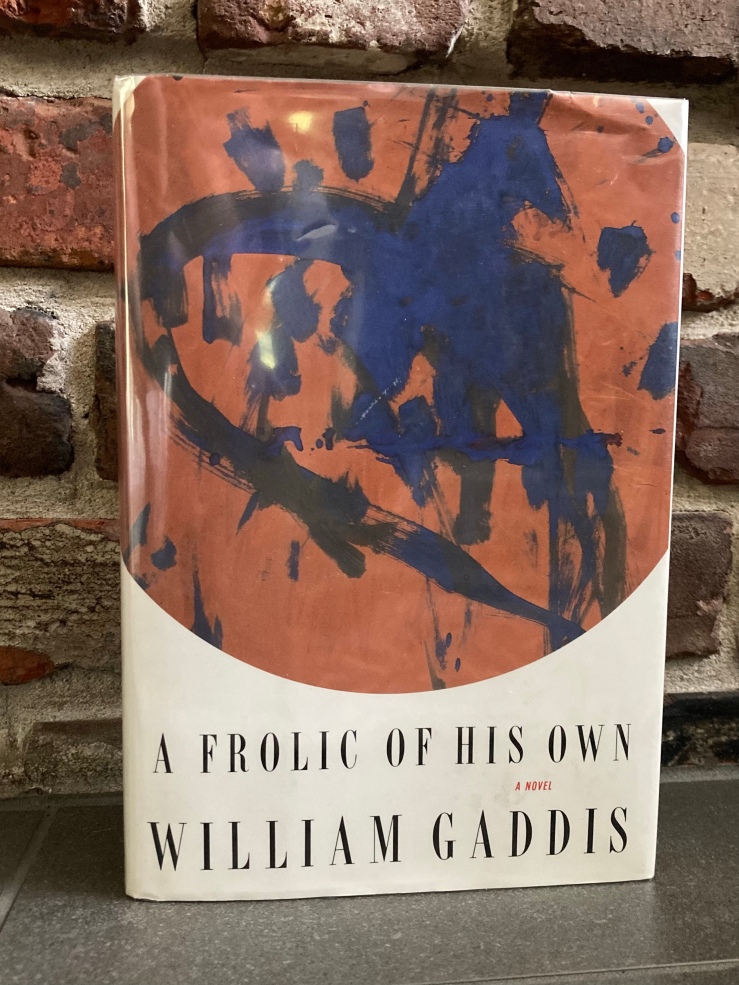
I want to comment on the themes and style of William Gaddis’s fourth novel, 1994’s A Frolic of His Own, and I’d like to do so without the burden of summarizing its byzantine plot, so I’ll crib from Steven Moore’s contemporary review of the novel that was first published in the Spring 1994 issue of The Review of Contemporary Fiction. Although he initially protests that the “plot is too wonderfully complex to summarize,” Moore nevertheless offers a concise precis. Moore writes that A Frolic of His Own

…concerns an interlocking set of lawsuits involving the Crease family: Oscar, a historian and playwright; Christina, his stepsister and married to a lawyer named Harry Lutz; and their father Judge Thomas Crease, presiding over two cases in Virginia during the course of the novel. The story unfolds by way of Gaddis’s trademark dialogue but also by various legal opinions, brilliantly rendered in the majestic language of the law.

Law, one of the major themes of the novel, is announced in its opening lines: “Justice? —You get justice in the next world, in this world you have the law.” A Frolic of His Own delves into the intersection of justice, law, art, theft, and compensation, all while foregrounding language as the mediating force of not just these nebulous concepts, but the medium, of course, of the novel itself. “What do you think the law is, that’s all it is, language,” the exasperated lawyer Harry declaims to his wife Christina.

Language is always destabilized and destabilizing in A Frolic of His Own. Gaddis lards the novel with mistakes, misinterpretations, and muddles of every mixture. Characters repeatedly fail to communicate clearly with each other, their dialogue twisting into new territories before they’ve mapped out their present concerns. A Frolic reads as linguistic channel surfing, an addled mind constantly turning the dial before a thought can fully land.

The effect of this linguistic channel surfing at times stuns and overwhelms the reader, approximating the noise of modern language that Gaddis’s heroes so often rail against, even as they participate in and create more of this noise. It’s worth sharing a paragraph in full to offer a sense of what Gaddis is doing in A Frolic of His Own. Here, Christina takes a phone call from her husband Harry, while her brother Oscar (who is slowly going mad) watches the evening news:

—Has Harry called? And when it finally rang —We’re fine, did you get to that new doctor? Well whatever you call him, you… I know that Harry but you’ve simply got to make time, if you don’t you’re going to end up like… that’s exactly what I mean, he’s sitting right here waiting for the evening news to whet his appetite for supper, I mean I can’t take care of both of you can I? Scenes of mayhem from Londonderry to Chandigarh, an overweight family rowing down main street in a freak flood in Ohio, a molasses truck overturned on the Jersey Turnpike, gunfire, stabbings, flaming police cars and blazing ambulances celebrating a league basketball championship in Detroit interspersed with a decrepit grinning couple on a bed that warped and heaved at the touch of a button —because they offered him a settlement Harry, almost a quarter million dollars but of course he insists on going ahead with the case or rather Mister Basie does, he was out here for… what? The Stars and Bars unfurled in a hail of rocks and beer cans showering the guttering remnants of a candlelight vigil—but if you can just try to be patient with her Harry, you know her mother just died and she’s been in an awful state trying to… to what? Oscar will you turn that down! that now she wants you to help her break her mother’s will? I don’t see what… well they never really got on after her mother was converted by that wildeyed Bishop Sheed was it? a million years ago convincing her that it was more exclusive with Clare Luce and all that after the wads of money she’d been giving St Bartholomew’s with these millions of Catholics jamming every slum you can think of if you call that exclusive, she…—Look! Christina look! Placards brandishing KEEP GOD IN AMERICA, MURDERER  come quickly! and caught in the emergency vehicles’ floodlights towering over it all the jagged thrust of —that, that Szyrk thing that, look!

The noisy force of mass-mediated language threatens to overwhelm the reader, whom Gaddis challenges to make meaning of his mess. Later, Christina sums up the problem: “I mean you talk about language how everything’s language it seems all that language does is drive us apart.” Naive Oscar, whose multiple lawsuits initiate the plot of A Frolic, tries to clarify the problem of language in his own way too: “—Isn’t that what language is for? to say what you mean? That’s why man invented language, isn’t it? so we can say what we mean?” But the events that Gaddis arranges in his novel suggest that the answer is, Not quite. There’s only one language all Americans understand—money:

—You want to sue them for damages, that’s money isn’t it?

—Because that’s the only damn language they understand! …Steal poetry what do you sue them for, poetry? …Two hundred hours teaching Yeats to the fourth grade?

Oscar’s complaint is the apparent plagiarism of his Civil War play Once at Antietam by a major Hollywood studio that has turned it into a “piece of trash” called The Blood in the Red White and Blue. Gaddis includes large sections of Oscar’s play in A Frolic of His Own, often having various characters (including its author) stop to make critical remarks. Here, Gaddis has actually cannibalized parts of a play he wrote in the late 1950s after he’d finished The Recognitions. He was unable to get Once at Antietam produced or published. In a 1961 letter, he admitted that “Now it reads heavy-handed, obvious, over-explained, oppressive,” adding that there might be some value somewhere in the work “but the vital problem remains, to extract it, to lift out something with a life of its own, give it wings, release it.” A Frolic of His Own may, on one hand, “release” Gaddis’s old play, but it denies it any life of its own. The play is bound within the text proper, incomplete, riddled with elisions, terminally unfinished.

It also comes to light (via a lengthy legal deposition) that Oscar (and perhaps the younger Gaddis?) has plagiarized large sections of his play, notably from Plato’s Republic. Oscar pleads that his plagiarisms are justified—they are art. But in A Frolic of His Own, “it all evaporates into language confronted by language turning language itself into theory till it’s not about what it’s about it’s only about itself turned into a mere plaything.”

Language is, of course, Gaddis’s plaything, and his novel repeatedly underlines its own textuality without the preciousness that sometimes afflicts postmodernist writing. For all his innovations and experimentation with form, Gaddis here and elsewhere is at his core a traditionalist like his hero T.S. Eliot. And like Eliot, he seeks to pick up the detritus of culture and meld it into something new, all while attacking the hollow men who run America. There’s more than just crankiness here: There is howling and bleating and often despair. There’s no justice for our characters, but at the same time, they hardly deserve any. For all their apparent cares and worries, these rich, venal, petty characters are ultimately, to borrow a phrase from another book, careless people, leaving messes for others to clean up (often quite literally). The satire bites; it’s rightfully mean-spirited, caustic, and bitter.

As such, A Frolic of His Own, for all its humor, is often very bleak. It also becomes increasingly claustrophobic. The characters get stuck in their language loops; the only way out seems to be madness or death. Gaddis’s writing had long evoked suffocating domestic spaces, whether it was the paper-stuffed 96th Street apartment shared by Bast, Eigen, and Gibbs in 1975’s J R or the haunted house of 1985’s Carpenter’s GothicA Frolic of His Own takes the madness to another level, setting the stage for the monolingual stasis of his final work, Agapē Agape.

Even if its cramped quarters are often gloomy and crammed with sharp objects, there’s a zaniness to the linguistic channel surfing of A Frolic that propels its fractured narrative forward. “The rest of it’s opera,” repeats Harry throughout, calling attention to the novel’s satirical histrionics. “It’s a farce,” repeats Oscar, pointing to both his own legal cases and his family history. As A Frolic progresses, its farcical twists become more and more bizarre, yet Gaddis always ties his loose ends. The modern world he satirizes is absurd, but it is real.

The realism Gaddis evokes in A Frolic centers around food and shelter. The action is confined primarily to the dilapidated old Crease estate, with its family (in ever-shifting configurations) frequently trying to feed themselves: “We’ve got to get some food in the house” becomes a mantra. Poor privileged half-siblings Oscar and Christina can hardly shop for themselves, let alone cook.

They are very adroit at drinking, however. As the novel careens towards madness, the half-siblings respond by hitting the booze. Consumption runs throughout the novel, presaged in its domestic-but-dooming epigraph, a recollection of something Thoreau said to Emerson while they were walking:

What you seek in vain for, half your life, one day you come full upon, all the family at dinner. You seek it like a dream, and as soon as you find it you become its prey.

Gaddis was fond of repurposing language, and first used the lines in his first novel, 1955’s The Recognitions. The last line of the epigraph, which finds the seeker become prey to his own dream, seems to me now to further highlight A Frolic’s themes of consumption—taboo consumption: cannibalism.

Very early in the novel, the narrator calls attention to Oscar’s copy of George Fitzhugh’s 1857 defense of slavery, Cannibals All! The phrase “cannibals all” is then inverted near the very end of the novel, when a former lawyer, in the hopes of perpetrating an insurance scam, wedges his foot in Oscar’s door: “they’re cannibals Mister Crease, they’re all cannibals,” the former lawyer insists, referring broadly to the insurance industry (he’ll later extend the term to those working in the real estate market in particular and humanity in general).

These direct inversions—cannibals-all/all-cannibals—bookend A Frolic of His Own, neatly encasing the metaphorical cannibalism that runs through the novel. Gaddis depicts a “dog eat dog” world (full of literal dead dogs) ruled by venal consumption. Family members cannibalize family members, law cannibalizes art, texts cannibalize texts. “When the food supply runs out and the only ones around are your own species, why go hungry?” interjects the narrator of a nature documentary that Oscar watches absentmindedly. Harry puts it succinctly:

That’s…what this whole country’s really all about? tens of millions out there with their candy and beer cans and this inexhaustible appetite for being entertained? Anything they can get their hands on…

Gaddis depicts a world where all attempts at culture and art are ultimately cannibalized and excreted by capital. In one of the novel’s goofiest and meanest gags, an entrepreneur seeks to exploit the highly-publicized death of Spot, a dog trapped and then zapped in an ugly postmodernist sculpture. The huckster, capitalizing on the public’s love for Spot, creates “Hiawatha’s Magic Mittens…labeled ‘Genuine Simulated Spotskin® Wear ‘Em With The Furside Outside.'”

“Hiawatha’s Magic Mittens” might seem like a throwaway joke, but the joke is nevertheless part of the novel’s theme of cannibalized culture. Those familiar with the legend of Hiawatha may recall that in many versions, Hiawatha practices ritual cannibalism until he is converted by the Great Peacemaker Deganawida. After his conversion, Hiawatha ceases to eat human flesh and strives for mutual aid and cooperation.

Gaddis also evokes the Hiawatha of Henry Wadsworth Longfellow’s epic poem, itself a cannibalization of sorts of the mytho-historical Hiawatha. Gaddis grafts the oft-cited opening line of “Hiawatha’s Childhood,” “By the shores of Gitche Gumee” a few times early in the novel. The poem seems to loll and roll around in Oscar’s skull; as his alcoholic madness increases, the poem’s trochaic tetrameter infects his thoughts. The result is some of the most beautiful prose in the book (even if the lines are intended as half-parody). Consider the following passage, which begins with Oscar watching the sunset on the wetlands around his crumbling estate, takes flight into the poetic cannibalization of Longfellow’s lines, and winds up in the jumble of Oscar’s fish tank (I strongly suggest reading the passage aloud to hear the trochaic tetrameter):

Neither the red scream of sunset blazing on the icebound pond nor the thunderous purple of its risings on a landscape blown immense through leafless trees off toward the ocean where in flocks the wild goose Wawa, where Kahgahgee king of ravens with his band of black marauders, or where the Kayoshk, the seagulls, rose with clamour from their nests among the marshes and the Mama, the woodpecker seated high among the branches of the melancholy pine tree past the margins of the pond neither rose Ugudwash, the sunfish, nor the yellow perch the Sahwa like a sunbeam in the water banished here, with wind and wave, day and night and time itself from the domain of the discus by the daylight halide lamp, silent pump and power filter, temperature and pH balance and the system of aeration, fed on silverside and flake food, vitamins and krill and beef heart in a patent spinach mixture to restore their pep and lustre spitting black worms from the feeder when a crew of new arrivals (live delivery guaranteed, air freight collect at thirty dollars) brought a Chinese algae eater, khuli loach and male beta, two black mollies and four neons and a pair of black skirt tetra cruising through the new laid fronds of the Madagascar lace plant.

Forgive the long quote. Or don’t. As the novel swerves to its gloomy end, the poem overtakes Oscar’s consciousness, the transcendental beauty of Longfellow’s vision cannibalized by the chainsaws of “land developers,” the real fauna replaced with Disneyfied simulations to send him off to drunken troubled dream. Dreamy Oscar:

…made a bed with boughs of hemlock where the squirrel, Adjidaumo, from his ambush in the oak trees watched with eager eyes the lovers, watched him fucking Laughing Water and the rabbit, the Wabasso sat erect upon his haunches, watched him fucking Minnehaha as the birds sang loud and sweetly where the rumble of the trucks drowned the drumming of the pheasant and the heron, the Shuh-shuh-gah gave a cry of lamentation from her haunts among the fenlands at the howling of the chainsaws and the screams of the wood chipper for that showplace on the corner promising a whole new order of woodland friends for the treeless landscape, where Thumper the Rabbit and Flower the Skunk would introduce the simpering Bambi to his plundered environment and instruct him in matters of safety and convenience by the shining Big-Sea-Water, by the shores of Gitche Gumee where the desolate Nokomis drank her whisky at the fireside, not a word from Laughing Water left abandoned by the windows, from the wide eyed Ella Cinders with the mice her only playmates as he turned his back upon them with his birch canoe exulting, all alone went Hiawatha.

Many contemporary reviewers suggested that A Frolic of His Own was Gaddis’s most accessible novel to date, and it might be. Whereas J R and Carpenter’s Gothic are composed almost entirely in dialogue, Gaddis provides more stage direction and connective tissue in A Frolic. There are also the fragments of other forms: legal briefs, depositions, TV news clips, Oscar’s play…Some of these departures can exhaust a reader. Gaddis’s parodies of legalese are full of jokes, but the tone of the delivery can lead one’s mind’s eye to glaze over. Oscar/Gaddis’s play is problematic too, but in a rewarding if confounding way: Is it supposed to be, like, good? The answer, I think, comes in its cannibalized version—I mean the cannibalized version that Oscar watches over broadcast television. When he finally sees The Blood in the Red White and Blue, Oscar experiences a wild array of emotions, both positive and negative—but his feelings are real.

A Frolic of His Own is not the best starting point for anyone interested in William Gaddis’s fiction, although I don’t think that’s where most people start. It is rewarding though, especially read contextually against his other works, in which it fits chaotically but neatly, underscoring the cranky themes in a divergent style that still feels fresh three decades after its original publication. Highly recommended.

[Ed. note — Biblioklept first ran this review in June 2023. I’ve been falling asleep to William Hootkins’ reading of The Song of Hiawatha every night for the past two weeks.]

In which Robert Coover admits to shoplifting William Gaddis’s The Recognitions

It was the grad-school summer of ’60, I was lingering in Chicago past quarter’s end to edit the university calendar, earn some pennies to help pay the obstetrician who would deliver our firstborn in August, subletting a friend’s basement flat, and using the down time to do a lot of reading, which that summer of occasional light fingered forays into bookstores (I have done penance through the years since, buying more than I can possibly read) included, simultaneously, two big fat novels: Saul Bellow’s Adventures of Augie March (Bellow was already a Chicago legend and I was a fan of Dangling Man and Victim) and William Gaddis’s The Recognitions (he was unknown to me, recommended by some forgotten person), with the immediate consequence that I found Bellow’s Chicago saga of Augie humping the old fellow to the local whorehouses a boisterous treat, a tale I felt as if my own (just look out the window, there they go), whereas the Gaddis book was difficult to get into (all that talk, I kept losing my place); but as the month wore on, Augie’s tale paled even as it moved south into the sun and soon the book got tossed in disappointment across the room, while in Gaddis’s great universal satire the characters behind the voices (all that talk!) had come vividly alive, and the likes of Basil Valentine and Esther and Wyatt, Stanley, Esme and Otto, and Recktall Brown (Recktall Brown!) and Agnes Deigh and the Town Carpenter had moved into the basement flat with me, companions for life, far from noble though they mostly were and failing even to last the book out, their lives eclipsed by chatter’s echoey art.

From “William Gaddis: A Portfolio,” published in Conjunctions no. 41 (2003).

Best Books of 1975?

Previously:

Best Books of 1972?

Best Books of 1973?

Best Books of 1974?

Not-really-the-rules recap:

I will focus primarily on novels here, or books of a novelistic/artistic scope.

I will include books published in English in 1975; I will not include books published in their original language in 1975 that did not appear in English translation until years later. So for example, Thomas Bernhard’s Korrektur will not appear on this list because although it was published in German in 1975, Sophie Wilkins’ English translation Correction didn’t come out until 1979.

I will not include English-language books published before 1975 that were published that year in the U.S.

I will fail to include titles that should be included, either through oversight or ignorance but never through malice. For example, I failed to include Dinah Brooke’s excellent 1973 novel Lord Jim at Home in my Best Books of 1973? post because I didn’t even know it existed until 2024. Please include titles that I missed in the comments.

So, what were some of the “Best Books of 1975?”

William Gaddis’s novel J R, one of the greatest 20th c. American novels, was published in 1975. I’ll make note of it first as an artistic ballast against the commercial list I’m about to offer up: The New York Times Best Seller list for 1975.

James Michener’s 1974 novel Centennial dominates the NYT list through winter and spring of 1975 (save for a brief one-week blip when Joseph Heller’s 1974 novel Something Happened published in paperback). By the summer, Arthur Hailey’s The Moneychangers rose to the top of the bestseller, the first novel of 1975 to do so. Judith Rossner’s Looking for Mr. Goodbar and E.L. Doctorow’s Ragtimcompeted for the top slot throughout the fall of ’75, with Agatha Christie’s final Poirot novel Curtain taking over in the winter.

My sense is that of these bestsellers, Ragtime‘s critical reputation has probably endured the strongest. The editors of the NYT Book Review included Ragtime in their 28 Dec. 1975 year-end round-up, along with Donald Barthelme’s The Dead Father, Saul Bellow’s Humboldt’s Gift, Peter Handke’s A Sorrow Beyond Dreams, Peter Matthiessen’s Far Tortuga and V. S. Naipaul’s Guerrillas

William Gaddis’s J R won the 1976 National Book Award for fiction; Paul Fussell’s The Great War and Modern Memory took the NBA for nonfiction; the NBA for poetry went to John Ashberry’s Self-Portrait in a Convex Mirror, and Walter D. Edmond’s Bert Breen’s Barn won the NBA for children’s literature. NBA finalists that year included Bellow’s Humboldt’s GiftVladimir Nabokov’s story collection Tyrants DestroyedJohnanna Kaplan’s Other People’s LivesLarry Woiwode’s Beyond the Bedroom Walland The Collected Stories of Hortense Calisher. (Robert Stone’s excellent 1974 novel Dog Soldiers won the 1975 NBA, if you’re keeping track).

If Bellow was sore about losing the NBA to Gaddis, he could console himself with the 1976 Pulitzer Prize for Literature (for Humboldt’s Gift). The 1975 Nobel Prize in Literature went to Eugenio Montale “for his distinctive poetry, which, with great artistic sensitivity, has interpreted human values under the sign of an outlook on life without illusions.” Montale did not publish a book in 1975.

The 1975 Booker Prize shortlisted only two of eighty-one novels (both published in 1975):  Ruth Prawer Jhabvala’s Heat and Dust and Thomas Keneally’s Gossip From the Forest. Heat and Dust took the prize.

The American Library Association’s Notable Books of 1975 list echoes many of the titles we’ve already seen, as well as some interesting outliers: Andre Brink’s self-translation of Looking on Darkness (banned by South Africa’s apartheid government), Alan Brody’s Coming ToBen Greer’s prison novel Slammer, Dagfinn Grønoset’s Anna (translated by Ingrid B. Josephson), Donald Harrington’s The Architecture of the Arkansas Ozarks, Anne Sexton’s The Awful Rowing toward God, and Mark Vonnegut’s memoir The Eden Express.

The National Book Critics Circle Awards for 1975 were Doctorow’s Ragtime, R.W.B. Lewis’s biography Edith Wharton, Ashbery’s Self-Portrait in a Convex Mirror, and Fussell’s The Great War and Modern Memory.

The 1975 Nebula Awards long list is particularly interesting. Along with sci-fi stalwarts like Poul Anderson, Alfred Bester, and Roger Zelzany, the Nebulas expanded their reach to include Doctorow’s Ragtime and Italo Calvino’s Invisible Cities. William Weaver’s translation of Invisible Cities was actually published in 1974 — as was the Nebula winner for 1975, Joe Haldeman’s The Forever War. Significant Nebula Awards shortlist titles published in 1975 include Joanna Russ’s The Female Man, Robert Silverberg’s The Stochastic Man, and Tanith Lee’s The Birthgrave. Most notable though is the inclusion of Samuel R. Delaney’s cult classic Dhalgren.

The 1976 Newberry Award went to Susan Cooper’s 1975 novel The Grey King; the Newberry Honor Titles were Sharon Bell Mathis’s The Hundred Penny Box (illustrated by Diane and Leo Dillon) and Laurence Yep’s DragonwingsOther notable books for children and adolescents published in 1975 include Natalie Babbitt’s Tuck EverlastingBeverly Cleary’s Ramona the Brave, and Roald Dahl’s Danny, the Champion of the World. 

Awards aside, commercial successes for 1975 included Stephen King’s Salem’s Lot, Joseph Wambaugh’s The Choirboys, Jack Higgins’s The Eagle Has Landed, James Clavell’s Shōgun, Michael Crichton’s The Great Train Robbery, Lawrence Sanders’s Deadly Sins, and Anthony Hope’s The Prisoner of Zenda.

Some critical/cult favorites (and genre exercises) from 1975 include: Martin Amis’s Dead Babies, J.G. Ballard’s High-Rise, Malcolm Bradbury’s The History Man, Charles Bukowski’s Factotum, Rumer Godden’s The Peacock Spring, Xavier Herbert’s insanely-long epic Poor Fellow My Country, Gayl Jones’s Corregidora, David Lodge’s Changing Places, Bharati Mukherjee’s Wife, Gary Myers’s weirdo fiction collection The House of the Worm, Tim O’Brien’s debut Northern Lights, James Purdy’s In a Shallow Grave, James Salter’s Light Years, Anya Seton’s Smouldering Fires, Gerald Seymour’s Harry’s Game, Robert Shea and Robert Anton Wilson’s The Illuminatus! Trilogy, Glendon Swarthout’s The Shootist, and Jack Vance’s Showboat World.

I’ve only read about fifteen books mentioned here (although I’ve abandoned several of them more than once (I’m looking at you Illuminatus! Trilogy and Dhalgren), so my own “best of 1975” list is uninformed and provisional, and frankly pretty obvious to anyone who checks in on this blog semi-regularly. My picks for ’75: J R, William Gaddis; The Dead Father, Donald Barthelme; High-Rise, J.G. Ballard.

19 Nov. 2024 (Blog about missing GY!BE and Alan Sparhawk this weekend in Atlanta)

This is Friday—not today, I mean, this, this blog, is Friday, four or five days ago, depending on how you count such things. We were maybe fifteen or twenty minutes on the road heading northwest to Atlanta—my wife driving the first leg before we stopped for gas—when I checked social media again to see if Godspeed You! Black Emperor were still going to play that night. They were not. This information came via opener Low legend Alan Sparhawk, who had reported the past two nights’ shows canceled.

We headed north anyway. The kids had left school early; my daughter pointed out that she had already missed an AP Bio test and that she wasn’t going with me and the boy to the show anyway, she just wanted to go to Atlanta to hang out. Fair point, of course.

My son was bummed and I was bummed. I don’t know exactly how he came to Godspeed You! Black Emperor’s strange, hypnotic, droney anthems—via an algorithm, really—but a few years ago I heard him blasting Lift Your Skinny Fists Like Antennas to Heaven in his bedroom. I gave him my copy of their debut LP, F♯ A♯ ∞, which I’d bought from the band back in 1998 or 1999 when they opened for Low at a record story I was working at in Florida. They knocked our socks off. It seemed there were more Godspeeds Yous than audience members, and to be clear, the tiny record store was packed. It was a summer afternoon in Florida; very hot and very sunny, a throbbing miasma of sound across Hemming Park, now James Weldon Johnson Park, in beautiful ugly downtown Jacksonville.

(It was just such a night my friend Travis was arrested for skateboarding across Laura Street. Jayskating. (I don’t think it was the same night.))

After the show I bought their record. It had a pouch crammed with incidentals—flattened pennies, a Canadian stamp, some illustrated scraps. I think I listened to it a million times that summer. One of the guys in the band asked me where they could get some hash in Jacksonville. I suggested the Waffle House. Low played after; everyone sat down, exhausted from what Godspeed had required. It was lovely. Perfect day.

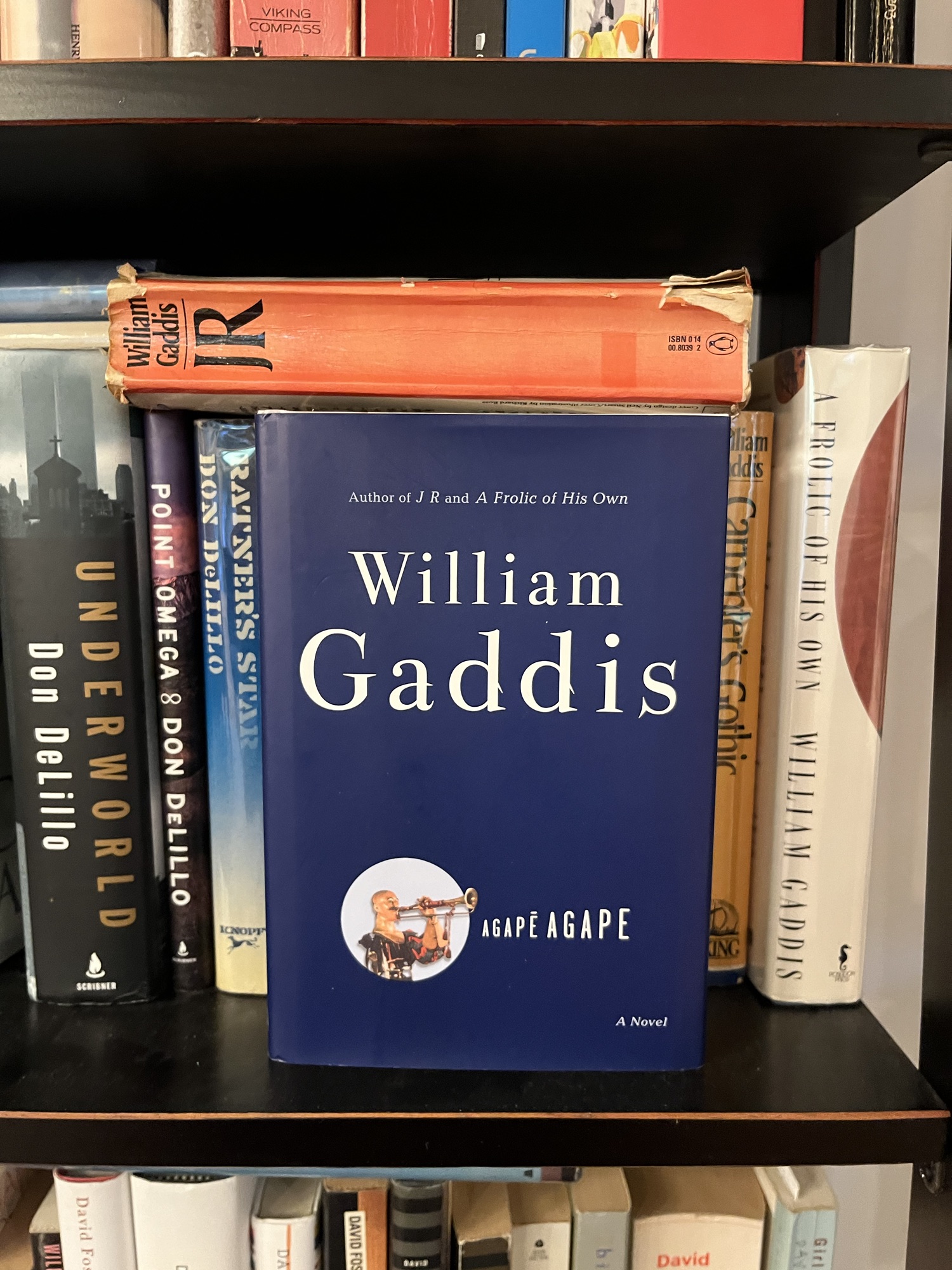
I had really wanted to experience my imaginative inversion of this concert this past weekend, but it didn’t emerge. I mean Alan Sparhawk, whose new record is so strange and daring and wonderful—I wanted to see that with my kid, who, he, my kid, wanted to see the ensemble Godspeed do their drone magic. I bought him an Aphex Twin record at Wax n’ Facts as a consolation prize, and he bought himself the first volume of Katsuhiro Otomo’s Akira at A Capella Books. I picked up a first edition hardback of William Gaddis’s last novel Agapē Agape.

And so well we made a weekend of it, browsing book stores and record stores and walking the Beltline. Love that city and my best wishes to GY!BE founding member, Efrim Menuck—I hate that we missed you on the tour but I hope that your health recovers. Thank you for making music my son and I love. 


He thinks of different ways to shoplift a book

Title: Gorland at Large

Location in archive (Box.Folder): 82.1

Date: Not dated

Complete? Yes

Extent of preserved material: A five-page lightly-corrected typescript, plus an earlier draft of five pages, heavily corrected and with other holograph notes.

The Story: Gorland as a boy of nine shoplifted cheap fishing tackle, and then his cousin stole a pocket knife from him. This sense that even those who steal for fun can be stolen from fills him with disappointment. As an adult in the narrative present, he meets a young woman who tells him that her friends are of two kinds: those who feel shame when they steal and those who don’t: Gorland feels sadness at this vision of a world of thieves. Gorland as an adult is a collector of books and finds out that an unpleasant bookshop owner has somehow stolen some of his, making him wonder if all the books in her shop are stolen. He thinks of different ways to shoplift a book, and takes a new standard edition of Kierkegaard’s Works of Love on his way out as she is distracted.

Works of Love is Kierkegaard’s most direct engagement with the concept of love-across-humankind: that is, agapē. The relevance is presumably that the model of human relations in which everyone steals from everyone else as a way of getting even and balancing their debts is a purely inverted counterpart to an Agapeic world of interaction through love.

Relation to Gaddis’s Published Writings: Ends with direct reference to a theorist of agapē, and hence a relevant text for Agapē Agape. A character in the shop asks for a book of poetry by WH Auden, whose early poems (eg “A Summer Night” or “Lullaby”) often suggest the precedence of love for all people over love for individuals.

Also a mention of central character “felt for a moment like Raskolnikov,” so another source for Gaddis’s explicit reference to the 19th-century Russians.

Other Notes and Mentions Elsewhere? N/A

The above selection is included in an exhaustive (but not exhausting) trip through the Gaddis archives, part of Electronic Book Review’s special issue, “Gaddis at His Centenary.” Our trip conductors are Gaddis scholars Ali Chetwynd (who organized and edited the special issue) and Joel Minor (who curates Washington University’s marvelous Modern Literature Collection. Titled “William Gaddis’s Unpublished Stories and Novel-Prototypes: An Archival Guide,” the piece diligently details Gaddis’s unpublished prose fiction, situating the pieces in the larger context of his five published novels. There are even some plot charts for Ducdame, a precursor for The Recognitions. 

I chose to share the entry for “Gorland at Large” above because it concerns a biblioklept.

The William Gaddis Centenary roundtable on “Para-Academic Venues for Discussing Gaddis” I took part in last summer is up now at Electronic Book Review (as well as other Gaddis stuff too)

Last August, I took part in one of Electronic Book Review’s “Gaddis Centenary” roundtables. Our discussion was on “Para-Academic Venues for Discussing Gaddis,” and that conversation is live on EBR now.

I really enjoyed talking with the other invitees, although I felt a bit out of my league. The roundtable included Victoria Harding, who managed the Gaddis listserv, as well as WilliamGaddis.org; novelist and critic Jeff Bursey;  book vlogger Chris Via of Leaf by Leaf; Chad Post, host of the Two Month Review podcast and founder of Open Letter Books; and moderator Ali Chetwynd.

I think we talked for a little over an hour, and while William Gaddis, his novels, and how we share ideas about him online (and elsewhere) was the focus, the conversation went to many other places: William Vollmann, Antoine Volodine, a fuck you to Jonathan Franzen, and the revelation of Evan Dara’s true identity (okay not really that last one).

There was also an underlying sense with most of the roundtable that the internet of yore as a means of deep conversation is slipping away; Chad summed it up neatly at one point, stating that “One of the disadvantages I see with everything right now, with the blog, podcasts, and so on, is being able to reach people, because the standard mechanisms have been screwed with for so long: it used to be that Google Reader and RSS feeds were a way to keeping aware of what was coming out. You could put something up and you’d have as much space as you wanted to, you could do whatever you wanted…”

There are also lots of new pieces up at the Gaddis Centenary page beyond our fun little roundtable, including a write-up by Mark Madigan of Gaddis’s 1979 lecture “On the Theme of Failure in Contemporary Literature” at St. Michael’s College in Vermont. Madigan’s piece shares John Puleio’s photograph of Gaddis and links to Vermont Public Radio’s audio recording of the lecture., which I enjoyed listening to this afternoon as I pulled weeds from my garden.

William Gaddis at St Michael’s College, November, 1979. Photograph by John Puleio.


I couldn’t think of anything worth saying in literature that can’t be said in 806 pages | John Barth on The Recognitions

Q: Do you find some such qualities in a neglected novel, William Gaddis’ The Recognitions?

Barth: I know that book only by sight. 950 pages: longer than The Sot-Weed Factor. Somebody asked me to review the new reprint of it, but I said I couldn’t think of anything worth saying in literature that can’t be said in 806 pages.

John Barth’s brief description of Donald Barthelme’s so-called postmodernist dinners

1fa8c7cbf8dc977653f7750905725da4
Photograph from “The Postmodernists Dinner,” 1983 by Jill Krementz (b. 1940)

In John Barth’s 1989 New York Times eulogy for Donald Barthelme, Barth gives a brief description of two so-called postmodernist dinners, both of which I’ve written on this blog before.

…though [Barthelme] tsked at the critical tendency to group certain writers against certain others ”as if we were football teams” – praising these as the true ”post-contemporaries” or whatever, and consigning those to some outer darkness of the passe – he freely acknowledged his admiration for such of his ”teammates,” in those critics’ view, as Robert Coover, Stanley Elkin, William Gaddis, William Gass, John Hawkes, Thomas Pynchon and Kurt Vonnegut, among others. A few springs ago, he and his wife, Marion, presided over a memorable Greenwich Village dinner party for most of these and their companions (together with his agent, Lynn Nesbit, whom Donald called ”the mother of postmodernism”). In 1988, on the occasion of John Hawkes’s academic retirement, Robert Coover impresarioed a more formal reunion of that team, complete with readings and symposia, at Brown University. Donald’s throat cancer had by then already announced itself – another, elsewhere, would be the death of him – but he gave one more of his perfectly antitheatrical virtuoso readings.

More on the first dinner here.

More on the second dinner here.

Gass was important to Gaddis

Gass read his peers’ work and commented on it regularly, in interviews, guest lectures, critical articles, and book reviews. Gaddis, on the other hand, was not inclined to read his contemporaries. Steven Moore writes that “[h]e seemed to have little interest in the novels of those contemporaries with whom he is most often associated,” including Barth, Donald Barthelme, Robert Coover, Don DeLillo, John Hawkes, Cormac McCarthy, and Thomas Pynchon. “William H. Gass was an exception,” says Moore, “whom he admired both personally and professionally.” At the tribute to her father in 1999, Sarah Gaddis said, “William Gass was important to Gaddis. . . . He held Gass in the highest esteem for his work, and no other writer made him feel so understood.” ( This respect for Gass and his opinions, literary and otherwise, is made clear by Gaddis’s frequently quoting or paraphrasing his friend in letters to others over the years; and his admiration for Gass’s abilities as a writer is put plainly in an April 13, 1994, letter to Michael Silverblatt, host of the literary radio program Bookworm: “Gass is for me our foremost writer, a magician with the language.”

From Ted Morrissey’s essay “‘Honored by the Error’: The Literary Friendship of Gaddis and Gass”. Morrissey’s essay is part of Electronic Book Review’s special issue, “Gaddis at His Centenary,” which includes Gaddis scholarship, histories, unpublished Gaddisalia, and some roundtable discussions.

Faust: We still need an essay tracing the importance of Faust to Gaddis

Faust: We still need an essay tracing the importance of Faust to Gaddis. Some critics have mentioned it, of course, but they’ve only skimmed the surface. Faust obviously plays a role in The Recognitions, which started off as a parody of it, but there’s a need to explore the Faust references in J R via Schramm’s Western (i.e. Gaddis’s screenplay Dirty Tricks). A Frolic of His Own too: In a 1988 letter, Gaddis compares Judge Crease’s law clerk to Faust’s assistant Wagner. Gaddis repeatedly cites both Marlowe’s Doctor Faustus and Goethe’s Faust; Dostoevsky cites the latter, so those two could be tied together. Gaddis even owned a signed copy of George Haimsohn’s The Bedside Faust, which is apparently a graphic novel version. Faust was also paramount in the nonfiction Gaddis was reading when he was composing The Recognitions: he is especially prominent in Spengler’s book, and to a lesser extent in Toynbee. The Faust figure was big in postwar fiction: Thomas Mann’s novel Doktor Faustus came out in 1947 (and was treated in one early dissertation on Gaddis), and Faustian man (via Spengler) was a recurring topic among the Beats: the subtitle to Jack Kerouac’s novel Dr. Sax, written in the early ’50s, is Faust Part Three, all of which could be brought in to widen the scope of a paper. Gaddis had a perhaps unique take on the subject: in a 1973 letter, he confessed to a “preoccupation with the Faust legend as pivotal posing the question: what is worth doing?” That question might even be the unifying theme of all of Gaddis’s work; all his novels can be regarded as dramatized responses to that question.

From “New Directions for Gaddis Scholarship,” Steven Moore’s address to the William Gaddis Centenary Conference at Washington University St Louis in October of 2022. The transcription is gathered as part of Electronic Book Review’s special issue, “Gaddis at His Centenary,” which includes Gaddis scholarship, histories, unpublished Gaddisalia, and some roundtable discussions (I was privileged enough to attend one and even opened my stupid mouth a few times).

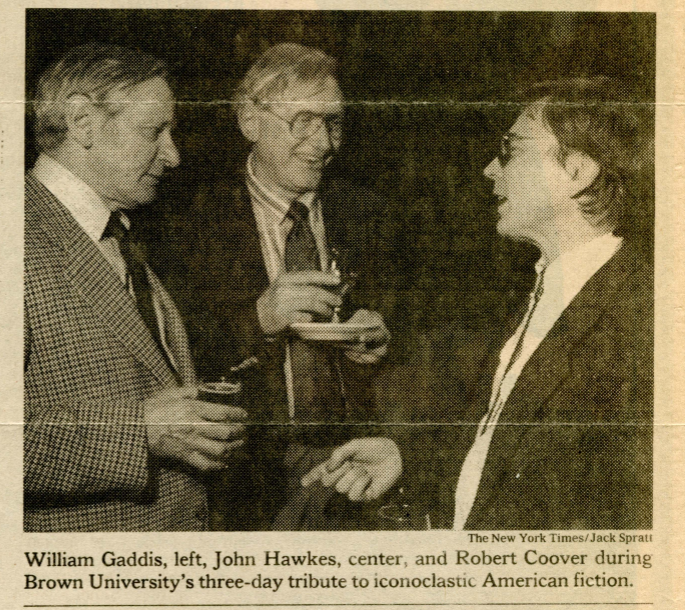
Don was there, as well as William Gass, Stanley Elkin, William Gaddis, and half a dozen others of the postmodernist bent.


The New Yorker: Last week, there was a three-day festival in your honor at Brown University, in Providence—titled, in part, “Celebrating the Unspeakable Practices of Robert Coover”—featuring appearances by many of your colleagues and admirers, including T. C. Boyle, Don DeLillo, Alexandra Kleeman, Marlon James, Edwidge Danticat, Paul Auster, and many others. What was the stimulus for the festival?

Robert Coover: “Unspeakable Practices” was the title of a farewell party I organized for the then retiring professor and great metafictionist John Hawkes, in 1988—a title taken from Donald Barthelme’s book of stories “Unspeakable Practices, Unnatural Acts.” Don was there, as well as William Gass, Stanley Elkin, William Gaddis, and half a dozen others of the postmodernist bent. After that, over the years, we continued with a sequence of vanguard literary ingatherings, calling them all “Unspeakables.” In effect, this was the last one and perhaps the most brilliant of the lot, peopled by old friends and many former students, now celebrated writers in their own right. The readings on the final day by Edwidge Danticat, Rick Powers, Siri Hustvedt, Don DeLillo, and Paul Auster were sensational, some of the best public performances I’ve ever heard. Its whole title was meant to include my creation of the International Writers Project and its freedom-to-write predecessors at Brown, as well as my pioneer digital language workshops in hyperfiction and “cave writing” (writing in immersive 3-D), both programs launched at Brown in 1989. It was a great party, a party that began with the performance of a short sequence from my son Roderick’s radio play based on “Gerald’s Party,” and ending with a reiteration of an old festival favorite, the “Unspeakable Circus.”

From a brief 2018 exchange between the great American novelist Robert Coover and Deborah Treisman (published in The New Yorker). More on Coover’s “Unspeakable Practices” event here.

Steven Moore on the wild talents of Thomas Pynchon, William Gaddis, and the occultist Charles Fort

At Socrates on the Beach, there’s a nice long essay by critic Steven Moore that traces the occult influence of Charles Fort on Thomas Pynchon and William Gaddis.

From “Wild Talents: Pynchon, Gaddis, and Charles Fort“:

Pynchon and Gaddis are “wild talents” not in Fort’s original sense, but in their daring willingness to incorporate such exotic material into their novels, which previously had been confined to science fiction, fantasy, and occult novels. At any rate, it is an extraordinary coincidence that two of the greatest American novels of the 20th century evoke Charles Fort, of all people, despite what he thought of coincidences.

Oh yeah. Debridement is one of the great words, says novelist William Gaddis, one of the great survivors.

Yeah . . . stubbing out another cigarette, in a voice like warm asphalt — this was an arrangement I had in hard times. I had root canal work to be done, and this man, who was an endodontologist, which is a root canal man, was writing pieces for dental journals. But he was not awfully good with the language, so we made an agreement, a barter arrangement, of one paper, one root. So I’d come in with one tooth with two bad roots and he would do them and then I’d rewrite, really write, because these were very, and there was a battle in the endodontological world about whether debridement was desirable or even possible. Debridement is when they try to remove any source of infection so that when they do pack the root, it won’t come to life. And his side was debridement was possible and necessary and can be done. So that’s the side I was supporting.

— Nice word, isn’t it.

— Oh yeah. Debridement is one of the great words . . . says novelist William Gaddis, one of the great survivors.

The first paragraph of a 23 Aug. 1985 profile on William Gaddis in The Washington Post by Lloyd Grove.

Aira/Márquez/Moore (Books acquired, 18 Aug. 2023)

Last week I read a 1985 Washington Post profile of the American novelist William Gaddis. The profile, by Lloyd Grove, celebrated the publication of Gaddis’s third novel Carpenter’s Gothic. In the profile, Grove paraphrases literary critic Frederick Karl’s 1985 essay “The Mega-Novel” in the following way:

Karl argues that unlike “categories of Jewish novelists, gays, Black writers [and] female authors” who address special interests, “these white Protestant males [Gaddis, Pynchon, John Barth et al.] write very close to what America is,” having “sensed the country as a whole.”

I tracked down and read Karl’s essay “The Mega-Novel”; it is, almost entirely, a sustained argument for the kind of giant-assed so-called “experimental” novels typical of the bracketed Gaddis, Pynchon, and Barth above. And yet Karl seems to slide into and side with Harold Bloom in that old man’s pompous war against the so-called “School of Resentment”; once in the quote above, and then a few pages later, when he chooses to claim that “The Mega-Novelists have avoided the individuation of ethnic, gay, female (or even strictly male) experience and sensed the country as a whole.” Yes—Grove weds this second line in Karl’s covert attack on the “School of Resentment,” this maddening and dismissive “country as a whole” bit to the previous language. The effect is so odd, as if Grove has purposefully ignored every other bit of Karl’s essay and cherry-picked the lines that valorize the Real American Viewpoint™ as White Protestant Straight and Male.

Karl’s essay is, apart from these unnecessary declarations, really quite good—he champions Gaddis’s J R and Joseph McElroy’s Lookout Cartridge in particular. And yet I found myself troubled by his claim that it is the dead white guys who write very close to what America is because they sense the country as a whole, in a way that somehow, like, I guess Ishmael Reed or Fran Ross or Toni Morrison or etc. just can’t. And because I’m so simpatico with Karl’s general idea in “The Mega-Novel,” I found myself looking for his 1983 book American Fictions 1940-1980 : A Comprehensive History and Critical Evaluation.

While I didn’t find it in the literary criticism section of my beloved used bookmine, I did find the second volume of Gaddis-scholar Steven Moore’s The Novel, covering 1600-1800.

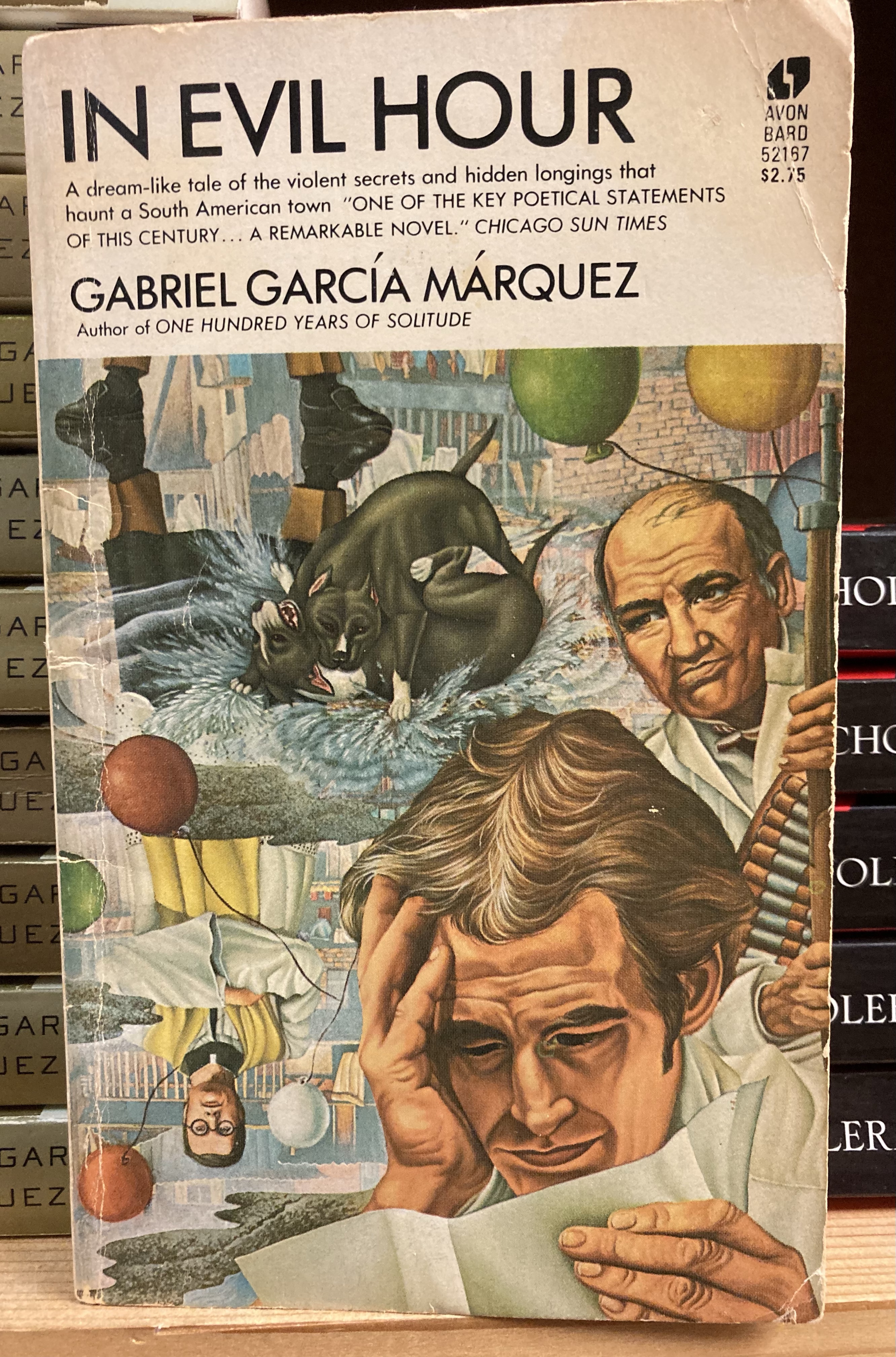
I also picked up César Aira’s An Episode in the Life of a Landscape Painter (in translation by Chris Andrews) and Gabriel García Márquez’s In Evil Hour (in translation by Gregory Rabassa). The latter is another title in Avon/Bard’s Latin American authors series, and I can’t resist them.


The next day, yesterday, Saturday, I participated in an online discussion about the literature of William Gaddis on non-academic forums. (I represented Ye Olde Bloggers, and I will share more about the forum some time in the future.) Early in our forum, one of the participants, the author Jeff Bursey, raised a copy of Frederick Karl’s American Fictions 1940-1980 in front of his webcam. I believe he declared it one of the first places he’d heard of Gaddis, although I could be misremembering. It seemed like a serendipitous moment. I hope to muster more words on most of this later.

Steven Moore on William Gaddis and Russian Literature

Photograph of William Gaddis by William H. Gass

The good folks at indie publisher Sublunary have shared on their site the text of Gaddis scholar Steven Moore’s essay “William Gaddis and Russian Literature.” The essay serves as the preface for a forthcoming Russian translation of Moore’s Gaddis study, William Gaddis: Expanded Edition.

From the essay:

By the age of twenty Gaddis had already read Dostoevsky’s Crime and Punishment—he later called it “the first ‘great’ novel I experienced”—and over the next decade he devoured much more Russian literature, as is evident from the letters he wrote while writing his first novel, The Recognitions. He tells his mother about reading Chekhov’s plays and Dostoevsky’s House of the Dead, praises Crime and Punishment and The Idiot to short-story writer Katherine Anne Porter, and informs an ex-girlfriend that he is re-reading Goncharov’s Oblomov, which he continued to praise all his life. When his first novel was published in 1955, many critics mistakenly assumed that it was influenced by James Joyce’s Ulysses; but an informed reader would have noticed the numerous references to books by Dostoevsky (Brothers Karamazov, Crime and Punishment, Demons, The Idiot) and Tolstoy (Kingdom of God, Power of Darkness, Redemption), and would have correctly concluded that Gaddis had adapted the 19th-century Russian novel for 20th-century Americans, one closer to The Idiot than to Ulysses.

Read the essay at Sublunary.

Cannibals all | On William Gaddis’s novel A Frolic of His Own

I want to comment on the themes and style of William Gaddis’s fourth novel, 1994’s A Frolic of His Own, and I’d like to do so without the burden of summarizing its byzantine plot, so I’ll crib from Steven Moore’s contemporary review of the novel that was first published in the Spring 1994 issue of The Review of Contemporary Fiction. Although he initially protests that the “plot is too wonderfully complex to summarize,” Moore nevertheless offers a concise precis. Moore writes that A Frolic of His Own

…concerns an interlocking set of lawsuits involving the Crease family: Oscar, a historian and playwright; Christina, his stepsister and married to a lawyer named Harry Lutz; and their father Judge Thomas Crease, presiding over two cases in Virginia during the course of the novel. The story unfolds by way of Gaddis’s trademark dialogue but also by various legal opinions, brilliantly rendered in the majestic language of the law.

Law, one of the major themes of the novel, is announced in its opening lines: “Justice? —You get justice in the next world, in this world you have the law.” A Frolic of His Own delves into the intersection of justice, law, art, theft, and compensation, all while foregrounding language as the mediating force of not just these nebulous concepts, but the medium, of course, of the novel itself. “What do you think the law is, that’s all it is, language,” the exasperated lawyer Harry declaims to his wife Christina.

Language is always destabilized and destabilizing in A Frolic of His Own. Gaddis lards the novel with mistakes, misinterpretations, and muddles of every mixture. Characters repeatedly fail to communicate clearly with each other, their dialogue twisting into new territories before they’ve mapped out their present concerns. A Frolic reads as linguistic channel surfing, an addled mind constantly turning the dial before a thought can fully land.

The effect of this linguistic channel surfing at times stuns and overwhelms the reader, approximating the noise of modern language that Gaddis’s heroes so often rail against, even as they participate in and create more of this noise. It’s worth sharing a paragraph in full to offer a sense of what Gaddis is doing in A Frolic of His Own. Here, Christina takes a phone call from her husband Harry, while her brother Oscar (who is slowly going mad) watches the evening news:

—Has Harry called? And when it finally rang —We’re fine, did you get to that new doctor? Well whatever you call him, you… I know that Harry but you’ve simply got to make time, if you don’t you’re going to end up like… that’s exactly what I mean, he’s sitting right here waiting for the evening news to whet his appetite for supper, I mean I can’t take care of both of you can I? Scenes of mayhem from Londonderry to Chandigarh, an overweight family rowing down main street in a freak flood in Ohio, a molasses truck overturned on the Jersey Turnpike, gunfire, stabbings, flaming police cars and blazing ambulances celebrating a league basketball championship in Detroit interspersed with a decrepit grinning couple on a bed that warped and heaved at the touch of a button —because they offered him a settlement Harry, almost a quarter million dollars but of course he insists on going ahead with the case or rather Mister Basie does, he was out here for… what? The Stars and Bars unfurled in a hail of rocks and beer cans showering the guttering remnants of a candlelight vigil—but if you can just try to be patient with her Harry, you know her mother just died and she’s been in an awful state trying to… to what? Oscar will you turn that down! that now she wants you to help her break her mother’s will? I don’t see what… well they never really got on after her mother was converted by that wildeyed Bishop Sheed was it? a million years ago convincing her that it was more exclusive with Clare Luce and all that after the wads of money she’d been giving St Bartholomew’s with these millions of Catholics jamming every slum you can think of if you call that exclusive, she…—Look! Christina look! Placards brandishing KEEP GOD IN AMERICA, MURDERER  come quickly! and caught in the emergency vehicles’ floodlights towering over it all the jagged thrust of —that, that Szyrk thing that, look!

The noisy force of mass-mediated language threatens to overwhelm the reader, whom Gaddis challenges to make meaning of his mess. Later, Christina sums up the problem: “I mean you talk about language how everything’s language it seems all that language does is drive us apart.” Naive Oscar, whose multiple lawsuits initiate the plot of A Frolic, tries to clarify the problem of language in his own way too: “—Isn’t that what language is for? to say what you mean? That’s why man invented language, isn’t it? so we can say what we mean?” But the events that Gaddis arranges in his novel suggest that the answer is, Not quite. There’s only one language all Americans understand—money:

—You want to sue them for damages, that’s money isn’t it?

—Because that’s the only damn language they understand! …Steal poetry what do you sue them for, poetry? …Two hundred hours teaching Yeats to the fourth grade?

Oscar’s complaint is the apparent plagiarism of his Civil War play Once at Antietam by a major Hollywood studio that has turned it into a “piece of trash” called The Blood in the Red White and Blue. Gaddis includes large sections of Oscar’s play in A Frolic of His Own, often having various characters (including its author) stop to make critical remarks. Here, Gaddis has actually cannibalized parts of a play he wrote in the late 1950s after he’d finished The Recognitions. He was unable to get Once at Antietam produced or published. In a 1961 letter, he admitted that “Now it reads heavy-handed, obvious, over-explained, oppressive,” adding that there might be some value somewhere in the work “but the vital problem remains, to extract it, to lift out something with a life of its own, give it wings, release it.” A Frolic of His Own may, on one hand, “release” Gaddis’s old play, but it denies it any life of its own. The play is bound within the text proper, incomplete, riddled with elisions, terminally unfinished.

It also comes to light (via a lengthy legal deposition) that Oscar (and perhaps the younger Gaddis?) has plagiarized large sections of his play, notably from Plato’s Republic. Oscar pleads that his plagiarisms are justified—they are art. But in A Frolic of His Own, “it all evaporates into language confronted by language turning language itself into theory till it’s not about what it’s about it’s only about itself turned into a mere plaything.”

Language is, of course, Gaddis’s plaything, and his novel repeatedly underlines its own textuality without the preciousness that sometimes afflicts postmodernist writing. For all his innovations and experimentation with form, Gaddis here and elsewhere is at his core a traditionalist like his hero T.S. Eliot. And like Eliot, he seeks to pick up the detritus of culture and meld it into something new, all while attacking the hollow men who run America. There’s more than just crankiness here: There is howling and bleating and often despair. There’s no justice for our characters, but at the same time, they hardly deserve any. For all their apparent cares and worries, these rich, venal, petty characters are ultimately, to borrow a phrase from another book, careless people, leaving messes for others to clean up (often quite literally). The satire bites; it’s rightfully mean-spirited, caustic, and bitter.

As such, A Frolic of His Own, for all its humor, is often very bleak. It also becomes increasingly claustrophobic. The characters get stuck in their language loops; the only way out seems to be madness or death. Gaddis’s writing had long evoked suffocating domestic spaces, whether it was the paper-stuffed 96th Street apartment shared by Bast, Eigen, and Gibbs in 1975’s J R or the haunted house of 1985’s Carpenter’s GothicA Frolic of His Own takes the madness to another level, setting the stage for the monolingual stasis of his final work, Agapē Agape.

Even if its cramped quarters are often gloomy and crammed with sharp objects, there’s a zaniness to the linguistic channel surfing of A Frolic that propels its fractured narrative forward. “The rest of it’s opera,” repeats Harry throughout, calling attention to the novel’s satirical histrionics. “It’s a farce,” repeats Oscar, pointing to both his own legal cases and his family history. As A Frolic progresses, its farcical twists become more and more bizarre, yet Gaddis always ties his loose ends. The modern world he satirizes is absurd, but it is real.

The realism Gaddis evokes in A Frolic centers around food and shelter. The action is confined primarily to the dilapidated old Crease estate, with its family (in ever-shifting configurations) frequently trying to feed themselves: “We’ve got to get some food in the house” becomes a mantra. Poor privileged half-siblings Oscar and Christina can hardly shop for themselves, let alone cook.

They are very adroit at drinking, however. As the novel careens towards madness, the half-siblings respond by hitting the booze. Consumption runs throughout the novel, presaged in its domestic-but-dooming epigraph, a recollection of something Thoreau said to Emerson while they were walking:

What you seek in vain for, half your life, one day you come full upon, all the family at dinner. You seek it like a dream, and as soon as you find it you become its prey.

Gaddis was fond of repurposing language, and first used the lines in his first novel, 1955’s The Recognitions. The last line of the epigraph, which finds the seeker become prey to his own dream, seems to me now to further highlight A Frolic’s themes of consumption—taboo consumption: cannibalism.

Very early in the novel, the narrator calls attention to Oscar’s copy of George Fitzhugh’s 1857 defense of slavery, Cannibals All! The phrase “cannibals all” is then inverted near the very end of the novel, when a former lawyer, in the hopes of perpetrating an insurance scam, wedges his foot in Oscar’s door: “they’re cannibals Mister Crease, they’re all cannibals,” the former lawyer insists, referring broadly to the insurance industry (he’ll later extend the term to those working in the real estate market in particular and humanity in general).

These direct inversions—cannibals-all/all-cannibals—bookend A Frolic of His Own, neatly encasing the metaphorical cannibalism that runs through the novel. Gaddis depicts a “dog eat dog” world (full of literal dead dogs) ruled by venal consumption. Family members cannibalize family members, law cannibalizes art, texts cannibalize texts. “When the food supply runs out and the only ones around are your own species, why go hungry?” interjects the narrator of a nature documentary that Oscar watches absentmindedly. Harry puts it succinctly:

That’s…what this whole country’s really all about? tens of millions out there with their candy and beer cans and this inexhaustible appetite for being entertained? Anything they can get their hands on…

Gaddis depicts a world where all attempts at culture and art are ultimately cannibalized and excreted by capital. In one of the novel’s goofiest and meanest gags, an entrepreneur seeks to exploit the highly-publicized death of Spot, a dog trapped and then zapped in an ugly postmodernist sculpture. The huckster, capitalizing on the public’s love for Spot, creates “Hiawatha’s Magic Mittens…labeled ‘Genuine Simulated Spotskin® Wear ‘Em With The Furside Outside.'”

“Hiawatha’s Magic Mittens” might seem like a throwaway joke, but the joke is nevertheless part of the novel’s theme of cannibalized culture. Those familiar with the legend of Hiawatha may recall that in many versions, Hiawatha practices ritual cannibalism until he is converted by the Great Peacemaker Deganawida. After his conversion, Hiawatha ceases to eat human flesh and strives for mutual aid and cooperation.

Gaddis also evokes the Hiawatha of Henry Wadsworth Longfellow’s epic poem, itself a cannibalization of sorts of the mytho-historical Hiawatha. Gaddis grafts the oft-cited opening line of “Hiawatha’s Childhood,” “By the shores of Gitche Gumee” a few times early in the novel. The poem seems to loll and roll around in Oscar’s skull; as his alcoholic madness increases, the poem’s trochaic tetrameter infects his thoughts. The result is some of the most beautiful prose in the book (even if the lines are intended as half-parody). Consider the following passage, which begins with Oscar watching the sunset on the wetlands around his crumbling estate, takes flight into the poetic cannibalization of Longfellow’s lines, and winds up in the jumble of Oscar’s fish tank (I strongly suggest reading the passage aloud to hear the trochaic tetrameter):

Neither the red scream of sunset blazing on the icebound pond nor the thunderous purple of its risings on a landscape blown immense through leafless trees off toward the ocean where in flocks the wild goose Wawa, where Kahgahgee king of ravens with his band of black marauders, or where the Kayoshk, the seagulls, rose with clamour from their nests among the marshes and the Mama, the woodpecker seated high among the branches of the melancholy pine tree past the margins of the pond neither rose Ugudwash, the sunfish, nor the yellow perch the Sahwa like a sunbeam in the water banished here, with wind and wave, day and night and time itself from the domain of the discus by the daylight halide lamp, silent pump and power filter, temperature and pH balance and the system of aeration, fed on silverside and flake food, vitamins and krill and beef heart in a patent spinach mixture to restore their pep and lustre spitting black worms from the feeder when a crew of new arrivals (live delivery guaranteed, air freight collect at thirty dollars) brought a Chinese algae eater, khuli loach and male beta, two black mollies and four neons and a pair of black skirt tetra cruising through the new laid fronds of the Madagascar lace plant.

Forgive the long quote. Or don’t. As the novel swerves to its gloomy end, the poem overtakes Oscar’s consciousness, the transcendental beauty of Longfellow’s vision cannibalized by the chainsaws of “land developers,” the real fauna replaced with Disneyfied simulations to send him off to drunken troubled dream. Dreamy Oscar:

…made a bed with boughs of hemlock where the squirrel, Adjidaumo, from his ambush in the oak trees watched with eager eyes the lovers, watched him fucking Laughing Water and the rabbit, the Wabasso sat erect upon his haunches, watched him fucking Minnehaha as the birds sang loud and sweetly where the rumble of the trucks drowned the drumming of the pheasant and the heron, the Shuh-shuh-gah gave a cry of lamentation from her haunts among the fenlands at the howling of the chainsaws and the screams of the wood chipper for that showplace on the corner promising a whole new order of woodland friends for the treeless landscape, where Thumper the Rabbit and Flower the Skunk would introduce the simpering Bambi to his plundered environment and instruct him in matters of safety and convenience by the shining Big-Sea-Water, by the shores of Gitche Gumee where the desolate Nokomis drank her whisky at the fireside, not a word from Laughing Water left abandoned by the windows, from the wide eyed Ella Cinders with the mice her only playmates as he turned his back upon them with his birch canoe exulting, all alone went Hiawatha.

Many contemporary reviewers suggested that A Frolic of His Own was Gaddis’s most accessible novel to date, and it might be. Whereas J R and Carpenter’s Gothic are composed almost entirely in dialogue, Gaddis provides more stage direction and connective tissue in A Frolic. There are also the fragments of other forms: legal briefs, depositions, TV news clips, Oscar’s play…Some of these departures can exhaust a reader. Gaddis’s parodies of legalese are full of jokes, but the tone of the delivery can lead one’s mind’s eye to glaze over. Oscar/Gaddis’s play is problematic too, but in a rewarding if confounding way: Is it supposed to be, like, good? The answer, I think, comes in its cannibalized version—I mean the cannibalized version that Oscar watches over broadcast television. When he finally sees The Blood in the Red White and Blue, Oscar experiences a wild array of emotions, both positive and negative—but his feelings are real.

A Frolic of His Own is not the best starting point for anyone interested in William Gaddis’s fiction, although I don’t think that’s where most people start. It is rewarding though, especially read contextually against his other works, in which it fits chaotically but neatly, underscoring the cranky themes in a divergent style that still feels fresh three decades after its original publication. Highly recommended.

Letter to Oppenheimer | William Gaddis

New York City
4 January 1955
Dear Doctor Oppenheimer.

I have already taken a greater liberty than this, asking your attention to my letter, in having called Harcourt, Brace & Co., who are publishing a long novel I have written, to ask that they send you a copy. You must receive mail of all sorts, crank notes and fan letters of every description, but few I should think of half a million words. And since I can also well imagine that you seldom if ever read novels, if only for not having the time, it is an added imposition to have sent you such a bulky one.

But for having read your recent address at Columbia’s anniversary, I should never have presumed to do so. But I was so stricken by the succinctness, and the use of the language, with which you stated the problems which it has taken me seven years to assemble and almost a thousand pages to present, that my first thought was to send you a copy. And I do submit this book to you with deepest respect. Because I believe that The Recognitions was written about “the massive character of the dissolution and corruption of authority, in belief, in ritual and in temporal order, . . .” about our histories and traditions as “both bonds and barriers among us,” and our art which “brings us together and sets us apart.” And if I may go on presuming to use your words, it is a novel in which I tried my prolonged best to show “the integrity of the intimate, the detailed, the true art, the integrity of craftsmanship and preservation of the familiar, of the humorous and the beautiful” standing in “massive contrast to the vastness of life, the greatness of the globe, the otherness of people, the otherness of ways, and the all-encompassing dark.”

The book is a novel about forgery. I know that if you do get into it, you will find boring passages, offensive incidents, and some pretty painful sophomorics, all these in my attempts to present “the evils of superficiality and the terrors of fatigue” as I have seen them: I tried to present the shadowy struggle of a man surrounded by those who have “dissolved in a universal confusion,” those who “know nothing and love nothing.”

However you feel about the book, please allow my most humble congratulations on your address which provoked my taking the liberty of sending it to you, and in expression of my deepest admiration for men like yourself in the world you described.

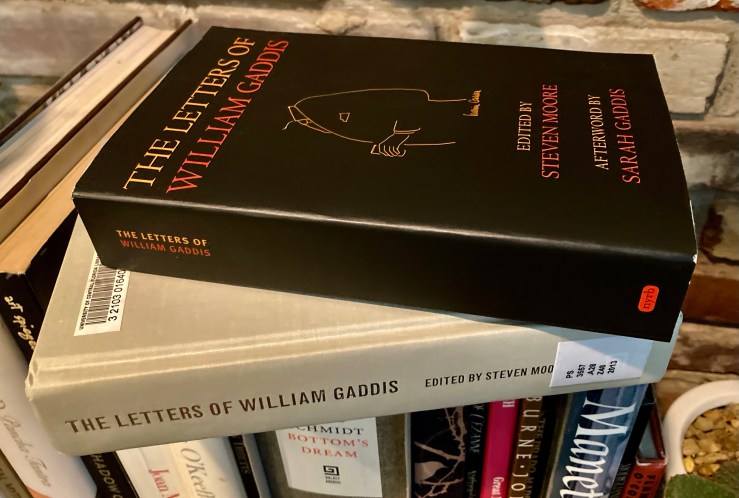
From The Letters of William Gaddis; ed. Steve Moore. Moore adds the following note: [American physicist (1904–67), known for his work on the atomic bomb. On 26 December 1954 he gave a lecture entitled “Prospects in the Arts and Sciences” at Columbia University’s bicentennial anniversary celebration, reprinted in his book The Open Mind (1955). The following letter is a corrected draft.]

You can read a version of “Prospects in the Arts and Sciences” here.