Beyond Black — Hilary Mantel

In Hilary Mantel’s 2005 novel Beyond Black, a fat psychic named Alison endures the harrowing torment of a collective of ghosts she calls the Fiends, the spirits of cruel men from her childhood. When a young, aimless woman named Colette comes into Alison’s life and assumes managerial duties for her career, Alison’s bilious past comes to a head. Colette engineers more and better gigs for Alison (the death of Princess Diana causes a huge spike in business), who, despite her genuine psychic talents, must nonetheless run the kind of scam the “punters” in her audience crave. Colette and Alison soon move in together, buying a new house in a quiet, boring suburb outside of London; their prefab homestead is drawn in sharp contrast to the slums of Aldershot where Alison grew up–the novel’s second setting. As Beyond Black progresses, contemporary suburban Britain increasingly crumbles into Alison’s grim, greasy past in Aldershot. Alison’s chief tormentor is, ironically, her “spirit guide,” a mean little man named Morris, a one-time frequent customer for Alison’s prostitute mother. Alison, like many victims, has suppressed much of her grotesque childhood, but it’s hard to black out everything with psychic baggage like Morris weighing her down. In time, more and more of the Fiends reemerge, forcing Alison to confront her mother and the abuse they both suffered at the hands of those awful men. As the book lurches to its chilling climax, Alison asserts independence, casting out her metaphysical and psychological demons.

At its core, Beyond Black asks what it means to be haunted and how one might survive an abusive past whole and intact. A slim specter of a character named Gloria floats through the book. The Fiends, whose vile antics are sometimes compared to a gypsy circus, have dismembered Gloria with the old saw trick. In Alison’s memory, pieces of Gloria are scattered around her childhood home, parceled out, fed to dogs, transported in boxes at midnight, hidden. Alison’s awful mother frequently alludes to Alison herself being “sawed up,” a metaphor that dances on the literal as we come to realize that the old drunk has pimped out her daughter repeatedly. Mantel’s novel investigates the return of the repressed, and although she gives us something like a happy ending, the book’s central thesis seems to be that pain cannot be abandoned or hidden, but only mitigated through direct confrontation.

The book’s humor does nothing to lighten its grim subject–if anything it exacerbates and confounds the darkness at the heart of Beyond Black. Mantel’s gift for dialogue fleshes out her characters (even the spectral ones), and while the book aims for a satirical tone at times, its characters are too richly drawn to be mere cutouts in a stage production. Mantel’s satire of contemporary English life is sharp and bleak; you laugh a little and then feel bad for laughing and a page later you’re horrified. It’s a successful book in that respect. It’s one real weakness is in the character of Colette, whose voice gives way to Alison’s past by the book’s end. This is actually no problem, as Colette’s narrative life is not nearly as interesting as Alison’s psychic traumas; Colette is, however, catalyst for the changes in Alison’s life. It would’ve been nice to see more resolution here, but I suppose Beyond Black hews closer to real life here, with all its messy loose ends.

I chose to read Beyond Black because I enjoyed Mantel’s recent Booker Prize winner Wolf Hall so much. The books have little in common other than being well-written and tightly paced, and I think that anyone who wanted more Mantel after an introduction via Wolf Hall would do right to pick up Beyond Black. Recommended. Beyond Black is available in trade paperback from Picador.

Tom McCarthy Talks C

James Wood on Virginia Woolf and the Anxiety of Influence

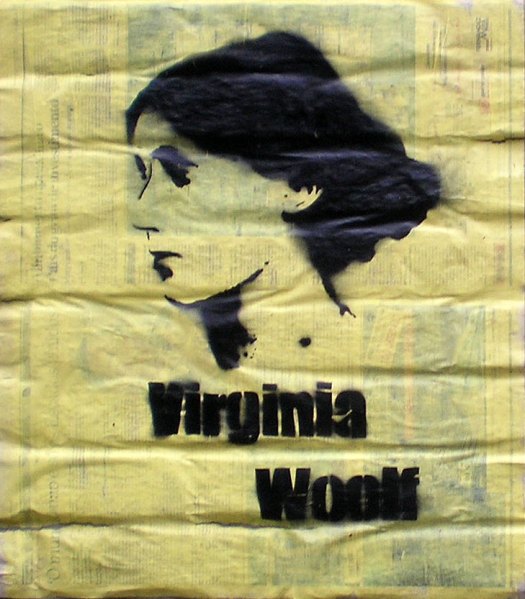
James Wood, writing about Virginia Woolf in his essay “Virginia Woolf’s Mysticism” (collected in The Broken Estate)–

Woolf, I think, became a great critic, not simply a “great reviewer.” The Collected Essays, which are still being edited, is the most substantial body of criticism in English this century. They belong in the tradition of Johnson, Coleridge, Arnold, and Henry James. This is the tradition of poet-critics, until the modern era, when novelists like Woolf and James join it. That is, her essays and reviews are a writer’s criticism, written in the language of art, which is the language of metaphor. The writer-critic, or poet-critic, has a competitive proximity to the writers she discusses. The competition is registered verbally. The writer-critic is always showing a little plumage to the writer under discussion. If the writer-critic appears to generalize, it is because literature is what she does, and one is always generalizing about oneself.

Wood’s description of Woolf is really Wood’s description of Wood.

Christopher Hitchens on J.D. Salinger

China Miéville Profiled at The New York Times

Today’s New York Times profiles one our favorite bizarros, China Miéville. Read the article here. Topics include embarrassing apocalypses, Star Trek, and his new book Kraken. From the article:

Mr. Miéville says what attracts him to the genre, as a reader and a writer, is the importance of the imagination — “that sense of the world blown apart, that sense of a crack in reality, that visionary sense, that ecstatic sense,” as he described it.

“At a certain stage some people end up not trusting their own imagination,” Mr. Miéville said. “You get this kind of baleful set of voices in your head that tell you, ‘That’s silly; you’re being silly.’

“But I think most people have more ideas in their heads than they think they do. It’s just that those of us in the fantastic fields — either we don’t listen to our own filters, or we have a much higher ridiculousness threshold.”

Tom McCarthy on Technology and the Novel

Great essay today at The Guardian from Tom McCarthy, author of Remainder and the the forthcoming, highly-anticipated C. McCarthy discusses technology, modernity, and literature, mulling over writers like Blake, Cervantes, Shelley, Joyce, and Ballard. He also talks about some of the research that went into C. From his essay:

C takes place, specifically, between 1898 and 1922. The dates aren’t accidental: they mark the period between Marconi’s early short-distance radio experiments and the founding of that centralised state broadcaster of entertainment, news and propaganda that we still know as the BBC. In 1922, Britain was erecting, in its colonial territory Egypt, the first long-distance pylons of its proposed imperial wireless chain – and as it went about this, it lost Egypt, which gained independence in February of that year. For ancient Egyptians, “pylons” were gateways to the underworld: these modern ones came to symbolise bereavement on a national scale. In November, also in Egypt, Howard Carter disinterred what would become the most famous family crypt of all time. 1922 was also modernism’s annus mirabilis, seeing the publication of The Waste Land, in which voices, dialogues and even weather reports drift in and out of audibility as its author-operator fiddles with his literary dial – and Ulysses, a huge textual switchboard in which the themes of death and media are plugged into each other time and again.

Look for our full review of C sometime next week.

Vanity Fair Interviews David Mitchell

Vanity Fair interviews David Mitchell about his new book The Thousand Autumns of Jacob de Zoet. The interviewer mistakenly (I believe, anyway) thinks James Wood is joking in his New Yorker review when he wonders if the book is “post-postmodernist.” Mitchell’s answer sounds about right.

VF: James Wood in the New Yorker was describing your books and he jokingly came up with the phrase post-postmodernism. If there were such a thing as post-postmodern literature, what do you think that might be?

DM: Oddly enough, I’m not sure if novelists are the best people to ask whither-the-novel questions. For me, it’s a little like I’m a duckbilled platypus and I’m being asked a question about taxonomy. You won’t get much of an answer out of a platypus because they’re busy going about their business digging tunnels, catching fish, and having sex. You really have to ask a critic, or a taxonomist. I feel like I should have a pithy answer because I’m a novelist and you’re asking a question about the future of the novel, but the biggest question I ever get to is, “How can I make this damned book work?” I rarely ever put my head above the rampart and see where this big lumbering behemoth called global literature is going.

(Thanks to the Bored Bookseller for the tip).

Woody Allen on Recording Audiobooks

Woody Allen talks to The New York Times about recording audiobook versions of his anthologies Getting Even, Without Feathers, Mere Anarchy, and Side Effects. Here’s Woody, from the interview, emitting his usual positive vibes:

I imagined it would be quite easy for me, and, in fact, it turned out to be monstrously hard. I hated every second of it, regretted that I had agreed to it, and after reading one or two stories each day, found myself exhausted. The discovery I made was that any number of stories are really meant to work, and only work, in the mind’s ear and hearing them out loud diminishes their effectiveness. Some of course hold up amusingly, but it’s no fun hearing a story that’s really meant to be read, which brings me to your next question, and that is that there is no substitute for reading, and there never will be. Hearing something aloud is its own experience, but it’s hard to beat sitting in bed or in a comfortable chair turning the pages of a book, putting it down, and eagerly awaiting the chance to get back to it.

“The Unwanted” — Joe Sacco

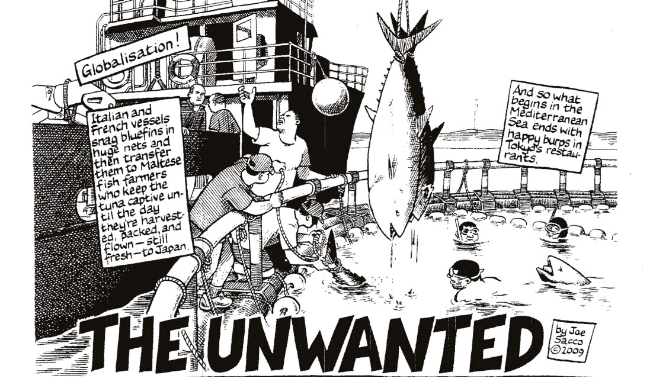
Read Joe Sacco’s comic “The Unwanted” at The Guardian. As usual, Sacco approaches a complex problem at the human level in his story about African immigration to Malta. Go here for more on Joe Sacco, his journalism, and his fantastic books, Safe Area Goražde and Palestine.

David Mitchell Discusses His New Novel, The Thousand Autumns of Jacob de Zoet

Hear the whole interview here.

In Honor of the Confounding Kafka Cache Caper, Listen to Susan Sontag, Paul Auster, David Foster Wallace and Others on Kafka’s Work

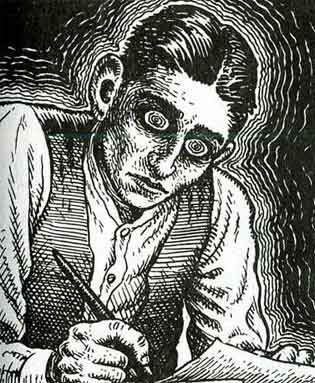
Kafka by R. Crumb

Yesterday, lawyers in Zurich opened four anonymous safety deposit boxes supposedly containing original manuscripts, letters, and drawings by Franz Kafka. The question of who owns the literary cache has turned into something of an international debacle, with lawyers and judges jostling for control.

In appreciation of Kafka (and this whole cosmically-ironic fiasco), we direct you to audio clips of the PEN fellowship’s March 26, 1998 tribute, which featured, among others, E.L. Doctorow, Susan Sontag, Cynthia Ozick, and Paul Auster, reading from their own essays on Kafka, or the Czech’s work. The highlight is David Foster Wallace’s essay “A Series of Remarks on Kafka’s Funniness from Which Not Enough Has Been Removed.”

You can stream the tracks here. True biblioklepts can download them directly from here.

The Thousand Autumns of Jacob de Zoet — David Mitchell

At some point, almost every character in David Mitchell’s new novel, The Thousand Autumns of Jacob de Zoet tells a story. The book teems with storytellers and their stories, overflows with compact bildungsromans, wistful jeremiads, high adventures drawn in miniature, comic escapades, bizarre folk tales, and romantic myths, all pressed into the service of the book’s larger narrative, the story of Jacob de Zoet, a Dutchman in Shogunate era Japan. In 1799, the relative starting point for this massive novel, Japan limited economic trade with Europeans to the Dutch East India Company, who, with a few rare exceptions, were not permitted to touch Japanese soil. Instead, the Dutch were confined to the man-made isle of Dejima in the bay of Nagasaki. With its rich cultural mishmash, claustrophobic isolation, and strange hybrid nature, Dejima makes a fascinating platform for Mitchell’s tale.

Most reviews of Mitchell’s new book have squared it against his earlier novels, particularly his experimental opus Cloud Atlas (The Guardian‘s review even begins by asking “Does it matter what books a novelist has written before? Should readers need to know an author’s preceding works fully to grasp the new one?”). The reason for this is plain. By and large, Thousand Autumns is a conventional historical novel, a straightforward linear narrative that combines a forbidden love triangle story with elements of high adventure. There are good guys and bad guys, Enlightened thinkers and scheming crooks, warriors and spies, and even an evil monk who may or may not have supernatural powers. Thousand Autumns (like its main setting Dejima) is richly detailed but hermetically sealed; what leaks from that seal are its myriad stories, its capacity for storytelling. This effusion of stories also marks the novel, I believe, as something more than the conventional historical novel it is purported to be. Even more interesting though is the space the novel is occupying in a current literary debate–is The Thousand Autumns of Jacob de Zoet a postmodern novel or not? The rest of my review will discuss this issue, along with James Wood’s review at The New Yorker and Dave Eggers’s review at The New York Times. The simple answer, of course, is that it doesn’t matter whether the book is postmodern or something else–it’s a very good book, I enjoyed it very much, and you probably will too. I encourage you to read Wood’s precis, which I’ve excised here, and then pick up the book. Anyone else interested in the foolish minutiae of what may or may not make a book postmodern or post-postmodern or something else may wish to continue (or not).

Here’s James Wood, using Mitchell’s oeuvre to dither over the fact that “The serious literary novel is at an interesting moment of transition” —

If postmodernism came after modernism, what comes after postmodernism? For that is where we are. “Post-postmodernism” tends toward an infinite stutter. “After postmodernism” suggests a severance that has not occurred. We might settle for “late postmodernism,” a term that suggests the peculiar statelessness of contemporary fiction, which finds itself wandering—not unhappily—between tradition and novelty, realism and anti-realism, the mass audience and the élitist critic. Thus David Mitchell can follow a “postmodern” novel with a “traditional” comic bildungsroman, and then follow that with a conventional historical novel. It is hard to know whether this statelessness is difficult freedom or easy imprisonment, but the more ambitious contemporary fiction will often blend a bewildering variety of elements and historical techniques [. . .]

Dave Eggers, however, feels no need to look for machinations beyond straightforward storytelling. He claims that Thousand Autumns retains the

[. . .] narrative tendencies [of Mitchell’s earlier works] while abandoning the structural complexities often (and often wrongly) called postmodern. This new book is a straight-up, linear, third-person historical novel, an achingly romantic story of forbidden love and something of a rescue tale — all taking place off the coast of Japan, circa 1799. Postmodern it’s not.”

There’s a certain reticence in Eggers’s review to situate Thousand Autumns against anything but itself, including even the rest of Mitchell’s works. In contrast, Wood spends the first half of his review positioning Mitchell’s postmodernism, throughout both his novels (against each other), and as the oeuvre of one author (against other authors). For Wood, Thousand Autumns, because of “its self-enclosed quality [. . .] represents an assertion of pure fictionality.” He continues, arguing that “although the book contains no literary games, it is itself a kind of long game.” Wood would like to see in Thousand Autumns‘s discrete self-containedness a kind of literary gesture, perhaps a sort of conventional historical novel (in scare quotes) that is so conventional as to efface all signs of self-awareness (and thus erase the scare quotes around the gesture). At the same time, Wood recognizes the power of storytelling in the book, asserting that this feature is what makes it a “representative late-postmodern document.” Wood continues:

In place of the grave silence that was the great theme of early postmodernism (or late modernism, if you prefer), language announcing a postwar exhaustion, its own impossibility, as in the work of Beckett or Blanchot, there is a confident profusion of narratives, an often comic abundance of story-making. Never, when reading Mitchell, does the reader worry that language may not be adequate to the task, and this seems to me both a fabulous fortune and a metaphysical deficiency.

These last sentiments are where I strongly disagree with Wood (as perhaps my lede attests)–the greatest strength of Mitchell’s work here is the fabulous fortune of its abundant storytelling. Far from being a metaphysical deficiency, the characters in Thousand Autumns, major and minor, repeatedly transcend their social, spiritual, economic, psychological, and physical confinement via storytelling. Again and again language breaks characters away from their isolation or imprisonment, gives them access to adventure and romance–to spirit. Ultimately, Wood condemns the book for this “metaphysical deficiency,” arguing that “the reader wants a kind of moral or metaphysical pressure that is absent, and that has ceded all the ground to pure storytelling.” (In Wood’s critical body, it is always “the reader,” never “this reader”). I think that the pleasure and power of pure storytelling is its own end, and perhaps it is this recognition that leads Eggers to pronounce of the book simply that “Postmodern it’s not.” And while this declaration is ultimately a more reader-friendly take on Thousand Autumns, it’s also clear to see how the experimental nature of Mitchell’s previous work calls for Wood’s need to place the novel, to situate it against a developing canon (even if Wood chooses ultimately to deny its status).

Wood is perhaps right in his assertion that the term “post-postmodernism” leads to an “infinite stutter.” Still, post-postmodernism ultimately seems more fitting to describe Thousand Autumns than Wood’s “late postmodernism.” The Thousand Autumns of Jacob de Zoet cunningly sets the spiky traps of language and then gracefully leaps over them. Like David Foster Wallace and William Vollmann–two writers who I believe mark the beginnings of post-postmodernism–Mitchell wants to transcend postmodernism’s ironic vision, and storytelling–giving his characters voices–is a means to this end. Perhaps it is Mitchell’s earnestness in conveying the power of storytelling leads Wood to conclude Thousand Autumns “a kind of fantasy [. . .] Or, rather, it is a brilliant fairy tale; and even nightingales, as a Russian proverb has it, can’t live off fairy tales.” If, finally, Thousand Autumns is not a late postmodernist historical fiction but indeed a fairy tale, then it’s worth noting that it’s a particularly enjoyable and nourishing one. Highly recommended.

David Foster Wallace on Commercial Literature and the Dread of Reading

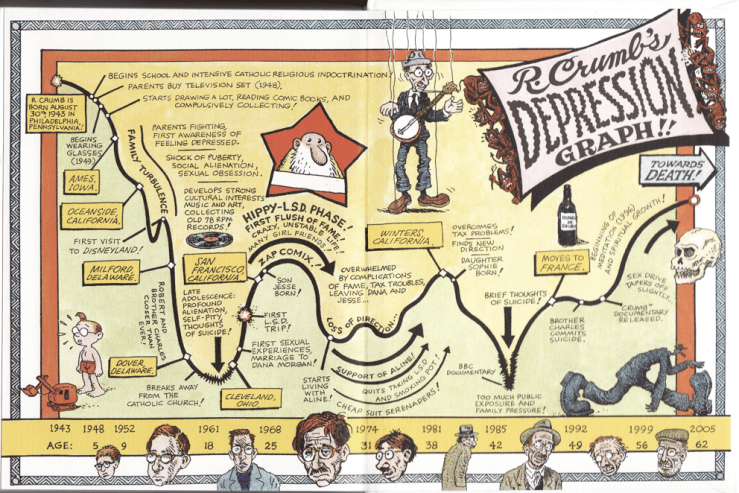
R. Crumb’s Depression Graph

Bret Easton Ellis Disses David Foster Wallace

At a in a reading in Hackney, England, two days ago, Bret Easton Ellis dissed the late great David Foster Wallace:

Question: David Foster Wallace – as an American writer, what is your opinion now that he has died?

Answer: Is it too soon? It’s too soon right? Well I don’t rate him. The journalism is pedestrian, the stories scattered and full of that Mid-Western faux-sentimentality and Infinite Jest is unreadable. His life story and his battle with depression however is really quite touching . . .

Via HTMLGIANT, via The Howling Fantods. The discussion at HTMLGIANT’s comment section is pretty great right now (see our own comment thread below for comments detailing HTMLGIANT readers who claim that BEE’s quote is misrepresented/mistranscribed), with a few commentators bringing up an interview in which DFW said the following about BEE:

I think it’s a kind of black cynicism about today’s world that Ellis and certain others depend on for their readership. Look, if the contemporary condition is hopelessly shitty, insipid, materialistic, emotionally retarded, sadomasochistic, and stupid, then I (or any writer) can get away with slapping together stories with characters who are stupid, vapid, emotionally retarded, which is easy, because these sorts of characters require no development. With descriptions that are simply lists of brand-name consumer products. Where stupid people say insipid stuff to each other. If what’s always distinguished bad writing—flat characters, a narrative world that’s cliched and not recognizably human, etc.—is also a description of today’s world, then bad writing becomes an ingenious mimesis of a bad world. If readers simply believe the world is stupid and shallow and mean, then Ellis can write a mean shallow stupid novel that becomes a mordant deadpan commentary on the badness of everything. Look man, we’d probably most of us agree that these are dark times, and stupid ones, but do we need fiction that does nothing but dramatize how dark and stupid everything is? In dark times, the definition of good art would seem to be art that locates and applies CPR to those elements of what’s human and magical that still live and glow despite the times’ darkness. Really good fiction could have as dark a worldview as it wished, but it’d find a way both to depict this world and to illuminate the possibilities for being alive and human in it. You can defend “Psycho” as being a sort of performative digest of late-eighties social problems, but it’s no more than that.

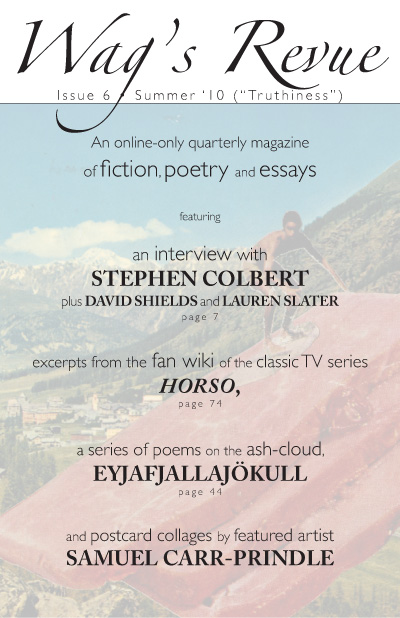
Wag’s Revue #6 Features Stephen Colbert, David Shields, and More

Issue 6 of the online literary journal Wag’s Revue is out now, and features interviews with Stephen Colbert and Reality Hunger author David Shields. They’re calling it the “Truthiness” issue, which I guess is appropriate. Here’s Colbert actually talking about Shields:

WG: Despite your professed aversion to books, you often have guests on the show from the world of literature. In fact, David Shields, who we recently interviewed, was on your show shortly after we spoke with him.

SC: Yeah, you guys should get a nice Colbert bump out of that.

WG: How do you reconcile that, though?

SC: Reconcile what? Having Shields on the show? I nailed Shields. You can go to the tape and see that. I mean, the guy’s book is the equivalent of you guys putting clips from my show on your website and calling it “The Wag-bert Report.” It’s—basically, it’s Wikipedia. A bunch of unattributed, slapped-together quotes. Mostly taken from Britannica.

“A bunch of unattributed, slapped-together quotes”–that’s about right, although it’s always a precarious position to agree with Colbert’s persona. As for the Shield’s interview, well, he manages to say a number of embarrassing things. Here he is explaining why he’s too busy to actually read the novels he’d love to see extinct:

What I find tedious are works that genuflect at the altar of narrative. What happens with so many books by supposedly intelligent writers is that the intelligence gets tamped down: ‘I’ll tell this story and the meaning will crawl through the cracks of the narrative at six crucial points.’ That’s not worth it. Part of my conversion, you could say, resulted of becoming aware of mortality. This is what I focused on in my previous book [The Thing About Life is One Day You’ll Be Dead]. This is it. This is my entire life. We are mortal beings watching the earth for a short time. I don’t have time for a 600-page novel that tells me that crime doesn’t pay.

Interviewer Sandra Allen has the intelligence to call Shields out on this. Observe:

SA: But doesn’t this dismissal also potentially dismiss art? Dismiss a reader experiencing the glorious immersion in the art that is Crime and Punishment, or for that matter Swann’s Way or Ulysses or 2666?

DS: First of all, most of the books that you mentioned were written a long time ago. I love Proust above all else pretty much. Of course if you want to read Crime and Punishment, Swann’s Way, these glacially-paced novels that have no place in a 21st century universe, you can. Even the Bolaño was written ten or so years ago. I’m trying to figure out how we’re going to write now.

Shields then blathers about how Reality Hunger, like Monet or Ulysses or Beethoven’s 5th (!) is really renewing art, claims that all of the critics who hated on Reality Hunger merely proved his point (Shields offers no support for this argument), and generally poses as a would-be revolutionary/college sophomore who just read half of Roland Barthes’s Mythologies. The interview is basically great ammunition for anyone who saw through Reality Hunger.

James Wood Summarizes David Mitchell’s The Thousand Autumns of Jacob de Zoet

I’m a few hours from the end of the audiobook version of David Mitchell’s new novel The Thousand Autumns of Jacob de Zoet. It’s fantastic stuff so far–engaging, imaginative, complex, and satisfying in its richness. Here’s a summary of the book from James Wood’s review of the book in The New Yorker, July 5, 2010:

Jacob de Zoet is a pious, pedantic, upright young clerk for the Dutch East Indies Company, newly arrived on the man-made island of Dejima, in the bay of Nagasaki. It is 1799. The Japanese, enforcing their policy of isolation, confined the Dutch to their post at Dejima, a kind of floating village connected by a bridge to the mainland, and strictly monitored them. The Dutch were effectively prohibited from entering the landmass of Japan, except for the purpose of making an annual visitation to the shogun, in Edo; religious services were banned, and books of Christian devotion were seized upon arrival. Jacob is quickly involved in two difficult narratives: as an employee of the utmost probity, he is tasked with auditing the company, and purging its corruption (various employees have been fiddling the books and stealing goods); unfortunately, the man who has bestowed that task, Unico Vorstenbosch, the chief of the Dejima trading station, is himself on the take. When Jacob confronts Vorstenbosch about his dishonesty, he is suddenly isolated, without allies.

The second struggle also isolates Jacob: he falls in love with Orito Aibagawa, an unusual Japanese woman who works as a midwife, and who has been taking medical instruction from a Dutch physician and intellectual, Dr. Marinus, long resident on Dejima. It is almost impossible for Jacob to advance his love; he is not even sure that Orito returns it, and, even if she did, how could a red-haired Dutchman and a wellborn Japanese woman form any serious bond? But, before anything might occur, Orito disappears. Her father has died, leaving large debts, and it seems that Orito’s family, in order to settle those debts, has “sold” the daughter into a kind of slavery: against her will, she is taken to a remote rural nunnery, run by a powerful and malevolent warlord, the Abbot Enomoto. Just as Jacob fought to unravel the corruptions of his company, so he now strives to unravel the corrupt potency of the Abbot Enomoto and his cultlike temple. As an English reviewer has remarked, the Abbot’s temple, where the enslaved nuns are drugged and impregnated by willing monks, is reminiscent of the world of Japanese anime.

This summary is really the best part of Wood’s review, which works overtime to find fault in what is a very good book. He spends a good deal of his review dithering over the space Mitchell occupies in the contemporary literary world–is Mitchell a postmodernist? A post-postmodernist? A late postmodernist? It’s all quite silly, and I’ll probably write about it in a later post.