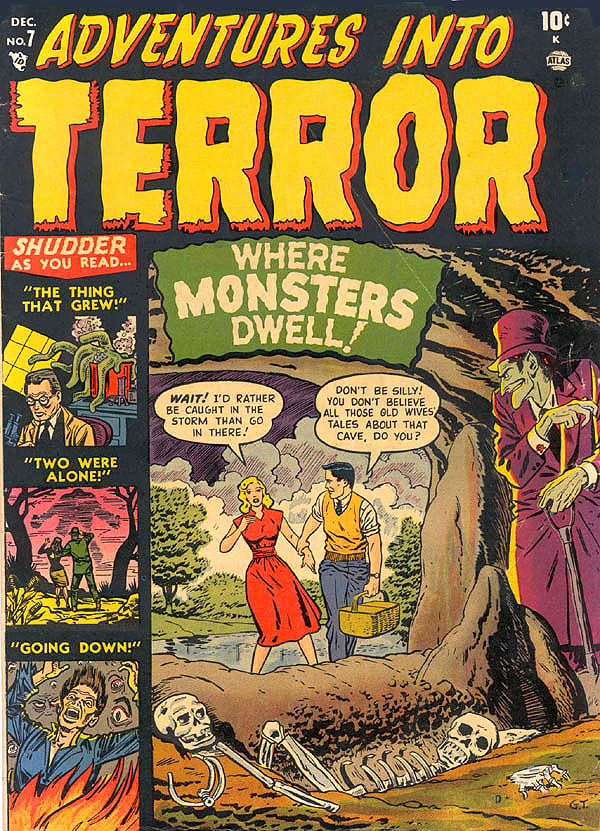
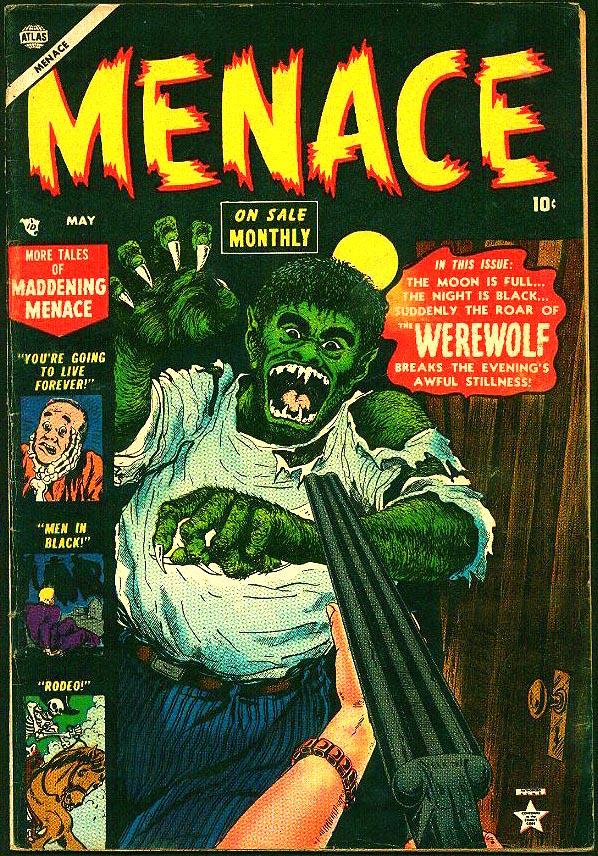
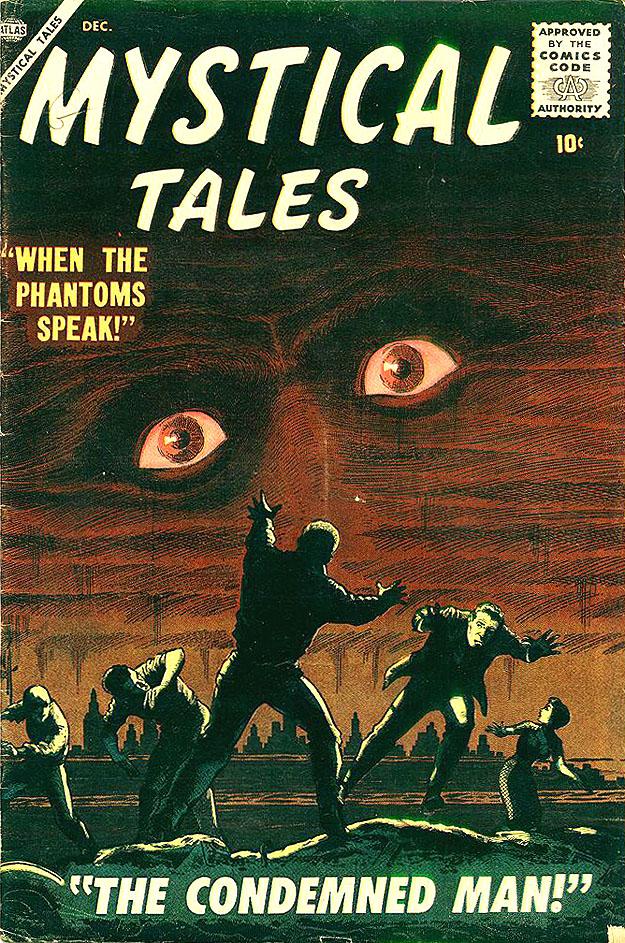
Let’s kick off Halloween week right by analyzing some old horror comic book covers from the 1950s.
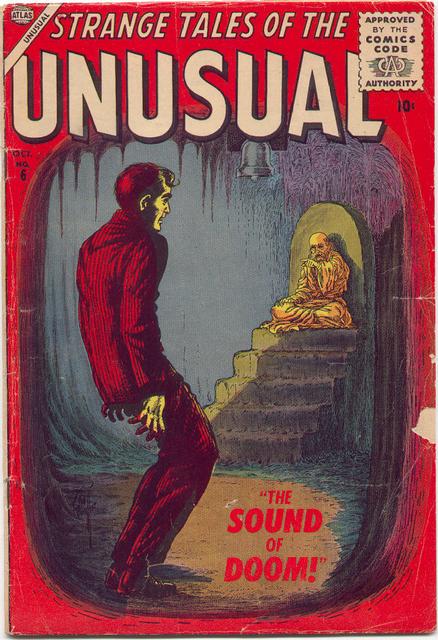
I love this one: the jagged posture, the bloody reds, the weird mystic guy. And what can beat a title as redundant as Strange Tales of the Unusual?
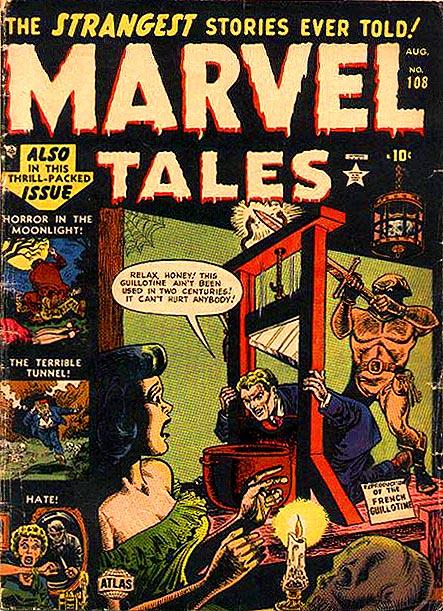
Of course, all of these titles are strange, except when they’re weird or uncanny or unusual. Or mystical. But honestly, what’s so strange about putting your head in an old guillotine? I mean, seriously, relax. Who hasn’t put their neck on the chopping block like this. Literally, that is. (I love the bottom corner panel that just says “HATE!” incidentally).
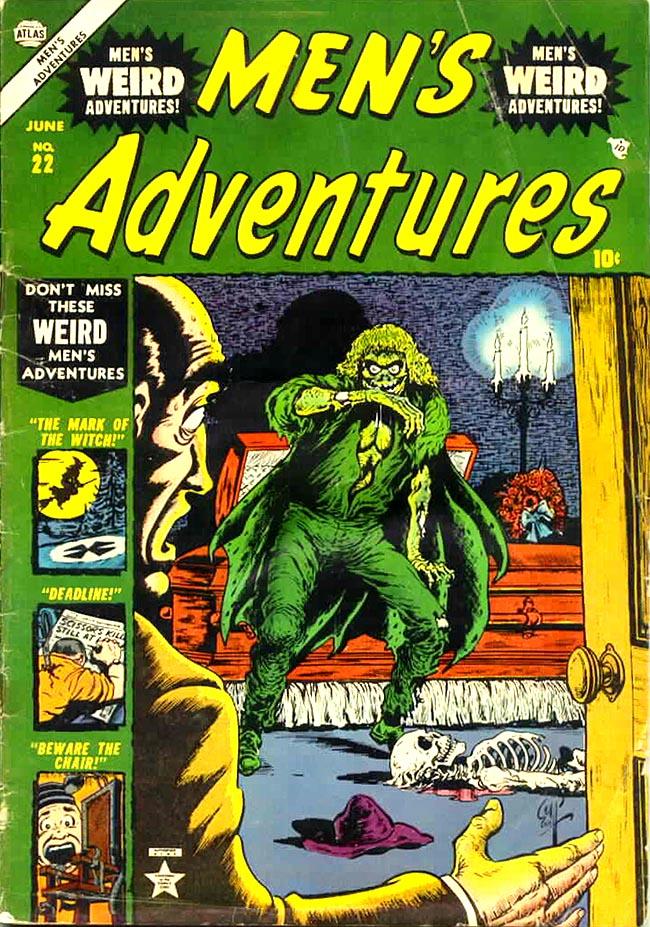
Let me be clear on this: I am a man. Further, I am a manly man. Therefore, I require–no, demand–only men’s adventures. Further, I require my adventures to be weird. And not just slightly weird. I need creepy-green-gay-zombie weird. I need mark-of-the-witch weird. Newspaper-oriented-murder weird. Chair weird!
This comic is a clear forerunner of all those eighties slasher films that warned against teenage sex. Look at all the sexual anxiety here: “THE THING THAT GREW!”? “TWO WERE ALONE!”? “GOING DOWN!”? Jeez! Or, alternately, I am a pervert who sees sex everywhere. But seriously, don’t go into caves, kids.
My grandpa always taught me that the only thing more maddeningly menacing than a werewolf is a green werewolf.
Nothing snarky to say about this one: it’s beautiful. But really, I love them all.
I voted last Thursday. It was easy. I had to go pick up my daughter from daycare, and an early voting location happened to be right on the way. I left half an hour early just in case, and then drove the 1.1 miles to the Murray Hill Library. I returned three audio books (I know you’re dying to know: Don DeLillo’s The Body Artist, Margaret Atwood’s Moral Disorder, and Michael Chabon’s The Amazing Adventures of Kavalier and Clay) and then stood in a line five-people deep where I waited all of 120 seconds before entering the voting area. There, I handed over my driver license and voter registration card, confirmed my address, and waited about 45 seconds for my ballot. The woman in front of me was living at an address different from the one on her ID, but she was able to vote anyway. Easy. I overheard the process involved (she had to fill out some form) while I waited about a minute to go to a booth. Then I went to the booth and voted for Obama (I didn’t even look wistfully at Nader’s name, I swear!). I voted on some other stuff too, but the only other thing I cared about quite a bit was Florida’s proposed Amendment 2, another American Taliban scheme to define marriage. I voted “no,” of course. The whole process, including driving, took less than 20 minutes (I should mention that I had my sample ballot with me, which is a time saver of course).
Some folks I know personally have worried about early voting–will their vote be counted?–and after debacles in 2000 and 2004, who can blame them for these anxieties? However, Florida voters can go to the Florida Division of Elections website to check the early voting and absentee ballot reports. I went there, clicked on my county’s updated report, downloaded a .txt file and found my name, as well as my wife’s, and the respective times we voted. Done. I know–and have a record–that my vote will be counted. Simple. Now, go vote–you never know what surprise might pop up on November 4th.
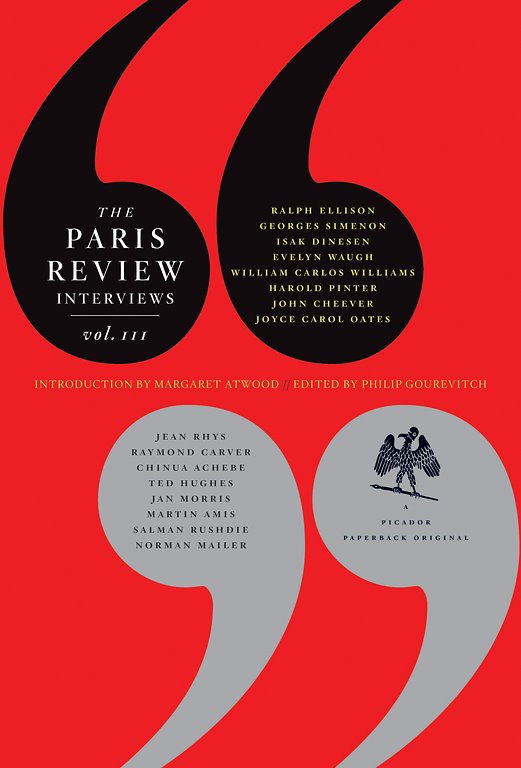
How much you enjoy the third collection The Paris Review Interviews will depend entirely on how much you enjoy reading intelligent and thoughtful writers discussing intelligent and thoughtful subjects. I happen to love reading author interviews–even interviews with authors I don’t particularly like–and hence, I enjoyed this book quite a bit.
Covering sixteen disparate authors and fifty-two tumultuous years, the interviews here are by turns insightful, hilarious, strange, and at times, infuriating. The first interview (the book is organized chronologically), a 1955 conversation with Ralph Ellison evokes all of these emotions. One can almost feel Ellison’s restraint as he patiently replies to asinine questions like, “Then you consider your novel a purely literary work as opposed to one in the tradition of social protest?” and, “But isn’t it going to be difficult for the Negro writer to escape provincialism when his literature is concerned with a minority?” If anything, these politicized charges prompt Ellison to some of the most salient observations about literature’s universalizing powers that I’ve ever read.
In his 1964 interview, poet William Carlos Williams also sheds quite a bit of light on his art and craft. Interestingly, his wife is also a major part of the interview, discussing at some length her own role in her husband’s writing. Beyond literature, craft, and writing, Williams also sets another early theme that unites the interviews collected here–dissing other writers. He calls T.S. Eliot a “conformist” determined to set poets back twenty years. Evelyn Waugh picks up on this theme in his 1963 interview. Of Faulkner: “I find Faulkner intolerably bad.” And Raymond Chandler: “I’m bored by all those slugs of whiskey. I don’t care for all the violence either.” Zing!
Don’t feel too bad for Chandler, though; he comes off funny and earthy and sad in his 1983 interview, especially when he discusses his alcoholism, and how and why he quit drinking. Apparently, teaching–and drinking–with John Cheever when the two were teaching at the Iowa Writer’s Workshop in 1973 had a major impact on Chandler’s decision to stop drinking.
John Cheever focuses mostly on the writing craft in his 1976 interview–not much talk of drinking here. He does, however, share this insight: “Plot implies narrative and a lot of crap. It is a calculated attempt to hold the reader’s interest at the sacrifice of moral conviction.” I’ve never liked Cheever’s writing, but he’s a great interview. In his 1994 interview, Achebe–an author whose fiction (and essays) I do like comes off as far more insightful and far less pretentious. On why creative writing classes exist: “I think it’s very important for writers who need something else to do, especially in these precarious times. Many writers can’t make a living. So to be able to teach how to write is a valuable to them. But I don’t really know about its value to the student.” Lovely. MFAs beware!
The interviews collected here are funny, smart, and very entertaining–whether its Achebe on general misunderstandings of his famous Conrad essay, Salman Rushdie on New Wave Cinema, or Joyce Carol Oates on Finnegans Wake, The Paris Review Interviews, Volume III is full of smart people talking about smart things–and what’s better than that? Highly recommended.
The Paris Review Interviews, Volume III is available October 28th, 2008 from Picador.
In Hitler’s Private Library, Timothy W. Ryback works from Walter Benjamin’s assertion that “a private library serves as a permanent and credible witness to the character of its collector.” Ryback delves into the books–the actual, physical books–that Hitler studied and pondered, paying particular attention to the dictator’s annotations and marginalia. To be sure, there are plenty of political tracts–especially anti-Semitic writings, such as Henry Ford’s The International Jew–to be found in Hitler’s library, but far more fascinating is Ryback’s analysis of Hitler’s love for Robinson Crusoe, Shakespeare, Don Quixote, and Uncle Tom’s Cabin, of all books. Hitler’s taste was varied–there’s an early infatuation with Max Osborn’s Berlin, an architectural guide to that city, an obsession with Ibsen’s Peer Gynt, and Hitler’s final day’s poring over a biography of Frederick the Great (he also comforted himself in the final days of his regime by rereading his boyhood favorite Karl May).
The Nazi party’s lurid mania for occultism is well documented, but Ryback brings a fresh perspective here, eschewing tabloid histrionics in favor of a measured approach to Hitler’s volumes of bizarre and arcane works. More troubling is the public misconception that the works of Schopenhauer and Nietchzsche some how gave philosophical weight to the Nazi’s crime spree; Ryback eliminates that notion:
For all the talk of Hitler’s exploitation of Friedrich Nietzsche’s concepts of the “master race” or Arthur Schopenhauer’s notion of the “will to power” that Hitler used to headline the 1934 party rally and Riefenstahl cribbed as a title for her cinematic chronicle of the event, we have little credible evidence of Hitler’s personal engagement with serious philosophy. Most of what we know is tenuous and at best anecdotal.
In short, Hitler was a poseur who recontextualized bit parts of great thinkers into mind-numbing sloganeering for his own ends (luckily, no politicians today would be so crude). Ryback’s even-handedness here is indicative of the project of his book: his is not a psychological study; he never seeks to explain the motivations for Hitler’s evil actions, but rather report what Hitler read closely. What we get in the end is an historicized, contextualized account of a bibliophile who initiated book burnings and mandated reading lists.
Hitler’s Private Library is really a book about books and how what we read shapes and then testifies to who we are and what we did in our life. I am not particularly interested in Hitler or the (well-documented) history of WWII, but I found in Hitler’s Private Library both a fascinating dialogic analysis as well as a new narrative take on some pretty stale material. The philosophy of Walter Benjamin permeates Ryback’s book, which is also a big plus. I’m not sure if the world needs another book about WWII, but I’m always a sucker for books about books. Recommended.
Hitler’s Private Library is available in hardback and ebook on October 21st, 2008 from Knopf.
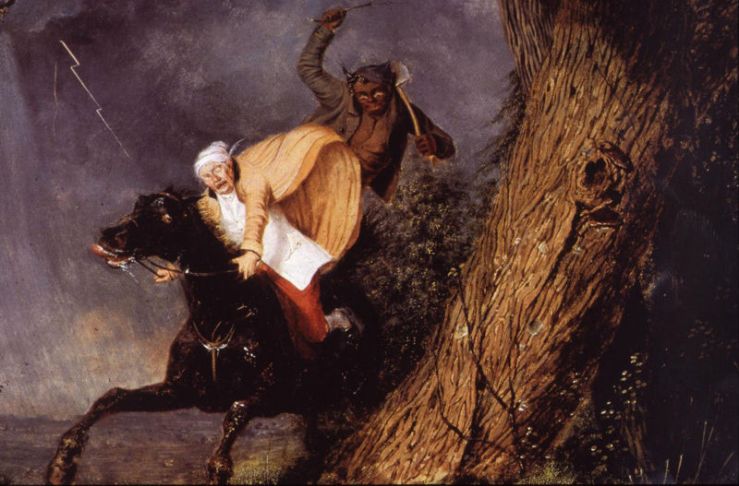
Washington Irving’s famous short story, “The Devil and Tom Walker,” seems as prescient and uncanny as ever in the lurid light of our recent financial woes:
Finding Tom so squeamish on this point, he did not insist upon it, but proposed instead that he should turn usurer; the devil being extremely anxious for the increase of usurers, looking upon them as his peculiar people.To this no objections were made, for it was just to Tom’s taste.“You shall open a broker’s shop in Boston next month,” said the black man.“I’ll do it to-morrow, if you wish,” said Tom Walker.“You shall lend money at two per cent. a month.”“Egad, I’ll charge four!” replied Tom Walker.“You shall extort bonds, foreclose mortgages, drive the merchant to bankruptcy—”“I’ll drive him to the d——l,” cried Tom Walker, eagerly.“You are the usurer for my money!” said the black legs, with delight. “When will you want the rhino?”“This very night.”“Done!” said the devil.“Done!” said Tom Walker. —So they shook hands, and struck a bargain.A few days’ time saw Tom Walker seated behind his desk in a counting house in Boston. His reputation for a ready moneyed man, who would lend money out for a good consideration, soon spread abroad. Every body remembers the days of Governor Belcher, when money was particularly scarce. It was a time of paper credit. The country had been deluged with government bills; the famous Land Bank had been established; there had been a rage for speculating; the people had run mad with schemes for new settlements; for building cities in the wilderness; land jobbers went about with maps of grants, and townships, and Eldorados, lying nobody knew where, but which every body was ready to purchase. In a word, the great speculating fever which breaks out every now and then in the country, had raged to an alarming degree, and every body was dreaming of making sudden fortunes from nothing. As usual the fever had subsided; the dream had gone off, and the imaginary fortunes with it; the patients were left in doleful plight, and the whole country resounded with the consequent cry of “hard times.”
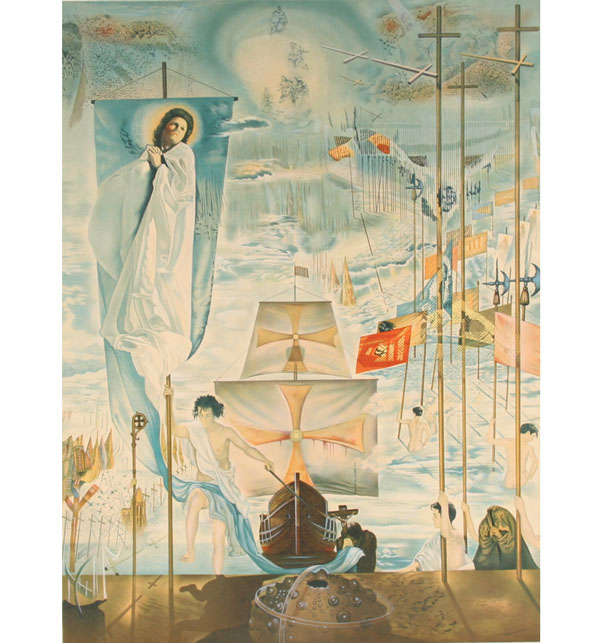
Salvador Dalí, The Discovery of America by Christopher Columbus, 1959, oil on canvas, 410 x 284 cm, St. Petersburg, Florida: Salvador Dalí Museum.
“Prayer of Columbus” by Walt Whitman
A batter’d, wreck’d old man,
Thrown on this savage shore, far, far from home,
Pent by the sea and dark rebellious brows, twelve dreary months,
Sore, stiff with many toils, sicken’d and nigh to death,
I take my way along the island’s edge,
Venting a heavy heart.
I am too full of woe!
Haply I may not live another day;
I cannot rest O God, I cannot eat or drink or sleep,
Till I put forth myself, my prayer, once more to Thee,
Breathe, bathe myself once more in Thee, commune with Thee,
Report myself once more to Thee.
Thou knowest my years entire, my life,
My long and crowded life of active work, not adoration merely;
Thou knowest the prayers and vigils of my youth,
Thou knowest my manhood’s solemn and visionary meditations,
Thou knowest how before I commenced I devoted all to come to Thee,
Thou knowest I have in age ratified all those vows and strictly kept them,
Thou knowest I have not once lost nor faith nor ecstasy in Thee,
In shackles, prison’d, in disgrace, repining not,
Accepting all from Thee, as duly come from Thee.
All my emprises have been fill’d with Thee,
My speculations, plans, begun and carried on in thoughts of Thee,
Sailing the deep or journeying the land for Thee;
Intentions, purports, aspirations mine, leaving results to Thee.
O I am sure they really came from Thee,
The urge, the ardor, the unconquerable will,
The potent, felt, interior command, stronger than words,
A message from the Heavens whispering to me even in sleep,
These sped me on.
By me and these the work so far accomplish’d,
By me earth’s elder cloy’d and stifled lands uncloy’d, unloos’d,
By me the hemispheres rounded and tied, the unknown to the known.
The end I know not, it is all in Thee,
Or small or great I know not–haply what broad fields, what lands,
Haply the brutish measureless human undergrowth I know,
Transplanted there may rise to stature, knowledge worthy Thee,
Haply the swords I know may there indeed be turn’d to reaping-tools,
Haply the lifeless cross I know, Europe’s dead cross, may bud and
blossom there.
One effort more, my altar this bleak sand;
That Thou O God my life hast lighted,
With ray of light, steady, ineffable, vouchsafed of Thee,
Light rare untellable, lighting the very light,
Beyond all signs, descriptions, languages;
For that O God, be it my latest word, here on my knees,
Old, poor, and paralyzed, I thank Thee.
My terminus near,
The clouds already closing in upon me,
The voyage balk’d, the course disputed, lost,
I yield my ships to Thee.
My hands, my limbs grow nerveless,
My brain feels rack’d, bewilder’d,
Let the old timbers part, I will not part,
I will cling fast to Thee, O God, though the waves buffet me,
Thee, Thee at least I know.
Is it the prophet’s thought I speak, or am I raving?
What do I know of life? what of myself?
I know not even my own work past or present,
Dim ever-shifting guesses of it spread before me,
Of newer better worlds, their mighty parturition,
Mocking, perplexing me.
And these things I see suddenly, what mean they?
As if some miracle, some hand divine unseal’d my eyes,
Shadowy vast shapes smile through the air and sky,
And on the distant waves sail countless ships,
And anthems in new tongues I hear saluting me.
“Having your book turned into a movie is like seeing your oxen turned into bouillon cubes” — John LeCarre
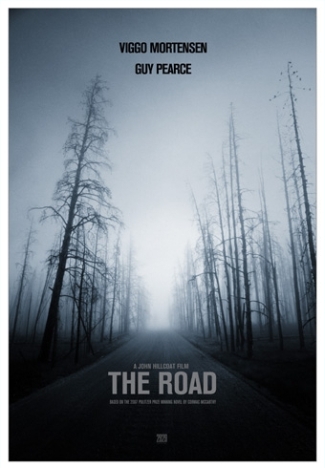
Movies rarely compare favorably to the books from which they are adapted and almost never surpass them. Still, film adaptations of books can be fantastic if handled by the right director–take Mexican director Alfonso Cuarón for example, whose brilliant films Children of Men and Harry Potter and the Prisoner of Azkaban (adaptations of books by P.D James and J.K. Rowling, respectively) convey richly imagined, engrossing worlds. Cuarón’s films join a small stable of adaptations that live up to–if not surpass–the books on which they are based. Most great film adaptations turn good genre fiction into great art. However, great literature doesn’t usually fare so well. Geniuses like Kubrick and Coppola have reconfigured airport reading like Stephen King’s The Shining and Mario Puzo’s The Godfather into cinematic masterpieces, but has anyone ever done justice to Melville or Hemingway or Hawthorne or Fitzgerald (of the four attempts at translating Gatsby to the screen, the 1974 Coppola-produced effort is arguably the best, but consider how short it falls of capturing Fitzgerald’s vision)? Which brings up the question: just how good, bad, or indifferent will the upcoming movie adaptation of Cormac McCarhy’s Pulitzer Prize winnerThe Roadbe? We thought we’d navigate the pros and cons here.
What The Road film adaptation has going for it:
The director: Australian director John Hillcoat’s 2005 feature film debut The Proposition captured the bloody violence and moral ambiguity of a world alienated from civilization. We loved the movie, and not enough people have seen it. The tone Hillcoat achieved in The Proposition seems well matched to McCarthy’s grim vision.
The producer: Nick Wechsler’s list of films includes Sex, Lies, and Videotape, The Player, Requiem for a Dream, 25th Hour, and Drugstore Cowboy–so it seems like he knows how to sit back and let a filmmaker create art without trying to, you know, have a massive Hollywood hit.
The leading man: Viggo Mortensen as the father seems like a great choice. Mortensen brought depth to the role he’s most famous for–Aragorn in The Lord of the Rings trilogy–something of a feat when you consider most of his screen time was devoted to scowling, brooding, or chopping up orcs. He was fantastic in the films he did with David Cronenberg, A History of Violenceand Eastern Promises (his bathhouse fight scene is unbelievable). Mortensen’s a published author who started his own publishing house, Perceval Press, so he probably understands the literary gravity of The Road.
The story: Anyone who’s read The Road knows that it’s a sad and moving and strangely beautiful take on one of the most hackneyed devices of science fiction: the post-apocalyptic wasteland.
Potential problem spots for The Road film adaptation:
The cast: We don’t know much about twelve year old Kodi Smit-McPhee who plays the son, but we do know that that is a major role. Let’s hope Kodi is more Jodie, less Jake Lloyd or (shiver) Dakota Fanning. However, Viggo’s had pretty positive things to say about him. Ringers Robert Duvall and Guy Pearce are also in there, but there aren’t too many other speaking parts in the book besides the father and the son, so it’s hard to predict what they’ll be doing–hopefully Hillcoat hasn’t fiddled with the story too much. Charlize Theron is also in the movie. The wife character showed up in a few dreamy flashbacks, but was more of a shadow than a fleshed out character; again, hopefully Hillcoat hasn’t chosen to expand the role to appease a wider demographic.
The story: Some of the best moments of The Road consist of the father’s inner monologues on memory and loss and very few directors can pull off a voice-over successfully (Terrence Malick is the only one who comes to mind right now). Of course, this problem of language is always the problem of movie adaptation.
All the Pretty Horses: Billy Bob Thornton’s leaden 2000 adaptation of the first of McCarthy’s “border trilogy” is pretty boring. I’ll admit that I’ve never finished the book, despite three attempts [ed. note: I finished the “border trilogy” in spring of ’09. Books are far, far, far superior to the film].
No Country for Old Men: Even though the Coens did a great job with No Country for Old Men, the book was still better than the movie–and No Country is, in some ways, McCarthy’s take on a genre novel, the crime procedural. In this sense, the Coens made a smart move, but they still couldn’t convey the depth and meaning of the book–again, much of it delivered via Sheriff Ed Tom Bell’s inner monologues. Although The Road may appear to have genre fiction elements–namely, the tropes of post-apocalyptic sci-fi–to describe it as such would be a severe limitation, as would be to film it in such a manner.
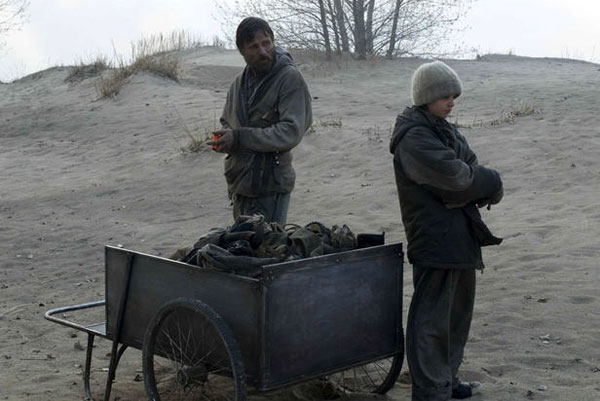
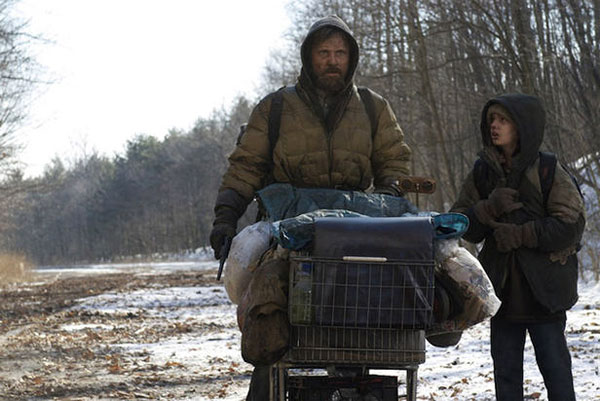
The advance stills: Sure, they’re grim and bleak, but are they grim and bleak enough?
Also, why the stylized cart? If you’ve read the novel, you know what I mean–the cart needs to be a grocery store cart, homeless style! Hang on–
–that’s better! (NB: images link to a gallery of advance images)
Does it seem worth seeing in the theater?
Yes. We’ll be carrying the fire on or around November 26th (and just in time for Thanksgiving!)
Motoko Rich’s article “The Future of Reading,” published in today’s New York Times, discusses the emerging trend in publishing and education of reaching out to young readers via video games. According to the article–
Increasingly, authors, teachers, librarians and publishers are embracing this fast-paced, image-laden world in the hope that the games will draw children to reading. Spurred by arguments that video games also may teach a kind of digital literacy that is becoming as important as proficiency in print, libraries are hosting gaming tournaments, while schools are exploring how to incorporate video games in the classroom. In New York, the John D. and Catherine T. MacArthur Foundation is supporting efforts to create a proposed public school that will use principles of game design like instant feedback and graphic imagery to promote learning.
Loyal readers will recall that last year I wrote quite positively about the MacArthur grant to promote gaming literacy. However, the trend detailed in today’s article seems like a big step in the wrong direction. While graphic design and computer programming are vital skill sets we should be teaching our kids, trying to hook them on reading through video games is altogether different. It smacks of cheap gimmickry that dismisses outright that reading might be a pleasure unto itself. In an age when the majority of college students can’t handle complex but necessary reading tasks and high school illiteracy rates are woefully underreported, trying to hook kids on books with Dance Dance Revolution just doesn’t seem like a great plan. If anything, it’s yet another step in the dumbing-down of America, a land increasingly hostile to anything with a hint of intellectualism–reading included. No wonder the Nobel Committee are such dicks to the U.S. Buried at the end of the article, luckily, is a voice of reason–
“I actually think reading is pretty great and can compete with video games easily,” said Mark S. Seidenberg, a professor at the University of Wisconsin in Madison who specializes in reading research. “So rather than say, ‘Oh, books are irrelevant in the modern era because there are all these other media available,’ I would ask shouldn’t we be doing a better job of teaching kids how to read?”
Professor Seidenberg seems like a wise and reasonable man. Let’s hope that we can get this country back on track and realize that the skill sets needed to survive and compete in a technological world do not replace but rather augment traditional literacy. Video games are great entertainment but it’s hard to imagine that they could ever trump the depth and breadth of philosophy and cultural currency contained in literature. Let’s not cheat our children out of that heritage by mistakenly believing that they cannot be taught to access it.
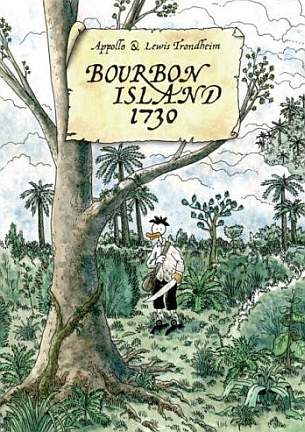
Bourbon Island 1730, part funny animal graphic novel, part historical literature, recounts the story of Raphael Pommeroy who travels from France to Bourbon Island with his ornithology professor in search of a living dodo. On the journey to the French colony, Raphael becomes entranced by pirate tales, and when he arrives to Bourbon Island, he immediately tries to join up with some ex-pirates–unsuccessfully, of course. The French government has offered an amnesty to all pirates, and many have become successful plantation owners. However, their new wealth comes at the expense of the large population of slaves brought to Bourbon Island from Madagascar and Mozambique. The most interesting subplot of Bourbon Island 1730 involves a network of maroons, runaway slaves who have colonized their own villages at the top of the island’s treacherous terrain. When the notorious pirate Captain Buzzard is captured, some of the maroons plan to set him free and lead a revolt against the French colonials. In the meantime, the colonial authorities, including the scheming governor and the greedy priest, are trying to get Buzzard to reveal where he’s hidden a large cache of treasure.
Lewis Trondheim’s art strikes a nice balance between vivid detail and the classic funny animal style, and the book’s measured pacing delivers the story at a nice clip. Appollodorus and Trondheim never rush, taking the time to convey the cultural complexity of Bourbon Island–quite a feat, really, when you consider how much is going on here: the end of a pirate age, the horrors of slavery, and the problematics of colonization. Appollodorus and Trondheim envision Bourbon Island as a strange nexus of slavery and freedom, piracy and central authority, of the meeting of the cultures of Africa, India, and Europe. Leading man Raphael is a hopeless romantic who pines wistfully for the absolute freedom he sees as the life of a pirate and the natural right of all men. And yet, as the book makes clear, idealism can rarely stand up to the corrosive complexity of the real world.
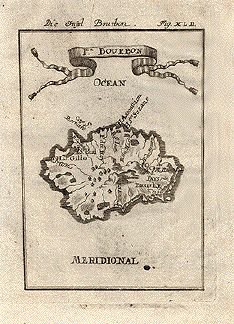
Allain Mallet's 1719 Map of Bourbon Island
With twelve pages of endnotes, Bourbon Island 1730 is just the kind of well-researched historical fiction that would fit neatly into any post-colonial studies course. There’s only one major fault with the book: it ends too quickly. Appollodorus and Trondheim have too many fascinating subplots that they don’t bother to resolve. While we have no problem with ambiguous conclusions, Bourbon feels simply rushed at the end, as it sprints to a virtual non-conclusion. We would’ve been much happier with a cliff-hanger and a promise of a part two. Nonetheless, anyone interested in colonialism and post-colonial studies should check out this book.
Bourbon Island 1730 is available October 28th, 2008 from First Second.
Like many Americans, my main interest in last night’s Vice-Presidential Debate was the hope for a little schadenfreude: I wanted to see Palin dissolve in a “nucular” meltdown. And while the clumsy silences and passive aggressive volleys of her previous interviews weren’t on show last night, Palin still managed to cram her “answers” with stock speaking points and vague generalities–namely, what passes for political rhetoric today. What gets me is this: expectations for the doltish Palin were so low that without a spectacle gaffe, many pundits are today declaring her jabberwocky a success. For example, take David Brooks’s gushing op-ed piece in today’s New York Times:
By the end of her opening answers, it was clear she would meet the test. She spoke with that calm, measured poise that marked her convention speech, not the panicked meanderings of her subsequent interviews.
Okay, so, now, in 2008, as America seeks to prove that we can dare to be dumber than ever, it seems that anything above “panicked meanderings” equals success (Palin’s agitated mannerisms, particularly at the beginning of the debate, didn’t really strike me as “calm” or “measured” either). Fair and balanced FOX News reported that Palin’s “cool and confident performance . . . helped John McCain regain his footing.” I don’t know what specific data they have to back this claim up.
What FOX hailed as a “bravura performance” was yet another incoherent string of non-answers tarted up in sloganeering and divisive, diversionary rhetoric. Palin doesn’t understand the traditional purpose of debate; at one point she even said as much: “I may not answer the questions that either the moderator or you [Biden] want to hear, but I’m going to talk straight to the American people and let them know my track record also.” Near the end of the debate, when asked what her biggest weakness is, Palin simply didn’t answer: she just blasted out a bunch of talking points (I thought that I might’ve misheard the question, but no–check out the transcript here). Governor Palin, the point of the debate is to respond to questions and to respond and rebut your opponent’s responses. Is it too much to ask that you do this? Or is it that you simply have no answers? I believe it’s the latter.
What fascinated me most during the debate was Palin’s syntax. Her long, elliptical answers danced around the topic at hand in a showy, glittery masquerade of stock phrases, slowly disintegrating into the kind of glowing generalities that I guess Joe Six-Pack and his hockey mom wife are supposed to lap up (being an east-coast liberal elitist I simply don’t understand such realities of the Heartland; I’m far too busy eating latte salads in my Subaru while listening to gay operas and worshiping false idols to care about this kind of mundane peasant behavior). At least one critic got it right. Also from today’s New York Times:
After a series of stumbling interviews that raised serious doubts even among conservatives about her fitness to serve as vice president, Ms. Palin had to do little more than say one or two sensible things and avoid an election-defining gaffe. By that standard, but only by that standard, the governor of Alaska did well. But Ms. Palin never really got beyond her talking points in 90 minutes, mostly repeating clichés and tired attack lines and energetically refusing to answer far too many questions.
Are specific answers too much to ask from our leaders? Or are we now okay with our politicians not even answering the questions that we ask?
This was too good not to repost. A few selections from “The Poetry of Sarah Palin,” courtesy of today’s Slate:
“On Good and Evil”
It is obvious to me
Who the good guys are in this one
And who the bad guys are.
The bad guys are the ones
Who say Israel is a stinking corpse,
And should be wiped off
The face of the earth.
That’s not a good guy.
(To K. Couric, CBS News, Sept. 25, 2008)
“Challenge to a Cynic”
You are a cynic.
Because show me where
I have ever said
That there’s absolute proof
That nothing that man
Has ever conducted
Or engaged in,
Has had any effect,
Or no effect,
On climate change.
(To C. Gibson, ABC News, Sept. 11, 2008)
And my personal favorite:
“Secret Conversation”
I asked President Karzai:
“Is that what you are seeking, also?
“That strategy that has worked in Iraq?
“That John McCain had pushed for?
“More troops?
“A counterinsurgency strategy?”
I’m not one of those who feel like whether that is part of the solution or not and we’ve got to remember what the desire is in this nation at this time.





 Biblioklept