“The book educates you about the book” — NPR Profiles Philip Roth

In case you missed it: NPR’s All Things Considered spoke with Philip Roth about his new book Nemesis earlier this week. From the profile–

Nemesis is Roth’s 31st work, and at age 77, he still continues to take risks with his narrative style. In Nemesis, he doesn’t reveal the identity of the narrator until well into the novel.

“It just dawned on me as I was writing along,” Roth explains. “The book educates you about the book.”

Though Roth developed the novel’s narrative structure unexpectedly, he was motivated to do so by a novel that continues to inspire him: Gustave Flaubert’s Madame Bovary. In the novel’s first scene, the reader is introduced to Charles Bovary, Madame Bovary’s husband-to-be, as a schoolboy. The scene is narrated by the collective voice of his mocking classmates — a voice that then disappears.

“Well, I don’t have the guts for that,” Roth says, laughing. “That’s what made Flaubert Flaubert, you know. But indeed, it is from the charm of that opening of Madame Bovary that I took my lead.”


See the Official Trailer for the New William Burroughs Documentary, A Man Within

Watch the 2010 Nobel Prize in Literature Announcement

Mario Vargas Llosa Wins the 2010 Nobel Prize for Literature

The BBC and other sources report that Peruvian writer Mario Vargas Llosa has won the 2010 Nobel Prize for Literature. He is the first South American to win the Nobel in lit since Gabriel García Márquez won in 1982.

According to the Nobel website, the prize was awarded to Mario Vargas Llosa for his cartography of structures of power and his trenchant images of the individual’s resistance, revolt, and defeat.”

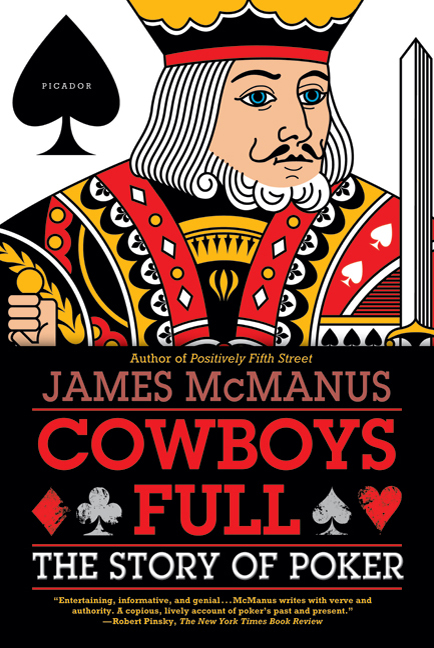
Win a Copy of James McManus’s History of Poker, Cowboys Full

Biblioklept and the kind folks at Picador want to give you a handsome new trade paperback copy of James McManus’s history of poker, Cowboys Full but you’ll have to ante up by taking our literary poker quiz. The first person to post correct answers in the comments section to all three questions will win a copy of McManus’s books.

UPDATE: Commenter Aspher correctly answered the initial questions–only he happens to live in Australia. And the contest is only open to U.S. addresses. Which I knew, but forgot to include in the original version of this post. So. Big sorry out there. I suppose this may confirm one of those American stereotypes–you know, that we see ourselves as the center of the universe. Fortunately, Aspher, via his cordial emails, confirmed a positive Australian stereotype: a good-natured easygoingness about the whole mistake. Mea culpa.

So anyway, there are some NEW questions to answer, under the first set.

1. What Edgar Allan Poe tale of doppelgängers features a duplicitous card sharp?

2. What Faulkner story about two brothers involves a poker game that will decide not one but two marriages? (Hint: although this story can stand alone, it is rightfully part of a collection that is sometimes classified as a cohesive novel).

3.  Which British essayist and critic said “Cards are war, in disguise of a sport”?

1. Which Tennessee Williams play ends, significantly, during a poker game?

2. Which Mark Twain story features a poker game set on a steamer headed from Acapulco to San Francisco?

3. Which Russian writer wrote a novel about gambling to pay off gambling debts? (Name the novelist and the novel).

“Things Like Kidnapping the Sex Slave” — William T. Vollmann Speaks of Women

More from The Paris Review’s vaults. Highlights from William T. Vollmann’s 2000 interview (the entire thing is precious. Just precious) —

VOLLMANN: One of the things that I had to do occasionally while I was collecting information for that prostitute story, “Ladies and Red Lights” from The Rainbow Stories, was sit in a corner and pull down my pants and masturbate. I would pretend to do this while I was asking the prostitutes questions. Because otherwise, they were utterly afraid of me and utterly miserable, thinking I was a cop.

. . .

I kept thinking when I first began writing that my female characters were very weak and unconvincing. What is the best way to really improve that? I thought, Well, the best way is to have relationships with a lot of different women. What’s the best way to do that? It’s to pick up whores.

. . .

Also, I often feel lonely.

. . .

I almost never sleep with American prostitutes any more, unless they really want me to—if they are going to get hurt if I don’t.

. . .

Anyway, so when I was in Thailand, I went to a town in the south and bought a young girl for the night. This awful brothel—one of these places hidden behind a flowershop with all these tunnels and locked doors and stuff—was like a prison. I tried to help a couple of the girls but you just can’t get them out. I tried and I couldn’t. I made the mistake of going to the police, trying to have the police get them out—all that did was nearly get them arrested and put in jail, because the police are paid off. I managed to get the raid called off by taking all the cops out to dinner and buying them Johnnie Walker. I bought this fourteen-year-old girl and got her in a truck and drove like hell to Bangkok. I was with this other girl at the time—Yhone-Yhone, a street prostitute, a very happy one. She was my interpreter. She put the fourteen-year-old girl at ease and got her to trust me. We got her set up at a school run by a relative of the king of Thailand. I went up north, met her father, gave him some money, and got a receipt for his daughter. He didn’t know she’d been sold to a brothel. When I met him and told him he said, Oh. I didn’t know that, but, well, whatever she wants. He’s not a bad guy, just a total loser. He’s a former Chiang Kai-shek soldier. They’re all squatters there in Thailand. They can’t read or write. He lives on dried dogs and dried snakes.

INTERVIEWER: You own his daughter?

VOLLMANN: That’s right. I own her. She doesn’t particularly like me, but she was really happy to be out of that place. She loves the school. It’s sort of a vocational school. It’s called something like the Center for the Promotion of the Status of Women. Many former prostitutes are in there.

. . .

The common motif is just prostitution and love.

. . .

I want to take some responsibility and act as well as write. I don’t mean to be an actor, but rather to accomplish things . . . do things that will help people somehow . . . things like kidnapping the sex slave. It would be great if I could make my contribution to abolishing the automobile or eliminating television or something like that.

Cowboys Full – James McManus

Jim McManus’s Cowboys Full is a thorough and energetic history of poker. Or, perhaps more accurately, Cowboys Full is a history of how power, will, and guile intersect with luck to shape national destinies. McManus examines poker’s political and cultural influence, from its origins in China to the game’s explosive popularity online today. McManus delineates his program in his first chapter, “Pokerticians,” an overview of the book that details how poker has had a lasting impact on world politics. Covering the gambling habits of Presidents and generals, kings and clerics, McManus’s book makes a strong case for poker as a metaphor of power and capitalism.

This is no dry history tome, however. McManus is a professional poker player and a professional writer, and Cowboys Full reads with a vigor that approximates the energy of a good game. While American presidents and politicians dominate his narrative, there are also outlaws, cowboys, and confidence men. And writers. Lots and lots of writers. McManus draws not just from earlier histories of poker, but also from novelists like Herman Melville and Mark Twain. He prefaces each of his chapters with a quote, usually from a novel or short story or poem, and I’ll confess I warmed quickly to the book after the first two chapters led with some heavy lines from Cormac McCarthy’s Blood Meridian (McManus also quotes from No Country for Old Men and uses The Road as a visual reference point). He’s also keen on Bob Dylan.

Of course, this is a history of poker (or “The Story of Poker,” rather, as its subtitle declares), and there’s plenty of poker here–famous games, cheating scams, and today’s big names–but not so much to elicit a yawn from a non-player (or a casual player like myself). The second half of the book moves to Las Vegas, detailing the ins and outs of big tournament action. It also seeks to explain how Texas Hold ‘Em became a spectator sport by the middle of the aughties. But McManus’s book does not fetishize (or unduly valorize) the superstars (and wannabes) of big time poker, and the narrative never falls into the kind of catty tell-all tone that often marks insider stories. McManus is more concerned with philosophy and game theory.

At its core, Cowboys Full is a cultural history of poker, and like the talk at many friendly games, there’s a rambling fluidity to McManus’s narrative, a willingness to run on and overflow in disparate directions. At the same time, there’s a considerable syntactic focus: McManus is handy with punchy sentences and sharp anecdotes, and he keeps most of his chapters short and lively. This is a fun book to read. Cowboys Full is well-researched, with a helpful index and a glossary of terms, but it should not be mistaken for a didactic theory manual or a comprehensive account of everything that ever happened in poker. Instead, McManus has given us a rewarding a volume that uses its subject to enlarge our understanding of both our past and our present–and maybe our future. Recommended.

Cowboys Full is new in trade paperback this week from Picador this week.

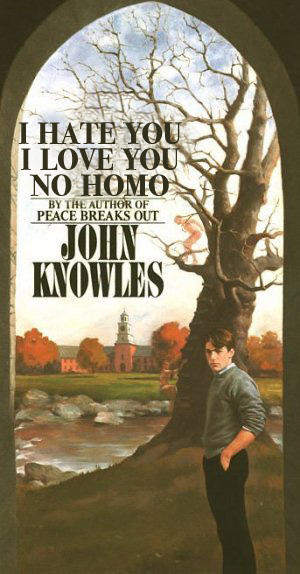
Better Book Titles

Check out the frank and funny images at Better Book Titles (via @MelvilleHouse). A few of our favorites–

James Franco and Michael Cunningham on YA Fiction (and What You Should Never Ask a Writer)

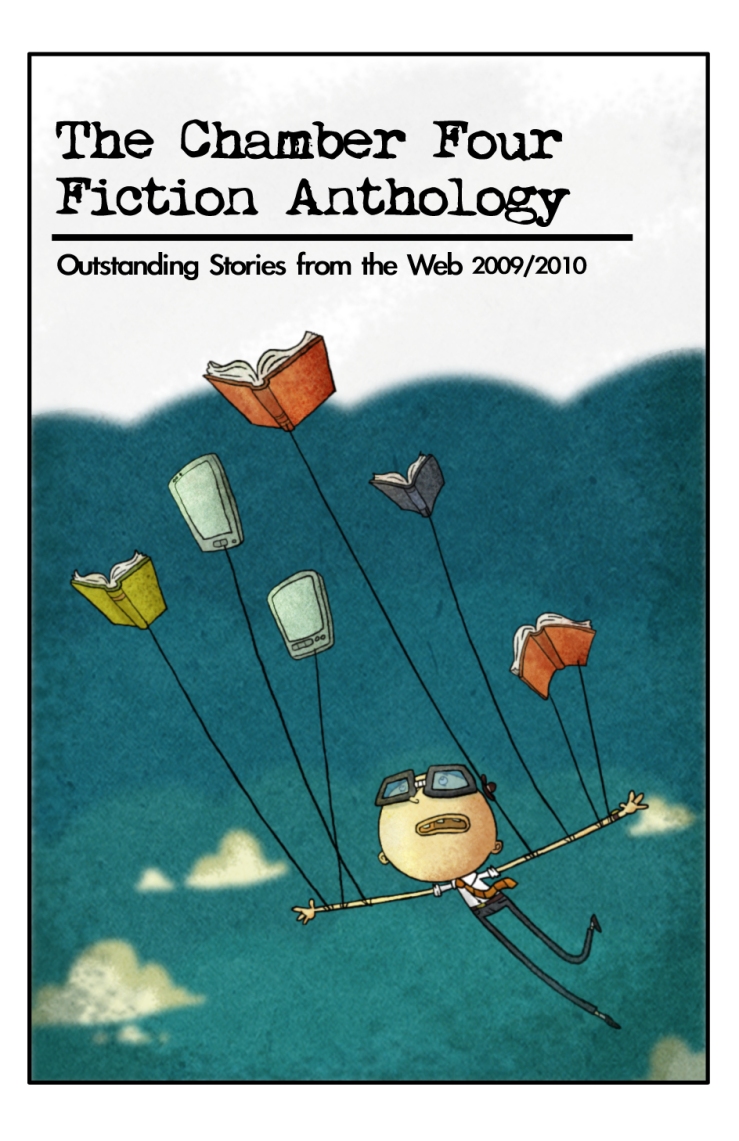
Download The Chamber Four Fiction Anthology

Download The Chamber Four Fiction Anthology. From their website–

This anthology contains 25 of the best short stories published on the web in 2009 and 2010 as chosen by the editors of ChamberFour.com, a website dedicated to making reading more enjoyable and more rewarding.

In this collection, you’ll find traditional, Carver-esque stories alongside magical realist tales of teleportation, long pieces that slowly pull you in, and single-page punches to the solar plexus. Some of these authors you’ve heard of, others you’ll be discovering for the first time, and you can be sure you’ll see them all again.

There is no factor that unifies the pieces collected here beyond their availability online and that hard-to-define but unmistakable hallmark of quality. These stories are as diverse and as wide in scope as the Internet, but each is true to their shared subject: the attempt to reconcile our world to the struggles of the human soul.

This anthology is DRM-free and free to download. Anybody charging for it is ripping you off.

A Plot Diagram of Infinite Jest

Odds and Ends

Hamlet: The Facebook feed edition.

Every book mentioned on Mad Men so far.

Betting odds for the 2010 Nobel Prize for Literature (our boy Cormac McCarthy is at 8 to 1; Bob Dylan is at 150 to 1).

Folks are gettin’ hot and bothered about MFA programs.

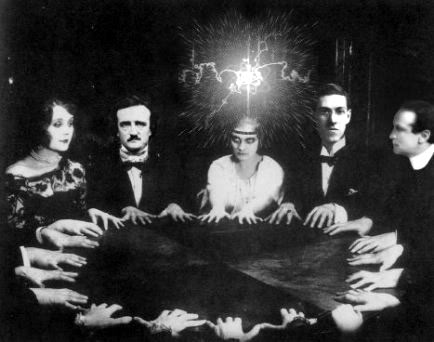
Linking to this post that is tangentially about Jean-Christophe Valtat’s awesome new book Aurorarama gives us an excuse to publish this weird pic of Edgar Allan Poe at a séance–

An inventory of opening sentences.

Raymond Carver Mad Libs.

Vintage Portuguese book covers at A Journey Round My Skull.

John Keats’s Death Mask

“He’s a good editor. Maybe he’s a great editor.” — Raymond Carver on Gordon Lish

We continue to raid The Paris Review’s vault of interviews. Here’s Raymond Carver on Gordon Lish–

INTERVIEWER: Where does Gordon Lish enter into this? I know he’s your editor at Knopf.

CARVER: Just as he was the editor who began publishing my stories at Esquire back in the early 1970s. But we had a friendship that went back before that time, back to 1967 or 1968, in Palo Alto. He was working for a textbook publishing firm right across the street from the firm where I worked. The one that fired me. He didn’t keep any regular office hours. He did most of his work for the company at home. At least once a week he’d ask me over to his place for lunch. He wouldn’t eat anything himself, he’d just cook something for me and then hover around the table watching me eat. It made me nervous, as you might imagine. I’d always wind up leaving something on my plate, and he’d always wind up eating it. Said it had to do with the way he was brought up. This is not an isolated example. He still does things like that. He’ll take me to lunch now and won’t order anything for himself except a drink and then he’ll eat up whatever I leave in my plate! I saw him do it once in the Russian Tea Room. There were four of us for dinner, and after the food came he watched us eat. When he saw we were going to leave food on our plates, he cleaned it right up. Aside from this craziness, which is more funny than anything, he’s remarkably smart and sensitive to the needs of a manuscript. He’s a good editor. Maybe he’s a great editor. All I know for sure is that he’s my editor and my friend, and I’m glad on both counts.

“It was a lone tree burning on the desert” — Blood Meridian’s Moral Core

Cormac McCarthy’s Blood Meridian begins as a strange, violent picaresque bildungsroman, detailing the adventures of a teenage runaway known only as “the kid.” When the Kid falls in with John Glanton’s marauders, the narrative lens expands and pulls back; Glanton’s gang essentially envelopes the Kid’s personality. The pronoun “they” dominates the Kid’s own agency, for the most part, and the massive figure of Judge Holden usurps the narrative’s voice. The effect is that the Glanton gang’s killing, raping, and scalping spree becomes essentially de-personalized, and, to a certain extent, amoralized.

The Kid, and perhaps the ex-priest Tobin and the Kid’s erstwhile partner Toadvine, are the only major characters who bear any semblance of conventional morality in the narrative. The Kid exhibits a willingness to help others early on when he agrees to stitch one of Tobin’s wounds; later, he removes an arrowhead from a wounded man when no other member of the company will (Tobin chides him for caring, declaring that the wounded man would have killed the Kid had the Kid’s efforts been unsuccessful). For most of the central narrative though, the Kid’s individual actions are consumed into the gang’s “they.” However, at the beginning of chapter 15 the narrative focuses again on the Kid, who is charged with killing a wounded man named Shelby to “spare” him from the approaching Mexican army (this is a bizarre version of mercy in Blood Meridian). Shelby pleads to live and the Kid allows it, even giving the man some water from his own canteen. After he leaves he catches up with a man named Tate whose horse is wounded. Tate remarks on the boy’s foolishness for helping him, but the Kid does so nonetheless, sharing Tate’s burden as they try to make their way back to the rest of their party. Tate is soon killed by Mexican scouts. In both cases, the outcome of the Kid’s moral actions–the will to help, to save, to preserve life–are negated by the book’s narrative outcomes, but I would argue that his intentions in the face of violence somehow secure his humanity.

His journey alone to rejoin the Glanton gang is figured as a kind of vision quest, a strange echo of Christ in the desert, perhaps. At its core–and perhaps the moral core of the book–is the following strange passage–

It was a lone tree burning on the desert. A herladic tree that the passing storm had left afire. The solitary pilgrim drawn up before it had traveled far to be here and he knelt in the hot sand and held his numbed hands out while all about in that circle attended companies of lesser auxiliaries routed forth into the inordinate day, small owls that crouched silently and stood from foot to foot and tarantulas and solpugas and vinegarroons and the vicious mygale spiders and beaded lizards with mouths black as a chowdog’s, deadly to man, and the little desert basilisks that jet blood from their eyes and the small sandvipers like seemly gods, silent and the same, in Jedda, in Babylon. A constellation of ignited eyes that edged the ring of light all bound in a precarious truce before the torch whose brightness had set back the stars in their sockets.

The burning tree alludes to YHWH’s appearance to Moses as a burning bush, and also the tree of smoke that led the Israelites through the desert. Significantly, all the strange, terrible creatures of the desert come to meet around it in a “precarious truce.” The burning tree inverts the natural, inescapable violence that dominates the novel and turns it into a solitary, singular moment of peace. When the Kid awakes–alone–the tree is merely a “smoldering skeleton of a blackened scrog.” God is not in the permanence of the object but rather in the witnessing of the event–Blood Meridian locates (a version of a) god in the natural violence of burning and consumption. There is a strong contrast here, I believe, with the book’s other version of god, the Judge’s proclamation that “War is god.” The Judge, a cunning, devilish trickster, wants to reduce (or enlarge) war to all contest of wills, to pure violence–to divorce it from any ideological structure. Yet the burning tree episode reveals natural violence divorced from ideology. The animals (and the man, the Kid) suspend their Darwinian animosities in order to witness the sublime. The episode is silent, outside of language, order, ideology. This silence is echoed in the novel’s final confrontation between the Judge and the Kid, who retorts simply “You ain’t nothin'” to the Judge’s barrage of grandiose language. While the rejoinder may not save the Kid, its rejection perhaps saves his soul (if such a thing exists in the novel, which I believe it does). So, while larger-than-life Judge Holden may dominate the novel, Cormac McCarthy has nonetheless given us another moral road to follow, should we choose to.

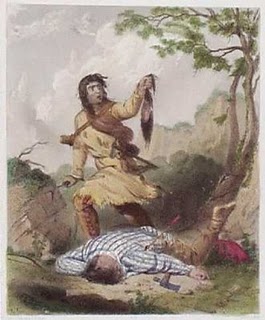
“. . . and seizing them up by their hair and passing their blades about the skulls of the living and the dead alike and snatching aloft the bloody wigs”

Blood Meridian week continues–more jolly times.

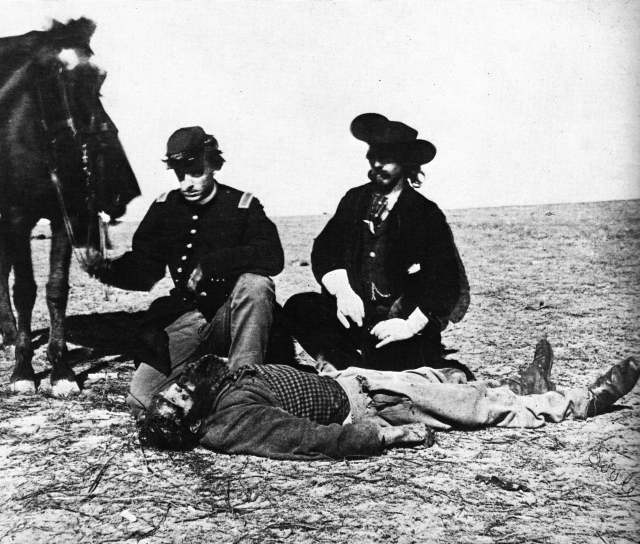
Buffalo hunter Ralph Morrison killed and scalped by Cheyennes in December 1868, near Fort Dodge, Kansas. Photographer: William S. Soule (1836-1908).
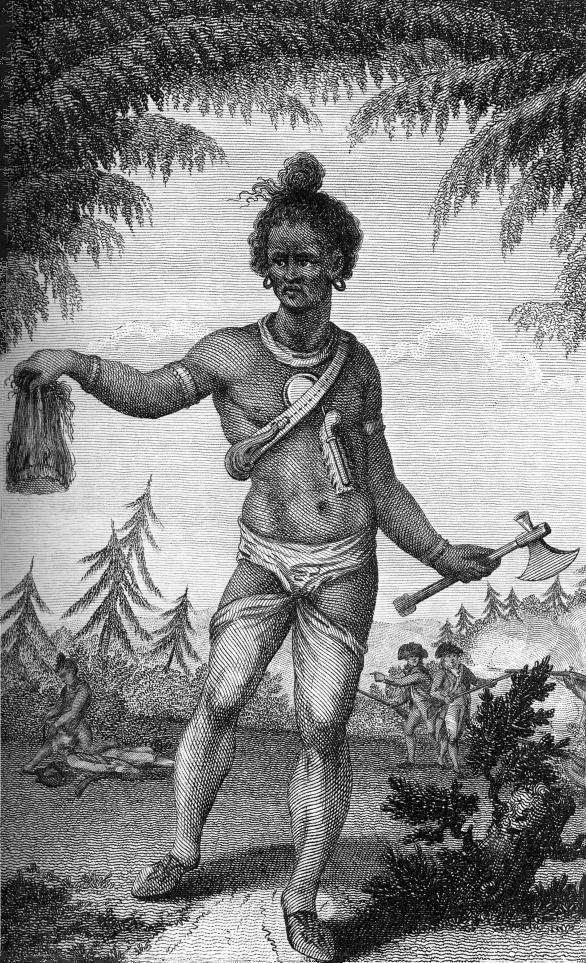
Indian Warrior with Scalp, 1789, by Barlow.
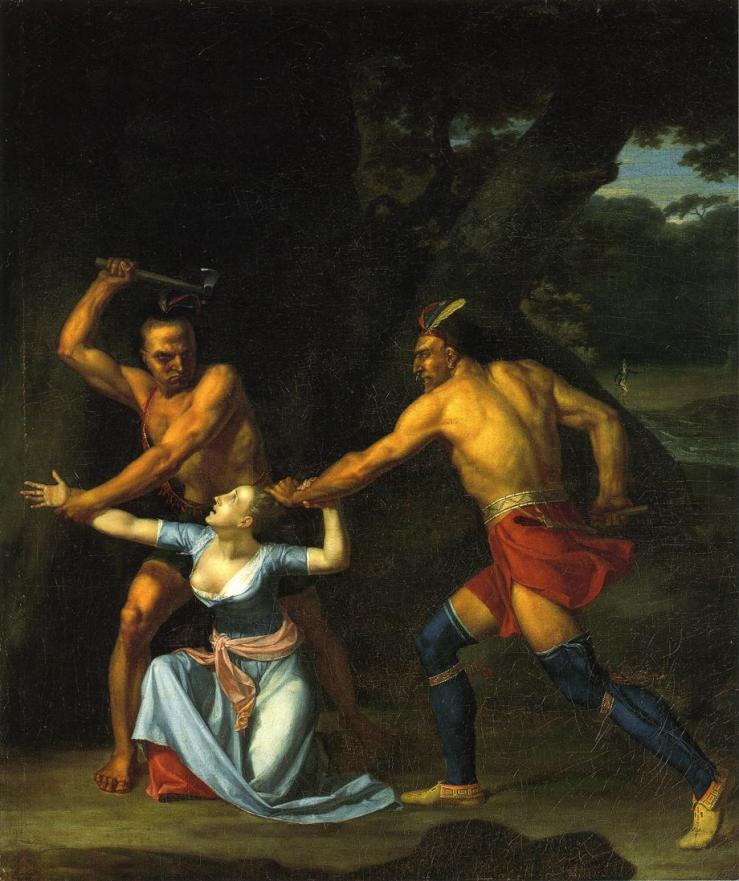
The Death of Jane McCrea, by John Vanderlyn, 1804.
Robert McGee, circa 1861.
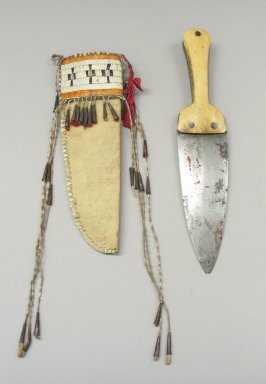
Eastern, Sioux (Native American). Scalping Knife and Sheath, 1801-1833
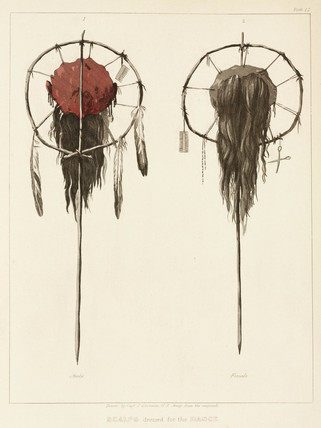
Engraving after Captain Seth Eastman, US Army, of a male and female scalp strung on frames, with combs, feathers and a pair of scissors. Circa 1847.
Hannah Duston
Death Whoop by Seth Eastman. Late nineteenth century.
"A scene on the frontiers as practiced by the 'humane' British and their 'worthy' allies," attributed to William Charles, 1812.