Elvis Vs. Cthulhu (And Other Alternate Universe Movie Posters by Sean Hartter)

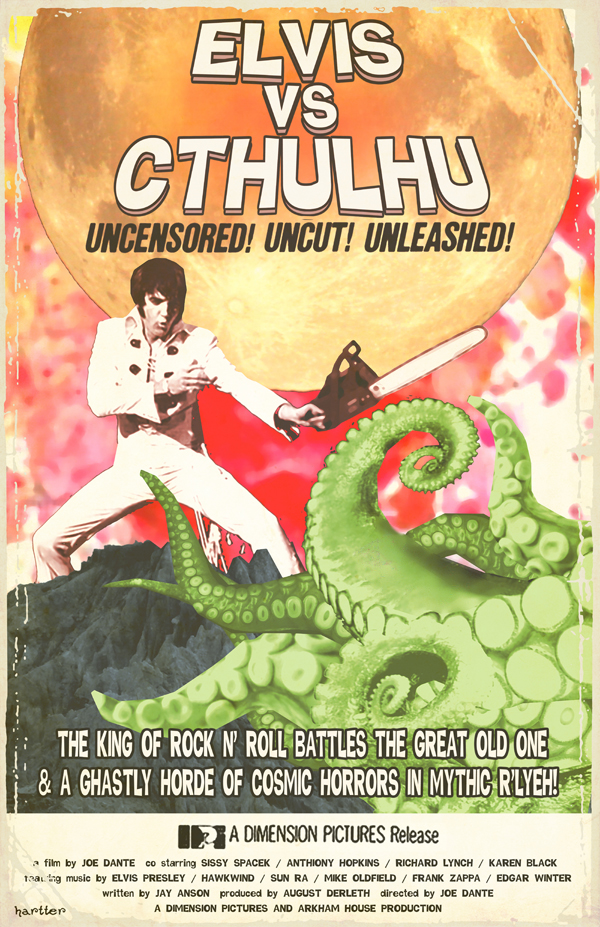
Sean Hartter’s fantabulous collection of movie poster designs from an alternate dimension relay such a precise aesthetic that they almost make me sad that these movies don’t exist. Still, I find some consolation by imagining scenes from, say, a Jodorowsky-helmed Star Wars or  Vincent D’Onofrio in an x-rated version of Avatar. (Thanks to Tilford for the tip).

As studios increasingly rely on franchises—and rebooting those franchises every decade—it makes sense that franchise titles will continue to evolve like comic books have, with new artists (directors, producers, writers, etc.) doing their “take” on the property.

A few of Hartter’s images, but I suggest getting lost in his site:

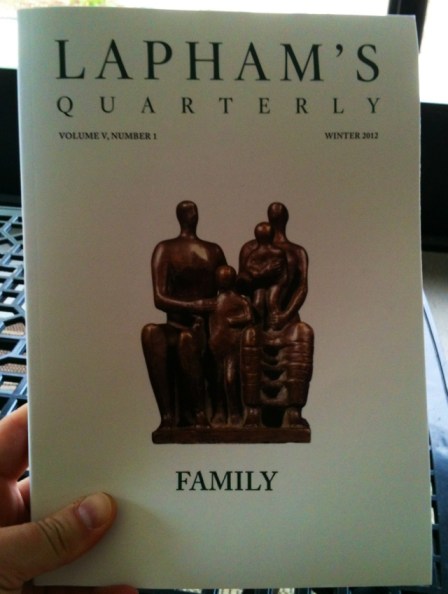
Book Acquired, 1.23.2012 — New Lapham’s Quarterly

20120125-161536.jpg

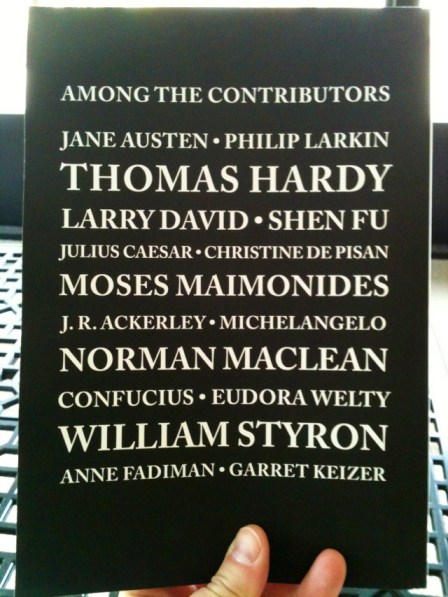
I was a relatively consistent subscriber to Harper’s magazine from 1997 to 2006, with brief flirtations after that year. Anyway, at some point my subscriptions to Harper’s, The Believer, McSweeney’s, etc. became too much. Just didn’t have time to read them all. I’m down to one subscription a year. Last year it was The Paris Review—and I very much enjoyed it. This year: Lapham’s Quarterly. The quarterly is right up my alley—short selections from (seemingly) 100s of authors. The back:

20120125-161543.jpg

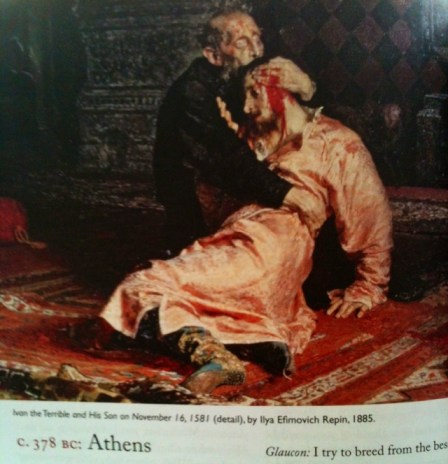
The magazine also features plenty of art selections, as well as tables, graphs, and other editorial content—but on the whole, Lapham’s Quarterly reminds me of my favorite aspect of Harper’s, the “Readings” selections.

20120125-161551.jpg

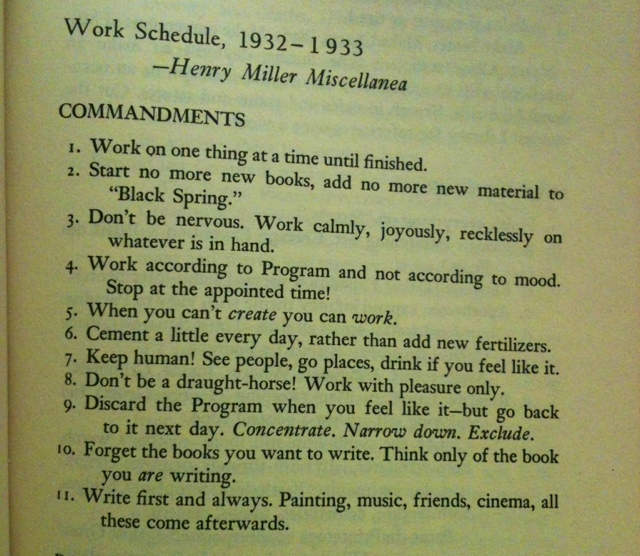
Henry Miller’s Eleven Commandments

20120125-160347.jpg

(From Henry Miller on Writing, New Directions).

Michel Houellebecq on Tocqueville, Nietzsche, and Democracy

(Click the CC button for English subtitles).

Book Acquired, 1.19.2012 — The Future of Ice

20120124-220452.jpg

Big thanks to Biblioklept reader (and frequent commenter) ccllyyddee, who sent me his copy of Gretel Ehrlich’s The Future of Ice. I dipped into it a bit this weekend; Ehrlich seems to be walking that strange line between the physical and metaphysical. A description from her website–

In this gripping circumnavigation of the Arctic Circle, Gretel Ehrlich paints a vivid portrait of the indigenous cultures that inhabit the starkly beautiful boreal landscape surrounding the Arctic Ocean, an ice-bound wilderness that includes northern Siberia, northwestern Greenland, Canada’s vast Nunavut, and northern Alaska. Ehrlich’s expedition, supported by the National Geographic Society, documents what remains of these cultures, specifically the similarities and differences among them, including hunting traditions, shamanic and ceremonial practices, languages and legends—the ways in which they have survived, or have been assimilated, and how they are adapting to the impact of climate change on their ice-age cultures.

Ehrlich is fascinated by what she calls the ecology of culture—the ways in which the human presence of indigenous Arctic people is intricately interwoven with land, rock, river, sea, and ice. Depicting human-caused climate change as only the latest and most destructive of the ills and abuses first peoples have been suffering for 250 years, Ehrlich’s haunting and lovely prose portrays ancient tribes and traditions on the edge of extinction and captures the austere beauty of their various lifeways in the frozen dreamscape of the world they have always known.

F. Scott Fitzgerald’s “Dyed Siberian Horse” (And Twelve Other Descriptions of Things and Atmosphere)

More from F. Scott Fitzgerald’s magical Notebooks

143 Days of this February were white and magical, the nights were starry and crystalline. The town lay under a cold glory.

144 Dyed Siberian horse.

145 As thin as a repeated dream.

146 The sea was coming up in little intimidating rushes.

147 The island floated, a boat becalmed, upon the almost perceptible curve of the world.

148 Lost in the immensity of surfaceless blue sky like air piled on air.

151 On the great swell of the Blue Danube, the summer ball rocked into motion.

152 A circus ring for ponies in country houses.

153 The tense, sunny room seemed romantic to Becky, with its odor of esoteric gases, the faint perfumes of future knowledge, the low electric sizz in the glass cells.

154 A rambling frame structure that had been a residence in the 80’s, the country poorhouse in the 1900’s, and now was a residence again.

155 The groans of moribund plumbing.

156 The silvery “Hey!” of a telephone.

161 Whining, tinkling hoochie-coochie show.

Brian Eno Talks About Music for Airports

Larry David Does George Costanza

“The Charade of the So-Called Free Market” — William Gaddis on What Moved Him to Write JR

From William Gaddis’s 1986 Paris Review interview:

INTERVIEWER

What moved you to write JR?

GADDIS

Even though I should have known from The Recognitions that the world was not waiting breathlessly for my message, that it already knew, and was quite happy to live with all these false values, I’d always been intrigued by the charade of the so-called free market, so-called free enterprise system, the stock market conceived of as what was called a “people’s capitalism” where you “owned a part of the company” and so forth. All of which is true; you own shares in a company, so you literally do own part of the assets. But if you own a hundred shares out of six or sixty or six hundred million, you’re not going to influence things very much. Also, the fact that people buy securities—the very word in this context is comic—not because they are excited by the product—often you don’t know what the company makes—but simply for profit: The stock looks good and you buy it. The moment it looks bad you sell it. What had actually happened in the company is not your concern. In many ways I thought . . . the childishness of all this. Because JR himself, which is why he is eleven years old, is motivated only by good-natured greed. JR was, in other words, to be a commentary on this free enterprise system running out of control. Looking around us now with a two-trillion-dollar federal deficit and billions of private debt and the banks, the farms, basic industry all in serious trouble, it seems to have been rather prophetic.

“Praise of Aphorisms” — Nietzsche

Friedrich Nietzsche. From Mixed Opinions and Maxims:

(168) Praise of aphorisms.— A good aphorism is too hard for the tooth of time and is not consumed by all millennia, although it serves every time for nourishment: this it is the great paradox of literature, the intransitory amid the changing, the food that always remains esteemed, like salt, and never loses its savor, as even that does.

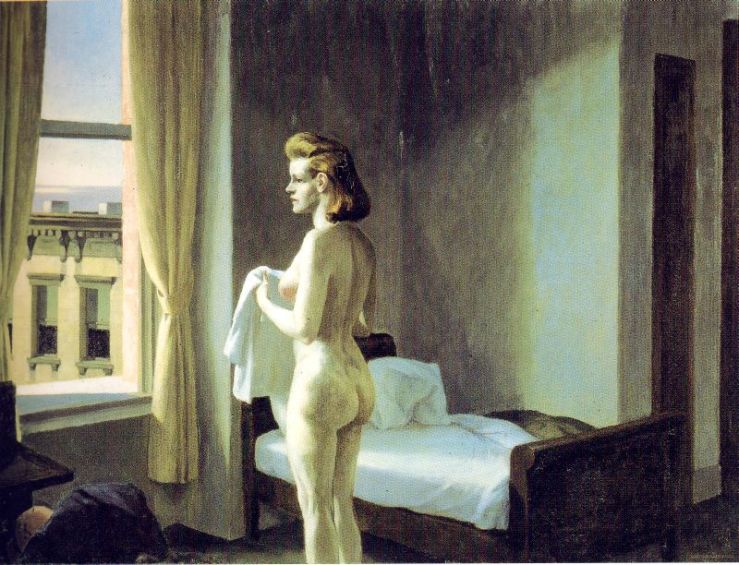
Morning in a City — Edward Hopper

Coffee Ideology — Slavoj Žižek

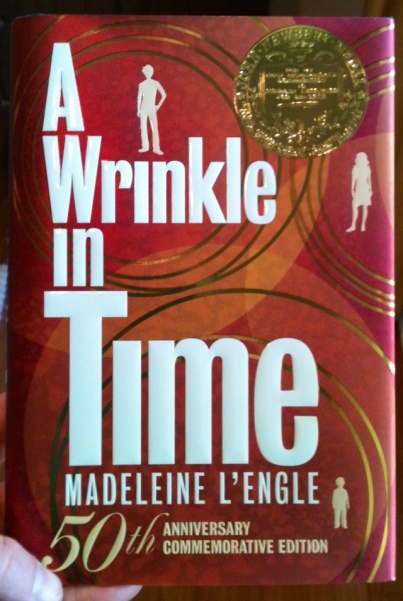
Book Acquired, 1.18.2012 — 50th Anniversary Edition of Madeleine L’Engle’s Classic A Wrinkle in Time

20120122-120441.jpg

The 50th anniversary edition of Madeleine L’Engle’s innovative YA classic A Wrinkle in Time showed up at the house last week (I wrote a bit about Wrinkle as well).

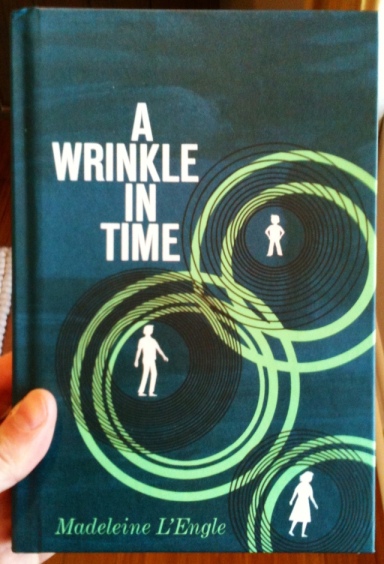
The new edition is chock full of extras, including manuscript pages, photos, and more. My favorite detail though is the actual cover—the one under the dust jackets (I hate dust jackets):

20120122-120459.jpg

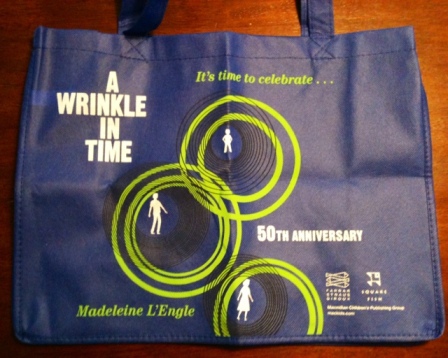
The kind people at Macmillan also sent along a bag—a first—one I’ll proudly use when I do my grocery shopping:

20120122-120509.jpg

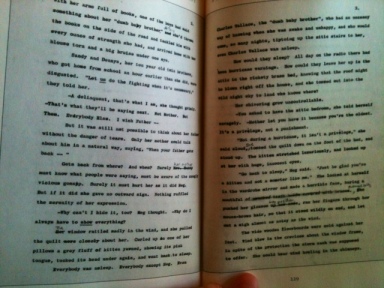
A blurry shot of the manuscript section:

20120122-120517.jpg

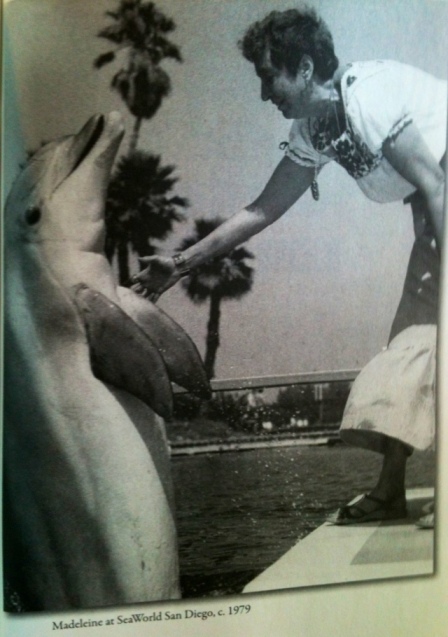
Madeleine and a dolphin:

20120122-120526.jpg

I Riff on William Gaddis’s Enormous Novel J R (From About Half Way Through)

1. I want to write about William Gaddis’s novel J R, which I am about half way through now.

2. I’ve been listening to the audiobook version, read with operatic aplomb by Nick Sullivan. I’ve also been rereading bits here and there in my trade paperback copy.

3. What is J R about? Money. Capitalism. Art. Education. Desperate people. America.

4. The question posed in #3 is a fair question, but probably not the right question, or at least not the right first question about J R. Instead—What is the form of J RHow is J R?

5. A simple answer is that the novel is almost entirely dialog, usually unattributed (although made clear once one learns the reading rules for J R). These episodes of dialogue are couched in brief, pristine, precise, concrete—yet poetic—descriptions of setting. Otherwise, no exposition. Reminiscent of a movie script, almost.

6. A more complex answer: J R, overstuffed with voices, characters (shadows and doubles), and motifs, is an opera, or a riff on an opera, at least.

7. A few of the motifs in J R: paper, shoes, opera, T.V. equipment, entropy, chaos, novels, failure, frustration, mechanization, noise, hunting, war, music, commercials, trains, eruptions of nonconformity, advertising, the rotten shallowness of modern life . . .

8. Okay, so maybe that list of motifs dipped into themes. It’s certainly incomplete (but my reading of J R is incomplete, so . . .)

9. Well hang on so what’s it about? What happens?—This is a hard question to answer even though there are plenty of concrete answers. A little more riffage then—

10. Our eponymous hero, snot-nosed JR (of the sixth grade) amasses a paper fortune by trading cheap stocks. He does this from a payphone (that he engineers to have installed!) in school.

11. JR’s unwilling agent—his emissary into the adult world—is Edward Bast, a struggling young composer who is fired from his teaching position at JR’s school after going (quite literally) off script during a lesson.

12. Echoes of Bast: Thomas Eigen, struggling writer. Jack Gibbs, struggling writer human. Gibbs, a frustrated, exasperated, alcoholic intellectual is perhaps the soul of the book. (Or at least my favorite character).

13. Characters in J R tend to be frustrated or oblivious. The oblivious characters tend to be rich and powerful; the frustrated tend to be artistic and intellectual.

14. Hence, satire: J R is very, very funny.

15. J R was published over 35 years ago, but its take on Wall Street, greed, the mechanization of education, the marginalization of art in society, and the increasing anti-intellectualism in America is more relevant than ever.

16. So, even when J R is funny, it’s also deeply sad.

17. Occasionally, there’s a histrionic pitch to Gaddis’s dialog: his frustrated people, in their frustrated marriages and frustrated jobs, explode. But J R is an opera, I suppose, and we might come to accept histrionics in an opera.

18. Young JR is a fascinating study, an innocent of sorts who attempts to navigate the ridiculous rules of his society. He is immature; he lacks human experience (he’s only 11, after all), and, like most young children, lacks empathy or foresight. He’s the perfect predatory capitalist.

19. All the love (whether familial or romantic or sexual) in J R (thus far, anyway) is frustrated, blocked, barred, delayed, interrupted . . .

20. I’m particularly fascinated by the scenes in JR’s school, particularly the ones involving Principal Whiteback, who, in addition to his educational duties, is also president of a local bank. Whiteback is a consummate yes man; he babbles out in an unending stammer of doubletalk; he’s a fount of delicious ironic humor. Sadly though, he’s also absolutely real, the kind of educational administrator who thinks a school should be run like a corporation.

21. The middlebrow novelist Jonathan Franzen, who has the unlikely and undeserved reputation of being a literary genius, famously called Gaddis “Mr. Difficult” (in an essay of the same name).

22. Franzen’s essay is interesting and instructive though flawed (he couldn’t make it through the second half of J R). From the essay:

“J R” is written for the active reader. You’re well advised to carry a pencil with which to flag plot points and draw flow charts on the inside back cover. The novel is a welter of dozens of interconnecting scams, deals, seductions, extortions, and betrayals. Between scenes, when the dialogue yields briefly to run-on sentences whose effect is like a blurry handheld video or a speeded-up movie, the images that flash by are of denatured, commercialized landscapes — trees being felled, fields paved over, roads widened — that recall to the modern reader how aesthetically shocking postwar automotive America must have been, how dismaying and portentous the first strip malls, the first five-acre parking lots.

23. Franzen, of course, is not heir to Gaddis. If there is one (and there doesn’t need to be, but still), it’s David Foster Wallace. Reading J R I am constantly reminded of Wallace’s work.

24. But also Joyce. J R is thoroughly Joycean, at least in its formal aspects: that friction between the deteriorated language of commerce and the high aims of art; the sense and sound and rhythms of the street. (Is there a character more frustrated in Western literature than Stephen Dedalus? Surely he finds some heirs in Gibbs, Bast, and Eigen . . .)

25. Gaddis denied (or at least deflected) a Joycean influence. Better to say then that they were both writing the 20th century, only from different ends of said century.

26. And then a question for navel-gazing lit major types, a question of little import, perhaps a meaningless question (certainly a dull one for most decent folks): Is J R late modernism or postmodernism? Late-late modernism?

27. Gaddis shows a touch of the nameyphilia that we see (out of control) in Pynchon: Hence, Miss Flesch, Father Haight, the diCephalis family, Nurse Waddams, Stella Angel, Major Hyde, etc.

28. To return to the plot, or the non-plot, of J R: As I’ve said, I’m only half way through the thing, but I can’t see its shape. That sentence might need a “yet” at the end; or, J R might be so much chaos.

29. In any case, I will report again at the end, if not sooner.

William Gaddis on James Joyce

William Gaddis on James Joyce (via/more):

I recall a most ingenious piece in a Wisconsin quarterly some years ago in which The Recognitions’ debt to Ulysses was established in such minute detail I was doubtful of my own firm recollection of never having read Ulysses.

(March 1972 letter to Jean [?] Howes)

I’ve about reached the end of the line on questions about what I did or didn’t read of Joyce’s 30 years ago. All I read of Ulysses was Molly Bloom at the end which was being circulated for salacious rather than literary merits; No I did not read Finnegans Wake though I think a phrase about “psychoanaloosing” one’s self from it is in The Recognitions; Yes I read some of Dubliners but don’t recall how many & remember only a story called “Counterparts”; Yes I read a play called Exiles which at the time I found highly unsuccessful; Yes I believe I read Portrait of an Artist but also think I may not have finished it; No I did not read commentary on Joyce’s work & absorb details without reading the original. I also read, & believe with a good deal more absorbtion [sic], Eliot, Dostoevski, Forster, Rolfe, Waugh, why bother to go on, anyone seeking Joyce finds Joyce even if both Joyce & the victim found the item in Shakespear, read right past whole lines lifted bodily from Eliot &c, all of which will probably go on so long as Joyce remains an academic cottage industry.

(June 1975 letter to Grace Eckley)

Portlandia Does Battlestar Galactica


“Value of Honest Books” — Nietzsche

Friedrich Nietzsche. From Mixed Opinions and Maxims:

(145) Value of honest books.—Honest books make the reader honest, at least by luring into the open his hatred and aversion which his sly prudence otherwise knows how to conceal best. But against a book one lets oneself go, even if one is very reserved toward people.