La Dama de Elche. Persephone’s thigh where Pluto clutches it in the Bernini. The right hand of Michelangelo’s David. The Ecstasy of St. Teresa.
–David Markson, Reader’s Block.
La Dama de Elche. Persephone’s thigh where Pluto clutches it in the Bernini. The right hand of Michelangelo’s David. The Ecstasy of St. Teresa.
–David Markson, Reader’s Block.
I recently listened to Hachette’s new audiobook version of David Foster Wallace’s essay collection A Supposedly Fun Thing I’ll Never Do Again, a collection of essays that I’ve read and enjoyed several times. My outline and notes for a review of the Fun Thing audiobook quickly swelled into an ugly, unmanageable bruise sporting a lengthy intro and dithering asides, when what I really intend to say boils down to “The audiobook is not very good.”
Why is it not very good? I hate to rest all the blame on voice talent Paul Garcia, because I’m sure that there were other people involved—a director, a producer, etc.—who also abetted this thing. If you’ve heard Wallace read—and I had to go back and listen to the few essays from Lobster that he reads to reconfirm this (more on that in a minute)—-if you’ve heard Wallace read his own stuff, you know that he brings this wonderfully restrained not-quite-affectless tone and rhythm to his work. I hesitate to call it naturalistic, but I guess that’s the closest word I can think of for what I’m trying to describe. Another way of putting this might be that when you hear Wallace reading his work, there’s a conversational tone to it, and that even when he’s reading something that is grossly hyperbolic or soaked in venom, he restrains himself from over-emoting these positions. It’s as if a barrier is removed between reader and auditor. In contrast, Paul Garcia mugs and hams his way through the essays in Fun Thing as if he’s doing bad dinner theater. He seems to delight in overzealously stressing every other syllable. The affectations tend to highlight how a certain way of reading—or perhaps hearing Wallace, in reality—can make him seem like a pompous, verbose asshole.
I suppose what I’m getting at is that hearing Garcia read Wallace’s first-person pronoun essays made me hear a different version of Wallace, one that I’d never heard in my own head when I’d read these pieces. Garcia made me hear a version of Wallace that I often disliked—finicky, vituperative, arrogant—one at odds with my own reading.
Reaching for an antidote, I then audited a few of the essays Wallace reads in Consider the Lobster—“Big Red Son,” recounting his trip to the AVN (porn film) awards in Las Vegas, and “Consider the Lobster,” where he visits the Maine Lobster Festival. These two essays balance neatly with the pair that likely stands out the most in Fun Thing: the title essay, Wallace’s infamous documentation of a luxury cruise, and “Getting Away from Already Being Pretty Much Away from It All,” an account of the Illinois State Fair. (I think “David Lynch Keeps His Head,” a rumination on Lynch’s place in cinema set against the backdrop of the filming of Lost Highway also holds up remarkably well—even in Garcia’s reading—but I’ve used some notes on it for another essay I’m working on about Roberto Bolaño and evil, so I’ll hold off any discussion). In any case, these four essays together illustrate the pattern Wallace’s reportage is most often identified with: Wallace goes to some place that he’s not really familiar with and writes about it, usually in obsessive, personal detail, mixing both humor and pathos as he details its absurdities and contradictions.
Several themes unify A Supposedly Fun Thing I’ll Never Do Again (one of the biggest is Wallace’s ever-present agon with irony), but what stood out most in going through the essays again was the sense of despair, the strange sadness that Wallace expresses when he shows us what happens when large groups of people get together for a good time. One of my favorite lines from pop music comes from Pulp’s “Common People,” where crooner Jarvis Cocker gently snarls, “Everybody hates a tourist.” I guess I love the line because I think it’s true, and it’s especially true in its own self-awareness of what it means to be a tourist—that a true tourist must be either oblivious (and thus hated) or self-hating (and thus in despair). So much of David Foster Wallace’s travel writing (if you want to call it that; I mean, it’s not travel writing, it’s more writing-about-mass-groups-of-people-in-contrived-situations) seems to be trying to work out these strange poles, to somehow understand what he is witnessing and overcome the hatred and disgust he feels at the vulgar, venal displays he’s seeing. In a footnote in “Consider the Lobster, Wallace lays it all out better than I can:
I confess that I have never understood why so many people’s idea of a fun vacation is to don flip-flops and sunglasses and crawl through maddening traffic to loud hot crowded tourist venues in order to sample a “local flavor” that is by definition ruined by the presence of tourists. This may (as my Festival companions keep pointing out) all be a matter of personality and hardwired taste: The fact that I just do not like tourist venues means that I’ll never understand their appeal and so am probably not the one to talk about it (the supposed appeal). But, since this note will almost surely not survive magazine-editing anyway, here goes:
As I see it, it probably really is good for the soul to be a tourist, even if it’s only once in a while. Not good for the soul in a refreshing or enlivening way, though, but rather in a grim, steely-eyed, let’s-look-honestly-at-the-facts-and-find-some-way-to-deal-with-them way. My personal experience has not been that traveling around the country is broadening or relaxing, or that radical changes in place and context have a salutary effect, but rather that intranational tourism is radically constricting, and humbling in the hardest way—hostile to my fantasy of being a real individual, of living somehow outside and above it all. (Coming up is the part that my companions find especially unhappy and repellent, a sure way to spoil the fun of vacation travel:) To be a mass tourist, for me, is to become a pure late-date American: alien, ignorant, greedy for something you cannot ever have, disappointed in a way you can never admit. It is to spoil, by way of sheer ontology, the very unspoiledness you are there to experience. It is to impose yourself on places that in all noneconomic ways would be better, realer, without you. It is, in lines and gridlock and transaction after transaction, to confront a dimension of yourself that is as inescapable as it is painful: As a tourist, you become economically significant but existentially loathsome, an insect on a dead thing.
I suppose it’s too easy, maybe even intellectually lazy to gravitate to Wallace’s despair in the cold light of his suicide, but this despair nevertheless is a thick vein that runs through his work. Just a few paragraphs above I offered a bit of bad logic, wherein I suggested that being a tourist is always an either/or position (oblivious, ignorant, smiling or hyper-aware and self- and other-loathing); if I’m more honest I suppose there are third and fourth ways, maybe fifth and sixth, but they become hard to imagine.
Frankly, I’ve always liked Wallace’s essays so much because I relate so strongly to his first-person pronoun’s experience of other people. When Wallace tries to navigate his contempt for the rubes at the Illinois State Fair (“Kmart People,” he calls them!) against the idea that he should try to understand and empathize with other human beings as, like, real human beings with complex inner-lives, hopes, dreams, desires, despairs, I get all that. I’ve been there. Every damn day. But it’s these complex articulations that put Wallace’s travel journalism in such a desperate position. Unlike Hunter S. Thompson, who fully embraced nihilism, Wallace couldn’t simply write off the people around him as creeps, mutants, and lizards; neither could he fully empathize or love them the way that William Vollmann seems to. In the essay “A Supposedly Fun Thing I’ll Never Do Again,” a wistful Wallace admits that he would love to jump from one ship to another in “a bold and William T. Vollmannish bit of journalistic derring-do” — but of course such a feat would never even be on Wallace’s radar (aside from a literary reference): this guy will spend the entire last day of the cruise alone in his room not talking to anyone. Which again, would probably be me.
I quoted a pop song above so I’ll indulge myself and cite another one. I love The Breeders’ fantastic 1993 LP Last Splash, and the song “Saints” is a great jam, but I’ve always felt a little alienated by its opening lyrics, where Kim Deal howls: “I like all the different people / I like sticky everywhere / Look around, you bet I’ll be there!” I guess I couldn’t hang with Kim Deal at the fair, because, if I’m honest, I don’t like all the different people, and I don’t like sticky everywhere. And even when I can enjoy a carnival atmosphere, there is usually some mediating substance like alcohol or irony involved.
This is perhaps a long-winded way of saying that I relate to the central discomfort-cum-despair that runs through Wallace’s essays about having to be in the midst of large groups of people. And while comfort isn’t the sign of great art or great writing (Wallace handles this issue as well in his Lynch essay, but more on that another time), I feel admittedly comfortable in his essays. Which is perhaps why I didn’t care for the Garcia-read audiobook: it made me feel like a tourist.

Diagetic, dialogic, hegemonic. Privilege, as a verb. Foreground, as a verb. Valorize. Praxis, Simulacra. Metafiction. Logocentrism. Phallocentrism. Discourse. Signifier/signified.
Aporia.
Late capitalism. Gynophobia.
Text.
None of the above.
From David Markson’s novel Reader’s Block.

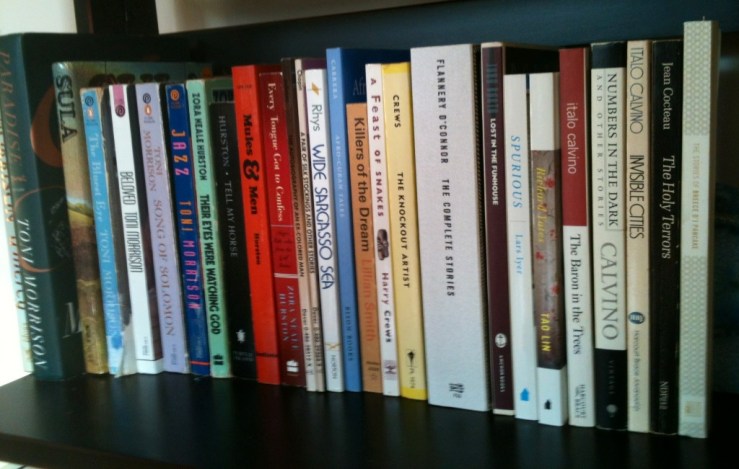
Book shelves series #23, twenty-third Sunday of 2012
Okay. So, a bit later than usual getting this in. It’s the daughter’s birthday and I’m recovering from a Saturday party and I’ve been out in the garden other day and some other excuses.
Toni Morrison, Zora Neale Hurston, James Weldon Johnson, Harry Crews, Flannery O’Connor—and then some books that seem misshelved. Calvino used to hang out with Umberto Eco but that shelf got too crowded. The John Barth should be with the other John Barth books, but they’re all mass market paperbacks in shabby condition.
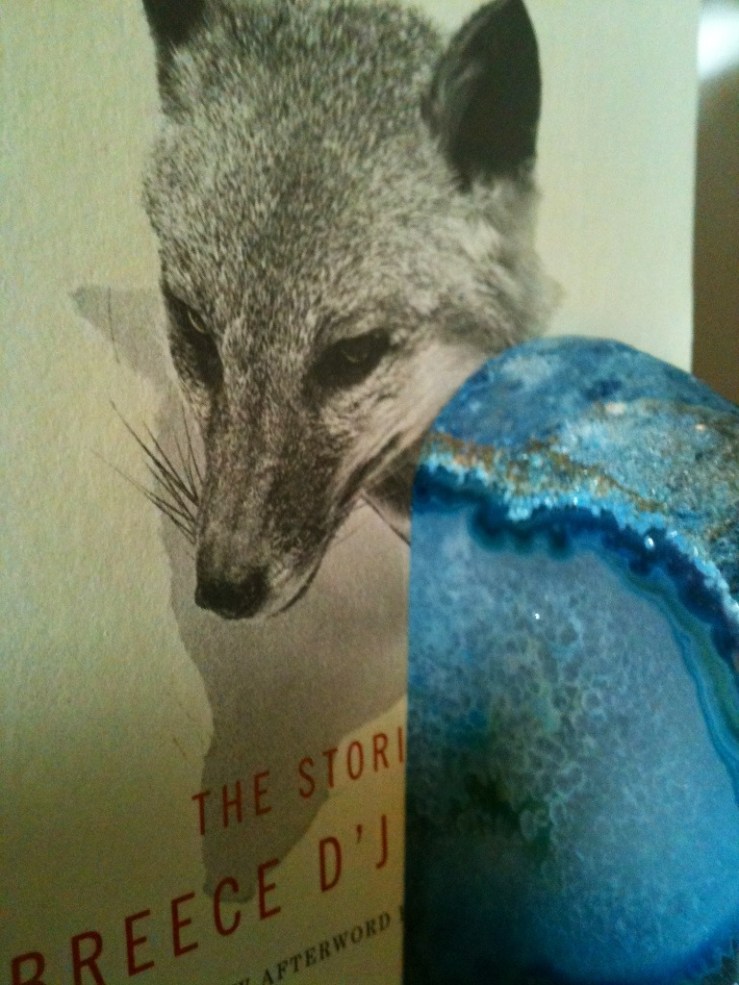
I like the cover of the Breece D’J Pancake collection:
Lydia Cabrera’s Afro-Cuban Tales is this secret awesome book that almost no one has read. It was one of the first books I reviewed on this blog and the review is so woefully short that I’ll just cut and paste it below:
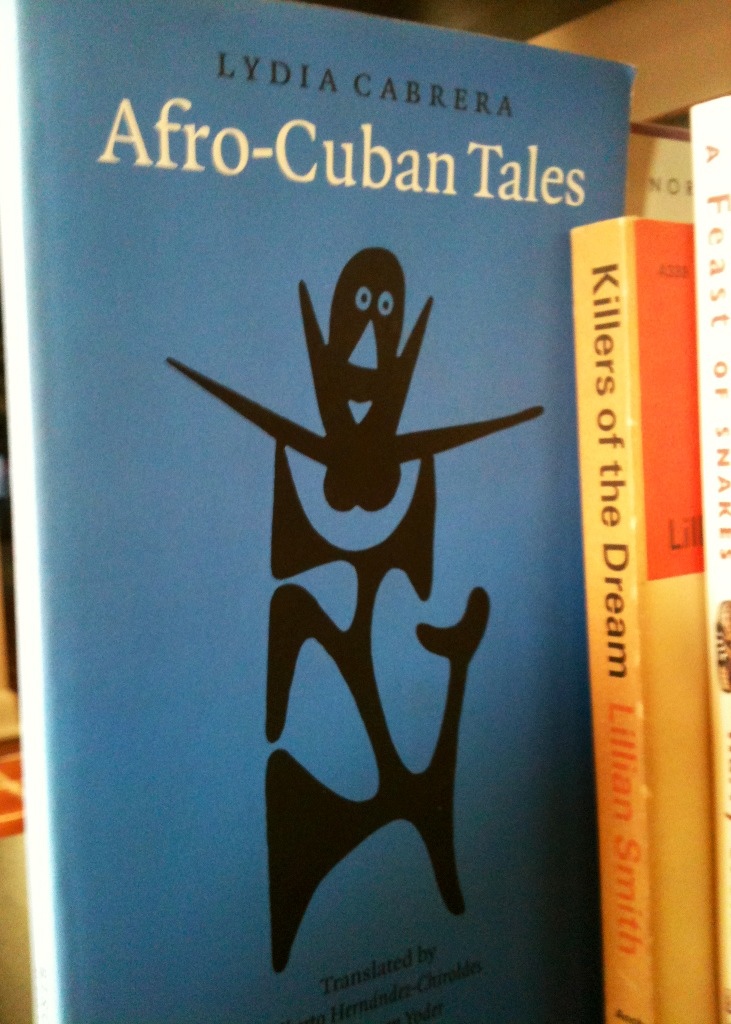
In a sublime synthesis of traditional folklore and imagistic surrealism, Lydia Cabrera’s Afro-Cuban Tales questions the normative spaces occupied by bodies. Deriving from animist tradition, her characters exist in an impossible multiplicity of spaces, being at once animals and plants, humans and gods. Cabrera’s characters endure trials of biological identity and social co-existence, and through these problems they internalize authority, evince taboos, and create a social code. Cabrera’s trickster characters provoke, challenge, or otherwise disrupt the symbolic order of this code. In “Bregantino Bregantín,” a story that recalls Freud’s primal horde theory, as well as the work of more contemporary theorists such as Julia Kristeva and Judith Butler, narcissist Bull kills all the males of his kingdom and takes all the women for himself. The sadistic titular turtle of “Papa Turtle and Papa Tiger” uses the power of his dead friend’s antlers to shame, torment, and torture the other animals of his community. And in the magical realism of “Los Compadres,” Capinche seeks to put the horns on his best friend Evaristo by sleeping with his wife–a transgression that ends in necrophilia. This union of sex and death, creation and destruction is the norm in Cabrera’s green and fecund world; the trickster’s displacements of order invariably result in reanimation, transformation, and regeneration—the drawing, stepping-over, and re-drawing of boundaries.
It is a northern country; they have cold weather, they have cold hearts.Cold; tempest; wild beasts in the forest. It is a hard life. Their houses are built of logs, dark and smoky within. There will be a crude icon of the virgin behind a guttering candle, the leg of a pig hung up to cure, a string of drying mushrooms. A bed, a stool, a table. Harsh, brief, poor lives.To these upland woodsmen, the Devil is as reals as you or I. More so; they have not seen us nor even know that we exist, but the Devil they glimpse often in the graveyards, those bleak and touching townships of the dead where the graves are marked with portraits of the deceased in the naif style and there are no flowers to put in front of them, no flowers grow there, so they put out small votive offerings, little loaves, sometimes a cake that the bears come lumbering from the margins of the forests to snatch away. At midnight, especially on Walpurgisnacht, the Devil holds picnics in the graveyards and invites the witches; then they dig up fresh corpses, and eat them. Anyone will tell you that.Wreaths of garlic on the doors keep out the vampires. A blue-eyed child born feet first on the night of St. John’s Eve will have second sight. When they discover a witch – some old woman whose cheeses ripen when her neighbours’ do not, another old woman whose black cat, oh, sinister! follows her about all the time, they strip the crone, search for her marks, for the supernumerary nipple her familiar sucks. They soon find it. Then they stone her to death.
Winter and cold weather.
Go and visit grandmother, who has been sick. Take her the oatcakes I’ve baked for her on the hearthstone and a little pot of butter.
The good child does as her mother bids – five miles’ trudge through the forest; do not leave the path because of the bears, the wild boar, the starving wolves. Here, take your father’s hunting knife; you know how to use it.
The child had a scabbby coat of sheepskin to keep out the cold, she knew the forest too well to fear it but she must always be on her guard. When she heard that freezing howl of a wolf, she dropped her gifts, seized her knife, and turned on the beast.
It was a huge one, with red eyes and running, grizzled chops; any but a mountaineer’s child would have died of fright at the sight of it. It went for her throat, as wolves do, but she made a great swipe at it with her father’s knife and slashed off its right forepaw.
The wolf let out a gulp, almost a sob, when it saw what had happened to it; wolves are less brave than they seem. It went lolloping off disconsolately between the trees as well as it could on three legs, leaving a trail of blood behind it. The child wiped the blade of her knife clean on her apron, wrapped up the wolf’s paw in the cloth in which her mother had packed the oatcakes and went on towards her grandmother’s house. Soon it came on to snow so thickly that the path and any footsteps, track or spoor that might have been upon it were obscured.
She found her grandmother was so sick she had taken to her bed and fallen into a fretful sleep, moaning and shaking so that the child guessed she had a fever. She felt the forehead, it burned. She shook out the cloth from her basket, to use it to make the old woman a cold compress, and the wolf’s paw fell to the floor.
But it was no longer a wolf’s paw. It was a hand, chopped off at the wrist, a hand toughened with work and freckled with old age. There was a wedding ring on the third finger and a wart in the index finger. By the wart, she knew it for her grandmother’s hand.
She pulled back the sheet but the old woman woke up, at that, and began to struggle, squawking and shrieking like a thing possessed. But the child was strong, and armed with her father’s hunting knife; she managed to hold her grandmother down long enough to see the cause of her fever. There was a bloody stump where her right hand should have been, festering already.
The child crossed herself and cried out so loud the neighbours heard her and come rushing in. They know the wart on the hand at once for a witch’s nipple; they drove the old woman, in her shift as she was, out into the snow with sticks, beating her old carcass as far as the edge of the forest, and pelted her with stones until she fell dead.
Now the child lived in her grandmother’s house; she prospered.

Blind, loving, wrestling touch! sheath’d, hooded, sharp-tooth’d touch!
Did it make you ache so, leaving me?Parting, track’d by arriving—perpetual payment of perpetual loan;
Rich, showering rain, and recompense richer afterward.Sprouts take and accumulate—stand by the curb prolific and vital:
Landscapes, projected, masculine, full-sized and golden
Section 29 of Walt Whitman’s Song of Myself.

Writing a novel is one of those modern rites of passage, I think, that lead us from an innocent world of contentment, drunkenness, and good humor, to a state of chronic edginess and the perpetual scanning of bank statements. By the eighteenth book, one has a sense of having bricked oneself into a niche, a roosting place for other people’s pigeons. I wouldn’t recommend it.


 Biblioklept