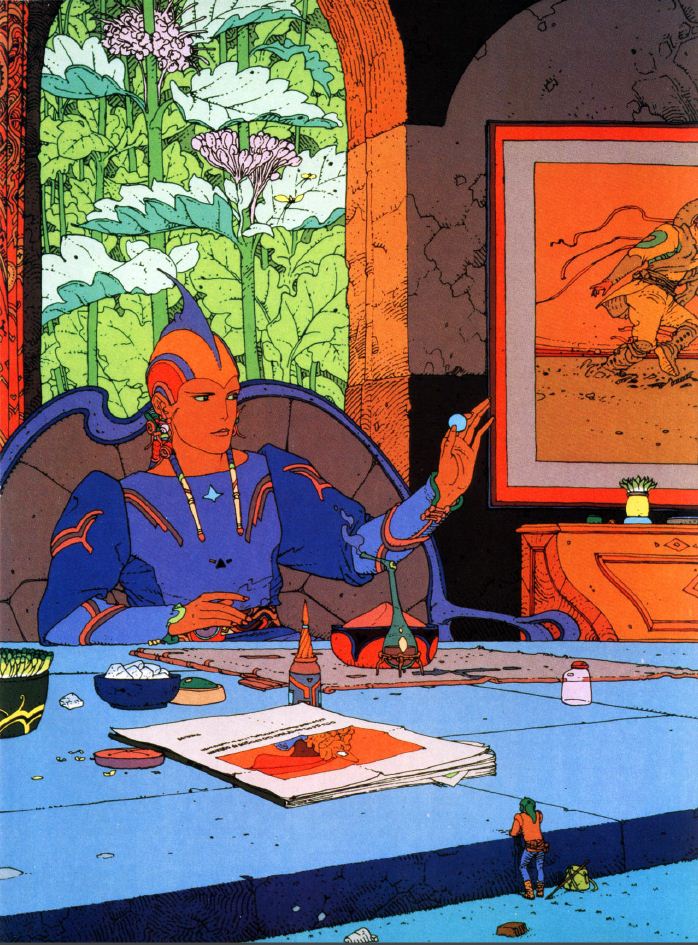
Starwatcher III — Moebius

Watch The Diary of Tortov Roddle, a Surreal Animated Dream Story

I Took My Kids to the Book Store (Books Acquired on Veterans Day (Observed), 2012)

I took my kids to the book store today and let them run like heathen.

20121112-141013.jpg

They had fun. I usually take them separately (and usually they go to the library), but their mother is at work and we needed to get out of the house.

My daughter picked out a few books for her little brother (and then read them to him, sort of).

She also picked out a book of antique paper dolls (Dolly Dingle) and an Anne of Green Gables pop up cottage book to let the dolls live in.

Here’s what I picked out, maybe more for me than them:

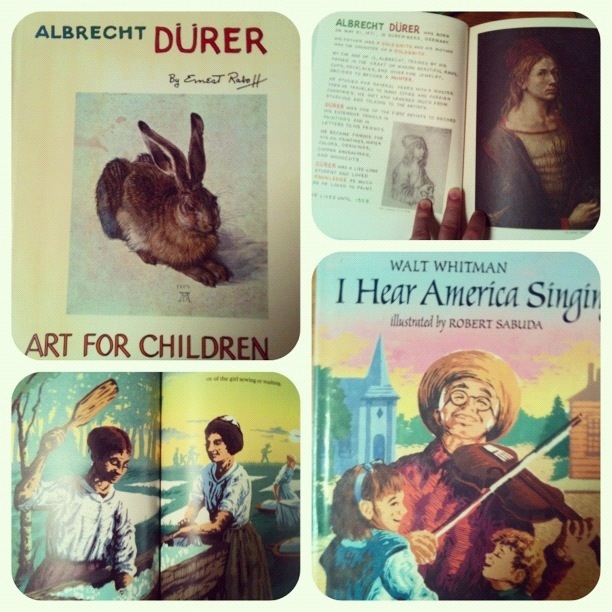
20121112-141020.jpg

A beautiful illustrated Durer biography that’s written more or less like a comic book, and an illustrated edition of Whitman’s “I Hear America Singing.”


“Wang Dang Doodle” — PJ Harvey (Live on 120 Minutes in 1993)

The Judgment of Paris — Charles Bell

David Foster Wallace on INTERPRET-ME Novels

Certain novels not only cry out for what we call “critical interpretations” but actually try to help direct them . . .  Books I tend to associate with this INTERPRET-ME phenomenon include stuff like Candide, Witold Gombrowicz’s Cosmos, Hesse’s The Glass Bead Game, Sartre’s Nausea, Camus’s The Stranger. These five are works of genius of a particular kind: they shout their genius. Mr. Markson, in Wittgenstein’s Mistress, tends rather to whisper, but his w.o.g.’s no less successful . . . Clearly the book was/is in some way “about” Wittgenstein, given the title. This is one of the ways an INTERPRET-ME fiction clues the critical reader in about what the book’s to be seen as on a tertiary level “about”: the title: Ulysses’s title, its structure as Odyssean/Telemachean map (succeeds); Goldstein’s The Mind-Body Problem (really terrible); Cortázar’s Hopscotch (succeeds exactly to the extent that one ignores the invitation to hop around in it); Burroughs’s Queer and Junkie (fail successfully (?)). 

From David Foster Wallace’s essay “The Empty Plenum: David Markson’s Wittgenstein’s Mistress,” which is collected in Both Flesh and Not.

Portrait of a Man Reading — Gerard Terborch

Native Carrying Some Guns, Bibles, Amorites on Safari — Jean-Michel Basquiat

Breaker Morant (Full Film)

Soldiers — Andrea Mantegna

Judge Holden Holds Forth on War (Blood Meridian)

From Chapter XVII of Cormac McCarthy’s novel Blood Meridian

They grew gaunted and lank under the white suns of those days and their hollow burnedout eyes were like those of noctambulants surprised by day. Crouched under their hats they seemed fugitives on some grander scale, like beings for whom the sun hungered. Even the judge grew silent and speculative. He’d spoke of purging oneself of those things that lay claim to a man but that body receiving his remarks counted themselves well done with any claims at all. They rode on and the wind drove the fine gray dust before them and they rode an army of gray-beards, gray men, gray horses. The mountains to the north lay sunwise in corrugated folds and the days were cool and the nights were cold and they sat about the fire each in his round of darkness in that round of dark while the idiot watched from his cage at the edge of the light. The judge cracked with the back of an axe the shinbone on an antelope and the hot marrow dripped smoking on the stones. They watched him. The subject was war.

The good book says that he that lives by the sword shall perish by the sword, said the black.

The judge smiled, his face shining with grease.

What right man would have it any other way? he said.

The good book does indeed count war an evil, said Irving. Yet there’s many a bloody tale of war inside it.

It makes no difference what men think of war, said the judge. War endures. As well ask men what they think of stone. War was always here. Before man was, war waited for him. The ultimate trade awaiting its ultimate practitioner. That is the way it was and will be. That way and not some other way.

He turned to Brown, from whom he’d heard some whispered slur or demurrer. Ah Davy, he said. It’s your own trade we honor here. Why not rather take a small bow. Let each acknowledge each.

My trade?

Certainly.

What is my trade?

War. War is your trade. Is it not?

And it aint yours?

Mine too. Very much so.

What about all them notebooks and bones and stuff?

All other trades are contained in that of war.

Is that why war endures?

No. It endures because young men love it and old men love it in them. Those that fought, those that did not.

That’s your notion.

The judge smiled. Men are born for games. Nothing else. Every child knows that play is nobler than work. He knows too that the worth or merit of a game is not inherent in the game itself but rather in the value of that which is put at hazard. Games of chance require a wager to have meaning at all. Games of sport involve the skill and strength of the opponents and the humiliation of defeat and the pride of victory are in themselves sufficient stake because they inhere in the worth of the principals and define them. But trial of chance or trial of worth all games aspire to the condition of war for here that which is wagered swallows up game, player, all.

Suppose two men at cards with nothing to wager save their lives. Who has not heard such a tale? A turn of the card. The whole universe for such a player has labored clanking to this moment which will tell if he is to die at that man’s hand or that man at his. What more certain validation of a man’s worth could there be? This enhancement of the game to its ultimate state admits no argument concerning the notion of fate. The selection of one man over another is a preference absolute and irrevocable and it is a dull man indeed who could reckon so profound a decision without agency or significance either one. In such games as have for their stake the annihilation of the defeated the decisions are quite clear. This man holding this particular arrangement of cards in his hand is thereby removed from existence. This is the nature of war, whose stake is at once the game and the authority and the justification. Seen so, war is the truest form of divination. It is the testing of one’s will and the will of another within that larger will which because it binds them is therefore forced to select. War is the ultimate game because war is at last a forcing of the unity of existence. War is god. Brown studied the judge.

You’re crazy Holden. Crazy at last.

The judge smiled.
 

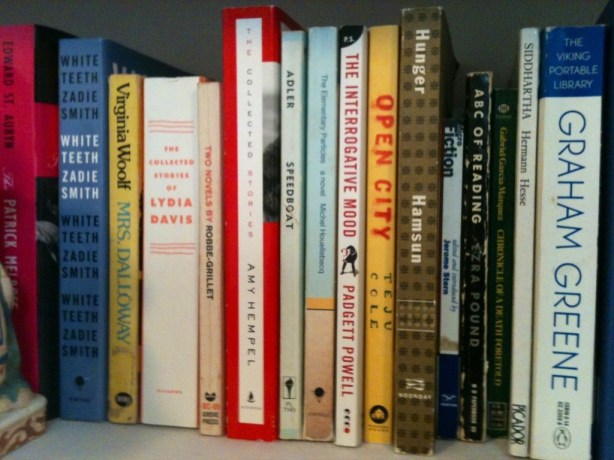
Book Shelves #46, 11.11.2012

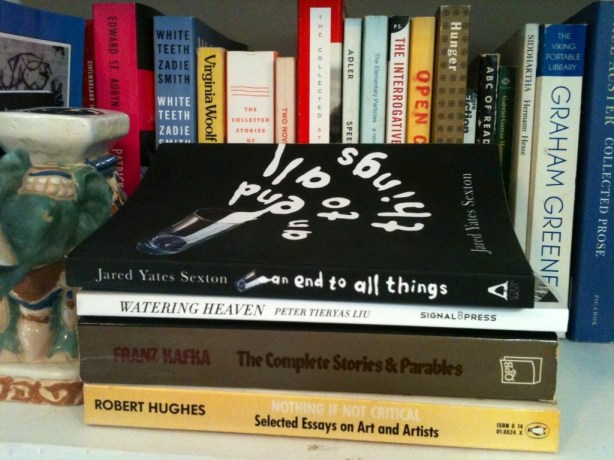
20121111-111049.jpg

Book shelves series #46, forty-sixth Sunday of 2012

Another double-stacked shelf. This one even has a stack of drifters.

This shelf is at my eye/arm level, and looking at it this way, I see that it gets a lot of shuffling—I can see where I started certain projects for the site.

I can see books that are in line, so to speak, for either proper shelving or for reading.

The mounding stack on the shelf below is a bit out of control, although most of what sits there comes from other places (I kinda sorta wrote about those here).

Below: Unsorted stuff that I’ve been reading of an afternoon:

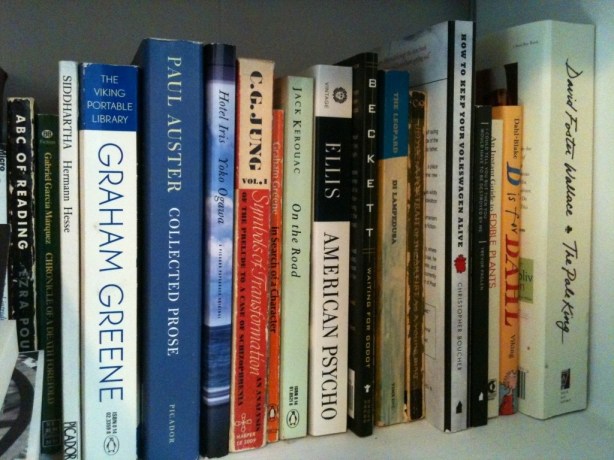
20121111-111057.jpg

This is the front stack—books that need proper shelving elsewhere, books that I’ve read (and sometimes reviewed here) in the past few months, or meant to read, or in some other way consulted or read from:

20121111-111105.jpg

The far right side of the shelf—again, a very mixed bag. I think I originally intended to properly shelf everything here and then got sidetracked:

20121111-111113.jpg

Moving left:

20121111-111124.jpg

And here’s what’s behind the front stack—okay, I can see now the edges of an idea I had for shelving; I also see where I just abandoned that idea:

20121111-111133.jpg

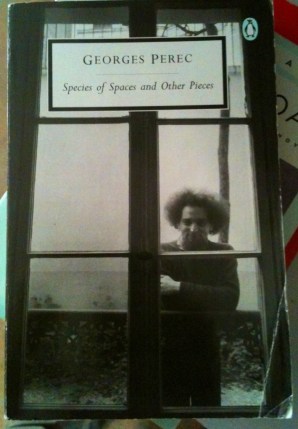
This whole project I blame on an essay by Georges Perec, collected in this one:

20121111-111157.jpg

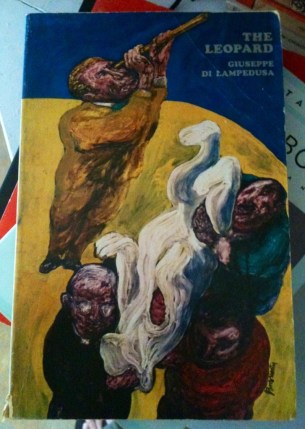
This is one of my favorite book covers:

20121111-111149.jpg

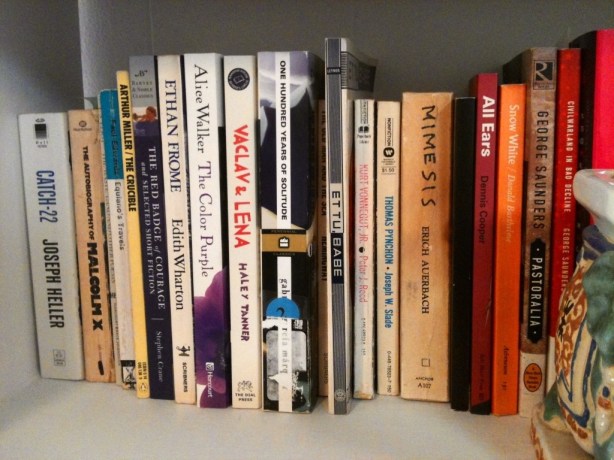
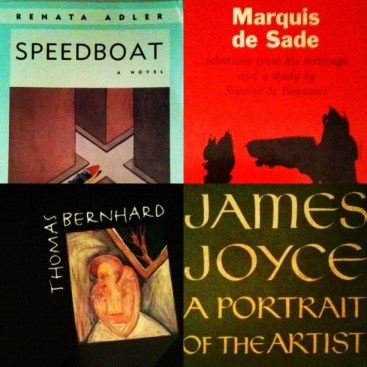
More covers I like from this shelf:

20121111-111204.jpg

Eleven Authors Who Were Also Veterans of War

Eleven Authors Who Were Also Veterans of War

1. Stendahl (Napoleonic Wars)

2. Ambrose Bierce (Union Army, American Civil War)

3. Erich Maria Remarque (German Army, WWI)

4. George Orwell (Republican Army, Spanish Civil War)

5. Kurt Vonnegut (U.S. Army, WWII)

6. Joseph Heller (U.S. Air Force, WWII)

7. Eveyln Waugh (British Royal Marines, WWII)

8. Norman Mailer (U.S Army, WWII)

9. Gore Vidal (U.S. Army, WWII)

10. Tim O’Brien (U.S. Army, Vietnam War)

11. Anthony Swofford (U.S. Marine Corps, Persian Gulf War)


“Parable of Cervantes and Don Quixote” — Jorge Luis Borges

Destiny — John William Waterhouse

Waiting for Elmo — Sesame Street Does Beckett

Still Life with Fruit, Dead Game, Vegetables, a Live Monkey, Squirrel and Cat — Frans Snyders