Poeta y Vago — Roberto Bolaño’s Business Card (And Drafts, Maps, and Diagrams)

rbbc

Lovely passel of images of Roberto Bolaño documents at Las obras de Roberto Bolaño by Maria Serrano, who attended BOLAÑO ARCHIVE. 1977-2003, an exhibition of Bolaño’s personal effects. Along with Bolaño’s card, Maria photographed pages of Bolaño’s journals, showing several drafts of Tinajero’s poem in The Savage Detectives and other diagrams. There’s also what appears to be a map of Santa Teresa Bolaño sketched. Very cool stuff. Thanks to Matt Bucher for sharing.

Plagiarism

The largest art theft in world history occurred in Boston on March 18, 1990 when thieves stole 13 pieces from the Isabella Stewart Gardner Museum.

Collectively worth $300 million.

$400 million.

At least $500 million.

Among the pieces stolen was Vermeer’s The Concert, which is considered to be the most valuable stolen painting in the world.

Also among the pieces stolen: Landscape with an Obelisk, which previously was attributed to Rembrandt.

Having achieved youthful success as a portrait painter, Rembrandt’s later years were marked by personal tragedy and financial hardships.

He died within a year of his son, on October 4, 1669 in Amsterdam, and was buried in an unmarked grave in the Westerkerk. 

More than half the subjects of Rembrandt’s etchings are portraits and studies of the human figure; about one-quarter are scriptural or religious. There are two dozen landscapes, and the remainder are allegorical and fancy compositions.

Rembrandt was his own most frequent model.

At least 40 paintings and 31 etchings. Maybe 60. Maybe 70.

Frida Kahlo produced 143 paintings, 55 of which are self-portraits.

Because I am so often alone.

Because I am the subject I know best.

The most acclaimed self-portrait of Leonardo da Vinci is critically, irreparably damaged.

The portrait has got blotches, stains and spots, a condition called foxing.

foxing

Leonardo’s self-portrait measures 33.5 by 21.6 centimetres (13.2 by 8.5 inches).

Any list of most famous paintings  would be incomplete without the mention of the Mona Lisa by Leonardo da Vinci.

This infamous portrait of Lisa del Giocondo was completed some time between 1503-1519 and currently on display at the Musee du Louvre in Paris.

Leonardo used a pyramid design to place the woman simply and calmly in the space of the painting.

Between 1851 and 1880, artists who visited the Louvre copied Mona Lisa roughly half as many times as certain works by Bartolomé Esteban Murillo, Antonio da Correggio, Paolo Veronese, Titian, Jean-Baptiste Greuze and Pierre-Paul Prud’hon.

And in 1911, Louis Béroud.

The Mona Lisa’s fame was emphasized when it was stolen on 21 August 1911.

On 22 August 1911, Louis Béroud walked into the Louvre and went to the Salon Carré where the Mona Lisa had been on display for five years. However, where the Mona Lisa should have stood, he found four iron pegs.

French poet Guillaume Apollinaire, who had once called for the Louvre to be “burnt down,” came under suspicion; he was arrested and put in jail. Apollinaire tried to implicate his friend Pablo Picasso, who was also brought in for questioning, but both were later exonerated.

(In 1900 Apollinaire would write his first pornographic novel, Mirely, ou le petit trou pas cher, which was eventually lost).

The 1991 film Hudson Hawk (1991) centers on a cat burglar who is forced to steal Da Vinci works of art for a world domination plot.

A colossally sour and ill-conceived misfire.

In 1812 France was devastated when its invasion of Russia turned out to be a colossal failure in which scores of soldiers in Napoleon’s Grand Army were killed or badly wounded.

Napoleon’s conquests in Europe were followed by a systematic attempt, later more tentatively echoed by Hitler, to take the finest works of art of conquered nations back to the Louvre in Paris for a grand central museum of all Europe.

Napoleon boasted:

We will now have all that is beautiful in Italy except for a few objects in Turin and Naples.

The contents of nearly all the tombs of the Pharaohs were already completely looted by grave robbers before the invasion of Egypt by Alexander the Great in 332 BCE.

Rome was sacked seven times.

King Shishak of Egypt attacked Jerusalem and took away the treasures of the Lord’s temple and of the royal palace. He took everything, including the gold shields that Solomon had made.

In the Book of Jeremiah 15:11 the Lord says:

Jerusalem, I will surely send you away for your own good. I will surely bring the enemy upon you in a time of trouble and distress. I will give away your wealth and your treasures as plunder. I will give it away free of charge for the sins you have committed throughout your land.

Sack of Constantinople by the Fourth Crusade, 1204.

The Sack of Baghdad, 1258.

Hernán Cortés and the looting of the Aztec gold.

Adolf Hitler was an unsuccessful artist who was denied admission to the Vienna Academy of Fine Arts.

The Third Reich amassed hundreds of thousands of objects from occupied nations and stored them in several key locations, such as Musée Jeu de Paume in Paris and the Nazi headquarters in Munich.

Later, storing the artworks in salt mines and caves for protection from Allied bombing raids.

These mines and caves offered the appropriate humidity and temperature conditions for artworks.

Raphael’s Portrait of a Young Man was confiscated from a Polish family by the Nazis in 1939 for Hitler’s Führermuseum in Linz.

It disappeared in 1945 shortly before the end of the Second World War.

On 1 August 2012, the Polish Ministry of Foreign Affairs announced that the painting had been found in a bank vault in an undisclosed location.

Thirty years after it was stolen, Camille Pissarro’s Le Marche aux Poissons was returned to the French.

Authorities believe they know who stole art from Boston’s Isabella Stewart Gardner Museum in the largest art heist in U.S. history.

Eventually they will resurface. Somebody will rat somebody else out. It’s really only a matter of time.

A drawing stolen from an ice cream shop is now back in the hands of its creator.
Memories of Breece D’J Pancake

Read “Complicated Manners: Memories of Breece D’J Pancake” by Marion Field (in Oxford American). Excerpt:

The night before he died, Breece went to the movies with his girlfriend, Emily. They saw The Deer Hunter.

The next morning was Palm Sunday, and Emily went to church while Breece stayed home with a cold. He went later, to a 3 p.m. Mass, and stopped by Emily’s place to let her know he’d pick her up Monday morning so she could ride with him to an out-of-town job interview.

After Mass, he went home and drank a few beers.

Around 6 p.m., a neighbor’s girlfriend was startled by the dark shadow of a man she did not expect or recognize when she walked into her boyfriend’s home with a sack of groceries. She screamed and dropped the bag and Breece rose from a chair in the unlit kitchen. According to the complainant’s report to the sheriff’s office, “Mr. Pancake cornered her and explained that he had a drinking problem and had a tendency to wander around.”

In the half-hour between the moments the woman dropped her groceries and the police arrived, Breece’s landlady, Mrs. Meade, knocked on his door and told him that police were on their way to question him.

He called out from his room that he was sorry, and as the sirens neared, he walked outside with the only gun he hadn’t gifted off, a Savage Arms over/under shotgun, serial number B366615, sat down in a plastic folding chair beneath an apple tree, propped the gun on the ground with the muzzle in his mouth, and pulled the trigger.


John Barth on Italo Calvino and Jorge Luis Borges

The paralleli of the achievements of Borges and Calvino are mostly obvious, the relevant anti-parallelino doubt likewise. To begin with, both writers, for all their great sophistication of mind, wrote in a clear, straightforward, unmannered, nonbaroque, but rigorously scrupulous style. ”. . . crystalline, sober, and airy . . . without the least congestion” is how Calvino himself describes Borges’s style (in the second of his Six Memos for the Next Millennium, the Norton lectures that Calvino died before he could deliver), and of course those adjectives describe his own as well, as do the titles of all six of his Norton lectures: “Lightness” (Leggerezza) and deftness of touch; “Quickness” (Rapidita) in the senses both of economy of means and of velocity in narrative profluence; “Exactitude” (Esatezza) both of formal design and of verbal expression; “Visibility” (Visibilita) in the senses both of striking detail and of vivid imagery, even (perhaps especially) in the mode of fantasy; “Multiplicity” (Molteplicita) in the senses both of an ars combinatoria and of addressing the infinite interconnectedness of things, whether in expansive, incompletable works such as Gadda’s Via Merulana and Robert Musil’s Man Without Qualities or in vertiginous short stories like Borges’s “Garden of Forking Paths”—all cited in Calvino’s lecture on multiplicity; and “Consistency” in the sense that in their style, their formal concerns, and their other preoccupations we readily recognize the Borgesian and the Calvinoesque. So appealing a case does Calvino make for these particular half-dozen literary values, it’s important to remember that they aren’t the only ones; indeed, that their contraries have also something to be said for them. Calvino acknowledges as much in the “Quickness” lecture: ”. . . each value or virtue I chose as the subject for my lectures,” he writes, “does not exclude its opposite. Implicit in my tribute to lightness was my respect for weight, and so this apology for quickness does not presume to deny the pleasures of lingering,” etc. We literary lingerers—some might say malingerers—breathe a protracted sigh of relief.

Read the rest of John Barth’s essay The Parallels!”.


The Anger of Gods — René Magritte

“Two Friends” — Guy de Maupassant

“Two Friends” — Guy de Maupassant

Besieged Paris was in the throes of famine. Even the sparrows on the roofs and the rats in the sewers were growing scarce. People were eating anything they could get.

As Monsieur Morissot, watchmaker by profession and idler for the nonce, was strolling along the boulevard one bright January morning, his hands in his trousers pockets and stomach empty, he suddenly came face to face with an acquaintance—Monsieur Sauvage, a fishing chum.

Before the war broke out Morissot had been in the habit, every Sunday morning, of setting forth with a bamboo rod in his hand and a tin box on his back. He took the Argenteuil train, got out at Colombes, and walked thence to the Ile Marante. The moment he arrived at this place of his dreams he began fishing, and fished till nightfall.

Every Sunday he met in this very spot Monsieur Sauvage, a stout, jolly, little man, a draper in the Rue Notre Dame de Lorette, and also an ardent fisherman. They often spent half the day side by side, rod in hand and feet dangling over the water, and a warm friendship had sprung up between the two.

Some days they did not speak; at other times they chatted; but they understood each other perfectly without the aid of words, having similar tastes and feelings.

In the spring, about ten o’clock in the morning, when the early sun caused a light mist to float on the water and gently warmed the backs of the two enthusiastic anglers, Morissot would occasionally remark to his neighbor:

“My, but it’s pleasant here.”

To which the other would reply:

“I can’t imagine anything better!”

And these few words sufficed to make them understand and appreciate each other.

In the autumn, toward the close of day, when the setting sun shed a blood-red glow over the western sky, and the reflection of the crimson clouds tinged the whole river with red, brought a glow to the faces of the two friends, and gilded the trees, whose leaves were already turning at the first chill touch of winter, Monsieur Sauvage would sometimes smile at Morissot, and say:

“What a glorious spectacle!”

And Morissot would answer, without taking his eyes from his float:

“This is much better than the boulevard, isn’t it?”

As soon as they recognized each other they shook hands cordially, affected at the thought of meeting under such changed circumstances.

Monsieur Sauvage, with a sigh, murmured:

“These are sad times!”

Morissot shook his head mournfully.

“And such weather! This is the first fine day of the year.”

The sky was, in fact, of a bright, cloudless blue.

They walked along, side by side, reflective and sad.

“And to think of the fishing!” said Morissot. “What good times we used to have!”

“When shall we be able to fish again?” asked Monsieur Sauvage.

They entered a small cafe and took an absinthe together, then resumed their walk along the pavement.

Morissot stopped suddenly.

“Shall we have another absinthe?” he said.

“If you like,” agreed Monsieur Sauvage.

And they entered another wine shop. Continue reading ““Two Friends” — Guy de Maupassant”

The Child’s Brain — Giorgio de Chirico

(This Is Known As) The Blues Scale — Outtakes from 1991: The Year Punk Broke

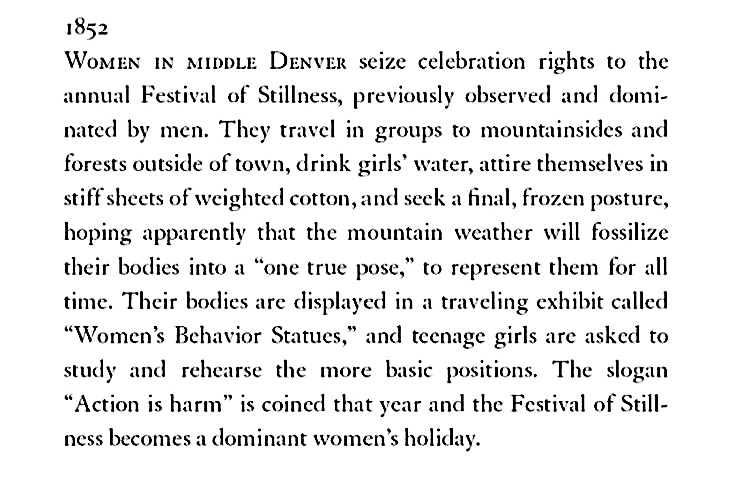
“1852” — Ben Marcus

Capture

Hayao Miyazaki, Holding an Axe

625517_10151784700199569_14228483_n

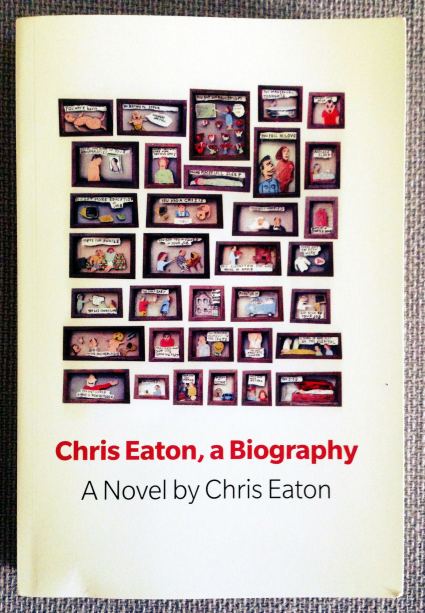
Chris Eaton, a Biography: A Novel by Chris Eaton (Book Acquired, 4.18.2013)

IMG_5190

Chris Eaton’s novel Chris Eaton, A Biography showed up last week.  I haven’t made time to get into it yet—even though it looks pretty cool—mostly because I’m reading too many books right now and it’s the end of the term and all that nonsense. Anyway, this looks like a weird one. Publisher Book Thug’s blurb:

Chris Eaton, A Biography is a novel that arises from the idea that we have all been driven, at some point, to Google ourselves. And if you did, what did you find? That there are people out there who seem to have something in common with you? Dates, places, interests? How coincidental are these connections? And what are the factors that define a human life? We are the sum of our stories: Anecdotal constructs. We remember moments in our pasts the way we remember television episodes. In pieces. And we realize that our own memories are no more valid in the construction of our identities than stories we’ve heard from others. Chris Eaton, A Biography constructs a life by using, as building blocks, the lives of dozens of other people who share nothing more than a name, identities that blur into each other with the idea that, in the end, we all live the same life, deal with the same hopes and fears, experience the same joys and tragedies. Only the specifics are different. From birth to death and everything in between, the narratives we share bring us closer to a truth about what it means to be alive. To be you.


Orestes Pursued by the Furies — John Singer Sargent

“The Princess with the Lily-white Feet” — Ludmila Petrushevskaya

“The Princess with the Lily-white Feet” by Ludmila Petrushevskaya

Once upon a time there lived a Youngest Princess, and everybody loved her. She had tiny little hands like rose petals, and her tiny white feet were like lily petals. On the one hand, this was pretty, but on the other hand, the Youngest Princess was almost too delicate and sensitive – she’d cry at the slightest provocation. She wasn’t exactly reprimanded for it, but the family certainly didn’t condone such behaviour, either. “You can’t let yourself fall apart like that!” her Mama, Papa, Grandma, and King-granddaddy used to say. “You have to keep yourself in hand. You’re a big girl now.”

This would only hurt her feelings even more, and the Youngest Princess would take to crying again.

Nevertheless, there came a time when a Prince came to woo the Princess, which is the way it’s meant to be.

The Prince was tall, handsome, and gentle. “A fine pair!” everybody in the kingdom agreed.

The Prince and the Princess went on lots of walks, they danced together, and the Princess – and for her this was totally unheard of – wove flower garlands on the meadow for the Prince and for herself, garlands of cornflowers every bit as blue as the Prince’s eyes.

The Prince and the Princess were betrothed, which is the way it was meant to be – that is, they were declared fiancé and fiancée. Then the Prince rode back to his own kingdom.

The Youngest Princess stayed home and started crying. Everyone disapproved of such behaviour; they even called the doctor. The doctor talked a bit with the Princess and unexpectedly prescribed not sedatives, which is the way it’s meant to be, but pain pills. Because it turned out that the Youngest Princess had overexerted herself with all that dancing and walking and chafed her tender little hands and feet till they were sore and bleeding.

Time passed, the wedding grew near, but the bride kept crying, sitting in bed and favouring her bandaged hands and feet. She couldn’t walk or hold a cup of tea in her hands: she was fed by her old nurse, who held her cup for her, too.

The doctor, however, optimistically predicted that everything would heal up before the wedding, and said the Youngest Princess was simply too delicate and too sensitive, a crybaby with no self-discipline, and that was the fruit of her improper upbringing in the family, but as soon as the Prince returned she would get up and dance and move her hands just the way she used to. “It’s all psychological,” said the doctor, and kept feeding the Princess pain pills.

Then the old nurse gathered together some photos of the Youngest Princess and set off to see a sorcerer. She brought back an enigmatic answer: “He who loves, carries in his arms.”

This phrase soon became legendary with absolutely everybody who had loved the Princess so much since she was a baby, when she used to smile blissfully, showing her first four tiny teeth and the two little dimples in her cheeks, when her little ringlets were like golden silk, and her little eyes like forget-me-nots. Continue reading ““The Princess with the Lily-white Feet” — Ludmila Petrushevskaya”

Embroidering the Earth’s Mantle — Remedios Varo

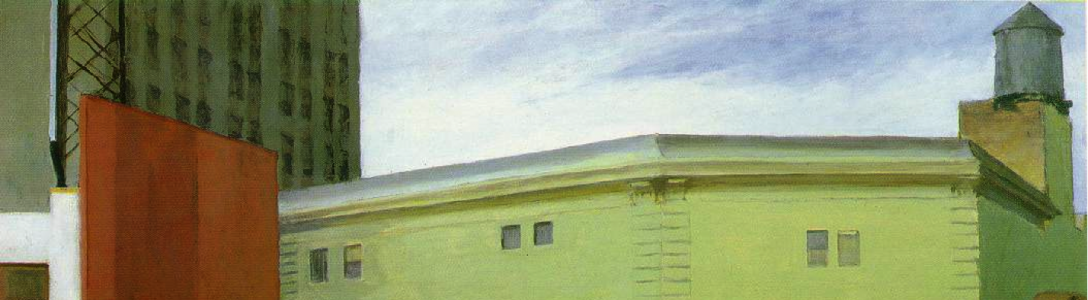
Shakespeare at Dusk — Edward Hopper

“Just mix up a mixture of theolologicophilolological” — Stephen Dedalus on Shakespeare

From Stephen Dedalus’s strange thesis on Shakespeare in episode 9 of James Joyce’s Ulysses–

— And the sense of property, Stephen said. He drew Shylock out of his own long pocket. The son of a maltjobber and moneylender he was himself a cornjobber and moneylender, with ten tods of corn hoarded in the famine riots. His borrowers are no doubt those divers of worship mentioned by Chettle Falstaff who reported his uprightness of dealing. He sued a fellowplayer for the price of a few bags of malt and exacted his pound of flesh in interest for every money lent. How else could Aubrey’s ostler and callboy get rich quick? All events brought grist to his mill. Shylock chimes with the jewbaiting that followed the hanging and quartering of the queen’s leech Lopez, his jew’s heart being plucked forth while the sheeny was yet alive: Hamlet and Macbeth with the coming to the throne of a Scotch philosophaster with a turn for witchroasting. The lost armada is his jeer in Love’s Labour Lost. His pageants, the histories, sail fullbellied on a tide of Mafeking enthusiasm. Warwickshire jesuits are tried and we have a porter’s theory of equivocation. The Sea Venture comes home from Bermudas and the play Renan admired is written with Patsy Caliban, our American cousin. The sugared sonnets follow Sidney’s. As for fay Elizabeth, otherwise carrotty Bess, the gross virgin who inspired The Merry Wives of Windsor, let some meinherr from Almany grope his life long for deephid meanings in the depths of the buckbasket.

I think you’re getting on very nicely. Just mix up a mixture of theolologicophilolological. Mingo, minxi, mictum, mingere.

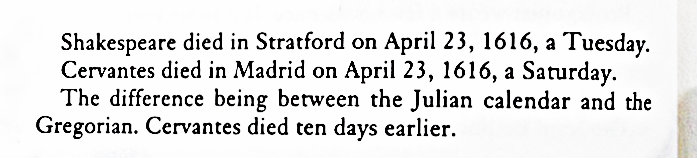
April 23, 1616 (David Markson)

dm