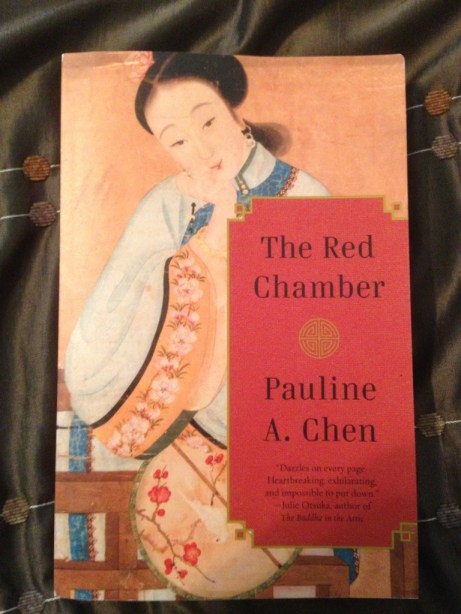
The Red Chamber (Book Acquired, Some Time Like Two Weeks Ago Maybe)

20130414-153312.jpg

A review copy of Pauline A. Chen’s The Red Chamber arrived at Biblioklept World Headquarters like maybe two weeks ago, but my wife snapped it up immediately and then I neglected to look at it until today. Publisher Random House’s blurb:

In eighteenth-century China, the beautiful orphan Daiyu leaves her home in the provinces to seek shelter with her mother’s family in Beijing. At Rongguo Mansion, she is drawn into a world of sumptuous feasts, silken robes, and sparkling jewels—as well as a complex web of secret rivalries and intrigues that threatens to trap her at every turn. When she falls in love with Baoyu, the family’s brilliant, unpredictable heir, she finds the forces of the family and convention arrayed against her, and must risk everything to follow her heart.

Based on the epic Dream of the Red Chamber—one of the most famous love stories in Chinese literature—this novel recasts a timeless tale for Western audiences to discover.


Something on Georges Perec’s La Boutique Obscure

georges-perec-la-boutique-obscure-124-dreams

1. Listening to someone’s dreams is usually pretty boring. Reading about someone’s dreams is even worse.

Except when it’s not, of course.

2. Perec, describing his dream journal La Boutique Obscure:

I thought I was recording the dreams
I was having; I have realized that it was
not long before I began having dreams
only in order to write them.

These dreams—overdreamed, overworked,
overwritten—what could I then
expect of them, if not to make them into
texts, a bundle of texts left as an o)ering
at the gates of that “royal road” I still
must travel with my eyes open?

3. La Boutique Obscure is new in English translation by Daniel Levin Becker, published by the good people at Melville House.

4. The dreams in La Boutique Obscure, rendered in fairly concrete prose (Perec avoids analysis), were recorded between 1968-1972.

5. I’ve been slowly reading the essays and riffs and lists collected in Perec’s Species of Spaces and Other Pieces over the past few years. There’s something wonderful about picking the book up at random and finding some little quip or note (or entire essay) that illuminates some fascinating aspect of what we might initially take to be a dull topic.

La Boutique Obscure works the same way.

6. Sample:

Capture

7. Many of the elements that we see in Dream No. 24 / “Cats” run throughout the collection: Friends, doors, streets, houses, apartments, disasters, performances, lists, etc. etc. Note also Perec’s refusal to analyze or contextualize or otherwise attempt to make meaning out of the dream.

8. My favorite pieces in the collection are the ones that convey more plot—adventures, chases, fragments of films and plays—but there’s also pleasure in Perec’s shortest pieces, which often resemble imagist poems—like “The stone bridge”:

Capture

9. A good review, a responsible review, might try to situate Perec’s dream journal against his role as Oulipo gamesmaster, or set the entries against Perec’s biography, or maybe compare it to other dream journals. Or maybe even try to tackle it as a novel, or a novelish book.

10. But I’m more interested in the aesthetic experience of reading La Boutique Obscure. The book is fun, distracting, and divergent. Perec’s refusal to interpret his dreams leaves plenty of space for the reader to make his own connection—and if need be, interpretations—but to be clear, the same banal anxieties that inform our own dreams are what Perec traces the contours of in La Boutique Obscure. The book’s greatest strength is its imagery, its evocation of place, space, movement. To fault it for lacking depth would be to entirely miss the point.

11. Reading La Boutique Obscure provides another nagging reminder that I have yet to read Life A User’s Manual.

12. Finally: Roman Muradov’s response to the book is better than any review:

tumblr_mkghmeCTMk1qzxelgo1_1280

False — Jean-Michel Basquiat

“On the Weather” — Jerome K. Jerome

“On the Weather” by Jerome K. Jerome

Things do go so contrary-like with me. I wanted to hit upon an especially novel, out-of-the-way subject for one of these articles. “I will write one paper about something altogether new,” I said to myself; “something that nobody else has ever written or talked about before; and then I can have it all my own way.” And I went about for days, trying to think of something of this kind; and I couldn’t. And Mrs. Cutting, our charwoman, came yesterday—I don’t mind mentioning her name, because I know she will not see this book. She would not look at such a frivolous publication. She never reads anything but the Bible and Lloyd’s Weekly News. All other literature she considers unnecessary and sinful.

She said: “Lor’, sir, you do look worried.”

I said: “Mrs. Cutting, I am trying to think of a subject the discussion of which will come upon the world in the nature of a startler—some subject upon which no previous human being has ever said a word—some subject that will attract by its novelty, invigorate by its surprising freshness.”

She laughed and said I was a funny gentleman.

That’s my luck again. When I make serious observations people chuckle; when I attempt a joke nobody sees it. I had a beautiful one last week. I thought it so good, and I worked it up and brought it in artfully at a dinner-party. I forget how exactly, but we had been talking about the attitude of Shakespeare toward the Reformation, and I said something and immediately added, “Ah, that reminds me; such a funny thing happened the other day in Whitechapel.” “Oh,” said they, “what was that?” “Oh, ’twas awfully funny,” I replied, beginning to giggle myself; “it will make you roar;” and I told it them.

There was dead silence when I finished—it was one of those long jokes, too—and then, at last, somebody said: “And that was the joke?”

I assured them that it was, and they were very polite and took my word for it. All but one old gentleman at the other end of the table, who wanted to know which was the joke—what he said to her or what she said to him; and we argued it out. Continue reading ““On the Weather” — Jerome K. Jerome”

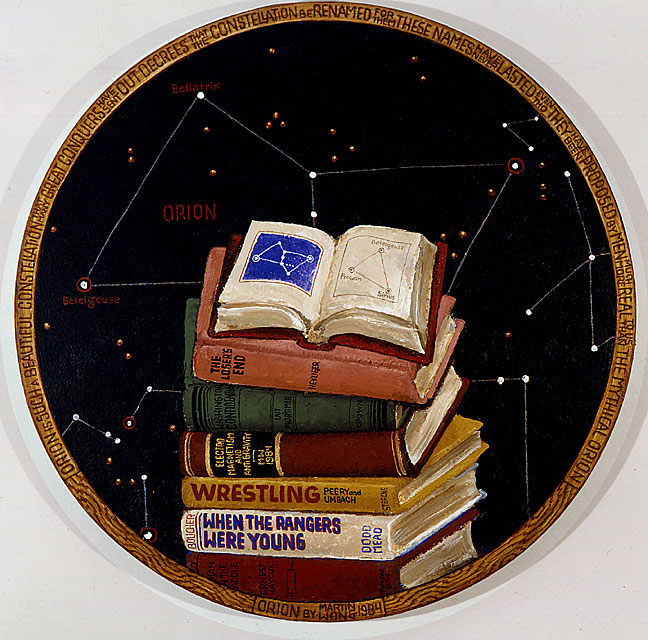
Orion — Martin Wong

02285

Theft of Substance — Remedios Varo

theft-of-substance

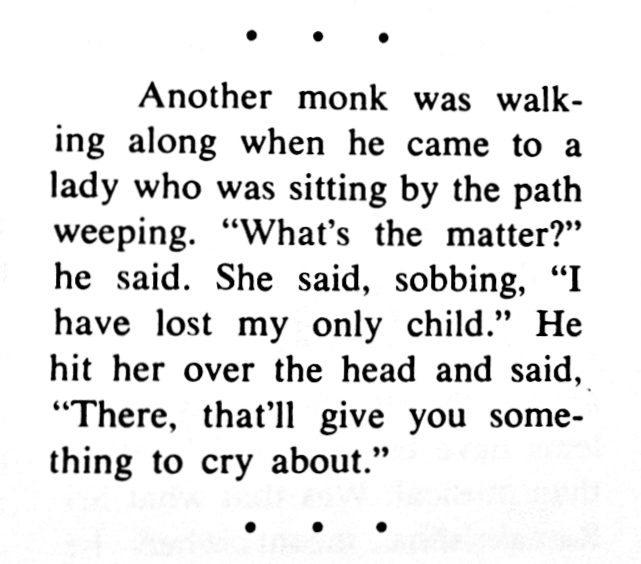
Something to cry about (John Cage)

jc

The Battle of Lapiths and Centaurs — Giorgio de Chirico

Willa Cather on Mark Twain

If there is anything which should make an American sick and disgusted at the literary taste of his country, and almost swerve his allegiance to his flag it is that controversy between Mark Twain and Max O’Rell, in which the Frenchman proves himself a wit and a gentleman and the American shows himself little short of a clown and an all around tough. The squabble arose apropos of Paul Bourget’s new book on America, “Outre Mer,” a book which deals more fairly and generously with this country than any book yet written in a foreign tongue. Mr. Clemens did not like the book, and like all men of his class, and limited mentality, he cannot criticise without becoming personal and insulting. He cannot be scathing without being a blackguard. He tried to demolish a serious and well considered work by publishing a scurrilous, slangy and loosely written article about it. In this article Mr. Clemens proves very little against Mr. Bourget and a very great deal against himself. He demonstrates clearly that he is neither a scholar, a reader or a man of letters and very little of a gentleman. His ignorance of French literature is something appalling. Why, in these days it is as necessary for a literary man to have a wide knowledge of the French masterpieces as it is for him to have read Shakespeare or the Bible. What man who pretends to be an author can afford to neglect those models of style and composition. George Meredith, Thomas Hardy and Henry James excepted, the great living novelists are Frenchmen.

Mr. Clemens asks what the French sensualists can possibly teach the great American people about novel writing or morality? Well, it would not seriously hurt the art of the classic author of “Puddin’ Head Wilson” to study Daudet, De Maupassant, Hugo and George Sand, whatever it might do to his morals. Mark Twain is a humorist of a kind. His humor is always rather broad, so broad that the polite world can justly call it coarse. He is not a reader nor a thinker nor a man who loves art of any kind. He is a clever Yankee who has made a “good thing” out of writing. He has been published in the North American Review and in the Century, but he is not and never will be a part of literature. The association and companionship of cultured men has given Mark Twain a sort of professional veneer, but it could not give him fine instincts or nice discriminations or elevated tastes. His works are pure and suitable for children, just as the work of most shallow and mediocre fellows. House dogs and donkeys make the most harmless and chaste companions for young innocence in the world. Mark Twain’s humor is of the kind that teamsters use in bantering with each other, and his laugh is the gruff “haw-haw” of the backwoodsman. He is still the rough, awkward, good-natured boy who swore at the deck hands on the river steamer and chewed uncured tobacco when he was three years old. Thoroughly likeable as a good fellow, but impossible as a man of letters. It is an unfortunate feature of American literature that a hostler with some natural cleverness and a great deal of assertion receives the same recognition as a standard American author that a man like Lowell does. The French academy is a good thing after all. It at least divides the sheep from the goats and gives a sheep the consolation of knowing that he is a sheep.

It is rather a pity that Paul Bourget should have written “Outre Mer,” thoroughly creditable book though it is. Mr. Bourget is a novelist, and he should not content himself with being an essayist, there are far too many of them in the world already. He can develop strong characters, invent strong situations, he can write the truth and he should not drift into penning opinions and platitudes. When God has made a man a creator, it is a great mistake for him to turn critic. It is rather an insult to God and certainly a very great wrong to man.

Willa Cather on Mark Twain. Originally published in Nebraska State Journal, May 5, 1895


Sappho (Raphael + David Markson)

raphael sappho(2)


Capture


“Avril 14th” — Aphex Twin

“Poker!” — A Short Play by Zora Neale Hurston

POKER! by Zora Neale Hurston

Time—Present

Place—New York

Cast of characters—
Nunkie
Too-Sweet
Peckerwood
Black Baby
Sack Daddy
Tush Hawg
Aunt Dilsey

SCENE—

A shabby front room in a shotgun house.

A door covered by dingy portieres upstage C. Small panel window in side Wall L. Plain centre table with chairs drawn up about it. Gaudy calendars on wall. Battered piano against wall R. Kerosene lamp with reflector against wall on either side of room.

At rise of curtain NUNKIE is at piano playing…. Others at table with small stacks of chips before each man. TUSH HAWG is seated at table so that he faces audience. He is expertly riffing the cards … looks over his shoulder and speaks to NUNKIE.

TUSH HAWG Come on here, Nunkie—and take a hand! You’re holding up the game. You been woofin’ round here about the poker you can play—now do it!

NUNKIE
Yeah, I plays poker. I plays the piano and Gawd knows I plays the devil.
I’m Uncle Bob with a wooden leg!*[Handwritten: Last sentence crossed out
in pencil in manuscript.]

BLACK BABY Aw, you can be had! Come on and get in the game! My britches is cryin’ for your money! Come on, don’t give the healer no trouble!*[Handwritten: last sentence crossed out in pencil]

NUNKIE Soon as I play the deck I’m comin’ and take you alls money! Don’ rush me.

 Ace means the first time that I met you
Duece means there was nobody there but us two
Trey means the third party—Charlie was his name
Four spot means the fourth time you tried that same old game—
Five spot means five years you played me for a clown
Six spot means six feet of earth when the deal goes down
Now I’m holding the seven spot for each day of the week
Eight means eight hours that she Sheba-ed with your Sheik—
Nine spot means nine hours that I work hard every day—
Ten spot means tenth of every month I brought you home my pay—
The Jack is three-card Charlie who played me for a goat
The Queen, that’s my pretty Mama, also trying to cut my throat—
The King stands for Sweet Papa Nunkie and he’s goin’ to wear the crown,
So be careful you all ain’t broke when the deal goes down!
(He laughs—X’es to table, bringing
piano stool for seat)

TUSH HAWG Aw now, brother, two dollars for your seat before you try to sit in this game.

NUNKIE
(Laughs sheepishly—puts money
down—TUSH HAWG pushes stack of chips
toward him. Bus.)
I didn’t put it down because I knew you all goin’ to be puttin’ it right
back in my pocket.

BECKERWOOD
Aw, Y’all go ahead and play.
(to TUSH HAWG)
Deal!
(TUSH HAWG begins to deal for draw
poker. The game gets tense. SACK
DADDY is first man at TUSH’s left—he
throws back three cards and is dealt
three more)

SACK DADDY My luck sure is rotten! My gal must be cheatin’ on me. I ain’t had a pair since John Henry had a hammer!

BLACK BABY
(Drawing three new cards)
You might be fooling the rest with the cryin’ you’re doin’ but I’m
squattin’ for you! You’re cryin’ worse than cryin’ Emma!

TOO-SWEET
(Studying his three new cards)
(Sings)
When yo’ cards gets lucky, oh Partner, you oughter be in a rollin’ game.
*[Handwritten: get you foot offa my chair etc]

AUNT DILSEY (Enters through portieres—stands and looks disapprovingly) You all oughter be ashamed of yourself, gamblin’ and carryin’ on like this!

BLACK BABY Aw, this ain’t no harm, Aunt Dilsey! You go on back to bed and git your night’s rest.

AUNT DILSEY
No harm! I know all about these no-harm sins! If you don’t stop this
card playin’, all of you all goin’ to die and go to Hell.
(Shakes warning finger—exits through
portieres—while she is talking the
men have been hiding cards out of
their hands and pulling aces out of
sleeves and vest pockets and
shoes—it is done quickly, one does
not see the other do it)

NUNKIE
(Shoving a chip forward)
A dollar!

SACK DADDY
Raise you two!

BLACK BABY I don’t like to strain with nobody but it’s goin’ to cost you five. Come on, you shag-nags! This hand I got is enough to pull a country man into town. *[Handwritten: Last sentence crossed through in pencil.]

TOO-SWEET You all act like you’re spuddin’! Bet some money! Put your money where your mouth is *[Handwritten: els my fist where yo mouf is.]

TUSH HAWG Twenty-five dollars to keep my company! Dog-gone, I’m spreadin’ my knots!

SACK DADDY
And I bet you a fat man I’ll take your money—I call you.
(Turns up his cards—he has four aces
and king)

TUSH HAWG (showing his cards) Youse a liar! I ain’t dealt you no aces. Don’t try to carry the Pam-Pam to me ’cause I’ll gently chain-gang for you!

SACK DADDY Oh yeah! I ain’t goin’ to fit no jail for you and nobody else. I’m to get me a green club and season it over your head. Then I’ll give my case to Miss Bush and let Mother Green stand my bond! I got deal them aces!

NUNKIE
That’s a lie! Both of you is lyin’! Lyin’ like the cross-ties from New
York to Key West! How can you all hold aces when I got four? Somebody is
goin’ to West hell before midnight!

BECKERWOOD Don’t you woof at Tush Hawg. If you do I’m goin’ to bust hell wide open with a man!

BLACK BABY
(Pulls out razor—Bus.)
My chop-axe tells me I got the only clean aces they is on this table!
Before I’ll leave you all rob me outa my money, I’m goin’ to die it off!

TOO-SWEET
I promised the devil one man and I’m goin’ to give him five!
(Draws gun)

TUSH HAWG
Don’t draw your bosom on me! God sent me a pistol and I’m goin’ to send
him a man!
(FIRES. Bus. for all)

AUNT DILSEY
(Enters after shooting bus. Stands.
Bus. drops to chair)
They wouldn’t lissen—
(Looks men over—Bus.)
It sure is goin’ to be a whole lot tougher in hell now!

CURTAIN


Woman Reading with Peaches — Henri Matisse

The Sacrifice — Andrei Tarkovsky (Full Film)

Satire on False Perspective — William Hogarth

I Riff on the Cloud Atlas Movie

Cloud-Atlas-Poster

1. Cloud Atlas is neither the bizarre trainwreck I thought it might be, nor is it a disastrously wrong-headed reinterpretation of David Mitchell’s novel.

2. It’s actually about as faithful an adaptation as one could expect.

3. A major deviation from the novel:

The filmmakers (the Wachowskis and Tom Tykwer) of Cloud Atlas chop up and rearrange the novel’s six sections such that each section’s individual arc (e.g. exposition, climax, dénouement, etc.) runs concurrently with the other narrative arcs—like braided strands—whereas the novel nests them—like matryoskha dolls.

It’s very clear why the filmmakers would wish to use a more traditional grammar, but the effect is often more taxing than rewarding—the work’s themes of eternal recurrence are overstated (yet somehow underdeveloped), pressed repeatedly on the viewer. There’s little breathing room.

4. Another (possible) deviation from Mitchell’s novel:

The filmmakers cast their company (including Tom Hanks, Halle Berry, Jim Broadbent, and Hugo Weaving) in multiple roles, so that each actor portrays a new character in each section. Mitchell’s novel played with the idea of eternal recurrence subtly, using a comet-shaped birthmark as a linking signifier. The film adaptation overloads the theme, creating the impression of a system that simply doesn’t inhere through the plot unless the viewer chooses to impose it (granted, certain actors tend to be cast in villainous roles or heroic roles—but there isn’t a coherent system of correspondences between the actors and the characters, despite what snippets of dialog would wish the viewer to believer).

5. The biggest problem with casting actors across a variety of roles:

The effect is extremely distracting—especially when actors are playing characters across gender or across race (especially the film’s notorious use of “yellow face,” which is problematic on many levels, not the least of which is that the make-up and prosthetics just look awful—and the part of the yellow face that’s worst to me (and perhaps the least-remarked-upon) is the awful fake “Asian” accents that the white actors use, with mangled intonations, etc. Disastrous).

The gambit may have worked (only may) if the filmmakers had cast actors who could actually pull it off. Denis Lavant, Tilda Swinton, and Gary Oldman all come to mind as actors who inhabit their roles to such a degree that the character transcends them (in plainer language: Gary Oldman is excellent at not looking like Gary Oldman). Tom Hanks—well, Hanks is wonderful at balancing charm with profound gazes—but he looks just like Tom Hanks in every damn scene he’s in, whether he’s playing a contemporary British gangster (maybe the low point of the film) or a post-apocalyptic tribesman (which, let me just shoehorn this in here real quickly—I imagined the Zachry of the novel to be like, much, much younger than mid-fifties). Halle Berry looks like Halle Berry, even in white face. And Hugo Weaving doing his Nurse Ratchet impression…well, leave it alone, leave it alone.

6. One thing the film does very well:

Stylized action sequences. We might expect this—the Wachowskis gave us The Matrix trilogy—but I was surprised at how well these moments fit into the film. There must have been a temptation to wedge shootouts and battles and cool cityscape sequences into the film, but these pockets of action are used sparingly, effectively buoying the film.

7. Another thing the film does well:

Explore the themes of slavery (and slave-master dynamics) that are central to Mitchell’s text.

8. The biggest thematic short-coming of the Cloud Atlas film:

Its muddled handling of eternal recurrence. In my review of Mitchell’s novel, I suggested that the book was overtly investigating the relationship between Nietzsche’s concept of eternal recurrence and his infamous and often misunderstood übermensch. Granted, the film does posit history as a cycle of domination and submission, and also suggests that figures who wish to break or disrupt or upset this cycle will be assassinated or martyred—but the film elides the novel’s Nietzschean impulses in favor of New Age contours. There’s a broad, hippy-dippy streak of faux-spiritualism to the film that’s too syrupy to swallow. (In full disclosure, dear reader—I prefer a healthy dose of bitter with any sweets).

9. Another problem:

The music. It’s not that the score by director Tom Tykwer and two collaborators is bad—it’s fine, I suppose—it’s that the filmmakers rely too heavily on music to stitch their story strands together. The effect is at times simultaneously dulling and claustrophobic.

10. An extension of the previous point:

This is perhaps the biggest shortcoming of Cloud Atlas: Its compression. The film runs to an epic three hours, but somehow feels rushed.

There’s not enough space for characters to develop, and because the film has created a system through which characters are essentially reiterations of previous “selves,” the changes that the characters do undergo seem like fore drawn conclusions. Perhaps the most drastic example comes in the fabricant Sonmi-451. She’s an emblematic character to the narrative, a messianic figure, and her catechism provides the novel’s perhaps strongest exploration of what it means to be human and free. While the film hardly botches the Sonmi-451 segment, it doesn’t devote enough time to showing her revolutionary arc.

11. I know, I know—the film is already three hours, and here I am asking for more.

Suggestion: Cloud Atlas might have been much stronger as a twelve part miniseries, giving its characters and themes room to breathe and grow.

Another suggestion: Cloud Atlas as a one-man theatrical show starring, I don’t know, Gary Oldman (?). 75 minutes tops.

12. My criticisms might seem overly nitpicky, and to be clear, they are from the perspective of someone who read and enjoyed the book first. Still, I hate to fault the Wachowskis and Tykwer for their ambition, scope, technical prowess, and, oddly, their restraint. The film is far more focused and coherent than it has any right to be and its themes come through clearly. The filmmakers show a deep respect for Mitchell’s novel as well as the film’s audience while at the same time offering their own personal interpretation of the source material. When Cloud Atlas stumbles or outright fails, it does so on its own terms—which is why I think the film ultimately succeeds.

What if a demon (Nietzsche)

The greatest weight.— What, if some day or night a demon were to steal after you into your loneliest loneliness and say to you: “This life as you now live it and have lived it, you will have to live once more and innumerable times more; and there will be nothing new in it, but every pain and every joy and every thought and sigh and everything unutterably small or great in your life will have to return to you, all in the same succession and sequence – even this spider and this moonlight between the trees, and even this moment and I myself. The eternal hourglass of existence is turned upside down again and again, and you with it, speck of dust!”
Would you not throw yourself down and gnash your teeth and curse the demon who spoke thus?… Or how well disposed would you have to become to yourself and to life to crave nothing more fervently than this ultimate eternal confirmation and seal?

–From Nietzsche’s The Gay Science.