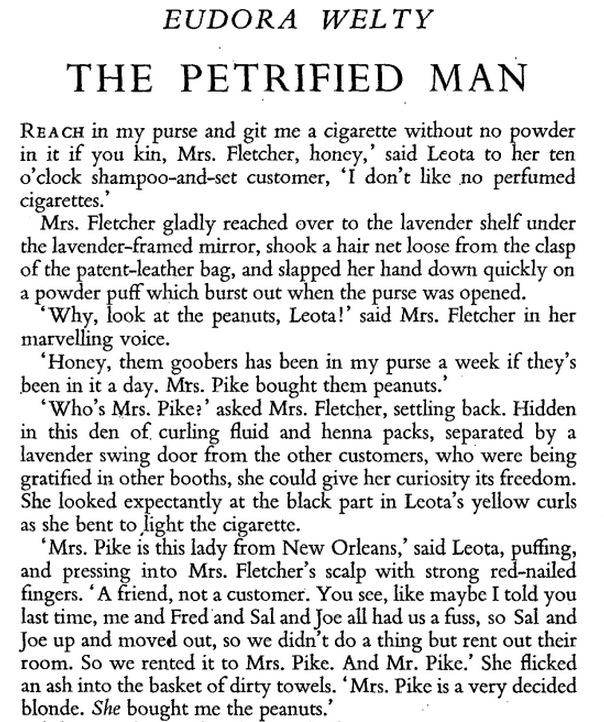
“Petrified Man” — Eudora Welty

ew

(Read the rest of “Petrified Man”).

Compartment Car — Edward Hopper

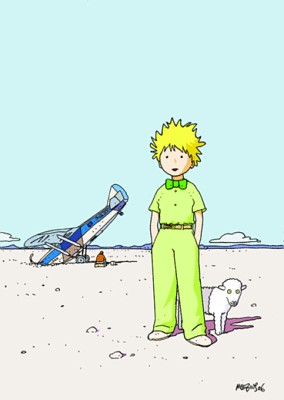
The Little Prince — Moebius

prince moebius

Handsome Devil William S. Burroughs, Smiling

William Burroughs in his flat, London, 1971. Photo by Baron Wolman

(Via).

Carl Shuker’s Anti Lebanon Reviewed

al

I’m tempted to say that Carl Shuker’s novel Anti Lebanon is full of twists, but twists isn’t the right word—it’s more like the novel’s trajectory repeatedly escapes the reader’s expectations, driving into increasingly alien terrain.

Anti Lebanon begins as a somewhat traditional novel focused on Leon Elias, “thirty years old, East Beiruti Greek Orthodox.” Leon has dropped out of university, leaving his degree in hydrogeology unfinished. Leon has since taken a job as the security guard of an abandoned amusement park, a symbolic stand-in for Lebanon’s tourist economy. The Arab Spring has destabilized Lebanon, leaving its Christian population in a precarious position as Hezbollah dominates the government—and the streets. After dropping out of school, Leon creates an experimental short film, In the anti Lebanon,  a film “about his family and his sister and their history” — a history of mixed cultures (Leon’s mother is Japanese) and pain (his sister, a soldier, was assassinated).

The early parts of Anti Lebanon seem to set the stage for a fairly conventional novel with strong political overtones, one that explores Leon’s guilt over his sister’s violent death and his conflicted place as a sensitive and artistic soul who’s the son an infamous warrior, all set against the backdrop of Christian Lebanon in the tumult of the Arab Spring. But then Shuker takes us other places. Lots of other places.

The crucible for this change comes after a night of drinking ends in violence and theft. I don’t want to spoil too much—this is a novel that constantly had me rereading entire passages, asking, Wait, what?—but let’s just say Leon, complicit in a crime, ends up moving a body by motorcycle. Let me share some of Shuker’s prose in a passage that reveals the novel’s major metaphysical gambit:

This time there was no crash and it probably was the alcohol but the pain of the thing’s biting was gristly and sharp and also distant and allied with the shock of the fall so he rode though it for it seemed several dozen feet— the most important thing was not to fall again. He came to a controlled halt, stopped the bike, and then over his shoulder punched the thing’s face several times, his knuckle hitting soft then hitting helmet, and it bit again and this time harder and it stung and went deeper, a popping sound or feeling in his neck that suddenly got desperately deep and he punched again and then he rolled violently and writhed in the grasp of the thing they had created and he fell over deliberately, twisting so as to topple over sideways upon and hurt and stop the thing, and he hit the ground landing on its arm and this dislodged the biting helmeted head and he pulled up its hands and wriggled away over the concrete like his sister palming herself away from her disappeared foot and he scrambled up, and the thing just lay there inert and still, wired to the scooter in a position absurd, all tied up and crooked and ruined and wrong. He stood and held his hot neck looking at the fallen boy and then knew that someone else was there.

Is Leon now a vampire? The novel answers this question clearly even as it refuses to explain or define what, exactly, being a vampire means.  Anti Lebanon at times threatens to become an allegory of Mideast politics and history, using vampirism as its major trope, but then Shuker shifts us into new, weird territory. An appropriately Borgesian chapter titled “Labyrinth” moves Leon and the reader into a propulsive engine of dream logic; we’re never quite sure exactly what is happening as Leon gives over to dark, primal violence.

Such violence inheres from history and geography and mythology. It’s worth sharing another passage at length to see how Shuker traces these contours, plunging character and reader into history’s strange tangles. Here, vampire Leon drinks a guard’s lifeblood—the beginning of an oblique spree—and tunnels into mythos, plumbing the history of his land to arrive at his sister’s murder:

Semi-unhinged single Christian men, living alone in brutalist concrete boxes on the borderlands with their rage and a shrieking TV, a simonized gun and a cross on the wall, were approached and made use of. Aries, Andromeda, and Perseus slowly wheeled across the dead guard’s sunglasses. Christian snipers took positions around Mar Mikhael overlooking Electricité du Liban. A secret. Leon, labyrinthine, tunneled from shadow to shadow. The criminal and the victim alike return to the scene of the crime. Would the Israelis come? The taste of blood was hot: There was juniper, vetyver, and chypres too, copper drying down to a powder, wealth and breadth of deathless rivers in endless cycle, over centuries, aeons, untouched and untouchable: Nahr al Kalb, the dog river, collecting on its rock walls the signatures of dead empires: the steles of Ramses II, Nebuchadnezzar, Napoleon III and Caracalla, General Gouraud and The XXI British Army Corps with Le Détachement Français de Palestine et Syrie occupied Beirut and Tripoli: October 1918 AD; and Nahr Ibrahim, the blood river, which flows red: iron-rich soil rusting, seeding red anemones of the rebirth along its banks. The land still bearing the imprint of its creator, still running with the blood of Adonis in cascades; cataracts of rust. The march crossed the exact point on the Green Line where the Black Saturday ID checkpoints were erected once upon a time and to cross was to have your ID checked for religion and your throat cut in the passenger seat, watched over by Phalange HQ, past Makhlouf’s sandwich store— his weakness, his frailty. He told her about the last shot, what he alone saw: that the assassin didn’t even look as he ruined her; as he ruined him.

From here—well, let’s just say that Leon goes, and that the book moves into a picaresque rhythm, erupting with Bolañoesque moments of horror and strange shifts into the unreal (there’s a moment at the end of an episode in Israel that confounded everything I’d read so far in the book, the effect approaching alterity). It would spoil too much of Anti Lebanon to delineate all its movements; suffice to say its unsettling shifts are grounded in motifs of dogs, water, film, art, crashes, the peri, the vampire.

Shuker’s book isn’t for everyone. Those looking for a classic Gothic horror or a sexy vampire romp will likely be disappointed (and probably confused). Shuker also throws his reader into the metaphorical deep end of Mideast politics and history, offering little exposition that might help explain some of the complexity. There’s a trust in the reader there that I admire (even as I often headed to Wikipedia to learn about Lebanon’s civil wars, the Druze, its relationship to Syria, Palestine, Israel…). That trust is best returned to the author—a trust to follow him where he goes, because frankly you won’t be able to see ahead. Anti Lebanon is unpredictable, strange, and very rewarding.

Anti Lebanon is new from Counterpoint Press.
Minotaur — William Blake

Joseph Heller’s Handwritten Outline for Catch-22

heller

(Via/more).

Duel (From A Week of Kindness) — Max Ernst

A Dwarf Holding a Tome in His Lap — Diego Velazquez

Vertigo — Leon Spilliaert

Plagiarism

Criminal man has lost all enterprise and originality.

And this same progeny of evils comes
From our debate, from our dissension;
We are their parents and original.

Those with no memory insist on their originality.

Books serve to show a man that those original thoughts of his aren’t very new after all.

Great poets steal.

The one and the only.

All my best thoughts!

Stolen by the ancients.

Ah! Gooblazqruk brukarchkrasht!

Truth! stark, naked truth, is the word; and I will not so much as take the pains to bestow the strip of a gauze wrapper on it, but paint situations such as they actually rose to me in nature, careless of violating those laws of decency that were never made for such unreserved intimacies as ours; and you have too much sense, too much knowledge of the originals, to sniff prudishly and out of character at the pictures of them.

Tear him for his bad verses, tear him for his bad verses.

Mature poets steal.

Nothing new except what has been forgotten.

It’s not a real leg, only a false leg.

And there’s a mighty difference between a living thump and a dead thump.

O! Weeshwashtkissinapooisthnapoohuck?

An original artist is unable to copy. So he has only to copy in order to be original.

Let a splinter swerve.

It hath it original from much grief, from study, and perturbation of the brain.

Great artists steal.

The original papers, together with the scarlet letter itself—a most curious relic—are still in my possession, and shall be freely exhibited to whomsoever, induced by the great interest of the narrative, may desire a sight of them. I must not be understood affirming that, in the dressing up of the tale, and imagining the motives and modes of passion that influenced the characters who figure in it, I have invariably confined myself within the limits of the old Surveyor’s half-a-dozen sheets of foolscap. On the contrary, I have allowed myself, as to such points, nearly, or altogether, as much license as if the facts had been entirely of my own invention. What I contend for is the authenticity of the outline.

Necessary to any originality: the courage to be an amateur.

It is all for the taking.

Great artists.

We have always been shameless about stealing great ideas.

The great artist who is truly schizophrenic will break the wall, reaching the unknown country where he does not belong to any age, any environment, any school.

And all that poets feign of bliss and joy.

Now, do you doubt that your bird was true?

Design for a Giant Crossbow — Leonardo da Vinci

Read “The Dark Arts,” A New Story by Ben Marcus

On a dark winter morning at the Müllerhaus men’s hostel, Julian Bledstein reached for his Dopp kit. At home, he could medicate himself blindfolded, but here, across the ocean, it wasn’t so easy. The room stank, and more than one young man was snoring. The beds in the old gymnasium were singles, which didn’t keep certain of the guests from coupling when the lights went out. Sometimes Julian could hear them going at it, fornicating as if with silencers on. He studied the sounds when he couldn’t sleep, picturing the worst: animals strapped to breathing machines, children smothered under blankets. In the morning he could never tell just who had been making love. The men dressed and left for the day, avoiding eye contact, mesmerized in the glow of their cell phones.

Julian held his breath and squeezed the syringe, draining untold dollars’ worth of questionable medicine into the flesh of his thigh. He clipped a bag holding the last of his money to the metal underside of his bed. His father’s hard-earned money. Not enough euros left. Not nearly enough. He’d have to make a call, poor-mouth into the phone until his father’s wallet spit out more bills.

Read the rest of Ben Marcus’s “The Dark Arts” at The New Yorker.

Don Quixote, Sancho Panza and the Dead Mule — Honore Daumier

A Creole Bovary — Willa Cather Reviews Kate Chopin’s Novella The Awakening

A Creole “Bovary” is this little novel of Miss Chopin’s. Not that the heroine is a creole exactly, or that Miss Chopin is a Flaubert—save the mark!—but the theme is similar to that which occupied Flaubert. There was, indeed, no need that a second “Madame Bovary” should be written, but an author’s choice of themes is frequently as inexplicable as his choice of a wife. It is governed by some innate temperamental bias that cannot be diagrammed. This is particularly so in women who write, and I shall not attempt to say why Miss Chopin has devoted so exquisite and sensitive, well-governed a style to so trite and sordid a theme. She writes much better than it is ever given to most people to write, and hers is a genuinely literary style; of no great elegance or solidity; but light, flexible, subtle and capable of producing telling effects directly and simply. The story she has to tell in the present instance is new neither in matter nor treatment. “Edna Pontellier,” a Kentucky girl, who, like “Emma Bovary,” had been in love with innumerable dream heroes before she was out of short skirts, married “Leonce Pontellier” as a sort of reaction from a vague and visionary passion for a tragedian whose unresponsive picture she used to kiss. She acquired the habit of liking her husband in time, and even of liking her children. Though we are not justified in presuming that she ever threw articles from her dressing table at them, as the charming “Emma” had a winsome habit of doing, we are told that “she would sometimes gather them passionately to her heart, she would sometimes forget them.” At a creole watering place, which is admirably and deftly sketched by Miss Chopin, “Edna” met “Robert Lebrun,” son of the landlady, who dreamed of a fortune awaiting him in Mexico while he occupied a petty clerical position in New Orleans. “Robert” made it his business to be agreeable to his mother’s boarders, and “Edna,” not being a creole, much against his wish and will, took him seriously. “Robert” went to Mexico but found that  fortunes were no easier to make there than in New Orleans. He returns and does not even call to pay his respects to her. She encounters him at the home of a friend and takes him home with her. She wheedles him into staying for dinner, and we are told she sent the maid off “in search of some delicacy she had not thought of for herself, and she recommended great care in the dripping of the coffee and having the omelet done to a turn.”

Only a few pages back we were informed that the husband, “M. Pontellier,” had cold soup and burnt fish for his dinner. Such is life. The lover of course disappointed her, was a coward and ran away from his responsibilities before they began. He was afraid to begin a chapter with so serious and limited a woman. She remembered the sea where she had first met “Robert.” Perhaps from the same motive which threw “Anna Keraninna” under the engine wheels, she threw herself into the sea, swam until she was tired and then let go.

“She looked into the distance, and for a moment the old terror flamed up, then sank again. She heard her father’s voice, and her sister Margaret’s. She heard the barking of an old dog that was chained to the sycamore tree. The spurs of the cavalry officer clanged as he walked across the porch. There was a hum of bees, and the musky odor of pinks filled the air.”

“Edna Pontellier” and “Emma Bovary” are studies in the same feminine type; one a finished and complete portrayal, the other a hasty sketch, but the theme is essentially the same. Both women belong to a class, not large, but forever clamoring in our ears, that demands more romance out of life than God put into it. Mr. G. Barnard Shaw would say that they are the victims of the over-idealization of love. They are the spoil of the poets, the Iphigenias of sentiment. The unfortunate feature of their disease is that it attacks only women of brains, at least of rudimentary brains, but whose development is one-sided; women of strong and fine intuitions, but without the faculty of observation, comparison, reasoning about things. Probably, for emotional people, the most convenient thing about being able to think is that it occasionally gives them a rest from feeling. Now with women of the “Bovary” type,  this relaxation and recreation is impossible. They are not critics of life, but, in the most personal sense, partakers of life. They receive impressions through the fancy. With them everything begins with fancy, and passions rise in the brain rather than in the blood, the poor, neglected, limited one-sided brain that might do so much better things than badgering itself into frantic endeavors to love. For these are the people who pay with their blood for the fine ideals of the poets, as Marie Delclasse paid for Dumas’ great creation, “Marguerite Gauthier.” These people really expect the passion of love to fill and gratify every need of life, whereas nature only intended that it should meet one of many demands. They insist upon making it stand for all the emotional pleasures of life and art, expecting an individual and self-limited passion to yield infinite variety, pleasure and distraction, to contribute to their lives what the arts and the pleasurable exercise of the intellect gives to less limited and less intense idealists. So this passion, when set up against Shakespeare, Balzac, Wagner, Raphael, fails them. They have staked everything on one hand, and they lose. They have driven the blood until it will drive no further, they have played their nerves up to the point where any relaxation short of absolute annihilation is impossible. Every idealist abuses his nerves, and every sentimentalist brutally abuses them. And in the end, the nerves get even. Nobody ever cheats them, really. Then “the awakening” comes. Sometimes it comes in the form of arsenic, as it came to “Emma Bovary,” sometimes it is carbolic acid taken covertly in the police station, a goal to which unbalanced idealism not infrequently leads. “Edna Pontellier,” fanciful and romantic to the last, chose the sea on a summer night and went down with the sound of her first lover’s spurs in her ears, and the scent of pinks about her. And next time I hope that Miss Chopin will devote that flexible, iridescent style of hers to a better cause.

Pittsburg Leader, July 8, 1899

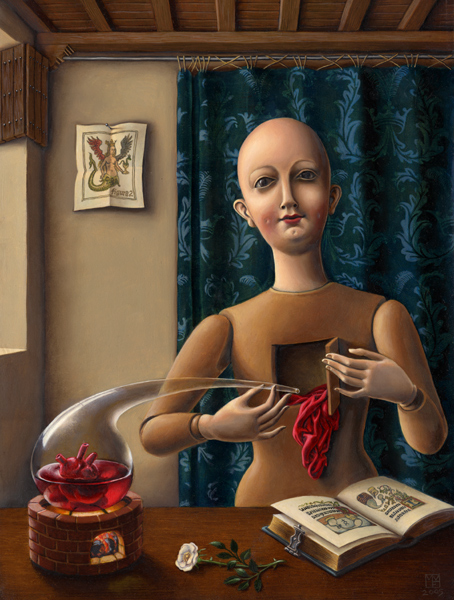
Essentia Exaltata — Madeline von Foerster

essentiaexaltata

Performance (Full Film)