A Short Riff on They Might Be Giants’ Album Flood (Book Acquired, 11.18.2013)

20131123-125515.jpg

In the seventh grade, my friend Tilford gave me a copy of They Might Be Giant’s album Flood. This was in 1991, back when “alternative” music was far more varied than it is now. What I mean by this is that back in those halcyon days, we listened to anything we could get our ears to—and really listened. This meant TMBG, R.E.M, RHCP, KMFDM, Sonic Youth, The Pixies, Fugazi, the Dead Kennedys, The Dead Milkmen, The Meat Puppets, The Meatmen, The Minutemen—just anything different than what was on the radio. Lack of access to music meant that we listened to a wider diversity of bands than maybe Kids Today do. (These are all crotchety claims. Get off my lawn).

Anyway, Flood—the album, its freewheeling zaniness, its nasal vibe, its silliness, its diversity, its poppiness—so much of it is still imprinted on my brain. “Birdhouse in Your Soul” is probably the only TMBG song that I’ll still put on a mix CD (okay, that and “Minimum Wage”), but Flood is rich in its strange pop vibes. Songs like “Road Movie to Berlin” (later covered by Frank Black) and “They Might Be Giants” played on a loop in my brain in the early nineties. Other songs like the jokey cover “Istanbul (Not Constantinople)” and “Particle Man” pointed the way to the kind of kid-friendly skewed pop that would define the second half of TMBG’s career. “You Racist Friend” is one of the most direct protest songs I’ve ever heard.

I’ve never forgiven TMBG for quitting two songs in to their set when I saw them in 1996. John Linnell was too ill to continue, and called the show off. In retrospect, I understand why—dude was sick, really sick (I can remember his face)—but for me it was an easy break with a band that lacked the art rock verve that I found more interesting in the late nineties. I could write They Might Be Giants off as kid music. That’s undoubtedly an unfair assessment though.

S. Alexander Reed and Philip Sandifer have written a new book (in the 33 1/3 series) on Flood. In the blurb, below, we get a clear overview of how important this record was—even if it isn’t discussed along with Sonic Youth’s Goo and Dirty, R.E.M.’s Green, or The Pixies’ last record (not to mention all the “grunge” bands that exploded after those records). Here’s the blurb:

For a few decades now, They Might Be Giants’ album Flood has been a beacon (or at least a nightlight) for people who might rather read than rock out, who care more about science fiction than Slayer, who are more often called clever than cool. Neither the band’s hip origins in the Lower East Side scene nor Flood’s platinum certification can cover up the record’s singular importance at the geek fringes of culture.

Flood’s significance to this audience helps us understand a certain way of being: it shows that geek identity doesn’t depend on references to Hobbits or Spock ears, but can instead be a set of creative and interpretive practices marked by playful excess—a flood of ideas.

The album also clarifies an historical moment. The brainy sort of kids who listened to They Might Be Giants saw their own cultural options grow explosively during the late 1980s and early 1990s amid the early tech boom and America’s advancing leftist social tides. Whether or not it was the band’s intention, Flood’s jubilant proclamation of an identity unconcerned with coolness found an ideal audience at an ideal turning point. This book tells the story.


The Briar Wood — Edward Burne-Jones

“On the Surface of Things” — Wallace Stevens

ws

New Fairy Tale — Nikolay Bogdanov-Belsky

Nude at the Beach (Night) — Albert von Keller

The Idea — Berthold Bartosch

The Awakening Conscience — William Holman Hunt

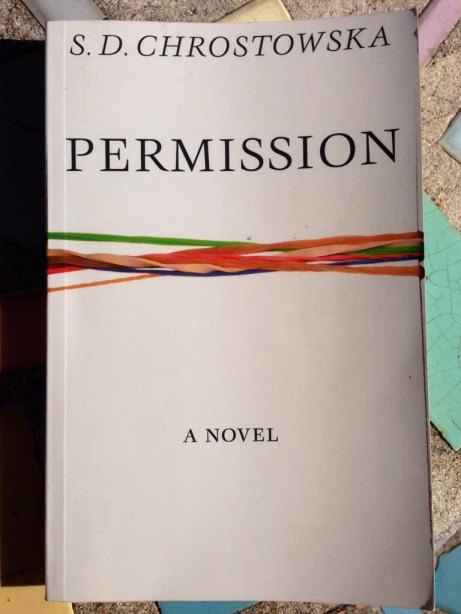
S.D. Chrostowska’s Novel Permission Deconstructs the Episotolary Form

20131123-125543.jpg

In trying to frame a review of S.D. Chrostowska’s novel Permission, I have repeatedly jammed myself against many of the conundrums that the book’s narrator describes, imposes, chews, digests, and synthesizes for her reader.

I have, for example, just now resisted the impulse to place the terms novelnarrator, and reader under radical suspicion. (I realize that the last sentence carries out the impulse even as it purports not to). Permission, thoroughly soaked in deconstruction, repeatedly places its own composition under radical suspicion.

This is maybe a bad start to a review.

Another description:

Permission pretends to be the emails that F.W. (later F. Wren, and even later, Fearn Wren) sends to an unnamed artist, a person she does not know, has never met, whom she contacts in a kind of affirmation of reciprocity tempered in the condition that her identity is “random and immaterial.” She aims to work out “an elementary philosophy of giving that is, by its very definition, anti-Western.” Her gift is the book she creates — “Permit me to write to you, today, beyond today,” the book begins.

Why?

What I want to measure—or, rather, what I want to obtain an impression of, since I do not claim exactitude of measurement for my results—is my own potential for creatio ad nihilum (creation fully within the limits of human ability, out of something and unto nothing). To rephrase my experimental question: can I give away what is inalienable from me (my utterance, myself) without the faintest expectation or hope of authority, solidarity, reciprocity?

F.W.’s project (Chrostowska’s project) here echoes Jacques Derrida’s deconstruction of giving, of the (im)possibility of authentic giving. F.W. wants to give, but she also deconstructs that impulse repeatedly. This is a novel (novel-essay, really) that cites Gilles Deleuze and Maurice Blanchot in its first twenty pages.

Her project is deconstruction; as she promises at the outset, her giving, her writing “is not solid, and does not lead to solidarity.” On the contrary,

it is solvent, and leads, through its progressive dissolution, towards the final solution of this writing (my work), which meanwhile becomes progressively less difficult, less obscure.

“Will it?” I asked in the margin of my copy. It does, perhaps.

After an opening that deconstructs its own opening, Chrostowska’s F.W. turns her attention to more concrete matters. We get a brief tour of cemeteries, a snapshot of the F.W.’s father (as a child) at a child’s funeral, a recollection of her first clumsy foray into fiction writing, a miniature memoir of a failed painter, color theory, the sun, the moon. We get an overview of our F.W.’s most intimate library—The Hound of the Baskervilles, a samizdat copy of Listy y Bialoleki [Letters from Bialoleka Prison], 1984. We get an analysis of Philip Larkin’s most famous line. Prisons, lunatic asylums, schools. Indian masks. Hamlet. More cemeteries.

My favorite entry in the book is a longish take on the “thingness of books,” a passage that concretizes the problems of writing—even thinking—after others. I think here of Blanchot’s claim that, ” No sooner is something said than something else must be said to correct the tendency of all that is said to become final.”

20131123-125626.jpg

The most intriguing passages in Permission seem to pop out of nowhere, as Chrostowska turns her keen intellect to historical or aesthetic objects. These are often accompanied by black and white photographs (sometimes gloomy, even murky), recalling the works of W.G. Sebald, novel-essays that Permission follows in its form (and even tone). Teju Cole—who also clearly followed Sebald in his wonderful novel Open Cityprovides the blurb for Permission, comparing it to the work of Sebald’s predecessors, Thomas Browne and Robert Burton. There’s a pervasive melancholy here too. Permission, haunted by history, atrocity, memory, and writing itself, is often dour. The novel-essay is discursive but never freewheeling, and by constantly deconstructing itself, it ironically creates its own center, a decentered center, a center that initiates and then closes the work—dissolves the book.

Permission, often bleak and oblique, essentially plotless (a ridiculous statement this, plotless—this book is its own plot (I don’t know if that statement makes any sense; it makes sense to me, but I’ve read the book—the book is plotless in the conventional sense of plotedness, but there is a plot, a tapestry that refuses to yield one big picture because its threads must be unthreaded—dissolved to use Chrostowska’s metaphor)—where was I?—Yes, okay, Permission, as you undoubtedly have determined now, you dear, beautiful, bright thing, is Not For EveryoneHowever, readers intrigued by the spirit of (the spirit of) writing may appreciate and find much to consider in this deconstruction of the epistolary form.

Permission is new from The Dalkey Archive.

Women in Their Sunday Best — Paul Klee

At a Roadside Tavern — Fyodor Bronnikov

Vasilisa the Beautiful at the Hut of Baba Yaga — Ivan Bilibin

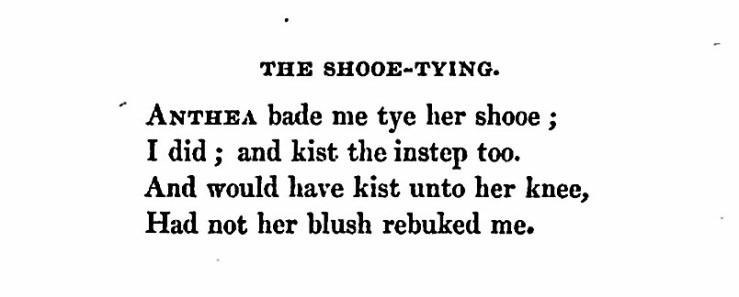
“The Shooe-Tying” — Robert Herrick

herrick

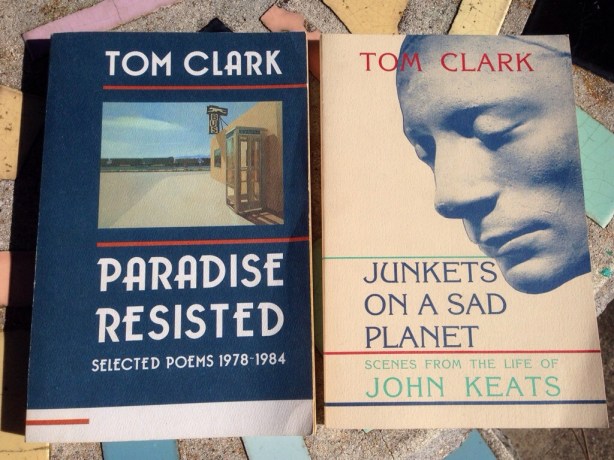
More Tom Clark (Books Acquired, 11.16.2013)

20131123-125447.jpg

Last week I picked up more Tom Clark books. Devouring these things. I lied to myself that I was buying Paradise Resisted for a friend (I didn’t give it to him; I did give him a copy of Blood Meridian though). Junkets on a Sad Planet is a Very Strange Book.

A poem from Paradise:

20131123-125456.jpg

The Start of a Fairy Tale — Eric Fischl

Coffee — Richard Diebenkorn

“Another orange juice, with a little vodka in it this time” (Donald Barthelme)

SNOW WHITE had another glass of healthy orange juice. “From now on I deny myself to them. These delights. I maintain an esthetic distance. No more do I trip girlishly to their bed in the night, or after lunch, or in the misty mid-morning. Not that I ever did. It was always my whim which governed those gregarious encounters summed up so well by Livy in the phrase, vae victis. I congratulate myself on that score at least. And no more will I chop their onions, boil their fettucini, or marinate their flank steak. No more will I trudge about the house pursuing stain. No more will I fold their lingerie in neat bundles and stuff it away in the highboy. I am not even going to speak to them, now, except through third parties, or if I have something special to announce — a new nuance of my mood, a new vagary, a new extravagant caprice. I don’t know what such a policy will win me. I am not even sure I wish to implement it. It seems small and mean-spirited. I have conflicting ideas. But the main theme that runs through my brain is that what is, is insufficient. Where did that sulky notion come from? From the rental library, doubtless. Perhaps the seven men should have left me in the forest. To perish there, when all the roots and berries and rabbits and robins had been exhausted. If I had perished then, I would not be thinking now. It is true that there is a future in which I shall inevitably perish. There is that. Thinking terminates. One shall not always be leaning on one’s elbow in the bed at a quarter to four in the morning, wondering if the Japanese are happier than their piglike Western contemporaries. Another orange juice, with a little vodka in it this time.”

From Donald Barthelme’s novel Snow White.


St. Augustine in His Study — Sandro Botticelli