



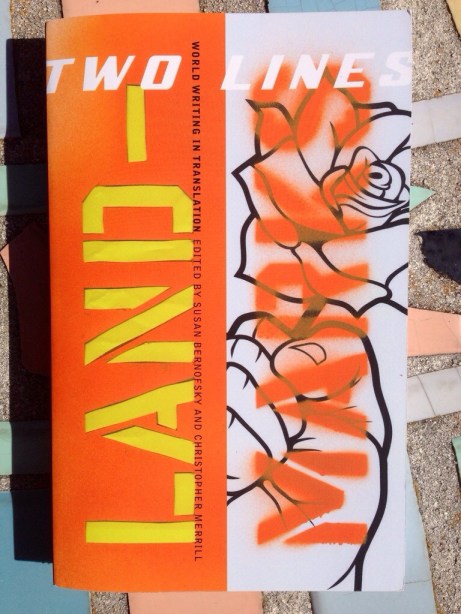
Landmarks, newish from Two Lines Press, collects poetry and prose in English translation. The collection features over a dozen languages and includes a special selection on the Arab Spring. I snacked on this book over the past few weeks, reading it at random whenever a nook of free time presented itself. There are still a few selections I haven’t gotten to yet, but most of what’s collected here is superb, thanks to editors Susan Bernofsky (who you probably know from her Robert Walser translations) and Christopher Merrill.
Two Lines’ blurb:
The premiere anthology of international literature returns for its 20th anniversary with stellar new prose and poetry, headlined by a collection of writing dedicated to the Arab Spring.
Coedited by leading German translator Susan Bernofsky and celebrated poet and translator Christopher Merrill, Landmarks gives us never-before-seen work from over 20 nations. Lauded Argentine author Juan Jose Saer, widely considered the heir to Jorge Luis Borges, transforms a photo of Earth from space into a tense, alcohol-fueled meditation on emptiness. Scholastique Mukasonga’s heartbreaking story ponders how so many of her fellow Rwandans could participate in a bloody genocide. And the Soviet absurdist Daniil Kharms is found among the volume’s many poets, alongside Yehuda Amichai—widely considered Israel’s greatest modern bard—and the up-and-coming Brazilian Ana Martins Marques.
In a special section of vital new work from the Middle East, ten writers provide an artist’s insight into the momentous events of the 2010 Arab Spring. Iraqi poet Naseer Hassan reveals haunting, everyday images from his nation. Ali Al Jallawi, twice imprisoned for critiquing of Bahrain’s political regime, ponders his relationship to God. And in Egyptian writer Mona Elnamoury’s surrealist story, images of torture and terror give way to a spectacular dream beneath the folds of an otherworldly quilt.
A truly a global education, Landmarks continues two proud decades of exploring the riches of world literature and making connections between the abundance of amazing work being produced around the world.
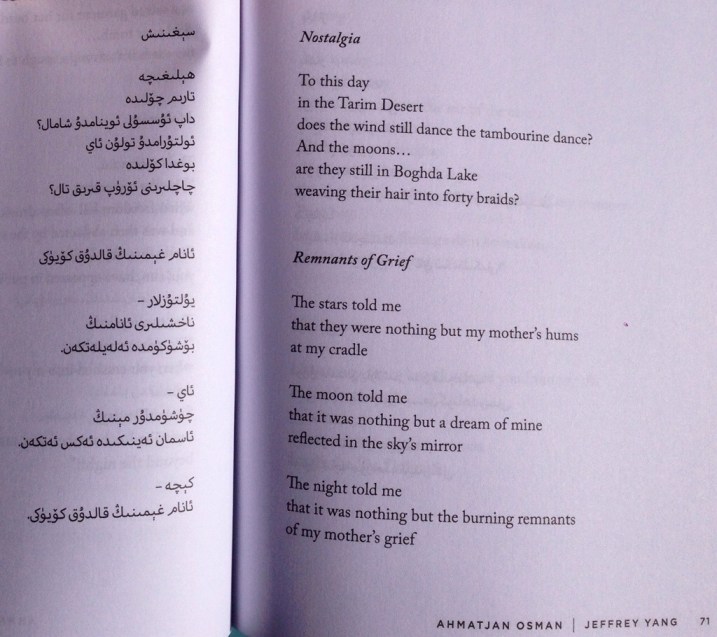
Maybe the best feature of Landmarks is the rich insight it offers into translation. Each selection is prefaced with an introduction that offers context for the writer and the conditions of the writing, as well as the translation process itself. The poems are printed in two languages as well—the original on the left, the translation on the right. (Prose selections only feature the first page of original language printed alongside the translation). Being able to see the form and contours of the poem next to its translation is fascinating. Even if the poem was composed in an alphabet utterly foreign to me, being able to see it in its original form still offers a sense of its rhythm. Great stuff.
Two from Ahmatjan Osman, translated from Uyghur by Jeffrey Yang:

“Coward” by Guy De Maupassant
In society he was called “Handsome Signoles.” His name was Vicomte Gontran-Joseph de Signoles.
An orphan, and possessed of an ample fortune, he cut quite a dash, as it is called. He had an attractive appearance and manner, could talk well, had a certain inborn elegance, an air of pride and nobility, a good mustache, and a tender eye, that always finds favor with women.
He was in great request at receptions, waltzed to perfection, and was regarded by his own sex with that smiling hostility accorded to the popular society man. He had been suspected of more than one love affair, calculated to enhance the reputation of a bachelor. He lived a happy, peaceful life—a life of physical and mental well-being. He had won considerable fame as a swordsman, and still more as a marksman.
“When the time comes for me to fight a duel,” he said, “I shall choose pistols. With such a weapon I am sure to kill my man.”
One evening, having accompanied two women friends of his with their husbands to the theatre, he invited them to take some ice cream at Tortoni’s after the performance. They had been seated a few minutes in the restaurant when Signoles noticed that a man was staring persistently at one of the ladies. She seemed annoyed, and lowered her eyes. At last she said to her husband:
“There’s a man over there looking at me. I don’t know him; do you?”
The husband, who had noticed nothing, glanced across at the offender, and said:
“No; not in the least.”
His wife continued, half smiling, half angry:
“It’s very tiresome! He quite spoils my ice cream.”
The husband shrugged his shoulders.
“Nonsense! Don’t take any notice of him. If we were to bother our heads about all the ill-mannered people we should have no time for anything else.”
But the vicomte abruptly left his seat. He could not allow this insolent fellow to spoil an ice for a guest of his. It was for him to take cognizance of the offence, since it was through him that his friends had come to the restaurant. He went across to the man and said:
“Sir, you are staring at those ladies in a manner I cannot permit. I must ask you to desist from your rudeness.”
The other replied:
“Let me alone, will you!”
“Take care, sir,” said the vicomte between his teeth, “or you will force me to extreme measures.” Continue reading ““Coward” — Guy De Maupassant”


 Biblioklept