“Good God, What a Night That Was” — Petronius

Capture(Translation by Kenneth Rexroth)

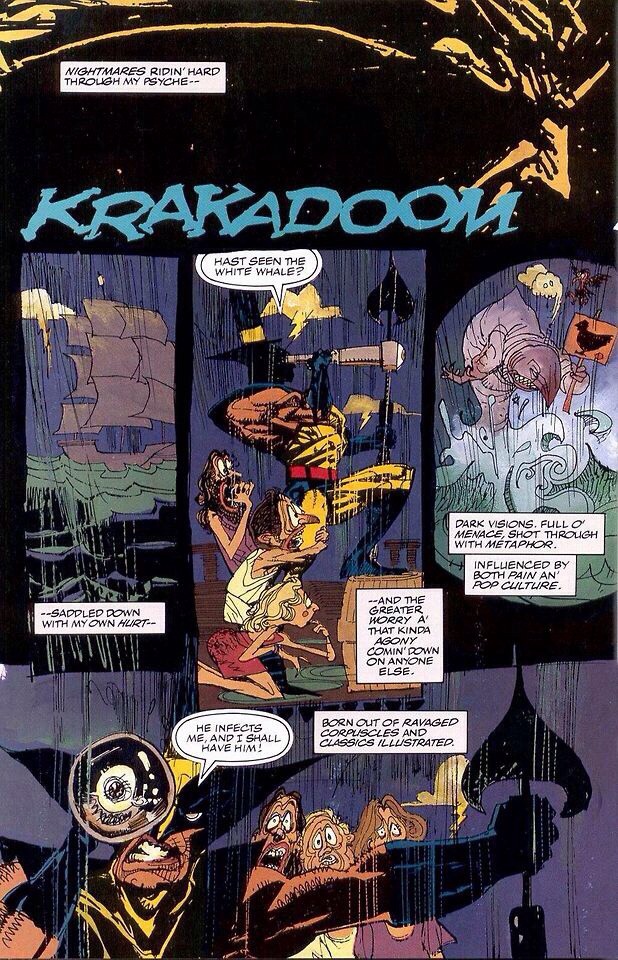
Wolverine/Moby-Dick (Bill Sienkiewicz)

IMG_0085.JPG

Meeting of Thirty-Five Heads of Expression — Louis Léopold Boilly

“The Undertaker’s Chat” — Mark Twain

“Now that corpse,” said the undertaker, patting the folded hands of deceased approvingly, “was a brick—every way you took him he was a brick. He was so real accommodating, and so modest-like and simple in his last moments. Friends wanted metallic burial-case—nothing else would do. I couldn’t get it. There warn’t going to be time—anybody could see that.

“Corpse said never mind, shake him up some kind of a box he could stretch out in comfortable, he warn’t particular ’bout the general style of it. Said he went more on room than style, anyway in a last final container.

“Friends wanted a silver door-plate on the coffin, signifying who he was and wher’ he was from. Now you know a fellow couldn’t roust out such a gaily thing as that in a little country-town like this. What did corpse say?

“Corpse said, whitewash his old canoe and dob his address and general destination onto it with a blacking-brush and a stencil-plate, ‘long with a verse from some likely hymn or other, and p’int him for the tomb, and mark him C. O. D., and just let him flicker. He warn’t distressed any more than you be—on the contrary, just as ca’m and collected as a hearse-horse; said he judged that wher’ he was going to a body would find it considerable better to attract attention by a picturesque moral character than a natty burial-case with a swell door-plate on it.

“Splendid man, he was. I’d druther do for a corpse like that ‘n any I’ve tackled in seven year. There’s some satisfaction in buryin’ a man like that. You feel that what you’re doing is appreciated. Lord bless you, so’s he got planted before he sp’iled, he was perfectly satisfied; said his relations meant well, perfectly well, but all them preparations was bound to delay the thing more or less, and he didn’t wish to be kept layin’ around. You never see such a clear head as what he had—and so ca’m and so cool. Jist a hunk of brains—that is what he was. Perfectly awful. It was a ripping distance from one end of that man’s head to t’other. Often and over again he’s had brain-fever a-raging in one place, and the rest of the pile didn’t know anything about it—didn’t affect it any more than an Injun Insurrection in Arizona affects the Atlantic States. Well, the relations they wanted a big funeral, but corpse said he was down on flummery—didn’t want any procession—fill the hearse full of mourners, and get out a stern line and tow him behind. He was the most down on style of any remains I ever struck. A beautiful, simpleminded creature—it was what he was, you can depend on that. He was just set on having things the way he wanted them, and he took a solid comfort in laying his little plans. He had me measure him and take a whole raft of directions; then he had the minister stand up behind a long box with a table-cloth over it, to represent the coffin, and read his funeral sermon, saying ‘Angcore, angcore!’ at the good places, and making him scratch out every bit of brag about him, and all the hifalutin; and then he made them trot out the choir, so’s he could help them pick out the tunes for the occasion, and he got them to sing ‘Pop Goes the Weasel,’ because he’d always liked that tune when he was downhearted, and solemn music made him sad; and when they sung that with tears in their eyes (because they all loved him), and his relations grieving around, he just laid there as happy as a bug, and trying to beat time and showing all over how much he enjoyed it; and presently he got worked up and excited, and tried to join in, for, mind you, he was pretty proud of his abilities in the singing line; but the first time he opened his mouth and was just going to spread himself his breath took a walk.

“I never see a man snuffed out so sudden. Ah, it was a great loss—a powerful loss to this poor little one-horse town. Well, well, well, I hain’t got time to be palavering along here—got to nail on the lid and mosey along with him; and if you’ll just give me a lift we’ll skeet him into the hearse and meander along. Relations bound to have it so—don’t pay no attention to dying injunctions, minute a corpse’s gone; but, if I had my way, if I didn’t respect his last wishes and tow him behind the hearse I’ll be cuss’d. I consider that whatever a corpse wants done for his comfort is little enough matter, and a man hain’t got no right to deceive him or take advantage of him; and whatever a corpse trusts me to do I’m a-going to do, you know, even if it’s to stuff him and paint him yaller and keep him for a keepsake—you hear me!”

He cracked his whip and went lumbering away with his ancient ruin of a hearse, and I continued my walk with a valuable lesson learned—that a healthy and wholesome cheerfulness is not necessarily impossible to any occupation. The lesson is likely to be lasting, for it will take many months to obliterate the memory of the remarks and circumstances that impressed it.

By Mark Twain. From Sketches New and Old.

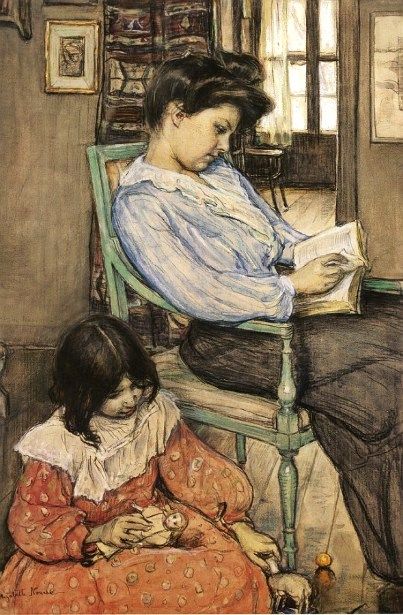
The Reader — Harold Knight

(c) John Croft; Supplied by The Public Catalogue Foundation

The story of the Fisher King

Mickey Mouse — Jack Kirby

IMG_0084.JPG

Hemingway’s regard for T. S. Eliot, as a poet, a critic, and a man (David Markson)

IMG_0087.PNG

Untitled — Zdislav Beksinski

“James Joyce” — James Huneker

“James Joyce,” a chapter from James Huneker’s collection of criticism, Unicorns (1917).

Who is James Joyce? is a question that was answered by John Quinn, who told us that the new writer was from Dublin and at present residing in Switzerland; that he is not in good health—his eyes trouble him—and that he was once a student in theology, but soon gave up the idea of becoming a priest. He is evidently a member of the new group of young Irish writers who see their country and countrymen in anything but a flattering light. Ireland, surely the most beautiful and most melancholy island on the globe, is not the Isle of Saints for those iconoclasts. George Moore is a poet who happens to write English, though he often thinks in French; Bernard Shaw, notwithstanding his native wit, is of London and the Londoners; while Yeats and Synge are essentially Celtic, and both poets. Yes, and there is the delightful James Stephen, who mingles angels’ pin-feathers with rainbow gold; a magic decoction of which we never weary. But James Joyce, potentially a poet, and a realist of the De Maupassant breed, envisages Dublin and the Dubliners with a cruel scrutinising gaze. He is as truthful as Tchekov, and as grey—that Tchekov compared with whose the “realism” of De Maupassant is romantic bric-à-brac, gilded with a fine style. Joyce is as implacably naturalistic as the Russian in his vision of the sombre, mean, petty, dusty commonplaces of middle-class life, and he sometimes suggests the Frenchman in his clear, concise, technical methods. The man is indubitably a fresh talent.

Emerson, after his experiences in Europe, became an armchair traveller. He positively despised the idea of voyaging across the water to see what is just as good at home. He calls Europe a tapeworm in the brain of his countrymen. “The stuff of all countries is just the same.” So Ralph Waldo sat in his chair and enjoyed thinking about Europe, thus evading the worries of going there too often. It has its merit, this Emersonian way, particularly for souls easily disillusioned. To anticipate too much of a foreign city may result in disappointment. We have all had this experience. Paris resembles Chicago, or Vienna is a second Philadelphia at times; it depends on the colour of your mood. Few countries have been so persistently misrepresented as Ireland. It is lauded to the eleventh heaven of the Burmese or it is a place full of fighting devils in a hell of crazy politics. Of course, it is neither, nor is it the land of Lover and Lever; Handy Andy and Harry Lorrequer are there, but you never encounter them in Dublin. John Synge got nearer to the heart of the peasantry, and Yeats and Lady Gregory brought back from the hidden spaces fairies and heroes.

Is Father Ralph by Gerald O’Donovan a veracious picture of Irish priesthood and college life? Is the fiction of Mr. Joyce representative of the middle class and of the Jesuits? A cloud of contradictory witnesses passes across the sky. What is the Celtic character? Dion Boucicault’s The Shaughraun? Or isn’t the pessimistic dreamer with the soul of a “wild goose,” depicted in George Moore’s story, the real man? Celtic magic, cried Matthew Arnold. He should have said, Irish magic, for while the Irishman is a Celt, he is unlike his brethren across the Channel. Perhaps he is nearer to the Sarmatian than the continental Celt. Ireland and Poland! The Irish and the Polish! Dissatisfied no matter under which king! Not Playboys of the Western World, but martyrs to their unhappy temperaments. Continue reading ““James Joyce” — James Huneker”

An Hour of Leisure — Elisabeth Nourse

woman reading

Countryside With Saint George Fighting the Dragon — Albrecht Altdorfer

Out of Focus

Sancho Finds Trees full of Hanged Men — Gustave Doré

“Housekeeping Observation” — Lydia Davis

Capture

Poster for Jodorowsky’s The Holy Mountain — Florian Bertmer

FlorianBertmerTheHolyMountain

“Dreams” — Guy de Maupassant

“Dreams”

by

Guy de Maupassant

They had just dined together, five old friends, a writer, a doctor and three rich bachelors without any profession.

They had talked about everything, and a feeling of lassitude came over them, that feeling which precedes and leads to the departure of guests after festive gatherings. One of those present, who had for the last five minutes been gazing silently at the surging boulevard dotted with gas-lamps, with its rattling vehicles, said suddenly:

“When you’ve nothing to do from morning till night, the days are long.”

“And the nights too,” assented the guest who sat next to him. “I sleep very little; pleasures fatigue me; conversation is monotonous. Never do I come across a new idea, and I feel, before talking to any one, a violent longing to say nothing and to listen to nothing. I don’t know what to do with my evenings.”

The third idler remarked:

“I would pay a great deal for anything that would help me to pass just two pleasant hours every day.”

The writer, who had just thrown his overcoat across his arm, turned round to them, and said:

“The man who could discover a new vice and introduce it among his fellow creatures, even if it were to shorten their lives, would render a greater service to humanity than the man who found the means of securing to them eternal salvation and eternal youth.”

The doctor burst out laughing, and, while he chewed his cigar, he said:

“Yes, but it is not so easy to discover it. Men have however crudely, been seeking for—and working for the object you refer to since the beginning of the world. The men who came first reached perfection at once in this way. We are hardly equal to them.”

One of the three idlers murmured:

“What a pity!”

Then, after a minute’s pause, he added:

“If we could only sleep, sleep well, without feeling hot or cold, sleep with that perfect unconsciousness we experience on nights when we are thoroughly fatigued, sleep without dreams.”

“Why without dreams?” asked the guest sitting next to him.

The other replied:

“Because dreams are not always pleasant; they are always fantastic, improbable, disconnected; and because when we are asleep we cannot have the sort of dreams we like. We ought to dream waking.”

“And what’s to prevent you?” asked the writer.

The doctor flung away the end of his cigar.

“My dear fellow, in order to dream when you are awake, you need great power and great exercise of will, and when you try to do it, great weariness is the result. Now, real dreaming, that journey of our thoughts through delightful visions, is assuredly the sweetest experience in the world; but it must come naturally, it must not be provoked in a painful, manner, and must be accompanied by absolute bodily comfort. This power of dreaming I can give you, provided you promise that you will not abuse it.”

The writer shrugged his shoulders:

“Ah! yes, I know—hasheesh, opium, green tea—artificial paradises. I have read Baudelaire, and I even tasted the famous drug, which made me very sick.”

But the doctor, without stirring from his seat, said:

“No; ether, nothing but ether; and I would suggest that you literary men should use it sometimes.”

The three rich bachelors drew closer to the doctor.

One of them said:

“Explain to us the effects of it.”

And the doctor replied:

“Let us put aside big words, shall we not? I am not talking of medicine or morality; I am talking of pleasure. You give yourselves up every day to excesses which consume your lives. I want to indicate to you a new sensation, possible only to intelligent men—let us say even very intelligent men—dangerous, like everything else that overexcites our organs, but exquisite. I might add that you would require a certain preparation, that is to say, practice, to feel in all their completeness the singular effects of ether.

“They are different from the effects of hasheesh, of opium, or morphia, and they cease as soon as the absorption of the drug is interrupted, while the other generators of day dreams continue their action for hours.

“I am now going to try to analyze these feelings as clearly as possible. But the thing is not easy, so facile, so delicate, so almost imperceptible, are these sensations.

“It was when I was attacked by violent neuralgia that I made use of this remedy, which since then I have, perhaps, slightly abused.

“I had acute pains in my head and neck, and an intolerable heat of the skin, a feverish restlessness. I took up a large bottle of ether, and, lying down, I began to inhale it slowly.

“At the end of some minutes I thought I heard a vague murmur, which ere long became a sort of humming, and it seemed to me that all the interior of my body had become light, light as air, that it was dissolving into vapor.

“Then came a sort of torpor, a sleepy sensation of comfort, in spite of the pains which still continued, but which had ceased to make themselves felt. It was one of those sensations which we are willing to endure and not any of those frightful wrenches against which our tortured body protests.

“Soon the strange and delightful sense of emptiness which I felt in my chest extended to my limbs, which, in their turn, became light, as light as if the flesh and the bones had been melted and the skin only were left, the skin necessary to enable me to realize the sweetness of living, of bathing in this sensation of well-being. Then I perceived that I was no longer suffering. The pain had gone, melted away, evaporated. And I heard voices, four voices, two dialogues, without understanding what was said. At one time there were only indistinct sounds, at another time a word reached my ear. But I recognized that this was only the humming I had heard before, but emphasized. I was not asleep; I was not awake; I comprehended, I felt, I reasoned with the utmost clearness and depth, with extraordinary energy and intellectual pleasure, with a singular intoxication arising from this separation of my mental faculties.

“It was not like the dreams caused by hasheesh or the somewhat sickly visions that come from opium; it was an amazing acuteness of reasoning, a new way of seeing, judging and appreciating the things of life, and with the certainty, the absolute consciousness that this was the true way.

“And the old image of the Scriptures suddenly came back to my mind. It seemed to me that I had tasted of the Tree of Knowledge, that all the mysteries were unveiled, so much did I find myself under the sway of a new, strange and irrefutable logic. And arguments, reasonings, proofs rose up in a heap before my brain only to be immediately displaced by some stronger proof, reasoning, argument. My head had, in fact, become a battleground of ideas. I was a superior being, armed with invincible intelligence, and I experienced a huge delight at the manifestation of my power.

“It lasted a long, long time. I still kept inhaling the ether from my flagon. Suddenly I perceived that it was empty.”

The four men exclaimed at the same time:

“Doctor, a prescription at once for a liter of ether!”

But the doctor, putting on his hat, replied:

“As to that, certainly not; go and let some one else poison you!”

And he left them.

Ladies and gentlemen, what is your opinion on the subject?