
“Good-bye to the Fruits”
by
John Barth
I agreed to die, stipulating only that I first be permitted to rebehold and bid good-bye to those of Earth’s fruits that I had particularly enjoyed in my not-extraordinary lifetime.
What I had in mind, in the first instance, was such literal items as apples and oranges. Of the former, the variety called Golden Delicious had long been my favorite, especially those with a blush of rose on their fetchingly speckled yellow-green cheeks. Of the latter–but then, there’s no comparing apples to oranges, is there, nor either of those to black plums: truly incomparable, in my opinion, on the rare occasions when one found them neither under- nor overripe. Good-bye to all three, alas; likewise to bananas, whether sliced transversely atop unsweetened breakfast cereal, split longitudinally under scoops of frozen yogurt, barbecued in foil with chutney, or blended with lime juice, rum, and Cointreau into frozen daiquiris on a Chesapeake August late afternoon.
Lime juice, yes: Farewell, dear zesty limes, squeezed into gins-and-tonics before stirring and over bluefish filets before grilling; adieu too to your citric cousins the lemons, particularly those with the thinnest of skins, always the most juiceful, without whose piquance one could scarcely imagine fresh seafood, and whose literal zest was such a challenge for us kitchen-copilots to scrape a half-tablespoonsworth of without getting the bitter white underpeel as well. Adieu to black seedless grapes for eating with ripe cheeses and to all the nobler stocks for vinting, except maybe Chardonnay. I happened not to share the American yuppie thirst for Chardonnay; too over-flavored for my palate. Give me a plain light dry Chablis any time instead of Chardonnay, if you can find so simple a thing on our restaurant wine-lists these days. And whatever happened to soft dry reds that don’t cost an arm and a leg on the one hand, so to speak, or, on the other, taste of iron and acetic acid? But this was no time for such cavils: Good-bye, blessed fruit of the vineyard, a dinner without which was like a day without et cetera. Good-bye to the fruits of those other vines, in particular the strawberry, if berries are properly to be called fruits, the tomato, and the only melon I would really miss, our local cantaloupe. Good-bye to that most sexual of fruits, the guava; to peaches, plantains (fried), pomegranates, and papayas; to the fruits of pineapple field and coconut tree, if nuts are fruits and coconuts nuts, and of whatever it is that kiwis grow on. As for pears, I had always thought them better canned than fresh, as Hemingway’s Nick Adams says of apricots in the story “Big Two-Hearted River”–but I couldn’t see kissing a can good-bye, so I guessed that just about did the fruits (I myself preferred my apricots sun-dried rather than either fresh or canned).
Month: September 2014
The Forest of Suicides — Salvador Dali
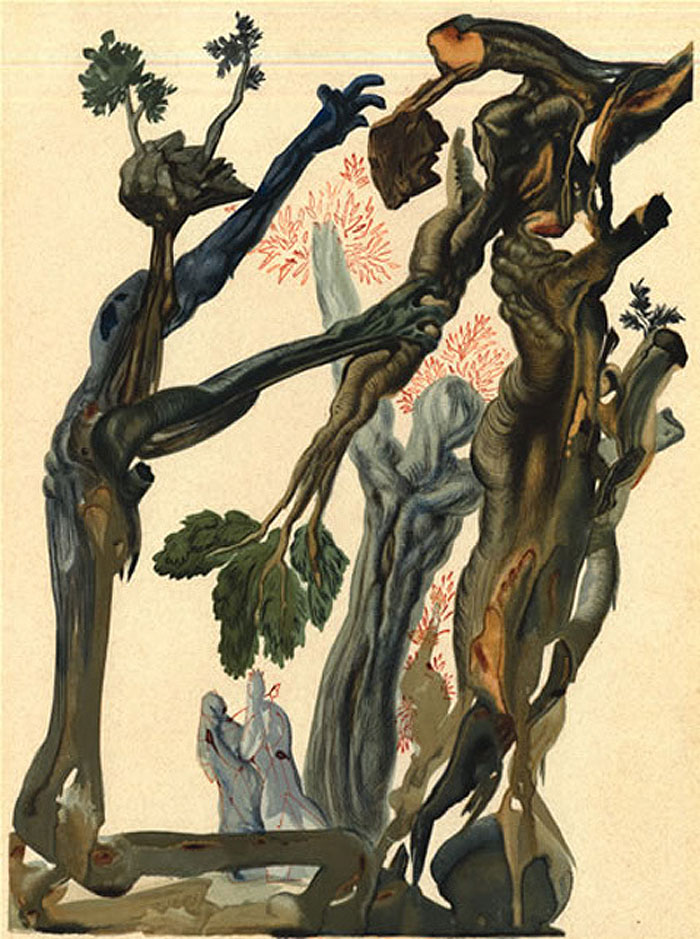
Portrait of Gina Severini — Gino Severini
List with No Name #47
- Charles Weedon Westover killed himself on February 8th, 1990.
- He was 55.
- He shot himself in the head with a .22-caliber rifle.
- Between the eye and the ear.
- The right eye and the right ear.
- The temple.
- Charles Weedon Westover was better known by his stage name, Del Shannon.
- The name printed on his death certificate is “Charles Weedon Westover” though.
- CWW found success as Del Shannon, performing and recording the song “Runaway.”
- The 7″ 45rpm recording of “Runaway” became a number one Billboard hit in the United States of America in February of 1961.
- “Runaway” was the number one hit in America for four weeks.
- It was later a number one hit in the United Kingdom.
- And Australia.
- But it was not a number one hit in 1967, when CWW as Del Shannon rerecorded it as “Runaway ’67.”
- In fact, “Runaway ’67” failed to chart.
- CWW, under the name Del Shannon, wrote “Runaway” with Max Crook.
- Crook played the strange, dark, jaunty, bipolar solo in “Runaway.”
- Crook played the solo on a musical instrument of his own invention, a type of early electronic synthesizer he called the Musitron.
- Crook’s Musitron was a modified version of an earlier synthesizer, the clavioline (similar, of course, to an ondioline).
- Perhaps Crook’s most significant modification was adding reverb to his organ via a custom-built echo chamber that incorporated garden gate springs.
- Crook’s solo is the haunting spirit of a haunting song.
- Or maybe the haunting spirit is actually CWW/DS’s falsetto, which cracks through the piano and baritone sax approximately 45 seconds into the song, announcing that the narrator wah-wah-wah-wah-wonders why why why why why why she ran away.
- The lyric is simple but also dark, portentous, loaded with a primal anxiety that hints at outright menace.
- Why a “runaway”?
- Why did she run away?
- And why does the narrator want her there with him, walking in the rain?
- (To end this misery).
- CWW continued recording and performing as Del Shannon for the rest of his life.
- His final performance was in Fargo, ND, not a week before his suicide.
- Of course he sang “Runaway” there.
- It was his biggest hit.
- None of his other songs came even close.
- He did the alcoholic thing, the drug addict thing, and then the AA thing.
- He was, by all accounts, a life-long manic depressive.
- And many claimed a kind man.
- A generous man.
- He played “Runaway” on the David Letterman Show in 1986, shouting the song but hitting the falsetto.
- (Back in 1961, Harry Balk, who produced “Runaway,” had to speed up the recording–from an A minor to a B flat–to match CWW’s vocal–he was nervous and flat).
- Shirley Westover, his wife of 31 years, had left him the year before his Letterman appearance.
- CWW remarried in 1987. He married a neighbor’s daughter, Bonnie Tyson (also known as LeAnne Gutierrez), who was half his age at the time of the marriage.
- Bonnie found CWW’s body.
- Slumped in a rocking chair, wearing his bathrobe but not his hair piece.
- He was working on music with Tom Petty and Jeff Lynne around the time of his death.
- And clearly a Wilbury in spirit.
- CWW has no grave.
Faust — Rembrandt

A Nancy strip by Chris Ware
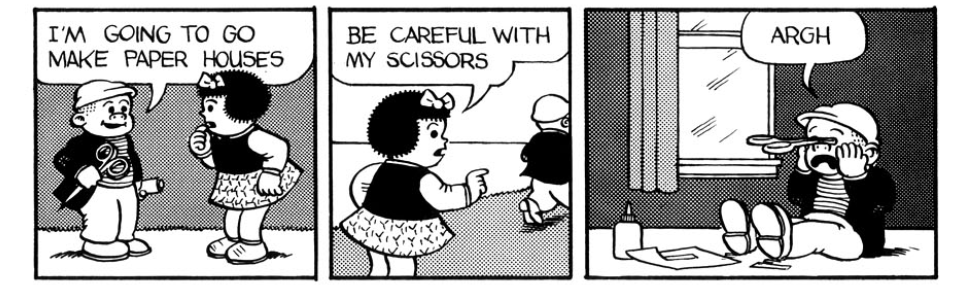
From Acme Novelty Library #3
You tell a story because a statement would be inadequate (Flannery O’Connor)
When you can state the theme of a story, when you can separate it from the story itself, then you can be sure the story is not a very good one. The meaning of a story has to be embodied in it, has to be made concrete in it. A story is a way to say something that can’t be said any other way, and it takes every word in the story to say what the meaning is. You tell a story because a statement would be inadequate. When anybody asks what a story is about, the only proper thing is to tell him to read the story. The meaning of fiction is not abstract meaning but experienced meaning, and the purpose of making statements about the meaning of a story is only to help you experience that meaning more fully.
From Flannery O’Connor’s essay “Writing Short Stories.” Collected in Mystery and Manners.
The Wood of the Self-Murderers: The Harpies and the Suicides — William Blake

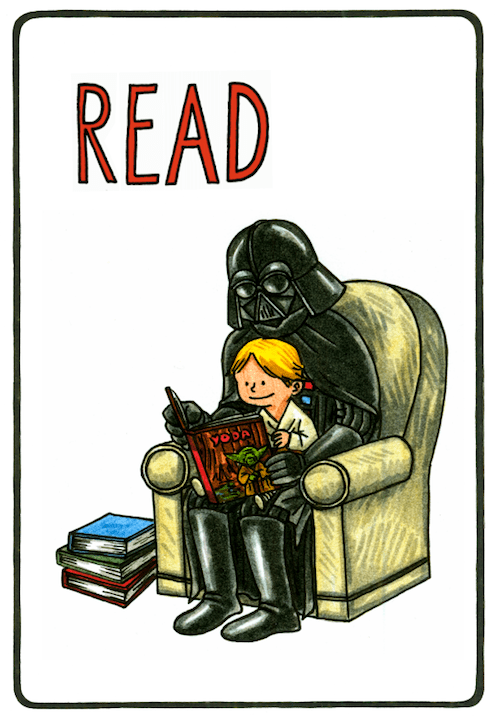
Read — Jeffrey Brown
“Biological Supremacy” — Tom Clark

“minipops 67 [120.2][source field mix],” a new Aphex Twin jam
Dmitry Samarov’s Where To? (Book Acquired, 8.22.2014)
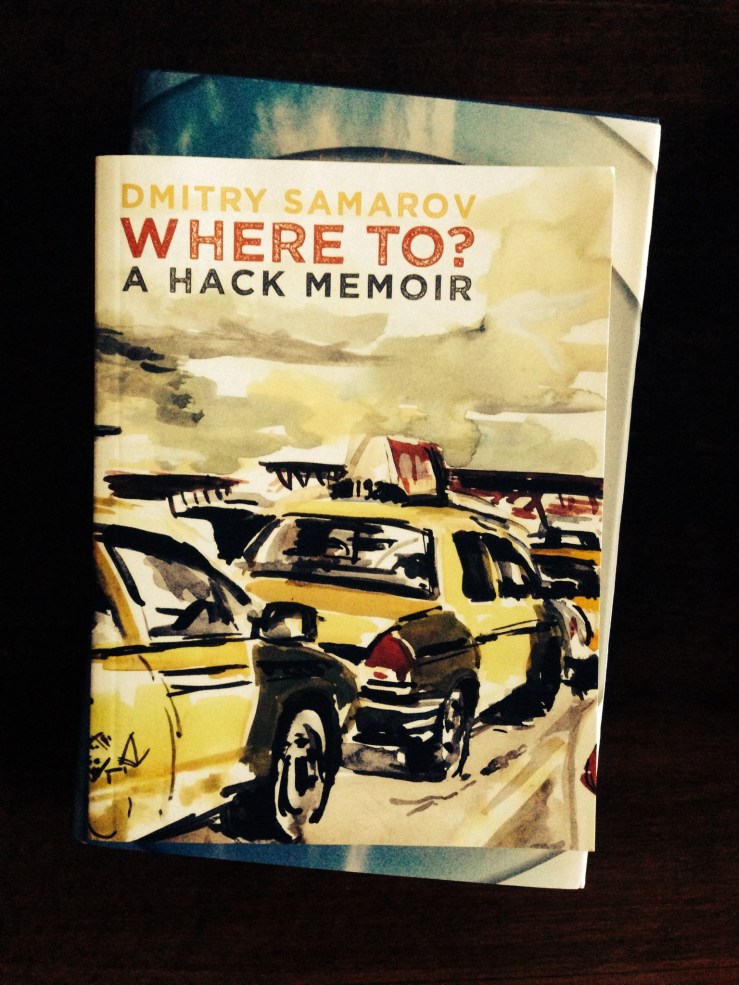
Where To? A Hack Memoir is Dmitry Samarov’s sequel to Hack.
Publisher Curbside Splendor’s blurb:
Dmitry Samarov’s illustrated memoir captures encounters with drunken passengers, overbearing cops, unreasonable city bureaucracy, his fellow cabdrivers, a few potholes, and other unexpectedly beautiful moments. Accompanied by dozens of Samarov’s original artworks—composed during traffic jams, waits at the airport, and lulls in his shifts—the stories in Where To? provide a street-level view of America from the perspective of an immigrant painter driving a cab for money.
I interviewed Dmitry about his art and his writing a few years ago, and he described Hack:
Hack started as a zine around 2000 as a way for me to make sense of my three years driving a cab in Boston (1993-1997). It was called Hack because the license to operate a taxi in Boston was called a Hackney Carriage License and they used to call cabbies hacks in the old days. It was my first attempt at writing outside of school homework assignments and there really wasn’t much writing, it was mostly pictures. Those pictures were a challenge too because, as I’ve said, I work primarily from direct observation and the only way to do these were from memory. These illustrations were made to work together with the words, not to stand on their own and that has continued to be the case through the whole history of Hack.
I started driving a taxi in Chicago in 2003 and revived Hack as a blog late in 2006. To my surprise, it got notice pretty quickly from some in the local press—Whet Moser, then of theChicago Reader especially—-and my high school pal John Hodgman mentioning it in a magazine didn’t hurt either. That got it noticed by a publicist at University of Chicago Press named Levi Stahl. He bought a copy of my self-published compilation (see the third one down) and eventually pitched Hack as a book to his employers. They published it in October 2011.
Pine Forest II — Gustav Klimt

“Indiscretion” — Guy de Maupassant
“Indiscretion”
by
Guy de Maupassant
They had loved each other before marriage with a pure and lofty love. They had first met on the sea-shore. He had thought this young girl charming, as she passed by with her light-colored parasol and her dainty dress amid the marine landscape against the horizon. He had loved her, blond and slender, in these surroundings of blue ocean and spacious sky. He could not distinguish the tenderness which this budding woman awoke in him from the vague and powerful emotion which the fresh salt air and the grand scenery of surf and sunshine and waves aroused in his soul.
She, on the other hand, had loved him because he courted her, because he was young, rich, kind, and attentive. She had loved him because it is natural for young girls to love men who whisper sweet nothings to them.
So, for three months, they had lived side by side, and hand in hand. The greeting which they exchanged in the morning before the bath, in the freshness of the morning, or in the evening on the sand, under the stars, in the warmth of a calm night, whispered low, very low, already had the flavor of kisses, though their lips had never met.
Each dreamed of the other at night, each thought of the other on awaking, and, without yet having voiced their sentiments, each longer for the other, body and soul.
After marriage their love descended to earth. It was at first a tireless, sensuous passion, then exalted tenderness composed of tangible poetry, more refined caresses, and new and foolish inventions. Every glance and gesture was an expression of passion. Continue reading ““Indiscretion” — Guy de Maupassant”
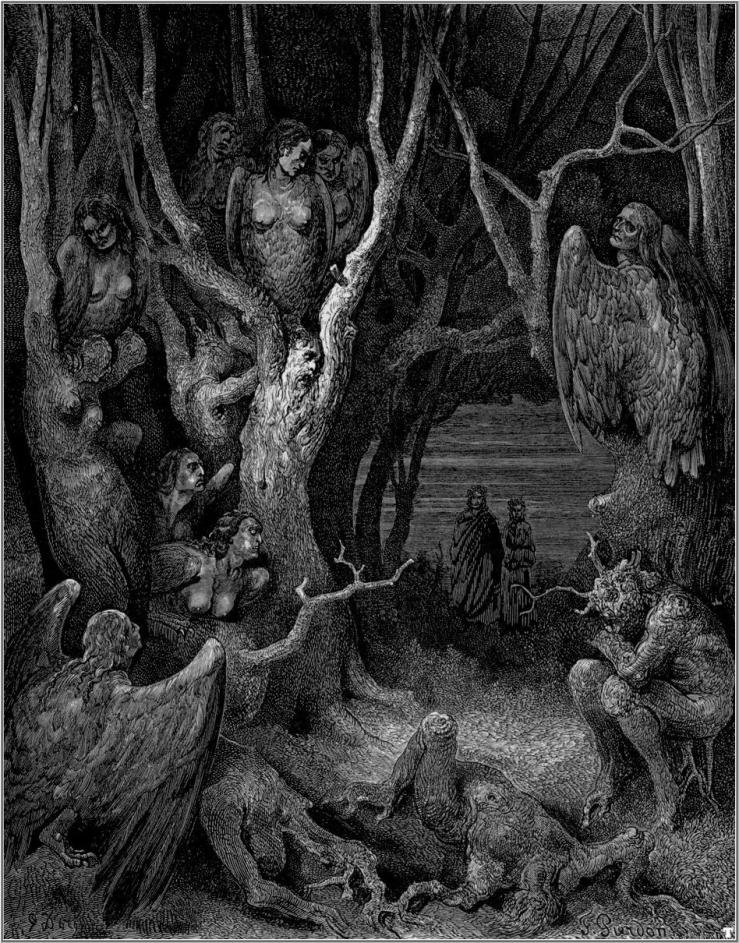
Harpies in the Forest of Suicides — Gustave Doré
Still Life and Street — M.C. Escher

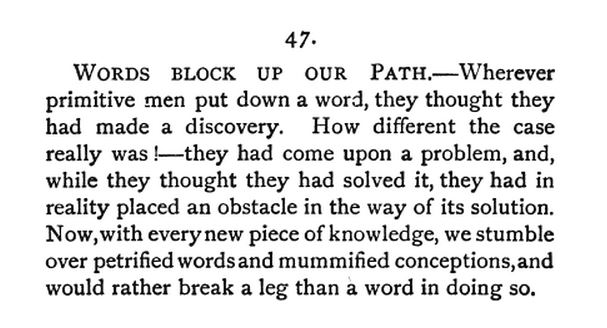
Words block up our path (Nietzsche)
 Biblioklept