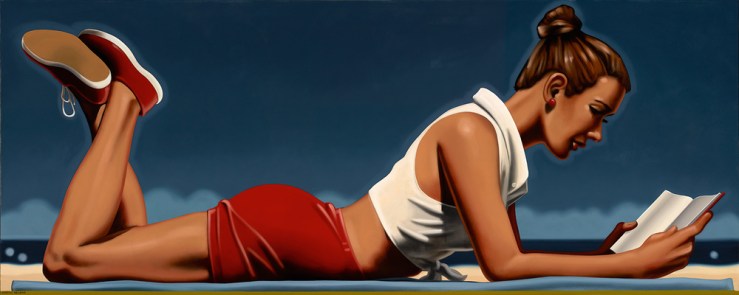
The Vision — Kenton Nelson

TheVision

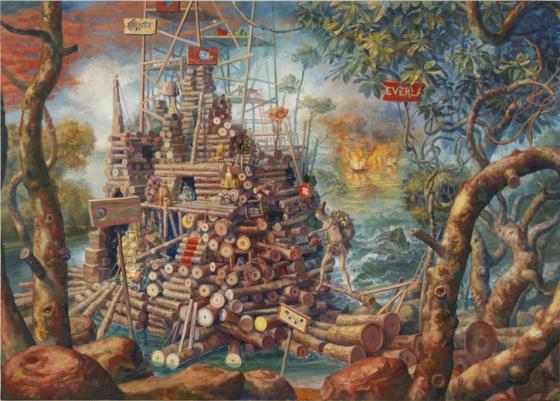
Self Portrait as Emergency Shipwright — Julie Heffernan

Emergency shipwright cropped

What’s got into you? | Ventriloquism in Doris Lessing’s novel The Golden Notebook

In Doris Lessing’s novel The Golden Notebook, Marion Portmain, a housewife neglected by her husband, resolves that she will begin to live her life with the aim of helping other people. Marion believes that this change is a major breakthrough in her life, a moment to claim agency for herself and to find her own authentic voice in a world where she has been silenced and ignored.

She asks her friend, the book’s protagonist Anna Wulf for the address of an imprisoned South African political activist:

‘Do you remember that black leader, the African man you used to know? Mathews, or something like that?’

This was not at all what Anna had expected. ‘You don’t mean Tom Mathlong?’Marion had actually taken out a notebook and was sitting with a poised pencil.

Marion has taken up her own notebook, a parallel to the colored notebooks that Anna keeps to impose some semblance of order—or at least to contain—the chaos of modernity.

Anna protests Marion’s request; she implicitly condescends Marion’s naïvety and myopic worldview:

‘But Marion…’ Anna looked at Marion, trying to make contact with the woman she had been talking to only a few minutes before. She was met by a gaze from brown eyes glazed with a guilty but happy hysteria. Anna went on, firmly: ‘It’s not a nice organized prison like Brixton or somewhere like that. It’s probably a shack in the bush, hundreds of miles from anywhere, about fifty political prisoners, and very likely they don’t even get letters. What did you think?—that they had visiting days and rights and things like that?’

And here is where the scene becomes particularly intriguing for me, as Anna begins to break down the various sources that ventriloquize Marion’s “new” consciousness: 

Marion pouted and said: ‘I think that’s an awfully negative attitude to take about the poor things.’

Anna thought: negative attitude is Tommy’s—echoes from the Communist Party; but poor things is all Marion’s—probably her mother and sisters give old clothes to charities.

For Anna, Marion’s (attempt at) a new outlook is merely the weak synthesis of the language of Marion’s stepson’s communism with the stock-phrases of her aristocratic family’s noblesse oblige. Anna does not accept Marion’s “transformation” as authentic, but rather the product of tuning in new voices. 

As Marion continues, Anna analyzes her speech, her unvoiced comments interposed in parentheses that name the news sources from which Marion has “clipped” her thoughts:

‘I mean,’ said Marion happily, ‘it’s a continent in chains, well, isn’t it?’ (Tribune, thought Anna; or possibly the Daily Worker.) ‘And measures ought to be taken immediately to restore the Africans’ faith in justice if it is not already too late.’ (The New Statesman, thought Anna.) ‘Well at least the situation ought to be thoroughly gone into in the interests of everybody.’ (The Manchester Guardian, at a time of acute crisis.) ‘But Anna, I don’t understand your attitude. Surely you’ll admit there’s evidence that something’s gone wrong?’ (The Times, editorializing a week after the news that the white administration has shot twenty Africans and imprisoned fifty more without trial.)

‘Marion, what’s got into you?

This scene responds to an earlier section of The Golden Notebook (I wrote before about it here) in which Anna’s note-book becomes pure collage: She no longer writes in her own “original” language, but rather cuts fragments from newspapers and pastes them directly into her diary. The section highlights (and rhetorically demonstrates) the novel’s theme of the disintegration of language, meaning, and order—one of the central problems of postmodernist literature.

Anna’s question to Marion at the end of the passage I’ve cited — “What’s got into you?” — is a banal commonplace, yet utterly sincere, authentic—-and all the more authentic for its underlying irony: Anna has already decided what’s “got into” Marion (The Tribune, The Daily Worker, etc.). 

Lessing’s passage here underscores just how susceptible we are to not-knowing, just at the moment when we feel most confident in our belief. Marion feels wholly authentic here, feels her way-of-seeing as rich, full, clear, alive—but it’s this very feeling of clarity that blinds her from seeing herself (seeing herself) parroting back the stock language of the sources that have infiltrated her consciousness.

Anna is far more attuned to her own self-blindness; indeed, her color-coded notebooks are a means to account for the discursive narratives that might try to give shape to the messiness of consciousness. In one extended episode, Anna attempts to write a complete narrative of a particular day, but as she repeatedly notes, her awareness of her project leads to such a heightened self-consciousness that every observation she makes about the day is placed under radical suspicion—she sees that she sees herself seeing (herself), but, intuiting her consciousness’ structure, also understands that there are ways in which she cannot see herself seeing (herself).

Can Anna’s realization of the limitations of first-person-perspective help to free her? I have not yet finished the novel, but so far, Lessing depicts the question as a deep, painful struggle. Anna grapples with a disintegrating sense of self, a self that can identify (and cut out and paste and record and document) the voices that have “got into” her, even as those voices destabilize her identity.

“All art constantly aspires towards the condition of music”

The Dream of Saffo — Agostino Arrivabene

For me, the word “writing” is the exact opposite of the word “waiting” (Roberto Bolaño)

The truth is, I don’t believe all that much in writing. Starting with my own. Being a writer is pleasant—no, pleasant isn’t the word—it’s an activity that has its share of amusing moments, but I know of other things that are even more amusing, amusing in the same way that literature is for me. Holding up banks, for example. Or directing movies. Or being a gigolo. Or being a child again and playing on a more or less apocalyptic soccer team. Unfortunately, the child grows up, the bank robber is killed, the director runs out of money, the gigolo gets sick and then there’s no other choice but to write. For me, the word “writing” is the exact opposite of the word “waiting.” Instead of waiting, there is writing. Well, I’m probably wrong—it’s possible that writing is another form of waiting, of delaying things. I’d like to think otherwise. But, as I said, I’m probably wrong.

Roberto Bolaño, in a 2001 email interview with Carmen Boullosa. First published in Bomb and then collected in Melville House’s The Last Interview.


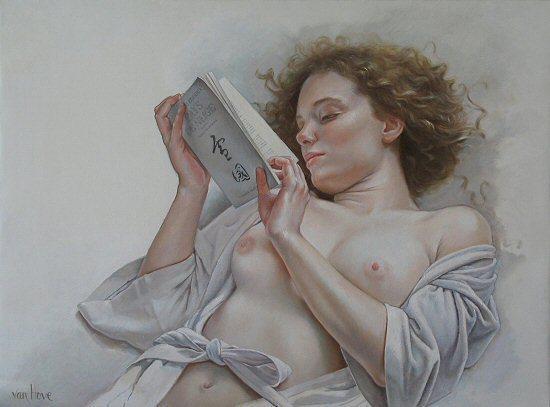
Snow — Francine van Hove

francine-van-hove-neiges

The Reverse of a Framed Painting — Cornelis Norbertus Gysbrechts

“The Mockingbird” — Charles Bukowski

IMG_3055

Lovers I — Milan Hrnjazović

Read Barry Hannah’s perfect short story “Even Greenland”

I was sitting radar. Actually doing nothing.

We had been up to seventy-five thousand to give the afternoon some jazz. I guess we were still in Mexico, coming into Mirimar eventually in the F-14. It doesn’t much matter after you’ve seen the curvature of the earth. For a while, nothing much matters at all. We’d had three sunsets already. I guess it’s what you’d call really living the day.

But then, “John,” said I, “this plane’s on fire.”

“I know it,” he said.

John was sort of short and angry about it.

“You thought of last-minute things any?” said I.

“Yeah. I ran out of a couple of things already. But they were cold, like. They didn’t catch the moment. Bad writing,” said John.

“You had the advantage. You’ve been knowing,” said I.

“Yeah. I was going to get a leap on you. I was going to smoke you. Everything you said, it wasn’t going to be good enough,” said he.

“But it’s not like that,” said I. “Is it?”

The wings were turning red. I guess you’d call it red. It was a shade against dark blue that was mystical flamingo, very spaceylike, like living blood. Was the plane bleeding?

“You have a good time in Peru?” said I.

“Not really,” said John. “I got something to tell you. I haven’t had a ‘good time’ in a long time. There’s something between me and a good time since, I don’t know, since I was was twenty-eight or like that. I’ve seen a lot, but you know I haven’t quite seen it. Like somebody’s seen it already. It wasn’t fresh. There were eyes that used it up some.”

“Even high in Mérida?” said I.

“Even,” said John.

“Even Greenland?” said I.

Read the rest of Barry Hannah’s short story “Even Greenland.”

Charles Bukowski on Individuality

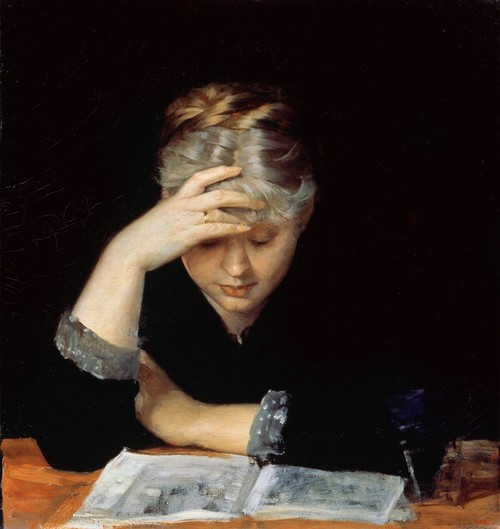
At a Book — Marie Bashkirtseff

at a book

L’Avventura – Michelangelo Antonioni (Full Film)

Syssigy — Leonora Carrington

Syssigy

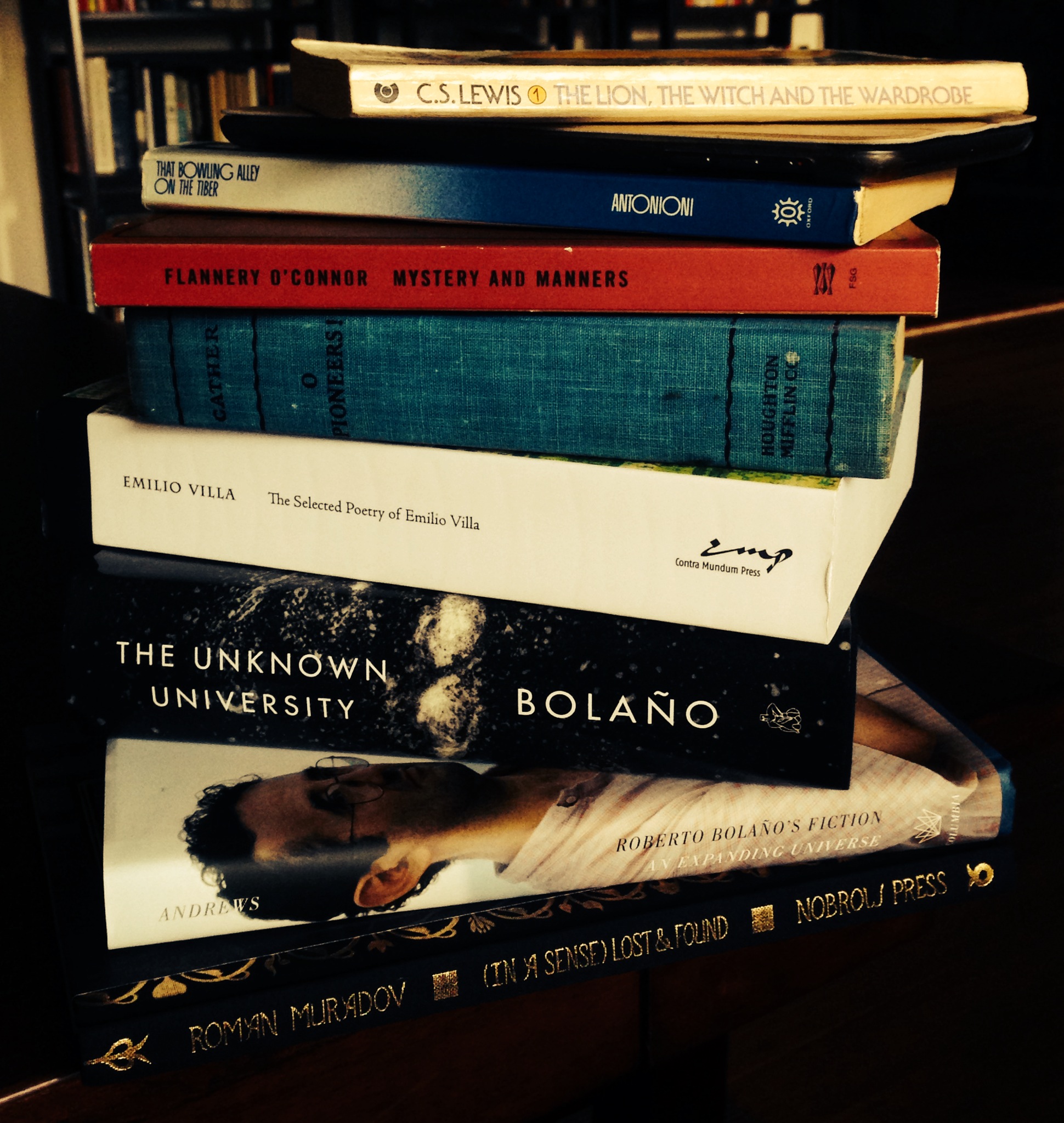
Reading/Have Read/Should Write About

IMG_3050.JPG

Ran out of time this week before I could write about anything I’ve been reading. So a quick riff, from top to bottom, in the pic above:

The Lion, the Witch, and the Wardrobe, C.S. Lewis

I’ve been reading this at night with my seven-year-old daughter. I’ve read it maybe a thousand times now. Lewis is not the best prose stylist, but he fuses together bits of pagan and Christian myth better than the best.

On the iPad:

The Possibility of an Island, Michel Houellebecq

My least-favorite Houellebecq so far—has some wonderful rants at times, but Houellebecq keeps embedding these terrible pop culture references (following his hero Bret Easton Ellis’s lead?) that usually dull the edge he’s been sharpening. And the narrator’s spite at this point is almost unbearable—reading it makes me feel like Gandalfdore drinking that poisonous potion in Harry Potter and the League of Bad Mentorsjust sucking down venom.

The Golden Notebook, Doris Lessing

Great stuff. A little over two-thirds finished. Wrote about is some here.

Lanark, Alasdair Gray

I might regret that I never wrote a Big Fat Review of Lanark, Gray’s bizarre cult novel. The book is a weird chimera: It starts as a weird sci-fi/fantasy trip—closer to Kafka’s The Castle than genre-conventional fare though, to be clear. Then it shifts into this modernist Künstlerroman that seems to want to be a Scottish answer to Joyce’s Portrait. Then there’s a short story inserted in the middle, a return to the dystopian fantasy (heavy streaks of Logan’s Run and Zardoz and Soylent Green—very ’70s!), and, right before its (purposefully) dissatisfying conclusion, an essay by a version of the author, who defensively critiques his novel for characters and readers alike. Gray wants to have written the Great Scottish Epic. I’m not sure if he did, but Lanark has moments that are better than anything I’ve read all year—even if the end result doesn’t hang together so well.

The Bowling Alley on the Tiber, Michelangelo Antonioni

Sketches and figments that Antonioni never turned into films. Not sure if he intended to.

Mystery and Manners, Flannery O’Connor

Good lord.

O Pioneers!, Willa Cather

There’s a tendency in American fiction to posit the American Dream as a masculine escapist fantasy. This version of the Dream is perhaps best expressed in the last lines of The Adventures of Huckleberry Finn, when Huck declares: “But I reckon I got to light out for the territory ahead of the rest, because Aunt Sally she’s going to adopt me and sivilize me, and I can’t stand it. I been there before.” Always more territory, always more space outside of the (maternal) civilizing body. Cather answers to that version of the Dream in her character Alexandra Bergson, who cultivates the land and claims her own agency through commerce and agriculture.

The Selected Poetry of Emilio Villa, translated by Dominic Siracusa

What a strange and wonderful book! I wrote about it here. Confounding.

The Unknown University, Roberto Bolaño

Okay, so I wrote about the first section in detail here. More or less finished it. Bolaño’s best poems are basically prose (that’s not a knock).

Roberto Bolaño’s Fiction: An Expanding Universe, Chris Andrews

Wrote about it a bit here; will write more when I finish. Makes me want to reread Bolaño (although I almost always want to reread Bolaño).

(In a Sense) Lost & Found, Roman Muradov

The plot of Muradov’s debut graphic novel floats like a dream-fog in surreal, rich art as the ludic dialogue refuses to direct the reader to a stable referent. Great stuff.

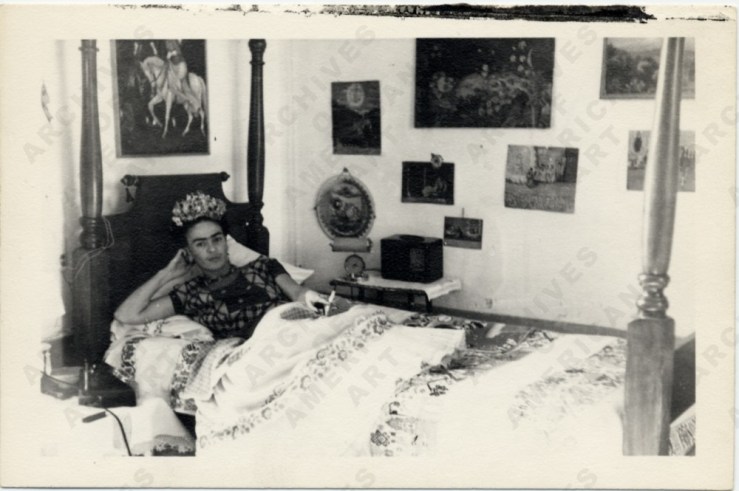
Frida Kahlo reclining on her bed in Coyoacán, Mexico

AAA_daleches_0002