Mumbo Jumbo by Ishmael Reed. 1978 mass market paperback by Bard Books, a division of Avon Books. No designer or illustrator credited. I picked this copy up after giving away the edition I read this summer. An amazing novel.
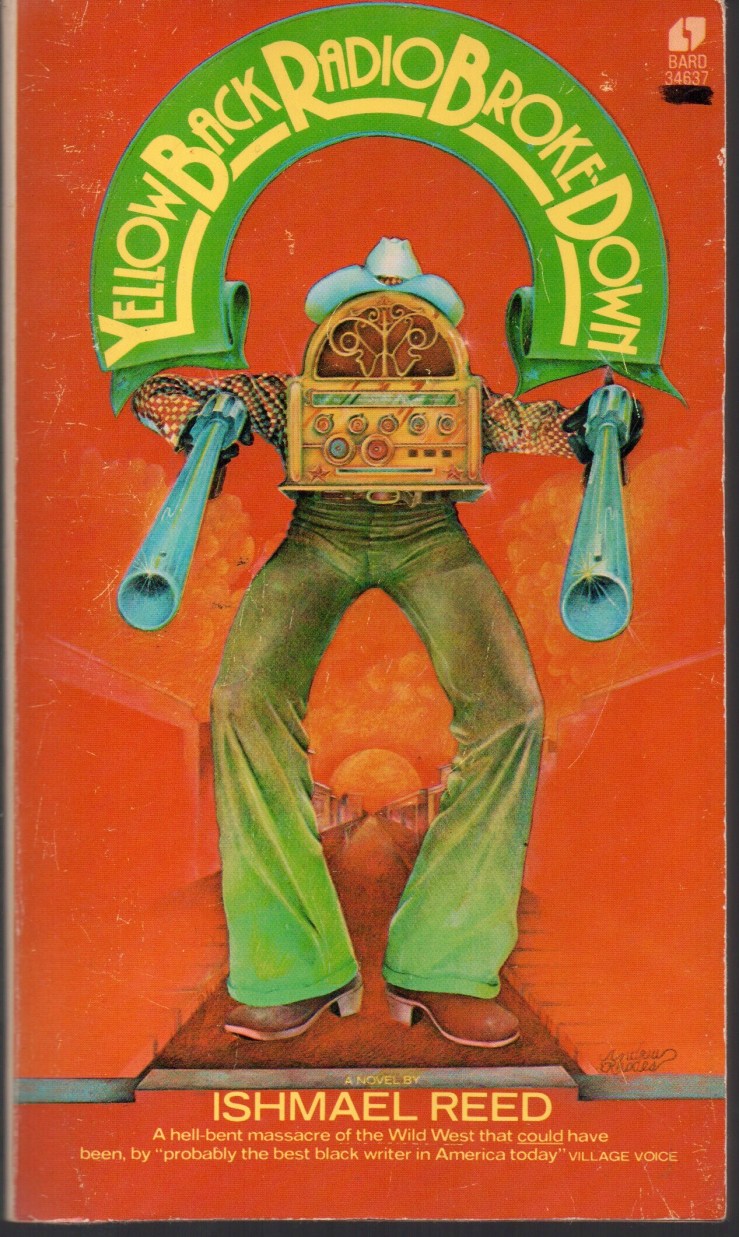
Yellow Back Radio Broke-Down by Ishmael Reed. 1977 mass market paperback by Bard Books, a division of Avon Books. No designer or illustrator credited—but the cover illustration seems to be signed “Andrew Rhodes.” Haven’t read this one yet.The Free-Lance Pallbearers by Ishmael Reed. 1969 mass market paperback by Bantam Books. No designer or illustrator credited. I finished this last week—a slim, strange, dazzling work.
But why, one is driven to ask, why has the tale of terror so special an appeal to Americans? Surely its success must be derived in part from the failure of love in our fiction; the death of love left a vacuum at the affective heart of the American novel into which there rushed the love of death. The triumph of the genteel sentimental incapacitated even our most talented writers, left them incapable of dealing with the relations of men and women as subtly and convincingly as the prose writers in the great novelistic tradition of France. Our novelists, deprived of the subject that sustained Stendhal or Constant, Flaubert or Proust, that seemed indeed to them the subject of the novel, turned to fables of loneliness and terror.
Moreover, in the United States, certain special guilts awaited projection in the gothic form. A dream of innocence had sent Europeans across the ocean to build a new society immune to the compounded evil of the past from which no one else in Europe could ever feel himself free. But the slaughter of the Indians, who would not yield their lands to the carriers of utopia, and the abominations of the slave trade, in which the black man, rum, and money were inextricably entwined in a knot of guilt, provided new evidence that evil did not remain with the world that had been left behind—but stayed alive in the human heart, which had come the long way to America only to confront the horrifying image of itself. Finally, there was the myth of Faust and of the diabolic bargain, which, though not yet isolated from gothic themes of lesser importance (that isolation was to be the word of American writers!), came quite soon to seem identical with the American myth itself.
How could one tell where the American dream ended and the Faustian nightmare began; they held in common the hope of breaking through all limits and restraints, of reaching a place of total freedom where one could with impunity deny the Fall, live as if innocence rather than guilt were the birthright of all men. In Huck’s blithe assertion, “All right, I’ll go to Hell,” is betrayed a significant undermeaning of the Faustian amor fati, at least in its “boyish” American form: the secret belief that damnation is not all it is cracked up to be.
From Leslie Fiedler’s Love and Death in the American Novel (1960).
The night was hot and overcast, the sky red, rimmed with the lingering sunset of mid-summer. They sat at the open window, trying to fancy the air was fresher there. The trees and shrubs of the garden stood stiff and dark; beyond in the roadway a gas-lamp burnt, bright orange against the hazy blue of the evening. Farther were the three lights of the railway signal against the lowering sky. The man and woman spoke to one another in low tones.
“He does not suspect?” said the man, a little nervously.
“Not he,” she said peevishly, as though that too irritated her. “He thinks of nothing but the works and the prices of fuel. He has no imagination, no poetry.”
“None of these men of iron have,” he said sententiously.
“They have no hearts.”
“He has not,” she said. She turned her discontented face towards the window. The distant sound of a roaring and rushing drew nearer and grew in volume; the house quivered; one heard the metallic rattle of the tender. As the train passed, there was a glare of light above the cutting and a driving tumult of smoke; one, two, three, four, five, six, seven, eight black oblongs—eight trucks—passed across the dim grey of the embankment, and were suddenly extinguished one by one in the throat of the tunnel, which, with the last, seemed to swallow down train, smoke, and sound in one abrupt gulp. Continue reading ““The Cone” — H.G. Wells”→
‘Make it new,’ Ezra Pound commanded, and ‘innovative’ is a good name for some kinds of fiction; however, most newness is new in all the same old ways: falsely, as products are said to be new by virtue of minuscule and trivial additions; or vapidly, when the touted differences are pointless; or opportunistically, when alterations are made simply in order to profit from imaginary improvements; or differentially, when newness merely marks a moment, place, or person off from others and gives it its own identity, however dopey.
From William H. Gass’s essay “Anywhere but Kansas.” Collected in Tests of Time.


 The Free-Lance Pallbearers by Ishmael Reed. 1969 mass market paperback by Bantam Books. No designer or illustrator credited. I finished this last week—a slim, strange, dazzling work.






 Biblioklept