Hopefully everyone is happy and with loved ones and friends during these holidays–and what better way to show love and fellowship than sharing a draught of delicious eggnog (alternately, the sad and solitary can drown their lonely sorrows in this high-alcohol, high-calorie treat). This is an old recipe; I remember my cousin and I stealing sips of this nog during my grandparents’ Christmas parties.
You will need:
A bottle of fine bourbon
A bottle of fine rum
A liqueur of your choice (this is optional; coffee, cream, or amaretto all add a nice touch)
A gallon of vanilla ice cream (substitute frozen yogurt if you’re concerned about calories)
A carton of store-bought eggnog (alternately, you can make your own eggnog from eggs, milk, and sugar, although it’s a genuine pain in the ass and no one will ever know the difference, unless you go around pointing it out to them, which will make you look like an asshole, and you don’t want to look like an asshole, do you?)
Nutmeg, cinnamon, mace, clove (Use whole spices! Any of your favorite holiday spices will do, but I consider these four essential)
To make a one gallon pitcher of eggnog:
Put about 6 cups of ice cream in the pitcher. Add some cinnamon sticks and cloves; grate some nutmeg and mace into the pitcher. Add 4 cups of the store-bought eggnog, stir mixture. Add about 3 and 1/2 cups of bourbon, 1 1/2 cups of rum, and liqueur (about 1/2 a cup will do) to taste; add more spices. Stir vigorously; cover and allow to set in the freezer for at least 12 hours before serving. Stir vigorously before serving.
To make your guests happy, I suggest serving the nog with both liquor and ice cream at hand; this way those inclined may add either as their taste dictates. (Note for heavy drinkers: if your intention is to get smashed, stop drinking the eggnog after two cups and begin drinking the bourbon straight! The high levels of cream and sugar in this nog will almost guarantee a hangover–don’t overdo it!)
At Christmas a boy lame of a leg goes round the country summoning the devil’s followers, who are countless, to a general conclave. Whoever remains behind, or goes reluctantly, is scourged by another with an iron whip till the blood flows, and his traces are left in blood. The human form vanishes, and the whole multitude become wolves. Many thousands assemble. Foremost goes the leader armed with an iron whip, and the troop follow, “firmly convinced in their imaginations that they are transformed into wolves.” They fall upon herds of cattle and flocks of sheep, but they have no power to slay men. When they come to a river, the leader smites the water with his scourge, and it divides, leaving a dry path through the midst, by which the pack may go. The transformation lasts during twelve days, at the expiration of which period the wolf-skin vanishes, and the human form reappears. This superstition was expressly forbidden by the church. “Credidisti, quod quidam credere solent, ut illæ quæ a vulgo Parcæ vocantur, ipsæ, vel sint vel possint hoc facere quod creduntur, id est, dum aliquis homo nascitur, et tunc valeant illum designare ad hoc quod velint, ut quandocunque homo ille voluerit, in lupum transformari possit, quod vulgaris stultitia, werwolf vocat, aut in aliam aliquam figuram?”–Ap. Burchard. (d. 1024).
From Sabine Baring-Gould’s marvelous volume The Book of Were-Wolves (1865).
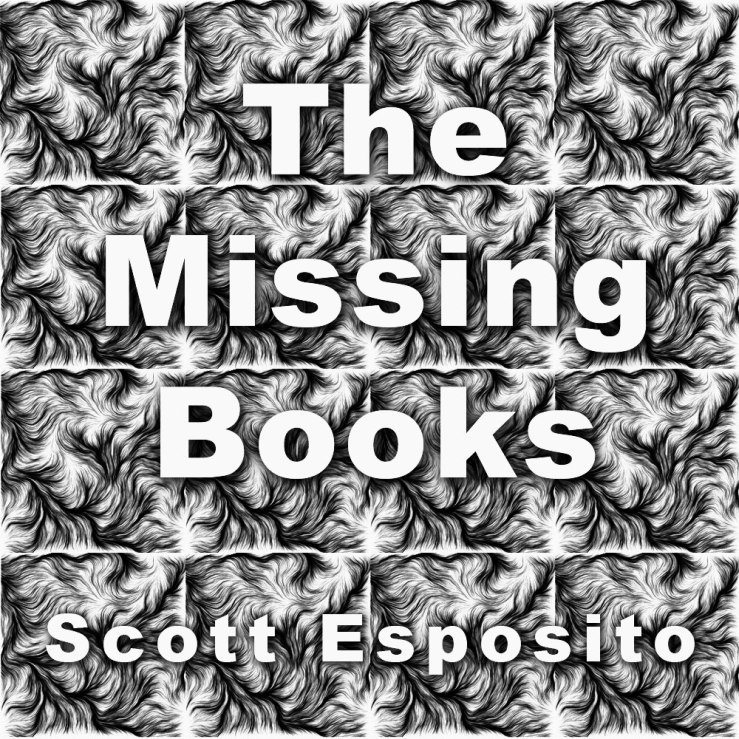
When I first heard about the concept for Scott Esposito’s new book The Missing Books, I thought, Damn. I wish I had thought of that. Then I read it and thought, Damn, I wish I had written that.
The Missing Books is an ongoing e-book project, “a curated directory of books that do not exist, but should.” The first version features missing books from “Cormac McCarthy, the Oulipo, Margaret Atwood, Stephen King, JM Coetzee, Roberto Bolaño, Vladimir Nabokov, Mario Bellatín, Jose Saramago, Philip K. Dick, Christian Bök, Kenneth Goldsmith, Gerald Murnane, Jorge Luis Borges, László Krasznahorkai, Edouard Levé,” and many others. It’s a joy for bibliophiles.
Esposito is the co-author of The End of Oulipo? (with Lauren Elkin) and the author of The Surrender. His book The Doubles is forthcoming in 2017. He’s a frequent contributor to the Times Literary Supplement and the San Francisco Chronicle. His blog is Conversational Reading. He was kind enough to talk with me about The Missing Books over a series of emails.
Biblioklept: When and how did the idea for The Missing Books come to you?
Scott Esposito: The concept of The Missing Books came together over the summer while I was trying to figure out a good concept for an ebook to release to my core fans.
Let me take a small step back to explain: I’m a big fan of hip hop music, and one of the things I’ve really taken note of about that scene is how rappers use mixtapes to stay relevant between projects, increase their fan base, try out new concepts, etc, etc. I think rappers are geniuses at marketing their concepts and getting attention for them in the world—they’re some of the best in terms of speaking in ways that the internet can understand—and mixtapes are a true innovation in this regard. I’ve long admired this. So I had the idea that I could try to create something like a mixtape in the literary world.Last fall I tried it out by releasing an ebook project titled The Latin American Mixtape, which was well-received. Like any good mixtape, it had some old content that was repurposed for the project, plus some things that were completely new and strictly Mixtape-only.
With the success of The Latin American Mixtape, I decided to do another one this year, so I began to try out concepts that might work for such a venture. Ebook-native projects are up against some barriers that don’t pertain to print titles, so I knew that in order to make this work, it would have to be a fairly catchy idea that could translate into various sorts of memes. Eventually when I hit upon the idea of doing missing books, I had the feeling that this was definitely a concept that could work in that way.
Of course, this wasn’t just about outreach. Lost books, non-existent books, book criticism, biographies of fictitious entities—these are all very much my aesthetic. I like what Borges says, along the lines of preferring to write about a novel instead of writing the novel itself, that you can have all of the essential features there in a condensed form, and it’s even better because you can dispense with all that unnecessary stuff. I feel an affinity for that kind of commentary that stands in for a book, that can be a way of grasping the inherent mystery and excitement of a book at a glance. And this is what I’ve tried to offer in The Missing Books, little chunks of what these books might have been, since we can’t actually read them.
I’ve also long been fascinated by the Oulipo, whose whole idea of writing “potential books” is very much in league with the project. (I had formerly wanted to title The Missing Books something along the lines of Potential Books, but I had to discard that, as it was too close to sounding like the Oulipo.) And just in general, I love to find out about the curiosities of the world, the oddities, those things that were epic failures, that drove writers to the end of their career, that never quite got completed, or that are so bizarre that they can only exist inside of other books. Those things have always appealed to my imagination.
Lastly, making The Missing Books electronic-only allows me to easily integrate a feature I really wanted to have in there: revisions. One of the core ideas of The Missing Books is that it grows and updates as I find out more about this world of nonexistent titles, and as the books themselves change their lost status. While this could be done in print, it’s much more practical to do this electronically. Moreover, it allows The Missing Books itself to be a missing book: a book that is always getting a little bit closer to completion, but who says I’ll ever finish it?
Biblioklept: When I first heard of The Missing Books, I thought it might be a work of fiction, like Bolaño’s Nazi Literature in the Americas, or Borges’s work in general.
Scott Esposito
SE: It’s a little bit of both. That was one of the fun things with a project like this. It was really fun to research (it got a little addicting to try and find more and more “missing books”; it was a great way to relax after hours of writing), but then it also opened a lot of doors to invent or embellish within the boundaries of the project. In the end, I don’t think it kind of defies definition as either nonfiction or fiction. I think there’s a little of the spirit of Borges in there, where if you write it maybe one day it finds a way to become true, or maybe the fiction is just better than the truth.
First off, I should say that there’s a lot in The Missing Books that’s based on solid fact, like the book Truman Capote never finished writing, or Georges Perec’s long lost first novel, which was recently discovered, translated, and published in English. That’s all pretty firm nonfiction—these things really happened, you can look it up—although in some places, I tread into fiction. Like, for instance, where I imply that someone should complete Kenneth Goldsmith’s conceptual art project to print out the Internet. That’s insane! I don’t really think anyone’s going to do that, or necessarily should. So there I’m playing with the unreliability of the voice and hinting that people who read The Missing Books might not take everything in it completely truthfully.
Then there’s a gray zone, books that may exist at some point in the future, like Cormac McCarthy’s The Passenger. There’s a lot of hearsay and rumor involved in that section, and of course what we regard as “facts” about these titles will change as dictated by future events. So I’d say those titles are rooted in nonfiction, but aren’t exactly nonfiction, something more along the lines of “speculative nonfiction,” stuff that you wouldn’t necessarily commit to print (or even e-print) but that is appropriate to a work like this, where the understanding is that it’s a living, updating document that often thrives on speculation and half-truths.
Then there are the books that themselves come from works of fiction, which turn into an even grayer zone. These are in some weird kind of ontological status, but where they come from fiction, and where in the context of The Missing Books I treat them like fact, even though we both probably know that these aren’t actual books. Except, in some cases they are: like H.P. Lovecraft’s Necronomicon, a fairly minor invention of Lovecraft’s that developed a huge and devoted following after his death and which now has been written into existence (multiple times) by other people. Or even a book found in Philip K. Dick, which someone self-published on the Amazon Kindle. What are these things? Fact or fiction? Are these books theNecronomicon? Could such a thing even exist, aside from some unstable and uncommitted concept in the mind of Lovecraft fans?
For fun and to add to the poeticism of the project a bit, I admit to embellishing or adding a few twists of my own to certain of these book-from-books, although fairly minor things that might be hard to detect. And—and this is something that to my knowledge no one has picked up on yet—I have invented a few titles in The Missing Books. Maybe some day they’ll come into existence in one way or another.
Biblioklept: My experience in reading The Missing Books was very much that strange mix of recognition and then its immediate opposite—for example, nodding in recognition at the entry on PK Dick’s The Owl in Daylight, but also puzzling over the veracity of Thomas Bernhard’s Breathing.
You brought up “the books that themselves come from works of fiction.” This is a potentially enormous section (just check out Wikipedia’s list of fictional books). How did you go about deciding what to include (and what to leave out) in this section?
SE: Oh yeah, it’s a ridiculously large category. Just the books listed in Bolaño’s Nazi Literature in the Americas is enough to make up a document five times as long as The Missing Books. Then you could start to bring in all the fake books in authors like Eco, Lem, and popular authors like Stephen King, and it all gets excessive very quickly.
I started off with a simple rule: I was only going to consider things from the beginning of the 20th century forward. So that right there slices off quite a bit, but it still leaves a whole lot. So to pare it down even further, I chose to only list items that I felt had some kind of story to tell us. One easy rule to follow was: do I find this interesting? If I can’t become intrigued by the story behind a missing book, that’s a pretty good indication that no one else is going to either, and that it probably doesn’t have anything of interest to communicate to us.
With those rules in place, I began to get together a fairly substantial group of projects, and some general themes and arcs of the project began to naturally emerge. Once that started happening, I began to purposely look for missing books based on how well they played off of what was already there. Like, for instance, The True Son of Job by Harry Sibelius, which is found in Bolaño’s Nazi Literature—it’s quite reminiscent of The Grasshopper Lies Heavy by Hawthorne Abendsen, found in Philip K. Dick’s Man in the High Castle, and I know that Bolaño was a big Dick fan, so it seems possible that there was some influence there. At the very least the similarities are striking enough that it’s interesting to situate them close to one another. And then from there, it seemed worthwhile to include various works by Phoebus K. Dank, which begins to comment on how the idea of the “Philip K. Dick” author has grown into a trope of his own.
I was also always interested in books that seemed to push up against the boundaries of the categories. Like The Book of Disquiet by Fernando Pessoa, which I place under the heading of “lost books”—is it really lost, or did Pessoa complete it? Well obviously Pessoa never “finished” it in the sense that most books are finished, but then again, Pessoa’s life project arguably rebuts the whole notion of finished books as we tend to construe them. And also, The Book of Disquiet is arguably a journal of sorts, and are those ever completed? George Steiner also makes an interesting case when he argues for Disquiet as a complete work by telling us that “As Adorno famously said, the finished work is, in our times and climate of anguish, a lie.” So I was also always on the lookout for titles that seem to render these categories less stable, the better to contemplate what they actually mean and whether or not there really is such a thing as a “missing book.”
Biblioklept: On the other side (if there is an “other” side) are the books that we never finish reading (even if we read all the words on all the pages)…there are books I return to again and again and richer, deeper, changed since the last time I read them. Do you experience this? Are there “missing,” unfinished books that you have, as a reader, “finished,” yet return to anew?
SE: For sure, it would be a disappointing kind of literature that didn’t permit those sorts of repeats. What immediately comes to mind is the author Stephen Marche, who claims to have read Hamlet over a hundred times, or Gerald Murnane, who avowed in his writing of the early 2000s that he would spend what time remained to him as a reader contemplating a handful of the mot profound texts in his life.
Certainly there are lots of books of theory that I have only begun to understand, writers like Heidegger or Lacan or Deleuze and Guattari, who have tried pushing language to challenging places in order to say things that it cannot currently say. Or a writer like Adorno, who wrote in such a way as to frustrate simple meanings or conclusions. These are people whose ideas can easily be summed up but whose actual work must simply be experienced as such and wrestled with for a long period of time.
In terms of literature, I think of writers like Pynchon, who writes in such a dense and maximalist and frustrating way that his books require long engagement, or someone like Proust, who understood humanity so deeply and extensively that one continually gains new insight as one becomes more and more experienced as a human being. But then there is also something to be said for the minimalism of a Coetzee or a Bioy or a Kafka, whose constructs seem to me like some kind of a simple-but-intricate object that one keeps staring at, trying to understand how it is built and what it means.
I would also add the category of books that I refuse to return to, books whose first experience was so bewildering and mysterious—and also so poetically infused with my life circumstances at the time—that I am fearful of destroying the impression they have left in my mind.
Biblioklept: Do you have a timeline for how the different versions of The Missing Books will come out? Or are you working on the project more organically?
SE: I very much want it to grow organically. I don’t have timetables other than to keep each new version somewhat spaced out in order to give readers a chance to chew over each edition of The Missing Books before the next one comes out. Also, I want to give the titles themselves a little time to move around and change status, as well as for new titles to emerge through the news cycle, so making the updates too frequent would be counterproductive. And of course, there’s a fairly heavy research component to each update, as I don’t want to release a new version without making some substantial additions. I’m also toying around with adding a new title grouping for Version 2, but I’ll have to see about that—it might be a little early for that sort of thing.
Right now, I’ve been more or less eyeing a spring release date for the next version.
Biblioklept: Which of the titles in The Missing Books do you most want to read?
SE: Wow, this is one of the hardest questions anyone has ever asked me. There are so many titles in The Missing Books that would greatly alter my sense of literature, that could change my life, that would put entirely new angles on writers I love…I think were I to pick just one, I would select the universal dictionary of all known human languages. I love reference books; when I was a kid I would just read volumes of the encyclopedia like they were novels, and to this day I spend obscene amounts of time reading random entries on Wikipedia, or Stanford’s online Encyclopedia of Philosophy. Dictionaries are great too in this way, although they offer a very different reading experience from the encyclopedias. I think it would be too much to pass up, the opportunity to be able to pore over all of the weird words and parts of grammar and ideas and what have you that have been embodied in the languages that humans have created to express themselves in over the course of our few thousand years of being writing, speaking beings on this planet.
Biblioklept: Have you ever stolen a book?
SE: No, definitely not. I’m fortunate in that books are one of those minor luxuries that I’ve always had the means to support for myself, so I’ve never been anywhere near the position of needing to steal them. When I was young my parents would always buy me any books I needed, and now it’s not an onerous expense to purchase the books I read. There are review copies, of course, there’s no getting around the need for them, but I make it a priority to support presses with purchases in at least some cases where I’d probably be “entitled” to a review copy. Especially nowadays, when my colleagues include many people at independent presses and bookstores, I try to do what I can to support their work financially.
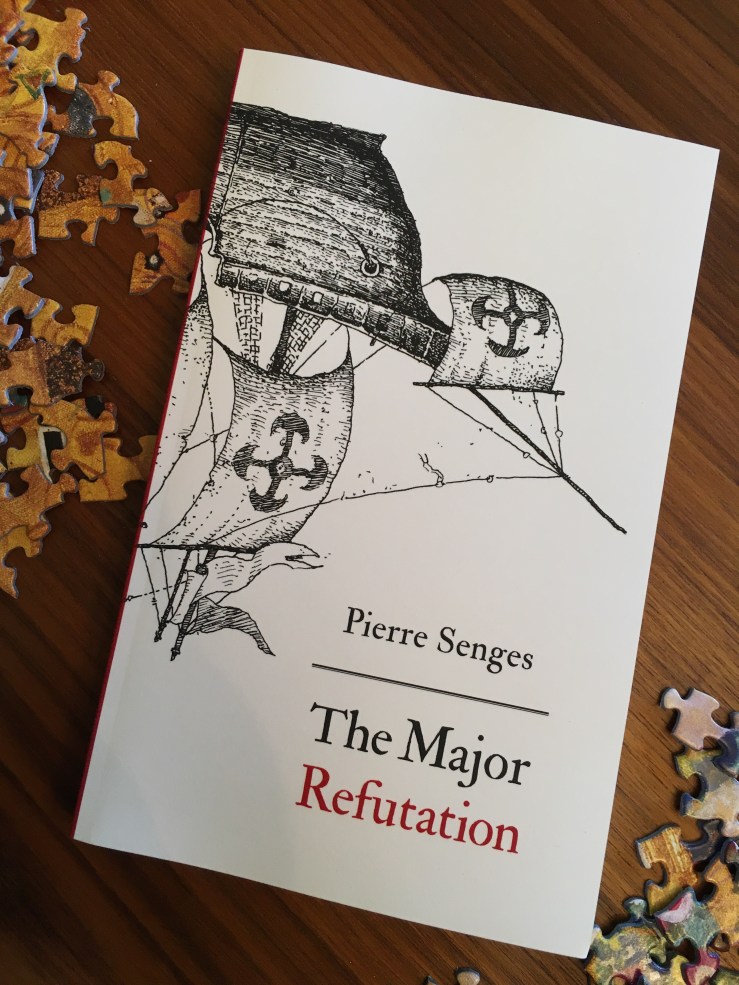
Pierre Senges’s novel The Major Refutation is new in English translation by Jacob Siefring from Contra Mundum Press. It looks pretty cool. Here’s their full “blurb”:
“Few or none of them heard of a book entitled Refutatio major, falsely attributed to Don Antonio de Guevara, in which the aforementioned Guevara avers that there does not exist a New World, but only chimaeras, malevolent rumors, and inventions spread by schemers. These same persons affirm that the reasons set forth by the aforementioned Guevara are highly disconcerting.” — Bonaventura d’Arezzo, Treatise on Shadows (1531)
“If this new world actually existed, if its measure could be had in hectares and in tons, or more maliciously in carats to reflect the value of its diamond mines, or in nautical miles because it is seemingly capable of devouring an entire hemisphere as a crab would, going from north to south and from east to west — if this were the case, then adventurers would have set foot there long ago, smugglers failing to find a better use for their discovery would have taken it as their refuge, and instead of traffickers by nature mute about their rallying points, we would have heard the cries of one thousand boasters, one thousand returning voyagers.” — The Major Refutation
Here is a book that unites all books: adventure book, historical panorama, satirical tale, philosophical summa, polemical mockery, geographical treatise, political analysis.
This edition of The Major Refutation is followed by a scholarly afterword discussing the conditions of the text’s genesis.
Pierre Senges is the author of fifteen books. His long novel, Fragments of Lichtenberg, is forthcoming in English from Dalkey Archive Press in 2017.
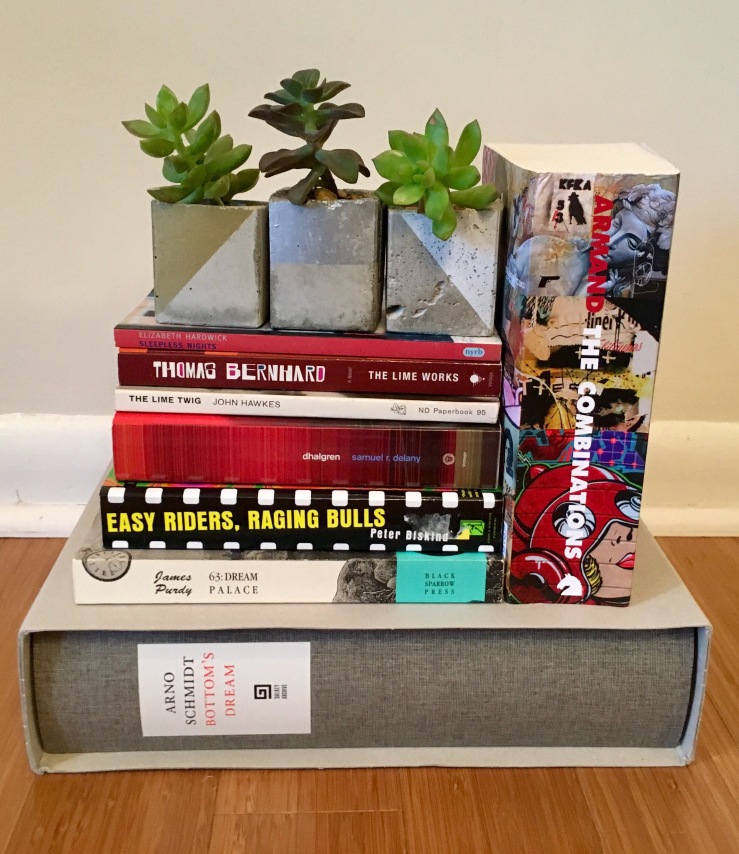
That big guy down on the bottom there, Arno Schmidt’s Bottom’s Dream (Eng. trans. by John Woods)?—I didn’t so much abandon it as I was told to put it away before we served Thanksgiving dinner at our house. There really isn’t a place for me to read the damn thing besides the dining room table. I’m sure I’ll dip into it more and I’m pretty sure I’ll never finish it in this lifetime. But I haven’t abandoned it forever. Earlier this year I wrote about the anxiety Bottom’s Dream produces in me.
Louis Armand’s The Combinations had the misfortune to show up as I was in the middle of a third reading of Gravity’s Rainbow. I read the first two chapters of Armand’s 888 page opus, then some other stuff showed up at the house in the mail, and then The Combinations got pushed to the back of the reading stack. The novel still interests me, but I’m not sure if I have the stamina right now.
Most of my reading experiences have as much to do with the time and the place that I read the book as they do with the form and content of the book. This year was not the time or the place for me to read Elizabeth Hardwick’s Sleepless Nights, a strange book I really, really, really wanted to love, but abandoned maybe 35 pages in.
I actually read a large portion of Peter Biskind’s history of the New Hollywood movement of the 1970s, Easy Riders, Raging Bulls. I broke down and finally bought it this summer after multiple viewings of William Friedkin’s film Sorcerer and two trips through Michael Cimino’s Heaven’s Gate. Biskind’s style is insufferable—gossipy and tawdry—and he swings wildly from venerating the book’s heroes (Bogdanovich, Coppola, Nichols, Scorsese, Malick, De Palma) to tearing them down (um, yeah, they were assholes). But there is an index which is of some use (although in reading Easy Riders, Raging Bulls you’re more likely to find out about a director’s drug problems or sex problems or money problems than you are to find out about, like, filmmaking). The worst part of Biskind’s book though is its repetitive insistence that not only did the Baby Boomers save Hollywood filmmaking, but also that the Boomers’ films were the last real outsider art ever to come out of Hollywood. Yeesh.
The first several stories in James Purdy’s short story collection 63: Dream Palace made me feel very, very sad, so I shelved it.
I read the first 258 pages of Samuel Delany’s novel Dhalgren. The book is 801 pages long and I couldn’t see it improving any. The book might be as great as everyone says it is, but it was mostly a boring mess (pages and pages of a character moving furniture around). On page 258, a character declares “There’s no reason why all art should appeal to all people.” I took that as a sign to ditch.






 Biblioklept