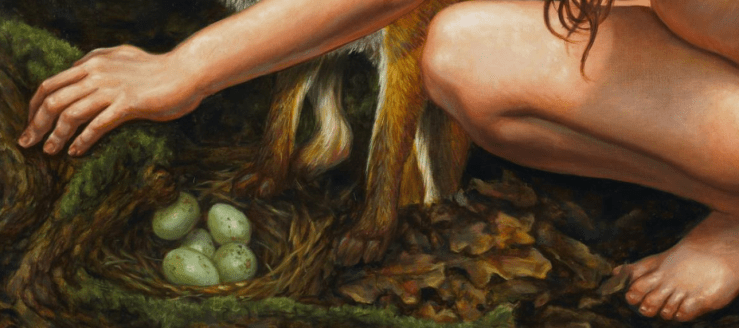
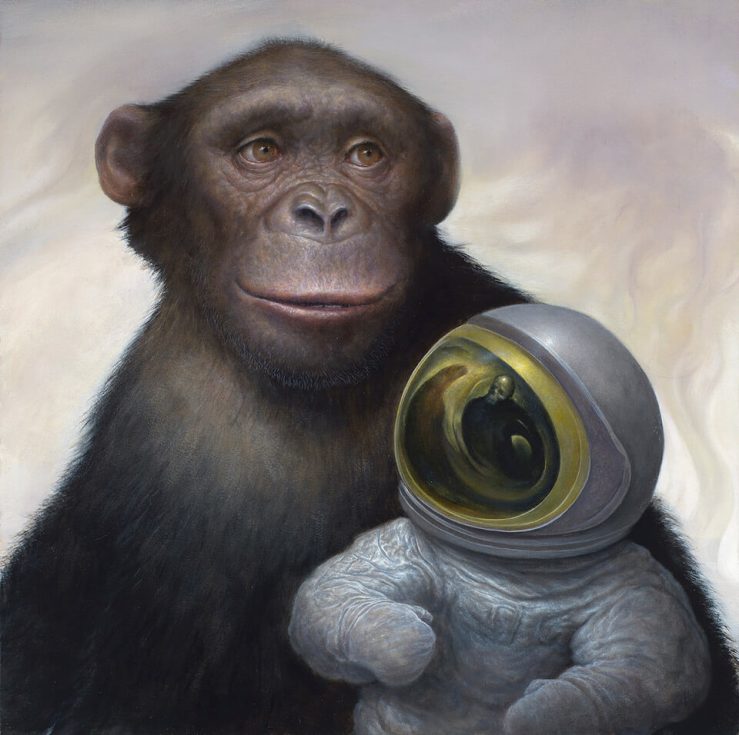
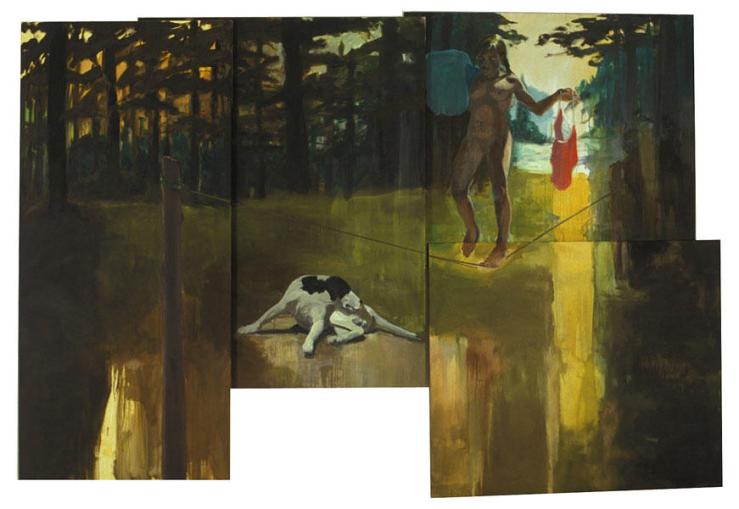
The Start of a Fairy Tale — Eric Fischl

eric-fischl-the-start-of-a-fairy-tale

The Start of a Fairy Tale, 1988 by Eric Fischl (b. 1948)

Posted in Art

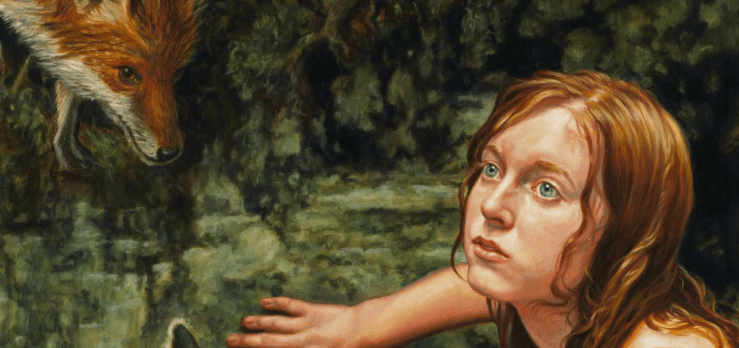
Hungry Little Things — Susannah Martin

2282385-kwfqvqkv-8

Screenshot 2017-10-23 at 7.51.56 PMScreenshot 2017-10-23 at 7.51.22 PMScreenshot 2017-10-23 at 7.50.58 PM

Hungry Little Things, 2015 by Susannah Martin (b. 1964)

You’ve probably already seen these Blade Runner short films, but I hadn’t because I’d been avoiding all coverage of the film before I could see it.

A review of Blade Runner 2049

vumoudl
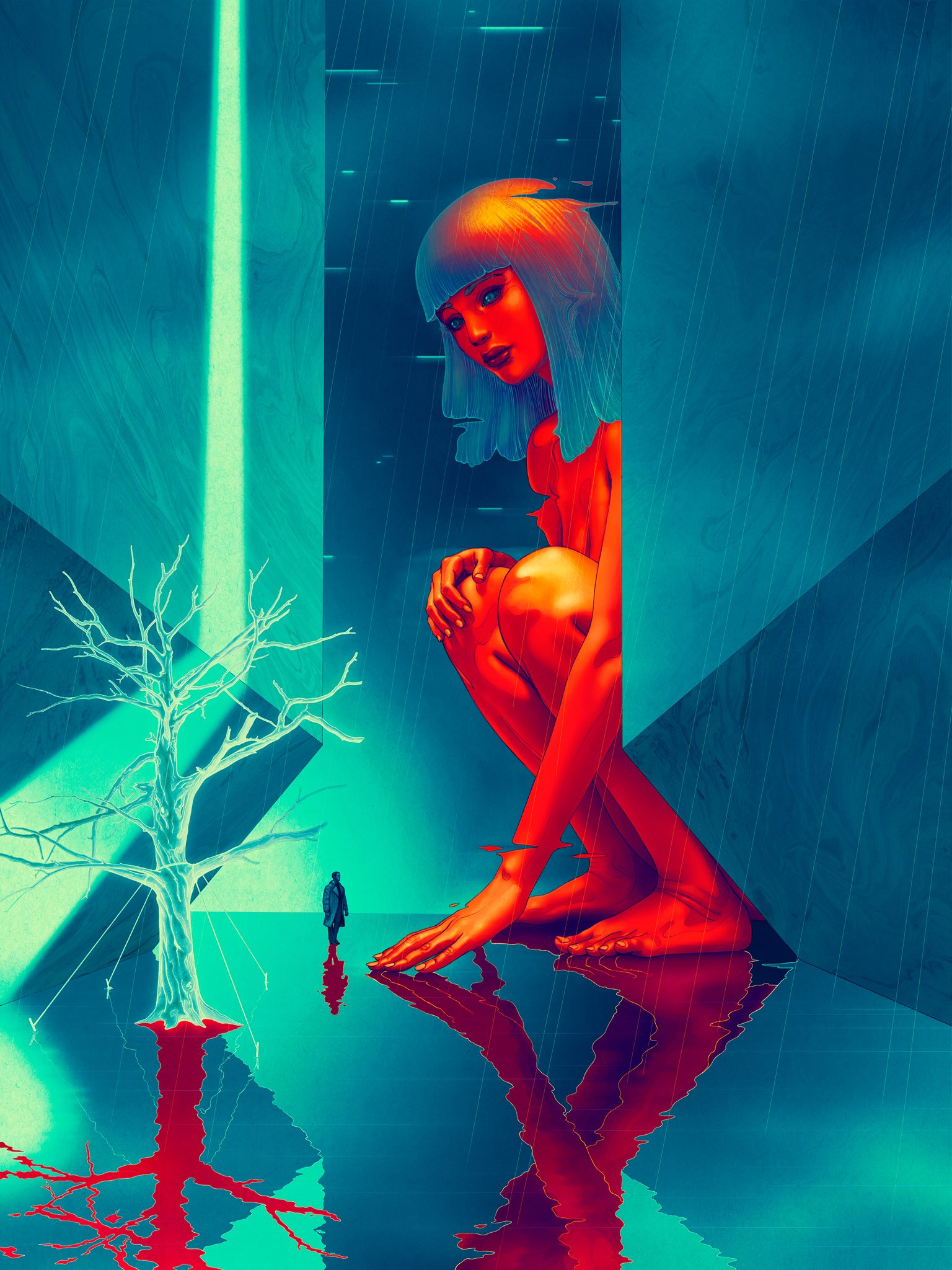
Film poster for Blade Runner 2049 by James Jean

I don’t remember how old I was the first time I saw Blade Runner (dir. Ridley Scott, 1982), but I do remember that it had an instant and formative aesthetic impact on me. Blade Runner’s dark atmosphere and noir rhythms were cut from a different cloth than the Star Wars and Spielberg films that were the VHS diet of my 1980’s boyhood. Blade Runner was an utterly perplexing film, a film that I longed to see again and again (we didn’t have it on tape), akin to Dune (dir. David Lynch, 1984), or The Thing (dir. John Carpenter, 1982)—dark, weird sci-fi visions that pushed their own archetypes through plot structures that my young brain couldn’t quite comprehend.

By the time Scott released his director’s cut of the film in 1993, I’d read Philip K. Dick’s source novel Do Androids Dream of Electric Sheep? and enough other dystopian fictions to understand the contours and content of Blade Runner in a way previously unavailable to me. And yet if the formal elements and philosophical themes of Blade Runner cohered for me, the central ambiguities, deferrals of meaning, and downright strangeness remained. I’d go on to watch Blade Runner dozens of times, even catching it on the big screen a few times, and riffing on it in pretty much every single film course I took in college. And while scenes and set-pieces remained imprinted in my brain, I still didn’t understand the film. Blade Runner is, after all, a film about not knowing.

Like its predecessor, Blade Runner 2049 (dir. Denis Villeneuve, 2017) is also a film about not knowing. Moody, atmospheric, and existentialist, the core questions it pokes at are central to the Philip K. Dick source material from which it originated: What is consciousness? Can consciousness know itself to be real? What does it mean to have–or not have—a soul?

Set three decades after the original, Blade Runner 2049 centers on KD6-3.7 (Ryan Gosling in Drive mode). K is a model Nexus-9, part of a new line of replicants created by Niander Wallace and his nefarious Wallace Corporation (Jared Leto, who chews up scenery with tacky aplomb). K is a blade runner, working for the LAPD to hunt down his own kind. At the outset of the film, K doesn’t recognize the earlier model Nexuses (Nexi?) he “retires” as his “own kind,” but it’s clear that the human inhabitants of BR ’49’s world revile all “skinjobs” as the same: scum, other, less human than human. K, beholden to his human masters, exterminates earlier-model replicants in order to keep the civil order that the corporate police state demands. This government relies on replicant slave labor, both off-world—where the wealthiest classes have escaped to—and back here on earth, which is recovering from a massive ecological collapse. The recovery is due entirely to Niander Wallace’s innovations in synthetic farming—and his reintroduction of the previously prohibited replicants.

Our boy K “retires” a Nexus-8 at the beginning of the film. This event leads to the film’s first clue: a box buried under a dead tree. This (Pandora’s) box is an ossuary, the coffin for a (ta da!) female replicant (a Nexus-7 if you’re counting). Skip the next paragraph if you don’t want any plot spoilers.

Continue reading “A review of Blade Runner 2049”

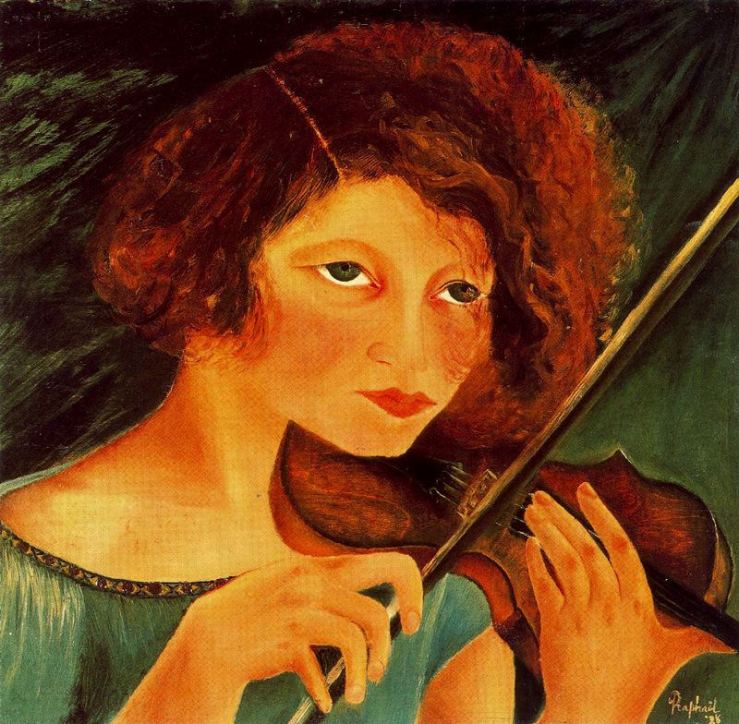
Self-Portrait with Violin — Antonietta Raphael

33909159032_af84c64f72_b

Self-Portrait with Violin, 1928 by Antonietta Raphael (1895-1975)

I want a funny face

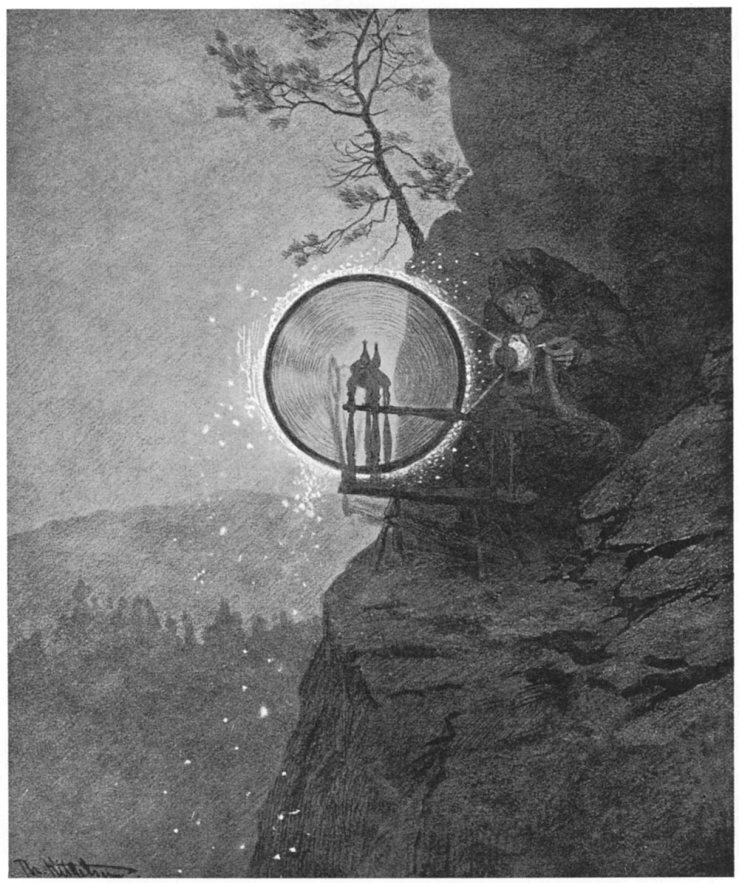
Witch — Theodor Severin Kittelsen

heksen-1892

Witch, 1892 by Theodor Severin Kittelsen (1857-1914)

Read “When I Was a Witch,” a short story by Charlotte Perkins Gilman

“When I Was a Witch”

by

Charlotte Perkins Gilman


If I had understood the terms of that one-sided contract with Satan, the Time of Witching would have lasted longer–you may be sure of that. But how was I to tell? It just happened, and has never happened again, though I’ve tried the same preliminaries as far as I could control them.

The thing began all of a sudden, one October midnight–the 30th, to be exact. It had been hot, really hot, all day, and was sultry and thunderous in the evening; no air stirring, and the whole house stewing
with that ill-advised activity which always seems to move the steam radiator when it isn’t wanted.

I was in a state of simmering rage–hot enough, even without the weather and the furnace–and I went up on the roof to cool off. A top-floor apartment has that advantage, among others–you can take a walk without the mediation of an elevator boy!

There are things enough in New York to lose one’s temper over at the best of times, and on this particular day they seemed to all happen at once, and some fresh ones. The night before, cats and dogs had broken my rest, of course. My morning paper was more than usually mendacious; and my neighbor’s morning paper–more visible than my own as I went down town–was more than usually salacious. My cream wasn’t cream–my egg was a relic of the past. My “new” napkins were giving out.

Being a woman, I’m supposed not to swear; but when the motorman disregarded my plain signal, and grinned as he rushed by; when the subway guard waited till I was just about to step on board and then slammed the door in my face–standing behind it calmly for some minutes before the bell rang to warrant his closing–I desired to swear like a mule-driver.

At night it was worse. The way people paw one’s back in the crowd! The cow-puncher who packs the people in or jerks them out–the men who smoke and spit, law or no law–the women whose saw-edged cart-wheel hats, swashing feathers and deadly pins, add so to one’s comfort inside.

Well, as I said, I was in a particularly bad temper, and went up on the roof to cool off. Heavy black clouds hung low overhead, and lightning flickered threateningly here and there.

A starved, black cat stole from behind a chimney and mewed dolefully. Poor thing! She had been scalded.

The street was quiet for New York. I leaned over a little and looked up and down the long parallels of twinkling lights. A belated cab drew near, the horse so tired he could hardly hold his head up.

Then the driver, with a skill born of plenteous practice, flung out his long-lashed whip and curled it under the poor beast’s belly with a stinging cut that made me shudder. The horse shuddered too, poor wretch, and jingled his harness with an effort at a trot.

I leaned over the parapet and watched that man with a spirit of unmitigated ill-will. Continue reading “Read “When I Was a Witch,” a short story by Charlotte Perkins Gilman”

Grey Skies — Chris Leib

chris-leib-grey-skies

Grey Skies by Chris Leib.

“Marriage” — William Carlos Williams

wcwmarriage

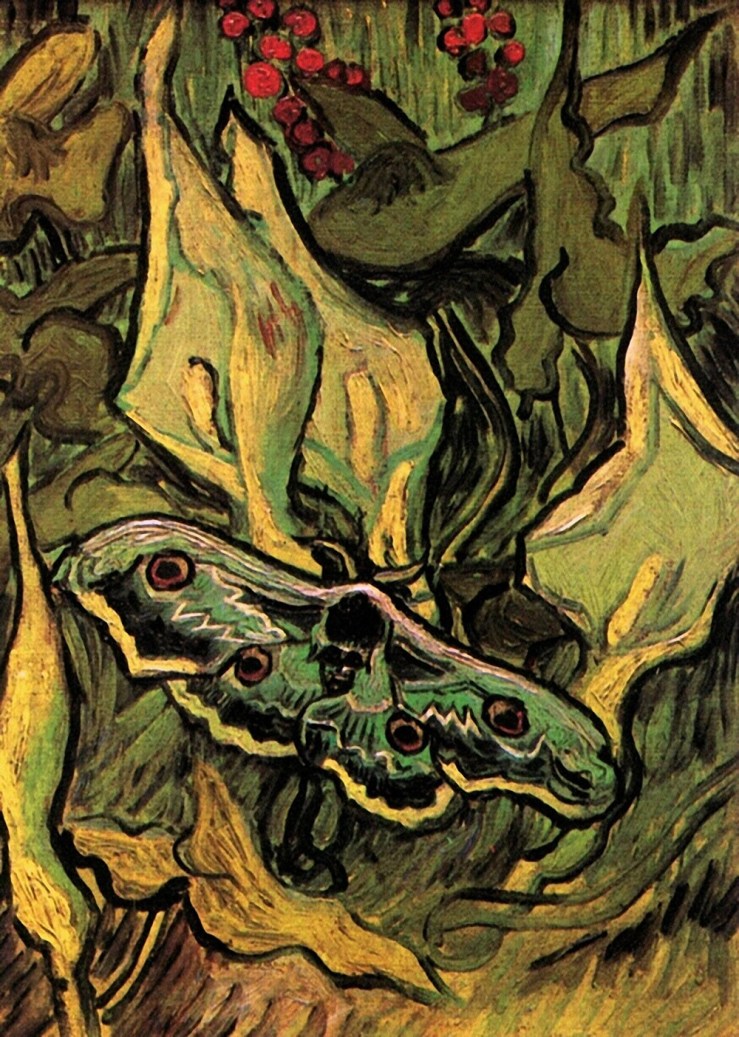
Great Peacock Moth — Vincent van Gogh

9

Great Peacock Moth, 1889 by Vincent van Gogh (1843-1890)

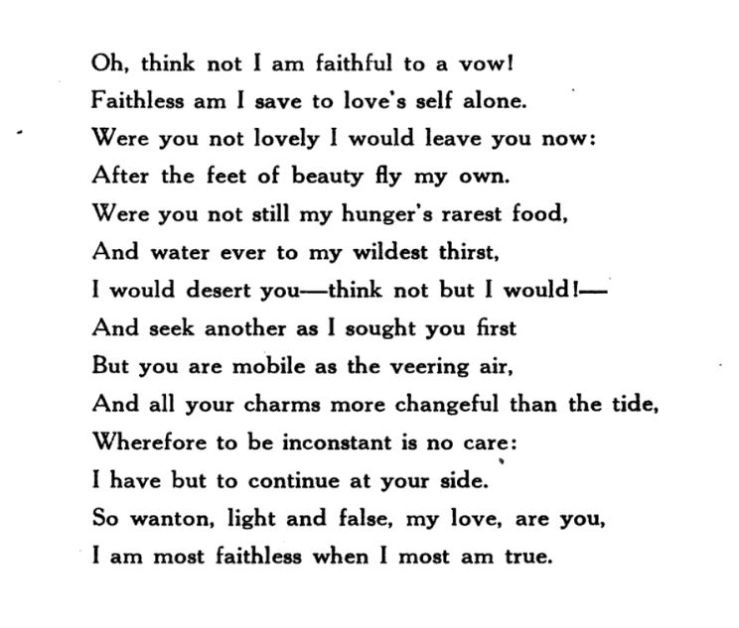
“Oh, think not I am faithful to a vow!” — Edna St. Vincent Millay

Capture

Roots — Jamie Wyeth

roots wyeth

Roots, 1971 by Jamie Wyeth (b. 1946)

Fall — Martin Wittfooth

fall

Fall, 2016 by Martin Wittfooth (b. 1981)

George Saunders wins the 2017 Man Booker Prize for Lincoln in the Bardo, a novel I couldn’t finish

George Saunders has won the 2017 Man Booker Prize for Fiction for his first novel Lincoln in the Bardo. He is the second American (in a row) to win this British prize after the prize’s rules were changed in 2013 to allow U.S. authors. (Paul Beatty’s The Sellout won last year).

I’m a fan of many of Saunders’s short stories, especially those in CivilWarLand in Bad Decline, which I did not review on this website, unlike the collections Pastoralia and Tenth of December, which I did review on this website.

really, really, really wanted to love Lincoln in the Bardo, but I didn’t. I tried to read it at least three times earlier this year and failed to make it past the halfway mark.

I first tried via the audiobook, a gimmicky affair that caught my interest. I’m a fan of audiobooks and like most humans I crave novelty. The Lincoln audiobook features 166 readers over a relatively slim seven and a half hours, and is led by the capable Nick Offerman, along with David Sedaris, George Saunders, Carrie Brownstein, Miranda July, Lena Dunham, et. al. I quit the first time maybe only an hour in, assuming that the chorus of narrators was throwing me off. But then I thought, Shit, Ed, it’s not even eight hours, just knock it out. After three hours I found that I genuinely hated it. So I picked up a physical copy from the library and tried again—maybe the audiobook was the wrong media—maybe I needed to see it on the page? But: Nope.

Lincoln in the Bardo might be a really good novel and I just can’t see it or hear it or feel it. I see postmodernism-as-genre, as form; I read bloodless overcooked posturing; I feel schmaltz. I failed the novel, I’m sure. I mean, I’m sure it’s good, right? The problem is me, as usual. I’m tempted here to launch into a long rant about how little contemporary fiction seems to do for me lately, but why? Why rant?

(The last really really great contemporary American novel I read was Atticus Lish’s Preparation for the Next Life, a novel that does everything I think Lincoln wants to do with a real raw precise blood-coursing intensity that I’ll never forget. And (I know this because I used my Twitter timeline as a reference just now) I just realized that I picked up Preparation for the Next Life on the same day that I downloaded the audiobook of Lincoln in the Bardo—so I was reading/auditing the novels at pretty much the exact same time. Look, let me very strongly recommend Atticus Lish’s novel Preparation for the Next Life).

In the second paragraph of this silly riff I wrote the words “I’m a fan of many of Saunders’s short stories.” One of those stories is a perfect two-paragraph joint, “Sticks,” which he included in Tenth of December. As I wrote in my review of that collection,

…the short, visceral two-paragraph perfection of “Sticks”…seems freer, sharper. At fewer than four hundred words it’s easily the shortest piece in the collection (and the shortest thing I’ve read by Saunders). “Sticks” condenses the harried middle class hero of almost every Saunders tale into one ur-Dad, stunning, sad, majestic. It’s also the oldest story in the collection, originally published by Harper’s in 1995, which means it predates the publication of all his other collections.

I figure out a way to insert “Sticks” into pretty much any literature class I teach—I love sharing it with students so I’ll share it with you:

Every year Thanksgiving night we flocked out behind Dad as he dragged the Santa suit to the road and draped it over a kind of crucifix he’d built out of metal pole in the yard. Super Bowl week the pole was dressed in a jersey and Rod’s helmet and Rod had to clear it with Dad if he wanted to take the helmet off. On Fourth of July the pole was Uncle Sam, on Veterans Day a soldier, on Halloween a ghost. The pole was Dad’s one concession to glee. We were allowed a single Crayola from the box at a time. One Christmas Eve he shrieked at Kimmie for wasting an apple slice. He hovered over us as we poured ketchup, saying, Good enough good enough good enough. Birthday parties consisted of cupcakes, no ice cream. The first time I brought a date over she said, What’s with your dad and that pole? and I sat there blinking.

We left home, married, had children of our own, found the seeds of meanness blooming also within us. Dad began dressing the pole with more complexity and less discernible logic. He draped some kind of fur over it on Groundhog Day and lugged out a floodlight to ensure a shadow. When an earthquake struck Chile he laid the pole on its side and spray-painted a rift in the earth. Mom died and he dressed the pole as Death and hung from the crossbar photos of Mom as a baby. We’d stop by and find odd talismans from his youth arranged around the base: army medals, theater tickets, old sweatshirts, tubes of Mom’s makeup. One autumn he painted the pole bright yellow. He covered it with cotton swabs that winter for warmth and provided offspring by hammering in six crossed sticks around the yard. He ran lengths of string between the pole and the sticks, and taped to the string letters of apology, admissions of error, pleas for understanding, all written in a frantic hand on index cards. He painted a sign saying LOVE and hung it from the pole and another that said FORGIVE? and then he died in the hall with the radio on and we sold the house to a young couple who yanked out the pole and left it by the road on garbage day.

 

Chemisette Verte — Domenico Gnoli

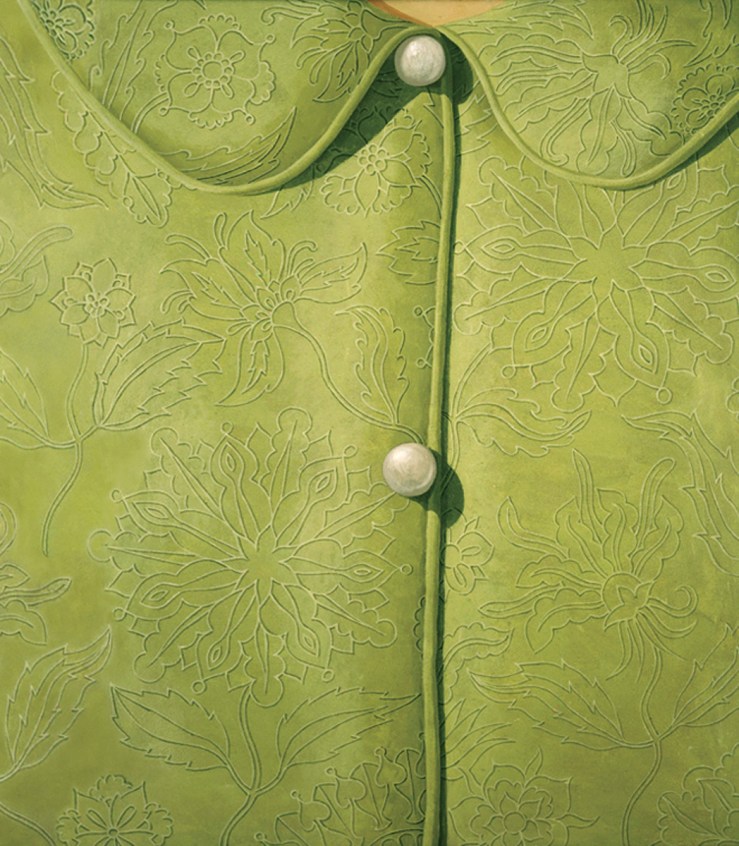
1-domenico-gnoli_155459209676

Chemisette Verte, 1967 by Domenico Gnoli (1933-1970)

The Wavering Woman — Max Ernst

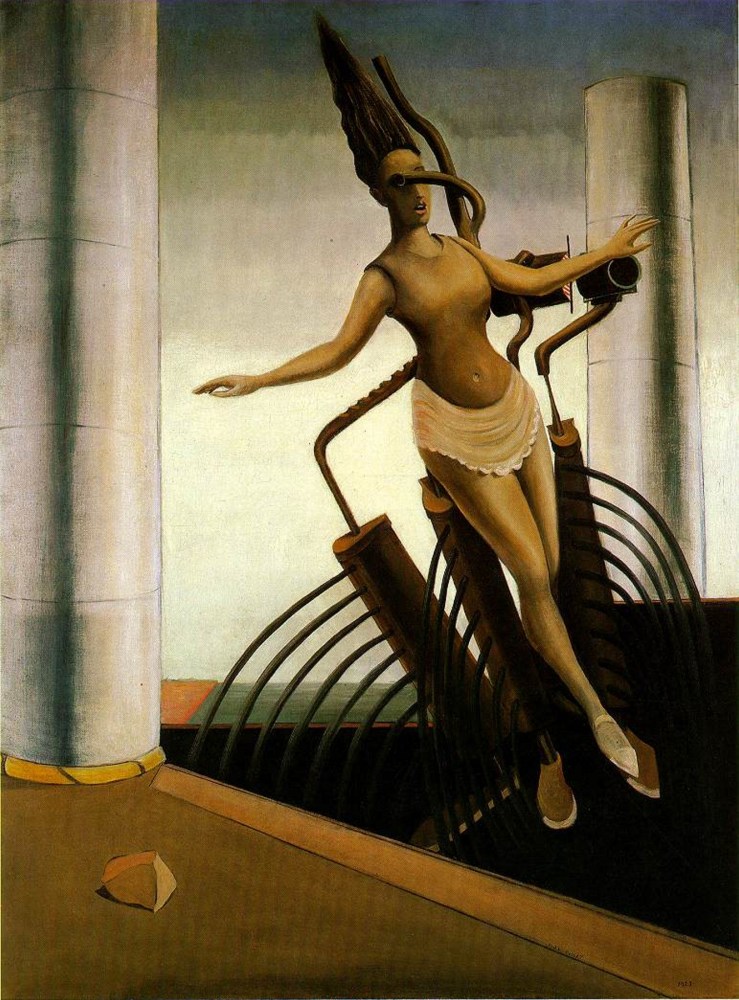
10226

The Wavering Woman, 1923 by Max Ernst (1891-1976)