How depressed

img_1154

Via Peanuts on This Day on Twitter:

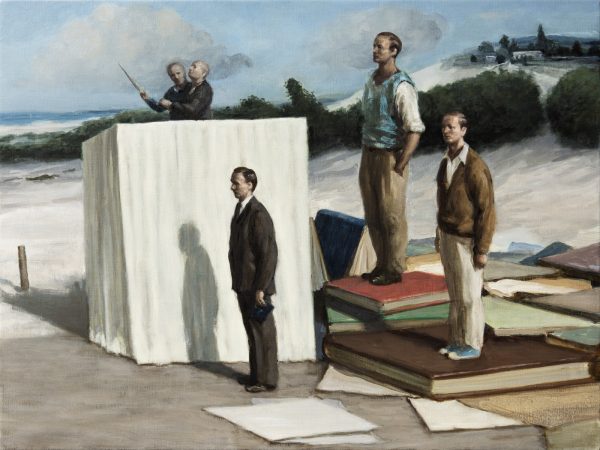
The Drawing Class — Nicole Eisenman

Style: "SCA"

The Drawing Class, 2011 by Nicole Eisenman (b. 1965)

Blog about Evan Dara’s two-act play Provisional Biography of Mose Eakins

Screenshot 2018-10-06 at 1.38.52 PM

Evan Dara’s latest work is a two-act play called Provisional Biography of Mose Eakins. Set “c. 2015” on a stage “As bare as you can stand it,” Dara’s play follows Mose Eakins, “35-ish and spry,” as he becomes afflicted with a condition that “has come to be known as imparlence.”

Mose’s imparlence erodes his ability to communicate with others. He loses his job, his home, and eventually his girlfriend Zina, from whom he initially hides his condition. Though his life deteriorates, Mose eventually lands a job as the maitre d’ of an overpriced French restaurant. Here, his sympathies extend to the overworked kitchen staff, and he takes a stand against the unjust working conditions, trying to make meaning through his actions, even as his words fail to communicate.

Dara keeps Provisional Biography spare but active, using a device he calls “the swirl” as a kind of Greek Chorus to keep the play shuttling along, even as the narrative threatens to fall apart. And because Mose is our viewpoint character, and because Mose is afflicted with “imparlence,” the narrative of Provisional Biography is under constant threat of its own linguistic erasure. As the swirl helpfully informs the audience, “people with imparlence lose the capacity to infuse their words with intelligible significance.”

Provisional Biography’s opening lines are an especially baffling affront to “intelligible significance.” When we meet Mose, he’s already imparlent, although he does not know it yet. Consider the play’s opening lines:

MOSE: Tell me something, Jeff. Those numbers convincing to you?

(to someone else)

Bring me the swordfish. Not blackened. You got that? Not blackened. Go.

(to someone else, jauntily)

Well, you know what they say…

(to someone else)

Nice, Zina – the chart is really good. Zina, your students will love it!

(to someone else, laughing)

Tell him that and he’s totally going to have a kitten!

The first few pages of the play continue in this line, Mose’s utterances disconnected from any context that might anchor their meaning. A swirl member eventually appears on stage to push the narrative into more traditional territory:

SWIRL MEMBER 1: Hear it here! Mose Eakins (born June 10, 1978) is an American
field-risk analyst working for Concord Oil. Specializing in mid-level hard-soil
extractions, he won the Kamden Prize for his research into adjacent fauna protection and occasionally lectures in his field.

As Mose’s imparlence worsens, the tension between Mose and the world he cannot communicate with increases, erupting in moments both tragic and comic (and farcical and tragicomic). The swirl is often there to assuage him (and the audience), armed with a humorous (and occasionally ironic) quiver of quotes from the likes of Melanie Klein, William H. Gass, Jean Jacques Rousseau, St. Augustine, and television personality Doctor Oz.

The swirl advises our poor hero, suggesting treatments and support groups—and also offering up punchlines when there’s no real hope in sight:

SWIRL MEMBER: There is no known cure. Imparlence is untreatable—

MOSE: But the doctor – the doctor recommended medicine!

(Mose pulls out the paper given by Doctor Mazlane, shows it to the swirl.)

He told me to take this and come see him again! It’s a prescription…

(reads the paper)

…a prescription…to pay him five hundred and twenty dollars… And I thought bleeding patients went out in the nineteenth century.

SWIRL MEMBER: There’s been a strong return to traditional medicine.

(Other jokes don’t land so neatly—in a segment mocking TV drug commercials, a swirl member offers up an absolute groaner with the phrase “irregular vowel movements.” Who knows though? Maybe the joke plays well on the stage).

With all of its humor, Provisional Biography is ultimately a sad, even tragic story, and nowhere is it sadder than in Mose’s revelation that he can communicate to other humans through one medium: economic exchange. He takes to desperately buying Tic Tacs from street vendors simply to communicate intelligibly, and eventually resorts to buying phrases from a fellow homeless person.

And yet these purchased utterances are not true linguistic exchanges—they do not mean outside of their inherent economic content. Mose Eakins despairs:

MOSE: So – so that’s it? That’s it for me? I can only just flapgaggle by myself for the
rest of my days – flapgaggle and hope?

SWIRL MEMBER: Perhaps inevitable. According to Robert Nozick of Harvard, imparlence is just the latest expression of the ownership society.

SWIRL MEMBER: Meaning has been privatized. It’s been made part of the private
sphere.

SWIRL MEMBER: Significance is no longer a publicly-owned utility, a service
provided by a command and control center.

SWIRL MEMBER: This will vastly increase our linguistic productivity—

SWIRL MEMBER: —liberate our potential as creators of meaning—

SWIRL MEMBER: —freeing us from the restrictions and inefficiencies of the nanny
dictionary!

MOSE: But…

The swirl here satirizes the newspeak of late capitalism, imagining language—a thing that makes us inherently human—as yet another commodity to be consumed and sold back to us by a dehumanizing system that seems to operate on its own inscrutable logic. While there’s humor in the little scene, it’s also quite painful.

The idea that late capitalism reduces linguistic exchange to only an economic (and thus inauthentic) exchange is repeated again in a far more painful scene later in the play. Mose pleads for “Something real…A real response – something that speaks from the heart!” from the homeless man he has been buying phrases from, to which the man simply puts out his hand for a coin. “Is that the only thing left?” cries Mose. The swirl is there to offer an out to this existentialist despair: “Salvation–only through action! Guided by further philosophical slivers proffered by the swirl, Mose converts his despair into radical action by the end of the play. The conclusion is fittingly moving and movingly strange.

Provisional Biography of Mose Eakins, in showing a human communication dissolve, follows Dara’s 2013 novel Flee, which shows a town dissolve. Flee is an oblique but devastating address to the 2008 economic collapse in America, and Provisional Biography is a fitting follow-up, continuing Dara’s critique of the human position in the late-capitalist landscape.

Significantly, Dara’s critique of the relationship between language and commerce extends to accessing his play, which can be downloaded for free at his publisher Aurora’s website.  You simply have to give them your email address. Under the “Download” button and above the PayPal button is the following message:

“If you please, reciprocation accepted only after reading. Thank you.”

And what would “reciprocation” mean, in the end? Write your own two-act play about the relationship between language and commerce in the early 21st century and send it to Evan Dara?

I PayPal’d Aurora $11.11.

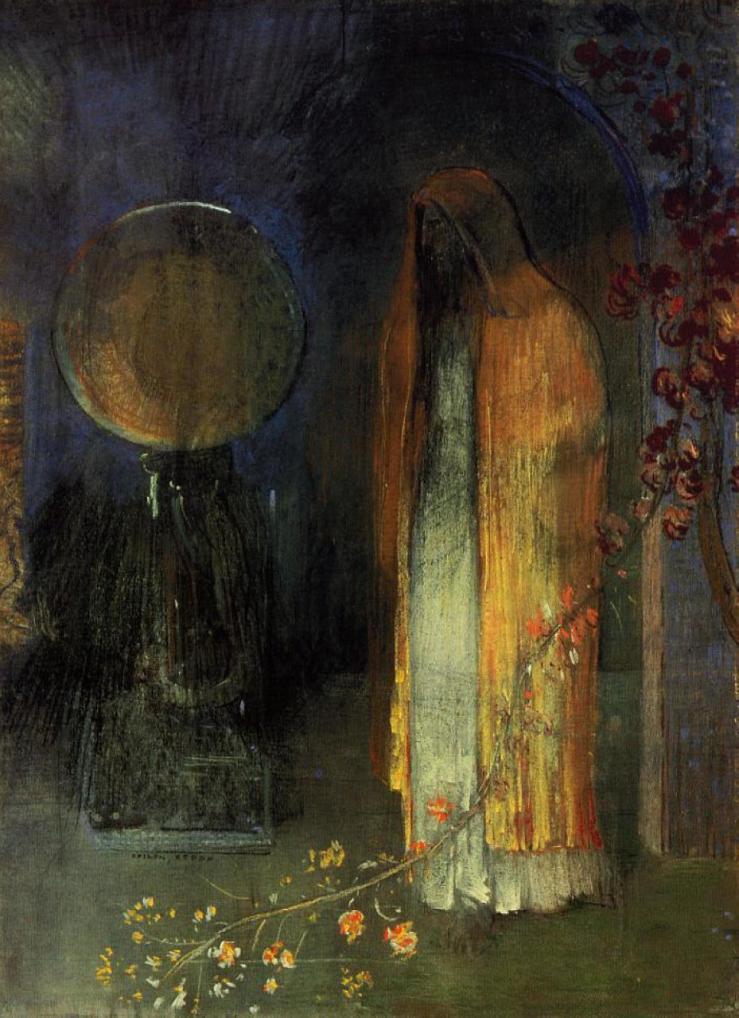
The Yellow Cape — Odilon Redon

the-yellow-cape-1895

The Yellow Cape, 1895 by Odilon Redon (1840-1916)

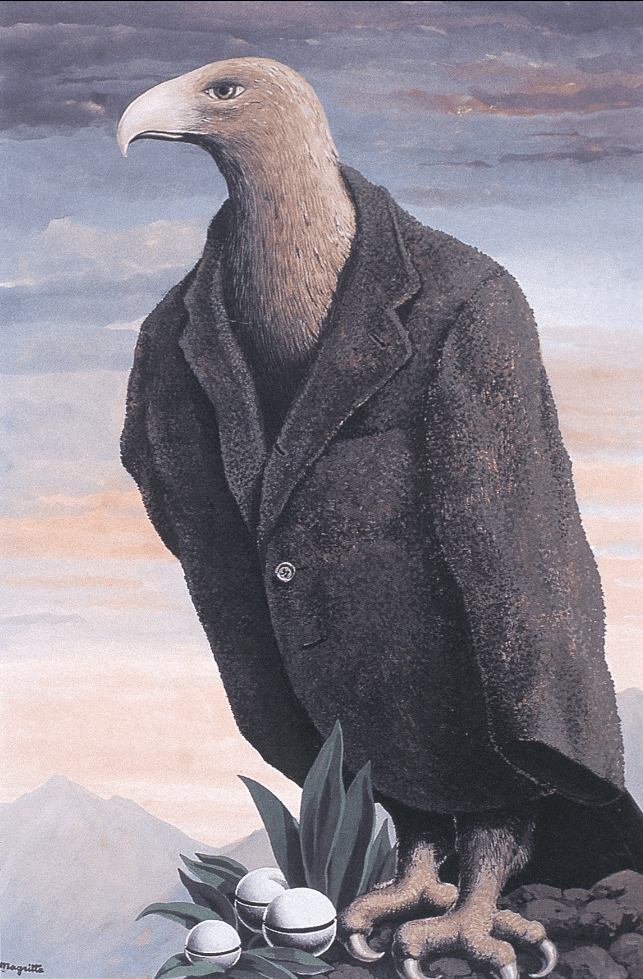
The Present — Rene Magritte 

the present

The Present, 1939 by Rene Magritte (1898-1967)

Blog about a list of films included in Antoine Volodine’s short story “The Theory of Image According to Maria Three-Thirteen”

img_1148

Antoine Volodine’s short story “The Theory of Image According to Maria Three-Thirteen” is collected in Writers, a book available in English translation by Katina Rogers from Dalkey Archive Press.

Writers is one of the best books I’ve read in the past few years: unsettling, bizarre, satirical, and savage, its stories focus on writers who are more than writers: they are would-be revolutionaries and assassins, revolting humans revolting against the forces of late capitalism.

Writers (which I wrote about here) functions a bit like a discontinuous novel that spins its own web of self-references to produce a small large gray electric universe—the Volodineverse, I guess—which we can also see in post-exotic “novels” like Minor Angels and Post-Exoticism in Ten Lessons, Lesson Eleven. 

Volodine’s post-exotic project refers obliquely to the ways in which the late 20th century damns the emerging 21st century. And yet the trick of it all is that the stories and sketches and vignettes seem ultimately to refer only to themselves, or to each other—the world-building is from the interior. This native interiority is mirrored by the fact that many of his writer-heroes are prisoners communicating from their cells, often to interrogators, but just as often to an unresponsive void.

“The Theory of Image According to Maria Three-Thirteen” takes place in such a void, a kind of limbo into which the (anti-)hero Maria Three-Thirteen speaks herself into existence. It’s an utterly abject existence; Maria Three-Thirteen crouches naked like “a madwoman stopped before the unknown, before strangers and nothingness, and her mouth and her orifices unsealed after death…all that remains for her is to speak.” She speaks to a semi-human tribunal, a horrorshow, creatures “without self-knowledge.” After several paragraphs of floating abject abstraction, Maria eventually illustrates her thesis—an evocation of speech without language, speech in a deaf natural voice–to this audience.

Her illustration is a list of scenes from 20th-century films.

I found this moment of the story initially baffling—it seemed, upon first reading, an utter surrender to exterior referentiality on Volodine’s part, a move inconsistent with the general interiority of Writers. Even though the filmmakers alluded to made and make oblique, slow, often silent, often challenging (and always beautiful) films, films aesthetically similar to Volodine’s own project, I found Volodine’s gesture too on-the-nose: Of course he’s beholden to Bergman, Tarkovsky, Bela Tarr!

Rereading the story, and rereading it in the context of having read more of Volodine’s work, I take this gesture as the author’s recognition of his aesthetic progenitors. Volodine here signals that the late 20th-century narrative that most informs his work is cinema—a very specific kind of cinema—and not per se literature.

This reading might be a misreading on my part though. Maybe Volodine simply might have wanted to make a list of some of his favorite scenes from some of his favorite films, and maybe Volodine might have wanted to insert that list into a story. And it’s a great list. I mean, I like the list. I like it enough to include it below. I have embedded the scenes alluded to where possible, and in a few places made what I take to be worthy substitutions.

Here is Volodine; here is Volodine’s Maria Three-Thirteen, speaking the loud deaf voice—

And now, she begins again, to illustrate, I will cite a few images without words or almost without words, several images that make their deaf voice heard. You know them, you have certainly attended cinema showings during which they’ve been projected before you. These are not immobile images, but they are fundamentally silent, and they make their deaf voice heard very strongly.

The chess match with death in The Seventh Seal by Ingmar Bergman, with, in the background, a procession of silhouettes that undertake the arduous a scent of a hill.

The man on all fours who barks in the mud facing a dog in Damnation by Bela Tarr.

The baby that cries in a sordid and windowless apartment in Eraserhead by David Lynch.

The bare facade of an abandoned apartment building, with Nosferatu’s head in a window, in Nosferatu by Friedrich Murnau.

The boat that moves away from across an empty sea, overflowing with cadavers, at the end of Shame by Ingmar Bergman.

The desert landscape, half hidden by a curtain that the wind lifts in Ashes of Time by Wong Kar Wai.

The early morning travel by handcar, with the regular sound of wheels, in Stalker by Andrei Tarkovsky.

The old man with cancer who sings on a swing in Ikiru by Akira Kurosawa.

The blind dwarfs with their enormous motorcycle glasses who hit each other with canes in Even Dwarfs Started Small by Werner Herzog.

The train station where three bandits wait at the beginning of Once Upon a Time in the West by Sergio Leone.

The flares above the river in Ivan’s Childhood by Andrei Tarkovsky.

The prairie traveled over by a gust of wind in The Mirror by Andrei Tarkovsky.

She is quiet for a moment.

There are many others she thinks. They all speak. They all speak without language, with a deaf voice, with a natural and deaf voice.


Joachim Trier on Nicolas Roeg’s film Don’t Look Now

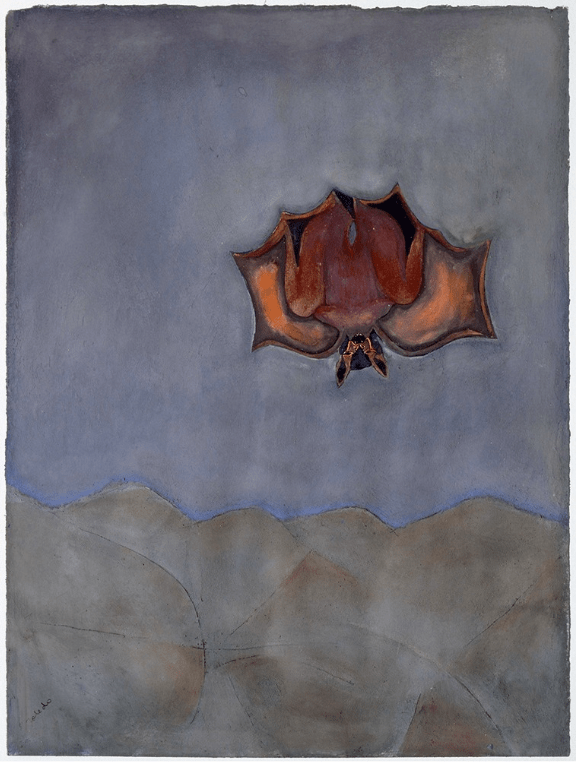
Bat — Francisco Toledo

bat

Bat, 1973 by Francisco Toledo (b. 1940)

Blog about George Eliot’s Silas Marner, a novel of not knowing

img_1146

I have just now finished George Eliot’s novel Silas Marner, which I enjoyed. The novel is set in England at the beginning of the nineteenth century, and its plot goes something like this:

As a young man, Silas Marner, a weaver, is a member of a nonconformist church with Calvinist tendencies. Falsely accused of theft, he is excommunicated from his church. Divided from the only community he knows, he loses faith in humanity and religion, leaves his “native place” Lantern Yard in Northern England, and moves to Raveloe, a village in the Midlands.

(Lantern Yard and Raveloe are both Eliot’s inventions, like Middlemarch in Middlemarch. And while Silas Marner is much shorter than Middlemarch, the world Eliot conjures in Raveloe is nevertheless similarly rich and full and detailed, a real fake place, a spot in the Eliotverse).

Silas’s technological prowess at the loom finds him plenty of customers in Raveloe, and while he amasses a wealth in gold coins, testifying to his weaving’s popularity, he nevertheless remains isolated from the community. For a decade and a half he hoards his gold coins, counting them late into the night alone at home, and cementing his reputation as an eccentric with the Raveloe folk. He’s always the Stranger.

In the meantime, Raveloe’s wealthiest family, the Casses, continue their lives as obnoxious rich assholes. The elder son Godfrey harbors a shameful secret, the younger son Dunstan is an alcoholic ne’er-do-well, and Papa Cass—excuse me, Squire Cass—is a pompous prick. There’s a ruined horse, an opium-addicted wife, a Christmas Party ruined by a visit from big-A Anxiety. Etc.

Through a series of skillful plot-moves, Eliot meshes the Cass story line with Marner’s story weaving the two together around the novel’s central conceit: Silas Marner’s hoard of gold is stolen. Soon after, he finds a baby girl, whose golden curls he takes as a kind of symbolic exchange for his golden coins. The girl saves his life in the sense that she saves his soul. Eliot gives us this moving exchange between adopted father and daughter near the end of the novel:

“But I know now, father,” said Eppie. “If it hadn’t been for you, they’d have taken me to the workhouse, and there’d have been nobody to love me.”

“Eh, my precious child, the blessing was mine. If you hadn’t been sent to save me, I should ha’ gone to the grave in my misery. The money was taken away from me in time; and you see it’s been kept—kept till it was wanted for you. It’s wonderful—our life is wonderful.”

There is nothing like a character declaring something like “It’s wonderful–our life is wonderful” to signal an impending moment of the unwonderful, of course, and Godfrey Cass barges into the life of Silas Marner on queue. Old secrets come to light, etc.

But there is a happy ending, a classically comic ending, with a wedding and a garden and laughter and everything.

I do not think my plot summary spoils too much, or at least I very much hope it spoils nothing. I went into Silas Marner not knowing anything about the plot, and, after writing my little summary, I can see how the novel might be misinterpreted as a tad, uh, sentimental. And it does earn its emotional ending, that’s true. But, as in Middlemarch, it’s really the way that Eliot captures emotion—psychology, intention, bewilderment—-that so compels me.

Silas Marner is a novel about conscience and consciousness, anxiety and isolation, strangers and community. It is a novel about knowing, but it is also very much a novel about not knowing. The novel’s strange hero Silas Marner is a weaver, a symbolic doubling for an author, sure, but Silas Marner is a novel that points to its own loose threads.

This theme of not knowing is most evident in the final paragraphs of the novel’s final numbered chapter. There is a chapter titled “Conclusion” after the final numbered chapter, and this chapter “Conclusion” gives us the classical comedic ending of a wedding in a garden and, you know, happily ever after. This “Conclusion” gives the text a sense of resolution that the novel’s final numbered chapter withholds. I find Eliot’s evocation of not knowing in the final numbered chapter a far more persuasive indicator of the emerging modernism I read in her novels.

In this final numbered chapter (Chapter XXI), Silas takes his daughter Eppie to the North, to Lantern Yard. He wants to show his daughter his “native place,” but he also wants to confront Mr. Patson the minister of the church that excommunicated him. He wants to demonstrate his innocence to the minister. He wants this member of his old community to know himself the way he knows himself; he wants to know that the minister knows what he himself knows.

Silas and Eppie are aghast at Lantern Yard though—the place looks awful and smells bad; none of it is as Silas had known it. It is a new place, an industrialized place. Even the church where he had worshiped is gone, replaced by a factory. And his detective work does not pay off:

But neither from the brush-maker, who had come to Shoe Lane only ten years ago, when the factory was already built, nor from any other source within his reach, could Silas learn anything of the old Lantern Yard friends, or of Mr. Paston the minister.

When Silas returns to Raveloe, he confides in his friend Dolly Winthrop, who serves as kind of leveling conscience in the novel, telling her:

The old home’s gone; I’ve no home but this now. I shall never know whether they got at the truth o’ the robbery, nor whether Mr. Paston could ha’ given me any light about the drawing o’ the lots. It’s dark to me, Mrs. Winthrop, that is; I doubt it’ll be dark to the last.

Silas has reconciled himself to the darkness of not knowing; there’s no teleological neatness in this conclusion. Teleological neatness is reserved for “Conclusion” —for the wedding, the garden, the laughter. And it’s in those human moments, moments that serve to counter his early years of isolation, that Silas finds “light enough to trusten” the human race he once rejected. Silas weaves the dark loose ends of his old life into something new and bright, and in this way, preserves his soul.
Front — Peter Martensen

pmar_20160520_090-600x450

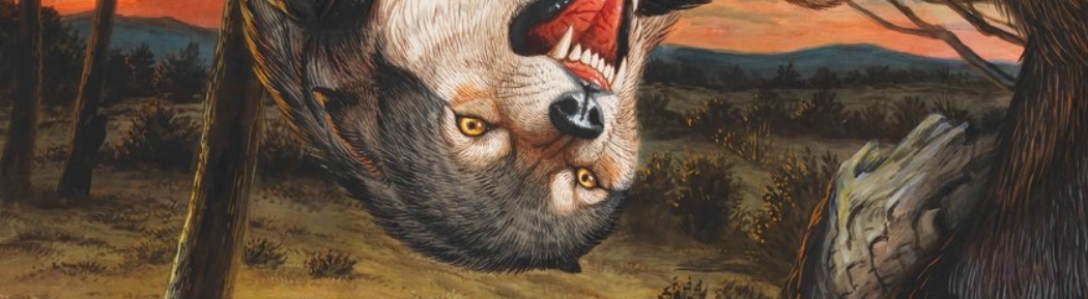
Front, 2016 by Peter Martensen (b. 1953)

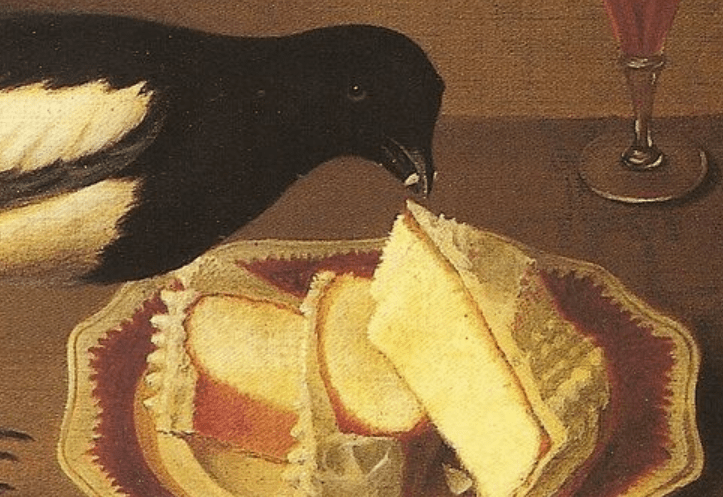
Magpie Eating Cake — Rubens Peale

4590e6a7b0943a1a9b42fa052637c1f0Screenshot 2018-10-03 at 2.06.21 PM

Magpie Eating Cake, 1865 by Rubens Peale (1784 – 1865)

Blog about not seeing Darren Aronofsky’s seventh film Mother! in the theater

120171105173333

I did not see Darren Aronofsky’s seventh feature film Mother! in the theater.

***

I saw director Darren Aronofsky’s first feature film Pi at the Reitz Union theater at the University of Florida in the fall semester of my sophomore year of college. In my four years attending the University of Florida, I always made a point to go watch the free films the Union’s theater screened. I saw The Big Lebowski and Fear and Loathing in Las Vegas there. I saw Christopher Nolan’s film Memento there, and Harmony Korine’s follow-up to Gummo, the unfortunate Julien Donkey-Boy (Chloe Sevigny ice-skating to Oval’s skittering soundtrack left a permanent mark on my memory). I saw Austin Powers: The Spy Who Shagged Me there. I saw a hypnotist there, also. (It was all free, in the sense that no money was required). And, like I said, I saw director Darren Aronofsky’s first feature film Pi there.

***

I saw Pi with my girlfriend and her roommate and her roommate’s boyfriend, who I was starting to be friends with. We—by which I mean my girlfriend and I—loved it; roommate and roommate’s boyfriend hated it. We found this out minutes after leaving the theater. I might have argued for it, using terms like claustrophobia and paranoia and German expressionism; I am the kind of asshole who might have brought up, like, The Cabinet of Dr. Caligari at this point of my life. The roommate’s boyfriend—who turned out to be and remains to this day one of the greatest friends I’ve ever made—pointed out that the film was silly–self-important, muddled, vague. He may or may not have used the word histrionic.

(He could be entirely right. I’ve never rewatched Pi).

***

(I’ve never rewatched any film directed by Darren Aronofsky).

***

The same roommate’s boyfriend, at this point broken up with the roommate (also no longer the roommate) would have been present at the small-screen screening of Requiem for a Dream held in The House Where We Always Drank Excessively some time in the fall of 2000. We–the ten or maybe twelve of us—did not Drink Excessively during the film, leaving bottles and bongs and etc. largely untouched after the first half hour, our horror slowly growing. This was No Fun. We didn’t talk after, slinking off in the humid Gainesville night. We tacitly agreed not to see each other for at least a week or two.

***

Aronofsky’s film The Fountain arrived in the mail on DVD via the mail-DVD service Netflix some time at my house in 2007. The film had a certain mystique to it—it was a boondoggle, an interesting failure, a trial balloon that popped. I recall liking it quite a bit, as I told my wife after she woke up after having fallen asleep thirty minutes into the film.

***

(I might have actually watched The Fountain a few times).

***

My daughter was an infant when The Wrestler was in theaters. I watched it too via a mail-ordered DVD from Netflix, and thought it was Pretty Good, but no My Cousin Vinny or By the Time the Devil Knows You’re Dead. (Marisa Tomei Forever).

***

My son was an infant when Black Swan was in theaters. So again: Netflix DVD, no big screen. My wife liked this one—we both laughed and laughed. At some point, maybe, one of us, getting up to pee or pour another glass of wine or check that a child was tidily asleep—well, I guess we took to it as a kind of histrionic comedy, a comedy-horror. This could be an entirely wrong take, but I don’t know. (I’ve never rewatched any film directed by Darren Aronofsky).

***

By the time I watched Aronofsky’s sixth film Noah, I had essentially given up on him: I found his films a remarkable mix of camp, melodrama, and repulsion—hard to read, searingly original, visually compelling areas I couldn’t wait to leave. I reviewed Noah on this blog, writing,

Aronofksy is an auteur, and like most auteurs, I’m sure rewatching his films would enrich an understanding of the themes and problems he’s trying to address. However, I find his films repulsive, by which I mean the opposite of compelling. I have never wanted to exit a fictional world as much as I wanted to escape Requiem for a Dream. I found The Wrestler depressing and empty. I’m afraid if I watch Black Swan again it will turn out that Aronofsky was actually not attempting to make a comedy about psychosis, but was rather actually serious about his melodrama’s tragic scope.

***

When Mother! (or mother!, as it is sometimes stylized) came out last year I was intrigued, first by the film’s marvelous posters (by James Jean), and then by the advance word on it. Mother! sounded Rosemary’s Baby, but also something like Salo or Irreversible or even Ichi the Killer—something scary and a bit psychotic and divisive and depraved. Something that some folks would certainly hate. But two kids and a job and etc. make a movie hard to grab on the go, and we wanted to see PT Anderson’s Phantom Thread, of course, which is what I think we ended up seeing instead of Mother! Maybe a week or two later at a party, a friend immediately asked me if I had seen Mother! yet. She wanted to talk about it very much. She told me to go see it.

***

Mother!: I should have gone to the theater to see Mother!

***

We watched Mother! via a streaming service in a very dark room on the largest TV we have ever owned, and I’m sure that this is not even close to what it was like to see the film in the theater. It was great. Great! I should have gone to see Mother! in the theater.

***

This blog began with the bestest of best intentions. I was going to write a proper review of Mother!, or not a review so much as a riff, or not so much a riff, really, but rather an appreciation, a take on the feeling of watching Mother!—but when I started writing I realized that I had these other thousand words to write first. And now that I’ve written them, I hate to just delete them—and anyway, it’s only blog. But I mostly see that I’d like to  watch Mother! again before I write about it again.

w3jbjps3wbmz


Mrs. Blanton’s October Table — Romare Bearden

Bearden

Mrs. Blanton’s October Table, 1983 by Romare Bearden (1911-1988)

Blog about October reading (and blogging) goals

On 1 April 2018 I set the silly goal of blogging about something every day of the month. I actually wound up meeting the goal, and it was fun (if sometimes exhausting). The April “Blog about” thing allowed me to just write in a way that was freeing. I have a tendency to let riffs and reviews languish, to leave my half-assed remarks on whatever I’m reading left unremarked, etc.

Anyway. Lately I’ve been Not Writing–in part because I’ve been extraordinarily busy with work and family, but also because it’s incredibly hot in Florida. (If this does not make sense to you, don’t worry. Look—sometimes it’s just too hot). So well anyway—I’m going to use 1 October 2018 as an occasion to declare my good intent to blog about something—books, film, art—every day or nearly every day. I’m not sure how it will go.

For now, some October reading goals, in no way prioritized:

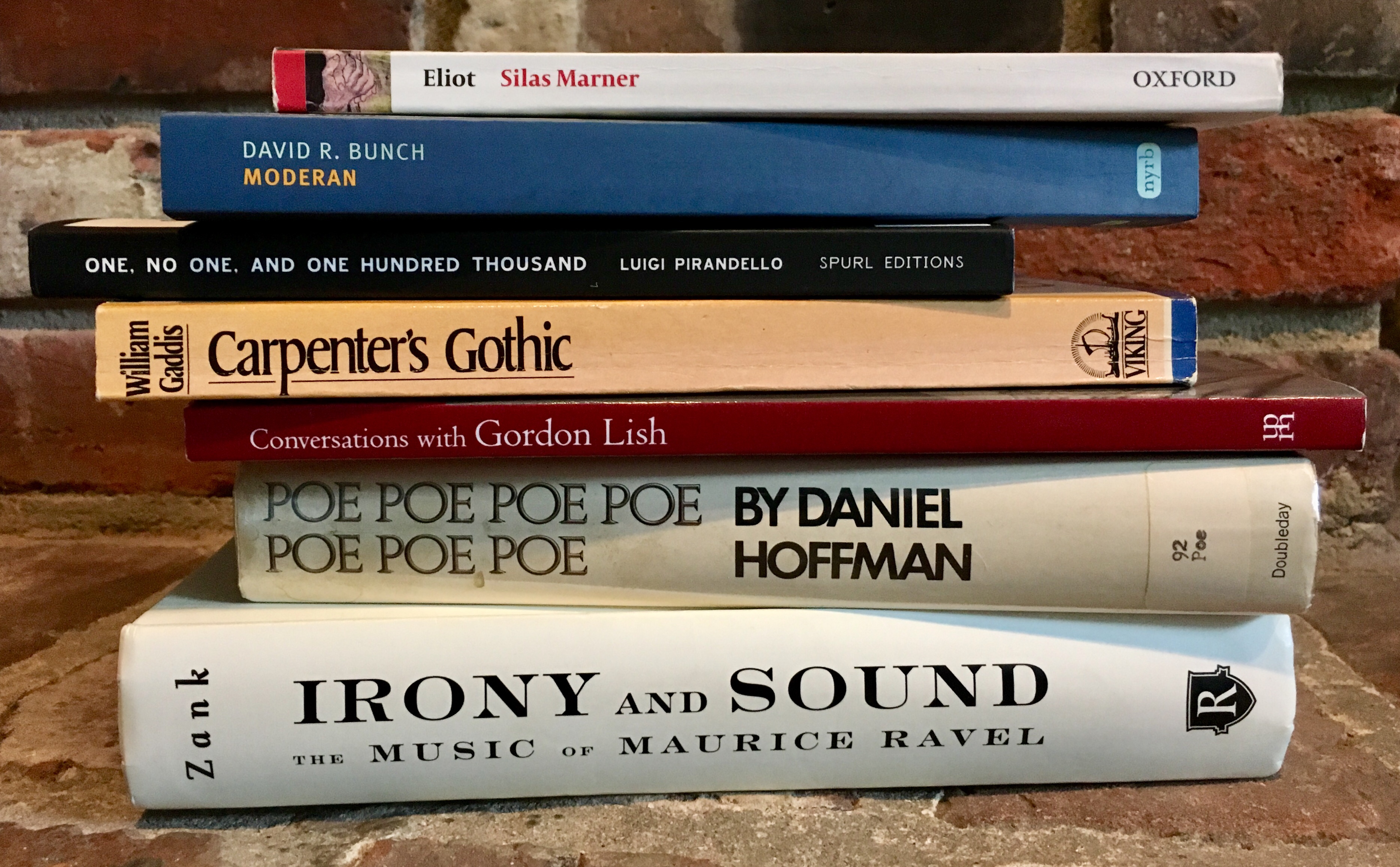
Finish George Eliot’s Silas Marner.

This probably should have been the first Eliot novel I read—it’s more approachable (and let’s be honest, much, much shorter) than Middlemarch. Eliot’s major skill, it seems to me, is in evoking consciousness-in-action—that’s the impression I got after finishing Middlemarch, anyway. Like MiddlemarchSilas Marner is also a thoroughly convincing evocation of place. And, in its treatment of anxiety, it also seems to me an easy pre-Modern Modern novel.

Make a bigger dent in David R. Bunch’s Moderan.

Bunch’s Moderan stories connect into a strange novel told in a thoroughly singular voice. “Thoroughly singular voice” is a total cliché, but it’s true here: Bunch’s New Metal Man Stronghold 10 paints his plastic-coated post-apocalyptic world as if it were a perfect paradise. The language, the voice, is its own idiom—barking, visceral, phallic—perfectly suited to conjure a postnuked dystopian world. The great trick of it all is that the narrator Stronghold 10 views this dystopia as a utopia, resulting in a layer of ironic distance between author and speaker that creates a bizarre comic tension that’s ripe for misreading. The voice’s singularity though means that’s a very particular flavor; one doesn’t always want Stronghold 10 booming in one’s ear. I hope to do a few posts on Moderan this month, but if your interest is piqued, check out Rob Latham’s thorough review at the Los Angeles Review of Books.

Check out Luigi Pirandello’s One, No One, and One Hundred Thousand.

A review copy from Spurl Editions of William Weaver’s translation of Pirandello’s final novel arrived late last week but I haven’t made much time to check it out.

Finally read Carpenter’s Gothic by William Gaddis.

It will happen.

Do a few posts on Conversations with Gordon Lish (ed. by David Winters and Jason Lucarelli).

I tried not to gobble most of these Lish interviews up too quickly—the experience of reading them is something closer to reading an essay or a transcript of a performance than a staid interview.

Read more of Poe Poe Poe Poe Poe Poe Poe.

I unexpectedly dipped into Daniel Hoffman’s biography-criticism-memoir Poe x 7 this weekend, after randomly flicking to a page where Hoffman comments on Poe commenting on Hawthorne (all on allegory already aye?). The book is so strange and intriguing.

Return a book to a friend.

I asked a colleague, a musicologist, what he thought of Ravel’s Bolero and he loaned me Stephen Zank’s Irony and Sound: The Music of Maurice Ravel, and then narrowed his eyes a bit and clarified that the book should be returned. (Hardback U of P books ain’t cheap, people). A lot of it is way over my head, but Zank’s analysis often turns to literature—Baudelaire shows up as much in the index as Debussy—so there’s that.

Try not to gobble up all of Paul Kirchner’s forthcoming collection Hieronymus & Bosch.

You might have read some of Biblioklept favorite Paul Kirchner’s comic strips Hieronymus & Bosch at Adult Swim Comics. This Fall, French publisher Tanibis Editions will release a 100-page collection of Kirchner’s comic riff on life in hell. The digital advance they sent me looks great—I’ve tried to restrain myself from eating it all up at once.

unnamed (1)

Blog every day, even about nothing.

October — Janet Fish

Screenshot 2018-10-01 at 1.57.49 PM

October, 2001 by Janet Fish (b. 1938)