That morning, the city was celebrating Consumer Thanksgiving Day. This feast came around every year, on a day in November, and had been set up to allow shoppers to display their gratitude toward the god Production, who tirelessly satisfied their every desire. The biggest department store in town organized a parade every year: an enormous balloon in the shape of a garishly colored doll was paraded through the main streets, pulled by ribbons that sequin-clad girls held as they marched behind a musical band. That day, the procession was coming down Fifth Avenue: the majorette twirled her baton in the air, the big drums banged, and the balloon giant, representing the Satisfied Customer, flew among the skyscrapers, obediently advancing on leashes held by girls in kepis, tassels, and fringed epaulets, riding spangly motorcycles.
At the same time, another parade was crossing Manhattan. The flaky, moldy moon was also advancing, sailing between the skyscrapers, pulled by the naked girls, and behind it came a line of beat-up cars and skeletons of trucks, amid a silent crowd that was gradually increasing in size. Thousands of people joined the throng that had been following the moon since the early hours of the morning, people of all colors, whole families with children of every age, especially as the procession filed past the crowded black and Puerto Rican areas of Harlem.
An intriguing and confounding section of Chapter 1 of Part II of William Gaddis’s 1955 novel The Recognitions focuses heavily on Esme, the poet who models for Wyatt Gwyon as he paints his forgeries. The episode eventually reveals Esme as one of the heroes of The Recognitions. It begins with Esme cloistering herself, pinning a sign to her door that reads: “Do Not Disturb Me I Am Working Esme.” She begins her “work” in a manic blur, “delighted to be alone.” As her energy shifts, she sews for a bit, before finally switching to attend to her small library:
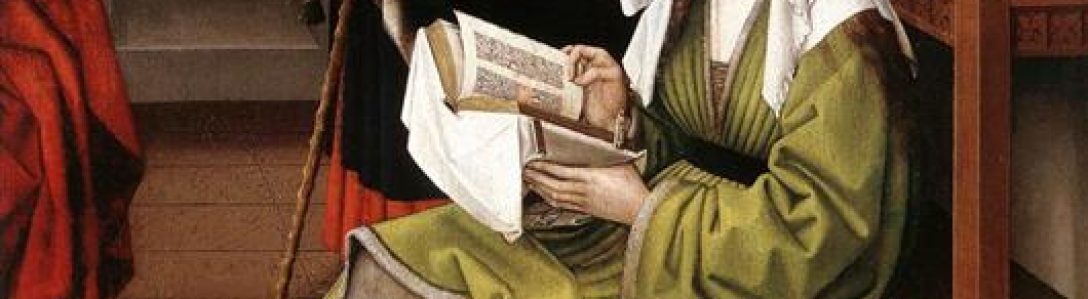
But before that sewing was done she was up, rearranging her books with no concern but for size. There was, really, little else their small ranks held in common (except color of the bindings, and so they had been arranged, and so too the reason often enough she’d bought them). Their compass was as casual as books left behind in a rooming house; and this book of stories by Stevenson, with no idea where she’d got it, she hadn’t looked into it for years, now could not put it down, and to her now it was the only book she owned.
Esme’s bookshelving is purely aesthetic, and the aesthetic seems arbitrary (and likely temporary). In this little scene she moves from arrangement by color to arrangement by size. Her aesthetic arrangement leads her back to a collection of Robert Louis Stevenson stories (likely The Merry Men, and Other Tales), her current (arbitrary, temporary) aesthetic obsession. The “Esme working” section of II.1 of The Recognitions actually begins with an entire paragraph a Stevenson story, presumably read aloud by Esme. This long quote goes unattributed, but Steven Moore identifies it in his annotations for The Recognitions as part of the Gothic short story “Olalla.”
The passage from “Olalla” quoted in The Recognitions begins with the phrase “What is mine, then, and what am I?” Olalla poses these questions to the narrator of Stevenson’s tale, a nameless Scottish soldier who recuperates from wounds in a Spanish hospital and then in the home of a fallen noble family (Gaddis cribs from this plot in the first chapter of The Recognitions, where Wyatt’s father, the Reverend Gwyon, recovers in a Spanish monastery).
Olalla’s questions are quite literal. She recognizes herself in the paintings of her ancestors, which line the walls of her family’s house, and claims a part of herself in those paintings in a haunting phrase: “Others, ages dead, have wooed other men with my eyes.” Olalla recognizes something in herself that antecedes her ancestors, some essential element that surpasses death and transcends time. She describes herself as “a transitory eddy” in a stream of time (lines not included in Gaddis’s graft from the story): not the original, but the wave that carries the impulse of origination. Her words challenge the notion of a stable, self-present self.
Olalla’s questions — “What is mine, then, and what am I?” — are essentially Esme’s questions. Esme fragments as the novel progresses, and Gaddis rhetorically highlights her looming madness by employing a daunting elliptical prose style in the sections that wander into her consciousness. Consider here, where we learn about Esme the reader:
Even so she had never read for the reasons that most people give themselves for reading. Facts mattered little, ideas propounded, exploited, shattered, even less, and narrative nothing.
This sentence is fairly straightforward—we see how Esme’s reading might differ from the way most of us read. But let’s see where we go next—what does Esme read for?
Only occasional groupings of words held her,
Esme reads discontinuously, perhaps arbitrarily, aesthetically—but let’s let that sentence unwind:
Only occasional groupings of words held her, and she entered to inhabit them a little while, until they became submerged, finding sanctuary in that part of herself which she looked upon distal and afraid, a residence as separate and alien, real or unreal, as those which shocked her with such deep remorse when the features of others betrayed them. An infinite regret, simply that she had seen, might rise in her then, having seen too much unseen; and it brought her eyes down quick.
I’ll admit I find the lines baffling. Esme inhabits the words, which then, strangely, become submerged within her, or a part of her that she has disassociated from her self-present self. The paragraph ends with a shock of recognition. Is this Esme gazing into the abyss? In any case, we see here Gaddis’s rhetorical skill at conjuring complex instability in his subject.
Let’s continue by moving from Esme the aesthetic reader to Esme the aesthetic writer:
The sole way, it seemed to her often enough when she was working at writing a poem, to use words with meaning, would be to choose words for themselves, and invest them with her own meaning: not her own, perhaps, but meaning which was implicit in their shape, too frequently nothing to do with dictionary definition.
And yet it would be too simple to suggest that Esme’s poetry is utterly meaningless, pure sound and shape without content. Rather, her writing is a writing against: A writing against the cheapness of language in a masscult zeitgeist, against newspapers and memos and comic books and flyers and stock ticker tape and museum guides and informational pamphlets and millions and millions of copies of How to Win Friends and Influence People. The paragraph continues, highlighting Gaddis’s fascination with entropy:
The words which the tradition of her art offered her were by now in chaos, coerced through the contexts of a million inanities, the printed page everywhere opiate, row upon row of compelling idiocies disposed to induce stupor, coma, necrotic convulsion; and when they reached her hands they were brittle, straining and cracking, sometimes they broke under the burden which her tense will imposed, and she found herself clutching their fragments, attempting again with this shabby equipment her raid on the inarticulate.
Esme is one of Gaddis’s heroes. Like Jack Gibbs in J R or McCandless in Carpenter’s Gothic or the narrator of Agapē Agape, she forces her will against an entropic dissolving world, and she does so to make art. And in her art she makes her self, or a version of her self, a self apart from the self-present self that might have to haggle and bustle in the tumult of the masscult midcentury metropolis. Esme strives for transcendence from language through language toward a place of pure recognition:
It was through this imposed accumulation of chaos that she struggled to move now: beyond it lay simplicity, unmeasurable, residence of perfection, where nothing was created, where originality did not exist: because it was origin; where once she was there work and thought in causal and stumbling sequence did not exist, but only transcription: where the poem she knew but could not write existed, ready-formed, awaiting recovery in that moment when the writing down of it was impossible: because she was the poem.
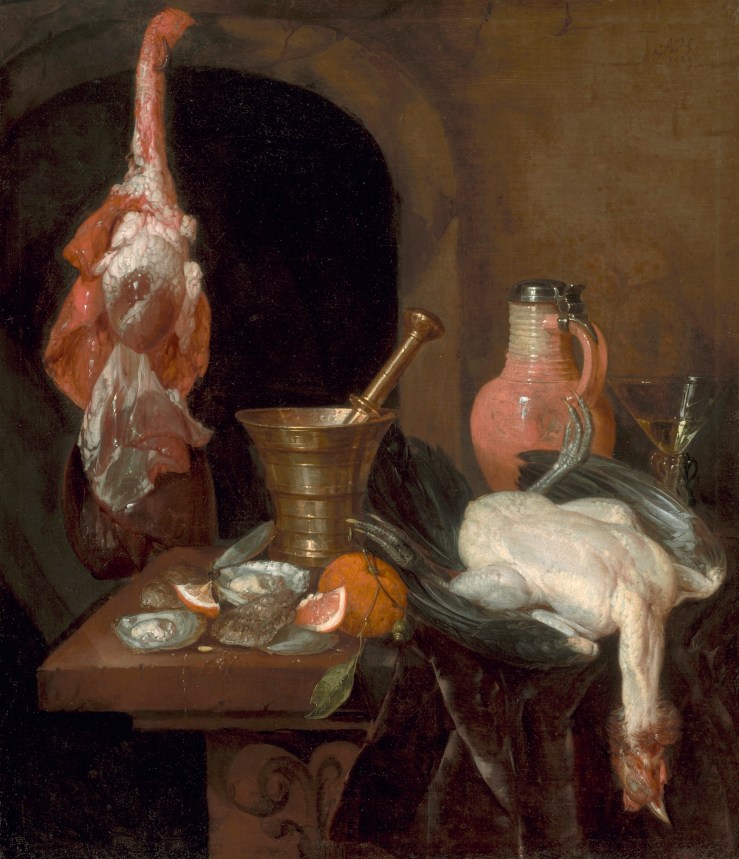
Skin a hare and put it on to roast. Whilst it is cooking, fry in the best English butter two carrots, a head of celery, two onions, two ounces of raw ham, two bay leaves, two cloves, a blade of mace, four shallots, a little thyme and parsley. Fry all these to a brown color in a stew pan.
When the hare has been roasting for an hour, remove the back fillets and pound the remainder in a mortar and add it to the vegetables. Add to this mixture a half pound of brown thickening which has been made with a pound of butter and sifted flour, and cook over a slow fire. The mixture should be moistened with two quarts of good stock and stirred over a fire until it boils. A glass of wine should be added and a small pinch of cayenne.
The recipe comes from the unsigned article “London Chef Explains Dickens’s Hare Soup,” published in The New York Times, 26 Dec. 1926.
According to the article, a “well-known London chef” shared the recipe as “a kind of Christmas card” with his patrons in 1926. Apparently Dickens enjoyed eating this hare soup regularly “a Strand restaurant” in the 1850s.
First check the refrigerator to make certain none of the following are in there: lettuce, butter, margarine, mustard, ketchup or mayo.
Remove the jar of mint jelly from the cupboard. (Marmalade is an acceptable substitution.)
Your bread should be of the diet variety, well-aged and adequately chilled. If the counter is wet, place two slices of bread on it. Press down with the heel of your hand to make sure they lie flat. (If you experience some difficulty in separating two slices of bread from the rest of the loaf, rap the loaf smartly on the edge of the counter.)
Never use presliced bologna. Your bologna should be of the sausage type, with good stout rind on it. Working with a dull knife, hack off what you need. What you’re aiming for here are pieces of bologna that display a certain ragged configuration.
Spread mint jelly on one slice of your dampened bread. On the other slice, distribute chunks of bologna. Lift jellied slice up, jellied side up and lower it over the other slice. (If jellied slice sticks to the counter, use screwdriver to pry it off.)
Still working with the same knife, halve the finished product, cutting from one corner to the other. (Bread should come apart into a number of small pieces all by itself. But if this does not occur, start over again.) Serve immediately. (If this is not possible, store in freezer for later use.) keeps indefinitely if wrapped in a brown paper bag with a rubber band around it.)
From “The Day Mother Invented Junk Food” by Gordon Lish. The full piece was published in The New York Times, 2 Aug. 1978. Thanks to David Winters for sharing it with me years ago.
The First Thanksgiving, 1973 by Warrington Colescott (1921 – 2018)
A grave and dark-clad company!” quoth Goodman Brown.
In truth, they were such. Among them, quivering to-and-fro, between gloom and splendor, appeared faces that would be seen, next day, at the council-board of the province, and others which, Sabbath after Sabbath, looked devoutly heavenward, and benignantly over the crowded pews, from the holiest pulpits in the land. Some affirm, that the lady of the governor was there. At least, there were high dames well known to her, and wives of honored husbands, and widows, a great multitude, and ancient maidens, all of excellent repute, and fair young girls, who trembled lest their mothers should espy them. Either the sudden gleams of light, flashing over the obscure field, bedazzled Goodman Brown, or he recognized a score of the church-members of Salem village, famous for their especial sanctity. Good old Deacon Gookin had arrived, and waited at the skirts of that venerable saint, his reverend pastor. But, irreverently consorting with these grave, reputable, and pious people, these elders of the church, these chaste dames and dewy virgins, there were men of dissolute lives and women of spotted fame, wretches given over to all mean and filthy vice, and suspected even of horrid crimes. It was strange to see, that the good shrank not from the wicked, nor were the sinners abashed by the saints. Scattered, also, among their pale-faced enemies, were the Indian priests, or powows, who had often scared their native forest with more hideous incantations than any known to English witchcraft.
What you seek in vain for, half your life, one day you come full upon, all the family at dinner. You seek it like a dream, and as soon as you find it you become its prey.
I attributed this tingling recognition to having read The Recognitions before (and to having read Part I once before that)—but then I realized that I’d read the line far, far more recently: It’s the epigraph to Gaddis’s fourth novel A Frolic of His Own, which I’d opened up again just a few weeks ago (and subsequently put back down).
Tyree’s essay is a fascinating read, tracking the strange history of the line. Thoreau’s words, it turns out, are not exactly Thoreau’s words—rather, they are Emerson’s recollections of a conversation between the pair from a walk in the woods. Additionally, Emerson wrote and attributed these words after Thoreau’s death. The remark initially appeared in Emerson’s literary eulogy “Thoreau,” published in the August 1862 edition of Atlantic Monthly. As Tyree observes,
This detail, which seems highly trivial at first, in fact slyly reinforces the theme of original and copy supersaturating Gaddis’s novel. The very nature of authorship falls into question here, in a manner similar to the problem of Socrates and Plato: is Thoreau’s saying from Emerson or from Thoreau, or is it from both?
While issues of originality and authenticity of authorship clearly correlate to the themes of The Recognitions, Tyree’s essay is most interesting to me in the ways by which it situates Gaddis’s work with/against the American Renaissance tradition. Tyree gives us some of the flavor of that tradition, recontextualizing Gaddis’s epigraph in a full paragraph of Emerson’s. Here’s Emerson eulogizing his friend Thoreau:
It was a pleasure and a privilege to walk with him. He knew the country like a fox or a bird, and passed through it as freely by paths of his own. He knew every track in the snow or on the ground, and what creature had taken this path before him. One must submit abjectly to such a guide, and the reward was great . . . Presently he heard a note which he called that of the night-warbler, a bird he had never identified, had been in search of twelve years, which always, when he saw it, was in the act of diving down into a tree or bush, and which it was vain to seek; the only bird that sings indifferently by night and by day. I told him he must beware of finding and booking it, lest life should have nothing more to show him. He said, “What you seek in vain for, half your life, one day you come full upon, all the family at dinner. You seek it like a dream, and as soon as you find it you become its prey.”
Tyree situates the passage within the contrasting (and quickly diverging) philosophies of the old friends: “Emerson was essentially cosmic in his Transcendentalism, while Thoreau sought the divine in the actual empirical details of nature.”
Tyree’s essay becomes most interesting to me when he begins to interpret just what the hell the quote means. His analysis hovers around the word family, underlining an obsession of American literature: escape from domesticity. Here’s Tyree’s paraphrase of the Thoreau’s/Emerson’s line:
One finds the object of a long quest, quite suddenly, at the family dinner table. But in the moment of discovery, something seems to go wrong; rather than capturing the truth, one becomes its prey. Clearly, the conversation here has expanded beyond night-warblers. Thoreau is now speaking of truth and its relationship to the family dinner table.
Tyree then susses out Thoreau’s complicated relationship with Emerson’s family:
It is possible to make too much of the fact that Thoreau’s intellectual life, as both a thinker and a man, developed in Emerson’s shade, in the shelter of Emerson’s house and family. But it is clear that Thoreau was often of two minds about living with or near Emerson. In a September 1841 letter….Thoreau told a friend that he was “living with Mr. Emerson in very dangerous prosperity.”
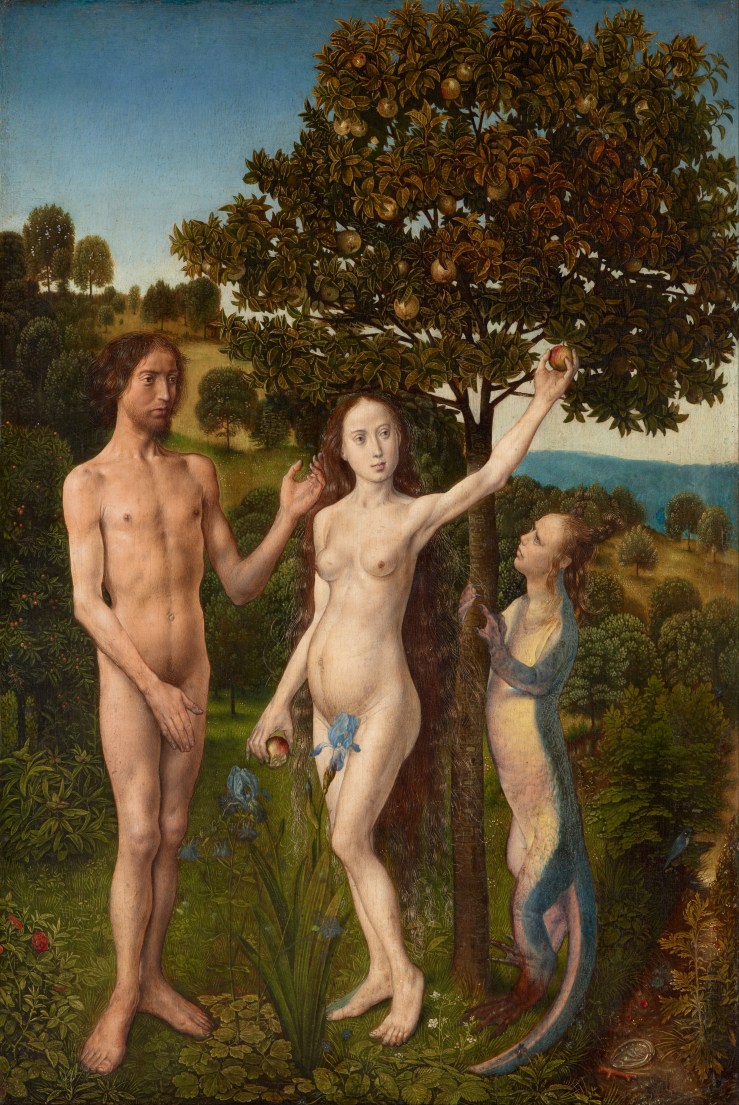
That “dangerous prosperity” of domestic life echoes one of the grand themes of American literature—namely, civilization is a blockade to be surpassed on the trek into wild nature, individuality, and freedom. Domestic duty interferes with such adventures. Just ask Rip Van Winkle, Ishmael, or Huck Finn. (Or perhaps Hawthorne’s cautionary figure, Young Goodman Brown).
Tyree underlines the point (final emphasis mine):
In the exchange over the night-warbler, the family is again identified in terms of danger; the quest is a danger to the family, or the family is a danger to the quest. One might read this as Thoreau’s critique of what would now be called Emerson’s “lifestyle.” A man who is the prey to truth must leave the dinner table to find it, but Emerson, in the comfort of his household, among his family, will never book the night-warbler. Thoreau does not say that having “all the family at dinner” stops one’s seeking, only that one becomes the prey of a protracted, half-conscious quest at mealtime. Then, one must decide what to do about it—whether to search out the night-warbler or not, and how to do it. The question seems to be whether the truth can be found through the life of the family, or whether one must leave it behind in some sense.
In The Recognitions, Wyatt circumvents the danger to his quest by not only removing himself from family (in the form of his wife Esther), but from removing himself from society in general. In J R(1975), most of Gaddis’s heroes find themselves unable to reconcile to Wyatt’s solution; their seeking fumbled out in half measures, neatly figured in the 96th Street apartment apartment shared by Gibbs, Eigen, and Bast. This hellhole is a transitory space, an inbetweeness of domesticity and city wilderness. Carpenter’s Gothic (1985) offers a more thorough critique of the impulse in American literature to send its (generally masculine) characters out into the wild spaces where they can transcend all the trappings of domesticity that bog them down. Carpenter’s Gothic confines its heroine to one haunted house, the men in her life flitting in and out if like silly birds on foiled quests. That domestic confinement reaches a kind of apotheosis in Gaddis’s posthumous novel Agapē Agape(2002), the stifling uninterrupted monologue of a man in a room, fighting against entropy.
And what about A Frolic of His Own (1994)? Well I haven’t read it yet.
I spent a relaxing hour and a half browsing my favorite local used bookstore this afternoon. I ended up finding a copy of Helen DeWitt’s debut novel The Last Samurai, which all kindsa smart folks have been telling me to read for years. I didn’t like her follow-up Lightning Rods, and stalled out on her collection Some Trick earlier this year—but we’ll see.
William Goldman died today. I’ve always thought of him primarily as a screenwriter, and I think much of his screenwriting work is pretty great, The Princess Bride in particular (the one Goldman novel we own is The Princess Bride, currently in my daughter’s possession). I couldn’t help but look over some of his books today.
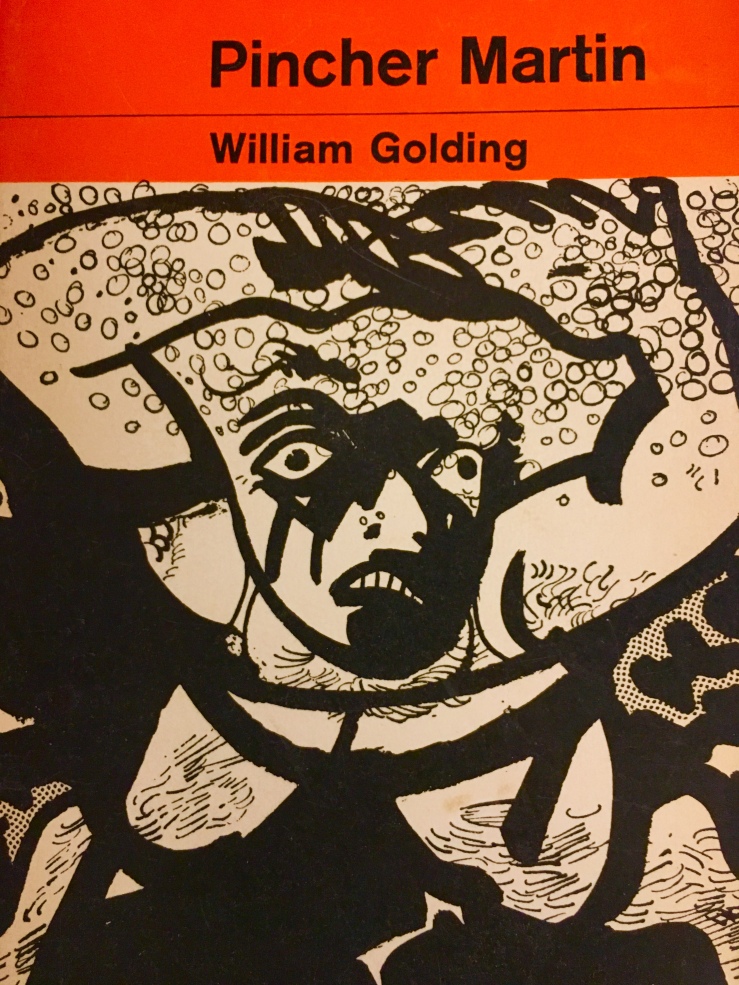
…which is how I ended up picking up William Golding’s Pincher Martin. (Golding, not Goldman). I read his 1955 novel The Inheritors a few years ago and I think when I was talking about it somewhere (maybe online), someone recommended Pincher Martin—and I couldn’t pass up this Penguin edition with cover art by Paul Hogarth.
I also thumbed through a copy of Robert Scholes’s Fabulation and Metafiction (1980), reading a big chunk of the chapter called “The Nature of Experimental Fiction.” The chapter begins with four illustrating quotations from four masters of metafiction:












 Biblioklept