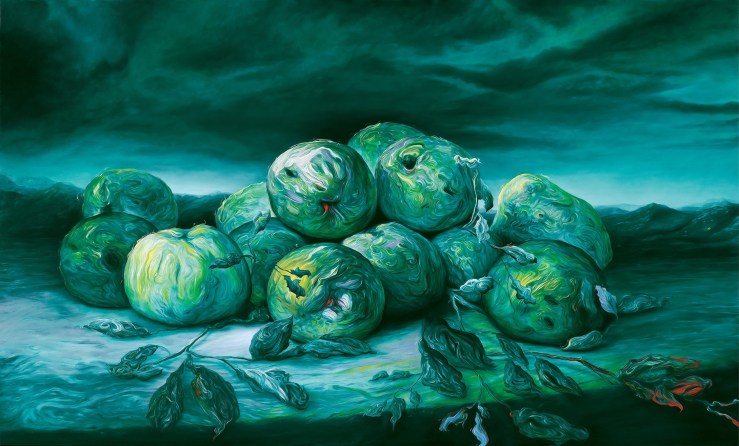
Burlesque — Glenn Brown

b0vnnbp2-9sr_2340x1316

Burlesque, 2008 by Glenn Brown (b. 1966)

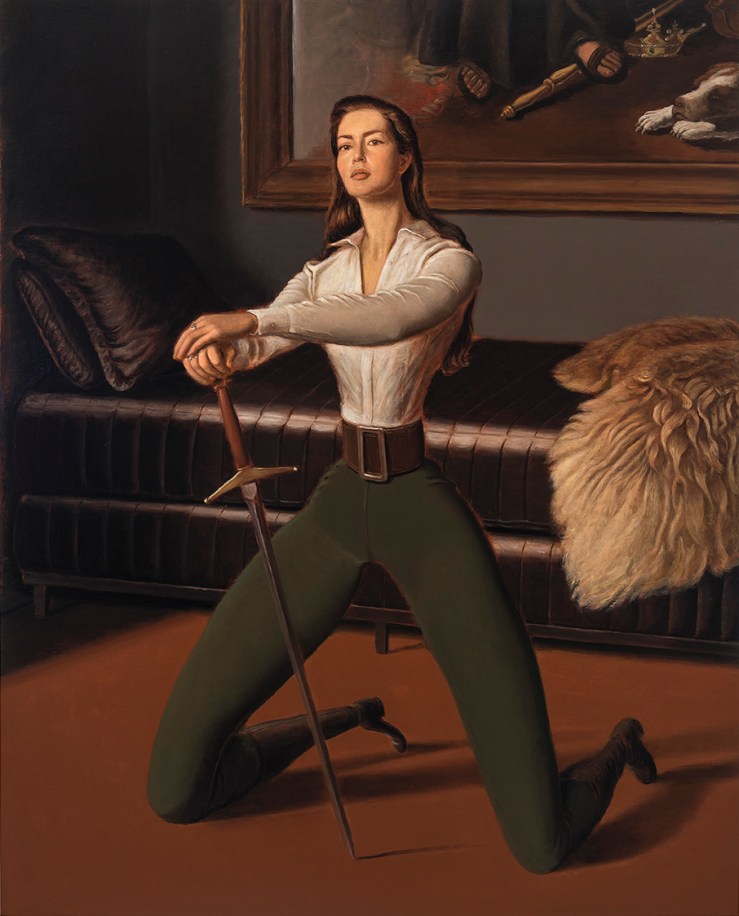
Swordswoman — Jansson Stegner 

swordswomanweb

Swordswoman, 2018 by Jansson Stegner (b. 1972)

Blog about some recent reading

img_2128

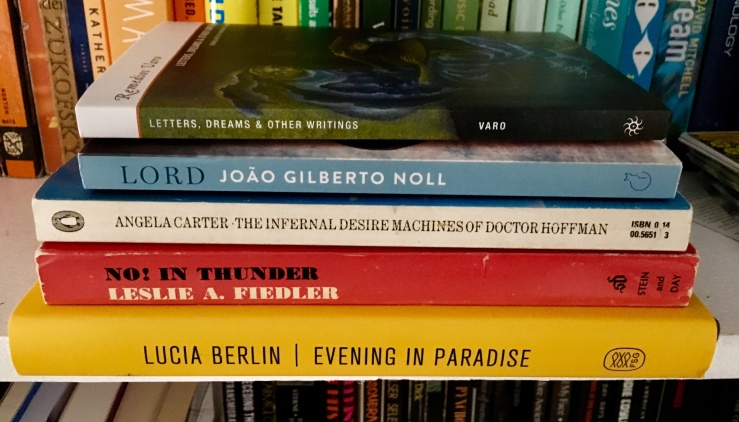
I finished Angela Carter’s surreal fantasia The Infernal Desire Machines of Doctor Hoffman a week or so ago, in a bit of a fever at its depraved horniness. Hoffman sprints along with an out-of-the-frying-pan-into-the-fire energy. The story is essentially a picaresque adventure—our narrator Desiderio sets out on a mission to assassinate Dr. Hoffman, a not-really-mad scientist who’s waging war on reality. Desiderio falls in love with Hoffman’s daughter Albertina though, complicating matters. All kinds of wild shit happens in each episode of the book—indeed, each chapter feels like it could stand on its own as a short story. I loved it, and it deserves a proper review, but for now I’ll lazily compare it to a bunch of other books I loved: Voltaire’s Candide, Réage’s Story of O, Le Guin’s The Farthest Shore, Kafka’s The Castle, Acker’s Don Quixote, any of Robert Coover’s fables, Kristeva’s Powers of Horror, and Swift’s Gulliver’s Travels. Oh, and video games. Someone could make a fantastic video game out of The Infernal Desire Machines of Doctor Hoffman.

I read the first half of João Gilberto Noll’s novel Lord (new in English translation by Edgar Garbeletto) on Sunday. The book is seriously weird. The narrator is “a Brazilian who wrote books that were mostly well received by critics but not the public.” The Brazilian novelist (a strange cipher of Noll himself) arrives in London in the winter on a “mission.” What that mission is is completely unclear, but it seems to involve an English university. Like the other Noll books I’ve read, Quiet Creature on the Corner and Atlantic Hotel,  Lord moves on its own dream logic. The narrator seems unstuck in both time and space. He’s an abject voice trying to reinvent himself from the outside in—but his disintegration seems fatally imminent.

I’ve also started in on the latest Lucia Berlin collection, Evening in Paradise, reading the first three stories. The first two, “The Musical Vanity Boxes” (which I’d read before in Homesick) and “Sometimes in Summer” are memoir pieces set in Berlin’s childhood home of El Paso (or, more properly I suppose, El Paso–Juárez). There’s a frankness to these tales that’s remarkable, an artistry of storytelling that never announces itself as such. The stories read like vivid recollections, and center on a very young Lucia and her best friend Hope, a Syrian immigrant. There’s an underlying menace here, too, a sense that these two friends might fall into disaster at any given moment. (In this way, these stories recalled the young female friends at the center of Elena Ferrante’s My Brilliant Friend who slowly come into consciousness of the real world around them). The third story in the collection “Andado: A Gothic Romance” is written in the third-person, although its hero “Laura” is clearly a stand-in for a teenage Lucia. Laura, like Lucia was, is an ex-pat teenager living in Chile. “Andado” too offers a slow swelling malice, as we perceive the dangers that Laura cannot. The story culminates in an impressionistic dreamlike sequence that matches Laura’s shaken psyche. I’m trying to restrain myself from reading all of these stories too fast.

I’ve poked about in Leslie Fiedler’s collection No! In Thunder, reading first his essay on Walt Whitman, and then his essay on Faulkner (it trapped me with its title: “William Faulkner, Highbrows’ Lowbrow”).

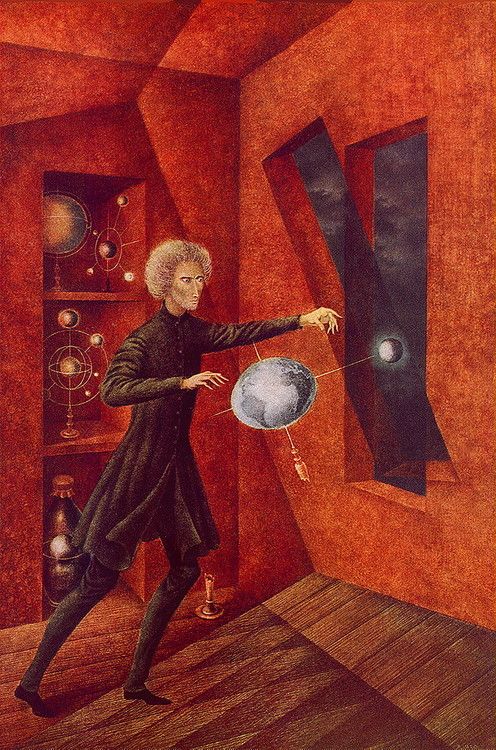
Finally, I’ve been reading Letters, Dreams & Other Writings by Remedios Varo (translated by Margaret Carson) in bits and pieces. I really dig the book and am happy Carson translated it and Wakefield Press published it. There’s a neat section where Varo describes her paintings—like this, for example:

Phenomenon of Weightlessness, 1963

The Earth escapes from its axis and its center of gravity to the great surprise of the astronomer, who tries to keep his balance with his left foot standing in one dimension and his right foot standing in another.

aeb34488236480657dc6aba97fc2d00d

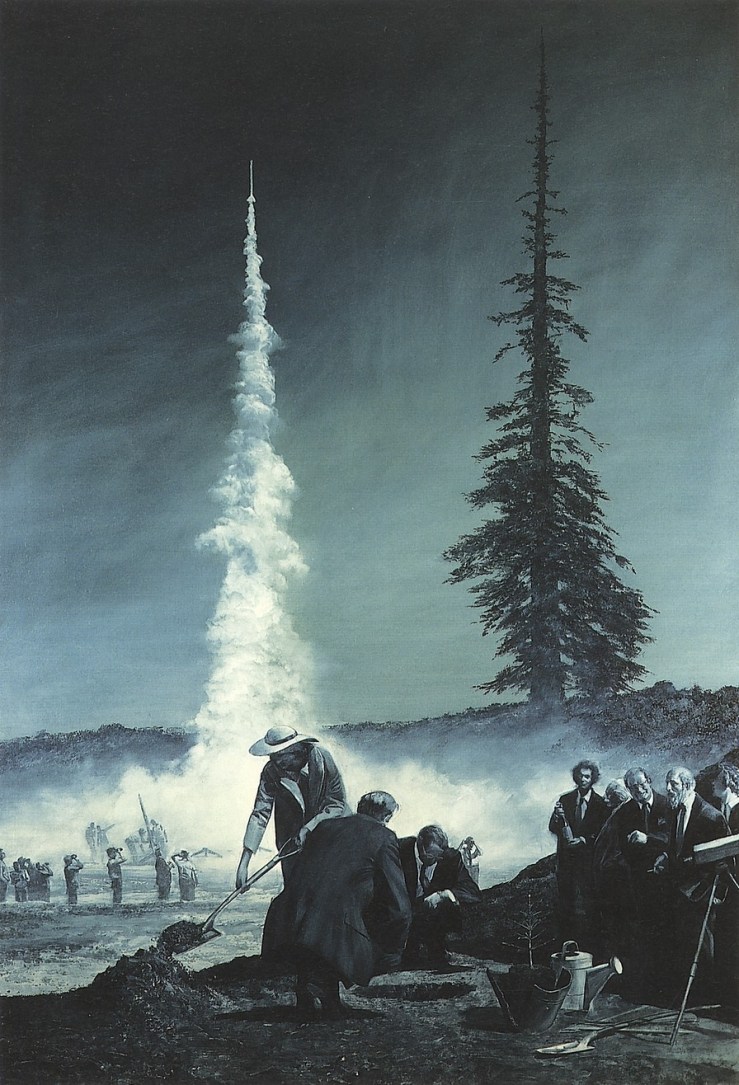
Achilles and the Tortoise — Mark Tansey

w6ykkoobuzck_2340x1316

Achilles and the Tortoise, 1986 by Mark Tansey (b. 1949)

Ishmael Reed at the Brockport Writers Forum, 1974

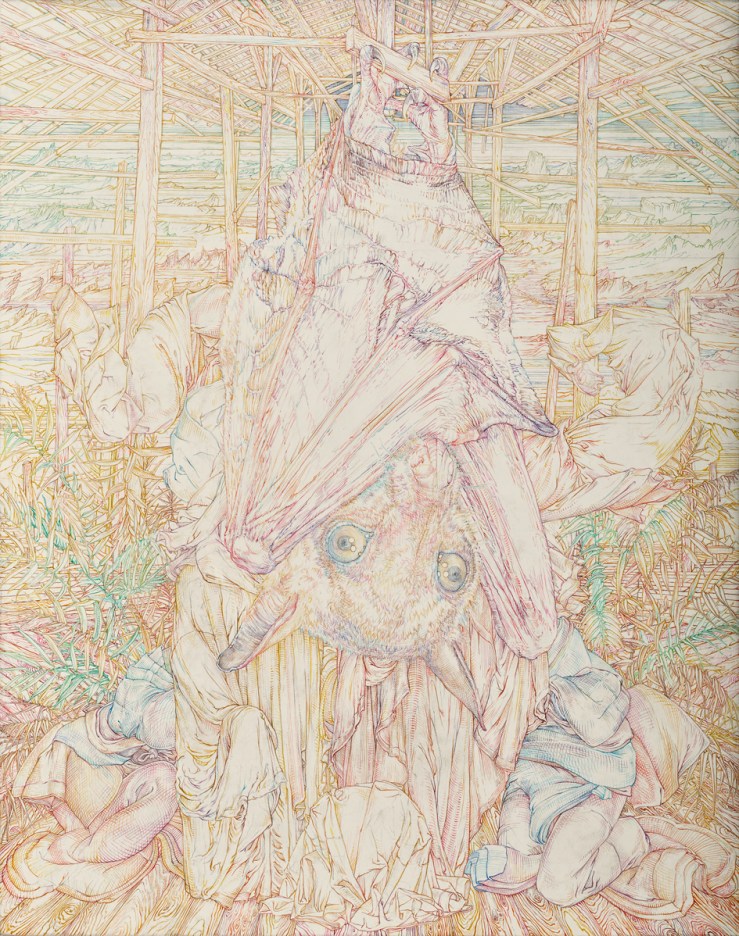
Untitled (Bat) — Koen De Cock

27fulloil

Untitled, 2013 by Koen De Cock

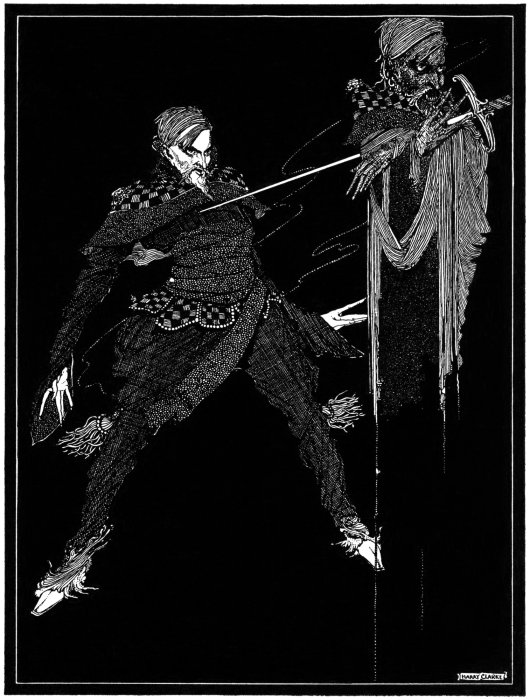
Read Edgar Allan Poe’s doppelgänger tale “William Wilson”


30177927321_1f58ba0c24_o
Harry Clarke’s 1919 illustration for “William Wilson”

“William Wilson”

by

Edgar Allan Poe


What say of it? what say of CONSCIENCE grim, That spectre in my path? Chamberlayne’s Pharronida.

LET me call myself, for the present, William Wilson. The fair page now lying before me need not be sullied with my real appellation. This has been already too much an object for the scorn—for the horror—for the detestation of my race. To the uttermost regions of the globe have not the indignant winds bruited its unparalleled infamy? Oh, outcast of all outcasts most abandoned!—to the earth art thou not forever dead? to its honors, to its flowers, to its golden aspirations?—and a cloud, dense, dismal, and limitless, does it not hang eternally between thy hopes and heaven?

I would not, if I could, here or to-day, embody a record of my later years of unspeakable misery, and unpardonable crime. This epoch—these later years—took unto themselves a sudden elevation in turpitude, whose origin alone it is my present purpose to assign. Men usually grow base by degrees. From me, in an instant, all virtue dropped bodily as a mantle. From comparatively trivial wickedness I passed, with the stride of a giant, into more than the enormities of an Elah-Gabalus. What chance—what one event brought this evil thing to pass, bear with me while I relate. Death approaches; and the shadow which foreruns him has thrown a softening influence over my spirit. I long, in passing through the dim valley, for the sympathy—I had nearly said for the pity—of my fellow men. I would fain have them believe that I have been, in some measure, the slave of circumstances beyond human control. I would wish them to seek out for me, in the details I am about to give, some little oasis of fatality amid a wilderness of error. I would have them allow—what they cannot refrain from allowing—that, although temptation may have erewhile existed as great, man was never thus, at least, tempted before—certainly, never thus fell. And is it therefore that he has never thus suffered? Have I not indeed been living in a dream? And am I not now dying a victim to the horror and the mystery of the wildest of all sublunary visions?

I am the descendant of a race whose imaginative and easily excitable temperament has at all times rendered them remarkable; and, in my earliest infancy, I gave evidence of having fully inherited the family character. As I advanced in years it was more strongly developed; becoming, for many reasons, a cause of serious disquietude to my friends, and of positive injury to myself. I grew self-willed, addicted to the wildest caprices, and a prey to the most ungovernable passions. Weak-minded, and beset with constitutional infirmities akin to my own, my parents could do but little to check the evil propensities which distinguished me. Some feeble and ill-directed efforts resulted in complete failure on their part, and, of course, in total triumph on mine. Thenceforward my voice was a household law; and at an age when few children have abandoned their leading-strings, I was left to the guidance of my own will, and became, in all but name, the master of my own actions. Continue reading “Read Edgar Allan Poe’s doppelgänger tale “William Wilson””

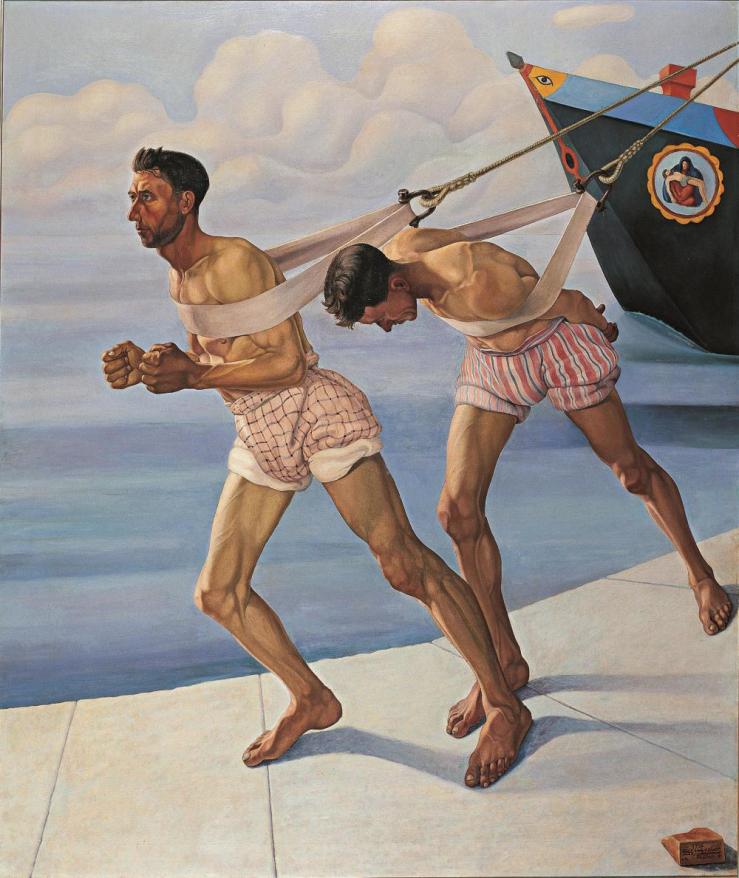
L’Alzana — Cagnaccio di San Pietro

cagnaccio-di-san-pietro-lalzana-1926

L’Alzana, 1926 by Cagnaccio di San Pietro (1897 – 1946)

Almayer’s Folly — Rene Magritte

78831

Almayer’s Folly, 1951 by René Magritte (1898-1967)

“Kaspar!  Makan!”

The well-known shrill voice startled Almayer from his dream of splendid future into the unpleasant realities of the present hour.  An unpleasant voice too.  He had heard it for many years, and with every year he liked it less.  No matter; there would be an end to all this soon.

He shuffled uneasily, but took no further notice of the call.  Leaning with both his elbows on the balustrade of the verandah, he went on looking fixedly at the great river that flowed—indifferent and hurried—before his eyes.  He liked to look at it about the time of sunset; perhaps because at that time the sinking sun would spread a glowing gold tinge on the waters of the Pantai, and Almayer’s thoughts were often busy with gold; gold he had failed to secure; gold the others had secured—dishonestly, of course—or gold he meant to secure yet, through his own honest exertions, for himself and Nina.  He absorbed himself in his dream of wealth and power away from this coast where he had dwelt for so many years, forgetting the bitterness of toil and strife in the vision of a great and splendid reward.  They would live in Europe, he and his daughter.  They would be rich and respected.  Nobody would think of her mixed blood in the presence of her great beauty and of his immense wealth.  Witnessing her triumphs he would grow young again, he would forget the twenty-five years of heart-breaking struggle on this coast where he felt like a prisoner.  All this was nearly within his reach.  Let only Dain return!  And return soon he must—in his own interest, for his own share.  He was now more than a week late!  Perhaps he would return to-night.  Such were Almayer’s thoughts as, standing on the verandah of his new but already decaying house—that last failure of his life—he looked on the broad river.  There was no tinge of gold on it this evening, for it had been swollen by the rains, and rolled an angry and muddy flood under his inattentive eyes, carrying small drift-wood and big dead logs, and whole uprooted trees with branches and foliage, amongst which the water swirled and roared angrily.

One of those drifting trees grounded on the shelving shore, just by the house, and Almayer, neglecting his dream, watched it with languid interest.  The tree swung slowly round, amid the hiss and foam of the water, and soon getting free of the obstruction began to move down stream again, rolling slowly over, raising upwards a long, denuded branch, like a hand lifted in mute appeal to heaven against the river’s brutal and unnecessary violence.  Almayer’s interest in the fate of that tree increased rapidly.  He leaned over to see if it would clear the low point below.  It did; then he drew back, thinking that now its course was free down to the sea, and he envied the lot of that inanimate thing now growing small and indistinct in the deepening darkness.  As he lost sight of it altogether he began to wonder how far out to sea it would drift.  Would the current carry it north or south?  South, probably, till it drifted in sight of Celebes, as far as Macassar, perhaps!

–The opening paragraphs of Joseph Conrad’s 1895 novel Almayer’s Folly.

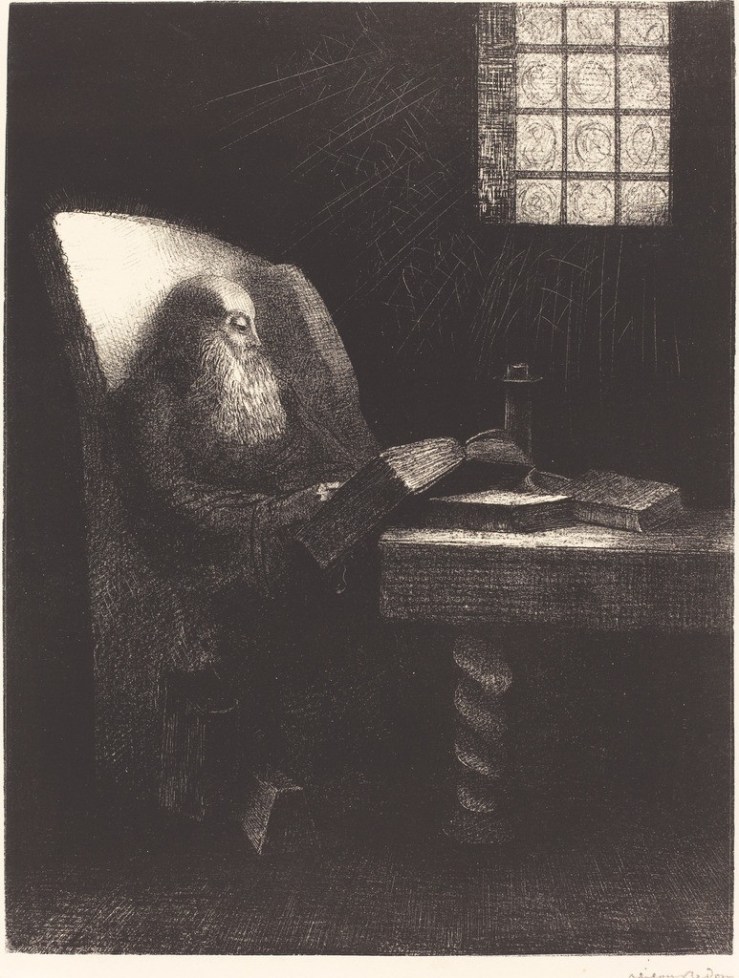
The Reader — Odilon Redon

odilon-redon-le-liseur-the-reader-1892

The Reader, 1892 by Odilon Redon (1840-1916)

The Count’s Tale — Angela Carter

img_1180

‘I have devoted my life to the humiliation and exaltation of the flesh. I am an artist; my material is the flesh; my medium is destruction; and my inspiration is nature.’

Now the valet moved painfully about, gathering together the dishes, and it grew light enough to make out the Count’s shape as he lolled against the desecrated altar, his head bare. His hair, a coarse and uniform grey, hung down to his shoulders.

‘I am impregnable because I always exist in a state of dreadful tension. My crises render me utterly bestial and in that state I am infinitely superior to man, as the tiger, who preys on man if he has any sense, is superior. My anguish is the price of my exaltation.’

I began to wonder if the Count was one of the Doctor’s agents and then I thought, no! This man might be the Doctor himself, under an assumed identity! The suspicion made me quiver.

I can hardly describe to you the man’s appalling, cerebral lucidity. He was like a corpse animated only by a demonic intellectual will. When he had rested a little, we climbed back into the carriage and rolled off across the green, spacious countryside, under a vertiginous arc of sky which began to clear and sparkle. The mountains dwindled behind us. The dew glittered in the budding hedgerows. A lark rose, singing. It was a beautiful morning in early spring.

‘The universe itself is not a sufficiently capacious stage on which to mount the grand opera of my passions. From the cradle, I have been a blasphemous libertine, a blood-thirsty debauchee. I travel the world only to discover hitherto unknown methods of treating flesh. When I first left my native Lithuania, I went at once to China where I apprenticed myself to the Imperial executioner and learned by heart a twelve-tone scale of tortures as picturesque as they are vile. When my studies were complete, I tied my tutor to the trunk of a blossoming apricot tree so the rosy petals showered down upon his increasing mutilations as, with incredible delicacy and a very sharp knife, I carved out little oysters of his living flesh – the torture known as the “slicing”, the dreaded ling ch’ih. What a terrible sight he was to behold! The apricot tree wept tears of perfumed flowers over him; that was Nature’s pity, decorative but unhelpful.

‘Subsequently I visited the rest of Asia, where, among other infamies too numerous to mention, I amputated the scarcely perceptible breasts of all the occupants of a geisha house in the exquisitely bell-haunted city of Kyoto. Then I left my crest stamped in wax plugs in all the capacious anuses of the royal eunuchs of the court of Siam. Subsequently I visited Europe where, as a reward for my villainies, I was condemned to burn at the stake in Spain, to hang by the neck in England and to break upon the wheel in a singularly inhospitable France, where, sentenced to death in absentia by the judiciary of Provence, my body was executed in effigy in the town square of Aix.

‘I fled to North America, where I knew my barbarities would pass unnoticed, and in Quebec I hired my valet, Lafleur, whose interesting nose has quite caved in under the weight of a hereditary syphilis. Young as he is, his face has already been totally obliterated by the ghastly residue of past pleasures he never tasted personally. Together we travelled the various states. I gave certain evidence in the trials at Salem, Mass., which condemned eighteen perfectly innocent persons to death by pressing. I instigated a rebellion among the slaves on a plantation in Alabama which led to bloody and wholesale retribution; they were all tied to bales of cotton and ignited by ululating Klansmen. Then, in a perfumed bordello in New Orleans, I strangled with my legs a mulatto whore just as she coaxed the incense from my member with a mouth the shape, colour and texture of an overripe plum.

But after that, I became the object of the vengeance of her enraged pimp, a black of more than superhuman inhumanity, in whom I sense a twin. And that is why I must not let him catch up with me for I know too well what he would do to me if he did so. So Lafleur and I drove over the neck of the continent, through deserts that delighted me since they were far too atrociously barren to sustain life, through jungles altogether envenomed with hatred for the brown maggots of men who dare to try to live in that green, festering meat; and then across those rearing mountains that now lie behind us than which, even in the steppes of Central Asia, I have seen nothing more arid or inimical. Refreshed, we now travel towards the coast for I feel stirring within me a strange desire to return to the peaks where I was born and perhaps I shall try to die there. Unless, that is, the vengeful pimp ensnares me first. Which is a horror beyond thought.’

From Angela Carter’s 1972 novel The Infernal Desire Machines of Doctor Hoffman.

Creeper — Dana Holst

holst_the_watchers_2017web-1024x679

Creeper, 2017 by Dana Holst (b. 1972)

Girl Seated, Wearing Hat — Grace Cossington Smith

869723f615079f8b6045518a555b72b1

Girl Seated, Wearing Hat, 1908 by Grace Cossington Smith (1892–1984)

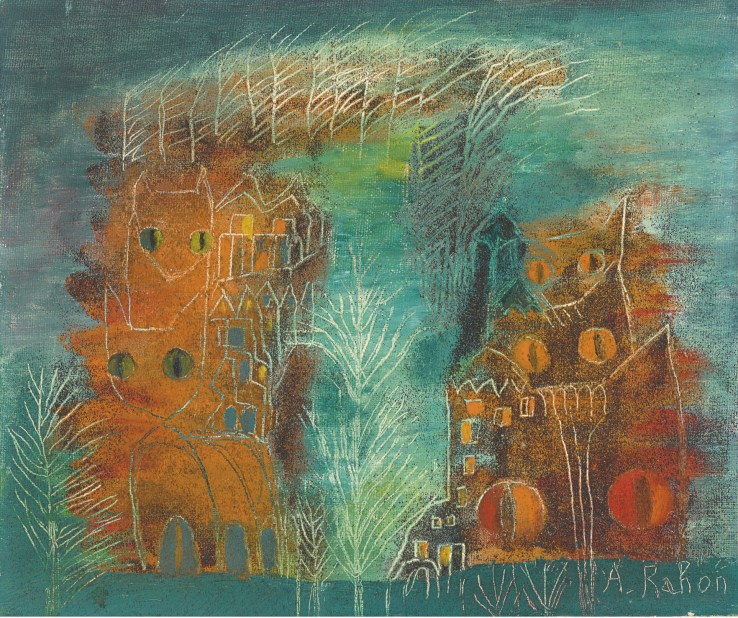
Cats in the Valley — Alice Rahon

2008_nyr_02054_0281_000

Cats in the Valley,  by Alice Rahon (1904–1987)

We/No! | Zamyatin/Fiedler (Books acquired, 11 Jan. 2019)

img_2107

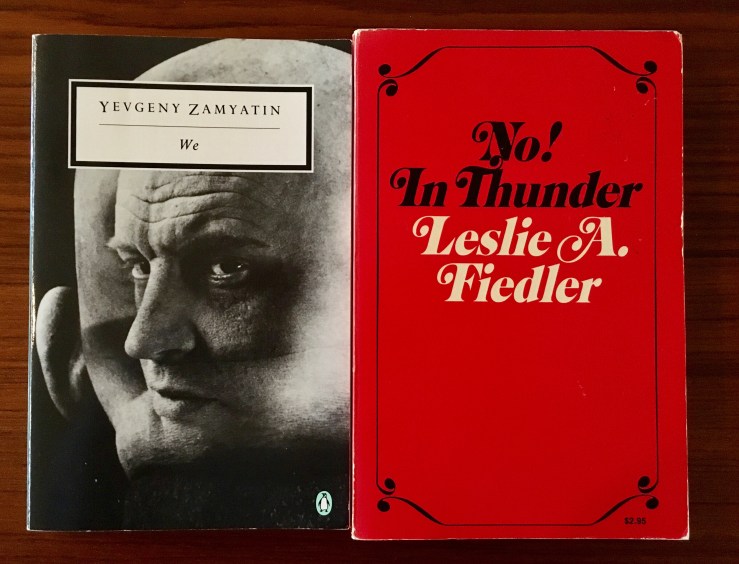
Last Friday afternoon I stalked about my favorite used bookstore for a spare hours, first looking for a copy of Joseph Tabbi’s literary biography of William Gaddis, Nobody Grew but the Business. I’ve been reading snatches of Tabbi’s Gaddis bio on Google Books (yergh) and I’d like to like really read it. I didn’t find it in the biography section, and then I didn’t find it in the literary criticism fiction, but I did find a copy of Leslie Fiedler’s No! In Thunder. I’ve been wanting to read this for awhile. In the absence of a blurb, let me cite the original Kirkus review:

His title is from a letter of Melville’s to Hawthorne and Fiedler has adapted it to emphasize his belief that to fulfill its essential moral obligation successful art must perform a negative critical function. It is, in fact, due to its ultimate No! that serious fiction has been, initially, unacceptable. In the section on The Artist there are essays on Dante, illusion in Shakespeare, Whitman, the moral duality in Stevenson, Peretz, Kafka and Malamud, Faulkner — the Highbrow’s Lowbrow, Robert Penn Warren and Cesare Pavese.

I also picked up a copy of Yevgeny Zamyatin’s seminal 1921 utopian/dystopian novel We, which I haven’t read in like 20 something years. I ended up getting Clarence Brown’s 1993 translation, which seemed a bit zippier zappier and weirder than the others I browsed (I skimmed the first few chapters of each). I also just like those Penguin Classic editions, as well as the cover photograph by Georgii Petrusov.

I’ll pick through the Fiedler slowly, but We might be the next novel I read after I finish up Angela Carter’s The Infernal Desire Machines of Doctor Hoffman, which I’m really digging.

Hideout — Michèle Fenniak 

michelefenniak_hideout_web

Hideout, 2014 by Michèle Fenniak

A review of Paul Kirchner’s Hieronymus & Bosch, a slapstick comedy set in Hell

hb

My review of Paul Kirchner’s latest collection Hieronymus & Bosch is up at The Comics Journal. Here is the first paragraph of the review:

Paul Kirchner’s Hieronymus & Bosch collects over eighty comic strips that riff on the afterlife of a “shameless ne’er-do-well named Hieronymus” and his faithful wooden toy duck, Bosch. The hapless pair are trapped in Hell, the primary setting for most of the strips (although we do get a bit of heaven and earth thrown in here and there). Kirchner’s Hell is a paradise of goofy gags. The one-pagers in Hieronymus & Bosch cackle with burlesque energy, propelled by a simple plot: our hero Hieronymus tries to escape, fails, and tries again.

Read the whole review.