Big Dreamer with an Ode to the Dawn — Adrian Cox

adrian-cox-big-dreamer-with-an-ode-to-the-dawn-_hi-res_1024x1024

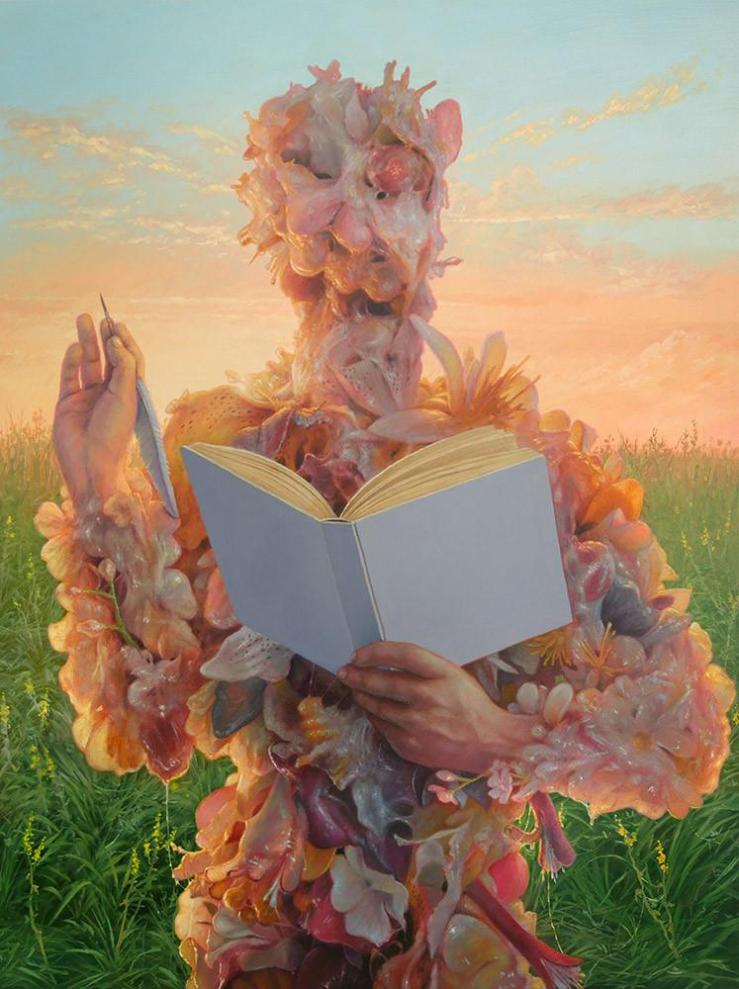
Big Dreamer with an Ode to the Dawn by Adrian Cox (b. 1988)

Read “Miss Furr and Miss Skeene,” a fiction by Gertrude Stein

“Miss Furr and Miss Skeene”

by

Gertrude Stein


Helen Furr had quite a pleasant home. Mrs. Furr was quite a pleasant woman. Mr. Furr was quite a pleasant man. Helen Furr had quite a pleasant voice a voice quite worth cultivating. She did not mind working. She worked to cultivate her voice. She did not find it gay living in the same place where she had always been living. She went to a place where some were cultivating something, voices and other things needing cultivating. She met Georgine Skeene there who was cultivating her voice which some thought was quite a pleasant one. Helen Furr and Georgine Skeene lived together then. Georgine Skeene liked travelling. Helen Furr did not care about travelling, she liked to stay in one place and be gay there. They were together then and travelled to another place and stayed there and were gay there.

They stayed there and were gay there, not very gay there, just gay there. They were both gay there, they were regularly working there both of them cultivating their voices there, they were both gay there. Georgine Skeene was gay there and she was regular, regular in being gay, regular in not being gay, regular in being a gay one who was one not being gay longer than was needed to be one being quite a gay one. They were both gay then there and both working there then.

They were in a way both gay there where there were many cultivating something. They were both regular in being gay there. Helen Furr was gay there, she was gayer and gayer there and really she was just gay there, she was gayer and gayer there, that is to say she found ways of being gay there that she was using in being gay there. She was gay there, not gayer and gayer, just gay there, that is to say she was not gayer by using the things she found there that were gay things, she was gay there, always she was gay there.

They were quite regularly gay there, Helen Furr and Georgine Skeene, they were regularly gay there where they were gay. They were very regularly gay.

To be regularly gay was to do every day the gay thing that they did every day. To be regularly gay was to end every day at the same time after they had been regularly gay. They were regularly gay. They were gay every day. They ended every day in the same way, at the same time, and they had been every day regularly gay.

The voice Helen Furr was cultivating was quite a pleasant one. The voice Georgine Skeene was cultivating was, some said, a better one. The voice Helen Furr was cultivating she cultivated and it was quite completely a pleasant enough one then, a cultivated enough one then. The voice Georgine Skeene was cultivating she did not cultivate too much. She cultivated it quite some. She cultivated and she would sometime go on cultivating it and it was not then an unpleasant one, it would not be then an unpleasant one, it would be a quite richly enough cultivated one, it would be quite richly enough to be a pleasant enough one.

They were gay where there were many cultivating something. The two were gay there, were regularly gay there. Georgine Skeene would have liked to do more travelling. They did some travelling, not very much travelling, Georgine Skeene would have liked to do more travelling, Helen Furr did not care about doing travelling, she liked to stay in a place and be gay there.

They stayed in a place and were gay there, both of them stayed there, they stayed together there, they were gay there, they were regularly gay there. Continue reading “Read “Miss Furr and Miss Skeene,” a fiction by Gertrude Stein”

Agbogo-Mmuo — Ben Enwonwu

tumblr_muef1pdehm1rqkjy0o5_1280

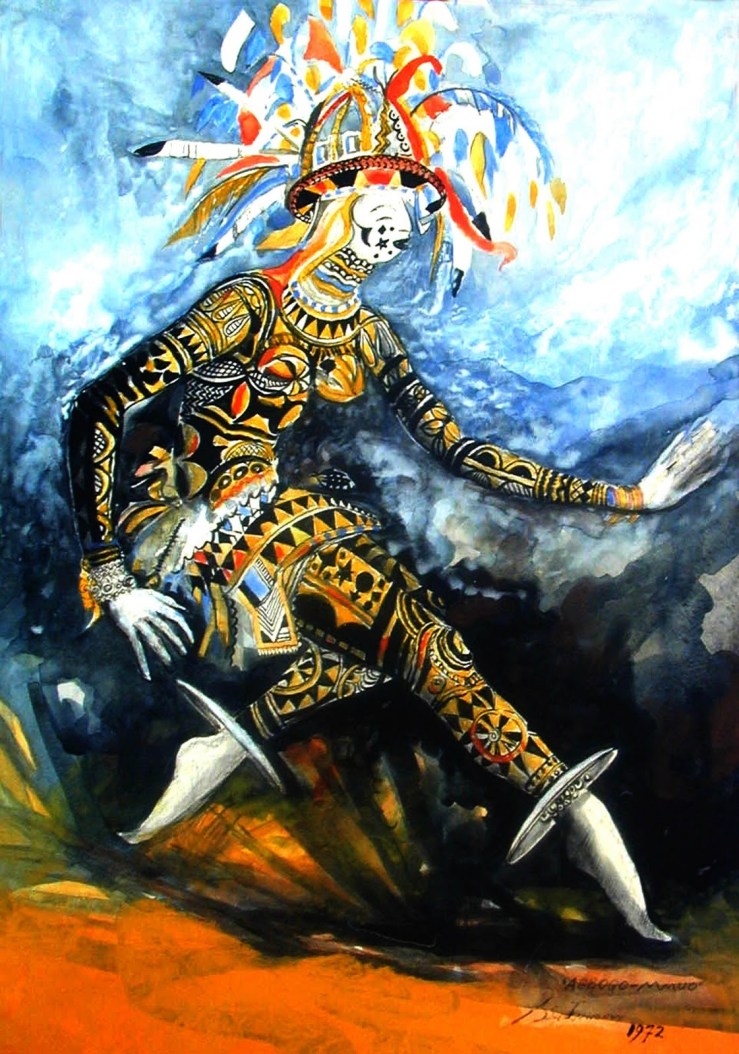
Agbogo-Mmuo, 1972 by Ben Enwonwu (1917-1994)

A review of Ishmael Reed’s sharp satire The Last Days of Louisiana Red

img_2323

Ishmael Reed’s 1974 novel The Last Days of Louisiana Red is a sharp, zany satire of US culture at the end of the twentieth century. The novel, Reed’s fourth, is a sequel of sorts to Mumbo Jumbo (1972), and features that earlier novel’s protagonist, the Neo-HooDoo ghost detective Papa LaBas.

In Mumbo Jumbo, Reed gave us the story of an uptight secret society, the Wallflower Order, and their attempt to root out and eradicate “Jes’ Grew,” a psychic virus that spreads freedom and takes its form in arts like jazz and the jitterbug. The Last Days of Louisiana Red also employs a psychic virus to drive its plot, although this transmission is far deadlier. “Louisiana Red” is a poisonous mental disease that afflicts black people in the Americas, causing them to fall into a neo-slave mentality in which they act like “Crabs in the Barrel…Each crab trying to keep the other from reaching the top.”

The Last Days of Louisiana Red begins with Ed Yellings, “an american negro itinerant who popped into Berkeley during the age of Nat King Cole. People looked around one day and there he was.” Yellings is the West Coast counterpart to New-York-based Papa LeBas, a fellow Worker of Neo-HooDoo who fights against the secret forces of psychic slavery.

Sliding into the mythological motif that ripple through Louisiana Red, Reed writes,

When Osiris entered Egypt, cannibalism was in vogue. He stopped men from eating men. Thousands of years later when Ed Yellings entered Berkeley, there was a plague too, but not as savage. After centuries of learning how to be subtle, the scheming beast that is man had acquired the ability to cover up.

Yellings’ mission is to destroy the psychic cannibalism that afflicts his people. He gets to it, and earns “a reputation for being not only a Worker [of the voodoo arts] but a worker too.” Yellings’ working class bona fides helps solidify his sympathies and his mission:

Since he worked with workers, he gained a knowledge of the workers’ lot. He knew that their lives were bitter. He experienced their surliness, their downtroddenness, their spitefulness and the hatred they had for one another and for their wives and their kids. He saw them repeatedly go against their own best interests as they were swayed and bedazzled by modern subliminal techniques, manipulated by politicians and corporate tycoons, who posed as their friends while sapping their energy. Whose political campaigns amounted to: “Get the Nigger.”

As always, Reed’s diagnosis of late 20th-century American culture seems to belong, unfortunately, just as much to our own time, giving his novels a perhaps-unintended sheen of prescience. Reed’s work points to dystopia, even as his heroes work for freedom and justice. And yet Reed gives equal air time to the forces that oppress freedom and justice, forces that find expression in “Louisiana Red”:

Louisiana Red was the way they related to one another, oppressed one another, maimed and murdered one another., carving one another while above their heads, fifty thousand feet, billionaires few in custom-made jet planes equipped with saunas tennis courts swimming pools discotheques and meeting rooms decorated like a Merv Griffin Show set….

The miserable workers were anti-negro, anti-chicano, anti-puerto rican, anti-asian, anti-native american, had forgotten their guild oaths, disrespected craftsmanship; produced badly made cars and appliances and were stimulated by gangster-controlled entertainment; turned out worms in the tuna fish, spiders in the soup, inflamatory toys, tumorous chickens, d.d.t. in fish and the brand new condominium built on quicksand.

As a means to fight the culture of erosion, decay, and entropy, Yellings founds the Solid Gumbo Works. Here, he manufactures a gumbo—a spell, really—to combat “Louisiana Red.” In the process he manages to cure cancer, which pisses off a lot of big corporations, and pretty soon Yellings is murdered. Papa LeBas is sent in from New York to solve the case.

Papa LeBas runs into trouble pretty quickly, mostly by way of Yellings’ adult children: Wolf, Street, Sister, and the provocative and gifted Minnie, who leads a group of militants called the Moochers. Each of the children seem to embody an allegorical parallel to some aspect of the American counterculture of the late sixties and seventies, allowing Reed to mash up genres and skewer ideologies. There are a lot flavors in this gumbo: voodoo lore and California history bubble in the same pot as riffs on astrology and Cab Calloway’s hit “Minnie the Moocher.” Reed frequently compares and contrasts East with West, New York with California, underscoring the latter’s anxieties of influence about being the New World of the New World. Throughout the novel, we get routines on Amos & Andy, slapstick pastiches straight out of George Herriman’s Krazy Kat comix, hysterical nods to Kafka. Reed plays off early blaxploitation films like Sweet Sweetback’s Baadasssss Song and Superfly (not to mention Putney Swope), and synthesizes these tropes with kung fu imagery and neo-Nazi nostalgia garb. He turns Aunt Jemima into a loa at one point.

Reed’s prose ping-pongs between genres, skittering from pulp fiction noir to surrealist frenzies, from bizarre sex to raucous action, from political essaying to postmodernist mythologizing. Through these stylistic shifts, Reed satirizes a host of ideologies that feed into “Louisiana Red.” Aspects of the Berkeley youth movement, radical feminism, free love, and intellectual hucksterism all get skewered, but through an allegorical lens—Reed dares us, often explicitly (by way of a character named Chorus) to read Louisiana Red as an allegorical retelling of Sophocles’ Antigone.

This retelling is both tragic and comic though, premodern and postmodern, a carnival of varied voices. The chapters are short, the sentences sting, and the plot shuttles along, pivoting from episode to episode with manic picaresque glee. Reed’s narrator is always way out there in front of both the reader and the novel’s characters, hollering at us to keep up.

Ultimately, The Last Days of Louisiana Red is a bit of a shaggy dog. It’s not that it doesn’t have a climax—it does, it has lots of climaxes, some quite literal. And it’s not that the novel doesn’t have a point—it very much does. Rather, it’s that Reed employs his detective story as a frame for the larger argument he wants to make about American culture. Sure, Papa LaBas gets to the bottom of Yellings’ murder, but that’s not ultimately what the narrative is about.

When we get to the final chapter, we find LaBas, sitting alone “on a plain box” in the empty offices of the Solid Gumbo Works reflecting on the case in a way that, in short, sums up what The Last Days of Louisiana Red is about:

He thought of the eaters and the eaten of this parable on Gumbo…all ‘oppressed people’ who often, like Tod Browning ‘Freaks,’ have their own boot on their own neck. They exist to give the LaBases, Wolfs and Sisters of these groups the business, so as to prevent them from taking care of Business, Occupation, Work. They are the moochers who cooperate with their ‘oppression,’ for they have the mentality of the prey who thinks his destruction at the fangs of the killer is the natural order of things and colludes with his own death. The Workers exist to tell the ‘prey’ that they were meant to bring down killers three times their size, using the old morality as their guide: Voodoo, Confucianism, the ancient Egyptian inner duties, using the technique of camouflage, independent camouflages like the leopard shark, ruler of the seas for five million years. Doc John, ‘the black Cagliostro,’ rises again over the American scene. The Workers conjure and command the spirit of Doc John to walk the land.

So here, near the end of The Last Days of Louisiana Red, Papa LeBas—and Ishmael Reed, of course—conjures up the spirit of Doctor John, the voodoo healer who escaped slavery and brought knowledge of the hoodoo arts to his people. There’s a promise of hope and optimism here at the novel’s end, despite its many bitter flavors. But the passage cited above is not the final moments of Louisiana Red—no, the novel, ends, despite what I wrote about its being a shaggy dog story, with a marvelous punchline.

Ishmael Reed remains an underappreciated novelist whose early work seems as vital as ever. The Last Days of Louisiana Red is probably not the best starting place for him, but it’s a great novel to read right after Mumbo Jumbo, which is a great starting place to read Reed. In any case: Read Reed. Highly recommended.

“The Fish” — Elizabeth Bishop

“The Fish”

by

Elizabeth Bishop


I caught a tremendous fish
and held him beside the boat
half out of water, with my hook
fast in a corner of his mouth.
He didn’t fight.
He hadn’t fought at all.
He hung a grunting weight,
battered and venerable
and homely. Here and there
his brown skin hung in strips
like ancient wallpaper,
and its pattern of darker brown
was like wallpaper:
shapes like full-blown roses
stained and lost through age.
He was speckled with barnacles,
fine rosettes of lime,
and infested
with tiny white sea-lice,
and underneath two or three
rags of green weed hung down.
While his gills were breathing in
the terrible oxygen
—the frightening gills,
fresh and crisp with blood,
that can cut so badly—
I thought of the coarse white flesh
packed in like feathers,
the big bones and the little bones,
the dramatic reds and blacks
of his shiny entrails,
and the pink swim-bladder
like a big peony.
I looked into his eyes
which were far larger than mine
but shallower, and yellowed,
the irises backed and packed
with tarnished tinfoil
seen through the lenses
of old scratched isinglass.
They shifted a little, but not
to return my stare.
—It was more like the tipping
of an object toward the light.
I admired his sullen face,
the mechanism of his jaw,
and then I saw
that from his lower lip
—if you could call it a lip—
grim, wet, and weaponlike,
hung five old pieces of fish-line,
or four and a wire leader
with the swivel still attached,
with all their five big hooks
grown firmly in his mouth.
A green line, frayed at the end
where he broke it, two heavier lines,
and a fine black thread
still crimped from the strain and snap
when it broke and he got away.
Like medals with their ribbons
frayed and wavering,
a five-haired beard of wisdom
trailing from his aching jaw.
I stared and stared
and victory filled up
the little rented boat,
from the pool of bilge
where oil had spread a rainbow
around the rusted engine
to the bailer rusted orange,
the sun-cracked thwarts,
the oarlocks on their strings,
the gunnels—until everything
was rainbow, rainbow, rainbow!
And I let the fish go.

Mourning and Fecundity II — Vincent Desiderio

mourningandfecundity2011

Mourning and Fecundity II, 2011 by Vincent Desiderio (b. 1955)

Woman in the Mirror — Cagnaccio di San Pietro

facd9e4ac9a239fca6897ab712c7404e

Woman in the Mirror, 1930 by Cagnaccio di San Pietro (1897 – 1946)

Posted in Art

“The Incredible and Sad Tale of Innocent Eréndira and Her Heartless Grandmother” — Gabriel García Márquez”

“The Incredible and Sad Tale of Innocent Eréndira and Her Heartless Grandmother”

by

Gabriel García Márquez

translation by

Gregory Rabassa


Erendira was bathing her grandmother when the wind of her misfortune began to blow. The enormous mansion of moon like concrete lost in the solitude of the desert trembled down to its foundations with the first attack. But Erendira and her grandmother were used to the risks of the wild nature there, and in the bathroom decorated with a series of peacocks and childish mosaics of Roman baths they scarcely paid any attention to the caliber of the wind.

The grandmother, naked and huge in the marble tub, looked like a handsome white whale. The granddaughter had just turned fourteen and was languid, soft-boned, and too meek for her age. With a parsimony that had something like sacred rigor about it, she was bathing her grandmother with water in which purifying herbs and aromatic leaves had been boiled, the latter clinging to the succulent back, the flowing metal-colored hair, and the powerful shoulders which were so mercilessly tattooed as to put sailors to shame.

“Last night I dreamt I was expecting a letter,” the grandmother said.

Erendira, who never spoke except when it was unavoidable, asked:

“What day was it in the dream?”

“Thursday.”

“Then it was a letter with bad news,” Erendira said, “but it will never arrive.”

When she had finished bathing her grandmother, she took her to her bedroom. The grandmother was so fat that she could only walk by leaning on her granddaughter’s shoulder or on a staff that looked like a bishop’s crosier, but even during her most difficult efforts the power of an antiquated grandeur was evident. In the bedroom, which had been furnished with an excessive and somewhat demented taste, like the whole house, Erendira needed two more hours to get her grandmother ready. She untangled her hair strand by strand, perfumed and combed it, put an equatorially flowered dress on her, put talcum powder on her face, bright red lipstick on her mouth, rouge on her cheeks, musk on her eyelids, and mother-of-pearl polish on her nails, and when she had her decked out like a larger than life-size doll, she led her to an artificial garden with suffocating flowers that were like the ones on the dress, seated her in a large chair that had the foundation and the pedigree of a throne, and left her listening to elusive records on a phonograph that had a speaker like a megaphone. Continue reading ““The Incredible and Sad Tale of Innocent Eréndira and Her Heartless Grandmother” — Gabriel García Márquez””

I’m into Shooting in Natural Environments — Dana Schutz

041c0e171d804339

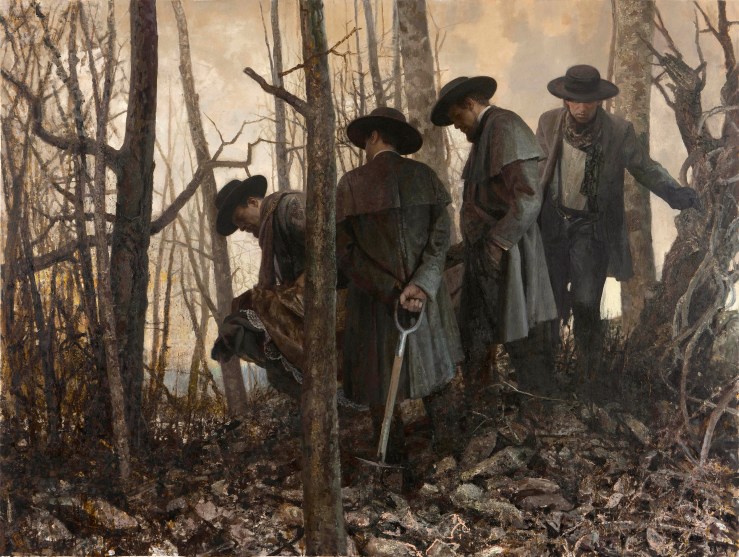
I’m into Shooting in Natural Environments, 2008 — Dana Schutz (b. 1976)

Four Fairies — Michaël Borremans

Four fairies

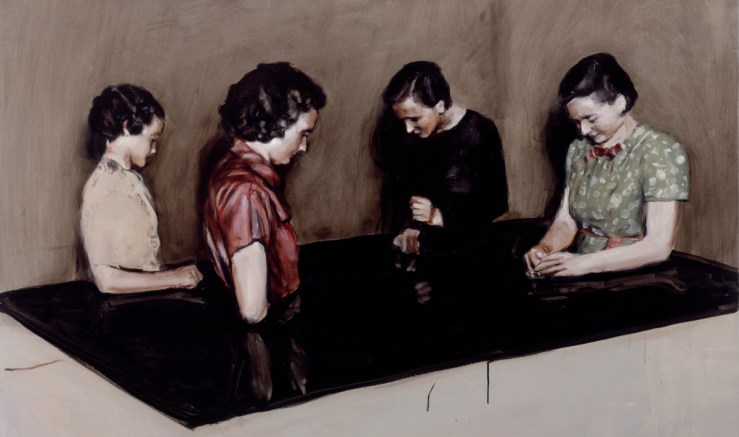
Four Fairies, 2003 by Michaël Borremans (b. 1963)

Vortex — Sharon Sprung

31065-2376695-_22moire_22_oil_on_panel_40x40

Vortex, Sharon Sprung (b. 1953)

Read Breece D’J Pancake’s short story “In the Dry”

“In the Dry”

by

Breece D’J Pancake


He sees the bridge coming, sees the hurt in it, and says aloud his name, says, “Ottie.” It is what he has been called, and he says again, “Ottie.” Passing the abutment, he glances up, and in the side mirror sees his face, battered, dirty; hears Bus’s voice from a far-off time, I’m going to show you something. He breathes long and tired, seems to puff out the years since Bus’s Chevy slammed that bridge, rolled, and Ottie crawled out. But somebody told it that way—he only recalls the hard heat of asphalt where he lay down. And sometimes, Ottie knows. Now and again, his nerves bang one another until he sees a fist, a fist gripping and twisting at once; then hot water runs down the back of his throat, he heaves. After comes the long wait—not a day or night, but both folding on each other until it is all just a time, a wait. Then there is no more memory, only years on the hustle with a semi truck—years roaring with pistons, rattling with roads, waiting to sift out one day. For one day, he comes back.

This hill-country valley is not his place: it belongs to Sheila, to her parents, to her Cousin Buster. Ottie first came from outside the valley, from the welfare house at Pruntytown; and the Gerlocks raised him here a foster child, sent him out when the money-crop of welfare was spent. He sees their droughty valley, cannot understand—the hills to either side can call down rain. Jolting along the pike, he looks at withered fields, corn tassling out at three feet, the high places worse with yellowish leaves. August seems early for the hills to rust with dying trees, early for embankments to show patches of pale clay between milkweed and thistle. All is ripe for fire.

At a wide berm near the farmhouse, he edges his tractor truck over, and the ignition bell rings out until the engine sputters, dies. He picks up his grip, swings out on the ladder, and steps down. Heat burns through his T-shirt under a sky of white sun; a flattened green snake turns light blue against the blacktop.

The front yard’s shade is crowded with cars, and yells and giggles drift out to him from the back. A sociable, he knows, the Gerlock whoop-dee-doo, but a strangeness stops him. Something is different. In the field beside the yard, a sin crop grows—half an acre of tobacco standing head-high, ready to strip. So George Gerlock’s notions have changed and have turned to the bright yellow leaves that bring top dollar. Ottie grins, takes out a Pall Mall, lets the warm smoke settle him, and minces a string of loose burley between his teeth. A clang of horseshoes comes from out back. He weaves his way through all the cars, big eight-grand jobs, and walks up mossy sandstone steps to the door. Continue reading “Read Breece D’J Pancake’s short story “In the Dry””

Mardi Gras — Sean Mellyn

mardi-gras

Mardi Gras, 1998 by Sean Mellyn (b. 1965)

The Day I Quit — Susannah Martin

e7310efcf8d4c593c7f42df44d64564c

The Day I Quit, 2014 by Susannah Martin (b. 1964)

Dick (Perry Bible Fellowship)

pbf300-dick

Roberto Bolaño’s novel The Spirit of Science Fiction reviewed in the The New Yorker 

There’s an interesting review of Roberto Bolaño’s posthumous novel The Spirit of Science Fiction in the The New Yorker  The review’s author, editor and translator Valerie Miles, read Bolaño’s novel through/against the work of the American Beats—William S. Burroughs and Jack Kerouac, specifically. From Miles’ review:

From 2008 to 2014, during the charged emergence of Bolaño in translation, I worked behind the scenes with the writer’s estate, reading through roughly fourteen thousand six hundred papers in his archive and helping to prepare his posthumous work. Bolaño, it should be said, saved everything. His archive includes notebooks, diaries, letters, magazines, war games, postcards, photos, typescripts, newspaper clippings, and an extensive library. (“I even found one of those paper napkins from a bar in Mexico,” his widow, Carolina López, has said, at a press conference.) The wealth of material makes it easy to locate Bolaño’s fixations at a given time, and much of my efforts involved establishing a chronology of when his work was written—a chronology that became a central part of the first exhibition dedicated to his papers, which I curated together with the Centre de Cultura Contemporània de Barcelona, in 2013.

That chronology also shed light on just how much “The Spirit of Science Fiction” was informed by poetry, and specifically by Bolaño’s reading of the Beats. In 1978, around the time Bolaño first began writing fiction in earnest, he wrote in his diary, “I write verses, dream of a novel.” During that time, he read William S. Burroughs daily and often commented on the writer’s work. (Burroughs was the “ice shard that would never melt,” he writes in his essay collection “Between Parentheses,” “the eye that never closes.”) In an early version of “The Spirit of Science Fiction,” Burroughs was the contact person for the young Chileans. Bolaño was also influenced by Burroughs’s approach to structure; he was fascinated by “Naked Lunch” and by the collage-like experimentation of “Nova Express.” He even borrowed some of Burroughs’s methods, riffing on Burroughs’s “cut-up” technique in his own verse.

miles-bolano-and-the-beats

“Kafka. Pure Kafka” (From Ishmael Reed’s The Last Days of Louisiana Red)

img_2323

He was a blonde. He lay in the bed, tossing turning. his room. What was that odor? The pungent odor of middle-class perfume making the air misty. He didn’t feel right. His hair. What on earth was the matter with his hair? It was long and was covering the pillow. The pillows? They had a flower print and were pink. Pink? He rose in his bed and his breasts jiggled. BREASTS? THE BREASTS?? He looked back into the mirror next to the bed and his mouth made a black hollow hole of horror. “O MY GOD. MY GOD.” He was a woman. You know what he said next, don’t you, reader? He’s from New York and so . . . you guessed it! “Kafka. Pure Kafka,” he said. A feeling crept over him. Tingly. What could he do? He felt like screaming, but he couldn’t scream. Was that someone coming coming down the hall? He ran and jumped back into the bed, pulled the covers up to his neck and pretended to be asleep.

From Ishmael Reed’s 1974 novel The Last Days of Louisiana Red.